


21,99 €
Mehr erfahren.
- Herausgeber: John Wiley & Sons
- Kategorie: Geisteswissenschaft
- Sprache: Englisch
Research consistently shows how through the years more of our time gets spent using media, how multitasking our media has become a regular feature of everyday life, and that consuming media for most people increasingly takes place alongside producing media.
Media Life is a primer on how we may think of our lives as lived in rather than with media. The book uses the way media function today as a prism to understand key issues in contemporary society, where reality is open source, identities are - like websites - always under construction, and where private life is lived in public forever more.
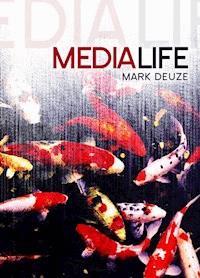
Ultimately, media are to us as water is to fish. The question is: how can we live a good life in media like fish in water? Media Life offers a compass for the way ahead.
Sie lesen das E-Book in den Legimi-Apps auf:
Seitenzahl: 486
Veröffentlichungsjahr: 2014
Ähnliche




















Media Life
Media Life
MARK DEUZE
Polity
Copyright © Mark Deuze 2012
The right of Mark Deuze to be identified as Author of this Work has been asserted in accordance with the UK Copyright, Designs and Patents Act 1988.
Artwork © Miek van Dongen
First published in 2012 by Polity Press
Polity Press65 Bridge StreetCambridge CB2 1UR, UK
Polity Press350 Main StreetMalden, MA 02148, USA
All rights reserved. Except for the quotation of short passages for the purpose of criticism and review, no part of this publication may be reproduced, stored in a retrieval system, or transmitted, in any form or by any means, electronic, mechanical, photocopying, recording or otherwise, without the prior permission of the publisher.
ISBN: 978-0-7456-6203-9
A catalogue record for this book is available from the British Library.
The publisher has used its best endeavours to ensure that the URLs for external websites referred to in this book are correct and active at the time of going to press. However, the publisher has no responsibility for the websites and can make no guarantee that a site will remain live or that the content is or will remain appropriate.
Every effort has been made to trace all copyright holders, but if any have been inadvertently overlooked the publisher will be pleased to include any necessary credits in any subsequent reprint or edition.
For further information on Polity, visit our website: www.politybooks.com
In Memoriam
Jan Deuze (1932–2010)
Twannie Deuze (1962–2011)
Contents
Overview: In Media
1 Media Life
2 Media Today
3 What Media Do
4 No Life Outside Media
5 Society in Media
6 Together Alone
7 In Media We Fit
8 Life in Media
Notes
References
Index
Overview: In Media
where who you are is what media are
You live inmedia. Who you are, what you do, and what all of this means to you does not exist outside of media. Media are to us as water is to fish. This does not mean life is determined by media – it just suggests that whether we like it or not, every aspect of our lives takes place in media. Part of this kind of life is coming to terms with a supersaturation of media messages and machines in households, workplaces, shopping malls, bars and restaurants, and all the other in-between spaces of today’s world. Over the last few decades, the key categories of human aliveness and activity converged in a concurrent and continuous exposure to, use of, and immersion in media. It must be clear that media are not just types of technology and chunks of content occupying the world around us – a view that considers media as external agents affecting us in a myriad of ways. If anything, today the uses and appropriations of media can be seen as fused with everything people do, everywhere people are, everyone people aspire to be. There is no external to media life – whatever we perceive as escape hatch, passage out, or potential Delete key is just an illusion. In fact, we can only imagine a life outside of media.
In terms of what media communicate, it is tempting to point to governments, companies and corporations for pushing an unrelenting, ever-accelerating stream of content and experiences into our lives. However, most mediated communication comprises of work done by you and me: through our endless texts, chats and e-mails, with our phone calls from anywhere at any time, and through our online social networks that function as the living archives of social reality. With the majority of the world population owning a mobile phone, telecommunication networks spanning almost every inch of the globe, sales figures of any and all media devices growing steadily worldwide, time spent with media up every year, and any and all media by default integrated into an always-on real-time live mode of being, an almost complete mediatization of society seems a somewhat self-evident observation.
A media life includes much more than media hardware, software and content – it is also everything we do with and in response to media: how we build and sustain relationships and family ties, how we derive cultural status and social currency from the kinds of media we use (the music we listen to, the shows we follow, the games we catch live), and the various ways we more or less deliberately manipulate time and space by checking our e-mail on mobile devices, listen to audiobooks with noise-cancelling headphones, and record our private participation in public proceedings (weddings, concerts, the weekend soccer game) with networked devices that simultaneously immediatize and immortalize our lived experience as they mediate it. As we merge our perception of ourselves and others with what can be mediated about us, media competencies, literacies and fitness become paramount to the human condition. Media benchmark our experience of the world, and how we make sense of our role in it. A media life reflects how media are both a necessary and unavoidable part of our existence and survival.
It certainly seems media multiply in everyday life. Media are ubiquitous – they are everywhere – and pervasive – they cannot be switched off. Furthermore, our near-complete immersion in media constitutes the majority of time spent in waking life. Research in countries as varied as the United States, Brazil, South Korea, the Netherlands, India and New Zealand consistently shows that most of our time on any given day gets spent using media, and that being concurrently exposed to media has become a mundane mark of existence. The media life perspective further recognizes that media, as much as the human brain (or the cosmos), are indeterminate. Media are not finished, nor static – but essentially plastic, and pliable. Media evolve, and have creative agency. As hardware and software, they act upon each other next to their interactions with us. We emotionally invest ourselves into media as much as our media become an affective part of us. As platforms for communication, media constitute as well as reproduce the world we live in.
Throughout this book, I use “media” interchangeably with “information” and “communication technologies,” and with “machines” more generally insofar as relations with humanity and society are involved. Media, thus broadly conceived, are any (symbolic or technological) systems that enable, structure or amplify communication between people. Life, on the other hand, is not just about surviving – it is about living a live life, a life worth living, and a form of liveness that goes beyond simply making it work from day to day. At the heart of the project in this book is the question of what a good, passionate, beautiful and socially responsible media life looks like. A dichotomous reading of the mixing of media and life identifies and maps ways in which human beings and behaviors steer the development of media to make sense of people’s everyday life and what can be done about it. Such media-centrism and technological determinism often boils down to benevolent or malevolent mechanistic fascination with the machinery of media and the technique of technologies. It tends to obscure rather than unveil the interdependency of humanity and technology – as it keeps insisting on finding ways of making sense of the world outside of media, of attributing primacy to the social over the technological.
In essence, media-centrism (and its attendant arguments about the real or perceived influences of media on ways of being alive) is a product of a live lived in media: it is an illusion we maintain in order to convince ourselves and each other that we exist not just next to, but in an intrinsically more central and indeed privileged relationship to our media. Maintaining an outside to media makes us, as human beings, feel special. As French philosopher Jean Baudrillard remarked in response to the way his work featured as inspiration for the popular The Matrix film franchise (in an interview with Le Nouvel Observateur, July 2004): “The Matrix is surely the kind of film about the matrix that the matrix would have been able to produce.”1 Correspondingly, media-centrism and technological determinism can be considered to be the kind of theoretical stopgaps a media life perspective would produce in order to mask itself. The illusion that we can comprehensively control our media (for example by pulling the plug, pressing the off switch on a remote control, by becoming mediawise and developing sophisticated media literacies) in fact preserves media as the primary definer of our reality. If we let go of this deception – this dualist fallacy of domination of man over machine (or vice versa) – it may be possible to come to terms with the world we are a part of in ways that are less about effects, things and what happens, more about process, practice and what can be done.
The key to this book is the question of how we can understand ourselves and the world we live in if we accept, if only for a moment, that we do not live with, but in, media. Media, to most people, belong to the realm of the unreal, or less real. What if this exclusive orientation to the alterity of (reality in) media acts as a crutch rather than a tool for living our lives more ethically and aesthetically? Instead of fusing the horizons of media and life, it seems as if we invest all our time in keeping them separate. By way of a first step and chapter in this book, I therefore unpack the history of man–machine separation, while at the same time highlighting how media life was always already firmly established in our sensemaking practices of the world and our role in it.
The second issue I faced was how to bring media back into our awareness without simply stating that one needs to look more closely at media – which would maintain their otherness. By adopting an archaeological approach to media in conjunction with a social history of dominant media species – the television and the mobile phone – I suggest in the second chapter that the key to understanding media is to emphasize not their difference but their disappearance from our lives. This amounts to a paradox: the more media dematerialize, the more people seem to be talking about media and what they mean to us. From a media-life point of view I engage this enigma by emphasizing how, through our apparent need for media in order to express anything about media, the intense discussions about the role of media in people’s lives are symptomatic of the mediatization of both individuals and society.
As we lose ourselves to technology, what happens next? The conflation of technology with technique, and of media with being mediated tends to be viewed with apprehension. Surely, the cold machines of media are alien to all that we consider as life? Yet, our media come very much alive in accounts of what it is like to live among them. Such an existence engulfed in media seems to mean we are perpetually caught in what has been aqueously described as a communicational bubble filled with the foam of media.2 Indeed, “we swim in an ocean of media,” as a headline in the Christian Science Monitor (of September 28, 2005) reads in a report on people’s expanding media use. Splashing around in open water makes it hard to notice what is going on around you, on shore and elsewhere, let alone to take in the plights of other human beings. These liquid lamentations pervade much of the otherwise prudent thinking on media and everyday life. I try to take up this challenge in chapter 3 by arguing that there is no necessary relationship between the technological and the social. The relations that do exist are clearly both structural – machines are always social as much as they are technical – and highly dynamic; living in media is not the same for everyone.3
Just like human beings, media have both traits and states. One of the key qualities of our media is their uncanny capacity for recording and storing everything we do with them. A media life can be seen as living in the ultimate archive, a public library of (almost) everything, embodying a personalized experience of all the information of the universe. At the same time, in media life the archive is alive, in that it is subject to constant intervention by yourself and others. In the absence of all-seeing librarians or neatly categorized compendiums, the only way we can make sense of ourselves and each other in media is by carefully, and continuously, checking each other out. This is the theme of the fourth chapter, as the age-old premise of a Big Brother-like surveillance society comes full circle in a media world of massive mutual monitoring, where everyone is (or can be expected to be) watching everyone else.
If we live in media, we are in the process of co-creating a society particular to the media of our time that are always already remediations of earlier technologies and societies: never the same, always similar. In chapter 5, I address the constituent elements of a society in media by suggesting that it resembles a world after the zombie apocalypse. Like zombies, we lose our sense of ego and individuality, as we are collectively lost in our technologies. Whether through watching the same or similar television shows regardless of where we are in the world, or simply by logging on to the global grid of the “network of networks” that is internet, we are – again, much like zombies – irreducibly plugged into a worldwide flow of data, information, techniques and technologies in which distinctions between private and public, as well as between social isolation and cohesion, become symbiotic rather than dichotomic. Like zombies, we cannot seem to get enough of media – even though there does not seem to be a collective or consensual agenda as to where we are going. As Sonia Livingstone suggests with regard to the motivation of a society in media: “First, the media mediate, entering into and shaping the mundane but ubiquitous relations among individuals and between individuals and society; and second, as a result, the media mediate, for better or for worse, more than ever before.”4 Zombies are similarly driven – even the amputation of limbs does not tend to stop them – yet seemingly without creative impulse (other than feasting on our brains). Beyond metaphor, thinking about media zombies is instrumental to digging deeper, going beyond the surface of media and life: looking for ways in which we can theorize conjunctions of humanity and technology that highlight how a society in media is at once individual and interconnected as it is both embodied and virtual. This would hopefully open social reality up for the kind of plasticity and malleability of a world we are used to in media: whether by wielding a remote control or by re-arranging hardware, by clicking a mouse or by re-programming software, reality (in media) is open source.
If our sense of the real is experienced in media, how can we think of media as elements of our lives that can help us to get closer to reality? This dilemma is at the heart of the sixth chapter, where I question the kinds of connections we have with each other and ourselves in media, and try to move beyond either postmodern or existentialist frames for what is (or may be) real. Our lifeworld – the world we experience most directly, instantly and without reservation – is irreversibly mediated. It confronts us with endless versions of ourselves and everyone else. There certainly seems to be too much information available – to us as well as about us. In media life it is pertinent to explore how one can derive value from mediated oversharing and overexposure. Such value may not only be affective or perceptual. The seventh chapter explores evolutionary readings of media life, showing how contemporary discourse about the skills and competences one needs to navigate a mediated lifeworld signposts multiple media literacies as survival values. The solution is not, as has been suggested as far back as in the immediate response to Charles Darwin’s On the origin of species (1859), to wage war on machines to prevent them from evolving beyond us. It is by becoming media we enhance our fitness for survival.
In the eighth and final chapter, I tie together all the elements of my exploration of life as lived in media through the diagnosis of a Truman Show Delusion by American psychiatrists Joel and Ian Gold, who suggest that classical syndromes such as narcissism and paranoia in combination with pervasive information technologies, in the context of a media culture where the boundaries between the physical and virtual world are blurring, have produced a new type of psychosis. What makes their analysis fit this book is the conclusion that this delusion can best be understood as an extreme manifestation of what most people feel. In media life, the world can certainly seem like a television studio as in the Truman Show movie (from 1998), with the significant difference that there is no exit. The question is therefore not how to avoid or destroy the media in our lives – we should rather investigate what Truman Burbank could do if he decided to stay inside of his fully mediated life. For one, he would be able to see himself live – and, if need be, adapt and evolve accordingly. This evolutionary process necessarily involves an awareness of how we are interconnected (in media), and therefore requires a sense of responsibility towards each other and ourselves that necessarily moves beyond the real or perceived manifestations of our divine machines. In other words: as Truman, we do not just have to perform for the cameras – the cameras can also perform for us. Whether we like it or not, I think we are slowly but surely becoming information players and creators rather than simply those who are expected to work with the information that is given to us. We can indeed create art with life. In media, that is.
Regarding art, please note the artwork in this book, designed by Dutch multimedia artist and web developer Miek van Dongen (miek.org). Miek is a lifelong friend with whom I share many sources of inspiration. When starting the media life project, I asked her to do the same in a series of drawings that would be independently featured throughout the book. Her pieces do not necessarily illustrate specific points in my argument, and should be seen as autonomous artworks reflecting elements of life as lived in media.
Notes
1 www.ubishops.ca/baudrillardstudies/vol1_2/genosko.htm For all URLs cited in this volume, the date last accessed is February 1, 2012.
2 These terms for example used by Patrice Flichy in his Une histoire de la communication moderne (Paris: La Découverte, 1991), and in Adrian Mackenzie’s Wirelessness (Cambridge, MA: MIT Press, 2010).
3 Source: Gilles Deleuze and Claire Parnet, Dialogues II (New York: Columbia University Press, 1987).
4 Sonia Livingstone, On the mediation of everything. Journal of Communication 59(1) (2009), 1–18.
CHAPTER ONE
Media Life
where we go beyond human–machine differences and focus on living a good media life
Wandering through the streets of Amsterdam, Johannesburg and Los Angeles, one cannot help but witness media life everywhere. The way people move through public space while wearing or wielding private media (such as mobile phones, digital cameras, and portable music players). How town precincts, historic buildings, parks and monuments get signposted by brightly colored maps urging onlookers to visit websites for more information. Restaurants that label their menus with pictures of delicacies next to clothing stores that blare out tailor-made soundtracks to match their fashion profile. Explorers who navigate the urban jungle by moving from wireless internet hotspot to hotspot – coffeeshop, public library, pop-up store, hotel lobbies. Drivers in cars passing by interacting with talkative personal navigation systems, children on back seats dividing their attention between the images of the city whizzing by and a movie playing on front-seat-mounted screens. A street vendor conducting her business while tunes from a small transistor radio play in the background, the sounds competing with those from a group of busking guitarists across the street – amplified by mini portable electric loudspeakers.
Even though it may be possible to disentangle the tighly woven web of humans and machines at work in this scenario, none of these practices, activities and forms of communication takes place without media. The place of the city has become the space of media – not completely, not without problems, and most definitely not outside of such natural conditions as the sun in the sky and the concrete pavement under our feet. What guides our experience of this world are the ongoing interactions between their constituent elements: people, places and spaces, all of which both produced and consumed in media. This is a life as lived in, rather than with, media.
The world in media resembles what British media scholar Roger Silverstone (2007) appropriately labels a mediapolis: a comprehensively mediated public space where media underpin and overarch the experiences and expressions of everyday life. “The mediapolis … signals the presence in everyday life, both empirically and potentially, of that mediated space within which as participants we confront the world, and where, as citizens, we might confront each other” (111). In this space, media have become infinitely intertwined with every single way of being, seeing, moving and acting – without replacing the world of lived experience. It is one thing to describe a media life in terms of the kind of media people use, how people generally go about doing things with media, and how all of these practices are oriented around media. It is another thing, as Ien Ang articulates, to clarify and understand “what it means, or what it is like, to live in a media-saturated world” (1995: 72; italics in original). This is not a life simply lived with more media than before the age of internet and mobile telephony. It is a way of living that fuses life with material and mediated conditions of living in ways that bypass the real or perceived dichotomy between such constituent elements of human existence.
Lesen Sie weiter in der vollständigen Ausgabe!
Lesen Sie weiter in der vollständigen Ausgabe!
Lesen Sie weiter in der vollständigen Ausgabe!
Lesen Sie weiter in der vollständigen Ausgabe!
Lesen Sie weiter in der vollständigen Ausgabe!
Lesen Sie weiter in der vollständigen Ausgabe!
Lesen Sie weiter in der vollständigen Ausgabe!
Lesen Sie weiter in der vollständigen Ausgabe!
Lesen Sie weiter in der vollständigen Ausgabe!
Lesen Sie weiter in der vollständigen Ausgabe!




