



22,99 €
Mehr erfahren.
- Herausgeber: John Wiley & Sons
- Kategorie: Fachliteratur
- Sprache: Englisch
Two complete ebooks for one low price! Created and compiled by the publisher, this medical school basics bundle brings together two of the bestselling For Dummies medical school titles in one, e-only bundle. With this special bundle, you’ll get the complete text of the following titles:
Medical Ethics For Dummies
Succeeding in the healthcare field means more than just making a diagnosis and writing a prescription. Healthcare professionals are responsible for convincing patients and their family members of the best course of action and treatments to follow, while knowing how to make the right moral and ethical choices. Unlike daunting and expensive texts, Medical Ethics For Dummies offers an accessible and affordable course supplement for anyone studying medical or biomedical ethics and includes moral issues surrounding stem cell research, genetic engineering, euthanasia, and much more.
Clinical Anatomy For Dummies
Clinical anatomy is the study of human anatomy as it relates to clinical practice. Unlike a basic anatomy and physiology course designed to teach general anatomical knowledge, clinical anatomy focuses on specific structures and issues that people may encounter in a clinical setting. Loaded with clear definitions, concise explanations, and plenty of full-color illustrations, Clinical Anatomy For Dummies presents a friendly, unintimidating overview of the material covered in a typical college-level Clinical Anatomy course.
About the Authors of Medical Ethics For Dummies
Jane Runzheimer, MD, is a family physician who has served on the Ethics Committee of Methodist Hospital in St. Louis Park, Minnesota. Linda Johnson Larsen has written 24 books, many of which have an emphasis on health, and has been a patient advocate for her husband and several family members.
About the Authors of Clinical Anatomy For Dummies
David Terfera, PhD, teaches biomedical sciences at the University of Bridgeport College of Naturopathic Medicine. Shereen Jegtvig, DC, MS, is a health and nutrition writer.
Das E-Book können Sie in Legimi-Apps oder einer beliebigen App lesen, die das folgende Format unterstützen:
Seitenzahl: 1210
Veröffentlichungsjahr: 2013
Ähnliche
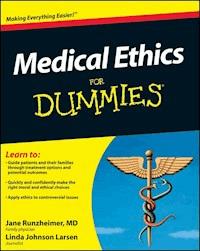


















Medical Ethics For Dummies®, 2-eBook Bundle
Medical Ethics For Dummies®
Table of Contents
Introduction
About This Book
Conventions Used in This Book
What You’re Not to Read
Foolish Assumptions
How This Book Is Organized
Part I: Medical Ethics, or Doing the Right Thing
Part II: A Patient’s Right to Request, Receive, and Refuse Care
Part III: Ethics at the Beginning and End of Life
Part IV: Advancing Medical Knowledge with Ethical Clinical Research
Part V: The Part of Tens
Icons Used in This Book
Where to Go from Here
Part I: Medical Ethics, or Doing the Right Thing
Chapter 1: What Are Medical Ethics?
Defining Medical Ethics
What are ethics?
The four principles of medical ethics
Differences between ethics and legality
Reconciling medical ethics and patient care
Turning to ethical guideposts and guidelines
Looking at the Common Medical Ethics Issues
Privacy and confidentiality concerns
Reproduction and beginning-of-life issues
End-of-life issues
Access to care
Moving Medicine Forward: The Ethics of Research
Chapter 2: Morality in Medicine
Distinguishing among Ethics, Morality, and Law
Looking at the Hippocratic Oath and Its Modern Descendents
Noting why the Oath was updated
Taking a new oath at graduation
Understanding humanitarian goals: The Declaration of Geneva
Rules for Engagement: Today’s Codes of Medical Ethics
American Medical Association Code of Ethics
American Nursing Association Code of Ethics
Bedside Manners: Ethics inside the Hospital
Understanding the hospital ethics panel
Patient bill of rights
Emergency room ethics
Bioethics as a Field of Study
Chapter 3: The Provider-Patient Relationship
Protecting Patient Privacy
Understanding confidentiality
Balancing privacy with public good
Confidentiality in research
Clear and Ethical Communications
Communicating with the patient
Informed consent
Understanding Full Disclosure: Telling the Patient What Matters
Decoding conflicts of interest
Deciding who has access to medical information
Choosing not to disclose information to a patient
Understanding Appropriate Referrals
Considering second opinions
Discovering the need for specialist referrals
Choosing Whom to Serve
Refusing to treat a patient
Ending a doctor-patient relationship
Giving medical advice to non-patients
Patient Rights and Obligations
Patient autonomy: Patient as decision-maker
Encouraging honesty
Balancing treatment and cost
Chapter 4: Outside the Examining Room: Running an Ethical Practice
Propriety in the Paperwork: Medical Records
Complying with the Health Insurance Portability and Accountability Act (HIPAA)
Training staff to handle records
Preventing identity theft
Releasing medical records
Safeguarding anonymity
Modern Managed Care and Today’s Office Practice
Ethical concerns of managed care
Working with midlevel providers
Prescribing good care while still getting paid
Third-Party Issues
Dealing with insurance companies and HMOs
Perks and freebies
Targeted advertising and ethics
Chapter 5: Learning from Mistakes: Disclosing Medical Errors
Types of Medical Errors and Ways to Prevent Them
Understanding diagnostic errors
Understanding treatment errors
Medication errors
Communication errors
Administrative errors
Lab errors
Equipment failures
Admitting Your Mistakes
Understanding truth telling
Disclosing an error to a patient
Balancing ethics with legal protection
Telling a higher-up that you’ve made an error
When Colleagues Don’t Disclose: Your Ethical Obligations
Healthcare Provider Impairment
Knowing the warning signs of impairment
Addressing a colleague’s impairment
Testifying before a medical board
How Reporting Errors Helps Medicine as a Whole
Creating a no-blame system for reporting errors
Understanding how to reduce errors
Part II: A Patient’s Right to Request, Receive, and Refuse Care
Chapter 6: The Ethical Challenges in Distributing Basic Healthcare
Ethics of Healthcare Distribution
Exploring Healthcare Rationing
How services are rationed
The ethics of rationing
Looking at Healthcare in the United States
The current system and its ethical challenges
The reformed system and potential ethical speed bumps
Examining universal healthcare
Chapter 7: When Spirituality and Cultural Beliefs Affect Care
Accommodating Religious Beliefs
Religions that limit or ban medical care
Discussing religion and understanding objections
Offering alternatives to care
Respecting Cultural Diversity
Attitudes and beliefs that affect care
Communicating with non-English-speaking patients
Discussing cultural beliefs
When the Patient Refuses Treatment
Determining competency
Making sure the patient understands
Validating concerns and assuaging fears
Accepting refusals
Chapter 8: Parental Guidance and Responsibilities
Acknowledging Parental Rights to Choose or Refuse Care
Responsibilities of a parent
Weighing parental choice against a child’s best interest
Caring for a child when parents disagree with you
Knowing when and how to treat impaired infants
Vaccination: The Evidence and the Ethics
Understanding vaccination as a public health issue
Considering risk-benefit analysis
Understanding full disclosure
Addressing parent opposition to vaccines
Child Endangerment: The Healthcare Provider’s Role
Discovering signs of abuse and neglect
Reporting abuse and working with Child Protective Services
Confidentiality, Care, and the Adolescent Patient
Understanding adolescent patients’ rights
Balancing privacy and patients’ rights
Talking to teens about informed consent
Mature minors and emancipated minors
Part III: Ethics at the Beginning and End of Life
Chapter 9: Two Lives, One Patient: Pregnancy Rights and Issues
Medical Intervention: Rights of the Mother versus Rights of the Fetus
Setting forth rights with the Fourteenth Amendment
Understanding self-determination
Balancing treatments for a woman and fetus
The role of technology
Considering a Father’s Rights
Birth Control
Educating your patient about birth control
Balancing your beliefs about birth control with a patient’s rights
Understanding religious ethics and birth control
Fetal Abuse
Maternal drug abuse or neglect: Crimes against the fetus
Detecting fetal abuse: Ethical and legal obligations
Limiting maternal freedom for fetal well-being
Seeing into the Future: Prenatal and Genetic Testing
Understanding the ethical use of prenatal testing
Understanding tests and accuracy issues
Genetic counseling and sharing results with parents
Chapter 10: When Science Supersedes Sex: Reproductive Technology and Surrogacy
In Vitro Fertilization
Understanding acceptable versus unacceptable harm
Pre-implantation genetic diagnosis: Choosing which embryos to implant
Multiple pregnancy reduction: When IVF works too well
Decoding embryo storage and destruction
Artificial Insemination
Understanding safe, anonymous, and consensual sperm donation
Sex selection: Is it ever ethical?
Surrogacy: Carrying Someone Else’s Child
Paying for pregnancy: The ethics of commercial surrogacy
Considering the emotional and physical health of the surrogate
Looking at the contract and surrogate responsibilities
Understanding rights of the child
The doctor’s responsibilities
Sterilization: Preventing Reproduction
Voluntary sterilization as birth control
The ethics of involuntary birth control
Understanding eugenics: Social engineering
Chapter 11: Walking a Fine Line: Examining the Ethics of Abortion
When Does Personhood Begin?
What, and who, is a person?
Applying ethical principles to personhood
Looking at Each Side’s Point of View
Understanding the pro-life stance
Understanding the pro-choice stance
Therapeutic Abortion: To Protect Maternal Health and Life
Reasons for therapeutic abortion
Informing the patient
Counseling for the family
When a patient refuses medical advice
Abortion Due to Fetal Defect
Reasons for abortion because of fetal defect
Weighing the ethics of selective abortion
Voluntary Abortion
Legal definition and limitations
A less invasive option: RU-486
Roe v. Wade: Legal Status of Abortion and Ethical Implications
Looking at changes on the state level
Accurate medical counseling
The Religious Divide
Toward Common Ground
Chapter 12: Determining Death: Not an Event, but a Process
Defining Death
Using heart and lung function to define death
Adding brain function to the definition of death
Examining Brain Death
A quick look at how the brain works
Looking at the types of brain death
Current standards of brain death
Declaring a patient brain dead
Understanding Cases That Defined Brain Death
Karen Ann Quinlan
Nancy Cruzan
Withdrawing Life-Sustaining Treatment
Weighing the benefits of further treatment
Counseling the family
Examining Euthanasia and Physician-Assisted Suicide
Relieving suffering with mercy-killing
Understanding the history of physician-assisted suicide
When a doctor aids in death
Chapter 13: Death with Dignity: The Right to Appropriate End-of-Life Care
Roadmaps for the End of Life
Understanding advance directives
Looking at living wills
Looking at Durable Power of Attorney for Health Care
Do Not Resuscitate and Do Not Intubate orders
Physician’s Order for Life-Sustaining Treatment (POLST)
Of Sound Mind: Establishing Mental Capacity
Understanding informed consent and a patient’s ability to give it
Assessing decision-making capacity
Substitute decision-makers: When a patient is declared incompetent
Relief of Pain and Suffering
Understanding palliative care
Walking a fine line: The double-effect rule
Easing pain with terminal sedation
Organ Donation and Allocation for Transplants
Legality of organ donation
Sustaining life for organ harvesting
Looking at living donation
The financial inequities of transplant eligibility
Compensation for donation: The ethical challenges
Xenotransplantation, or animal to human transplant
Part IV: Advancing Medical Knowledge with Ethical Clinical Research
Chapter 14: Toward Trials without Error: The Evolution of Ethics in Clinical Research
An Introduction to Medical Research
Moving from lab experiments to research on humans
Understanding the importance of informed consent in clinical trials
Turning Points in Medical Research in America
The Tuskegee Syphilis Study: The ethics of withholding treatment
The establishment of the Office for Human Research Protections and IRBs
Guiding Principles of Ethical Studies
The Nuremberg Code: New research standards in the wake of World War II
The Declaration of Helsinki: A global roadmap for ethical clinical research
Good Clinical Practice Guidelines: Replacing the Declaration of Helsinki
The Belmont Report: Best ethical practices in U.S. research
Chapter 15: Beyond Guinea Pigs: Anatomy of an Ethical Clinical Trial
Elements of a Valid Trial: Leveling the Playing Field Ethically
Collective clinical equipoise: Asking whether a trial is needed
Understanding basic trial design
Choosing ethical controls
Preventing bias with blind studies and randomization
Minimizing any risk of harm
The Institutional Review Board: Ethical Gatekeepers of Clinical Research
Looking at the role of the IRB
Evaluating and green-lighting a clinical trial
Recruiting Study Participants
Deciding to ask patients to participate
Laying out all the risks and benefits with informed consent
Full disclosure: Explaining financial and institutional conflicts of interest
Ending a Trial Early
Remembering obligations to patients
Looking at implications for research
Publicizing preliminary results
Chapter 16: Research in Special Populations
Animal Research
Understanding why animals are used
Ethical treatment of research animals
Psychiatric Research and Consent
Assessing decision-making ability in psychiatric patients
Protecting the patient: Risk versus benefit
Pregnancy and Pediatrics
Understanding research with pregnant women
Why risk may outweigh the benefits
Research on children: Surrogate consent
Chapter 17: It’s All in the Genes: The Ethics of Stem Cell and Genetic Research
Understanding Stem Cell Research
Who will benefit? The case for stem cell research
The ethical debate over embryonic stem cell lines
Focusing on adult stem cells
Genetic Testing: Looking for Problems in DNA
Knowing what we can and can’t change
Weighing the risks and benefits
Offering emotional counseling for patients
Genome Sequencing: Mapping DNA
Gene patents: Deciding who owns what
Looking at ethical problems with patents
Deciding who can use the human genome
Gene Therapy: Changing the Code
Weighing the risks and benefits of gene therapy
Designer genes: Going beyond therapy
Cloning: Making Copies
Cloning as a reproductive option
Growing tissues with therapeutic cloning
Part V: The Part of Tens
Chapter 18: Ten Ethical Issues to Address with Your Patients
Confidentiality in the Patient Visit
Informed Consent
Integration of Religious and Cultural Beliefs into Patient Care
The Ethics of Clinical Research
Help for the Uninsured
Screening for Genetic Diseases
Ethical Dilemmas in Infertility
Minimize Suffering in Terminal Conditions
The Living Will Discussion
Honor the Patient-Provider Relationship
Chapter 19: Ten High-Profile Medical Ethics Cases
Terri Schiavo: The Right to Die
Daniel Hauser: A Child’s Right to Refuse Lifesaving Treatment
Angela Carder: Maternal versus Fetal Rights
Sister Margaret Mary McBride: Religion in Conflict with Medicine
Baby Manji: An Unclear Identity
Louise Brown: The First Test Tube Baby
Jesse Gelsinger: The Risks of Gene Therapy
Nadya Suleman: Too Much Fertility
Glen Mills: Autonomy versus Protecting Society
Baby Jane Doe: Treatment of Impaired Babies
Chapter 20: Almost Ten Ethical Issues for the Future
Cloning
Designer Babies and Future Elites
Rationing of Medical Care
Who Owns Your Genes?
The Doctor Is Online
Pandemic Influenza Outbreak
Future Clinical Trials
Artificial Wombs
The Global Spread of AIDS
Clinical Anatomy For Dummies®
Visit www.dummies.com/cheatsheet/clinicalanatomy to view this book's cheat sheet.
Table of Contents
Medical Ethics For Dummies®
Table of Contents
Introduction
About This Book
Conventions Used in This Book
What You’re Not to Read
Foolish Assumptions
How This Book Is Organized
Part I: Medical Ethics, or Doing the Right Thing
Part II: A Patient’s Right to Request, Receive, and Refuse Care
Part III: Ethics at the Beginning and End of Life
Part IV: Advancing Medical Knowledge with Ethical Clinical Research
Part V: The Part of Tens
Icons Used in This Book
Where to Go from Here
Part I: Medical Ethics, or Doing the Right Thing
Chapter 1: What Are Medical Ethics?
Defining Medical Ethics
What are ethics?
The four principles of medical ethics
Differences between ethics and legality
Reconciling medical ethics and patient care
Turning to ethical guideposts and guidelines
Looking at the Common Medical Ethics Issues
Privacy and confidentiality concerns
Reproduction and beginning-of-life issues
End-of-life issues
Access to care
Moving Medicine Forward: The Ethics of Research
Chapter 2: Morality in Medicine
Distinguishing among Ethics, Morality, and Law
Looking at the Hippocratic Oath and Its Modern Descendents
Noting why the Oath was updated
Taking a new oath at graduation
Understanding humanitarian goals: The Declaration of Geneva
Rules for Engagement: Today’s Codes of Medical Ethics
American Medical Association Code of Ethics
American Nursing Association Code of Ethics
Bedside Manners: Ethics inside the Hospital
Understanding the hospital ethics panel
Patient bill of rights
Emergency room ethics
Bioethics as a Field of Study
Chapter 3: The Provider-Patient Relationship
Protecting Patient Privacy
Understanding confidentiality
Balancing privacy with public good
Confidentiality in research
Clear and Ethical Communications
Communicating with the patient
Informed consent
Understanding Full Disclosure: Telling the Patient What Matters
Decoding conflicts of interest
Deciding who has access to medical information
Choosing not to disclose information to a patient
Understanding Appropriate Referrals
Considering second opinions
Discovering the need for specialist referrals
Choosing Whom to Serve
Refusing to treat a patient
Ending a doctor-patient relationship
Giving medical advice to non-patients
Patient Rights and Obligations
Patient autonomy: Patient as decision-maker
Encouraging honesty
Balancing treatment and cost
Chapter 4: Outside the Examining Room: Running an Ethical Practice
Propriety in the Paperwork: Medical Records
Complying with the Health Insurance Portability and Accountability Act (HIPAA)
Training staff to handle records
Preventing identity theft
Releasing medical records
Safeguarding anonymity
Modern Managed Care and Today’s Office Practice
Ethical concerns of managed care
Working with midlevel providers
Prescribing good care while still getting paid
Third-Party Issues
Dealing with insurance companies and HMOs
Perks and freebies
Targeted advertising and ethics
Chapter 5: Learning from Mistakes: Disclosing Medical Errors
Types of Medical Errors and Ways to Prevent Them
Understanding diagnostic errors
Understanding treatment errors
Medication errors
Communication errors
Administrative errors
Lab errors
Equipment failures
Admitting Your Mistakes
Understanding truth telling
Disclosing an error to a patient
Balancing ethics with legal protection
Telling a higher-up that you’ve made an error
When Colleagues Don’t Disclose: Your Ethical Obligations
Healthcare Provider Impairment
Knowing the warning signs of impairment
Addressing a colleague’s impairment
Testifying before a medical board
How Reporting Errors Helps Medicine as a Whole
Creating a no-blame system for reporting errors
Understanding how to reduce errors
Part II: A Patient’s Right to Request, Receive, and Refuse Care
Chapter 6: The Ethical Challenges in Distributing Basic Healthcare
Ethics of Healthcare Distribution
Exploring Healthcare Rationing
How services are rationed
The ethics of rationing
Looking at Healthcare in the United States
The current system and its ethical challenges
The reformed system and potential ethical speed bumps
Examining universal healthcare
Chapter 7: When Spirituality and Cultural Beliefs Affect Care
Accommodating Religious Beliefs
Religions that limit or ban medical care
Discussing religion and understanding objections
Offering alternatives to care
Respecting Cultural Diversity
Attitudes and beliefs that affect care
Communicating with non-English-speaking patients
Discussing cultural beliefs
When the Patient Refuses Treatment
Determining competency
Making sure the patient understands
Validating concerns and assuaging fears
Accepting refusals
Chapter 8: Parental Guidance and Responsibilities
Acknowledging Parental Rights to Choose or Refuse Care
Responsibilities of a parent
Weighing parental choice against a child’s best interest
Caring for a child when parents disagree with you
Knowing when and how to treat impaired infants
Vaccination: The Evidence and the Ethics
Understanding vaccination as a public health issue
Considering risk-benefit analysis
Understanding full disclosure
Addressing parent opposition to vaccines
Child Endangerment: The Healthcare Provider’s Role
Discovering signs of abuse and neglect
Reporting abuse and working with Child Protective Services
Confidentiality, Care, and the Adolescent Patient
Understanding adolescent patients’ rights
Balancing privacy and patients’ rights
Talking to teens about informed consent
Mature minors and emancipated minors
Part III: Ethics at the Beginning and End of Life
Chapter 9: Two Lives, One Patient: Pregnancy Rights and Issues
Medical Intervention: Rights of the Mother versus Rights of the Fetus
Setting forth rights with the Fourteenth Amendment
Understanding self-determination
Balancing treatments for a woman and fetus
The role of technology
Considering a Father’s Rights
Birth Control
Educating your patient about birth control
Balancing your beliefs about birth control with a patient’s rights
Understanding religious ethics and birth control
Fetal Abuse
Maternal drug abuse or neglect: Crimes against the fetus
Detecting fetal abuse: Ethical and legal obligations
Limiting maternal freedom for fetal well-being
Seeing into the Future: Prenatal and Genetic Testing
Understanding the ethical use of prenatal testing
Understanding tests and accuracy issues
Genetic counseling and sharing results with parents
Chapter 10: When Science Supersedes Sex: Reproductive Technology and Surrogacy
In Vitro Fertilization
Understanding acceptable versus unacceptable harm
Pre-implantation genetic diagnosis: Choosing which embryos to implant
Multiple pregnancy reduction: When IVF works too well
Decoding embryo storage and destruction
Artificial Insemination
Understanding safe, anonymous, and consensual sperm donation
Sex selection: Is it ever ethical?
Surrogacy: Carrying Someone Else’s Child
Paying for pregnancy: The ethics of commercial surrogacy
Considering the emotional and physical health of the surrogate
Looking at the contract and surrogate responsibilities
Understanding rights of the child
The doctor’s responsibilities
Sterilization: Preventing Reproduction
Voluntary sterilization as birth control
The ethics of involuntary birth control
Understanding eugenics: Social engineering
Chapter 11: Walking a Fine Line: Examining the Ethics of Abortion
When Does Personhood Begin?
What, and who, is a person?
Applying ethical principles to personhood
Looking at Each Side’s Point of View
Understanding the pro-life stance
Understanding the pro-choice stance
Therapeutic Abortion: To Protect Maternal Health and Life
Reasons for therapeutic abortion
Informing the patient
Counseling for the family
When a patient refuses medical advice
Abortion Due to Fetal Defect
Reasons for abortion because of fetal defect
Weighing the ethics of selective abortion
Voluntary Abortion
Legal definition and limitations
A less invasive option: RU-486
Roe v. Wade: Legal Status of Abortion and Ethical Implications
Looking at changes on the state level
Accurate medical counseling
The Religious Divide
Toward Common Ground
Chapter 12: Determining Death: Not an Event, but a Process
Defining Death
Using heart and lung function to define death
Adding brain function to the definition of death
Examining Brain Death
A quick look at how the brain works
Looking at the types of brain death
Current standards of brain death
Declaring a patient brain dead
Understanding Cases That Defined Brain Death
Karen Ann Quinlan
Nancy Cruzan
Withdrawing Life-Sustaining Treatment
Weighing the benefits of further treatment
Counseling the family
Examining Euthanasia and Physician-Assisted Suicide
Relieving suffering with mercy-killing
Understanding the history of physician-assisted suicide
When a doctor aids in death
Chapter 13: Death with Dignity: The Right to Appropriate End-of-Life Care
Roadmaps for the End of Life
Understanding advance directives
Looking at living wills
Looking at Durable Power of Attorney for Health Care
Do Not Resuscitate and Do Not Intubate orders
Physician’s Order for Life-Sustaining Treatment (POLST)
Of Sound Mind: Establishing Mental Capacity
Understanding informed consent and a patient’s ability to give it
Assessing decision-making capacity
Substitute decision-makers: When a patient is declared incompetent
Relief of Pain and Suffering
Understanding palliative care
Walking a fine line: The double-effect rule
Easing pain with terminal sedation
Organ Donation and Allocation for Transplants
Legality of organ donation
Sustaining life for organ harvesting
Looking at living donation
The financial inequities of transplant eligibility
Compensation for donation: The ethical challenges
Xenotransplantation, or animal to human transplant
Part IV: Advancing Medical Knowledge with Ethical Clinical Research
Chapter 14: Toward Trials without Error: The Evolution of Ethics in Clinical Research
An Introduction to Medical Research
Moving from lab experiments to research on humans
Understanding the importance of informed consent in clinical trials
Turning Points in Medical Research in America
The Tuskegee Syphilis Study: The ethics of withholding treatment
The establishment of the Office for Human Research Protections and IRBs
Guiding Principles of Ethical Studies
The Nuremberg Code: New research standards in the wake of World War II
The Declaration of Helsinki: A global roadmap for ethical clinical research
Good Clinical Practice Guidelines: Replacing the Declaration of Helsinki
The Belmont Report: Best ethical practices in U.S. research
Chapter 15: Beyond Guinea Pigs: Anatomy of an Ethical Clinical Trial
Elements of a Valid Trial: Leveling the Playing Field Ethically
Collective clinical equipoise: Asking whether a trial is needed
Understanding basic trial design
Choosing ethical controls
Preventing bias with blind studies and randomization
Minimizing any risk of harm
The Institutional Review Board: Ethical Gatekeepers of Clinical Research
Looking at the role of the IRB
Evaluating and green-lighting a clinical trial
Recruiting Study Participants
Deciding to ask patients to participate
Laying out all the risks and benefits with informed consent
Full disclosure: Explaining financial and institutional conflicts of interest
Ending a Trial Early
Remembering obligations to patients
Looking at implications for research
Publicizing preliminary results
Chapter 16: Research in Special Populations
Animal Research
Understanding why animals are used
Ethical treatment of research animals
Psychiatric Research and Consent
Assessing decision-making ability in psychiatric patients
Protecting the patient: Risk versus benefit
Pregnancy and Pediatrics
Understanding research with pregnant women
Why risk may outweigh the benefits
Research on children: Surrogate consent
Chapter 17: It’s All in the Genes: The Ethics of Stem Cell and Genetic Research
Understanding Stem Cell Research
Who will benefit? The case for stem cell research
The ethical debate over embryonic stem cell lines
Focusing on adult stem cells
Genetic Testing: Looking for Problems in DNA
Knowing what we can and can’t change
Weighing the risks and benefits
Offering emotional counseling for patients
Genome Sequencing: Mapping DNA
Gene patents: Deciding who owns what
Looking at ethical problems with patents
Deciding who can use the human genome
Gene Therapy: Changing the Code
Weighing the risks and benefits of gene therapy
Designer genes: Going beyond therapy
Cloning: Making Copies
Cloning as a reproductive option
Growing tissues with therapeutic cloning
Part V: The Part of Tens
Chapter 18: Ten Ethical Issues to Address with Your Patients
Confidentiality in the Patient Visit
Informed Consent
Integration of Religious and Cultural Beliefs into Patient Care
The Ethics of Clinical Research
Help for the Uninsured
Screening for Genetic Diseases
Ethical Dilemmas in Infertility
Minimize Suffering in Terminal Conditions
The Living Will Discussion
Honor the Patient-Provider Relationship
Chapter 19: Ten High-Profile Medical Ethics Cases
Terri Schiavo: The Right to Die
Daniel Hauser: A Child’s Right to Refuse Lifesaving Treatment
Angela Carder: Maternal versus Fetal Rights
Sister Margaret Mary McBride: Religion in Conflict with Medicine
Baby Manji: An Unclear Identity
Louise Brown: The First Test Tube Baby
Jesse Gelsinger: The Risks of Gene Therapy
Nadya Suleman: Too Much Fertility
Glen Mills: Autonomy versus Protecting Society
Baby Jane Doe: Treatment of Impaired Babies
Chapter 20: Almost Ten Ethical Issues for the Future
Cloning
Designer Babies and Future Elites
Rationing of Medical Care
Who Owns Your Genes?
The Doctor Is Online
Pandemic Influenza Outbreak
Future Clinical Trials
Artificial Wombs
The Global Spread of AIDS
Medical Ethics For Dummies®
by Jane Runzheimer, MD, and Linda Johnson Larsen
Medical Ethics For Dummies®
Published byWiley Publishing, Inc.111 River St.Hoboken, NJ 07030-5774www.wiley.com
Copyright © 2011 by Wiley Publishing, Inc., Indianapolis, Indiana
Published simultaneously in Canada
No part of this publication may be reproduced, stored in a retrieval system, or transmitted in any form or by any means, electronic, mechanical, photocopying, recording, scanning, or otherwise, except as permitted under Sections 107 or 108 of the 1976 United States Copyright Act, without either the prior written permission of the Publisher, or authorization through payment of the appropriate per-copy fee to the Copyright Clearance Center, 222 Rosewood Drive, Danvers, MA 01923, 978-750-8400, fax 978-646-8600. Requests to the Publisher for permission should be addressed to the Permissions Department, John Wiley & Sons, Inc., 111 River Street, Hoboken, NJ 07030, (201) 748-6011, fax (201) 748-6008, or online at http://www.wiley.com/go/permissions.
Trademarks: Wiley, the Wiley Publishing logo, For Dummies, the Dummies Man logo, A Reference for the Rest of Us!, The Dummies Way, Dummies Daily, The Fun and Easy Way, Dummies.com, Making Everything Easier!, and related trade dress are trademarks or registered trademarks of John Wiley & Sons, Inc. and/or its affiliates in the United States and other countries, and may not be used without written permission. All other trademarks are the property of their respective owners. Wiley Publishing, Inc., is not associated with any product or vendor mentioned in this book.
Limit of Liability/Disclaimer of Warranty: The contents of this work are intended to further general scientific research, understanding, and discussion only and are not intended and should not be relied upon as recommending or promoting a specific method, diagnosis, or treatment by physicians for any particular patient. The publisher and the author make no representations or warranties with respect to the accuracy or completeness of the contents of this work and specifically disclaim all warranties, including without limitation any implied warranties of fitness for a particular purpose. In view of ongoing research, equipment modifications, changes in governmental regulations, and the constant flow of information relating to the use of medicines, equipment, and devices, the reader is urged to review and evaluate the information provided in the package insert or instructions for each medicine, equipment, or device for, among other things, any changes in the instructions or indication of usage and for added warnings and precautions. Readers should consult with a specialist where appropriate. The fact that an organization or Website is referred to in this work as a citation and/or a potential source of further information does not mean that the author or the publisher endorses the information the organization or Website may provide or recommendations it may make. Further, readers should be aware that Internet Websites listed in this work may have changed or disappeared between when this work was written and when it is read. No warranty may be created or extended by any promotional statements for this work. Neither the publisher nor the author shall be liable for any damages arising herefrom.
For general information on our other products and services, please contact our Customer Care Department within the U.S. at 877-762-2974, outside the U.S. at 317-572-3993, or fax 317-572-4002.
For technical support, please visit www.wiley.com/techsupport.
Wiley also publishes its books in a variety of electronic formats. Some content that appears in print may not be available in electronic books.
Library of Congress Control Number: 2010939506
ISBN: 978-0-470-87856-9
Manufactured in the United States of America
10 9 8 7 6 5 4 3 2 1
About the Authors
Jane Runzheimer, MD, is a family physician who has been practicing primary care medicine for ten years. Her practice at Allina Medical Clinic in Northfield, Minnesota, includes pregnancy care, pediatrics, adult medicine, and geriatrics. She has a bachelor of science degree in molecular biology from the University of Wisconsin–Madison and is a graduate of the University of Minnesota Medical School. She is a member of the American Academy of Family Physicians and the Alpha Omega Alpha Medical Honor Society.
She has served on the Ethics Committee of Methodist Hospital in St. Louis Park, Minnesota, and Northfield Hospital. She has a special interest in medical ethics, especially in the areas of race and end-of-life care. She has also worked with the Indian Health Service in Zuni, New Mexico, and the Pine Ridge Indian Reservation in South Dakota.
Linda Johnson Larsen is an author and journalist who has written 24 books, many about food and nutrition. She earned a bachelor of arts degree in biology from St. Olaf College and a bachelor of science degree with high distinction in food science and nutrition from the University of Minnesota after she realized she didn’t want to go to medical school after all.
She has been a patient advocate for her husband and several family members. She has spent thousands of hours in hospital and doctor’s waiting rooms, learning the questions to ask when someone is sick, studying how doctors and nurses work together, and researching hospital standards. Linda understands that someone must be the voice for patients in the hospital. She has always been a student of ethics, and even made several life decisions (such as honoring a commitment to a college roommate when a semester studying abroad beckoned) depending on ethical issues such as nonmaleficence.
Linda is the Busy Cooks Guide for About.com and writes about food, recipes, and nutrition. Her books with an emphasis on health include recipes for Detox Diet For Dummies, Knack Low-Salt Cooking, The Everything No Trans Fat Cookbook, and The Everything Low-Cholesterol Cookbook.
Dedication
From Jane: First, I dedicate this book to my husband, Mark, the greatest gift in my life. I also dedicate this book to our three wonderful children — Jessica, Luke, and Marie Labenski. You four are deeply loved. I also would like to honor my parents, Kitty and Lee Runzheimer. They are two of the greatest examples of love, compassion for others, and ethical behavior that a person could ever have. And I can’t forget my little brother, Kurt, who has been my best friend from the very beginning. Thank you all for the love and support you have given me. Finally, I dedicate this book back to God in gratitude for the many gifts He has given me — my loving family and friends, a profession that is my passion, my own (usually) good health, and the opportunity to spread a little light into places of darkness. Thank you, God, for your many gifts!
From Linda: I dedicate this book first and foremost to my husband, Doug. Throughout the last 29 years, we’ve had many ups and downs with medical issues and had the good fortune to be treated by excellent doctors and nurses. Through it all, he’s been by my side and is my biggest cheerleader and confidant. I’d also like to dedicate the book to my parents, Duane and Marlene Johnson, for their support and encouragement. They always told me I could do anything I put my mind to!
Authors’ Acknowledgments
From Jane: I would like to thank Linda Larsen for inviting me to work on this project with her. She has been an excellent coauthor — a gifted writer, a patient partner, and a great friend. I would also like to thank three of my fellow physicians — my husband, Dr. Mark Labenski, and my dear friends Dr. Amy Ripley and Dr. Laurel Gamm — for their professional input and their personal support.
I would like to thank all of my co-workers at Allina for putting up with a doctor who was more underslept than usual — I couldn’t work with a better group of people. I send a special thanks to Linda Franek, LPN, my nurse of ten years, who is my dedicated friend and partner in our practice. I would also like to acknowledge Pastor Timothy McDermott and Lois Lindbloom for their spiritual input and support. And I would like to thank the two doctors who keep me healthy — Dr. Marty Freeman and Dr. Gretchen Ehresmann.
I should also say a special thanks to the man who first inspired my love of writing — my high school English teacher Roger Mahn. And also those professors who fueled my interest in medical ethics — Dr. Wayne Becker and Dr. Norm Fost (University of Wisconsin) and Dr. Arthur Caplan (University of Minnesota).
Finally, I would be remiss if I didn’t mention my most important teachers and supporters — my many patients. Thank you all for the things that you have taught me, all the times that you have encouraged me, all the times you have forgiven me when I have failed you, and all the times we have worked together for a successful outcome.
From Linda: I’d like to thank my co-author, Jane, first of all, for being such a wonderful friend and guide while working on this book. We made a great team, and I’m grateful that we share the same sense of humor!
I’d also like to thank the biology department at St. Olaf College for giving me such a strong foundation in science, and for helping me realize I didn’t want to become a doctor!
Thanks to our agent, Barb Doyen. She had such confidence in my ability to write this book and encouraged me every step of the way. Thanks to our wonderful editors for their support, suggestions, and guidance.
Special thanks to Amy Adams and Meg Schneider for their assistance and excellent logical reasoning skills. And thanks to my friends, especially my Facebook friends, and my faithful family for their support and love as I poured myself into this project.
Publisher’s Acknowledgments
We’re proud of this book; please send us your comments at http://dummies.custhelp.com. For other comments, please contact our Customer Care Department within the U.S. at 877-762-2974, outside the U.S. at 317-572-3993, or fax 317-572-4002.
Some of the people who helped bring this book to market include the following:
Acquisitions, Editorial, and Media Development
Project Editor: Victoria M. Adang
Acquisitions Editor: Michael Lewis
Senior Copy Editor: Danielle Voirol
Copy Editor: Susan Hobbs
Assistant Editor: David Lutton
Technical Editor: Karen Spears
Editorial Manager: Michelle Hacker
Editorial Assistants: Rachelle S. Amick,Jennette ElNaggar
Cover Photo: © Images.com/Corbis
Cartoons: Rich Tennant (www.the5thwave.com)
Composition Services
Project Coordinator: Sheree Montgomery
Layout and Graphics: Laura Westhuis
Proofreaders: Lindsay Littrell, Nancy L. Reinhardt
Indexer: Dakota Indexing
Publishing and Editorial for Consumer Dummies
Diane Graves Steele, Vice President and Publisher, Consumer Dummies
Kristin Ferguson-Wagstaffe, Product Development Director, Consumer Dummies
Ensley Eikenburg, Associate Publisher, Travel
Kelly Regan, Editorial Director, Travel
Publishing for Technology Dummies
Andy Cummings, Vice President and Publisher, Dummies Technology/General User
Composition Services
Debbie Stailey, Director of Composition Services
Introduction
While I (co-author Linda) was writing this book, my husband was admitted to the hospital and had to undergo a surgical procedure. Because I have studied medical ethics, it was interesting to see how the nurses, doctors, and other staff worked with us and each other, and how many of the issues in this book were addressed.
We had a very positive experience. Everyone was kind and helpful, and many of the topics I had researched were covered without a single glitch, down to asking about advance directives and telling us about the patient’s bill of rights. But not every hospital or clinic visit is so smooth. Everyone who practices medicine takes a course or two on medical ethics, but applying what you’ve learned to real-life experiences takes effort. You gain knowledge from day-to-day experiences, and you learn from stories of other patients and providers. That’s what Medical Ethics For Dummies is about.
For healthcare providers, Jane and I have provided many examples of real-life cases that require wrestling with ethical and philosophical problems. These examples cover many of the aspects you’ll encounter as you build your practice. From the ethics of prenatal care, through family practice, medical research, and dealing with the last stages of life, the principles of medical ethics are examined and applied.
We don’t always draw conclusions from the examples. Sometimes an issue can raise more questions than answers, and some of these issues are so personal they must be answered on a case-by-case basis.
About This Book
The practice of medicine is an art and a science. The art comes from dealing with human beings, who can be fragile and unpredictable when they are sick and need your help. The science comes from years of research and study. Medical ethics puts the art and science together in practical applications to tricky problems.
This book is arranged in a practical format. First, we examine the basics of medical ethics, its principles, and some controversies. Then we move on to putting morality in medicine. We look at the provider-patient relationship and how you can run a good, ethical practice. Everyone makes mistakes, but it’s possible to learn from medical errors and design your practice so they are caught and fixed before they become serious problems or affect patients.
Then we follow patients through their lives, from prenatal care and dealing with the ethical issues of pregnancy, abortion, and reproductive technology, to treating children and working with parents. Then the discussion turns to death, both understanding when life ends and the ethics of end-of-life care. Finally, standards for medical research and the ethics of clinical trials using human beings are covered.
The great thing about Medical Ethics For Dummies is that providers and patients can both learn something relevant to their lives. Everyone is a patient at some point in their life, so understanding the philosophical side of medicine can only make the process smoother. And the more providers understand about the ethics of their profession, the more satisfying their work lives will be.
Conventions Used in This Book
The following conventions are used throughout the text to make things consistent and easy to understand:
All Web addresses appear in monofont.
Some new terms appear in italic and are closely followed by an easy-to-understand definition. We also italicize words that are often used in the medical field.
Bold is used to highlight keywords in bulleted lists.
Co-author Jane has gleaned many stories relating to the ethics of practicing medicine from her practice and years of experience; we’ve placed those in sidebars throughout the text and marked them with an “A Note From the Doctor” icon. They are written in her voice and explain the issues she’s faced in her work as a family practice physician and as a member of hospital medical ethics boards. Chapter 18, on ethical issues to address with your patients, is also written in her voice.
Because patients are both male and female, we’ve tried to alternate using male and female pronouns throughout the book — except of course in the chapters on pregnancy! Names and genders of the cases in the book have been changed, and actual information, although medically accurate, has been tweaked to protect privacy.
What You’re Not to Read
We’ve written this book so you can find information easily and understand what you find. Each chapter covers one area of medicine and gives you the ethical basics you’ll need to practice. But if you don’t read every word, that’s okay. Some text is set off from the main information, and it’s interesting and relevant, but it’s also stuff you can live without.
Text in sidebars: Sidebars are the shaded boxes that give detailed examples or add interesting information that will help enhance your understanding of medical ethics.
The copyright and publisher’s acknowledgments pages: Unless you want to read legal jargon or are interested about all the people who put the book together (and they are important!), that’s not the essential meat of the book.
Foolish Assumptions
This is what we’ve assumed about you because you’re reading this book:
You’re a physician or medical student who wants to know more about medical ethics, either to enhance your practice or before you take licensing board exams.
You’re a nursing student who is curious about medical ethics. Nurses have their own code of medical ethics, which you’ve probably studied.
You’re in the medical field or a community member of a hospital ethics committee and have questions about ethical issues, or you need a refresher course on topics you may have studied in school.
You’re not in the medical field, but you want to know more about medical ethics from a patient’s point of view. This knowledge will help make you a better patient because you can more actively participate in your healthcare needs and decisions. We’ve tried to avoid using much medical jargon in this book so anyone can understand it. An interest in the topic is all you really need to learn more.
How This Book Is Organized
This book is divided into five parts. Each part deals with a certain aspect of medicine and discusses the relevant ethical issues. You don’t have to read straight through the book; you can pick a chapter of interest and read that to find out all you need to know about that issue.
Part I: Medical Ethics, or Doing the Right Thing
Medical ethics is based on essential principles. Those principles of autonomy, beneficence, nonmaleficence, and justice can be applied to difficult ethical situations. That’s not as complicated as it sounds! When you decide which principle or principles apply, you can use them in a medical situation to reach an ethical decision on some pretty knotty subjects. You find out about codes of medical ethics and the importance of the doctor-patient relationship, especially the importance of confidentiality and informed consent. In this part, we also discuss how to set up an ethical medical practice and how to prevent medical mistakes, as well as learn from them.
Part II: A Patient’s Right to Request, Receive, and Refuse Care
Should everyone have access to healthcare? If so, how are we going to make sure it’s distributed fairly? We try to answer those questions and address the issues of religious and cultural differences. Finally, we include information about parental responsibilities and rights and the privacy rights of minor patients.
Part III: Ethics at the Beginning and End of Life
Personhood is the focus of this section. When does an embryo become a person? What are the ethical issues surrounding abortion? What about genetic testing and counseling for pregnant women? And because reproductive technology has exploded over the past years, we look at the ethics of in vitro fertilization (IVF), embryo storage, surrogacy, and sterilization. And at the other end of life, when does life end? What are the ethical standards regarding brain death? How can we help patients die with dignity and minimize suffering without violating ethical standards? We also look at some landmark ethical cases on the right to die and discuss physician-assisted suicide.
Part IV: Advancing Medical Knowledge with Ethical Clinical Research
Clinical research is the cornerstone of medicine. Just think how much the average lifespan has increased over the last 100 years. Much of that is due to modern medicine! Clinical research has given us more effective treatments for diseases, has found cures for some, discovered ways to diagnose problems earlier, and offers hope for the future. But there have been some dark times in medical research. Those need to be studied to avoid problems in the future. We look at the basics of ethical research trials, including the issue of informed consent and truth telling. We also take a look at some of the most controversial research projects: stem cell and genetic research.
Part V: The Part of Tens
Finally, we address some ethical issues you should talk about with your patients, look at some high profile medical ethics cases that set the current ethical standards (and even changed some laws), and try to gaze into a crystal ball at future ethics issues.
Icons Used in This Book
To make this book easier to read and simpler to use, we include some icons that can help you find and fathom key ideas and information.
We use this icon to highlight Jane’s thoughts on the ethics of practicing medicine or to draw your attention to real-life situations she has encountered.
Whenever you see this icon, you know that the information that follows is so important that it’s worth reading twice. Or three times!
This icon appears whenever an idea or information can help you in your medical practice or in your work with other providers.
When you see this icon, it’s highlighting information that’s important or that could be dangerous to you or your patient if not heeded.
Where to Go from Here
This book is organized so you can go wherever you want to find complete information. Want to know more about the ethical issues of abortion? Head to Chapter 11. If you’re interested in the history of medical research and clinical trials, Chapter 14 is for you. If you want to know about the ethics of treating children and parental responsibilities, read Chapter 8. You can use the table of contents to find the broad categories of subjects, or use the index to look up specific information.
If you’re not sure where to start, read Part I. It gives you all the basic information you need to understand the ethics of medicine and will tell you where to get the details.
Part I
Medical Ethics, or Doing the Right Thing
In this part . . .
Medical ethics, also called bioethics, is the underpinning of any medical practice. To understand medical ethics, you need to look at the historical context and guideposts that have been developed over the years. “Doing the right thing” sounds simple, but can be difficult in practice. We define the four main principles of medical ethics, take a look at the basics of running an ethical practice, examine the doctor-patient relationship, and discover what to do when mistakes are made.
Chapter 1
What Are Medical Ethics?
In This Chapter
Defining medical ethics
Looking at common controversies
Moving medicine forward in research
Do the right thing. It sounds so easy, but it isn’t. Every time a story is written about any medical issue, whether it’s abortion, end-of-life care, or multiple births, everyone has an opinion about what’s right and what’s wrong. We’re bombarded with two or more opposing viewpoints, and each one sound reasonable. But which one is right?
And that’s medical ethics in a nutshell. What’s the right thing to do? How do we structure clinics, hospitals, and government so the most people benefit and patients are treated with respect and compassion? What should you, as the provider, do in certain situations?
There are guidelines and principles in place to help us make decisions, but sometimes those come into direct conflict with each other. When that happens, we need to use logical reasoning skills, ethical theories, and some tools of philosophy to balance and weigh our options. Even after all of that is done, there are still questions. Medical ethics gets into the gray areas of life. As you look at these issues in more depth, you realize there aren’t many that are truly black and white.
In this chapter, we define medical ethics, look at the differences between ethical and legal behaviors, and explain the difference between patient rights and provider responsibilities. We need to understand the guidelines and guideposts to follow while treating patients in all stages of life. We look at some of the common and hot-button controversies and take a peek at the ethics of medical research, which is on the forefront of medicine.
Defining Medical Ethics




