


55,99 €
Mehr erfahren.
- Herausgeber: John Wiley & Sons
- Kategorie: Fachliteratur
- Sprache: Englisch
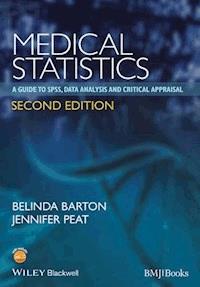
Medical Statistics provides the necessary statistical tools to enable researchers to undertake and understand evidence-based clinical research.
It is a practical guide to conducting statistical research and interpreting statistics in the context of how the participants were recruited, how the study was designed, what types of variables were used, what effect size was found, and what the P values mean. It guides researchers through the process of selecting the correct statistics and show how to best report results for presentation and publication.
Clear and concise explanations, combined with plenty of examples and tabulated explanations are based on the authors’ popular medical statistics courses.
The table of contents is divided into sections according to whether data are continuous or categorical in nature as this distinction is fundamental to selecting the correct statistics. Each chapter provides a clear step-by-step guide to each statistical test with practical instructions on how to generate and interpret the numbers, and present the results as scientific tables or graphs. The chapters conclude with critical appraisal guidelines to help researchers review the reporting of results from each type of statistical test.
This new edition includes a new chapter on repeated measures and mixed models and a helpful glossary of terms provides an easy reference that applies to all chapters.
Sie lesen das E-Book in den Legimi-Apps auf:
Seitenzahl: 686
Veröffentlichungsjahr: 2014
Ähnliche



















Table of Contents
Title Page
Copyright
Introduction
Features of this book
New to this edition
Reference
Acknowledgements
About the companion website
Chapter 1: Creating an SPSS data file and preparing to analyse the data
1.1 Creating an SPSS data file
1.2 Opening data from Excel in SPSS
1.3 Categorical and continuous variables
1.4 Classifying variables for analyses
1.5 Hypothesis testing and
P
values
1.6 Choosing the correct statistical test
1.7 Sample size requirements
1.8 Study handbook and data analysis plan
1.9 Documentation
1.10 Checking the data
1.11 Avoiding and replacing missing values
1.12 SPSS data management capabilities
1.13 Managing SPSS output
1.14 SPSS help commands
1.15 Golden rules for reporting numbers
1.16 Notes for critical appraisal
References
Chapter 2: Descriptive statistics
2.1 Parametric and non-parametric statistics
2.2 Normal distribution
2.3 Skewed distributions
2.4 Checking for normality
2.5 Transforming skewed variables
2.6 Data analysis pathway
2.7 Reporting descriptive statistics
2.8 Checking for normality in published results
2.9 Notes for critical appraisal
References
Chapter 3: Comparing two independent samples
3.1 Comparing the means of two independent samples
3.2 One- and two-sided tests of significance
3.3 Effect sizes
3.4 Study design
3.5 Influence of sample size
3.6 Two-sample
t
-test
3.7 Confidence intervals
3.8 Reporting the results from two-sample
t
-tests
3.9 Rank-based non-parametric tests
3.10 Notes for critical appraisal
References
Chapter 4: Paired and one-sample t-tests
4.1 Paired
t
-tests
4.2 Non-parametric test for paired data
4.3 Standardizing for differences in baseline measurements
4.4 Single-sample
t
-test
4.5 Testing for a between-group difference
4.6 Notes for critical appraisal
References
Chapter 5: Analysis of variance
5.1 Building ANOVA and ANCOVA models
5.2 ANOVA models
5.3 One-way analysis of variance
5.4 Effect size for ANOVA
5.5 Post-hoc tests for ANOVA
5.6 Testing for a trend
5.7 Reporting the results of a one-way ANOVA
5.8 Factorial ANOVA models
5.9 An example of a three-way ANOVA
5.10 Analysis of covariance (ANCOVA)
5.11 Testing the model assumptions of ANOVA/ANCOVA
5.12 Reporting the results of an ANCOVA
5.13 Notes for critical appraisal
References
Chapter 6: Analyses of longitudinal data
6.1 Study design
6.2 Sample size and power
6.3 Covariates
6.4 Assumptions of repeated measures ANOVA and mixed models
6.5 Repeated measures analysis of variance
6.6 Linear mixed models
6.7 Notes for critical appraisal
References
Chapter 7: Correlation and regression
7.1 Correlation coefficients
7.2 Regression models
7.3 Multiple linear regression
7.4 Interactions
7.5 Residuals
7.6 Outliers and remote points
7.7 Validating the model
7.8 Reporting a multiple linear regression
7.9 Non-linear regression
7.10 Centering
7.11 Notes for critical appraisal
References
Chapter 8: Rates and proportions
8.1 Summarizing categorical variables
8.2 Describing baseline characteristics
8.3 Incidence and prevalence
8.4 Chi-square tests
8.5 2 × 3 Chi-square tables
8.6 Cells with small numbers
8.7 Exact chi square test
8.8 Number of cells that can be tested
8.9 Reporting chi-square tests and proportions
8.10 Large contingency tables
8.11 Categorizing continuous variables
8.12 Chi-square trend test for ordered variables
8.13 Number needed to treat (NNT)
8.14 Paired categorical variables: McNemar's chi-square test
8.15 Notes for critical appraisal
References
Chapter 9: Risk statistics
9.1 Risk statistics
9.2 Study design
9.3 Odds ratio
9.4 Protective odds ratios
9.5 Adjusted odds ratios
9.6 Relative risk
9.7 Number needed to be exposed for one additional person to be harmed (NNEH)
9.8 Notes for critical appraisal
References
Chapter 10: Tests of reliability and agreement
10.1 Reliability and agreement
10.2 Kappa statistic
10.3 Reliability of continuous measurements
10.4 Intra-class correlation
10.5 Measures of agreement
10.6 Notes for critical appraisal
References
Chapter 11: Diagnostic statistics
11.1 Coding for diagnostic statistics
11.2 Positive and negative predictive values
11.3 Sensitivity and specificity
11.4 Likelihood ratio
11.5 Receiver Operating Characteristic (ROC) Curves
11.6 Notes for critical appraisal
References
Chapter 12: Survival analyses
12.1 Study design
12.2 Censored observations
12.3 Kaplan–Meier survival method
12.4 Cox regression
12.5 Questions for critical appraisal
References
Glossary
Useful websites
Index
End User License Agreement
Pages
ix
x
xi
xv
1
2
3
4
5
6
7
8
9
10
11
12
13
14
15
16
17
18
19
20
21
22
23
24
25
26
27
28
29
30
31
32
33
34
35
36
37
38
39
40
41
42
43
44
45
46
47
48
49
50
51
52
53
54
55
56
57
58
59
60
61
62
63
64
65
66
67
68
69
70
71
72
73
74
75
76
77
78
79
80
81
82
83
84
85
86
87
88
89
90
91
92
93
94
95
96
97
98
99
100
101
102
103
104
105
106
107
108
109
110
111
112
113
114
115
116
117
118
119
120
121
122
123
124
125
126
127
128
129
130
131
132
133
134
135
136
137
138
139
140
141
142
143
144
145
146
147
148
149
150
151
152
153
154
155
156
157
158
159
160
161
162
163
164
165
166
167
168
169
170
171
172
173
174
175
176
177
178
179
180
181
182
183
184
185
186
187
188
189
190
191
192
193
194
195
196
197
198
199
200
201
202
203
204
205
206
207
208
209
210
211
212
213
214
215
216
217
218
219
220
221
222
223
224
225
226
227
228
229
230
231
232
233
234
235
236
237
238
239
240
241
242
243
244
245
246
247
248
249
250
251
252
253
254
255
256
257
258
259
260
261
262
263
264
265
266
267
268
269
270
271
272
273
274
275
276
277
278
279
280
281
282
283
284
285
286
287
288
289
290
291
292
293
294
295
296
297
298
299
300
301
302
303
304
305
306
307
308
309
310
311
312
313
314
315
316
317
318
319
320
321
322
323
324
325
326
327
328
329
330
331
332
333
334
335
336
337
338
339
340
341
342
343
344
345
346
347
348
349
350
351
352
353
354
355
356
357
358
359
360
361
362
363
364
365
366
367
368
369
370
371
372
373
374
375
376
377
378
379
380
381
382
383
384
385
386
387
388
389
390
391
392
Guide
Cover
Table of Contents
Introduction
Begin Reading
List of Illustrations
Figure 2.1
Figure 2.2
Figure 2.3
Figure 2.4
Figure 2.5
Figure 2.6
Figure 2.7
Figure 3.1
Figure 3.2
Figure 3.3
Figure 3.4
Figure 3.5
Figure 3.6
Figure 3.7
Figure 3.8
Figure 3.9
Figure 3.10
Figure 4.1
Figure 4.2
Figure 4.3
Figure 5.1
Figure 5.2
Figure 5.3
Figure 5.4
Figure 5.5
Figure 5.6
Figure 5.7
Figure 5.8
Figure 5.9
Figure 5.10
Figure 5.11
Figure 6.1
Figure 6.2
Figure 6.3
Figure 6.4
Figure 6.5
Figure 6.6
Figure 7.1
Figure 7.2
Figure 7.3
Figure 7.4
Figure 7.5
Figure 7.6
Figure 7.7
Figure 7.8
Figure 7.9
Figure 7.10
Figure 7.11
Figure 7.12
Figure 7.13
Figure 8.1
Figure 8.2
Figure 8.3
Figure 8.4
Figure 8.5
Figure 8.6
Figure 9.1
Figure 9.2
Figure 9.3
Figure 10.1
Figure 11.1
Figure 11.2
Figure 11.3
Figure 12.1
Figure 12.2
Figure 12.3
List of Tables
Table 1.1
Table 1.2
Table 1.3
Table 1.4
Table 1.5
Table 1.6
Table 1.7
Table 1.8
Table 2.1
Table 2.2
Table 2.3
Table 2.4
Table 2.5
Table 2.6
Table 2.7
Table 3.1
Table 3.2
Table 3.3
Table 3.4
Table 3.5
Table 3.6
Table 3.7
Table 3.8
Table 3.9
Table 3.10
Table 3.11
Table 4.1
Table 4.2
Table 4.3
Table 5.1
Table 5.2
Table 5.3
Table 5.4
Table 5.5
Table 5.6
Table 5.7
Table 6.1
Table 7.1
Table 7.2
Table 7.3
Table 7.4
Table 7.5
Table 7.6
Table 8.1
Table 8.2
Table 8.3
Table 8.4
Table 8.5
Table 8.6
Table 8.7
Table 8.8
Table 8.9
Table 8.10
Table 8.11
Table 8.12
Table 8.13
Table 8.14
Table 8.15
Table 8.16
Table 8.17
Table 8.18
Table 9.1
Table 9.2
Table 9.3
Table 9.4
Table 9.5
Table 9.6
Table 10.1
Table 10.2
Table 10.3
Table 10.4
Table 10.5
Table 10.6
Table 11.1
Table 11.2
Table 11.3
Table 11.4
Table 11.5
Table 11.6
Table 12.1
Table 12.2
Medical Statistics
A Guide to SPSS, Data Analysis and Critical Appraisal
Second Edition
Belinda Barton
Children's Hospital Education Research Institute, The Children's Hospital at Westmead, Sydney, Australia
Jennifer Peat
Honorary Professor, Australian Catholic University and Research Consultant, Sydney, Australia
This edition first published 2014 © 2014 by John Wiley & Sons Ltd.
BMJ Books is an imprint of BMJ Publishing Group Limited, used under licence by John Wiley & Sons.
First edition © 2005 by Blackwell Publishing Ltd.
Registered office: John Wiley & Sons, Ltd, The Atrium, Southern Gate, Chichester, West Sussex, PO19 8SQ, UK
Editorial offices: 9600 Garsington Road, Oxford, OX4 2DQ, UK
The Atrium, Southern Gate, Chichester, West Sussex, PO19 8SQ, UK
111 River Street, Hoboken, NJ 07030-5774, USA
For details of our global editorial offices, for customer services and for information about how to apply for permission to reuse the copyright material in this book please see our website at www.wiley.com/wiley-blackwell
The right of the author to be identified as the author of this work has been asserted in accordance with the UK Copyright, Designs and Patents Act 1988.
All rights reserved. No part of this publication may be reproduced, stored in a retrieval system, or transmitted, in any form or by any means, electronic, mechanical, photocopying, recording or otherwise, except as permitted by the UK Copyright, Designs and Patents Act 1988, without the prior permission of the publisher.
Designations used by companies to distinguish their products are often claimed as trademarks. All brand names and product names used in this book are trade names, service marks, trademarks or registered trademarks of their respective owners. The publisher is not associated with any product or vendor mentioned in this book. It is sold on the understanding that the publisher is not engaged in rendering professional services. If professional advice or other expert assistance is required, the services of a competent professional should be sought.
The contents of this work are intended to further general scientific research, understanding, and discussion only and are not intended and should not be relied upon as recommending or promoting a specific method, diagnosis, or treatment by health science practitioners for any particular patient. The publisher and the author make no representations or warranties with respect to the accuracy or completeness of the contents of this work and specifically disclaim all warranties, including without limitation any implied warranties of fitness for a particular purpose. In view of ongoing research, equipment modifications, changes in governmental regulations, and the constant flow of information relating to the use of medicines, equipment, and devices, the reader is urged to review and evaluate the information provided in the package insert or instructions for each medicine, equipment, or device for, among other things, any changes in the instructions or indication of usage and for added warnings and precautions. Readers should consult with a specialist where appropriate. The fact that an organization or Website is referred to in this work as a citation and/or a potential source of further information does not mean that the author or the publisher endorses the information the organization or Website may provide or recommendations it may make. Further, readers should be aware that Internet Websites listed in this work may have changed or disappeared between when this work was written and when it is read. No warranty may be created or extended by any promotional statements for this work. Neither the publisher nor the author shall be liable for any damages arising herefrom.
Library of Congress Cataloging-in-Publication Data
Peat, Jennifer K., author.
Medical statistics : a guide to SPSS, data analysis, and critical appraisal / Belinda Barton, Jennifer Peat. - Second edition.
p. ; cm.
Author's names reversed on the first edition.
Includes bibliographical references and index.
ISBN 978-1-118-58993-9 (pbk.)
I. Barton, Belinda, author. II. Title.
[DNLM: 1. Statistics as Topic-methods. 2. Research Design. WA 950]
R853.S7
610.285′555—dc23
2014020556
A catalogue record for this book is available from the British Library.
Wiley also publishes its books in a variety of electronic formats. Some content that appears in print may not be available in electronic books.
Introduction
Statistical thinking will one day be as necessary a qualification for efficient citizenship as the ability to read and write.
H.G. WELLS
Anyone who is involved in medical research should always keep in mind that science is a search for the truth and that, in doing so, there is no room for bias or inaccuracy in statistical analyses or interpretation. Analyzing the data and interpreting the results are the most exciting stages of a research project because these provide the answers to the study questions. However, data analyses must be undertaken in a careful and considered way by people who have an inherent knowledge of the nature of the data and of their interpretation. Any errors in statistical analyses will mean that the conclusions of the study may be incorrect.1 As a result, many journals may require reviewers to scrutinize the statistical aspects of submitted articles, and many research groups include statisticians who direct the data analyses. Analyzing data correctly and including detailed documentation so that others can reach the same conclusions are established markers of scientific integrity. Research studies that are conducted with integrity bring personal pride, contribute to a successful track record and foster a better research culture, advancing the scientific community.
In this book, we provide a step-by-step guide to the complete process of analyzing and reporting your data – from creating a file to entering your data to how to report your results for publication. We provide a guide to conducting and interpreting statistics in the context of how the participants were recruited, how the study was designed, the types of variables used, and the interpretation of effect sizes and P values. We also guide researchers, through the processes of selecting the correct statistic, and show how to report results for publication. Each chapter includes worked research examples with real data sets that can be downloaded and used by readers to work through the examples.
We have included the SPSS commands for methods of statistical analysis, commonly found in the health care literature. We have not included all of the tables from the SPSS output but only the most relevant SPSS output information that is to be interpreted. We have also included the commands for obtaining graphs using SigmaPlot, a graphing software package that is frequently used. In this book, we use SPSS version 21 and SigmaPlot version 12.5, but the messages apply equally well to other versions and other statistical packages.
We have written this book as a guide from the first principles with explanations of assumptions and how to interpret results. We hope that both novice statisticians and seasoned researchers will find this book a helpful guide.
In this era of evidence-based health care, both clinicians and researchers need to critically appraise the statistical aspects of published articles in order to judge the implications and reliability of reported results. Although the peer review process goes a long way to improving the standard of research literature, it is essential to have the skills to decide whether published results are credible and therefore have implications for current clinical practice or future research directions. We have therefore included critical appraisal guidelines at the end of each chapter to help researchers to evaluate the results of studies.
Features of this book
Easy to read and step-by-step guide
Practical
Limited use of computational or mathematical formulae
Specifies the assumptions of each statistical test and how to check the assumptions
Worked examples and corresponding data sets that can be downloaded from the book's website
SPSS commands to conduct a range of statistical tests
SPSS output displayed and interpreted
Examples on how to report your results for publication
Commands and output on how to visually display results using SPSS or SigmaPlot
Critical appraisal checklists that can be used to systematically evaluate studies and research articles
Glossary of terms
List of useful websites such as effect size and sample size on-line calculators, free statistical packages and sources of statistical help.
New to this edition
In this second edition, the significant changes include updating all the IBM Statistics SPSS commands and output using version 21. As the versions of SPSS are very similar, the majority of the commands are applicable to previous and future versions. Similarly, we have updated the commands and the output for SigmaPlot to version 12.5. We have also included additional sections and discussions on statistical power, the sample size required and the different measures of effect size and their interpretations.
There is an additional chapter on the analysis of longitudinal data, where the outcome is measured repeatedly over time for each participant. We have included both statistical methods that can be used to analyze these types of data – repeated measures and linear mixed models. In Chapter 12 on survival analysis, we have included a section on Cox's regression, which provides an estimate of survival time while adjusting for the effects of other explanatory or predictor variables.
In reporting study findings, it is important that they are presented clearly and contain the necessary information to be interpreted by readers. Although disciplines and journals may differ slightly in the information that require to be reported, we provide examples of how to report the information required for most publications, both in a written and in a tabular format, as well as visually such as by graphs. Finally, we have updated the glossary and the links to useful websites and resources.
There is a saying that ‘everything is easy when you know how’ – we hope that this book will provide the ‘know how’ and make statistical analysis and critical appraisal easy for all researchers and health care professionals.
Belinda BartonHead of Children's Hospital Education Research Institute (CHERI) and Psychologist, The Children's Hospital at Westmead, Sydney, Australia
Jennifer PeatHonorary Professor, Australian Catholic University and Research Consultant, Sydney, Australia
Reference
1. Altman DG.
Statistics in medical research
. In:
Practical statistics for medical research
. Chapman and Hall: London, 1996.
Acknowledgements
We extend our thanks to our colleagues, hospitals and universities for supporting us. We also thank all of the researchers and students who attend our classes and consultations and provide encouragement and feedback. Mostly, we will always be eternally grateful to our friends and our families who inspired us and supported whilst we were revising this book.
About the companion website
This book is accompanied by a companion website:
www.wiley.com/go/barton/medicalstatistics2e
The website includes:
Original data files for SPSS
Chapter 1Creating an SPSS data file and preparing to analyse the data
There are two kinds of statistics, the kind you look up and the kind you make up.
REX STOUT
Objectives
The objectives of this chapter are to explain how to:
create an SPSS data file that will facilitate straightforward statistical analyses
ensure data quality
manage missing data points
move data and output between electronic spreadsheets
manipulate data files and variables
devise a data management plan
select the correct statistical test
critically appraise the quality of reported data analyses
1.1 Creating an SPSS data file
Creating a data file in SPSS and entering the data is a relatively simple process. In the SPSS window located on the top left-hand side of the screen is a menu bar with headings and drop-down options. A new file can be opened using the File → New → Data commands located on the top left-hand side of the screen. The SPSS IBM Statistics Data Editor has two different screens called the ‘Data View’ and ‘Variable View’. You can easily move between the two views by clicking on the tabs located at the bottom left-hand side of the screen.
1.1.1 Variable View screen
Before entering data in Data View, the features or attributes of each variable need to be defined in Variable View. In this screen, details of the variable names, variable types and labels are stored. Each row in Variable View represents a new variable and each column represents a feature of the variable such as type (e.g. numeric, dot, string, etc.) and measure (scale, ordinal or nominal). To enter a variable name, simply type the name into the first field and default settings will appear for almost all of the remaining fields, except for Label and Measure.
The Tab, arrow keys or mouse can be used to move across the fields and change the default settings. In Variable View, the settings can be changed by a single click on the cell and then pulling down the drop box option that appears when you double click on the domino on the right-hand side of the cell. The first variable in a data set is usually a unique identification code or a number for each participant. This variable is invaluable for selecting or tracking particular participants during the data analysis process.
Unlike data in Excel spreadsheets, it is not possible to hide rows or columns in either Variable View or Data View in SPSS and therefore, the order of variables in the spreadsheet should be considered before the data are entered. The default setting for the lists of variables in the drop-down boxes that are used when running the statistical analyses are in the same order as the spreadsheet. It can be more efficient to place variables that are likely to be used most often at the beginning of the spreadsheet and variables that are going to be used less often at the end.
Lesen Sie weiter in der vollständigen Ausgabe!
Lesen Sie weiter in der vollständigen Ausgabe!
Lesen Sie weiter in der vollständigen Ausgabe!
Lesen Sie weiter in der vollständigen Ausgabe!
Lesen Sie weiter in der vollständigen Ausgabe!
Lesen Sie weiter in der vollständigen Ausgabe!
Lesen Sie weiter in der vollständigen Ausgabe!
Lesen Sie weiter in der vollständigen Ausgabe!
Lesen Sie weiter in der vollständigen Ausgabe!
Lesen Sie weiter in der vollständigen Ausgabe!
Lesen Sie weiter in der vollständigen Ausgabe!
Lesen Sie weiter in der vollständigen Ausgabe!
Lesen Sie weiter in der vollständigen Ausgabe!
Lesen Sie weiter in der vollständigen Ausgabe!
Lesen Sie weiter in der vollständigen Ausgabe!




