


33,99 €
Mehr erfahren.
- Herausgeber: John Wiley & Sons
- Kategorie: Fachliteratur
- Serie: Wiley Series on Cognitive Dynamic Systems
- Sprache: Englisch
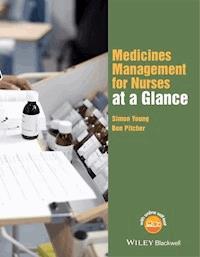
Medicines Management for Nurses at a Glance is the perfect companion for study and revision for pre-registration nursing and healthcare students. Combining superb full colour illustrations with accessible and informative text, it provides an easy-to-read and supportive guide to the key pharmacological knowledge nursing students and registered nurses need to know.
Divided into three sections, the first introduces key topics within clinical pharmacology and medicines management including, numeracy, pharmacokinetics, routes of administration, and pharmacodynamics. The second and final sections cover the management of medicines for common medical conditions, drug interactions, side effects, and safe and effective prescribing.
- Written specifically for nurses, it covers the fundamentals of pharmacology as they apply to nursing practice.
- Breaks down complex concepts in an accessible way, providing helpful overviews of all key pharmacological topics.
- Includes practical issues relating to practice, and is written to support the Essential Skills Cluster of the NMC, and the content of the BNF.
- Includes content relevant to each of the four fields of nursing, and covers drugs for specific groups such as children, pregnant and breastfeeding women, and the elderly.
A companion website is available at www.ataglanceseries.com/nursing/medicinesmanagement featuring interactive multiple choice questions.
Sie lesen das E-Book in den Legimi-Apps auf:
Seitenzahl: 270
Veröffentlichungsjahr: 2015
Ähnliche



















This title is also available as an e-book. For more details, please seewww.wiley.com/buy/9781118840726or scan this QR code:
This edition first published 2016 © 2016 by John Wiley & Sons Ltd.
Registered office: John Wiley & Sons, Ltd, The Atrium, Southern Gate, Chichester,West Sussex, PO19 8SQ, UK
Editorial offices: 9600 Garsington Road, Oxford, OX4 2DQ, UKThe Atrium, Southern Gate, Chichester, West Sussex,PO19 8SQ, UK350 Main Street, Malden, MA 02148-5020, USA
For details of our global editorial offices, for customer services and for information about how to apply for permission to reuse the copyright material in this book please see our website at www.wiley.com/wiley-blackwell
The right of the authors to be identified as the authors of this work has been asserted in accordance with the UK Copyright, Designs and Patents Act 1988.
All rights reserved. No part of this publication may be reproduced, stored in a retrieval system, or transmitted, in any form or by any means, electronic, mechanical, photocopying, recording or otherwise, except as permitted by the UK Copyright, Designs and Patents Act 1988, without the prior permission of the publisher.
Designations used by companies to distinguish their products are often claimed as trademarks. All brand names and product names used in this book are trade names, service marks, trademarks or registered trademarks of their respective owners. The publisher is not associated with any product or vendor mentioned in this book. It is sold on the understanding that the publisher is not engaged in rendering professional services. If professional advice or other expert assistance is required, the services of a competent professional should be sought. The contents of this work are intended to further general scientific research, understanding, and discussion only and are not intended and should not be relied upon as recommending or promoting a specific method, diagnosis, or treatment by health science practitioners for any particular patient. The publisher and the author make no representations or warranties with respect to the accuracy or completeness of the contents of this work and specifically disclaim all warranties, including without limitation any implied warranties of fitness for a particular purpose. In view of ongoing research, equipment modifications, changes in governmental regulations, and the constant flow of information relating to the use of medicines, equipment, and devices, the reader is urged to review and evaluate the information provided in the package insert or instructions for each medicine, equipment, or device for, among other things, any changes in the instructions or indication of usage and for added warnings and precautions. Readers should consult with a specialist where appropriate. The fact that an organization or Website is referred to in this work as a citation and/or a potential source of further information does not mean that the author or the publisher endorses the information the organization or Website may provide or recommendations it may make. Further, readers should be aware that Internet Websites listed in this work may have changed or disappeared between when this work was written and when it is read. No warranty may be created or extended by any promotional statements for this work. Neither the publisher nor the author shall be liable for any damages arising herefrom.
Library of Congress Cataloging-in-Publication Data
Young, Simon, 1971- , author. Medicines management for nurses at a glance / Simon Young, Ben Pitcher. p. ; cm. – (At a glance series) Includes index. ISBN 978-1-118-84072-6 (paperback) I. Pitcher, Ben, 1979-, author. II. Title. III. Series: At a glance series (Oxford, England) [DNLM: 1. Drug Therapy–nursing–Great Britain. 2. Drug Prescriptions–nursing– Great Britain. 3. Drug Therapy–methods–Great Britain. 4. Nurse Clinicians–Great Britain. WY 100 FA1] RT68 615.1'4–dc23
2015033805
A catalogue record for this book is available from the British Library.
Wiley also publishes its books in a variety of electronic formats. Some content that appears in print may not be available in electronic books.
Cover image: GettyImages-478860007/sturti
CONTENTS
Preface
About the companion website
Part 1: Introduction to pharmacology and medicines management
Chapter 1: Why is managing medicines important in nursing?
Medicines management and nursing
Defining medicines management
Chapter 2: Keeping up to date with medicines management
Continuing professional development
Post-registration educational practice
Chapter 3: What is a medicine?
How are medicines developed and monitored?
Chapter 4: Medicines nomenclature: what’s in a name?
Endings
Chapter 5: Numeracy and medicines management
Symbols
Illustrative biological unit standards for medicinal products
Chapter 6: Clinical pharmacokinetics I
Absorption
Distribution
Chapter 7: Clinical pharmacokinetics II
Metabolism
Excretion
Chapter 8: Routes of administration I
Oral
Intravenous
Intramuscular
Subcutaneous
Chapter 9: Routes of administration II
Inhaled
Topical
Transdermal
Sublingual
Rectal
Chapter 10: Pharmacodynamics I
What is pharmacodynamics?
Why do chemicals have such varied but specific effects on the body?
Receptors
Second messenger systems
Ion channels
Chapter 11: Pharmacodynamics II
Agonists and antagonists
Receptor specificity
Enzymes
Part 2: Managing medicines
Chapter 12: Dyspepsia
Dyspepsia
Antacids
Histamine (H2) antagonists
Proton pump inhibitors (PPIs)
Chapter 13: Acute diarrhoea and constipation
Acute diarrhoea
Constipation
Chapter 14: Chronic bowel disease
Medications
Aminosalicylates
Corticosteroids
Immunoregulating agents
Chapter 15: Nausea and vomiting
Medications
Metoclopramide
Antihistamines
5-HT
3
receptor antagonists
Chapter 16: Anti-anginals
Indications
Nitrates
Calcium channel blockers
Chapter 17: Anti-arrhythmics
Digoxin
Amiodarone
Other anti-arrhythmic drugs
Chapter 18: Heart failure
Angiotensin converting enzyme (ACE) inhibitors
Angiotensin-II receptor antagonists
Other drugs used in heart failure
Chapter 19: Hypertension
Drugs used to treat hypertension
Beta-blockers
Calcium channel blockers
Angiotensin converting enzyme (ACE) inhibitors and angiotensin receptor blockers (ARBS)
Diuretics
Other drugs used in hypertension
Chapter 20: Diuretics
Pharmacodynamics
Chapter 21: Respiratory conditions I
Bronchodilators
Adrenoceptor agonists
Antimuscarinic bronchodilators
Theophylline and aminophylline
Inhaled corticosteroids
Leukotriene receptor antagonists
Chapter 22: Respiratory conditions II
Decongestants
Mucolytics
Antihistamines
Oxygen
Chapter 23: Opioid analgesics
Opioid analgesics
Commonly used opioid analgesics
Chapter 24: Anxiolytics and hypnotics
Benzodiazepines
Buspirone
Antidepressants and beta-blockers
Hypnotics – the ‘Z’ drugs (Zaleplon, Zopiclone and Zolpidem)
Chapter 25: Antipsychotics
First-and second-generation antipsychotics
Chapter 26: Depression
SSRIs
Tricyclic and related antidepressants
Other antidepressants
Chapter 27: Epilepsy
Anti-epileptic medication
Valproate
Carbamazepine
General advice
Chapter 28: Alcohol: detoxification
Medication that aids in the detoxification process
Thiamine and B vitamins
Chapter 29: Alcohol: maintaining abstinence
Lesen Sie weiter in der vollständigen Ausgabe!
Lesen Sie weiter in der vollständigen Ausgabe!
Lesen Sie weiter in der vollständigen Ausgabe!
Lesen Sie weiter in der vollständigen Ausgabe!
Lesen Sie weiter in der vollständigen Ausgabe!
Lesen Sie weiter in der vollständigen Ausgabe!
Lesen Sie weiter in der vollständigen Ausgabe!
Lesen Sie weiter in der vollständigen Ausgabe!
Lesen Sie weiter in der vollständigen Ausgabe!
Lesen Sie weiter in der vollständigen Ausgabe!
Lesen Sie weiter in der vollständigen Ausgabe!
Lesen Sie weiter in der vollständigen Ausgabe!
Lesen Sie weiter in der vollständigen Ausgabe!
Lesen Sie weiter in der vollständigen Ausgabe!
Lesen Sie weiter in der vollständigen Ausgabe!
Lesen Sie weiter in der vollständigen Ausgabe!
Lesen Sie weiter in der vollständigen Ausgabe!
Lesen Sie weiter in der vollständigen Ausgabe!
Lesen Sie weiter in der vollständigen Ausgabe!
Lesen Sie weiter in der vollständigen Ausgabe!
Lesen Sie weiter in der vollständigen Ausgabe!
Lesen Sie weiter in der vollständigen Ausgabe!
Lesen Sie weiter in der vollständigen Ausgabe!
Lesen Sie weiter in der vollständigen Ausgabe!
Lesen Sie weiter in der vollständigen Ausgabe!
Lesen Sie weiter in der vollständigen Ausgabe!
Lesen Sie weiter in der vollständigen Ausgabe!
Lesen Sie weiter in der vollständigen Ausgabe!
Lesen Sie weiter in der vollständigen Ausgabe!
Lesen Sie weiter in der vollständigen Ausgabe!
Lesen Sie weiter in der vollständigen Ausgabe!
Lesen Sie weiter in der vollständigen Ausgabe!
Lesen Sie weiter in der vollständigen Ausgabe!
Lesen Sie weiter in der vollständigen Ausgabe!
Lesen Sie weiter in der vollständigen Ausgabe!
Lesen Sie weiter in der vollständigen Ausgabe!
Lesen Sie weiter in der vollständigen Ausgabe!
Lesen Sie weiter in der vollständigen Ausgabe!
Lesen Sie weiter in der vollständigen Ausgabe!
Lesen Sie weiter in der vollständigen Ausgabe!
Lesen Sie weiter in der vollständigen Ausgabe!
Lesen Sie weiter in der vollständigen Ausgabe!
Lesen Sie weiter in der vollständigen Ausgabe!
Lesen Sie weiter in der vollständigen Ausgabe!
Lesen Sie weiter in der vollständigen Ausgabe!
Lesen Sie weiter in der vollständigen Ausgabe!
Lesen Sie weiter in der vollständigen Ausgabe!
Lesen Sie weiter in der vollständigen Ausgabe!
Lesen Sie weiter in der vollständigen Ausgabe!
Lesen Sie weiter in der vollständigen Ausgabe!
Lesen Sie weiter in der vollständigen Ausgabe!
Lesen Sie weiter in der vollständigen Ausgabe!
Lesen Sie weiter in der vollständigen Ausgabe!
Lesen Sie weiter in der vollständigen Ausgabe!
Lesen Sie weiter in der vollständigen Ausgabe!
Lesen Sie weiter in der vollständigen Ausgabe!
Lesen Sie weiter in der vollständigen Ausgabe!




