


31,99 €
Mehr erfahren.
- Herausgeber: John Wiley & Sons
- Kategorie: Geisteswissenschaft
- Sprache: Englisch
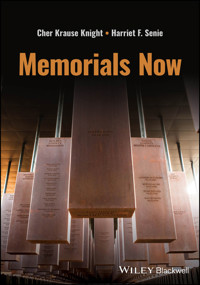
A comprehensive guide to addressing the present-day challenges of commemorating the past
As debates over historical monuments and their meanings unfold, Memorials Now offers a critical exploration of how communities can navigate the complex terrain of commemorative practices. From controversial statues to emerging forms of public memory, the topics covered in this timely volume provide insights into historical challenges while also encouraging a more inclusive and just memorial landscape for the future.
Authors Cher Krause Knight and Harriet F. Senie explore evolving narratives of heroes and victims, ethical challenges of memorial design, strategies for promoting inclusivity, and possibilities for alternative forms of commemoration. Memorials Now analyzes case studies from around the world in which communities are rethinking their memorials and creating innovative memorialization projects that reflect shifting cultural values.
Memorials Now is ideal for students and educators in art history, architecture, urban planning, and cultural studies, as well as professionals in fields such as public art, city planning, museum curation, and civic engagement.
Sie lesen das E-Book in den Legimi-Apps auf:
Seitenzahl: 571
Veröffentlichungsjahr: 2025
Ähnliche



















Table of Contents
Cover
Table of Contents
Title Page
Copyright Page
Dedication Page
List of Illustrations
Acknowledgments
1 Introduction
References
Part 1: Reckoning with the Past
2 Critical Issues
Honoring the Remains
The Memorial Competition and the Foley Square Sculpture
The Art Commissioned for 290 Broadway
Subsequent Discoveries
Seneca Village
Other African Burial Grounds
References
3 Case Studies
Revisiting the “Lost Cause”
The Rise and Fall of Monument Avenue
Remaining Confederate Memorials
Reckoning with Slavery Elsewhere
References
4 Future Directions
The Memorial
The Museum
The Legacy Pavilion
Proposed Strategies
Ongoing Challenges
References
Part 2: From Heroes to Victims
5 Critical Issues
The 1960s as Radical Break
The Place of Heroic Monuments Today
Reconsidering Former Heroes
References
6 Case Studies
Terrorist Attacks and Mass Shootings
COVID‐19 and Other Plague Memorials
References
7 Future Directions
Legacy Memorials
Group Memorials
Participatory Memorials
The Role of Controversy
References
Part 3: A More Inclusive Memorial Landscape
8 Critical Issues
Names
Pedestals
Climates
Photographs
References
9 Case Studies
Embedding Race: Mark Bradford and Steve Locke
Sustaining Indigeneity: Reko Rennie, Marie Watt, and Cannupa Hanska Luger
Visualizing Gender and Queerness: Suzanne Lacy, Enrico David, Group Material, and Félix González‐Torres
Materializing the Disappeared: Sebastian Errazuriz, Alfredo Jaar, Hernán Parada, and Claudia Vásquez Gómez
Invoking the Imprisoned: Virgil Marti, Titus Kaphar, and Christina Henri
Accounting for Artists: Jeffrey Vallance, Dan Flavin, Gillian Wearing, and a Pageant
References
10 Future Directions
Removal as Public Process
History – Challenged, Expanded, Corrected
Everyday People, Everyday Lives
References
Part 4: Alternative Memorial Forms
11 Critical Issues
The Counter Memorial
Absence as Presence
Ephemerality, Recurring or Nomadic
Immersion and Intervention
References
12 Case Studies
Anti, Colossal, Unbuilt, Invisible, and Feasible: Claes Oldenburg
Intentional, Unintentional, and Spectacular: Christo and Jeanne‐Claude
Nature and Destruction: Tadao Ando, Óscar Concha, and Alberto Burri
Ghosts and Shadows: Rachel Whiteread, Kerry James Marshall, and Glenn Kaino
References
13 Future Directions
The Reclaimed and the Repurposed
A Laboratory Approach
Digital Technologies and Cyberspace Memorials
References
14 Conclusion
Problematic Heroes
Memorials to Victims
Holocaust Memorials
Ongoing Omissions in the Memorial Landscape
What Comes Next?
References
Index
End User License Agreement
List of Illustrations
Chapter 1
Figure 1.1 Dale Lamphere,
United Flight 232 Memorial (Spirit of Siouxland)
, ...
Chapter 2
Figure 2.1 Lorenzo Pace,
Triumph of the Human Spirit
, 2000, Foley Square, Ne...
Figure 2.2 Houston Conwill, Jose De Pace, and Estella Conwill Majozo,
The Ne
...
Chapter 3
Figure 3.1 Marius‐Jean‐Antonin Mercié,
Robert E. Lee
, unveiled in 1890, Rich...
Figure 3.2 Marc Quinn,
A Surge of Power (Jen Reid)
, 2020, Bristol, England....
Figure 3.3 Philip Moore,
1763 Monument
, 1976, Georgetown, Guyana.
Chapter 4
Figure 4.1 MASS Design Group,
National Memorial for Peace and Justice
, 2018,...
Chapter 6
Figure 6.1 DHM Design,
Columbine Memorial
, dedicated 2007, Littleton, Colora...
Figure 6.2 Daniel Affleck and Ben Waldo (SWA Group),
The Clearing or Sandy H
...
Figure 6.3 Matthias Rauchmiller (original design), completed by Paul Strudel...
Chapter 7
Figure 7.1 Meredith Bergmann,
Boston Women
'
s Memorial
, 2003, Boston, Massach...
Figure 7.2 Gaeta Springall Arquitectos,
Memorial to the Victims of Violence
,...
Chapter 8
Figure 8.1 Kehinde Wiley,
Rumors of War
, 2019; Times Square, New York (left)...
Figure 8.2 Sharon Hayes,
If They Should Ask
, 2017, Rittenhouse Square, Phila...
Figure 8.3 Agnes Denes,
Tree Mountain – A Living Time Capsule – 11,000 Trees
...
Figure 8.4 Deana Lawson,
Monetta Passing
, 2021.
Chapter 9
Figure 9.1 Steve Locke, proposal for
Slavery Auction Block Memorial at Faneu
...
Figure 9.2 Cannupa Hanska Luger,
Every One (#MMIWQT Bead Project)
, 2018.
Figure 9.3 Félix González‐Torres,
Untitled (Portrait of Ross in L.A.)
, 1991....
Figure 9.4 Hernán Parada,
Obra Abierta A
, 1978–ongoing, Santiago, Chile.
Figure 9.5 Virgil Marti,
For Oscar Wilde
, 1995, installation at Eastern Stat...
Chapter 10
Figure 10.1 Will Wilson and Adam W. McKinney,
New Trinity Cemetery, Haltom C
...
Figure 10.2 Raoul Marek, detail of
La salle du monde (The Room of the World)
Figure 10.3 Zanele Muholi,
Bester I, Mayotte
, 2015 (left), and
Bester V, May
...
Chapter 11
Figure 11.1 Dread Scott,
The Legacy of Slavery Is in the Way of Progress and
...
Figure 11.2 SINAI and ON Architekur,
Berlin Wall Memorial
, 2014, Berlin, Ger...
Chapter 12
Figure 12.1 Tadao Ando,
Awaji Yumebutai or Hyakudan‐en
, created in mid...
Figure 12.2 Glenn Kaino, “In the Light of a Shadow,” 2021, MASS MoCA, North ...
Chapter 13
Figure 13.1 Joseph DeLappe,
dead‐in‐iraq
, 2006–2011.
Figure 13.2 Janet Echelman,
1.8
, 2015, Smithsonian Institution, Washington, ...
Guide
Cover Page
Table of Contents
Title Page
Copyright Page
Dedication Page
List of Illustrations
Acknowledgments
Begin Reading
Index
WILEY END USER LICENSE AGREEMENT
Pages
iii
iv
v
ix
x
xi
xii
xiii
1
2
3
4
5
6
7
8
9
10
11
13
15
16
17
18
19
20
21
22
23
24
25
26
27
28
29
30
31
32
33
34
35
36
37
38
39
40
41
42
43
44
45
46
47
48
49
50
51
52
53
54
55
56
57
58
59
60
61
62
63
64
65
66
67
68
69
70
71
73
75
76
77
78
79
80
81
82
83
84
85
86
87
88
89
90
91
92
93
94
95
96
97
98
99
100
101
102
103
104
105
106
107
108
109
110
111
112
113
114
115
116
117
118
119
120
121
122
123
124
125
126
127
128
129
131
132
133
134
135
136
137
138
139
140
141
142
143
144
145
146
147
148
149
150
151
152
153
154
155
156
157
158
159
160
161
162
163
164
165
166
167
168
169
170
171
172
173
174
175
176
177
178
179
180
181
182
183
184
185
186
187
188
189
190
191
192
193
194
195
196
197
198
199
200
201
202
203
204
205
207
209
210
211
212
213
214
215
216
217
218
219
220
221
222
223
224
225
226
227
228
229
230
231
232
233
234
235
236
237
238
239
240
241
242
243
244
245
246
247
248
249
250
251
252
253
254
255
256
257
258
259
260
261
262
263
264
265
266
267
268
269
270
271
272
273
274
275
276
277
278
279
280
281
282
283
284
285
286
287
288
289
Memorials Now
Cher Krause Knight
Harriet F. Senie
Copyright © 2025 by John Wiley & Sons, Inc. All rights reserved, including rights for text and data mining and training of artificial intelligence technologies or similar technologies.
Published by John Wiley & Sons, Inc., Hoboken, New Jersey.Published simultaneously in Canada.
No part of this publication may be reproduced, stored in a retrieval system, or transmitted in any form or by any means, electronic, mechanical, photocopying, recording, scanning, or otherwise, except as permitted under Section 107 or 108 of the 1976 United States Copyright Act, without either the prior written permission of the Publisher, or authorization through payment of the appropriate per‐copy fee to the Copyright Clearance Center, Inc., 222 Rosewood Drive, Danvers, MA 01923, (978) 750‐8400, fax (978) 750‐4470, or on the web at www.copyright.com. Requests to the Publisher for permission should be addressed to the Permissions Department, John Wiley & Sons, Inc., 111 River Street, Hoboken, NJ 07030, (201) 748‐6011, fax (201) 748‐6008, or online at http://www.wiley.com/go/permission.
The manufacturer’s authorized representative according to the EU General Product Safety Regulation is Wiley‐VCH GmbH, Boschstr. 12, 69469 Weinheim, Germany, e‐mail: [email protected].
Trademarks: Wiley and the Wiley logo are trademarks or registered trademarks of John Wiley & Sons, Inc. and/or its affiliates in the United States and other countries and may not be used without written permission. All other trademarks are the property of their respective owners. John Wiley & Sons, Inc. is not associated with any product or vendor mentioned in this book.
Limit of Liability/Disclaimer of Warranty: While the publisher and author have used their best efforts in preparing this book, they make no representations or warranties with respect to the accuracy or completeness of the contents of this book and specifically disclaim any implied warranties of merchantability or fitness for a particular purpose. No warranty may be created or extended by sales representatives or written sales materials. The advice and strategies contained herein may not be suitable for your situation. You should consult with a professional where appropriate. Further, readers should be aware that websites listed in this work may have changed or disappeared between when this work was written and when it is read. Neither the publisher nor authors shall be liable for any loss of profit or any other commercial damages, including but not limited to special, incidental, consequential, or other damages.
For general information on our other products and services or for technical support, please contact our Customer Care Department within the United States at (800) 762‐2974, outside the United States at (317) 572‐3993 or fax (317) 572‐4002.
Wiley also publishes its books in a variety of electronic formats. Some content that appears in print may not be available in electronic formats. For more information about Wiley products, visit our web site at www.wiley.com.
Library of Congress Cataloging‐in‐Publication DataNames: Knight, Cher Krause, author. | Senie, Harriet, author.Title: Memorials now / Cher Krause Knight, Harriet F. Senie.Description: Hoboken, New Jersey: Wiley, [2025] | Includes bibliographical references and index.Identifiers: LCCN 2024041143 (print) | LCCN 2024041144 (ebook) | ISBN 9781394154500 (paperback) | ISBN 9781394154517 (adobe pdf) | ISBN 9781394154524 (epub)Subjects: LCSH: Memorials–Social aspects. | Monuments–Social aspects. | Public art–Social aspects. | Memorialization.Classification: LCC NA9345 .K59 2025 (print) | LCC NA9345 (ebook) | DDC 306.4/7–dc23/eng/20240926LC record available at https://lccn.loc.gov/2024041143LC ebook record available at https://lccn.loc.gov/2024041144
Cover Design: WileyCover Image: © Equal Justice Initiative/Human Pictures (2018)
For our daughters:
Beatrix Marcel Knight – I love you the whole world.
and
Laura Kim Senie – like always!
And in memory of Elke Solomon –
a dear friend, a valued reader, and a wonderful artist.
List of Illustrations
Figure 1.1
Dale Lamphere,
United Flight 232 Memorial (Spirit of Siouxland)
, dedicated 2004, Sioux City, Iowa.
Figure 2.1
Lorenzo Pace,
Triumph of the Human Spirit
, 2000, Foley Square, New York City.
Figure 2.2
Houston Conwill, Jose De Pace, and Estella Conwill Majozo,
The New Ring Shout
, installed 1994, Ted Weiss Federal Building, New York City.
Figure 3.1
Marius‐Jean‐Antonin Mercié,
Robert E. Lee
, unveiled in 1890, Richmond, Virginia. Photo on the right taken in August of 2020.
Figure 3.2
Marc Quinn,
A Surge of Power (Jen Reid)
, 2020, Bristol, England.
Figure 3.3
Philip Moore,
1763 Monument
, 1976, Georgetown, Guyana.
Figure 4.1
MASS Design Group,
National Memorial for Peace and Justice
, 2018, Montgomery Alabama, exterior (left); interior (right).
Figure 6.1
DHM Design,
Columbine Memorial
, dedicated 2007, Littleton, Colorado, overall view (left); detail (right).
Figure 6.2
Daniel Affleck and Ben Waldo (SWA Group),
The Clearing
or
Sandy Hook Memorial
, 2022, Newtown, Connecticut, aerial view (left); detail (right).
Figure 6.3
Matthias Rauchmiller (original design), completed by Paul Strudel,
die Weiner Pestsäule or Dreifaltigkeitssäule
, 1694, Vienna, Austria.
Figure 7.1
Meredith Bergmann,
Boston Women
’
s Memorial
, 2003, Boston, Massachusetts.
Figure 7.2
Gaeta Springall Arquitectos,
Memorial to the Victims of Violence
, 2013, Chapultepec, Mexico City.
Figure 8.1
Kehinde Wiley,
Rumors of War
, 2019; Times Square, New York (left); Virginia Museum of Fine Arts, Richmond, Virginia (right).
Figure 8.2
Sharon Hayes,
If They Should Ask
, 2017, Rittenhouse Square, Philadelphia.
Figure 8.3
Agnes Denes,
Tree Mountain – A Living Time Capsule – 11,000 Trees, 11,000 People, 400 Years
, conceived in 1982, trees planted 1992–1996, Ylöjärvi, Finland. 145
Figure 8.4
Deana Lawson,
Monetta Passing
, 2021.
Figure 9.1
Steve Locke, proposal for
Slavery
Auction Block Memorial at Faneuil Hall: A Site Dedicated to Those Enslaved Africans and African‐Americans Whose Kidnapping and Sale Here Took Place and Whose Labor and Trafficking Through the Triangular Trade Financed the Building of Faneuil Hall
, 2018.
Figure 9.2
Cannupa Hanska Luger,
Every One (#MMIWQT Bead Project)
, 2018.
Figure 9.3
Félix González‐Torres,
Untitled (Portrait of Ross in L.A.)
, 1991.
Figure 9.4
Hernán Parada,
Obra Abierta A
, 1978–ongoing, Santiago, Chile.
Figure 9.5
Virgil Marti,
For Oscar Wilde
, 1995, installation at Eastern State Penitentiary, Philadelphia (left); and textile printed by The Fabric Workshop and Museum, Philadelphia (right).
Figure 10.1
Will Wilson and Adam W. McKinney,
New Trinity Cemetery, Haltom City, TX, 2019,
from
SCAB: Honoring the Memory of Mr. Fred Rouse
, 2019‐ongoing.
Figure 10.2
Raoul Marek, detail of
La salle du monde (The Room of the World)
, 1993, Château d’Oiron, France.
Figure 10.3
Zanele Muholi,
Bester I, Mayotte
, 2015 (left), and
Bester V, Mayotte
, 2015 (right), from
Somnyama Ngonyama
series. 201
Figure 11.1
Dread Scott,
The Legacy of Slavery Is in the Way of Progress and Will Be Until America, Which Benefits From That Legacy, Has Been Replaced With a Completely Different Society
, c. 2018, concept for site of the Robert E. Lee monument, New Orleans, Louisiana.
Figure 11.2
SINAI and ON Architekur,
Berlin Wall Memorial
, 2014, Berlin, Germany.
Figure 12.1
Tadao Ando,
Awaji Yumebutai or Hyakudan‐en
, created in mid‐1990s, Awaji, Hyōgo Prefecture, Japan. 239
Figure 12.2
Glenn Kaino, “In the Light of a Shadow,” 2021, MASS MoCA, North Adams, Massachusetts, as installed in Building 5 (left); and detail (right). 242
Figure 13.1
Joseph DeLappe,
dead‐in‐iraq
, 2006–2011.
Figure 13.2
Janet Echelman,
1.8
, 2015, Smithsonian Institution, Washington, DC, as installed in Renwick Gallery (left); detail (right).
Acknowledgments
This book is an outgrowth of our previous collaborations on anthologies: A Companion to Public Art (Wiley Blackwell 2016) and Museums and Public Art? (Cambridge Scholars Publishing 2018). But it dates back even further to our founding, over fifteen years ago, of Public Art Dialogue (a College Art Association affiliate international organization and its eponymous journal). These projects enabled us to observe how the field of public art, and, in particular memorials, has changed.
Both of us – separately and together – have been writing about memorials for some time now. For us, “writing memorials” takes on a distinct advocacy role, either in suggesting solutions to existing problems or raising issues remaining to be resolved. In these ways public art has called upon us to extend our activities beyond scholarship, and thus we need to acknowledge here not only those who have supported our academic endeavors but also the people who work, literally on the ground and in the field, bringing theory into applied practice. In addition to people such as artists, architects, and urban planners we want to recognize those who too often go unseen and underappreciated. Behind the scenes there are many curators, art administrators, education, and outreach specialists, and others who work in spheres ranging from nonprofit organizations to civic governments, and everywhere in between, enriching our collective memorial landscape.
At Wiley there were numerous people who offered support along the trajectory of this book’s development. In particular we want to thank Catriona King (then Publisher, now Editorial Director), with whom early conversation about our concept for this volume guided the shaping of it. From the start our Commissioning Editor Rachel Greenberg believed strongly in the book and our voices within it. After Jocelyn Kwiatkowski, with whom it was wonderful to work, left the press, Pascal Raj Francois became our Managing Editor. Pascal, you are the kindest, most helpful editor anyone could hope to have.
Hadley Newton was an exceptional editorial assistant, whose keen eye for content consistency, corrections, and formatting kept all aspects of the project on track, with diligent attentiveness. Cher must also thank Emerson College, especially for the sabbatical leave that enabled her dedicated time to finish this book. Colleagues on both the Boston and Los Angeles campuses also offered her much encouragement for the project. Harriet thanks in particular Sally Webster and the late Elke Solomon, with whom she discussed many of the issues covered in this volume. And in this, our third book together, we again thank our close circles of family and friends who sustained us throughout the process with much enthusiasm and good will in what has been a more challenging project then we could have anticipated. As always we thank Beatrix Marcel Knight, Brooke Knight, Elaine Krause, Laura Kim Senie, and the much missed Harold Krause.
And finally, we thank each other as co‐authors. Writing memorials can be a very lonely and draining pursuit, requiring one to linger in both physical and emotional graveyards. It was a comfort to wander through these together, rather than alone.
1Introduction
To commemorate is to take a stand.
–Sanford Levinson, 1998
We are in the midst of a “memory boom.” As described by Marita Sturken, this international “embrace of cultural memory” is manifested in the ever increasing number of memory projects (a wide range of memorials, monuments, and museums) over the last few decades. Writing in her most recent book, Terrorism in American History, Sturken affirms: “The memory boom has been global in all senses of the word; aesthetic and strategic influences have traveled transnationally.” Though minimalist and modernist Euro‐American forms may have proliferated around the world, memory projects in countries such as South Africa, Rwanda, Vietnam, and Cambodia are providing more culturally diverse approaches to commemoration. As Sturken contends, “who is remembered, who is grieved, who is designated as worthy of public and collective memorialization – tells us a great deal about the values of a nation.” While this “memory boom” offers paths for advocacy and the recognition of people and events that might otherwise be ignored, it is too often accompanied by “dark” memorial tourism and overt commercialism, evidenced in a spate of museum shops, souvenirs, and guided tourist experiences (Sturken 2022, pp. 11–12, 14, 16, 267). Within this context it became apparent to us that the conception, design, commission, and installation of memorials requires sensitive and informed practices that transcend superficial treatments. Museum and curatorial studies scholar Gaynor Kavanagh aptly asserts that memory work “forces difficult questions” as “memories implicitly mean working with emotions, with the past, present and future. It is not easy … Ethical responsibilities are not lightly avoided here” (Kavanagh 2002, p. 111).
This current memorial boom, coinciding with an international reckoning regarding existing monuments and the values they celebrate, begs a multi‐pronged question: Should such artworks be removed, relocated, replaced, or recontextualized? These pressing issues directly prompted Memorials Now. We have found that the act of “writing memorials” reveals our shared commemorative landscape as more fraught than we had ever imagined. How, then, to proceed in writing about these kinds of works to advance the current state of research, and also identify and support emerging best practices in the commissioning, creating, and siting of them, as well as for their removal? Looking ahead, would it be possible to build memorials that can be meaningfully adapted as social change occurs? Our efforts to answer these questions have led us to four primary areas of concern here: reckoning with the past; tracing an evolution from heroes to victims that has led to a conflation of the two; creating a more inclusive commemorative landscape; and providing alternative memorial forms. Thus this book is organized into four interrelated parts, each examining its overarching theme through three distinctive though often overlapping perspectives. We examine Critical Issues that are foundational to the given theme; offer pertinent Case Studies to elucidate those theoretical aspects with examples in applied practice; and suggest Future Directions that reinvigorate the memorial landscape by pointing to promising paths forward. This approach, we believe, will help avoid the repetition of mistakes, while considering how to best extend and replicate impactful accomplishments in the field. To these ends, the structure of Memorials Now was conceived with readers and also educators in mind. Our intention is to enhance the book's utility through key themes that can be explored for individual interest, or as part of course curriculum, by identifying primary issues, examples, and possible paths forward related each theme. All four parts are interconnected and function in tandem with each other so that one could read or teach across the entire text; for example, educators and students might add their own critical analysis, local examples, and future trends to those provided here. Yet while we imagine, and hope, that the whole book will be of benefit to a broad variety of people, we recognize that it is useful to be able to work with its individual parts and chapters and thus have designed it accordingly.
A primary aim of Memorials Now is to interrogate established memorial conventions and rhetoric, especially when these are rooted in westernized suppositions about “high” art, “elevated” ideals, and “noble” agendas. As characterized by art historian and critic Deborah Root, “many people have been unwilling to recognize that aesthetics are dependent on very explicit sets of power relations.” Too often art has been used to “gild ugly social and historical facts with the patina of taste and beauty” (Root 1998, pp. 18–19, 141). Simultaneously we need to scrutinize public institutions and organizations instead of assuming these always, and only, operate for the public good. David Fleming, founding president of the Social Justice Alliance for Museums (SJAM), offers astute warnings for museums that we should also apply to memorial culture, in particular to be vigilant in recognizing how democratic functions can be suppressed by the self‐interests of groups or individuals. Though he believes institutions can help us advocate for social change, he also acknowledges how these “have long been mechanisms for reinforcing the status quo” and upholding established systems of social control (Fleming 2002, pp. 217–218). Thus we also encourage the reexamination of concepts now common in the field of public art as related to memorials more particularly. For example, perhaps it is more accurate to discuss a memorial as being “site appropriate” given the traumatic event or personal loss it may mark, rather than “site specific.”
The conception of memorialization predates our contemporary understandings of what constitutes public art. But if we consider that a form such as a triumphal arch is an ancient type of public art we can then realize that human beings have long been concerned with “satisfying aesthetic needs, instilling morals, teaching lessons, codifying history, swaying opinions, or securing allegiance” (Knight 2014, p. 312). The impulse to commemorate is even more instinctive; it is less a desire and more a human necessity to remember our loved and lost, to mark significant and somber events, and to acknowledge and try to heal trauma. In public art the attention is often upon the artist or the art but with memorials, especially in the past, the creator or work was typically secondary to the person, place, or event remembered. In some cases the artist is not known, or even of much concern. The patron, however, was typically of great import, as the memorial's existence could serve sociocultural and political agendas that extended beyond straightforward commemoration; making visible narratives of power, shoring up belief systems, demonstrating military might and social clout – in short, memorials were frequently used to assert authority.
Our seriousness about fostering critical dialogues on commemorative culture is reflected in our decision to italicize the titles of memorials and monuments throughout this book. We first addressed this point jointly in our editors' statement for “Memorials 2 – The Culture of Remembrance,” a special issue of Public Art Dialogue (the name of both the journal and international organization we co‐founded in 2008), in which we noted that memorials were rarely “italicized or underlined when written about as are other works of art” (Knight and Senie 2013). We returned to this point a few years later, in 2016, in our A Companion to Public Art. As we explicated in that volume, the choice to italicize memorials challenged standard conventions in the field as “italics denote an art specific status” that has long been denied to many memorials and to their creators as artists. As we wrote then, and still believe now, memorials are works of “ART,” “conceived and designed to communicate…with audiences through a visual language, and likely one that builds upon preexisting artistic conventions and practices” (Knight and Senie 2016b, pp. 15–16). Not italicizing memorials' titles can avoid a number of issues, particularly analysis of their aesthetics, concentrating instead only on their subjects and implicit messages. In Memorials Now we assert that what a memorial looks like tells us much about what it is meant to say, and to whom. If we hope to accurately assess the efficacy of memorials, then we must consider all aspects of their form and function. Of course, in some cases a good concept for memorialization can still result in poor execution. These are tricky scenarios, as the subject matter is usually sensitive given the frequently traumatic nature of the circumstances. To consider such a work as “bad art” might seem a critique of the impetus to memorialize the people and events remembered. But in our view the aim is to consider how well a design does its job of commemoration, not to offend the memorialized, but instead to advocate for a useful, just, inclusive, and artistically enriching memorial landscape.
And, as noted above, we have now come to reckon with many of our memorials; some that have outlived their welcome, or actually were welcomed in the first place only among those in or trying to secure power. It is here that we must recognize a core distinction between the conceptions of “monument” and “memorial.” The monument is most frequently celebratory in nature, for example, marking a military victory or lionizing a supposedly heroic figure. The memorial, in contrast, can provide more sobering and even nuanced commemorations that recall loss and tragedy, while frequently eschewing conventional glorifications (Knight 2014, pp. 312–313, 315). The concept of reckoning is a complex one; it encapsulates the combined intellectual, psychological, and emotional toll of coming to terms with deeply troubling legacies, and generations of oppression, discrimination, and abuse.
A memorial's existence routinely presupposes the authority of sociocultural and political systems, as well as the constituencies that support and participate in them. Memorials frequently require the advocacy of those in power to commission projects, grant permissions, and lobby for their creation, and thus are regularly called upon to consecrate a sense of shared history that may not be relevant over time or even widely agreed upon (Knight and Senie 2016a, p. 9). Thus the privileging structures embedded in memorial culture can also incite challenges to their overarching power dynamics. As curator Ralph Rugoff urged, the underlying conceptions of monuments and memorials do not condemn them to provide only an unwavering focus upon the past; they can provoke “us to take heed” as we “reframe our picture of the present” (Rugoff 2005, p. 6). W.J.T. Mitchell makes a related point in his seminal essay, “The Violence of Public Art,” asserting that much of “the world's public art – memorials, monuments, triumphal arches, obelisks, columns, and statues – has a rather direct reference to violence in the form of war or conquest” (Mitchell 1990, p. 35). Reckoning with that violence, being confronted with suffering, death, and loss, and to do so in the public sphere, is a highly complicated endeavor. Artists have utilized a variety of tactics to approach such sensitive content and often eschew the most graphic depictions of violence in favor of more symbolic forms, abstract compositions, and immersive experiences. As Sturken notes, for decades we have been witnessing the “rise of abstraction and minimalism as key aesthetic strategies for memorialization,” especially as figurative memorials become more likely to be controversial and contested. Along with this shift comes a notable uptick in which architects, rather than artists, are commissioned to design memorials that are experiential commemorations rather than object based ones (Sturken 2022, pp. 15–16). In their co‐authored book, Memorials as Spaces of Engagement, Quentin Stevens and Karen Franck take up a particular memorial paradigm, initially described by art historian Kirk Savage, which traces the transition from statues to spatial monuments. Expanding further upon this model, Stevens and Franck track the continued rise of memorial designs visitors can enter and move through, or that are public spaces in and of themselves. Rather than attempting to force a singular, definitive interpretation such memorials elicit a range of responses from their users “requiring more intensive cognitive engagement,” while also extending beyond the visual to offer sensory “embodied experiences” (Stevens and Franck 2016, pp. 1–2, 5).
In Public Art by the Book, in many ways a sort of evergreen handbook for artists and practitioners in the field, editor Barbara Goldstein recommends a cautionary approach to the commission, design, and siting of memorials. While a memorial has the potential to become a meaningful civic landmark, it also poses an array of challenges in the decisions to be made about it. Is a policy in place, with clear criteria, to evaluate a memorial proposal? Are funding, possible sites, and planning resources available? Whom or what is being remembered, and are these commemorations significant to specific communities and/or wider audiences? Is the memorial's message likely to have relevance for future generations? What kind of maintenance will be required? Is the memorial expected to cause any controversy and, if so, how will such be addressed? Is a permanent memorial being proposed when a temporary one might be more effective or appropriate? And, importantly, has a sufficient amount of time passed since an event (such as a death) occurred so that there is enough perspective on if and how to best memorialize it (Goldstein 2005, pp. 100–101, 107–108)? In the case of acts of terrorism, such questions become ever more complex. Terrorism, whether it be international or domestic, has been a primary frame of reference globally for many memorials, especially since the start of this millennium. Some countries have been able to reckon more honestly (even if slowly) with their own troubled histories. This is true of Chile when it was under the dictatorship of Augusto Pinochet, while others, including the United States, have often faltered in addressing terrorism at home. For example, Sturken admonishes that we too rarely identify and contextualize racist hate crimes as racial terrorism, despite how such violence attempts to exert control through fear. She affirms: “Terrorism aims to undo life, to unmake the world, to shake the foundation of life as the everyday” (Sturken 2022, pp. 17–18). Paul Farber, co‐founder of the influential public art initiative Monument Lab, offers an additional observation. Although referencing Philadelphia, his contention is that we have inherited an “incomplete monumental landscape” is true on a global scale. As Farber maintains, “we elevate a disproportionately wealthier, whiter, more militaristic, and overwhelmingly male version of the past above others, in our monuments and our social systems,” while the challenges of “[d]isplacement, economic inequity, racial and ethnic violence, and gender and queer exclusion” remain and the “stories of struggle, solidarity, and collective action” are often obscured (Farber 2020, pp. 3–7).
Art critic and historian Lucy Lippard also cautions us about phenomena such as “tragic tourism,” in which visits to places such as murder sites may be motivated more by morbid curiosity than a desire to learn about an event or pay respects to the deceased. Lippard professes that in such cases public memorials and related sites embody a “struggle between memory, denial, and repression,” concluding, “monuments serve as reliquaries, repositories for memories we prefer not to carry around with us” (Lippard 1999, pp. 118–119, 128–129). How much the content of a site contributes to its memorial context is an issue that comes up frequently throughout this book. People often treat sites as if they carry fixed or inherent meanings, forever bound to the people who might have once occupied them, or to the events – ranging from the joyous to the tragic – that have occurred there. A brief evolution of how we have come to think about a site's social, political, cultural, and personal meanings is made evident through the site relationship models art historian Miwon Kwon identified (2004). The art‐in‐public‐places paradigm allows for random siting; the artist or artwork are of greater consequence and the location is of little to no consideration. In these cases sites could even be interchangeable; thus the term “plop art” coined by architect James Wines. With the rise of the art‐as‐public‐spaces model, the site took on more import, often becoming an artwork's determining factor. Art‐as‐public‐spaces typically emphasizes issues of functionality and physical accessibility, concerned with amenities together with aesthetics. That being said, such art may be the real “placemaker,” and the site only subsequently attracting attention brought by the art. Art‐in‐the‐public‐interest, an approach directly indebted to artist Suzanne Lacy's conception of socially engaged “new genre public art,” is decidedly political and often activist as it focuses upon process and collaboration, and artists frequently work with members of underrepresented communities (Knight 2008, p. 109). Returning specifically to commemorative gestures, we realize not all memorials are site dependent, but also acknowledge that culturally many of us invest their locations with great meaning. It is as if these are not only sites where significant events took place or loved ones perished, but also that they somehow become literal containers for the past, gathering together any existing remnants of what and whom have been otherwise lost to us.
In addition to the themes examined here – and the challenges we offer to the aesthetics, power structures, and conventions of memorialization – we think the value of Memorials Now is increased by its expansion of the commemorative landscape, both physically and symbolically. While we consider well established memorial types as the seemingly ever‐present bronze statue, we also explore how a medium such as portrait photography is used to create public memorials rather than personal mementos. In Memory of: Designing Contemporary Memorials offers a truly unique viewpoint on the subject as its author, Spencer Bailey, survived an airplane accident in which his mother and others perished. Rescued from the wreck by a national guardsman when Bailey was just three years old, a photograph of him being carried to safety was widely circulated. This photo became the reference for a statue of the man holding Bailey, part of a memorial grouping in Sioux City, Iowa, which memorializes the tragic crash of Flight 232 (Figure 1.1). Bailey makes an unnerving point: many visitors to the memorial, and viewers of the photo, must have assumed he died rather than being made to understand that the small child memorialized actually grew to adulthood. This is understandable since memorials rarely depict the living. As Bailey shares, his experience is a genuinely “odd” and “strange‐out‐of‐body” one, witnessing his own commemoration despite having gone on living: “For me, the notion of a memorial is deeply personal because it has long been a literal, cast‐in‐bronze fact of my life” (Bailey 2020, pp. 19–21).
Figure 1.1 Dale Lamphere, United Flight 232 Memorial (Spirit of Siouxland), dedicated 2004, Sioux City, Iowa.
SOURCE: Carol M. Highsmith/The Library of Congress, Prints & Photographs Division.
Quite different from the representational memorial that depicts him, Bailey lauds how abstract works “allow for messiness, complexity, and contradiction.” Favoring open and alternate interpretations over literal and limited ones, abstract memorials can give rise to “a vast array of connections between cultures, individuals, and emotions.” In this way, such monuments serve wider and more varied constituencies. Regardless, commemoration is complicated, “fraught with decisions (or not) about what to include (or not), decided by a wide range of forces, private and public, and various people in power or control.” And even when memorials are realized, there is “essentially nothing fixed, constant, or consistent about them” (Bailey 2020, pp. 19–21, 23, 25, 27). As Knight affirmed, “[n]othing can last forever, not even bronze,” and while memorial designers may have thought of their creations as permanent, “no artwork can be assured to endure beyond an undetermined number of generations” (Knight 2019, p. 129).
In this book we have also attempted another type of reckoning – that is, to reckon with the limitations of memorials. Chief among these limitations is an unrelenting focus upon specific moments in time that have passed, without providing contextualization relevant for the present or to the future. With the building of a memorial often comes “a kind of implicit permission to forget,” as if the memorial will absolve us from the need to remember. Further complicating the situation is the reality that any site is never actually static but continually evolves in a multitude of ways, even if its artwork does not (Knight and Senie 2016a, pp. 3–4). As James E. Young asserted in his study of counter‐memorials (explored further throughout Memorials Now):
For in its linear progression, time drags old meanings into new contexts, estranging a monument's memory from both past and present, holding past truths up to ridicule in present moments. Time mocks the rigidity of monuments, the presumptuous claim that in its materiality a monument can be regarded as eternally true, a fixed star in the constellation of collective memory.
(Young 1992, p. 76)
In support of Young's contention, consider how memorial processes have progressively adopted a tripartite structure, in which the commemorated event or person is first marked by an immediate response, followed by an interim or intermediate memorial that precedes a permanent one. The proliferation of immediate memorials, those that offer quick reactions to sudden tragedies (with tributes such as photos, flowers, and candles) and are fleeting in nature, evidence the international rise of commemorative culture. Such memorials “briefly transform public spaces into sites of mourning” and reflect the shock, chaos, and confusion experienced by their creators, but also frequently set the stage for permanent memorials “amplifying the valorization of victims.” Interim memorials “provide ongoing foci of mourning, places to gather and grieve in public.” And the permanent memorial is an official response, designed for the “long view” of the event in its aftermath. A related trend to this three‐part process is the increased involvement of victims' family members in memorial commissions, in which they may be treated as “a class of privileged participants” even if they have no professional expertise in art, design, urban planning, civic service, or other fields pertinent to building memorials. Though certainly experts in their own deep and often unfathomable grief, without any other relevant memorial experience upon which to draw, and likely hampered in making decisions while in the midst of mourning, it is important to consider the best means through which such family members can contribute to efforts commemorating their loved ones. Perhaps this would be in the intermediate phase between an immediate and a long‐term remembrance – an intervening space “between the awful rupture of the event and the completed permanent memorial” – rather than expecting the aggrieved to make decisions that have ramifications for the foreseeable future. Family members could also participate in the permanent memorials as well, for example, serving in an advisory capacity regarding the needs of mourners. Regardless of the form a memorial may take, it will require designers and audiences who are committed to a fuller exploration of the underlying circumstances of the given loss or tragedy, while simultaneously avoiding the tropes of selective memory and diversionary narratives (Senie 2016, pp. 8–10, 92–93, 172–174).
Our method in this book has been not to measure “success” or “satisfaction” (such matters are often not quantifiable anyway), but rather to assess a given memorial's efficacy in conveying its messages and engaging its public. Finally, a few words about us and our approach to public art, more generally, and to the topic of memorials, in particular. We consider ourselves “public public art historians,” a term Senie coined to convey that, in addition to our roles as scholars, teachers, and writers, we also both routinely serve on commissioning panels, advisory boards, and juries, as well as provide consultancy (Senie 2021, p. 115). Thus our strategy is, and has long been, to consistently entwine theory and practice. In Memorials Now we seek to share and contextualize the most relevant ideas undergirding commemorative culture today, while guiding the conversations toward concepts that are accessible, viable, and, most importantly, useful. To do so, we must confront the past so that its challenges, falsehoods, omissions, prejudices, and injustices are fully revealed. Only then will we be prepared for possibilities and opportunities in the present – our Memorials Now – and the future. For us, “writing memorials” has become a form of advocacy: we assert that a more just commemorative landscape is not only feasible and desirable, but absolutely necessary.
References
Bailey, S. (2020).
In Memory of: Designing Contemporary Memorials
. London/New York: Phaidon.
Farber, P.M. (2020). How to Build a Monument. In:
Monument Lab: Creative Speculations for Philadelphia
(ed. P.M. Farber and K. Lum), 2–15. Philadelphia: Temple University Press.
Fleming, D. (2002). Positioning the Museum for Social Inclusion. In:
Museums, Society, Inequality
(ed. R. Sandell), 213–224. London/New York: Routledge.
Goldstein, B. (2005). Developing a Policy for Gifts and Memorials. In:
Public Art by the Book
(ed. B. Goldstein), 100–108. Seattle/London: Americans for the Arts in Association with University of Washington Press.
Kavanagh, G. (2002). Remembering Ourselves in the Work of Museums: Trauma and the Place of the Personal in the Public. In:
Museums, Society, Inequality
(ed. R. Sandell), 110–122. London/New York: Routledge.
Knight, C.K. (2008).
Public Art: Theory, Practice and Populism
. Malden, MA: Blackwell Publishing.
Knight, C.K. (2014). Public Art. In:
Oxford Encyclopedia of Aesthetics
, 2e (ed. M. Kelly), 312–316. Oxford/New York: Oxford University Press.
Knight, C.K. (2019). Sorry Not Sorry: A Short Evolution of Public Art in Boston.
Boston Art Review
4 (Fall): 128–135.
Knight, C.K. and Senie, H.F. (2013). Editors' Statement: Memorials 2 – The Culture of Remembrance.
Public Art Dialogue
3 (1): 2–5.
Knight, C.K. and Senie, H.F. (2016a). A Companion to Public Art: Introduction. In:
A Companion to Public Art
(ed. C.K. Knight and H.F. Senie), 1–12. Chichester: Wiley Blackwell.
Knight, C.K. and Senie, H.F. (2016b). Traditions: Introduction. In:
A Companion to Public Art
(ed. C.K. Knight and H.F. Senie), 15–21. Chichester: Wiley Blackwell.
Kwon, M. (2004).
One Place after another: Site‐Specific Art and Locational Identity
. Cambridge, MA: MIT Press.
Levinson, S. (1998).
Written in Stone: Public Monuments in Changing Societies
. Durham, NC/London: Duke University Press.
Lippard, L. (1999).
On the Beaten Track: Tourism, Art, and Place
. New York: New Press.
Mitchell, W.J.T. (1990). The Violence of Public Art:
Do the Right Thing
. In:
Art and the Public Sphere
(ed. W.J.T. Mitchell), 29–48. Chicago/London: University of Chicago Press.
Root, D. (1998).
Cannibal Culture: Art, Appropriation and the Commodification of Difference
. Boulder, CO: Westview Press.
Rugoff, R. (2005).
Monuments for the USA
. Oakland/San Francisco: Solstice Press/California College of the Arts, Wattis Institute for Contemporary Arts.
Senie, H.F. (2016).
Memorials to Shattered Myths: Vietnam to 9/11
. Oxford: Oxford University Press.
Senie, H.F. (2021). Addressing Monumental Controversies in New York City Post Charlottesville. In:
Teachable Monuments: Using Public Art to Spark Dialogue and Confront Controversy
(ed. S. Rooney, J. Wingate, and H.F. Senie), 115–130. New York/London: Bloomsbury.
Stevens, Q. and Franck, K.A. (2016).
Memorials as Spaces of Engagement: Design, Use and Meaning
. New York: Routledge.
Sturken, M. (2022).
Terrorism in American Memory: Memorials, Museums, and Architecture in the Post‐9/11 Era
. New York: New York University Press.
Young, J.E. (1992). The Counter‐Monument: Memory against Itself in Germany Today. In:
Art and the Public Sphere
(ed. W.J.T. Mitchell), 49–78. Chicago/London: University of Chicago Press.
Part 1Reckoning with the Past
2Critical Issues
Among the scars left by the heritage of slavery, one of the greatest is an absence: where are the memorials, cemeteries, architectural structures or sturdy sanctuaries that typically provide the ground for a people's memory?
–Edward Rothstein, 2010
Reckoning with the past in the context of this book calls for reconsidering our memorial landscape in light of contemporary values. The United States, for example, has many things to reckon with but currently at the forefront is its history of the enslavement of Black people, which is implicit in the Confederate memorials that honor a society based upon white supremacy and its heroes. Critical issues include considering the actual meaning of Confederate memorials, defining strategies for dealing with existing works, and taking into account different audiences. But perhaps most critical is considering the buried and therefore unwritten histories in our midst. The issue of unearthed cemeteries exists throughout the world; here we focus upon the African Burial Ground (ABG) in New York City. The specific events, artworks and commemorations related to this site, examined in depth and detail, reflect global trends in reckoning with buried histories.
Although there was once a sizable community of enslaved and some free African Americans living in Manhattan, their history was literally buried. With the excavation of a portion of the ABG in Lower Manhattan, much has been learned about their lives including the kinds of work they did and their burial customs. In use from the late 1600s to 1796, the ABG may have contained between ten and twenty thousand bodies, some stacked 3 or 4 deep (Blakey 1998). Originally known as the Negroes Burying Ground, it is the largest and earliest known such cemetery, covering somewhere between five to seven acres (estimates vary) outside the limits of the City. Although its precise boundaries have not been confirmed, it was thought to be located in what is now the area around City Hall and Foley Square, bounded by Duane, Chambers, Centre, and Lafayette Streets and Broadway.
At the time of the American Revolution, New York was second only to Charleston, South Carolina, in the number of enslaved inhabitants. Nevertheless, the presence of slavery in New York has as yet not been widely publicized or even acknowledged. The Dutch West Indies Company first imported enslaved men to New Amsterdam (named after the city in the present‐day Netherlands) in 1626; a short time later women were brought over as well. The Dutch Church kept records of the marriages and baptisms of enslaved people. Unquestionably African Americans were fundamental to the building and functioning of New York. Among other things, enslaved men helped build “The Wall” (now Wall Street), New Amsterdam's most famous fort. Skilled and semiskilled Black workers included “carpenters, blacksmiths, printers, sailors, dock loaders, tailors, seamstresses, bakers, and servants” (Kaufman 1994, p. 4). The British who took over in 1664 treated the enslaved more harshly. They did not recognize African American marriages and births and separated families more frequently. In addition, the enslaved were no longer entitled to own property and their gatherings were severely restricted. In 1697, Trinity Church prohibited Blacks from being buried within city limits, a policy the author Spencer P.M. Harrington aptly called “mortuary apartheid” (Harrington 1993, p. 30). In 1731, the British passed a law prohibiting the enslaved from serving as pall bearers or covering their caskets on the way to the grave. They were frequently executed in public and in 1741, 14 were burned alive and 18 hanged in what has been described as “the ugliest orgy of Negro persecutions occurring anywhere in America during the colonial period” (Edward Robb Ellis qtd. in Von Drehle 1991).
Over time the ABG was treated with callous disrespect. Local pottery and tanning industries dumped refuse on the cemetery. Columbia University medical students dug up bodies for experiments and left them exposed to the elements and animals. Although local Blacks petitioned the New York City Common Council in 1788 for protection from this heinous practice, it was halted only when the students began to dig up white people's graves in Trinity Church Graveyard. In spite of many challenges, African Americans continued to bury their dead with as much dignity as possible, believing in the continuity between the dead and the living. Their deceased were thought of as kinfolk who might be reborn into the family at a future time and if they were properly honored, the living could count upon their advice. The unbroken link between death and rebirth, evidence of a cyclical understanding of time, was never acknowledged, much less respected.
The ABG was closed in 1795 and leveled with as much as 25 feet of landfill, resulting in the survival of some graves under the basements of later buildings. Even though the ABG was documented on early maps, over time memory or recognition of its existence seems to have disappeared. After a time the ABG and some of the adjacent land was divided into lots that could be sold for development. In December 1990, the federal government's General Services Administration (GSA) purchased properties in this area from New York for 104 million US dollars. It constructed a 34‐story office building at what became 290 Broadway, a 4‐story pavilion on what had been a parking lot, and a federal courthouse at Foley Square. Among other entities, the office building would house the US Attorney, a regional office of the Environmental Protection Agency, and the downtown office of the Internal Revenue Service. The pavilion was intended to be home to a day care center, an auditorium, and a pedestrian galleria.
Before getting approval for construction, the GSA was required to do an environmental impact study. The report of the Historic Conservation and Interpretation firm (HCI) noted the existence of a section of the old Negroes Burial Ground but conjectured that any archaeological remains would have been destroyed by subsequent construction. Digging continued even in the face of evidence that they might be building over a Black cemetery. Six months later in May 1991, the GSA hired HCI to determine if there were, in fact, undisturbed burials – indeed there were. When a Con Edison utility company crew using a backhoe damaged actual bones, the accident was blamed on the use of out‐of‐date plans. The HCI archaeologist in charge complained of being overworked by time demands, always with an emphasis upon the money that was involved with a delay. Due to the hurried nature of the excavations, many skulls were damaged because they were not properly wrapped with the requisite material and mold formed. Some bones were also damaged while they were in storage at the laboratories of the City's Metropolitan Forensic Anthropology Team hired by HCI to do the scientific analysis. The remains were then sent to a facility at Lehman College in the Bronx, where they were also improperly stored. Forensic anthropologist Michael L. Blakey, who identifies as Black and whose expertise had previously been ignored by the GSA, toured the Lehman facility and published his concerns in Archaeology: “We intervened in time to prevent the potential for further deterioration, such as the spread of mold in the skeletal remains due to inadequate environmental controls, and improper storage of skeletal materials on top of fragile bone” (Blakey qtd. in Harrington 1993, p. 35). Blakey pointed out many irregularities in the existing process, including the absence of an approved research plan and the failure of the federal government to consult the public.
Eventually the remains were sent to the Cobb Biological Anthropological Laboratory at Howard University in Washington, DC, and Blakey was placed in charge of caring for and interpreting them. Greater governmental oversight was then established at various levels. New York State Senator David Patterson formed a committee to monitor the process, and then Mayor David Dinkins established a Mayor's Advisory Committee of Concerned Citizens, chaired by Howard Dodson, president of the Schomburg Center for Research in Black Culture. Most importantly, Representative Gus Savage (Democrat, Illinois), head of the House Subcommittee on Public Buildings and Grounds that is in charge of GSA funding, threatened to cut all further requests if the excavations did not stop. His committee had never been informed of the possibility of intact graves nor was Congress apprised of this information before they approved construction. In response to Savage's threat, the GSA formed a Federal Steering Committee which met from 1992 to 1994; it, too, was chaired by Howard Dodson. In 1993, the City Landmarks Preservation Commission declared the ABG to be a New York City historic district and a few months later it was designated a National Historic Landmark. Eventually the federal government allocated up to three million dollars for protection and memorialization of the ABG.
Blakey's research was sensitive to African American beliefs and concerns. He stopped testing remains for race because he believed doing so reinforced the racist structure of our society. Instead, he focused on three basic questions:
…what are the origins of the population, what was their physical quality of life, and what can the site reveal about the biological and cultural transition from African to African‐American identities? … The methods employed to answer these questions are both anthropological and multidisciplinary. Molecular genetics, bone chemistry, skeletal biology, history and archaeology (American and African), ethnology, conservation, and African art history.
(La Roche and Blakey 1997, pp. 86–87)
Individuals with filed teeth were thought to have been born in Africa. They generally fared better than those born in the United States, presumably because they had healthier childhoods. Their bones were in better shape and they seem to have lived longer. As many as half of the enslaved population born here died in childhood; those that survived longer showed lesions and stress fractures associated with hard labor and heavy lifting. Some graves contained ritual objects such as cowrie shells that symbolize a sea passage, possibly referring to the afterlife or a return to Africa. The presence of copper pins indicated that most bodies were wrapped in shrouds. A heart‐shaped symbol representing the importance of learning from the past that appeared on one grave was identified as originating with the Akan people of Ghana. The presence of other objects such as glass beads, clam and oyster shells, or crystals was evidence that in spite of their poverty, the mourners tried to honor the dead as best as they could (Frohne 2015, pp. 124–143; Harrington 1993, p. 36).
Honoring the Remains
After human remains had been found at the ABG, spiritual ceremonies eventually took place at the various related sites, with gifts and messages being left for the dead. A shrine was created at the excavation site and an altar at Lehman College where the bones had been stored. The transfer of human remains from Lehman to Howard was honored at the site in Lower Manhattan with services by leaders of Islamic, Yoruba, and Christian faiths; there was also West African drumming and dance. A homecoming ceremony took place when the bones arrived at Howard University (Epperson 1997, p. 108). In August 1995, a group of Ghanaian chiefs visited the University and subsequently poured libations on the cemetery in New York – as both an apology and atonement for the role they played in the Atlantic slave trade. The most elaborate rituals, “The Rites of Ancestral Returns,” took place in October 2003 when the remains were reinterred behind 290 Broadway. Wooden coffins lined with kente cloth had been hand carved in Ghana; some were marked with various African symbols. Celebrations featured performances by various community groups. Finally, the coffins and all the offerings left during the five days of ceremonies were placed into four large wooden crypts and lowered into the ground (Frohne 2015, pp. 221–227).
The ABG's museum, located next to the entrance to the lobby of 290 Broadway, opened in February 2010 under the direction of Dr. Sherrill Wilson. The permanent exhibit, “Reclaiming Our History,” includes a tableau of a dual funeral for an adult and child. The amount of information presented in formats of various lengths can hardly be absorbed in a single visit, even if one is knowledgeable about the history of the ABG and African burial customs. Overall it reads like a too dense book on the walls. There is also a 40‐person theater and a gift shop. On a 27 October 2023 visit a high school class was in the auditorium, but there were only a few visitors in the museum itself. A 20‐minute film provides a good introduction, emphasizing the role African American enslaved people played in building the City. Slavery is framed in terms of enforced labor and the life of pain and suffering it inflicted, as well as the violence required to enforce it. The film emphasizes the active resistance of enslaved people wherever possible including the burial of their dead with dignity and acknowledges the obstructionist role of the GSA. There is also an Ancestral Libation Chamber, designed by Rodney Leon and AARIS Architects, located behind the Federal Building at the corner of Duane Street and African Burial Way (Elk Street). This 24‐foot‐high structure is intended to represent the soaring African spirit. The inscription on the exterior reads: “For all those who were lost/For all those who were stolen/For all those who were left behind/For all those who were not forgotten.” The interior perimeter wall encircles a descending ramp, engraved with a variety of symbols to represent cultures of the African Diaspora.




