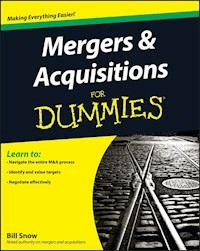
Mergers and Acquisitions For Dummies - William R. Snow - E-Book

Mergers and Acquisitions For Dummies E-Book

William R. Snow

0,0
17,99 €

oder
-100%
Sammeln Sie Punkte in unserem Gutscheinprogramm und kaufen Sie E-Books und Hörbücher mit bis zu 100% Rabatt.

Mehr erfahren.
Beschreibung

The easy way to make smart business transactions Are you a business owner, investor, venture capitalist, or member of a private equity firm looking to grow your business by getting involved in a merger with, or acquisition of, another company? Are you looking for a plain-English guide to how mergers and acquisitions can affect your investments? Look no further. Mergers & Acquisitions For Dummies explains the entire process step by step?from the different types of transactions and structures to raising funds and partnering. Plus, you'll get expert advice on identifying targets, business valuation, doing due diligence, closing the purchase agreement, and integrating new employees and new ways of doing business. * Step-by-step techniques and real-world advice for making successful mergers and acquisitions * Covers international laws and regulations * How to take advantage of high-value deals Going beyond the case studies of other books, Mergers & Acquisitions For Dummies is your one-stop reference for making business growth a success.

Sie lesen das E-Book in den Legimi-Apps auf:

Android
iOS
von Legimi
zertifizierten E-Readern

Seitenzahl: 530

Veröffentlichungsjahr: 2011

Bewertungen
0,0
0
0
0
0
0
Mehr Informationen
Mehr Informationen
Legimi prüft nicht, ob Rezensionen von Nutzern stammen, die den betreffenden Titel tatsächlich gekauft oder gelesen/gehört haben. Wir entfernen aber gefälschte Rezensionen.


Mergers & Acquisitions For Dummies®

Visit www.dummies.com/cheatsheet/mergersandacquisitions to view this book's cheat sheet.

Table of Contents

Introduction
About This Book
Conventions Used in This Book
What You’re Not to Read
Foolish Assumptions
How This Book Is Organized
Part I: Mergers & Acquisitions 101
Part II: Taking the First Steps to Buy or Sell a Company
Part III: Starting the Deal on the Right Foot
Part IV: Firming Up the Deal
Part V: Closing the Deal . . . and Beyond!
Part VI: The Part of Tens
Icons Used in This Book
Where to Go from Here
Part I: Mergers & Acquisitions 101
Chapter 1: The Building Blocks of Mergers and Acquisitions
Defining Mergers and Acquisitions
Introducing Important Terms and Phrases
Buyer
Seller
Transaction (also known as the deal)
Consideration
EBITDA
Adjusted EBITDA
Closing
Adhering to Basic M&A Rules and Decorum
Follow the steps to getting a deal done
Understand M&A etiquette
Know what to tell employees — and when
Considering the Costs Associated with M&A
Tallying advisors’ fees and other costs
Paying off debt
Post-closing adjustments
Sigh . . . talking taxes
Determining What Kind of Company You Have
Sole proprietorship
Small business
Middle market and lower middle market company
Large company (and beyond)
Chapter 2: Get ting Ready to Buy or Sell a Company
Considering Common Reasons to Sell
Retirement
Let someone else take the company to the next level
Divesting a division or product line
The industry is changing
I’ve got troubles, troubles, troubles
Selling a piece of the company
Planning Ahead to Ensure a Smooth Sale
Clean up the balance sheet
Pay off debt
Address legal issues
Trim staff and cut dead weight
Increase sales
Quantify owner’s expenses and other add backs
Owner, make thyself expendable
Exploring Typical Reasons to Acquire
Make more money
Gain access to new products and new markets
Implement vertical integration
Take advantage of economies of scale
Buy out a competitor
Prepping before an Acquisition
Determine the appropriate type of acquisition
Get your company’s balance sheet in order
Have the money lined up
Set up an acquisition chain of command
Buying a Company from a PE Firm
Understanding why PE firms sell
Evaluating a PE firm’s portfolio company
Chapter 3: Previewing the Generally Accepted M&A Process
Take Note! The M&A Process in a Nutshell
Step 1: Compile a target list
Step 2: Make contact with the targets
Step 3: Send or receive a teaser or executive summary
Step 4: Execute a confidentiality agreement
Step 5: Send or review the confidential information memorandum
Step 6: Solicit or submit an indication of interest
Step 7: Conduct management meetings
Step 8: Write or review the letter of intent
Step 9: Perform due diligence
Step 10: Draft the purchase agreement
Step 11: Show up for closing
Step 12: Deal with post-closing adjustments and integration
Exploring Two Types of M&A Processes: Auction versus Negotiation
Who Has It Easier, Buyer or Seller?
Selling is easy if you know what you’re doing
Buying is difficult even if you know what you’re doing
Following the Power Shifts in the M&A Process
Looking at the factors of motivation
Understanding who has power
Reading the other party’s situation
Maintaining as much power as possible when disclosing undesirable news
What to Tell Employees and When
Keep news of a sale process confidential
Never lie
A staggered release
Part II: Taking the First Steps to Buy or Sell a Company
Chapter 4: Financing M&A Deals
Exploring Financing Options
Buyer uses his own cash
Buyer borrows money
Buyer utilizes Other People’s Money
Buyer seeks financial help from the Seller
Understanding the Levels of Debt
Surveying senior lenders and subordinated debt
Looking at lines of credit
Taking a Closer Look at Investors
Institutions versus individuals
Private equity (PE) firm
Strategic Buyer
Striking the Right Type of Deal
Exploring the differences among buyouts and majority and minority investments
Choosing an asset or a stock deal: What’s Buyer buying?
Examining the All-Important EBITDA
Making Buyers’ Return Calculations
Return on equity
Return on investment
Internal rate of return
Financing a Problem Child
Debt is greater than purchase price
The business has operating losses
Chapter 5: With a Little Help from Your Friends: Working with M&A Advisors
Choosing Wisely: Identifying Ideal Advisors
Utilizing Inside Advisors
CFO or other financial bigwig
Corporate development people
Hiring Outside Advisors
Consulting wealth advisors when you’re ready to sell
Considering an intermediary
Lawyering up on both sides
Looking at accountants and auditors for Buyers and Sellers
I’m the tax man!
Recruiting more consultants to Buyer’s team
Seeking friendly advice: Using friends and family as informal advisors
Skipping business appraisers
Keeping Everyone on the Same Page: Avoiding Communication Breakdowns
Getting Your Banker Involved
Chapter 6: Finding and Contacting Buyers or Sellers
Creating a Target List
Getting started
Expanding and winnowing the list
Capping the list: How many (and which) companies to include
Sellers on Your Mark: Contacting Buyers
Speaking with the right person
Following a script that works
Easy Does It: Contacting Sellers
Getting the call off on the right foot
Using a successful script
You’re having a serious conversation! What now?
Additional Tips for Getting Past Screeners
Recognizing who you’re dealing with
Overcoming screener roadblocks
Tracking Your Calls
Part III: Starting the Deal on the Right Foot
Chapter 7: Assuring Confidentiality
Tempting Buyers with an Anonymous Teaser
Keeping it short and sweet
Including high-level financial info only
Touting key selling points
Executing a Confidentiality Agreement
Perusing the CA’s contents
Figuring out which party sends the CA
Determining who gets more value out of the CA
Handling a Breach of Confidentiality
Confirming a breach
Thinking long and hard about legal action
Keeping the Cat in the Bag: Advice for Buyers
Involving employees and advisors
Discussing the deal in public
Chapter 8: Creating and Reviewing an Offering Document
The Offering Document in a Nutshell
Compiling the Executive Summary
The thesis
Seller’s rationale for seeking a deal
Seller’s deal guidance
Presenting the Company’s Background
The company’s past and present
Ownership and legal entity
Employee info and benefits
Locations of offices and facilities
Real estate
Technology
Legal disclosures
Sharing the Go-to-Market Strategy
Description of market and products
Customer names
Info about competitors
Doing the Numbers
Historical financials
Financial projections
Balance sheet basics
Income statement basics
Losses on the books
Accounts receivable terms
Fixed assets (equipment)
Inventory
Intangible assets
Chapter 9: Properly Expressing Interest in Doing a Deal
Understanding the Indication of Interest
Including Key Bits of Information in an Indication of Interest
Preamble, platitudes, and Buyer background
The proposed deal: Valuation range and other considerations
The legalese
An enthusiastic send off
Chapter 10: Ensuring Successful First Meetings between Buyer and Seller
Understanding the Importance of Meeting in Person
The buyer gets to interact with key management
Both sides perform due diligence on the other
The parties gauge chemistry
Ironing Out Management Meeting Logistics
Assembling key players
Agreeing on a venue
Setting the meeting agenda
Perfecting the Seller’s Presentation
Gathering the right material
Making Seller’s presentation shine
Prepping Buyers for Management Meetings
Reading the Tea Leaves: Did the Meeting Go Well?
Part IV: Firming Up the Deal
Chapter 11: An Insider’s Guide to M&A Negotiating
Keys to Negotiating Success
Know your position
Remember the goal: Closing a deal
Negotiate with the decision-maker
Bend where you can
Take it one day at a time
Remember your ABNs: Always be negotiating
Using Successful Negotiating Tactics
Say “Here’s the deal that gets it done”
Pick up the phone
Offer a conditional if-then agreement
Understand that the first who speaks loses
Don’t be afraid to haggle
Beware of a bad bluff
Avoiding Common M&A Negotiating Mistakes
Surviving Unforeseen Twists and Turns
Getting a deal gone sideways back on track
Negotiating in good faith
Chapter 12: Crunching the Numbers: Establishing Valuation and Selling Price
What’s a Company Worth? Determining Valuation
Meeting in the Middle: Agreeing on a Price
Testing the waters
Buyers: Measure returns
Sellers: Create a compelling valuation
When Buyer and Seller Disagree: Bridging a Valuation Gap
Using an earn-out to prove valuation
Settling a valuation disagreement with a Seller note
Paying for a company with stock
Selling less than 100 percent of the company
Dealing with Renegotiation
Chapter 13: LOI and Behold: Making or Receiving an Offer
Signaling Sincerity with a Letter of Intent
Understanding the Salient Issues in the LOI
Salutation and preamble
Valuation and deal structure
Holdback and escrow
Representations and warranties
Financing
Due diligence and timing
Approvals and conditions
Role of management
Access to information
Expenses
Exclusivity
Non-disclosure and publicity
Nonbinding agreement
Governing law or jurisdiction
Agreeing to and Extending Exclusivity
Considering exclusivity in pre-emptive bids
Running out of time: Prolonging exclusivity
You Have a Signed LOI — Now What?
Chapter 14: Confirming Everything! Doing Due Diligence
Digging into the Due Diligence Process
Getting the process underway
Allowing enough time for the due diligence phase
Covering the expense
Conveying the due diligence info to Buyer
Business as usual: Running the company during due diligence
Providing Appropriate Information
Corporate info
Operations
Financials
Sales and marketing info
Real estate and facilities info
Fixed assets
Inventory
Supplier info
Intellectual property
Human resources
Debt and financial dealings
Environmental concerns
Taxes
Contract information
Insurance
Litigation history
Governmental filings
Considering Requests for Additional Information
Chapter 15: Documenting the Final Deal: The Purchase Agreement
Drafting the Deal
Writing the first draft
Redlining the initial draft
Navigating the Final Purchase Agreement
Confirm the name, rank, and serial number of the deal
Determine what’s being sold, for how much, and when
Know what to bring to the closing
Review the representations and warranties
Secure against loss with indemnifications
Agree on how to handle a rep and warranty breach
Get acquainted with the exhibits and schedules
Part V: Closing the Deal . . . and Beyond!
Chapter 16: Knowing What to Expect on Closing Day
Gathering the Necessary Parties
Walking Through the Closing Process
Reviewing the flow of funds statement
Signing the final purchase agreement and other documents
Distributing the funds: Show me the money!
Popping the champagne
Tying Up Loose Ends Shortly after Closing
Allowing time to fully close the books
Making a working capital adjustment
Chapter 17: Handling Post-Closing Announcements and Adjustments
Start Spreading the News
Telling Seller’s employees about the deal
Making a media announcement
Following Through: The Deal after the Deal
Closing the loop on post-closing adjustments
Wrapping up the contingent payments
Dealing with Disputes
Handling breaches
Making claims against escrow
Chapter 18: Come Together: Integrating Buyer and Seller
Planning the Integration
Assembling a Buyer’s transition team
Determining the level of autonomy
Covering the carve-out bases
Communicating with Seller before the close
Transition process: Planning the first 90 days
Culling Products and Services
Combining Operations, Administration, and Finance
Handling Personnel: Successful First Steps for New Owners
Addressing cultural differences
Resolving conflict
Acting like a leader at all times
Making friends
Instituting accountability
Firing people
Part VI: The Part of Tens
Chapter 19: Ten Considerations Prior to Signing an LOI
Is the Deal Too Good to Be True?
How Is the Buyer Financing the Deal?
How Much Cash Is in the Offer?
What Are the Conditions of Escrow?
Is the Deal a Stock or Asset Deal?
How Does the Deal Settle Working Capital Issues Post-Closing?
Is the Inventory 100 Percent Salable?
Who Pays Off Any Long-Term Debt and What Happens to the Line of Credit?
What Are the Tax Implications of the Seller’s Accounts Receivable?
Is the Seller Signing a Noncompete Agreement with the Buyer?
Chapter 20: Ten Major M&A Errors and How to Avoid Them
Assuming the Deal Is Done after the LOI Stage
Being Unprepared for Due Diligence
Asking for a High Valuation with No Rationale
Figuring Buyers Won’t Discover Problems in the Financials
Underestimating the Other Side’s Sophistication
Failing to Understand Who Really Has the Power
Withholding Material Information
Blabbing about the Deal Before It Closes
Calling the Seller’s Employeeswithout Permission
Contacting a Seller’s Customers or Vendors without Authorization
Chapter 21: Ten Possible Ways to Solve Valuation Differences
Payments over Time
Earn-Out Based on Revenues
Earn-Out Based on Earnings
Earn-Out Based on Gross Profit
Valuation Based on a Future Year
Partial Buyout
Stock and Stock Options
Consulting Contract
Stay Bonus
Combo Package
Appendix
Groups, associations, and networking organizations
Virtual data rooms
Periodicals
Advisors
Regulatory agencies
Online business references
Financial Buyer Indication of Interest
Strategic Buyer Indication of Interest
Corporate information
Operations
Financials
Sales and marketing info and documents
Real estate and facilities
Fixed assets
Inventory and costing
Purchasing and suppliers
Intellectual property
Human resources
Debt and financings
Environmental
Taxes
Contracts
Insurance and risk management
Litigation and contingent claims
Governmental filings and reporting
Cheat Sheet
End User License Agreement

Mergers & Acquisitions For Dummies®

by Bill Snow

Mergers & Acquisitions For Dummies®

Published byWiley Publishing, Inc.111 River St.Hoboken, NJ 07030-5774www.wiley.com

Copyright © 2011 by Wiley Publishing, Inc., Indianapolis, Indiana

Published by Wiley Publishing, Inc., Indianapolis, Indiana

Published simultaneously in Canada

No part of this publication may be reproduced, stored in a retrieval system or transmitted in any form or by any means, electronic, mechanical, photocopying, recording, scanning or otherwise, except as permitted under Sections 107 or 108 of the 1976 United States Copyright Act, without either the prior written permission of the Publisher, or authorization through payment of the appropriate per-copy fee to the Copyright Clearance Center, 222 Rosewood Drive, Danvers, MA 01923, (978) 750-8400, fax (978) 646-8600. Requests to the Publisher for permission should be addressed to the Permissions Department, John Wiley & Sons, Inc., 111 River Street, Hoboken, NJ 07030, (201) 748-6011, fax (201) 748-6008, or online at http://www.wiley.com/go/permissions.

Trademarks: Wiley, the Wiley Publishing logo, For Dummies, the Dummies Man logo, A Reference for the Rest of Us!, The Dummies Way, Dummies Daily, The Fun and Easy Way, Dummies.com, Making Everything Easier, and related trade dress are trademarks or registered trademarks of John Wiley & Sons, Inc. and/or its affiliates in the United States and other countries, and may not be used without written permission. All other trademarks are the property of their respective owners. Wiley Publishing, Inc., is not associated with any product or vendor mentioned in this book.

LIMIT OF LIABILITY/DISCLAIMER OF WARRANTY: THE PUBLISHER AND THE AUTHOR MAKE NO REPRESENTATIONS OR WARRANTIES WITH RESPECT TO THE ACCURACY OR COMPLETENESS OF THE CONTENTS OF THIS WORK AND SPECIFICALLY DISCLAIM ALL WARRANTIES, INCLUDING WITHOUT LIMITATION WARRANTIES OF FITNESS FOR A PARTICULAR PURPOSE. NO WARRANTY MAY BE CREATED OR EXTENDED BY SALES OR PROMOTIONAL MATERIALS. THE ADVICE AND STRATEGIES CONTAINED HEREIN MAY NOT BE SUITABLE FOR EVERY SITUATION. THIS WORK IS SOLD WITH THE UNDERSTANDING THAT THE PUBLISHER IS NOT ENGAGED IN RENDERING LEGAL, ACCOUNTING, OR OTHER PROFESSIONAL SERVICES. IF PROFESSIONAL ASSISTANCE IS REQUIRED, THE SERVICES OF A COMPETENT PROFESSIONAL PERSON SHOULD BE SOUGHT. NEITHER THE PUBLISHER NOR THE AUTHOR SHALL BE LIABLE FOR DAMAGES ARISING HEREFROM. THE FACT THAT AN ORGANIZATION OR WEBSITE IS REFERRED TO IN THIS WORK AS A CITATION AND/OR A POTENTIAL SOURCE OF FURTHER INFORMATION DOES NOT MEAN THAT THE AUTHOR OR THE PUBLISHER ENDORSES THE INFORMATION THE ORGANIZATION OR WEBSITE MAY PROVIDE OR RECOMMENDATIONS IT MAY MAKE. FURTHER, READERS SHOULD BE AWARE THAT INTERNET WEBSITES LISTED IN THIS WORK MAY HAVE CHANGED OR DISAPPEARED BETWEEN WHEN THIS WORK WAS WRITTEN AND WHEN IT IS READ.

For general information on our other products and services, please contact our Customer Care Department within the U.S. at 877-762-2974, outside the U.S. at 317-572-3993, or fax 317-572-4002.

For technical support, please visit www.wiley.com/techsupport.

Wiley also publishes its books in a variety of electronic formats. Some content that appears in print may not be available in electronic books.

Library of Congress Control Number: 2011926316

ISBN: 978-0-470-38556-2

Manufactured in the United States of America

10 9 8 7 6 5 4 3 2 1

About the Author

Bill Snow is an experienced M&A professional. He advises business owners in the sale of their companies or the acquisition of other companies. He’s the one who contacts the buyers and sellers, negotiates and structures deals, oversees the due diligence, works with the attorneys to draft the purchase agreement, and ultimately gets the deal across the finish line.

Companies that Bill has advised include (but aren’t limited to) businesses in marketing services, food processing equipment, drink dispensing equipment, guarding, cleaning, staffing, distribution, data marketing, wastewater services, telecommunications, and systems integrators.

Bill has written articles for numerous online sources and self-published a book about venture capital called Venture Capital 101. He has been involved with World Business Chicago, the Chicagoland Chamber of Commerce, the Chicagoland Entrepreneurial Center, the Technology Executive’s Club, the Midwest Entrepreneur’s Forum, and DePaul University’s PEN Symposium. He also hosts occasional networking events.

He has an MBA and a BS in finance, both from DePaul University, and he’s a registered limited representative (FINRA series 63 and 79). You can find out more about Bill at his Web site, www.billsnow.com.

Dedication

To business owners and executives who are thinking about buying or selling a company.

Author’s Acknowledgments

The genesis of this book goes back to my humble little attempt at some creative writing. Little did the subjects of those silly newsletters know that I had ulterior motives for documenting (and, uh, embellishing) those crazy years in our 20s. Sure, our little newsletter contained some funny bits, but truth to tell, I was writing it to hone my technical writing skills and to foster my creative abilities. Seriously. And you thought it was all about you!

So a big thank you to a cast of characters that include Ebbitt and that fine woman Clare, Little Lisa, Big Steve, Stevie V, Johnny V, Mariola, Jason S, Jason T, Joe, Carrie, Rogie, Rainbow, Jen, Tony, the Dold Boys and everyone at the Dold Family Compound, the brood of ungrateful Kemps (Tim, Kelly, Kerry, Karla, and Loren), and the unknowing and unwitting, creative-juice-generating granddaddy of ’em all . . . our Romanian pal Mark. I am grateful for your youthful antics, and more important, I am grateful for your continued friendship. Well, those of you who still speak to me.

A huge thanks to my mother and father, Carol and Bill Snow. I will never be able to repay you both for all that you have done for me over the years. When I find a T-shirt that reads, “We gave our kids everything and all we got was a lousy mention in a book,” I’ll send one to each of you. And to my sister, Laura, the first in the family to get a PhD. You made it so much easier for me to pursue this book venture: Now I can be the first in the family with a published book. You also said I was a perfect choice to write a For Dummies book, “’cause they’re snarky.” Though I’ll have you know, Ms. PhD smarty-pants, that For Dummies books are actually irreverent.

I’d like to thank Bob Kinsella, Bob Stutz, Louis Krzys, and Chuck Weikel from Kinsella Group, Inc., for their extremely valuable input about deal-making. I also owe a debt of gratitude to Justin Kaplan of BNY-Melon; Mark Powers of Mark Powers, PC; Keith Berk of Horwood Marcus & Berk; and Brian Krob of Ungaretti & Harris for their insights about M&A transactions.

I am greatly appreciative to Wiley Publishing for backing me in this attempt at being a “wise old sage” for others. I am thankful that my little treatise on venture capital somehow found its way to Michael Lewis’s desk at Wiley in New Jersey. Thank you for getting the green light, and thank you, Internet; without you I never would have gotten the chance to write this book. And to my project editor, Alissa Schwipps, thank you for your sage advice and assistance. I was listening!

Lastly, to my long-lost dog park friend . . . safe travels.

Publisher’s Acknowledgments

We’re proud of this book; please send us your comments at http://dummies.custhelp.com. For other comments, please contact our Customer Care Department within the U.S. at 877-762-2974, outside the U.S. at 317-572-3993, or fax 317-572-4002.

Some of the people who helped bring this book to market include the following:

Acquisitions, Editorial, and Media Development

Senior Project Editor: Alissa Schwipps

Acquisitions Editor: Michael Lewis

Copy Editor: Megan Knoll

Assistant Editor: David Lutton

Technical Editor: Joelle Marquis

Senior Editorial Manager: Jennifer Ehrlich

Editorial Assistant: Rachelle Amick

Cover Photo: © Getty Images/Rick Elkins

Cartoons: Rich Tennant (www.the5thwave.com)

Composition Services

Project Coordinator: Sheree Montgomery

Layout and Graphics: Joyce Haughey, Corrie Socolovitch

Proofreaders: Melissa Cossell, Melissa D. Buddendeck

Indexer: BIM Indexing & Proofreading Services

Special Help: Todd Lothery

Publishing and Editorial for Consumer Dummies

Diane Graves Steele, Vice President and Publisher, Consumer Dummies

Kristin Ferguson-Wagstaffe, Product Development Director, Consumer Dummies

Ensley Eikenburg, Associate Publisher, Travel

Kelly Regan, Editorial Director, Travel

Publishing for Technology Dummies

Andy Cummings, Vice President and Publisher, Dummies Technology/General User

Composition Services

Debbie Stailey, Director of Composition Services

Introduction

In every job — whether it be sales, managing retail establishments, raising capital, crunching numbers, writing, working with venture capitalists, creating online ventures, or working investment banking deals (I’ve done all these, by the way) — you quickly discover that you need a whole new set of rules, lingo, conventions, and nomenclature. And more often than not, what you need to know to excel at your job can be distilled into just a few salient points. If you’re lucky, you bump into a wise old sage who, upon experiencing your questioning, utterly confused face, and dispirited body language, simply says, “Forget all that other stuff; here’s what you really need to know.” Enter Mergers & Acquisitions For Dummies, an inside look at the process of buying and selling companies.

Although companies change hands every day, buying and selling can mean many things and take many forms. Who or what is the Buyer or Seller? What kind of transaction is it? How will the Buyer finance the deal, and what does the Seller receive? These are only a few of the considerations in any given mergers and acquisitions (M&A) deal. It’s so confusing!

As a result, business owners, some of the main participants in M&A, are often completely befuddled when the time comes to sell their businesses or make acquisitions. They don’t know anything about M&A because they’ve been focused on their own businesses and not on the business of buying and selling companies.

Lesen Sie weiter in der vollständigen Ausgabe!

Lesen Sie weiter in der vollständigen Ausgabe!

Lesen Sie weiter in der vollständigen Ausgabe!

Lesen Sie weiter in der vollständigen Ausgabe!

Lesen Sie weiter in der vollständigen Ausgabe!

Lesen Sie weiter in der vollständigen Ausgabe!

Lesen Sie weiter in der vollständigen Ausgabe!

Lesen Sie weiter in der vollständigen Ausgabe!

Lesen Sie weiter in der vollständigen Ausgabe!

Lesen Sie weiter in der vollständigen Ausgabe!

Lesen Sie weiter in der vollständigen Ausgabe!

Lesen Sie weiter in der vollständigen Ausgabe!

Lesen Sie weiter in der vollständigen Ausgabe!

Lesen Sie weiter in der vollständigen Ausgabe!

Lesen Sie weiter in der vollständigen Ausgabe!

Lesen Sie weiter in der vollständigen Ausgabe!

Lesen Sie weiter in der vollständigen Ausgabe!

Lesen Sie weiter in der vollständigen Ausgabe!

Lesen Sie weiter in der vollständigen Ausgabe!

Lesen Sie weiter in der vollständigen Ausgabe!

Lesen Sie weiter in der vollständigen Ausgabe!

Lesen Sie weiter in der vollständigen Ausgabe!

Lesen Sie weiter in der vollständigen Ausgabe!

Lesen Sie weiter in der vollständigen Ausgabe!

Lesen Sie weiter in der vollständigen Ausgabe!

Lesen Sie weiter in der vollständigen Ausgabe!

Lesen Sie weiter in der vollständigen Ausgabe!

Lesen Sie weiter in der vollständigen Ausgabe!

Lesen Sie weiter in der vollständigen Ausgabe!

Lesen Sie weiter in der vollständigen Ausgabe!











