


8,49 €
Mehr erfahren.
- Herausgeber: The History Press
- Kategorie: Geisteswissenschaft
- Sprache: Englisch
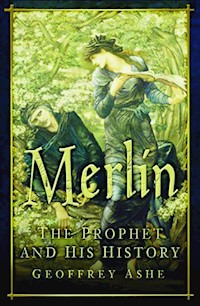
Geoffrey Ashe's book on this legendary figure offers a succession of surprises. The Merlin of legend was born to be a magician. He was 'immaculately' conceived and was able to interpret dreams and utter prophecies. Even his fate was imbued with magic. Like Arthur, he acquired immortality and sleeps on Bardsey Island, in a subterranean chamber with nine companions. Ashe reveals the man behind the myth, establishing beyond doubt the historicity of a Welsh prophet called Myrddin Emrys. Despite his 'supernatural' status it is Merlin, of all the great characters of the Arthurian world, who has the strongest claim to have existed.
Das E-Book können Sie in Legimi-Apps oder einer beliebigen App lesen, die das folgende Format unterstützen:
Veröffentlichungsjahr: 2011
Ähnliche




















Merlin
Merlin
THE PROPHET AND HIS HISTORY
GEOFFREY ASHE
Has it ever struck you what an odd creation Merlin is?
He’s not evil; yet he’s a magician.
He is obviously a druid; yet he knows all about the Grail.
He’s ‘the devil’s son’; but then Layamon goes out of his way to tell you that the kind of being who fathered Merlin needn’t have been bad after all. . . .
‘I often wonder,’ said Dr. Dimble, ‘whether Merlin doesn’t represent the last trace of something the later tradition has quite forgotten about.’
C.S. Lewis, That Hideous Strength, in The Cosmic Trilogy (London: Macmillan, 1989), p. 375
First published 2006
This edition published 2008
The History Press
The Mill, Brimscombe Port
Stroud, Gloucestershire, GL5 2QG
www.thehistorypress.co.uk
This ebook edition first published in 2011
All rights reserved
© Geoffrey Ashe, 2006, 2008, 2011
The right of Geoffrey Ashe, to be identified as the Author of this work has been asserted in accordance with the Copyrights, Designs and Patents Act 1988.
This ebook is copyright material and must not be copied, reproduced, transferred, distributed, leased, licensed or publicly performed or used in any way except as specifically permitted in writing by the publishers, as allowed under the terms and conditions under which it was purchased or as strictly permitted by applicable copyright law. Any unauthorised distribution or use of this text may be a direct infringement of the author’s and publisher’s rights, and those responsible may be liable in law accordingly.
EPUB ISBN 978 0 7524 7542 4
MOBI ISBN 978 0 7524 7541 7
Original typesetting by The History Press
Contents
Acknowledgements
Introduction
1. The Fatherless Boy
2. Prophecy Transformed
3. Stonehenge and Tintagel
4. King Arthur
5. How Many Merlins?
6. A British God
7. Merlin and the Grail
8. Spenser’s Myth
9. Shakespeare and Others
10. Magic, Monarchy and Morals
11. The Merlin Tradition at Home and Overseas
12. The New Matter of Britain
Epilogue: Merlin’s Island
Appendix: The Continuing Encounter
Bibliography
Acknowledgements
Merlin reflects many years of reading, travel, and discussion, involving obligations to more people than could ever be recalled individually. A few Outstandingly valued contacts are mentioned in the text.
But I am happy to repeat a richly deserved tribute in a previous book. My supreme and special thanks are due to my wife Patricia, who made a truly extraordinary contribution by taking on massive tasks of transcription, revision, inquiry, and compilation. These things were done in an exemplary style and with an outpouring of enthusiasm that cannot be too highly praised.
I must record specific thanks for permission to use copyright material from the works designated:
The History of the Kings of Britain by Geoffrey of Monmouth, translated by Lewis Thorpe. Penguin Classics, 1966. Permission for use of extracts granted by Penguin Books Ltd.
The Once and Future King by T.H. White. Published by HarperCollins; originally, by Collins, 1958. Permission for use of extracts granted by David Higham Associates Limited.
That Hideous Strength by C.S. Lewis, copyright © C.S. Lewis Pte. Ltd. 1945. Extract reprinted by permission.
Introduction
Merlin is an enigma. He is one of the strangest characters in legend and literature, and all the more enigmatic because there is nobody else like him, no basis for comparison or classification. He changes shape and he darts about. The obvious thing to say, the starting-point for any discussion, is that he is King Arthur’s court wizard. But that is no more than the beginning of an account of him, and even the story of his association with Arthur, at least in its most familiar form, is briefer than anyone would suppose without actually looking it up.
Yet for someone so elusive, he has had an extraordinary impact. In the Middle Ages and long afterwards, almost everyone who knew about him at all believed that he was a real person and had lived in the fifth century. That was the case not only in England. His fame was international. Copies of prophecies he was said to have uttered on a hill in Wales were passed around and interpreted. French commentators tried to fit them to facts and show that they had been fulfilled; Italians had the audacity to put him on a level with biblical prophets, such as Isaiah. Actually, no one understood the alleged prophecies, and it is an open question whether there was much to understand. Yet they revolutionised thinking about prophecy in general, giving it a new kind of status, and the revolution continued. Without Merlin’s lingering presence in European imagination, there would very likely have been no Nostradamus.
People believed something else about Merlin: he was a magician as well as a prophet. They were less interested in him in that capacity. His most notorious feat of magic, at Tintagel in Cornwall, verged on the ludicrous. Yet by common consent it had laid the foundation of a glorious age in British tradition, the age of King Arthur. It was Merlin who had the Round Table made for him; it was Merlin who obtained the wonderful sword Excalibur. Plantagenet and Tudor sovereigns took this Merlin-sponsored Utopia seriously, and sometimes entertained notions of reviving it. Merlin’s presence still lingered in the England of Elizabeth I. It has resurfaced at intervals ever since, with or without literal belief, to inspire poems, novels and films.
Was he real? And why the persistent fascination, even in an age that often reduces him to a semi-comic old gentleman with a long beard and a pointed hat? We can look for him, of course. We can search in a famous book that looks like history... but unfortunately it isn’t. We can trace him in medieval fantasies of love and adventure... but their authors were not much concerned with facts. Different theories have made him a god or a lunatic, or a fabrication of Welsh propaganda.
The Merlin-seeker must face an issue that applies to Arthur himself. It is no use asking the direct question, ‘Did King Arthur exist?’ There is no way of cutting through the entanglements of legend so as to arrive at a plain yes-or-no answer. We can ask, ‘How did the legend originate, and what facts is it rooted in?’ That question can be answered, at least to some extent. The investigation may or may not point to a real person behind the legend. The same question can be asked about Merlin. An answer is possible, and that answer can do something to explain his uniqueness, his persistent reputation, and his paradoxical spell – whatever it may say about him as a figure in history. We can go on from there, and follow his multiple manifestations through the centuries. Whether the result counts as biography, or at least has biography in it, I leave to the persevering reader.
1
The Fatherless Boy
Merlin makes his first appearance by name in a work called The History of the Kings of Britain. Published in 1138, or thereabouts, this was one of the most influential books of the Middle Ages. It created a framework for a whole body of memorable literature. It established images of the British past throughout western Europe, images that have never quite been eradicated. Yet it was not, as it professed to be, a history of the kings of Britain – not really.
Its author, who introduced Merlin to the public, is known as Geoffrey of Monmouth after a town on the south-east fringe of Wales, perhaps his family home. A genius in his own very peculiar way, Geoffrey is elusive. He was probably Welsh; he was a cleric certainly, a teacher very likely. At Oxford from 1129 to 1151, he was probably attached to a school, though the university did not exist yet. Moving to London, he was made Bishop of St Asaph in Wales. It is not clear whether he ever took up the appointment. He died in or about 1155.
Biographically, hardly anything more is known about him. But his lifelong concern is very well known indeed. The term ‘patriotic’ might be applied here, though patriotism in the modern sense hardly existed then. Geoffrey never forgot that the harassed Welsh of his day were descendants of the Celtic Britons, who once populated the whole of this island. They had been dispossessed and subordinated by Anglo-Saxons, the ancestors of the English, so that most of the Britons’ territory had become ‘England’, and nothing was left of the rich Celtic inheritance but Wales – geographical Wales. Geoffrey and others believed, nevertheless, that the ancestral Britons had been a great people, with wise and powerful rulers, among whom the renowned King Arthur was supreme.
Geoffrey formed the project of writing the history of these kings, forcing recognition of their importance on a world that seemed ignorant of them. He knew traditions, legends, poems, genealogies. But his researches revealed very little in writing. He studied what was available: a tract by a sixth-century Briton, Gildas, who took up more space with abuse of other Britons than with records of fact; the unrivalled historical work of Bede in the eighth century, although Bede was interested in Anglo-Saxons and hardly at all in British kings; and a chaotic and amateurish ‘British history’ attributed to the Welsh monk Nennius in the ninth century. But these books did not go far towards supplying what he needed. Then, he tells us, the project was transformed:
At a time when I was giving a good deal of attention to such matters, Walter, Archdeacon of Oxford... presented me with a certain very ancient book written in the British language. This book, attractively composed to form a consecutive and orderly narrative, set out all the deeds of these men.... At Walter’s request I have taken the trouble to translate the book into Latin.
Archdeacon Walter lived in Oxford, and documents signed by both men show that Geoffrey knew him. The book, which might have been in Welsh or the related Breton language, is more of a problem. No one else ever seems to have seen it, and Geoffrey’s final production is plainly more than a mere translation. There are clues suggesting that the ‘British book’ was not a total invention, as has often been claimed. But even if it existed in some form, The History of the Kings of Britain is certainly far longer, and covers far more ground, than the ‘ancient book’ could have done. Essentially it is Geoffrey’s work and no one else’s, and that includes the account of Merlin embedded in it.
Geoffrey begins by adopting and expanding an old notion about the origin of the Britons. Learned Welshmen knew the Romans’ tradition about their ancestry, and tried to carry it further for the greater glory of their own ancestors. When Troy fell, one of its princes, Aeneas, reputedly escaped with a party of fugitives. Divinely guided, these Trojans made their way to Italy and settled there, and the main Roman stock was descended from them. This belief was rendered by Virgil into epic poetry, which put the Romans in historic company.
Welshmen developed a version of their own people’s descent that was, in effect, a sequel to Virgil, though without the poetry. Geoffrey embellishes it with family details. Aeneas had a great-grandson, Brutus, who migrated to Greece, liberated some Trojans descended from prisoners-of-war, and led the whole party overseas to the west. After two days’ sail they landed on a deserted island and found a temple of Diana. Brutus prayed to her to tell him where the expedition should go. He slept in front of her altar, and she appeared to him, saying (in verse):
Brutus, beyond the setting of the sun, past the realm of Gaul, there lies an island in the sea, once occupied by giants. Now it is empty and ready for your folk.... For your descendants it will be a second Troy. A race of kings will be born there from your stock and the round circle of the whole earth will be subject to them.
Geoffrey seems to have pictured Diana in pre-Christian terms, as a real being, a goddess, however Christianity may have demoted her since.
The party sailed on, collecting more of the scattered Trojan remnant, and landed at last at Totnes in Devon. (According to a local legend inspired by Geoffrey but not actually in his book, Brutus stepped ashore on a rock and announced:
Here I am and here I rest,
And this town shall be called Totnes.
That, at least, is an English version of what he said. The rock is the Brutus Stone, now near the East Gate. It may really be a medieval boundary marker.) The island where the party had landed was then called Albion. With a slight vowel modification, Brutus renamed it ‘Britain’ after himself, and called his Trojan companions Britons. Diana had not been quite accurate about the giants. There were still a few, mostly in Cornwall, but after a skirmish the survivors disappeared into the mountains and died out.
Meanwhile the Trojans, or rather Britons, acknowledged Brutus as their first king, divided up the land, and built a capital city beside the Thames, called Troia Nova or New Troy. It was afterwards called London. (Another offshoot: London Stone in Cannon Street was an altar set up by Brutus in honour of Diana, the goddess who had guided him. So long as the stone of Brutus is safe, so long shall London flourish.)
Geoffrey then proceeds with his line of kings, seventy-five of them. Some are totally fictitious. Some have names borrowed from Welsh genealogies, names of men who lived long afterwards, but applied here to the successors of Brutus. Other kings are taken from myths and folktales. But some are interesting and, in their way, worth meeting. The reader learns about Bladud in the ninth century BC, who discovered the hot springs at Bath, experimented with magic, flew over New Troy on home-made wings, and crashed on the temple of Apollo. His son Leir had trouble with his three daughters, and was to be remodelled millennia later as Shakespeare’s King Lear. Geoffrey supplies what Shakespeare does not, an approximate date. He also, unintentionally, suggests a riddle: What relation was King Lear to Aeneas? It sounds like a nonsense question, yet an answer can be worked out from the History: he was Aeneas’s great-great-great-great-great-great-great-great-grandson. Two brothers, Belinus and Brennius, ruled as joint sovereigns, led an expedition to Italy and captured Rome. This exploit sets a precedent to be invoked by King Arthur later in the History. A queen, Marcia, promulgated a code of laws which – another surprising piece of information – was eventually adopted by Alfred the Great. King Lud reconstructed New Troy, and it became Lud’s City and presently London. His name survived in one of the city’s entrances, and still does – Ludgate.
When the History reached the point where Britain was drawn into the Roman orbit, Geoffrey had to curb his inventiveness. Caesar’s expeditions, Claudius’s invasion and all the things that resulted from them were on record and could not be ignored. He managed to cope with them, acknowledging real history, but rewriting it freely. After Caesar he still can never be trusted for facts, but he uses facts, or what he would like to think are facts, somewhat more; it can be quite interesting to find where he got them from. He glosses over the conquest; his line of British kings continues; Britain pays tribute to Rome, but as a protectorate rather than a province. Some of its rulers, even emperors, are made out to have been Britons or semi-Britons or Britons-by-marriage. Britons colonise the north-west part of Gaul, Armorica, and turn it into Brittany, a kingdom in its own right.
No one today would defend Geoffrey’s account of Britain as more or less autonomous through the Roman period. Yet, by contrast with many accounts, it has a sort of ghostly rightness. During the heyday of the British Empire, imperially conditioned historians treated the Romans in Britain as if they were the only real people there, and dismissed the majority as anonymous ‘natives’. There is more willingness now to see the native culture as continuing, and preserving some of its character. The Roman regime had a tremendous impact and Romanised the higher levels of British society, but Britain was not extinguished and native cultural elements resurfaced later in art and literature.
About the year 410 Britain ceased to be part of the Roman Empire. And here Geoffrey, following the course of events in his own way, moves into the climactic phase of his History. He confronts the supreme traumatic disaster of Welsh tradition: the transformation of Celtic Britain, or most of it, into England – Angle-land, the domain of the Anglo-Saxons.
This began to happen in the fifth century, but the actual process is still a matter of dispute. Historians – including, unfortunately, authors of schoolbooks – used to picture an invincible Germanic horde pouring in across the North Sea, slaughtering the effete British natives, and driving the panic-stricken remnant into Wales and Cornwall, all within a generation or so. The extraordinary thing about this nonsense is its persistence, even though the Anglo-Saxons’ own Chronicle disproves it.
In the early aftermath of the break with Rome, the Britons seem to have maintained something like the Roman system, though regional ‘strong men’ were soon making themselves felt. However, the island was beset by raiding barbarians – the Irish in the west, Picts in the north, Angles and Saxons in the east – and, after many years of being weaponless by Roman decree, it lacked the military resources to fight them all. A governing council, presided over by a sort of high king called Vortigern (this means ‘over-chief’ and may be a title rather than a name), allowed Angles, Saxons, Jutes and associated tribes to settle in the country as auxiliaries or ‘federates’, who were allotted land and supplies in return for keeping order and repelling other barbarians.
Many more followed the first groups. The Britons could not keep all of them supplied, and a revolt followed, with widespread raiding and possibly unauthorised land-taking. Under new leadership the Britons at last recovered, and partially stabilised the situation. They still vastly outnumbered their tormentors. (Since the question is inevitable, it may be said here that the legend of Arthur is rooted in this period of revival.) During the sixth century the balance of population shifted in favour of the new people. They multiplied; they encroached further. The formation of regional Anglo-Saxon kingdoms and their eventual coalescence into ‘England’ proceeded, but it took centuries.
The Welsh, though they too split into small kingdoms, retained their independence. They cherished traditions of the catastrophe and the brief heroic age that supposedly followed. Vortigern became an arch-villain, and the people whom he iniquitously welcomed became, simply, Saxons. Whether or not Geoffrey had an ‘ancient book’, he certainly read authors who gave him information about the disaster – the aforesaid Gildas, Bede and Nennius – and his dramatic fictionalisation was accepted as history through most of the Middle Ages. There was nothing to refute it.
His version begins in the chaos of the early fifth century. He tells his readers that the Archbishop of London, aware that the Little Britain in Armorica was in a sounder condition than the island, crossed the Channel and urged the Breton king, Aldroenus, to take charge of the parent country. The king’s brother Constantine sailed over with two thousand soldiers and landed at Totnes, like Brutus and other characters in the History. He enlarged his force by enrolling Britons on the spot, and dispersed the barbarian marauders. An assembly at Silchester, a Roman town, made Constantine king. He had three sons: Constans, who entered a monastery; Aurelius Ambrosius; and Uther. Constantine and his elder sons are historical figures, reshaped by Geoffrey in his own style. He plants Uther to be the father of Arthur.
Constantine reigned in peace for ten years. But the defeated Picts became dangerous again because they had a secret ally at the British court, Vortigern the Thin (here he is), the unscrupulous overlord of the Gewissei in south-east Wales. Perhaps with his connivance, a Pict assassinated Constantine. Vortigern exploited the murder. He persuaded Constantine’s eldest son, the monk Constans, to leave his monastery and assume the kingship as the legitimate heir. Constans was entirely unfitted to the role, and became a puppet in Vortigern’s hands. The plotter then installed friends of his own in key positions. He recruited a hundred Picts as his bodyguard and bribed them to clamour for his own coronation. They killed Constans, and Vortigern took the crown. Constans’s brother Aurelius should have reigned, with Uther next in line, but both the princes were young and in the care of a guardian, who hurried them off to Brittany out of Vortigern’s reach. The usurper knew that they would soon be old enough to return to Britain. Like Macbeth, he could never feel secure while a potential challenger lived, let alone two of them. His scheming had made enemies, and the princes would certainly find support.
In the fourth year of Vortigern’s reign, while he was visiting Canterbury, three foreign longships landed on the Kentish coast. The newcomers were Saxon exiles, led by two brothers, Hengist and Horsa. They asked to be taken to the king, and offered him their services. He was impressed by their stature and martial bearing. Although he regretted their paganism (they explained that they worshipped Woden and Freia), he accepted them as auxiliaries and allotted lands in Thanet and Lincolnshire for them and their followers.
Hengist, at first, kept his side of the bargain and fought the barbarians who were harassing Britain again. But he was more astute than Vortigern, and realised that the king’s weaknesses and apprehensions could be manipulated. With Vortigern’s approval, he imported more Saxons from the continent. As soon as they were safely in Britain, he held a banquet at which his beautiful daughter Renwein was present. She handed Vortigern a goblet of wine, saying ‘Was hail!’ Prompted by his interpreter, he gave the correct response, ‘Drinc hail!’ His first wife, by whom he had adult sons, was dead, and Renwein’s father perceived that he was ripe for an elderly infatuation. Hengist offered him her hand in marriage in return for more territory. Vortigern duly handed over the whole of Kent, without even informing its regional ruler. Saxons were now flooding into the country, not simply as auxiliaries but as settlers, bringing wives and families. Vortigern fell more and more under Hengist’s control. Many of his subjects were turning against him, as a friend of the heathen foreigners, who were already having sexual relations with British women.
The king’s eldest son, Vortimer, was horrified by all these developments, not least by his father’s Saxon marriage. He rebelled, and allowed fellow-rebels to make him a rival sovereign. At the head of his supporters he won four battles. The Saxon warriors fled to their ships and put to sea, though they left their families behind, indicating that they had no serious intention of going for good. Vortimer’s stepmother Renwein poisoned him (a Saxon atrocity which Geoffrey introduces too often, in order to get a character off the stage). As he lay dying, Vortimer asked his followers to build a pyramid at the place where the Saxons usually landed, and place his body on top. Superstitious dread of the man who had beaten them might cause them to hesitate. However, his wish was not carried out and he was buried in London.
Hengist’s horde reassembled, stronger than ever. Talking of a new treaty, he invited Vortigern and his nobles to a peace conference near Amesbury. The Britons, somewhat naively, trusted him and arrived unarmed. The Saxons hid daggers in their boots and, at a signal from Hengist, killed more than three hundred of the nobles, whose bodies were dumped in a mass grave on Salisbury Plain. Hengist threatened the king himself and extorted more territory. The Saxons seized London, York, Lincoln and Winchester, and roamed about the country at will, wrecking and pillaging.
Vortigern, driven to desperation, consulted soothsayers – by courtesy, magicians. They advised him to give up the attempt to control his kingdom, and instead to build himself an impregnable stronghold in some remote place, where he could at least survive. After considering several possible sites, he tried Snowdonia and picked out the hill-fort now known as Dinas Emrys.
Dinas Emrys is in the valley of Nant Gwynant near Beddgelert, and 3 miles south of Snowdon. The fort is on a rocky height, a little apart from neighbouring hills. Its ramparts defend a fairly level summit enclosure, about 800 by 500 feet. The original entrance is on the west, where it is possible to climb to the plateau through three lines of earthworks, but access is easier – though not much – on the east; here, a footpath of sorts runs along a ridge.
Vortigern brought his counsellors and magicians to the chosen site, and gathered masons and other skilled workers from different parts of the country, together with stones and timber as building materials. It must be supposed that in those days there was some way of getting such materials up the hill. The logistic problem was solved, the problem of construction was not. Vortigern ordered his team to build a tower for him. They laid the foundations, and then laid them again, but after several days they had achieved nothing. Every time the base of the tower began to take shape, it fell to pieces, and all the materials vanished into the earth. Since the professionals could offer no explanation, Vortigern consulted his magicians again.
But then something totally unexpected happened....
While Geoffrey was spinning pseudo-history out of unpromising matter, he was also taking an interest in prophecy – specifically, Welsh prophecy. In his time the Welsh were unique among western nations in having a lively prophetic tradition, not necessarily of prophecy as prediction, but of prophecy as inspired utterance, which might or might not be predictive. It had a recognised kinship with the poetic inspiration of bards, called awen. Men and women who had the gift went into trances and poured out oracular sayings. These might be simply responses to inquirers, making the activity a kind of fortune-telling, but sometimes they did foreshadow the future, even the political future. Occasionally such prophecies, however cryptic, were remembered and recorded.
A famous poem composed about 930, and preserved in writing, treated this public prophecy with special respect. Called Armes Prydein, ‘The Omen of Britain’, it put together various hopeful forecasts of English decline and British recovery. In the upshot it turned out to be too optimistic. When it came to an actual battle, the English king Athelstan routed the Welsh and their allies. But it could always be taken up again, and reinterpreted.
Geoffrey read ‘The Omen of Britain’ and noted that one of its prophecies was attributed to someone called Myrddin, who plainly had a long-standing reputation. There was nothing in the poem to show who Myrddin was, but he was understood to have lived several centuries before. Other prophecies, mostly obscure or fragmentary, also had his name attached to them. Geoffrey made a collection of Myrddin material, with prophetic items from other sources. Setting the History aside for a while, he combined his collection with a large body of ‘prophecy’ that he made up himself, and gave the result to the public in 1135.
In the course of doing so, he took a momentous step. He realised that ‘Myrddin’ would be rendered ‘Merdinus’ in Latin, which for many prospective Norman-French readers would suggest merde, a dirty word. So he changed ‘Myrddin’ to ‘Merlin’. In this almost accidental way, a new name entered literature, one that was destined to have an impact that neither Geoffrey nor anybody else could have anticipated.




