


143,99 €
Mehr erfahren.
- Herausgeber: John Wiley & Sons
- Kategorie: Fachliteratur
- Sprache: Englisch
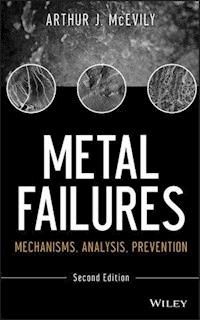
One of the only texts available to cover not only how failure occurs but also examine methods developed to expose the reasons for failure, Metal Failures has long been considered the most definitive and authoritative resources in metallurgical failure analysis. Now in a completely revised edition, this Second Edition features updates of all chapters plus new coverage of elastic behavior and plastic deformation, localized necking, the phenomenological aspects of fatigue, fatigue crack propagation, alloys and coatings, tensors and tensor notations, and much more.
Sie lesen das E-Book in den Legimi-Apps auf:
Seitenzahl: 660
Veröffentlichungsjahr: 2013
Ähnliche



















Table of Contents
Title Page
Copyright
Dedication
Preface
Chapter 1: Failure Analysis
I. Introduction
II. Examples of Case Studies Involving Structural Failures
III. Summary
References
Problems
Chapter 2: Elements of Elastic Deformation
I. Introduction
II. Stress
III. Strain
IV. Elastic Constitutive Relationships
V. State of Stress Ahead of a Notch
VI. Summary
References
Appendix 2-1: Mohr Circle Equations for a Plane Problem (1)
Appendix 2-2 Three-Dimensional Stress Analysis
Appendix 2-3: Stress Formulas Under Simple Loading Conditions
Problems
Chapter 3: Elements of Plastic Deformation
I. Introduction
II. Theoretical Shear Strength
III. Dislocations
IV. Yield Criteria for Multiaxial Stress
V. State of Stress in the Plastic Zone Ahead of a Notch in Plane-Strain Deformation
VI. Summary
For Further Reading
Appendix 3-1: The von Mises Yield Criterion
Problems
Chapter 4: Elements of Fracture Mechanics
I. Introduction
II. Griffith's Analysis of the Critical Stress for Brittle Fracture
III. Alternative Derivation of the Griffith Equation
IV. Orowan-Irwin Modification of the Griffith Equation
V. Stress Intensity Factors
VI. The Three Loading Modes
VII. Determination of the Plastic Zone Size
VIII. Effect of Thickness on Fracture Toughness
IX. The R-Curve
X. Short Crack Limitation
XI. Case Studies
XII. The Plane-Strain Crack Arrest Fracture Toughness, KIa, of Ferritic Steels
XIII. Elastic-plastic Fracture Mechanics
XIV. Failure Assessment Diagrams
XV. Summary
References
Problems
Chapter 5: Alloys and Coatings
I. Introduction
II. Alloying Elements
III. Periodic Table
IV. Phase Diagrams
V. Coatings (9)
VI. Summary
References
Problems
Chapter 6: Examination and Reporting Procedures
I. Introduction
II. Tools for Examinations in the Field
III. Preparation of Fracture Surfaces for Examination
IV. Visual Examination
V. Case Study: Failure of a Steering Column Component
VI. Optical Examination
VII. Case Study: Failure of a Helicopter Tail Rotor
VIII. The Transmission Electron Microscope (TEM)
IX. The Scanning Electron Microscope (SEM)
X. Replicas
XI. Spectrographic and Other Types of Chemical Analysis
XII. Case Study: Failure of a Zinc Die Casting
XIII. Specialized Analytical Techniques
XIV. Stress Measurement by X-Rays (4)
XV. Case Study: Residual Stress in a Train Wheel
XVI. The Technical Report
XVII. Record Keeping and Testimony
XVIII. Summary
References
Problem
Chapter 7: Brittle and Ductile Fractures
I. Introduction
II. Brittle Fracture
III. Some Examples of Brittle Fracture in Steel
IV. Ductile-Brittle Behavior of Steel
V. Case Study: The Nuclear Pressure Vessel Design Code
VI. Case Study: Examination of Samples from the Royal Mail Ship (RMS) Titanic (6)
VII. Ductile Fracture
VIII. Ductile Tensile Failure, Necking
IX. Fractographic Features Associated with Ductile Rupture
X. Failure in Torsion
XI. Case Study: Failure of a Helicopter Bolt (12)
XII. Summary
References
Problems
Chapter 8: Thermal and Residual Stresses
I. Introduction
II. Thermal Stresses, Thermal Strain, and Thermal Shock
III. Residual Stresses Caused by Nonuniform Plastic Deformation
IV. Residual Stresses Due to Quenching
V. Residual Stress Toughening
VI. Residual Stresses Resulting from Carburizing, Nitriding, and Induction Hardening
VII. Residual Stresses Developed in Welding
VIII. Measurement of Residual Stresses
IX. Summary
References
Appendix 8-1: Case Study of a Fracture Due to Thermal Stress
Problems
Chapter 9: Creep
I. Introduction
II. Background
III. Characteristics of Creep
IV. Creep Parameters
V. Creep Fracture Mechanisms
VI. Fracture Mechanism Maps (6)
VII. Case Studies
VIII. Residual Life Assessment
IX. Stress Relaxation
X. Elastic Follow-up
XI. Summary
References
Problems
Chapter 10: Fatigue
I. Introduction
II. Background
III. Design Considerations
IV. Mechanisms of Fatigue
V. Factors Affecting Fatigue Crack Initiation
VI. Factors Affecting Fatigue Crack Growth
VII. Analysis of the Rate of Fatigue Crack Propagation
VIII. Fatigue Failure Analysis
IX. Case Studies
X. Thermal-Mechanical Fatigue
XI. Cavitation
XII. Composite Materials
XIII. Summary
References
For Further Reading
Problems
Chapter 11: Statistical Distributions
I. Introduction
II. Distribution Functions
III. The Normal Distribution
IV. Statistics of Fatigue; Statistical Distributions
V. The Weibull Distribution (1)
VI. The Gumbel Distribution (3)
VII. The Staircase Method
VIII. Summary
References
Appendix 11-1: Method of Linear Least Squares (C. F. Gauss, 1794)
Problems
Chapter 12: Defects
I. Introduction
II. Weld Defects
III. Case Study: Welding Defect
IV. Casting Defects
V. Case Study: Corner Cracking during Continuous Casting
VI. Forming Defects (6)
VII. Case Studies: Forging Defects
VIII. Case Study: Counterfeit Part (8)
IX. The Use of the Wrong Alloys; Errors in Heat Treatment, etc.
X. Summary
References
Problems
Chapter 13: Environmental Effects
I. Introduction
II. Definitions
III. Fundamentals of Corrosion Processes
IV. Environmentally Assisted Cracking Processes
V. Case Studies
VI. Cracking in Oil and Gas Pipelines
VII. Crack Arrestors and Pipeline Reinforcement
VIII. Plating Problems
IX. Case Studies
X. Pitting Corrosion of Household Copper Tubing
XI. Problems with Hydrogen at Elevated Temperatures
XII. Hot Corrosion (Sulfidation)
XIII. Summary
References
Problems
Chapter 14: Flaw Detection
I. Introduction
II. Inspectability
III. Visual Examination (VE)
IV. Penetrant Testing (PT)
V. Case Study: Sioux City DC-10 Aircraft (2)
VI. Case Study: MD-88 Engine Failure (3)
VII. Magnetic Particle Testing (MT)
VIII. Case Study: Failure of an Aircraft Crankshaft
IX. Eddy Current Testing (ET)
X. Case Study: Aloha Airlines
XI. Ultrasonic Testing (UT)
XII. Case Study: B747
XIII. Radiographic Testing (RT)
XIV. Acoustic Emission Testing (AET)
XV. Cost of Inspections
XVI. Summary
References
Problems
Chapter 15: Wear
I. Wear
II. The Coefficient of Friction
III. The Archard Equation (1)
IV. An Example of Adhesive Wear
V. Fretting Fatigue
VI. Case Study: Friction and Wear; Bushing Failure
VII. Roller Bearings
VIII. Case Study: Failure of a Railroad Car Axle
IX. Gear Failures (10, 11)
X. Summary
References
Problems
Concluding Remarks
Solutions to Problems
Chapter 1
Chapter 2
Chapter 3
Chapter 4
Chapter 5
Chapter 6
Chapter 7
Chapter 8
Chapter 9
Chapter 10
Chapter 11
Chapter 12
Chapter 13
Chapter 14
Chapter 15
Name Index
Subject Index
Cover image: background, © Michael Rutkowski; circle images, © courtesy of the author
Cover design: Michael Rutkowski
This book is printed on acid-free paper.
Copyright © 2013 by John Wiley & Sons, Inc. All rights reserved
Published by John Wiley & Sons, Inc., Hoboken, New Jersey
Published simultaneously in Canada
No part of this publication may be reproduced, stored in a retrieval system, or transmitted in any form or by any means, electronic, mechanical, photocopying, recording, scanning, or otherwise, except as permitted under Section 107 or 108 of the 1976 United States Copyright Act, without either the prior written permission of the Publisher, or authorization through payment of the appropriate per-copy fee to the Copyright Clearance Center, 222 Rosewood Drive, Danvers, MA 01923, (978) 750-8400, fax (978) 646-8600, or on the web at www.copyright.com. Requests to the Publisher for permission should be addressed to the Permissions Department, John Wiley & Sons, Inc., 111 River Street, Hoboken, NJ 07030, (201) 748-6011, fax (201) 748-6008, or online at www.wiley.com/go/permissions.
Limit of Liability/Disclaimer of Warranty: While the publisher and author have used their best efforts in preparing this book, they make no representations or warranties with the respect to the accuracy or completeness of the contents of this book and specifically disclaim any implied warranties of merchantability or fitness for a particular purpose. No warranty may be created or extended by sales representatives or written sales materials. The advice and strategies contained herein may not be suitable for your situation. You should consult with a professional where appropriate. Neither the publisher nor the author shall be liable for damages arising herefrom.
For general information about our other products and services, please contact our Customer Care Department within the United States at (800) 762-2974, outside the United States at (317) 572-3993 or fax (317) 572-4002.
Wiley publishes in a variety of print and electronic formats and by print-on-demand. Some material included with standard print versions of this book may not be included in e-books or in print-on-demand. If this book refers to media such as a CD or DVD that is not included in the version you purchased, you may download this material at http://booksupport.wiley.com. For more information about Wiley products, visit www.wiley.com.
Library of Congress Cataloging-in-Publication Data:
McEvily, A. J.
Metal failures : mechanisms, analysis, prevention / Arthur J. McEvily. – 2nd edition.
p. cm
Includes bibliographical references and index.
ISBN 978-1-118-16396-2 (cloth); ISBN 978-1-118-41939-7 (ebk); ISBN 978-1-118-42116-1 (ebk)
1. Metals–Fracture. 2. Fracture mechanics. I. Title.
TA460.M382 2013
620.1′66–dc23
2012039445
To
Preface
As result of using the first edition in the teaching of courses on Failure Analysis in the United States, Europe, and Asia, it is clear that students need more background in fundamental areas such as elasticity and plasticity, phase diagrams, fatigue, and statistics in order to deal comfortably with the subject matter, and in this second edition, additional material has been presented to provide this background. In addition, new topics such as the staircase method in fatigue have been included and a few subjects, such as discussion of the stresses developed in crane hooks, have been omitted.
In addition, more homework problems have been included that are directly related to failure analysis so that the applicability of subjects such as fracture mechanics to real-world situations is more clearly understood. In this regard, Prof. Leon Shaw, formerly of the University of Connecticut and now with the lllinois Institute of Technology has been a valued contributor.
Further, as an aid to those readers who tackle the homework problems on their own, a section containing the solutions to these problems can be found at the end of the book.
One of the objectives of this second edition is to correct the typos and errata of the first edition. It is hoped that this objective has been met.
Finally, a special thank-you to Dr. Jirapong Kasivitamnuay of Chulalongkorn University for his input to this second edition. I would also like to thank Profs. Tul and Tawee of Chulalongkorn University, Prof. F. Kennedy of Dartmouth University, and Profs. S. Ishihara, M. Endo, A. Otuska, and Y. Mutoh of Japan for their assistance and encouragement.
A. J. McEvilyAugust 2013
Chapter 1
Failure Analysis
I. Introduction
Despite the great strides forward that have been made in technology, failures continue to occur, often accompanied by great human and economic loss. This text is intended to provide an introduction to the subject of failure analysis. It cannot deal specifically with each and every failure that may be encountered, as new situations are continually arising, but the general methodologies involved in carrying out an analysis are illustrated by a number of case studies. Failure analysis can be an absorbing subject to those involved in investigating the cause of an accident, but the capable investigator must have a thorough understanding of the mode of operation of the components of the system involved, as well as knowledge of the possible failure modes if a correct conclusion is to be reached. Since the investigator may be called upon to present and defend opinions before highly critical bodies, it is essential that opinions be based upon a sound factual basis and reflect a thorough grasp of the subject. A properly carried out investigation should lead to a rational scenario of the sequence of events involved in the failure as well as to an assignment of responsibility, either to the operator, the manufacturer, or the maintenance and inspection organization involved. A successful investigation may also result in improvements in design, manufacturing, and inspection procedures that preclude a recurrence of a particular type of failure.
The analysis of mechanical and structural failures might initially seem to be a relatively recent area of investigation, but upon reflection it is clear that the topic has been an active one for millennia. Since prehistoric times, failures have often resulted in taking one step back and two steps forward, but often with severe consequences for the designers and builders. For example, according to the Code of Hammurabi, which was written in about 2250 BC (1):
If a builder build a house for a man and do not make its construction firm, and the house which he has built collapse and cause the death of the owner of the house, that builder shall be put to death. If it cause the death of a son of the owner of the house, they shall put to death a son of that builder. If it destroy property, he shall restore whatever it destroyed, and because he did not make the house which he built firm and it collapsed, he shall rebuild the house which collapsed at his own expense.
The failure of structures such as bridges, viaducts, and cathedrals resulted in better designs, better materials, and better construction procedures. Mechanical devices such as wheels and axles were improved through empirical insights gained by experience, and these improvements often worked out quite well. For example, a recent program in India was directed at improving the design of wheels for bullock-drawn carts. However, after much study, it was found that improvements in the design over those that had evolved over a long period of time were not economically feasible.
An example of an evolved design that did not work out well is related to the earthquake that struck Kobe, Japan, in 1995. That area of Japan had been free of damaging earthquakes for some time but had been visited frequently by typhoons. To stabilize homes against the ravages of typhoons, the local building practice was to use a rather heavy roof structure. Unfortunately, when the earthquake struck, the collapse of these heavy roofs caused considerable loss of life as well as property damage. The current design codes for this area have been revised to reflect a concern for both typhoons and earthquakes.
The designs of commonplace products have often evolved rapidly to make them safer. For example, consider the carbonated soft-drink bottle cap. At one time a metal cap was firmly crimped to a glass bottle, requiring a bottle opener for removal. Then came the easy-opening, twist-off metal cap. These caps were made of a thin, circular piece of aluminum that was shaped by a tool at the bottling plant to conform to the threads of the glass bottle. If the threads were worn, or if the shaping tool did not maintain proper alignment, then the connection between cap and bottle would be weak and the cap might spontaneously blow off the bottle while sitting on a shelf in a supermarket. Worse than that, there were a number of cases where, during the twisting-off process, the expanding gas suddenly propelled a weakly attached cap from the bottle and caused eye damage. To guard against this danger, the metal caps were redesigned to have a series of closely spaced perforations along the upper side of the cap so that as the seal between the cap and bottle was broken at the start of the twisting action, the gas pressure was vented and the possibility of causing an eye injury was minimized. The next stage in the evolution of bottle cap design has been to use plastic bottles and plastic caps. In a current design, the threads on the plastic bottle are slotted so that, as in the case of the perforated metal cap, as the cap is twisted the CO2 gas is vented, and the danger of causing eye damage is reduced.
Stress analysis plays an important role both in design and in failure analysis. Ever since the advent of the Industrial Revolution, concern about the safety of structures has resulted in significant advances in stress analysis. The concepts of stress and strain developed from the work of Hooke in 1678 and were firmly established by Cauchy and Saint-Venant early in the nineteenth century. Since then, the field of stress analysis has grown to encompass the strength of materials and the theories of elasticity, viscoelasticity, and plasticity. The advent of the high-speed computer has led to further rapid advances in the use of numerical methods of stress analysis by means of the finite element method (FEM), and improved knowledge of material behavior has led to advances in development of constitutive relations based upon dislocation theory, plasticity, and mechanisms of fracture. Design philosophies such as safe-life and fail-safe have also been developed, particularly in the aerospace field.
Lesen Sie weiter in der vollständigen Ausgabe!
Lesen Sie weiter in der vollständigen Ausgabe!
Lesen Sie weiter in der vollständigen Ausgabe!
Lesen Sie weiter in der vollständigen Ausgabe!
Lesen Sie weiter in der vollständigen Ausgabe!
Lesen Sie weiter in der vollständigen Ausgabe!
Lesen Sie weiter in der vollständigen Ausgabe!
Lesen Sie weiter in der vollständigen Ausgabe!
Lesen Sie weiter in der vollständigen Ausgabe!
Lesen Sie weiter in der vollständigen Ausgabe!
Lesen Sie weiter in der vollständigen Ausgabe!
Lesen Sie weiter in der vollständigen Ausgabe!
Lesen Sie weiter in der vollständigen Ausgabe!
Lesen Sie weiter in der vollständigen Ausgabe!
Lesen Sie weiter in der vollständigen Ausgabe!
Lesen Sie weiter in der vollständigen Ausgabe!
Lesen Sie weiter in der vollständigen Ausgabe!
Lesen Sie weiter in der vollständigen Ausgabe!




