


25,99 €
Mehr erfahren.
- Herausgeber: John Wiley & Sons
- Kategorie: Wissenschaft und neue Technologien
- Serie: RGS-IBG Book Series
- Sprache: Englisch
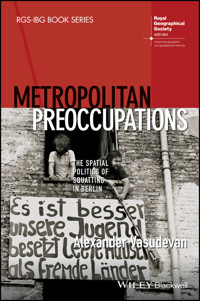
In this, the first book-length study of the cultural and political geography of squatting in Berlin, Alexander Vasudevan links the everyday practices of squatters in the city to wider and enduring questions about the relationship between space, culture, and protest.
- Focuses on the everyday and makeshift practices of squatters in their attempt to exist beyond dominant power relations and redefine what it means to live in the city
- Offers a fresh critical perspective that builds on recent debates about the “right to the city” and the role of grassroots activism in the making of alternative urbanisms
- Examines the implications of urban squatting for how we think, research and inhabit the city as a site of radical social transformation
- Challenges existing scholarship on the New Left in Germany by developing a critical geographical reading of the anti-authoritarian revolt and the complex geographies of connection and solidarity that emerged in its wake
- Draws on extensive field work conducted in Berlin and elsewhere in Germany
Sie lesen das E-Book in den Legimi-Apps auf:
Seitenzahl: 559
Veröffentlichungsjahr: 2015
Ähnliche



















Table of Contents
Cover
Title page
Series Editors’ Preface
List of Figures
Acknowledgements
Chapter One: Introduction: Making Radical Urban Politics
Spatialising the Anti-Authoritarian Revolt
The Squatted City
Towards a Spatial Grammar of Squatting
Chapter Two: Crisis and Critique
The Making of the Tenement City
Tenant Trouble: Rent Strikes in Weimar Berlin
Re-building a Divided City
Re-animating the ‘Housing Question’
Chapter Three: Resistance and Autonomy
‘The Berlin Commune’
Performing the Political
From Protest to Occupation
Spatialising the New Left?
Chapter Four: Antagonism and Repair
“Wir wollen alles und wollen es jetzt”: Re-imagining Protest in 1970s Berlin
From Demolition to Occupation: Squatting the City
Making ‘Free Space’: The Material and Emotional Geographies of Squatting
From Resistance to Pacification: The Decline of the West Berlin Scene
Chapter Five: Separation and Renewal
Schwarzwohnen: An Alternative History of Housing in East Berlin
Occupying a Vacuum: Squatting after the Fall of the Berlin Wall
Postscript
Chapter Six: Capture and Experimentation
Squatting as Art: Performing Architectural Activism in the New Berlin
From Creativity to Experimentation
Reclaiming the Radical City
The Autonomous City?
Chapter Seven: Conclusion: “Der Kampf geht weiter”
References
Archives and Archival Collections
Magazines and Periodicals
Newspapers
Secondary Sources
Index
End User License Agreement
List of Illustrations
Chapter 01
Figure 1.1 Arrest of the journalist Ulrike Meinhof at a protest occupation in the Märkisches Viertel in West Berlin, 1 May 1970 (Klaus Mehner, BerlinPressServices).
Figure 1.2 Map of squatted spaces in West Berlin up to the end of 1981. Map produced by Elaine Watts, University of Nottingham.
Figure 1.3 Map of the second wave of squatting in the former East of Berlin, 1989–1990. Map produced by Elaine Watts, University of Nottingham.
Chapter 02
Figure 2.1 Berlin’s ‘shanty town’. Image in
Die Gartenlaube
by Ludwig Löffler (1819–1876), p. 459.
Figure 2.2 The creative destruction of the Berlin tenement. Kreuzberg in the early 1980s. Skalitzer Straße between Kottbusser Tor and Görlitzer Bahnhof (Manfred Kraft/Umbruch Archiv).
Chapter 03
Figure 3.1 The Georg von Rauch-Haus (photo by author).
Figure 3.2 “The stones that hit your head are from the house you pulled down.” Cover of
Sponti
magazine,
Wir wollen alles
(Nr. 13/14, 1974) documenting the Frankfurter
Häuserkampf
(personal collection, author).
Chapter 04
Figure 4.1 Cover of TUNIX conference flyer, December 1977/January 1978 (personal collection, author).
Figure 4.2 The TUNIX conference in West Berlin, January 1978 (Klaus Mehner, BerlinPressServices).
Figure 4.3 Programme for TUNIX conference,
InfoBUG,
December 1977/January 1978 (personal collection, author).
Figure 4.4 The Fire Station on Reichenberger Straße in Kreuzberg, occupied in Spring 1977, cover of brochure produced in December 1977 (Papiertiger Archiv Berlin).
Figure 4.5 Bürgerinitiative SO36 Flyer announcing the occupation of two squatted apartment blocks in Kreuzberg, reproduced in the
Südost Express
, February 1979 (Papiertiger Archiv Berlin).
Figure 4.6 American soldiers conducting urban military exercises in Kreuzberg.
Südost Express
, December 1979 (Papiertiger Archiv Berlin).
Figure 4.7 Protests in the wake of the eviction of squatters from a house on Fränkelufer 48, Kreuzberg, 12 December 1980 (Michael Kipp/Umbruch Archiv).
Figure 4.8 DIY instructions in the
Instand-Besetzer-Post,
17.3.1981, p. 10 (Papiertiger Archiv Berlin).
Figure 4.9 The makeshift city: Rehabilitating occupied spaces in Kreuzberg (Umbruch Archiv).
Figure 4.10 The Regenbogenfabrik social centre in Kreuzberg (photo by author).
Figure 4.11 Intimacy and utopia: The Frauencafé in Moabit,
Instand-Besetzer-Post
, 12.6.81, p. 23 (Papiertiger Archiv Berlin).
Figure 4.12 “The city as festival”: Street performance in Charlottenburg on 21 September 1981 (Wolfgang Sünderhauf/Umbruch Archiv).
Figure 4.13 Map produced for TUWAT ‘spectacle’ in Kreuzberg, August 1981,
Instand-Besetzer-Post
(Papiertiger Archiv).
Figure 4.14 Second map produced for TUWAT ‘spectacle’ in Kreuzberg, August 1981,
Instand-Besetzer-Post
(Papiertiger Archiv).
Chapter 05
Figure 5.1 The eviction of squatters from Mainzer Straße in Friedrichshain, November 1990 (Umbruch Archiv).
Figure 5.2
Umweltblätter
, cover of dissident underground Samisdat publication of the Kirche von Unten, East Berlin, 1988 (Robert-Havemann-Gesellschaft).
Figure 5.3 The occupation of abandoned apartments in Mainzer Straße by squatters in 1990 (Umbruch Archiv).
Figure 5.4 During the Mainzer Straße evictions in Friedrichshain, November 1990 (Umbruch Archiv).
Chapter 06
Figure 6.1 Performing architecture? Squatters occupying Kastanienallee 77, Berlin-Prenzlauer Berg on 20 June 1992 (pamphlet produced by K77).
Figure 6.2 The ‘art’ of squatting (pamphlet produced by K77).
Figure 6.3 Kastanienallee 77 in 2009 (photo by author).
Figure 6.4 The ‘remains’ of the Brunnenstraße 183 squat after its eviction in 2009 (photo by author).
Figure 6.5 The Kotti & Co ‘
gecekondu
’ in Kreuzberg (photo by author).
Chapter 07
Figure 7.1 Montage of the West Berlin Squatter Scene in the
Instand-Besetzer-Post
, 30.4.1981, n.p. (Papiertiger Archiv Berlin).
Guide
Cover
Table of Contents
Begin Reading
Pages
ii
iii
iv
v
viii
ix
x
xi
xii
xiii
1
2
3
4
5
6
7
8
9
10
11
12
13
14
15
16
17
18
19
20
21
22
23
24
25
26
27
28
29
30
31
32
33
34
35
36
37
38
39
40
41
42
43
44
45
46
47
48
49
50
51
52
53
54
55
56
57
58
59
60
61
62
63
64
65
66
67
68
69
70
71
72
73
74
75
76
77
78
79
80
81
82
83
84
85
86
87
88
89
90
91
92
93
94
95
96
97
98
99
100
101
102
103
104
105
106
107
108
109
110
111
112
113
114
115
116
117
118
119
120
121
122
123
124
125
126
127
128
129
130
131
132
133
134
135
136
137
138
139
140
141
142
143
144
145
146
147
148
149
150
151
152
153
154
155
156
157
158
159
160
161
162
163
164
165
166
167
168
169
170
171
172
173
174
175
176
177
178
179
180
181
182
183
184
185
186
187
188
189
190
191
192
193
194
195
196
197
198
199
200
201
202
203
204
205
206
207
208
209
210
211
212
213
214
215
216
217
218
219
220
221
222
223
224
225
226
227
228
229
230
231
232
233
234
235
236
237
238
239
240
241
242
RGS-IBG Book Series
For further information about the series and a full list of published and forthcoming titles please visit www.rgsbookseries.com
Published
Metropolitan Preoccupations: The Spatial Politics of Squatting in BerlinAlexander Vasudevan
Everyday Peace? Politics, Citizenship and Muslim Lives in IndiaPhilippa Williams
Assembling Export Markets: The Making and Unmaking of Global Food Connections in West AfricaStefan Ouma
Africa’s Information Revolution: Technical Regimes and Production Networks in South Africa and TanzaniaJames T. Murphy and Pádraig Carmody
Origination: The Geographies of Brands and BrandingAndy Pike
In the Nature of Landscape: Cultural Geography on the Norfolk BroadsDavid Matless
Geopolitics and Expertise: Knowledge and Authority in European DiplomacyMerje Kuus
Everyday Moral Economies: Food, Politics and Scale in CubaMarisa Wilson
Material Politics: Disputes Along the PipelineAndrew Barry
Fashioning Globalisation: New Zealand Design, Working Women and the Cultural EconomyMaureen Molloy and Wendy Larner
Working Lives - Gender, Migration and Employment in Britain, 1945–2007Linda McDowell
Dunes: Dynamics, Morphology and Geological HistoryAndrew Warren
Spatial Politics: Essays for Doreen MasseyEdited by David Featherstone and Joe Painter
The Improvised State: Sovereignty, Performance and Agency in Dayton BosniaAlex Jeffrey
Learning the City: Knowledge and Translocal AssemblageColin McFarlane
Globalizing Responsibility: The Political Rationalities of Ethical ConsumptionClive Barnett, Paul Cloke, Nick Clarke and Alice Malpass
Domesticating Neo-Liberalism: Spaces of Economic Practice and Social Reproduction in Post-Socialist CitiesAlison Stenning, Adrian Smith, Alena Rochovská and Dariusz Świątek
Swept Up Lives? Re-envisioning the Homeless CityPaul Cloke, Jon May and Sarah Johnsen
Aerial Life: Spaces, Mobilities, AffectsPeter Adey
Millionaire Migrants: Trans-Pacific Life LinesDavid Ley
State, Science and the Skies: Governmentalities of the British AtmosphereMark Whitehead
Complex Locations: Women’s Geographical Work in the UK 1850–1970Avril Maddrell
Value Chain Struggles: Institutions and Governance in the Plantation Districts of South IndiaJeff Neilson and Bill Pritchard
Queer Visibilities: Space, Identity and Interaction in Cape TownAndrew Tucker
Arsenic Pollution: A Global SynthesisPeter Ravenscroft, Hugh Brammer and Keith Richards
Resistance, Space and Political Identities: The Making of Counter-Global NetworksDavid Featherstone
Mental Health and Social Space: Towards Inclusionary Geographies?Hester Parr
Climate and Society in Colonial Mexico: A Study in VulnerabilityGeorgina H. Endfield
Geochemical Sediments and LandscapesEdited by David J. Nash and Sue J. McLaren
Driving Spaces: A Cultural-Historical Geography of England’s M1 MotorwayPeter Merriman
Badlands of the Republic: Space, Politics and Urban PolicyMustafa Dikeç
Geomorphology of Upland Peat: Erosion, Form and Landscape ChangeMartin Evans and Jeff Warburton
Spaces of Colonialism: Delhi’s Urban GovernmentalitiesStephen Legg
People/States/TerritoriesRhys Jones
Publics and the CityKurt Iveson
After the Three Italies: Wealth, Inequality and Industrial ChangeMick Dunford and Lidia Greco
Putting Workfare in PlacePeter Sunley, Ron Martin and Corinne Nativel
Domicile and DiasporaAlison Blunt
Geographies and MoralitiesEdited by Roger Lee and David M. Smith
Military GeographiesRachel Woodward
A New Deal for Transport?Edited by Iain Docherty and Jon Shaw
Geographies of British ModernityEdited by David Gilbert, David Matless and Brian Short
Lost Geographies of PowerJohn Allen
Globalizing South ChinaCarolyn L. Cartier
Geomorphological Processes and Landscape Change: Britain in the Last 1000 YearsEdited by David L. Higgitt and E. Mark Lee
Forthcoming
Smoking Geographies: Space, Place and TobaccoRoss Barnett, Graham Moon, Jamie Pearce, Lee Thompson and Liz Twigg
Home SOS: Gender, Injustice and Rights in CambodiaKatherine Brickell
Pathological Lives: Disease, Space and BiopoliticsSteve Hinchliffe, Nick Bingham, John Allen and Simon Carter
Work–Life Advantage: Sustaining Regional Learning and InnovationAl James
Rehearsing the State: The Political Practices of the Tibetan Government-in-ExileFiona McConnell
Articulations of Capital: Global Production Networks and Regional TransformationsJohn Pickles, Adrian Smith and Robert Begg, with Milan Buček, Rudolf Pástor and Poli Roukova
Body, Space and AffectSteve Pile
Making Other Worlds: Agency and Interaction in Environmental ChangeJohn Wainwright
Transnational Geographies of the Heart: Intimacy in a Globalising WorldKatie Walsh
Metropolitan Preoccupations
The Spatial Politicsof Squatting in Berlin
Alexander Vasudevan
This edition first published 2015© 2015 John Wiley & Sons, Ltd
Registered OfficeJohn Wiley & Sons, Ltd, The Atrium, Southern Gate, Chichester, West Sussex, PO19 8SQ, UK
Editorial Offices350 Main Street, Malden, MA 02148-5020, USA9600 Garsington Road, Oxford, OX4 2DQ, UKThe Atrium, Southern Gate, Chichester, West Sussex, PO19 8SQ, UK
For details of our global editorial offices, for customer services, and for information about how to apply for permission to reuse the copyright material in this book please see our website at www.wiley.com/wiley-blackwell.
The right of Alexander Vasudevan to be identified as the author of this work has been asserted in accordance with the UK Copyright, Designs and Patents Act 1988.
All rights reserved. No part of this publication may be reproduced, stored in a retrieval system, or transmitted, in any form or by any means, electronic, mechanical, photocopying, recording or otherwise, except as permitted by the UK Copyright, Designs and Patents Act 1988, without the prior permission of the publisher.
Wiley also publishes its books in a variety of electronic formats. Some content that appears in print may not be available in electronic books.
Designations used by companies to distinguish their products are often claimed as trademarks. All brand names and product names used in this book are trade names, service marks, trademarks or registered trademarks of their respective owners. The publisher is not associated with any product or vendor mentioned in this book.
Limit of Liability/Disclaimer of Warranty: While the publisher and author have used their best efforts in preparing this book, they make no representations or warranties with respect to the accuracy or completeness of the contents of this book and specifically disclaim any implied warranties of merchantability or fitness for a particular purpose. It is sold on the understanding that the publisher is not engaged in rendering professional services and neither the publisher nor the author shall be liable for damages arising herefrom. If professional advice or other expert assistance is required, the services of a competent professional should be sought.
Library of Congress Cataloging-in-Publication Data
Vasudevan, Alexander. Metropolitan preoccupations : the spatial politics of squatting in Berlin / Alexander Vasudevan. pages cm. – (RGS-IBG book series) Includes bibliographical references and index.
ISBN 978-1-118-75059-9 (cloth) – ISBN 978-1-118-75060-5 (pbk.) 1. Squatter settlements–Germany–Berlin–History. 2. Squatters–Political activity–Germany–Berlin–History 3. Housing–Germany–Berlin–History. 4. Protest movements–Germany–Berlin–History–20th century. 5. Human geography–Political aspects. I. Title. HD7287.96.G32B483 2016 307.3′36–dc23 2015019948
A catalogue record for this book is available from the British Library.
Cover image: Squatted House with banner (“It is better that our young people occupy empty houses rather than foreign countries”). Richardplatz, Berlin-Neukölln, June 8, 1982. (Michael Kipp/Umbruch Bildarchiv)
The information, practices and views in this book are those of the author(s) and do not necessarily reflect the opinion of the Royal Geographical Society (with IBG).
For Megan
Series Editors’ Preface
The RGS-IBG Book Series only publishes work of the highest international standing. Its emphasis is on distinctive new developments in human and physical geography, although it is also open to contributions from cognate disciplines whose interests overlap with those of geographers. The Series places strong emphasis on theoretically-informed and empirically-strong texts. Reflecting the vibrant and diverse theoretical and empirical agendas that characterize the contemporary discipline, contributions are expected to inform, challenge and stimulate the reader. Overall, the RGS-IBG Book Series seeks to promote scholarly publications that leave an intellectual mark and change the way readers think about particular issues, methods or theories.
For details on how to submit a proposal please visit:www.rgsbookseries.com
David FeatherstoneUniversity of Glasgow, UK
Tim AllottUniversity of Manchester, UK
RGS-IBG Book Series Editors
List of Figures
1.1
Arrest of the journalist Ulrike Meinhof at a protest occupation in the Märkisches Viertel in West Berlin, 1 May 1970 (Klaus Mehner, BerlinPressServices).
1.2
Map of squatted spaces in West Berlin up to the end of 1981. Map produced by Elaine Watts, University of Nottingham.
1.3
Map of the second wave of squatting in the former East of Berlin, 1989–1990. Map produced by Elaine Watts, University of Nottingham.
2.1
Berlin’s ‘shanty town’. Image in
Die Gartenlaube
by Ludwig Löffler (1819–1876), p. 459.
2.2
The creative destruction of the Berlin tenement. Kreuzberg in the early 1980s. Skalitzer Straße between Kottbusser Tor and Görlitzer Bahnhof (Manfred Kraft/Umbruch Archiv).
3.1
The Georg von Rauch-Haus (photo by author).
3.2
“The stones that hit your head are from the house you pulled down.” Cover of
Sponti
magazine,
Wir wollen alles
(Nr. 13/14, 1974) documenting the Frankfurter
Häuserkampf
(personal collection, author).
4.1
Cover of TUNIX conference flyer, December 1977/January 1978 (personal collection, author).
4.2
The TUNIX conference in West Berlin, January 1978 (Klaus Mehner, BerlinPressServices).
4.3
Programme for TUNIX conference,
InfoBUG
, December 1977/January 1978 (personal collection, author).
4.4
The Fire Station on Reichenberger Straße in Kreuzberg, occupied in Spring 1977, cover of brochure produced in December 1977 (Papiertiger Archiv Berlin).
4.5
Bürgerinitiative SO36 Flyer announcing the occupation of two squatted apartment blocks in Kreuzberg, reproduced in the
Südost Express
, February 1979 (Papiertiger Archiv Berlin).
4.6
American soldiers conducting urban military exercises in Kreuzberg,
Südost Express
, December 1979 (Papiertiger Archiv Berlin).
4.7
Protests in the wake of the eviction of squatters from a house on Fränkelufer 48, Kreuzberg, 12 December 1980 (Michael Kipp/Umbruch Archiv).
4.8
DIY instructions in the
Instand-Besetzer-Post
, 17.3.1981, p. 10 (Papiertiger Archiv Berlin).
4.9
The makeshift city: Rehabilitating occupied spaces in Kreuzberg (Umbruch Archiv).
4.10
The Regenbogenfabrik social centre in Kreuzberg (photo by author).
4.11
Intimacy and utopia: The Frauencafé in Moabit,
Instand-Besetzer-Post
, 12.6.81, p. 23 (Papiertiger Archiv Berlin).
4.12
“The city as festival”: Street performance in Charlottenburg on 21 September 1981 (Wolfgang Sünderhauf/Umbruch Archiv).
4.13
Map produced for TUWAT ‘spectacle’ in Kreuzberg, August 1981,
Instand-Besetzer-Post
(Papiertiger Archiv).
4.14
Second map produced for TUWAT ‘spectacle’ in Kreuzberg, August 1981,
Instand-Besetzer-Post
(Papiertiger Archiv).
5.1
The eviction of squatters from Mainzer Straße in Friedrichshain, November 1990 (Umbruch Archiv).
5.2
Umweltblätter
, cover of dissident underground Samisdat publication of the Kirche von Unten, East Berlin, 1988 (Robert-Havemann-Gesellschaft).
5.3
The occupation of abandoned apartments in Mainzer Straße by squatters in 1990 (Umbruch Archiv).
5.4
During the Mainzer Straße evictions in Friedrichshain, November 1990 (Umbruch Archiv).
6.1
Performing architecture? Squatters occupying Kastanienallee 77, Berlin-Prenzlauer Berg on 20 June 1992 (pamphlet produced by K77).
6.2
The ‘art’ of squatting (pamphlet produced by K77).
6.3
Kastanienallee 77 in 2009 (photo by author).
6.4
The ‘remains’ of the Brunnenstraße 183 squat after its eviction in 2009 (photo by author).
6.5
The Kotti & Co ‘
gecekondu
’ in Kreuzberg (photo by author).
7.1
Montage of the West Berlin Squatter Scene in the
Instand-Besetzer-Post
, 30.4.1981, n.p. (Papiertiger Archiv Berlin).
Acknowledgements
The origins of this book can be traced to a bus tour of West Berlin that I was taken on by my mum in the summer of 1987 as a young child. While the tour took in all the expected sites, it also wound its way through the streets of Kreuzberg, a neighbourhood still reeling from the violent clashes between police and protesters on May Day and the subsequent police blockade which sealed off the district during the visit of American President Ronald Reagan. I was captivated, in particular, by the neighbourhood’s recent history as an alternative enclave in which artists, dropouts, migrants, students, and workers all made a home. I realise now that this is a powerful imaginary with its own biases and blind spots. I was, nevertheless, struck by the graffiti and the colourful exterior of many apartment blocks in the neighbourhood. My mum explained to me that these were houses that had been occupied in the early 1980s by squatters who lived in them without paying any rent and that some had been legalised while, in the case of many other houses, the residents had been evicted.
Lesen Sie weiter in der vollständigen Ausgabe!
Lesen Sie weiter in der vollständigen Ausgabe!
Lesen Sie weiter in der vollständigen Ausgabe!
Lesen Sie weiter in der vollständigen Ausgabe!
Lesen Sie weiter in der vollständigen Ausgabe!
Lesen Sie weiter in der vollständigen Ausgabe!
Lesen Sie weiter in der vollständigen Ausgabe!
Lesen Sie weiter in der vollständigen Ausgabe!
Lesen Sie weiter in der vollständigen Ausgabe!
Lesen Sie weiter in der vollständigen Ausgabe!




