


15,99 €
Mehr erfahren.
- Herausgeber: Parkstone International
- Kategorie: Geisteswissenschaft
- Sprache: Englisch
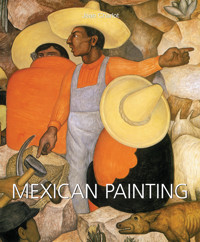
Mexican painting did not come to be internationally recognised until the early 20th century. It was the muralist movement, starting in the 1920s and strongly connected to the Mexican Revolution of the previous decade, from which such great artists as José Clemente Orozco (1883-1949), David Alfaro Siqueiros (1896-1974), and Diego Rivera (1886-1957) emerged. Rarely has art been more political. Thus, what Mexican muralists of the time put up on the walls of the most diverse buildings also tells the story of this ever so restless nation.
Das E-Book können Sie in Legimi-Apps oder einer beliebigen App lesen, die das folgende Format unterstützen:
Seitenzahl: 142
Veröffentlichungsjahr: 2018
Ähnliche




















Jean Charlot
Author:
Jean Charlot
Layout:
Baseline Co. Ltd
Ho Chi Minh City, Vietnam
© Confidential Concepts, worldwide, USA
© Parkstone Press International, New York, USA
© Image-Barwww.image-bar.com
All rights reserved.
No part of this publication may be reproduced or adapted without the permission of the copyright holder, throughout the world. Unless otherwise specified, copyright on the works reproduced lies with the respective photographers, artists, heirs or estates. Despite intensive research, it has not always been possible to establish copyright ownership. Where this is the case, we would appreciate notification.
ISBN: 978-1-68325-456-0
Osvaldo Barra Cunningham with his mural San Marcos Fair. Photograph. Family collection.
Contents
I. Dawn of the Mural Renaissance
Towards a National Art
Muralism: A Political Art?
José Vasconselos, Secretary of Education
II. The First Murals and Their Masters
San Pedro y San Pablo
The Preparatoria School: Diego Rivera
Dieguitos
The Preparatoria School: David Alfaro Siqueiros
The Preparatoria School: José Clemente Orozco
III. An Early End
The Ministry of Education
Riots at the Preparatoria School
The End of the Vasconcelos Era
Renaissance in Guadalajara
Conclusion
List of Illustrations
I. Dawn of the Mural Renaissance
Towards a National Art
The Mexican murals of the 20th century were not a freak flare-up lighted by the bonfire of a revolution. However, a national style was not at all in evidence as the movement began. By 1920 decades of successful official pressure had succeeded in stifling Mexican aesthetics, or at any rate in running them underground into the subconscious. When the time came for the young revolutionaries to re-establish a link to their plastic heritage, they went through pangs of pioneering and blind progress, which have earned the movement its name of renaissance or rebirth.
To study the Mexican school of painting that immediately precedes the mural era, impregnated by Indian, colonial, and popular tradition, is to witness the awakening of a national plastic language, perhaps more important in its trend than in its actual results. The nationalist movement, whose fate was to be overshadowed by the greater daring of the muralist group, dared a great deal during the short season that it reigned unchallenged. It proved a substantial instrument in switching the taste of a lay public from the veneration of European bon ton to claims of a racial aesthetic. The Mexican renaissance would scarcely have flourished if this previous stream of Mexican art had not flowed its way.
Throughout the 19th century pictures were painted with Mexican subject matter, featuring popular costumes and mores. The costumbristas, artists like Hesiquio Iriarte and Casimiro Castro, were more adept at the graphic mediums than at painting. They left us an encyclopaedic survey of 19th-century Mexico in albums of lithographs, some hand-coloured, and a few pictures, now housed in the historical museum of Chapultepec. But, prophets in their own country, they remained without honour in their time, their works embedded anonymously in the plentiful and ever-varied folk production.
It took the recognised fine arts a long time to contact, unashamed, the Mexican milieu. The critics saw further ahead than the artists, and a leitmotiv runs through writings on art in the mid-19th century, a sighing for a national art to match the national independence that had just been realised. When in 1869 Petronilo Monroy exhibited his allegory The Constitution of ‘57, a flying female in Pompeian drapes, critics admired it but suggested: “Beautiful as it may be, is it not time that our artists exploit the dormant wealth of our own ways of life, both old and new.”
Once the revolution of 1910 came about, the paradox of a majority of painters unaware of the national pride that shook their native hearth became acute. Manuel Gamio complained in 1916: “Painters copy Murillo, Rubens, Zuloaga, or still worse paint views of France, Spain, Italy, if need be of China, but hardly ever do they paint Mexico.” “Hardly ever” shows that Gamio was aware of exceptions to his statement. The contemporary plastic rediscovery of Mexico had already begun when he spoke those disheartened words.
In 1907 the young provincial painter Jorge Enciso had come from his native Guadalajara to seek his fortune in the capital. That he needed it is suggested by El Kaskabel, a jocular tapatío (colloquial term for a person from Guadalajara) sheet, which swears that the artist made the memorable trip clinging under a boxcar, with his pictures rolled inside a pillowcase since he had no trunks but those he wore.
At the time, serious art students, driven by the applause of enlightened amateurs and the photographic ideals of Maestro Fabres, were preparing to paint musketeers as jaunty as those of Roybet, odalisques as pink as those of Gerome, and grenadiers as martial as those of Meissonnier. Unaware of this ambition, Enciso on arrival unrolled the fruit of his young life’s work in the studio of Gerardo Murillo with whom he roomed, and soon opened a one-man show in Calle de San Francisco, No. 3, fourth floor. Three rooms were piled high with over 250 items, oils, pastels, charcoal and lead pencil drawings. On the cover of the catalogue a gentle china poblana bowed to her public before a background of nopales; green and red on white, the colours of the Mexican flag emphasised the national flavour.
All the pictures were on Mexican themes and of great simplicity. They were mostly landscapes, often merely a bare wall or a cubic house, with a few faceless people bundled in sarape or rebozo, their backs turned, unaware that they are being watched. Titles suggested the mood: Muse of Dawn, To Mass, Old House. An instant success, the show in its simplicity punctured the badly aimed pretension of the Fabres group, raising the grave question of a national art.
Alfredo Ramos Martínez, Returning Home from the Market, c. 1940. Mixed media, tempera and charcoal on paper, 67.3 x 51.1 cm. Location unknown.
Alfredo Ramos Martínez, The Little Chapel, date unknown. Tempera on newsprint laid down on board, 45.7 x 43.2 cm. Dalzell Hatfield Galleries, Los Angeles.
Besides contemporary landscapes, Enciso revived ancient Aztec themes. Such was The Three Kings, with flowing quetzal plumes for headdresses, the figures holding copal censers. Such themes inspired the poet José Juan Tablada, who saw the artist and his Indian subject matter as one: “The Eyes of Enciso are made of obsidian, sharp and brilliant as the silex arrows soaked in the fire of a star... Brown and agile as an Aztec bowman, the artist resurrects the prodigy of Ilhuilcamina... Arrows shot from his eyes blast stars from the firmament.”
Enciso also painted the first 20th-century murals with Amerindian content. Painted directly on the walls of two schools, one for boys and one for girls, in the not so aristocratic Colonia de la Bolsa, they were begun in December of 1910 and finished on 16 May 1911. They were destroyed when the buildings were remodeled.
His evaluation still holds good. After he became conservator of colonial buildings, the artist stopped painting in 1915, but his influence remains an active factor in Mexican art.
Another pioneer, Saturnino Herrán, painted in a manner that states, even if it fails to solve, the problem of a national style as distinct from the stressing of local colour. Born in 1888 and dead at thirty, Herrán, during his short life, was a not too successful painter, rounding out a meagre income with a life class at the Academy of San Carlos. Making virtue of necessity, Herrán never left Mexico, never failed to paint Mexican themes. Typical of his work is El Rebozo, dated 1916, it displays a nude mestiza with national trimmings, a corner of the metropolitan cathedral, Mexican fruits, a Mexican hat. The hazelnut skin, the gold-embossed charro felt hat, a damask cloth, the “churrigueresque” stone-lace of the colonial facade – all stress Mexico. But staying at home failed somehow to immunise Herrán against Europe. He had looked long and hard at magazine illustrations and at what foreign originals came his way. Dominant influences are those of the Englishman Brangwyn and the Spaniard Zuloaga, while the melancholy mood of much of the work parallels what Herrán could learn from reproductions of the blurred art of the Frenchman Eugene Carriere. But critics overlooked his style and stressed his subject matter. When he died, Herrán became a symbol of Mexicanism and was hailed as “the Mexican who was most a painter and the painter who was most Mexican”.
Tapatío-born like Enciso, Roberto Montenegro started painting at the Guadalajara Academy of Felix Bernadelli. The first printed record of this hardy perennial of Mexican art is an entry in the catalogue of the 1900 Paris World Fair, when the precocious artist was only thirteen years old by his own count: “Roberto Montenegro (de Guadalajara): Peinture”.
Montenegro came to the capital in 1905 to study with Fabres. At San Carlos, he vied with Diego Rivera for top honours. Their reward came in 1906 – a single fellowship to Europe. The deadlock of excellency between the two adolescents was decided in favour of Montenegro on the toss of a coin. He left a few months before Diego could raise enough money to follow him.
Saturnino Herrán, The Offering, 1913. Oil on canvas, 210 x 182 cm. Museo Nacional de Arte, Mexico City.
Roberto Montenegro, Mayan Women, 1926. Oil on canvas, 80 x 69.8 cm. The Museum of Modern Art, New York.
Both were back home for the Feasts of the Centennial of 1910, and both had become consecrated masters, carting back crates of canvasses to prove it. This time Rivera did beat his rival to the draw with a show that opened at San Carlos in November 1910. Montenegro’s opened in February of the next year at the Vilches Salons.
Once their sales were made and their fame secure at home, Montenegro and Rivera returned to Europe, missing most of the revolution. While Diego, who had become a cubist, brewed alchemies of the fourth dimension in Paris, Roberto deftly mixed plastic cocktails, Bakst-coloured and spiked with a dash of Aubrey Beardsley. Henri de Regnier found his pen-and-ink drawings a match for his own sophisticated poems. In the casino of Palma de Mallorca in 1919, Montenegro painted a mural, his first.
It is a change of heart that brings him within the scope of this chapter. From the vantage point of Europe, Montenegro discovered the Mexican scene, and by 1919 his conversion was made public. Mexican Motifs, a set of etchings, “is a constant exhortation to American artists, a model showing why they should cultivate the milieu of their birth in preference to any other… A prominent aspect of Roberto Montenegro’s personality is his will to orient American artists towards their fatherland, and to offer them a precedent.” Previous mural training and Mexican subject matter made the artist a natural choice to receive, when the time came, the first government-sponsored mural commission.
Adolfo Best Maugard also reached nationalism in a roundabout way. Wrote Pedro Henriquez Urena: “Around 1910, when Adolfo was very young, a young and promising painter, he illustrated an ethnological study by the learned investigator Franz Boas, reproducing in all their minutiae and variety the archaic decorations of the ancient tribes of the Mexican valley… There were over 2,000 drawings.” The artist’s personal thoughts concerning this commissioned data became the nucleus of a drawing method that stressed the common denominator latent in the fine arts. He discovered a plastic alphabet of seven elements, “the spiral, the circle, the half-circle, the S form, the wavy line, the zigzag, the straight line.”
Best was the first to parade a distinctive Mexican art through foreign capitals, and to prove the truth of Marti’s pithy saying of fifty years before: “Mexican painting has a great future – outside Mexico.” The sets and costumes that Best designed for Anna Pavlova’s Mexican Fantasy were endorsed both by Paris and New York.
While his method helped multitudes to self-expression, the growing philosophical strain ended by smothering Best’s own will to paint. His gifted hands fell limp as he concentrated on what he called the “whirling spiral” just as Faustus had on the magic disk. “Aesthetic... is what has been called by philosophers the ‘musical state’ or the ‘lyric state’, or what is known as ‘ecstasy’ in the practices of mysticism.” His was a brand of mysticism closer to the Eastern than to the Catholic since it proved incompatible with action. Best never actually took part in the mural movement when it came. The commission he received in 1922 to paint the private offices of Secretary Vasconcelos was never even begun.
An important task of the nationalists proved to be the reappraisal of folk art. The turning point in public appreciation was the show of folk crafts that opened on 19 September 1921, on Montenegro’s initiative, patterned after a show of Russian folk arts that he had admired in Paris.
Stylistically, nationalism found another way out of academism than the kind of Impressionism favoured at the time by Ramos Martínez. The lineal beauty of lacquer and pottery patterns, with their balance of flat areas, was not unlike that of Persian miniatures, then the fashion in a Paris all agog over Poiret turbans and Bakst costume designs. Because of the similarity, the works of Best and Montenegro were enthusiastically received by people of informed taste. The public at large accepted such works only later, having recoiled in horror from the first frescos. But during the short period in which the nationalist style reigned alone (1920-1921) laymen were set against it.
Ángel Zárraga, Bread and Water, 1910. Oil on canvas. Collection of the Cámara Mexicana de la Industria de la Construcción.
Ángel Zárraga, The Annunciation, 1938. Oil on canvas, 54 x 65.4 cm. Location unknown.
As is the fate of transitional styles, nationalism, attacked for its daring by conservative elements, was despised by the true vanguard for its timidity. José Clemente Orozco spat on the picturesqueness that was synonymous with the movement.
Rivera shrugged it off: “Our youngsters oscillate from the admiration of Ramos Martínez to the influence of Leon Bakst, thinking that they further nationalist art.”
Good or bad, Mexican art was far from dormant before walls came to be painted. It was in fact in the throes of giving birth to a new style. Nationalist art honorably fills the interregnum between academism and the rise of the mural school. It was a movement at once brave, in the sense that it featured local elements despised under President Díaz, and timid, insofar as it sifted these folk ingredients through a mesh of propriety and elegance that left them blanched, nerveless, and deodorised. Its timing, however, was wrong. The nationalist trend was gathering momentum at the very moment that the tougher art of the muralists rendered it obsolete.
Muralism: A Political Art?
Whatever their source, bookish Marxism or the slowly laid sediment of individual grievances, social theories in revolutionary Mexico were no longer simply ideas. They had acquired body, just as the transparent, imponderable element, air, at times becomes opaque, “thick enough to cut with a knife.” Individuals existed within an element of social consciousness as real as pea-soup fog. It held individuals together better than clean air, and directed each and all towards common ideas and actions, artists no less than laymen.
Twice Rivera attempted to describe the phenomenon: “Our hope is based on the fact that all personages, positive as well as negative, of this as yet minute movement, are impelled by a deep force: the aspirations of the masses, which shake the surface of the country as does an earthquake. Let us hope that some artist or group of artists manages to give such aspirations a voice.”
This milieu was preconditioned to breed group action and communal mural work as a natural outlet for collective emotions. Some sort of subterranean initiation had long been smoldering, a chrysalis stage that left few clues, but that alone explains the winged swiftness of the rebirth. The spilling over of an aesthetic into the field of sociology would, in most countries, be a question of taste rather than of emergency. In Mexico sociologists, unconcerned with the arts came to the conclusion that art alone could be trusted to perform certain urgent social tasks, even before the artists themselves had realised it clearly.
Murals are the logical genre for pictures envisaged as social levers, and some painters worked on walls at least a decade before the renaissance came of age. We have mentioned Enciso’s school murals. In 1910, during the last days of the Díaz regime, a guild of young artists that included Orozco secured a government commission to paint a collective mural in the auditorium of the Preparatoria School, on the very wall where Rivera was to paint his first mural in 1922.
Artistic rebirth had to give precedence to the armed revolution. An explicit manifesto antedating the motives and aims current in the twenties was set forth by Gerardo Murillo, called Dr Atl, on accepting his nomination as director of the School of Fine Arts in 1914:
Reform must come at the same pace in the political, administrative, military, and artistic orders. If in this moment of universal renovation, the Mexican artists, pleading the serenity of their sacerdocy, remain inert, refuse to play a consciously virile part in the struggle, if they let others do their job and fail to leaven the national upsurge with the purity of their good will and the thrust of their energy, then the rolling avalanche is sure to leave them behind, in a heap of debris.
Ángel Zárraga, Still Life




