


11,49 €
Mehr erfahren.
- Herausgeber: Atlantic Books
- Kategorie: Geisteswissenschaft
- Sprache: Englisch
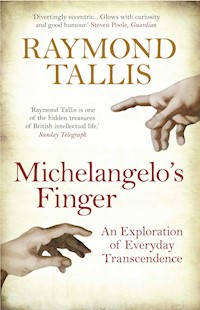
Raymond Tallis is a renowned polymath: he was listed by the Independent in 2007 as one of fifty 'Brains of Britain' and in 2004 Prospect magazine voted him one of Britain's top public intellectual. In this startlingly original and persuasive book, Raymond Tallis shows that it is easy to underestimate the influence of small things in determining what manner of creatures humans are. He reveals that over time the repeated and multiple effects of the seemingly insignificant can make an enormous difference and argues that the independent movement of the human index finger is one such easily overlooked factor. Indeed, not for nothing is the index finger called 'the forefinger'. It is the one we most naturally deploy when we want to winkle things out of small spaces, but it plays a far more significant role in an action unique to us among primates: pointing. In Michelangelo's Finger, Raymond Tallis argues that it is through pointing that the index finger made a significant contribution to hominid development and to the creation of a human world separate to the rest of the natural world. Observing the ceiling of the Sistine Chapel and the hugely familiar and awkward encounter between Michelangelo's God and Man through their index fingers, Tallis identifies an intuitive indication of the central role of the index finger in making us unique. Just as the reaching index fingers of God and Man are here made central to the creation of our kind, so Tallis believes that the simple act of pointing is central to our extraordinary evolution.
Das E-Book können Sie in Legimi-Apps oder einer beliebigen App lesen, die das folgende Format unterstützen:
Veröffentlichungsjahr: 2010
Ähnliche



















Copyright
First published in hardback in Great Britain in 2010 by Atlantic Books, an imprint of Grove Atlantic Ltd.
Copyright © Raymond Tallis 2010
The moral right of Raymond Tallis to be identified as the author of this work has been asserted in accordance with the Copyright, Designs and Patents Act of 1988.
The extract taken from ‘In Time of War’, Section VIII, Collected Poems ©The Estate of W. H. Auden and reprinted by permission of Faber and Faber Ltd.
The extract taken from ‘The Love Song of J. Alfred Prufrock’, Collected Poems, 1909–62 ©The Estate of T. S. Eliot and reprinted by permission of Faber and Faber Ltd.
All rights reserved. No part of this publication may be reproduced, stored in a retrieval system, or transmitted, in any form or by any means, electronic, mechanical, photocopying, recording, or otherwise, without the prior permission of both the copyright owner and the above publisher of this book.
Every effort has been made to trace or contact all copyright holders. The publishers will be pleased to make good any omissions or rectify any mistakes brought to their attention at the earliest opportunity.
Atlantic Books
An imprint of Grove Atlantic Ltd
Ormond House
26–27 Boswell Street
London
WC1N 3JZ
www.atlantic-books.co.uk
First eBook Edition: January 2010
ISBN: 978-1-84887-119-9
Dedicated to Edna Turnberg (who always sees the point) with love and admiration and with gratitude for being such a wonderful friend
Contents
Cover
Copyright
Acknowledgements
Foreword
chapter one: How to Point: A Primer for Martians
chapter two: What it Takes to be a Pointer
chapter three: Do Animals Get the Point?
chapter four: People Who Don’t Point
chapter five: Pinning Language to the World
chapter six: Pointing and Power
chapter seven: Assisted Pointing and Pointing by Proxy
chapter eight: The Transcendent Animal: Pointing and the Beyond
Notes
Index
Acknowledgements
It is a huge privilege and pleasure to be working with the Atlantic team for a third time. I am enormously grateful to Toby Mundy, Chairman and Publisher of Atlantic Books, for his enthusiasm for this book, for understanding what it was really about, and for a conversation which not only gave Michelangelo’s Finger its title but also pointed it in the right direction. My thanks also to Sarah Norman for her excellent editorial work.
Foreword
It is easy to underestimate the influence of small things in deter -mining what manner of creatures we humans are. Over time, the repeated and multiple effects of a slight difference can make a big difference. The independent movement of the index finger is one such small and easily overlooked thing, and it has made a big difference. We sometimes need thinkers of genius to make us see this. Michelangelo was such a thinker, although he usually thought with a paintbrush and chisel rather than a pen. The Creation of Adam, one of his frescoes on the ceiling of the Sistine Chapel in Rome, is one of the most familiar images in Western art, depicting, if you believe the story, the most important event in the history of the universe. Yes, God had been pretty busy up to that moment. In just five days he had instructed the void to shape up; had commanded light to come into being and stand in tidy rows of days and nights; had divided the water from the land and heaven from the earth; had summoned grass and beasts and the sun and the moon and the stars into being and instructed them to take up their stations and carry out their proper functions; and had checked, and found, at in tervals, that the results were excellent – or good enough anyway for Him to rank them as good. But now we come to the climactic moment, recorded in Genesis 1: 27: the culminating act of creation, at the end of the sixth day, when God played his master-stroke and created man in His own image. And it is this that Michelangelo represents on the ceiling of the Sistine Chapel.
At the centre of the picture are two fingers separated by a small gap: the index finger of God’s right hand; and the index finger of Adam’s left hand. This extraordinary fresco is open to many in -terpretations. We might see it as God’s outstretched right hand transmitting the spark of life from Himself to Adam, whose left hand is extended in a pose that mirrors that of the Creator. Through His extended forefinger God infuses his spirit into Adam, and hence into humanity. This image is somewhat at odds with the more detailed account of the creation of Adam in Genesis 2: 7, in which God ‘formed man of the dust of the ground, and breathed into his nostrils the breath of life; and man became a living soul’. Alternatively, therefore, given that this is an act of creation, we might conclude that it represents the moment after the separation of God and man, of the Creator and the pinnacle of his creation. The index fingers are the final point at which separation takes place – a profoundly tragic moment, given what was to happen in Genesis 3, when God is betrayed by the one creature whom He created in his own image.
This leaves the fact that the index finger is centre stage still to be explained. This was no mere eccentricity. The best-known and most venerable of Catholic hymns, sung at supremely important occasions such as the election of Popes, already over 700 years old when Michelangelo deployed his brush in the Sistine Chapel, is ‘Veni Crea -tor Spiritus’ – ‘Come Creator Spirit’. In this hymn, the Holy Spir it is called ‘the Finger of the Hand Divine’ and the digit in question is the index finger. There appears to be a deep symbolic connection between this finger and the special nature of human beings, who are understood in the Judaeo-Christian tradition as being created uniquely in the image of God. Why?
I ask this question in full awareness that, if the hand has lifted man above other living creatures, the credit would seem to lie with the thumb. Indeed, in The Hand: A Philosophical Inquiry into Human Being I argued precisely that. 1 I examined the unique versatility of the human hand, originating from the possession of a fully opposable thumb, that transformed this organ into a tool; and the ‘toolness’ of the hand altered our relations to our own bodies and ultimately to our environment. Hominids developed an instrumental relationship to their bodies and for this, and a variety of other reasons, they were no longer just organisms living their lives but self-conscious, embodied subjects actively leading them. The crucial role of the hand, and indeed the importance of the opposable thumb, had been postulated by many other thinkers – philosophers such as Anaxagoras, Aristotle, Kant and even Heidegger, and theoretical biologists such as Erasmus, Darwin, and F. Wood Jones, who famously said that ‘Man’s place in nature is largely writ upon the hand.’ In The Hand, I took this story a bit further by teasing out how the possession of a uniquely versatile manual organ enabled hominids to become the self-conscious agents that we are; how it provided a biological means by which we loosened the grip of biology and came to live in a world that was increasingly human.
The present examination of the index finger – more precisely, one immensely important function of that finger – takes this story further. Of course the index finger works with the thumb and with other digits to make possible the hand’s dazzling virtuosity. At the most obvious level, all of those so-called ‘pinch grips’ which enable us to manipulate the material world with such exquisite precision involve the index finger. Furthermore, many of the instruments that enhance our precision grip on the material world – needles and screws and so on – would have had no rationale without its contribution. And the index finger also throws in its lot with its fellow digits to give strength to those ‘power grips’ that are so important to our manipulation of the material world, as when we squeeze objects (including the throats of our enemies) or hang on for dear life. But in addition to this cooperative activity of the index finger, there is stand-alone activity, made possible by its unique capacity for independent movement.
Look at your index finger now. Waggle it about and note how easily it does its own thing, how much more fluid and liberated it is compared to its fellow digits. The others can do similar things, but with more effort and less grace, as if they were merely imitating the index finger without fully knowing what they are up to. Not for nothing is the index called ‘the forefinger’. At any rate, it is the one we most naturally deploy when we want to winkle things out of small spaces within and without the body. (The reader may wish to be spared examples of the former and that wish will be respected.) But there is an even more important function, one which it does not share with other primates.
Quite likely when you were invited to look at your index finger just now, you got it to do something that is connected closely with its name: you got it to indicate; that is to say, to point. Pointing is a beautiful gesture. But it is much more than this. And it is through pointing, I will argue, that the index finger has contributed so much to hominid development and to the creation of a human world outside of the natural world that encloses all other animals. I like to think that the slightly awkward encounter between God and man through their index fingers depicted by Michelangelo, and indeed the theological idea behind it, was influenced by an intuition of the central role of the index finger in making us so different. The mutual pointing of the index fingers of God and Man was placed at the centre of a supernatural image of man’s extra-natural nature.
My own viewpoint, incidentally, and one that I have elaborated in many books, shuns both supernatural and naturalistic accounts of human beings. I believe in what I have called ‘Darwinism without Darwinitis’. That is, I do not doubt that we are descended from hominids and that our hominid ancestors came into being by the same processes that gave rise to centipedes, frogs and monkeys. But I have equally no doubt that, since the hominids forked off from the other great apes, they have taken different paths, and their journey has been powered by different processes, from all other living creatures. We did not fall from the sky, or come into our distinctive being by means of supernatural intervention: it is biology that gave us our passport out of nature to a place from which we can manipulate nature to our advantage and to ends that nature did not envisage (not that nature does any envisaging). This is a process I have described in great, indeed pitiless, length in a trilogy of books that the reader may wish to consult but will be spared here, though I will visit the relevant aspects of it in Chapter 2. 2
The role of the index finger in this remarkable story is by no means insignificant, even though the item in question is not terribly impressive. As is so often the case, it is not the kit which nature has bestowed upon us but what we do with the kit that makes the difference, or, rather, that makes a large difference out of a small one. This is most obviously true of the fully opposable thumb. The human pincer grip, with thumb-pad to finger-pad contact, is very rarely used in chimps who cannot achieve full opposition. 3 This has not only increased the versatility of the hand – even adult chimps, in contrast with infants, lack a means of selecting customized grips for small objects – but has also conferred upon us a more explicit sense of our hands as tools. This lies at the origin of our awareness of our-selves as (self-conscious) agents. It is against this background that we are able to transform the biological givens of our organic bodies into quite other things that serve quite other purposes, something that I have explored at length in The Kingdom of Infinite Space. 4
Making a big difference out of a small one also applies to the index finger and those small developments that have given the fore-finger freedom to operate in a way that is not narrowly, or even broadly, prescribed by nature. It is against the background of a hand (and indeed a body) that has become the primordial tool, or tool-kit, of a self-conscious agent that the index finger is utilized as one of the richest means of communication that humans possess outside language. Indeed, pointing is possibly one of the bridges to language (though this claim will be hedged about with qualifications). At any rate, the unnatural nature of pointing and what it tells us about ourselves are the theme of this book.
Just how extraordinary – and indeed extra-natural – pointing is will become evident when, in Chapter 1, I examine what successful pointing requires of us. This will be elaborated in the Chapter 2, where I look a bit more closely at the mode of consciousness necessary to want to point something out to someone else, or to understand what is meant when someone else points something out to us. This mode of consciousness is not achieved in animals, which makes the claim that some animals really do point of considerable interest. In Chapter 3 I examine, and reject, this claim, which reflects a tend ency to attribute mental capacities to beasts, an anthropomorphism ubiquitous in research into animal behaviour, especially into the behaviour of primates. That some human beings do not point is itself a pointer to a profound problem: the failure to point is an early sign of autism, a condition that affects language, behaviour and every aspect of socialization and which appears to be founded in an impaired sense of self and of others as selves. Autism is discussed in Chapter 4.
Pointing is often seen as a bridge between the pre-linguistic and linguistic states of humanity. We should beware of this assumption, not only because, as I have already argued, the claim of pointing to be ‘natural’ in the required sense is ill-founded, but also because the relationship between words and the contents of the world is not one that can be conveyed by pointing. The limitations of teaching names by pointing at objects and of so-called ‘ostensive definition’ cast a sharp light on the extraordinary nature of language. Chapter 5, which deals with this, includes forays into the philosophy of language which some may find quite hard going but, I hope, worth the effort. Chapter 6 offers the reader something of a break, with a series of observations about some of the things the index finger gets up to that are directly and indirectly connected with pointing, and recalls some of the uses to which the extended index finger may be put that go beyond a declarative pointing that informs another person of something they may not, but should, know. By pointing to others, we also increase their self-consciousness, and this is not always neutral or benign. The reasons why it is rude to point, and how pointing may be a way of asserting power, touch on something close to the heart of what it is to be a human being. Chapter 7 deals with assisted pointing; with the prostheses and prosthetic extensions of the forefinger that human beings have manufactured to perform indication more effectively than with the forefinger or even in the complete absence of a conscious indicator. The metamorphoses of ‘the pointer’ are legion and the transformation of an act of pointing into a standing artefactual pointer is deeply thought-provoking, reminding us of how we turn an infinity of strangers into a cognitive community.
The final chapter delivers the philosophical message of Michel -angelo’s Finger. Pointing is a means of indicating a transcendent world – general, hidden and shared – and takes us decisively out of our solitary, transient bodies, subject to the laws of nature. The examination of this aspect of pointing begins with the transcendence inherent in everyday human consciousness, takes in my own boyhood and that of Sir Walter Raleigh, and ends with the idea of God – a God whom we see pointing back to us and thus bringing our distinctive nature into being. In short, I end, where I began, with Michelangelo’s vision of humanity, though I give it an interpretation of which the Catholic Church would most certainly not approve.
I first became interested in pointing in the early 1970s and in 1973 I wrote a first draft of this book, under the title Studies in Pointish. I laboured over it, in the spare time I had from my 104-hour week as a junior doctor, for the best part of a year. I then typed it out and, as this was before the era of word processors, I typed it out again. And again. When, finally, I had produced a script that was not so bespattered by Tippex as to look as if it had been composed under a flock of seagulls, I sent it off. A succession of extremely patient editors and publishers found it unsatisfactory. And so, as I in the end admitted to myself, did I. Pointing excited me, but I did not know why. I had to write the trilogy referred to earlier to see the bigger picture into which pointing fitted and, indeed, pointed to – an illustration of how we may learn as much from writing books as from reading them. Finally, a conversation with Toby Mundy, of Atlantic Books, in which he suggested the title Michelangelo’s Finger, made me think a little harder and deeper and really see what my excitement over this exquisitely beautiful – and terrifying – gesture was all about.
As much as anything else, Michelangelo’s Finger is a contribution to the unfinishable project of waking to, and out of, the enabling constraints of everyday meaning, of linking our ordinary moments with their extraordinary origins. The fact that I have focused on something that seems trivial and far less worthy of examination than language, or human consciousness, or the working of the brain, is no accident. Pointing (to pick up on one of an endless number of puns waiting in the wings) points to something that goes very deep in us; and it is subject, as so many things in human life are, to a multitude of transformations. I hope this inquiry into the nature and significance of, and the role played by, this small gesture will make that point, and help us to see ourselves more clearly.
The fact that humans are the only creatures who routinely point things out to one another links, ultimately, with what is distinctive about our nature, and that, irrespective of whether we are made in the image of God (whatever God is), we are not such as is mirrored in nature. Indeed, we are a mirror in which nature sees herself. Because we transcend our natural condition, we are aware of our own nature and of nature herself in the way that no other part of nature is aware. Pointing both presupposes and develops that transcendence. I was tempted to call this book The Godfinger. I believe, however, that, in placing the forefinger of God and the ultimate forefather of man at the centre of the act in which humanity was created, Michelangelo captured a great truth – a greater truth than he perhaps realized. 5
chapter one
How to Point: A Primer for Martians
There can be few more dispiriting experiences than being the re -cipient of detailed but entirely superfluous explanation. Of all the things readers of this book may feel they need, instruction in how to point might seem to be the least pressing. But it is a necessary step towards understanding what pointing, ultimately, points to.
At first sight, nothing could be more straightforward, natural and unpuzzling, than pointing. It seems, of all our gestures, to justify what St Augustine said when he famously described bodily movements as ‘the natural language…of all nations’. 1 Pointing ap pears to be the least conventionalized of the signs human beings use to communicate with one another, and consequently to require the minimum of decoding. It certainly appeared so to the Sophist Cratylus. According to Plato, he argued that, if we communicated solely by pointing, misunderstanding would be avoided. 2 Indeed, ‘Pointish’ seems so transparent a language, or proto-language, that it has frequently been seen as the key to the miracle by which the speechless infant becomes the toddler who speaks. And when some -one wants to know what you are talking about, you can always, as a last resort, point to it.
However, all is not what it seems. Pointing is not at all straight -forward. What is mor e, it does not deliver what would be needed if it were the sole bridge from babbling babyhood to talking toddler -hood, or an all-purpose means of clarifying what is meant when language fails us. Nevertheless, it is central to developing the mode of consciousness – explicit, shared, collective – that is in finitely elaborated in (uniquely human) language. It is worth dwelling on this a bit.




