


16,99 €
Mehr erfahren.
- Herausgeber: John Wiley & Sons
- Kategorie: Fachliteratur
- Serie: China Today
- Sprache: Englisch
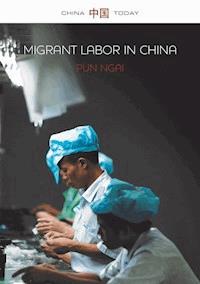
Long known as the world's factory, China is the largest manufacturing economy ever seen, accounting for more than 10% of global exports. China is also, of course, home to the largest workforce on the planet, the crucial element behind its staggering economic success. But who are China s workers who keep the machine running, and how is the labor process changing under economic reform? Pun Ngai, a leading expert in factory labor in China, charts the rise of China as a world workshop and the emergence of a new labor force in the context of the post-socialist transformations of the last three decades. The book analyzes the role of the state and transnational interests in creating a new migrant workforce deprived of many rights and social protection. As China increases its output of high-value, high-tech products, particularly for its own growing domestic market of middle-class consumers, workers are increasingly voicing their discontent through strikes and protest, creating new challenges for the Party-State and the global division of labor. Blending theory, politics, and real-world examples, this book will be an invaluable guide for upper-level students and non-specialists interested in China s economy and Chinese politics and society.
Sie lesen das E-Book in den Legimi-Apps auf:
Seitenzahl: 322
Veröffentlichungsjahr: 2016
Ähnliche



















Series page
China Today series
Greg Austin,
Cyber Policy in China
Steven M. Goldstein,
China and Taiwan
David S. G. Goodman,
Class in Contemporary China
Stuart Harris,
China's Foreign Policy
Elaine Jeffreys with Haiqing Yu,
Sex in China
Michael Keane,
Creative Industries in China
Joe C. B. Leung and Yuebin Xu,
China's Social Welfare
Hongmei Li,
Advertising and Consumer Culture in China
Orna Naftali,
Children in China
Pitman B. Potter,
China's Legal System
Pun Ngai,
Migrant Labor in China
Xuefei Ren,
Urban China
Judith Shapiro,
China's Environmental Challenges 2nd edition
Alvin Y. So and Yin-wah Chu,
The Global Rise of China
Teresa Wright,
Party and State in Post-Mao China
You Ji,
China's Military Transformation
LiAnne Yu,
Consumption in China
Xiaowei Zang,
Ethnicity in China
Copyright page
Copyright © Pun Ngai 2016
The right of Pun Ngai to be identified as Author of this Work has been asserted in accordance with the UK Copyright, Designs and Patents Act 1988.
First published in 2016 by Polity Press
Polity Press
65 Bridge Street
Cambridge CB2 1UR, UK
Polity Press
350 Main Street
Malden, MA 02148, USA
All rights reserved. Except for the quotation of short passages for the purpose of criticism and review, no part of this publication may be reproduced, stored in a retrieval system, or transmitted, in any form or by any means, electronic, mechanical, photocopying, recording or otherwise, without the prior permission of the publisher.
ISBN-13: 978-0-7456-7174-1
ISBN-13: 978-0-7456-7175-8(pb)
A catalogue record for this book is available from the British Library.
Library of Congress Cataloging-in-Publication Data
Pun, Ngai, 1970-
Migrant labor in China : post-socialist transformation / Pun Ngai.
pages cm
Includes bibliographical references and index.
ISBN 978-0-7456-7174-1 (hardback) – ISBN 978-0-7456-7175-8 (pbk.) 1. Migrant labor–China. 2. Labor market–China. 3. Manpower policy–China. 4. Rural-urban migration–China. 5. China–Economic conditions–2000- 6. China–Economic policy–2000- I. Title.
HD5856.C5P864 2016
331.5′440951–dc23
2015032717
Typeset in 11.5 on 15 pt Adobe Jenson Pro
by Toppan Best-set Premedia Limited
Printed and bound in Great Britain by Clay ltd, St Ives PLC
The publisher has used its best endeavours to ensure that the URLs for external websites referred to in this book are correct and active at the time of going to press. However, the publisher has no responsibility for the websites and can make no guarantee that a site will remain live or that the content is or will remain appropriate.
Every effort has been made to trace all copyright holders, but if any have been inadvertently overlooked the publisher will be pleased to include any necessary credits in any subsequent reprint or edition.
For further information on Polity, visit our website:
politybooks.com
Chronology
1894–95
First Sino–Japanese War
1911
Fall of the Qing dynasty
1912
Republic of China established under Sun Yat-sen
1927
Split between Nationalists (KMT) and Communists (CCP); civil war begins
1934–5
CCP under Mao Zedong evades KMT in Long March
December 1937
Nanjing Massacre
1937–45
Second Sino–Japanese War
1945–9
Civil war between KMT and CCP resumes
October 1949
KMT retreats to Taiwan; Mao founds People's Republic of China (PRC)
1950–3
Korean War
1953–7
First Five-Year Plan; PRC adopts Soviet-style economic planning
1954
First constitution of the PRC and first meeting of the National People's Congress
1956–7
Hundred Flowers Movement, a brief period of open political debate
1957
Anti-Rightist Movement
1958–60
Great Leap Forward, an effort to transform China through rapid industrialization and collectivization
March 1959
Tibetan Uprising in Lhasa; Dalai Lama flees to India
1959–61
Three Hard Years, widespread famine with tens of millions of deaths
1960
Sino–Soviet split
1962
Sino–Indian War
October 1964
First PRC atomic bomb detonation
1966–76
Great Proletarian Cultural Revolution; Mao reasserts power
February 1972
President Richard Nixon visits China; “Shanghai Communiqué” pledges to normalize US–China relations
September 1976
Death of Mao Zedong
October 1976
Ultra-Leftist Gang of Four arrested and sentenced
December 1978
Deng Xiaoping assumes power; launches Four Modernizations and economic reforms
1978
One-child family planning policy introduced
1979
US and China establish formal diplomatic ties; Deng Xiaoping visits Washington
1979
PRC invades Vietnam
1982
Census reports PRC population at more than one billion
December 1984
Margaret Thatcher co-signs Sino–British Joint Declaration agreeing to return Hong Kong to China in 1997
1989
Tiananmen Square protests culminate in June 4 military crack-down
1992
Deng Xiaoping's Southern Inspection Tour re-energizes economic reforms
1993–2002
Jiang Zemin is president of PRC, continues economic growth agenda
November 2001
WTO accepts China as member
2002–12
Hu Jintao, General-Secretary CCP (and President of PRC from 2003)
2002–3
SARS outbreak concentrated in PRC and Hong Kong
2006
PRC supplants US as largest CO
2
emitter
August 2008
Summer Olympic Games in Beijing
2010
Shanghai World Exposition
2012
Xi Jinping appointed General-Secretary of the CCP (and President of PRC from 2013)
Acknowledgements
This book would not have been possible without the Chinese migrant workers who have been actively involved in many of the research projects. I am grateful for the trust and confidence of Chinese migrant workers who have shared their experiences, stories, and struggles not only with me, but also my colleagues and students. Many of the research projects were carried out with an enthusiastic team of colleagues and students. Lu Huilin, Guo Yuhua, and Shen Yuan are the most important collaborators who participated in the joint research projects over the past five years. Without their unfailing support, it would have been impossible to carry out most of the research projects.
I cannot imagine that I would have had enough courage to complete these years-long studies without the joys and tears shared with my students and colleagues, especially Zhang Huipeng, Li Dajun, Liang Zicun, Su Yihui, Fan Lulu, Li Changjiang, Tang Weifeng, Jin Shuheng, Deng Yunxue, Chen Hangying, Liu Ya, Wu Xiongwenqian, Anita Koo, Jack Qiu, Yan Hairong, Ben Ku, and many others.
In the course of research and writing, Chris Smith, Michael Burawoy, Peter Evans, Ralf Ruckus, Ferruccio Gambino, Devi Sacchetto, Rutvica Andrijasevic, Anita Chan, and Jonathan Unger have always provided critical thought, informed commentary, and warm encouragement. I am deeply grateful to their intellectual support and encouragement.
I am very grateful to SACOM (Students and Scholars Against Corporate Misbehavior), CWWN (The Chinese Working Women Network), and supporters including Debby Chan, Yiyi Cheng, Pui Kwan Liang, Parry Leung, Sophia So, Vivien Yau, Ken Yau, Yun-chung Chen, Kenneth Ng, Choi Suet-wah, Lau Ka-mei, and Leung Shuk-mei. I am also thankful for the support of Emma Longstaff, Jonathan Skerrett, Elen Griffiths, and Ian Tuttle of Polity Press, who offered help throughout the production process of the whole manuscript.
Earlier versions of the chapters have been published in Modern China, China Journal, Global Labour Journal, Work, Employment and Society, and Cultural Anthropology, and I would like to thank the editors and reviewers of those journals. I also would like to acknowledge academic funding support from Hong Kong Polytechnic University, Hong Kong Polytechnic University-Peking University China Social Work Research Center, and Hong Kong Research Grant Council for the project, “A New Age of World Factory: Capital Expansion, the Role of State and Foxconn Production in China” (2012–2015).
Last but not least, I would like to thank deeply my family, especially my mother and my two brothers who never fail to provide me support in times of need.
1China and Its Labor in the Neoliberal World
Let's enter the workshop of the world with the guidance of Chinese migrant workers who are now the protagonists of the new working class. The new working class, comprising mainly internal rural migrant subjects, is of an entirely different nature to that of Maoist China, and these subjects are the sole concern of this book. I owe this writing to the new working class as she has continuously revealed her rich, reflexive, and sometimes contradictory lived experiences to me over the past two decades. The rich and vividly lived experiences of this class in terms of work organization, dormitory labor life, feeling of class and class action are key to understanding China in the neoliberal world. Unlike most postmodern literature, which criticizes Karl Marx's ideas about class, class is still the central concept of this book, providing an effective analytical weapon with which to discern the lives of the working class under the major contradictions of contemporary capitalism.
Lesen Sie weiter in der vollständigen Ausgabe!
Lesen Sie weiter in der vollständigen Ausgabe!
Lesen Sie weiter in der vollständigen Ausgabe!
Lesen Sie weiter in der vollständigen Ausgabe!
Lesen Sie weiter in der vollständigen Ausgabe!
Lesen Sie weiter in der vollständigen Ausgabe!
Lesen Sie weiter in der vollständigen Ausgabe!
Lesen Sie weiter in der vollständigen Ausgabe!
Lesen Sie weiter in der vollständigen Ausgabe!




