


20,99 €
Mehr erfahren.
- Herausgeber: John Wiley & Sons
- Kategorie: Geisteswissenschaft
- Sprache: Englisch
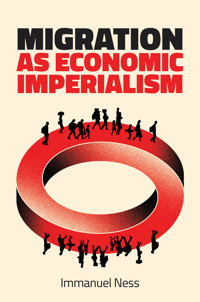
For several decades, wealthy states, international development agencies and multinational corporations have encouraged labour migration from the Global South to the Global North. As well as providing essential workers to support the transformation of advanced economies, the remittances that migrants send home have been touted as the most promising means of national development for poor and undeveloped countries. As Immanuel Ness argues in this sharp corrective to conventional wisdom, temporary labour migration represents the most recent form of economic imperialism and global domination. A closer look at the economic and social evidence demonstrates that remittances deepen economic exploitation, unravel societal stability and significantly expand economic inequality between poor and rich societies. The book exposes the damaging political, economic and social effects of migration on origin countries in Africa, Asia and Latin America, and how border and security mechanisms control and marginalize low-wage migrant workers, especially women and youth. Ness asserts that remittances do not bring growth to poor countries but extend national dependence on the export of migrant workers, leading to warped and unequal development on the global periphery. This expert take will be a valuable resource for students and scholars of migration and development across the social sciences.
Sie lesen das E-Book in den Legimi-Apps auf:
Seitenzahl: 463
Veröffentlichungsjahr: 2023
Ähnliche



















Table of Contents
Cover
Title Page
Copyright Page
List of Figures and Tables
Figures
Tables
List of Abbreviations
Acknowledgements
Introduction
Migrant workers are integral to destination societies
From foreign aid to migration and remittances
Interpretations of migration as a force for economic growth
The limits of migration as agent of development
Social remittances as cultural imperialism
The migration as imperialist nexus
Chapter outlines
1 Neoliberal Capitalism, Imperialism and Labour Migration
The Third World, formal independence and economic imperialism
Unequal exchange and global migration
Systemic global inequality
Redistribution of global income and wealth
Foreign capital investment in the Global South
Official development assistance
Foreign direct investment Special Economic Zones
Migration, remittances and development
Covid-19 pandemic and economic development
FDI and Covid-19
Conclusion
2 Underdevelopment and Labour Migration as Economic Imperialism
Countering socialism through economic development, 1945–1980
Imperialism and the development myth
Failure of free-market economic development models in the Global South and the rise of neoliberalism
Remittances as a source of investment and national development
United Nations Development Programme and economic remittances
Labour mobility and development
Focus on low-wage migrant workers
Peripheral labour in strategic production centres
The non-transmittal of remittances
Migration as individual freedom and national catastrophe
Benefits to destination countries
Remittances as economic imperialism
3 Labour Migration and Origin Countries
Why do origin states develop a labour-migration system?
Labour demand and remittances
Recruitment agency power over migrant workers
Exploitation by labour-migration intermediaries
Recruitment agencies and brokers
Labour migration and the exploitation of countries of origin
Nepal: forging a labour export state
How are migration recruitment regimes formed?
Remittances and the failure of economic development in Nepal
Vietnam: labour migration, poverty and social dislocation
Recruitment and identification of migrants
Vietnam: women and migration
El Salvador: structural remittances and social dislocation
Salvadoran migrant passage to the United States
Moldova: foreign labour, remittances and depopulation
Moldova: migration and remittances
Migration and economic crisis
Migration, remittances and social breakdown
Conclusions
4 Labour Migration and Destination States
Destination countries and critique of migration as development
Criminalization of migrant workers: irregular and undocumented migration
Fortress America and Fortress Europe
Temporary migration and unequal exchange
South–south temporary labour migration
Malaysia and temporary migrant labourers
Malawian migration to South Africa: poverty and exclusion
Covid-19 and worker exploitation and discrimination in destination states
Conclusion: opposing exploitation and empowering migrant workers
5 The Damage of Borders
Borders, inequality and migration
The utopian and neoliberal illusion of open borders
Migration and precarious labour
Expanded border control and labour exploitation
At-risk migrant workers in destination states
Border control and multinational corporations’ profits
Legal and undocumented programmes: popular movements and government strategies
Global compact on migration and multilateral international organizations
Global Compact for Safe, Orderly and Regular Migration
Covid-19 pandemic and socio-economic chaos
Covid-19 and migrant worker documentation
Migrant worker resistance to exploitation
Internal labour migration
International labour initiatives and solidarity with migrant workers
The limitations of trade-union support for migrant workers
Conclusion: Dismantling the Migration–Development Nexus
The costs of the global labour migration regime
The imaginary benefits of temporary labour migration
Labour migration: capitalist road to development or economic degeneration?
Remittances and the emergence of the rent economy
Women and migration: social reproduction, exploitation and isolation
Organic composition of capital and social reproduction of labour
Migration and global supply chains
Development or exploitation? Towards a new societal model for the Global South
Rise in low-income migrant migration, global production and inequality
Rise in labour migration, populism, xenophobia and restrictive borders
Enforcing workers’ rights and the future of labour migration
How will labour migration evolve in the coming decades?
Where does the growth of international, temporary migrant labour point in the future?
Exploitation of low-wage migrant workers in destination states
What is the alternative to remittances for economic development?
References
Index
End User License Agreement
List of Tables
Chapter 1
Table 1.1 Key Statistics on Migration, 2000 and 2020
Table 1.2 Global Income and Wealth Inequality, 2021
Table 1.3 Foreign Direct Investment, Net Inflows, 1970–2020
Chapter 2
Table 2.1 Labour and World Migration, 2020
Table 2.2 International Migration Stock, 1990–2020
Chapter 3
Table 3.1 Remittances to Nepal, 2000–2020
Table 3.2 Remittances to Vietnam, 2000–2020
Table 3.3 Remittances to El Salvador, 2000–2020
Table 3.4 Remittances to Moldova, 2000–2020
Chapter 4
Table 4.1 Leading Remittance-Sending Countries as Share of GDP, 2000–2020
Chapter 5
Table 5.1 Regional Shares of the Global Labour Force, 2022 (%)
Table 5.2 Labour Force by Region, 2022
List of Illustrations
Introduction
Figure 0.1 Remittances Received by Country Income (US$ Billions), 1990–2020
Figure 0.2 Remittances Received by Country Income (% of GDP), 1990–2020
Figure 0.3 Top 25 Countries of Destination (Migrant Share of Population), 2020
Figure 0.4 Top Ten Remittance-Receiving Countries (% of GDP), 2020
Guide
Cover
Table of Contents
Begin Reading
Pages
iii
iv
vi
vii
viii
ix
x
1
2
3
4
5
6
7
8
9
10
11
12
13
14
15
16
17
18
19
20
21
22
23
24
25
26
27
28
29
30
31
32
33
34
35
36
37
38
39
40
41
42
43
44
45
46
47
48
49
50
51
52
53
54
55
56
57
58
59
60
61
62
63
64
65
66
67
68
69
70
71
72
73
74
75
76
77
78
79
80
81
82
83
84
85
86
87
88
89
90
91
92
93
94
95
96
97
98
99
100
101
102
103
104
105
106
107
108
109
110
111
112
113
114
115
116
117
118
119
120
121
122
123
124
125
126
127
128
129
130
131
132
133
134
135
136
137
138
139
140
141
142
143
144
145
146
147
148
149
150
151
152
153
154
155
156
157
158
159
160
161
162
163
164
165
166
167
168
169
170
171
172
173
174
175
176
177
178
179
180
181
182
183
184
185
186
187
188
189
190
191
192
193
194
195
196
197
198
199
200
201
202
203
204
205
206
207
208
209
210
211
212
213
214
215
216
217
218
219
220
221
222
223
224
225
226
227
228
229
230
231
232
233
234
235
236
237
238
239
240
241
242
243
244
245
246
247
248
249
250
251
252
253
254
Migration as Economic Imperialism
How International Labour Mobility Undermines Economic Development in Poor Countries
Immanuel Ness
polity
Copyright Page
Copyright © Immanuel Ness 2023
The right of Immanuel Ness to be identified as Author of this Work has been asserted in accordance with the UK Copyright, Designs and Patents Act 1988.
First published in 2023 by Polity Press
Polity Press
65 Bridge Street
Cambridge CB2 1UR, UK
Polity Press
111 River Street
Hoboken, NJ 07030, USA
All rights reserved. Except for the quotation of short passages for the purpose of criticism and review, no part of this publication may be reproduced, stored in a retrieval system or transmitted, in any form or by any means, electronic, mechanical, photocopying, recording or otherwise, without the prior permission of the publisher.
ISBN-13: 978-1-5095-5398-3
ISBN-13: 978-1-5095-5399-0(pb)
A catalogue record for this book is available from the British Library.
Library of Congress Control Number: 2022952049
by Fakenham Prepress Solutions, Fakenham, Norfolk NR21 8NL
The publisher has used its best endeavours to ensure that the URLs for external websites referred to in this book are correct and active at the time of going to press. However, the publisher has no responsibility for the websites and can make no guarantee that a site will remain live or that the content is or will remain appropriate.
Every effort has been made to trace all copyright holders, but if any have been overlooked the publisher will be pleased to include any necessary credits in any subsequent reprint or edition.
For further information on Polity, visit our website: politybooks.com
List of Figures and Tables
Figures
0.1 Remittances Received by Country Income (US$ Billions), 1990–2020
0.2 Remittances Received by Country Income (% of GDP), 1990–2020
0.3 Top 25 Countries of Destination (Migrant Share of Population), 2020
0.4 Top Ten Remittance-Receiving Countries (% of GDP), 2020
Tables
1.1 Key Statistics on Migration, 2000 and 2020
1.2 Global Income and Wealth Inequality, 2021
1.3 Foreign Direct Investment, Net Inflows, 1970–2020
2.1 Labour and World Migration, 2020
2.2 International Migration Stock, 1990–2020
3.1 Remittances to Nepal, 2000–2020
3.2 Remittances to Vietnam, 2000–2020
3.3 Remittances to El Salvador, 2000–2020
3.4 Remittances to Moldova, 2000–2020
4.1 Leading Remittance-Sending Countries as Share of GDP, 2000–2020
5.1 Regional Shares of the Global Labour Force, 2022 (%)
5.2 Labour Force by Region, 2022
List of Abbreviations
CIS
Commonwealth of Independent States
CSO
civil society organization
EPZ
Export Processing Zone
EU
European Union
FDI
foreign direct investment
GCM
Global Compact for Safe, Orderly and Regular Migration
GDP
gross domestic product
GNP
gross national product
GUF
global union federation
IIT
Indian Institutes of Technology
ILO
International Labour Organization
IMF
International Monetary Fund
IOM
International Organization for Migration
IRCA
Immigration Control and Reform Act
ISI
import substitution industrialization
ITUC
International Trade Union Confederation
KNOMAD
Global Knowledge Partnership on Migration and Development
MENA
Middle East and North Africa
MNC
multinational corporation
MNE
multinational enterprise
MoLE
Ministry of Labour and Employment (Nepal)
MPI
Multidimensional Poverty Index
MRC
migrant worker resource centre
NAFEA
National Association of Foreign Employment Agencies
NAFTA
North American Free Trade Agreement
NGO
non-governmental organization
NSA
national security adviser
ODA
Official Development Assistance
OECD
Organisation for Economic Co-operation and Development
SDG
Sustainable Development Goal
SEZ
Special Economic Zone
STEM
science, technology, engineering and mathematics
TMP
temporary migration programme
UN
United Nations
UNDESA
United Nations Department of Economic and Social Affairs
UNDP
United Nations Development Programme
UNICEF
United Nations Children’s Fund
USAID
United States Agency for International Development
WFTU
World Federation of Trade Unions
WTO
World Trade Organization
Acknowledgements
In January 2015, on a research visit to Thembelihle, an informal settlement on the south-west fringes of Johannesburg, I found a community of migrants who had travelled from Eswatini, Lesotho, Malawi, Mozambique, Zimbabwe, and countries all over Southern Africa, struggling to survive. The settlement did not have basic services, including electricity, water, sanitation and roads. The migrants had come to South Africa to work and send money back to their home countries, yet on my last return, more than seven years later in October 2022, many remained beleaguered and destitute, scraping by to pay rent for their shacks, undernourished and lacking transportation to and from their exploitative workplaces. Some workers, especially women, were desperate to return to their origin countries but earned too little to save up to pay for the trip home. Living precarious lives at their destinations, few had extra money to send back to their families for food, education and essential needs. The migrant workers of Thembelihle have improved some facets of their lives, but they remain impoverished and have little hope for the future.
This book would not have been possible without migrant workers from the Global South sharing their stories of sadness, misfortune and exploitation during more than two decades of research in Africa, Asia, the Americas and Europe.
I have benefited from many scholars, activists who shared their research and organizing efforts in an effort to improve the conditions of migrants and their families in origin states. I thank all those who have encouraged me to pursue this project and accurately reveal the major dynamic of migration today that departs from the established narrative. Of course, in a complex world, some migrants succeed, but the global project of economic remittances as a source of development is a failed construct for those who are compelled to move for work. The perspectives shared by anonymous reviewers in origin and destination states were immensely beneficial in refining this unapologetic book for a general readership who, I hope, will recognize the severity for the victims of the current global migration project.
First and foremost, thanks to the many temporary migrant workers who I corresponded with in Southern Africa (Malawi, Zimbabwe, Lesotho, Mozambique); Central Asia (India and Nepal); East and Southeast Asia (Korea, Indonesia, Malaysia, Philippines, Thailand, Vietnam); Latin America (El Salvador, Honduras, Guatemala, Mexico) and Eastern Europe (Hungary, Moldova, Romania, Serbia). Particular thanks to experts who guided me in origin and destination states. I thank Shiva Kumar Adikhari, Chong Hye-won, Lee Chulwoo, Mondli Hlatshwayo, Elmer Labog, Maria Leskova, Park Jae-choil, Adrian Pereira, Bruno Pereira, Pragna Ragunanan, Abhinav Sinha, Won Young-su, Yoon Hyowon, and many others who have helped me comprehend the constraints of migration on development.
Particular thanks to scholars of migration and political economy who have advised me, most notably Dirk Hoerder, Cecilia Menjívar and Ali Kadri. I also thank all those with whom I have shared ideas and who have helped advance my thinking on this project, especially Stephen Castles, Claudia Tazreiter, Dario Azzellini, Maurizio Atzeni, Marcel van der Linden, Kristin Surak, Maxwell Lane, Zhun Xu and Paris Yeros. My work benefited from discussions with Wilma Dunaway, Torkil Lauesen, Nemanja Lukić, Brett Nielson, Sarika Chandra, Eileen Boris, Marie Ruiz, Luke Sinwell, Amiya Kumar Bagchi, Ranabir Samaddar, Mithilesh Kumar, Sarah Raymundo and Achin Vanaik.
I am especially grateful to the superb research support of Sibgha Sohaib and the ethnographic prowess of Siphiwe Mbatha.
Special thanks and appreciation to Jonathan Skerrett, Senior Commissioning Editor at Polity Press, who encouraged me to write this book from the start and meticulously helped me shape the fundamental arguments I have advanced in this book, and to Gail Ferguson, copy-editor, and all those who helped to produce this book.
Introduction
Migration as Economic Imperialism challenges the narrative set forward by the world’s leading economic development agencies, finance capitalists and western governments that international labour migration is beneficial to the entire world economy and is the primary means for the economic development of poor countries.
The central arguments of that orthodoxy are that migrant labourers benefit poor and rich countries through providing jobs for low-wage workers from southern countries, supplying necessary labour for destination states in the Global North and contributing to the economic development of origin states by sending hundreds of billions in remittances and by training workers in relevant jobs skills for economic development in poor countries. From the 1990s to the present, economic remittances have been recognized by migration scholars and development economists as the foundation of the neoliberal development programme, as labour migration from the South and economic transfers have expanded dramatically. In this way, the rise of labour migration since the global spread of neoliberal capitalism in the 1990s has benefited rich states in the North, the Arab Gulf and countries integrated into global production networks with labour shortages.
Migrant workers are integral to destination societies
Even as migrant labourers do not appreciably contribute to the development of their origin states, their work in indispensable jobs ensures stable and thriving societies in destination states. In the wake of the coronavirus pandemic, migrant workers filled essential private and public jobs shunned by native-born workers, enabling reliable access to food, medical services, consumer goods and critical logistical services in destination states. At great personal risk, migrants worked in agriculture, food services, medical and healthcare services, construction and infrastructure, and in distribution of crucial goods to residents of destination societies. Significantly, the pandemic has given rise to the ubiquitous presence of precarious migrant workers in logistics and platforms in destination states worldwide, serving the gig economy in delivery, for-hire transport and as cleaners and domestics (Altenried 2021).
The coronavirus pandemic also reveals the hypocrisy of populist critics of migration that are mostly beneficiaries of foreign workers who work for a fraction of native-born workers’ remuneration. While migrant labourers work in precarious jobs that are shunned by native-born workers, they are indispensable for the efficient running of society. Business requires temporary migrants to work in agriculture, construction and manufacturing, and residents in the destinations require gig workers for delivery, transport and home care. In this way, global migration advocates have underplayed the benefits which accrue to destination states employing exploitable and comparatively inexpensive workers to fill essential jobs (van Doorn, Ferrari and Graham 2022).
In spite of temporary migrant workers’ substantial contribution to destination communities during the pandemic, their support has not been reciprocated by destination states, as many have been forced to return to their home countries without payment of wages by employers (Foley and Piper 2021). Temporary migrants in economic distress are left to fend on their own with minimal community assistance in destination states in Europe, North America, the Arab Gulf, Russia and South East Asia (Rajan and Akhil 2022). Worse still, migrant workers lacking money and social resources have been subjected to discrimination and xenophobia as ethno-national populism and racism against labourers has expanded over the last two decades, a trend which was amplified during the pandemic (Elias et al. 2021).
Thus migrant labourers in rich countries of the Global North and South cope with a paradox of being both essential workers and social pariahs who are expendable and replaceable when socio-economic demand for their labour expands. In this context of exploitation, low-wage temporary migration is not a remedy for socio-economic uplift and poverty alleviation, let alone the most promising means of socio-economic development of origin countries. Both documented and undocumented workers toil on a treadmill of disposable labour predominantly subject to deportation and substitution when demand drops.
The contradictory status of the temporary migrant worker, often known as a guest worker, as valued employee and despised foreigner is a long-standing historical pattern stretching back to the nineteenth century. It has been resurrected by development economists as the remedy for economic development (Surak 2013). Temporary workers are typically recruited to travel from poor regions to affluent destination societies for a defined period of time, normally six months to three years. By contrast, migrants may gain permanent resident status in host countries with the same rights as citizens. Both temporary and permanent migrants may experience discrimination and xenophobia from native-born residents.
Temporary migrants differ from undocumented and irregular residents in North America and Western Europe, the latter not being permitted to live and work in destination states. However, both temporary and undocumented migrants send remittances to families in their countries of origin. Most developmental economists contend that remittances sent back to origin countries appreciably contribute to economic development. Undeniably, remittances prevent severe hunger and provide basic needs, commodities and consumer goods for families of migrant labourers. In some cases, they may pay for school fees or to build or rebuild homes. International development agencies and financial institutions promote remittances as a leading form of economic development for poor countries, as workers can send them home to support families, start small businesses and contribute to national economic growth.
In September 2019, the World Bank self-assuredly reported that migration benefits origin countries even more than destination states, while acknowledging rising xenophobia for workers in host countries:
Global welfare gains from an increase in cross-border labor mobility could be several times larger than those from full trade liberalization. Migrants tend to gain the most in terms of increases in income and better access to education and health services. Migration empowers women. Child mortality is reduced after migration. However, these gains are hindered by the discrimination and difficult working conditions that immigrants from LMICs [lower middle-income countries] face in the host countries. Origin countries can benefit through increased remittances, investments, trade, and transfers of skill and technology, resulting in reduced poverty and unemployment. (World Bank 2019)
This book offers a contrary perspective on the benefits of migration to poor countries in the Global South. While most temporary migrants from poor countries are unskilled and earn low wages in destination states, this book finds that, while remittances are sent sporadically and may pay for emergencies, such as medical care of sick family members, rent to prevent eviction, or funeral expenses for family members, they do not contribute to the economic development of most people in poor countries.
From foreign aid to migration and remittances
In globalized neoliberal capitalism, financial institutions and multinational corporations (MNCs) have been major drivers of capitalist investment for programmes aimed at the economic development of poor countries in the Global South. For more than 75 years, since the end of the Second World War, classical economists have advanced market-based remedies for alleviating systemic poverty. Western capitalist countries have favoured market solutions in exchange for negligible investment in the South through development assistance from the World Bank, foreign aid through insignificant western economic assistance programmes, and economic bailouts of poor countries indebted to western banks and financial institutions through the International Monetary Fund (IMF). These measures have been taken by western corporate investment in the Global South’s agriculture and natural resources for the alleged purpose of economic growth in developing countries. In almost every instance, MNCs of the Global North were the beneficiaries of profits derived from the extraction of everything from petroleum to bananas and rare minerals. When economically impoverished southern countries called for the nationalization of natural resources, the United States and Britain responded by overthrowing state leaders in Iran, Guatemala, Indonesia, Chile and elsewhere.
The capitalist market economies of the Global North, led by the United States, were motivated by the low-cost extraction of profit from the Global South. Though migrant labour was used to rebuild Western Europe in the 1950s and 1960s, it was not until the collapse of the USSR and the emergence of the United States as the indisputable, dominant economic and military world power that capitalist development strategists began to shift their focus to low-wage southern labour, precisely as the northern economies were shifting from manufacturing to service industries.
Thus international labour migration expanded dramatically in the 1990s to reduce shortages in the Global North of low-wage workers willing to work in tedious jobs in agriculture, construction, urban services, manufacturing and home care. For instance, in the 1990s, millions of Mexican workers crossed the US border to work in low-wage jobs which became available as the children of US industrial workers sought employment in higher-wage service and tertiary economic sectors. The capitalist assault on trade unions in the Global North eroded most construction and manufacturing jobs with high wages and comprehensive benefits into precarious work with low wages. In most cases, basic manufacturing of steel and industrial products shifted to the Global South in order to profit from low-wage jobs which produced higher corporate profits.
Most countries of the Global South which are now origin migration states have undergone a succession of western development schemes, from official development assistance (ODA) to foreign investments. International development organizations did not at first take an interest in encouraging migration to the Global North, except for temporary migration programmes (TMPs) necessary for rebuilding war-torn Europe, and encouraged import substitution industrialization (ISI), focused on developing industry in the Global South, until the 1980s, when neoliberal capitalism began to replace endogenous development in southern countries. However, in the 1990s, international finance and development organizations recognized that documented and undocumented labour migration gave rise to a growth in remittances – a portion of migrant worker earnings saved and sent home that development economists consider essential to the growth and development of origin countries – which constituted a leading source of foreign-exchange earnings in origin states. Remittances were always important sources of foreign exchange for small states in the Caribbean, Pacific and elsewhere, but in the 1990s they precipitously became leading sources of external revenue for large states, including India, Mexico, Pakistan and the Philippines. The expansion of the European Schengen Area extended official migration programmes to Eastern and South-East Europe, which were struggling to emerge from the ‘shock therapy’ policies which imposed capitalist market economies throughout the former Eastern bloc.
Interpretations of migration as a force for economic growth
As neoliberal economic globalization transforms the nature and composition of workforces, migrant temporary labourers comprise a higher share of the global workforce than at any time in the history of capitalism, even though labour migration has marginally declined to 164 million worldwide in 2021 in the wake of the Covid-19 pandemic (Black 2021; Hoerder 2010). In the Global North, demand for migration is increasing as its population ages and requires essential services which are developed in low-wage regions: medical services, care giving, food preparation, transport and even manufacturing (Milkman 2020).
According to the World Migration Report 2022, there were 281 million international migrants in the world, equivalent to 3.6 per cent of the world population (IOM 2022a: 21). If migrant workers have a family of four, a conservative figure in the Global South, about 1.125 billion people are directly impacted by migration, either as workers in foreign destination countries or as family members in countries of origin who are dependent on money and remittances sent back to them. In addition, 800 million workers migrate within states from agrarian and rural regions to urban centres, which increases the significance of migration (IOM 2019; World Bank 2021b). If immediate family members are included as being impacted by migration, constituting at least 3 billion people, nearly 40 per cent of the world’s population of 7.8 billion are directly involved in internal and international migration (Ness 2015).
In the first two decades of the twenty-first century, the number of migrant workers from low-income countries has increased, while migration from high-income countries is declining. Remittance studies have grown extensively over the past 15–20 years and are regarded as essential to sociology, politics and economics. Many studies are published every year on the subject, for example by two agencies of the United Nations (the International Organization for Migration [IOM] and the International Labour Organization [ILO]), the World Bank, the Global Knowledge Partnership on Migration and Development (KNOMAD), and numerous research institutes advocating remittances as the latest form of development. By 2018, migrant remittances had increased to US$689 billion, chiefly through capital flows from migrant workers working in developed countries to poor and developing countries and from the labour value of profit that accrues from poor countries to rich countries. In the aftermath of the Covid-19 pandemic, despite restrictions on international mobility, due to avid global demand for low-wage migrant labour, remittances held steady at US$630 million (KNOMAD 2022). Figure 0.1 shows the growing significance of remittances throughout the world; most global remittances are transfers from migrant workers in upper-middle-income and high-income countries to low-income and low-middle-income countries. In addition, a large share of remittances is from highly skilled migrant workers from high-wage countries sending money home to high-wage countries.
Figure 0.1Remittances Received by Country Income (US$ Billions), 1990–2020
Source: Derived from ‘Personal Remittances, Received (US$ Billion)’, The World Bank Data, https://data.worldbank.org/indicator/BX.TRF.PWKR.CD.DT
Even though an overwhelming majority of remittances flow to upper-middle-income and high-income countries, remittances constitute an outsized proportion of gross domestic product (GDP) in poor countries, as shown in Figure 0.2. As such, remittances flows reveal incredible global structural inequality. Today, southern countries send far more workers abroad than do rich countries and, in return, receive a fraction of the share of all global remittances, reproducing unequal exchange on a global scale.
Figure 0.2Remittances Received by Country Income (% of GDP), 1990–2020
Source: Derived from ‘Personal Remittances, Received (% of GDP)’, The World Bank Data, https://data.worldbank.org/indicator/BX.TRF.PWKR.DT.GD.ZS
Figure 0.3 shows the top 25 migrant destination countries in 2020. Eight of the top ten were high-income countries, and only four of the top 25 were not at least upper-middle-income countries.
Figure 0.3Top 25 Countries of Destination (Migrant Share of Population), 2020
Source: Derived from United Nations Department of Economic and Social Affairs, Population Division (2020b)
In contrast to the countries reaping benefits from migrant workers, Figure 0.4 shows that the ten leading remittance-receiving nations are among the poorest states in the world. Each country may benefit from remittance inflows, but the size of these inflows relative to each country’s GDP reflects the political and economic weakness of each state on the global stage.
Figure 0.4Top Ten Remittance-Receiving Countries (% of GDP), 2020
Source: Derived from ‘Remittance Inflows’. KNOMAD, World Bank, https://www.knomad.org/data/remittances
Migrants pay a high human cost to send remittances to their families in origin countries. Labour migration follows major capital flows and higher economic growth and development in global and rising cities. Migrants search for freedom from want in a sea of global economic insecurity, leaving their families in exchange for earning money to send back home. Although migrants can reduce extreme levels of poverty among core family members by improving food, health care, education and housing expenditures, community inequalities remain, family ties are weakened or broken and sending countries continue to be underdeveloped and economically insecure, subject to global financial crises and pandemics. Most importantly, they lack the capacity to provide for basic social needs to sustain populations: food, medicine, housing, education and essential infrastructure.
At first, migration was considered a means of providing employment for migrant labourers who could earn far higher wages and benefits in destination states to improve their own standard of living and that of their families in origin countries. Migrant labourers were performing economically and socially essential high-wage work in the Global North in hospitals, engineering, information technology, finance and business services, as well as low-wage work in agriculture, construction, manufacturing and care services. Most high-wage workers were recruited from other northern countries. However, a not insignificant share of high-skilled workers was also drawn from the Global South to work in these same industries.
For instance, highly educated workers in engineering and information technology in India were recruited to work on special visas in the United States and other western countries. Proponents of global migration consider foreign workers employed in cutting-edge industries of the Global North (science, technology, engineering and mathematics [STEM]), where temporary workers may acquire valuable skills, as sources of economic growth in the Global South. Migrant workers are supposed to bring these new skills home, where they are applied to the formation of new industries which contribute to the economic revitalization of poor countries through modern industrialization and services. However, as this book will show, many skilled international migrant labourers do not return to work in origin countries. In most destination states, southern skilled workers are more likely to be provided with legal status than low-wage workers. If they do return to origin countries, they often work in niche economies which do not contribute to improving the lives of most residents there but are directed to building networks with international business, engineering and technology firms. Examples of economic development occur in India’s tech and business-services sectors, and in those elsewhere in South Asia and sub-Saharan Africa, but they benefit a small fraction of elites as the majority of inhabitants remain mired in poverty. These phenomena have also given rise to criticism that migration to the Global North by high-skilled workers contributed to a ‘brain drain’, or the flight of human capital, from the Global South to the Global North. The Philippines, for example, devolved into an economy which exported migrant labourers for care work in affluent countries, fostering what Robyn Rodriguez considers a form of ‘migration for export’ (Rodriguez 2010).
Nonetheless, as a consequence of the vast rise in remittances to the Global South, neoliberal proponents of migration now judge the expansion of global migration and attendant return of money as the latest major form of economic development and a new means of replacing direct foreign aid by providing critical investment for the national development of poor and ‘developing’ countries of the Global South (Ratha 2013). Since the end of the Second World War, foreign aid has been directed at infrastructural projects that would supposedly contribute to economic growth and development, but has made a negligible contribution to development. As foreign aid has been tied to credit from western banks, southern countries have been trapped by extensive foreign debt, which has often led the IMF to force structural readjustment programmes, severely eroding basic survival needs: health, education and other social services. This in turn triggers foreign migration to provide benefits privately to the migrants’ families or, in some cases, smaller private initiatives. The rise of global temporary migration is in part a consequence of the worldwide expansion of neoliberal capitalism by the West. Remittances absolve western banks from funding foreign aid while at the same time privatizing the nominal public social benefits which were provided by poor countries to the poor from 1950 to 1990.
The limits of migration as agent of development
As the orthodox economic argument goes, economic remittances sent from foreign migrants are a far more valuable and viable growth strategy for driving national development among poor countries as they provide investment which advances strategic, private capitalist accumulation (Munck and Delgado Wise 2019). Whereas foreign aid kept elites in southern countries dependent on the economic largesse of advanced capitalist economies of the Global North, remittances are now judged as essential for invigorating poor countries and sparking free-market economic development and growth. Non-governmental organizations (NGOs) and development-policy advocates in academia contend that temporary labour migration will contribute to the economic growth and modernization of southern countries (Eggoh, Bangake and Semedo 2019). But these remittances do not improve the standard of living for most inhabitants living in poor countries and do contribute to economic imbalances which engender higher levels of crime and violence. Remittances themselves can contribute to the erosion of the agrarian sector in southern economies as they constitute a form of rent for many residents in origin countries who are dependent on the continuing flow of remittances, which, as we shall see, constitute an unreliable source of income.
Supporting this narrative of migration as development, academic research has countered and diminished critics who claimed that labour migration was a symptom of poverty (Nyberg-Sørensen, Van Hear and Engberg-Pedersen 2003; Ratha et al. 2019). For instance, migration scholar Ronald Skeldon contends:
One misunderstanding that pre-dated current concerns was the idea that migration was caused by a lack of development: that people left poor areas or poor countries because of a lack of opportunities at home. Certainly, this idea contains an element of truth, but closer investigation revealed that it was rarely the poorest who moved and rarely the poorest countries that participated most in the global migration system. (Skeldon 2008: 3)
The problem here is that these dominant interpretations of migration trends tend to track the latest statistics rather than take historical comparative perspectives. Malawian migration to South Africa provides a revealing example of the limitations of migration for the lowest-income countries in the Global South (see chapter 4). With a gross domestic product per capita of less than US$650 per annum (World Bank 2022f), among the lowest in the world, Malawi has a robust history of labour migration, extending over more than a century, which remains a highly significant feature of its political economy. The principal cause of labour migration is a function of poverty and lack of opportunity in origin states. Yet, as we shall see in chapter 4, the evidence shows that migrant labourers travel to South Africa to survive, and most cannot afford to send more than nominal funds home as the cost of living is far higher in South Africa. In low-income countries, migration frequently prevents national development as foreign workers do not have sufficient money to send home.
As this book asserts and demonstrates, severe poverty plagues the largest origin countries in South Asia, South East Asia, Latin America and South-East Europe, impoverished regions which have had among the highest migration rates from 2000 to the present. If migration were beneficial to development, then countries with high migration would not be suffering the highest poverty rates, or would at least be seeing improvements outstripping those countries that were not following a migration–development strategy. While labour migration is triggered by numerous personal and social factors, and the causes of poverty in impoverished states are complex, the primary dynamic of migration is rooted in the political economy of imperialism, which subordinates poor regions of the Global South.
The global political economy is fundamentally divided between rich countries in the Global North and poor countries in the Global South. But within the global divide, variations create greater complexity. Not all southern economies are exclusively impoverished, as they are riven by socio-economic and class divisions that benefit some who travel abroad and remit money back home. We must account for highly skilled professional migrants who remit funds to their homes. It is necessary, then, to distinguish between skilled and unskilled migrant workers. Skilled workers do well, but many of them migrate from developed countries or represent the privileged of the Global South.
In addition, while this book counters the migration and economic development dogma, middle-class migration and the historic diasporas improve the living standards of families in origin states and create translocal connections between home-town communities in host countries. For example, between the United States and origin states in Mexico, Central America and the Caribbean, cross-cultural networks are generated, even if US border control blocks regional integration and family unification (Massey 1986). Fundamentally, rising populism and nationalism in destinations expand border control and securitization and obstruct human mobility. It divides rather than unifies most poor and working-class communities of the Global South.
Social remittances as cultural imperialism
Research on the benefits of economic remittances by development enthusiasts has been accompanied by corresponding scholarship on the social, cultural and political benefits of migration, identified generally as cultural remittances which derive from the inculcation of western liberal-democratic ideals and practices into origin countries. Notably, Peggy Levitt claims that ‘[s]ocial remittances are the ideas, behaviors, identities, and social capital that flow from receiving- to sending-country communities’ and stimulate business formation and strengthen communities, families and political systems of origin countries (Levitt 1998). Social and cultural remittances are fostered through the integration of receiving-country social practices into the public sphere and civil society of origin states. Undoubtedly, transnational social and cultural integration is significant in promoting mutual understanding and the diffusion of cultural practices which cultivate diversity and global integration, along with community development in sending societies.
For Levitt, social remittances are obtained through new normative ideas and practices being learned by migrants in wealthy host countries and brought back with them when they return or visit their countries of origin. Social remittances extend to the political arena through the application of western liberal-democratic norms of imperialist countries to southern countries. Supposedly, the origin country will hold its politicians more accountable. Evidently, the Dominican Republic, under the cudgel of US imperialist dominance, would benefit from adopting its political and even religious practices, which were shaped in the first place by the imposition of US militarism (Levitt 1998). It is important to understand the experiences of migrants in destination states and how they shape society on their return, but the social remittance perspective, rooted in the transmission of norms, practices, identities and social capital, neglects the imbalance between dependent origin states and typically rich destinations (Levitt and Lamba-Nieves 2011).
In the imaginary of migration advocates, the only protagonists are those in and from origin states. Social remittance proponents advocate a form of social imperialism, whereby the sending country adopts the cultural and social practices of the destination to engender social reform, while the social capital of migrants in rich destination states is completely disregarded. Certainly, no major wave of temporary labour migration from rich to poor states is in the offing, due to the disparity in wages.
What is most significant to origin states are economic remittances. The capacity to send remittances is a function of border control and national chauvinism, populism and migration restrictions. Contrary to migration proponents’ assertions that labour migration is a positive force for promoting democracy, as foreign workers bring back democratic ideals, the departure of educated young migrants operates as a safety valve to avert popular protest against authoritarian governments. Educated youths and workers are encouraged to travel abroad as temporary workers, increasingly to authoritarian destination states in the Global South, rather than to remain at home and protest against inequality and authoritarianism. The reality that most temporary migrants are disparaged as undocumented or irregular in the destination states of Europe and the United States belies the view that such migrant workers will return to provide cosmopolitan and western liberal ideals which could democratize authoritarian or corrupt states (Escribà-Folch, Meseguer and Wright 2022).
This book is a corrective to the hyperbole among migration scholars about the benefits of economic, social, cultural and political remittances. It grasps the stark reality of neoliberal migration and imperialism and its continuity rooted in unequal exchange between the Global North and the Global South which originated in the European colonial project of resource extraction over the last three centuries. Thus this book seeks to focus on the principal contradiction of modern-day migration policies while simultaneously recognizing that numerous migration studies demonstrate the complex positive particularities and exceptions to the dominant analytic construct. Exceptions abound. But global migration data demonstrate the harm which is inflicted on the poor and working classes of the Global South.
Economic remittances only rarely offset the negative effects of migration in low-income countries of origin and reinforce dependence and uneven development (Amin 1976). Poverty and inequality continue to encourage migration on a global scale, but the inequalities inherent in the migration system mean that, for the global poor, the current regime of large-scale labour migration neither reduces global inequalities nor provides a path to ending economic and political power dominated by North America and Western Europe.
The orthodox, classical-economic migration literature contends that money earned by foreign workers, labouring for a fraction of native-born workers’ wages, can create revenue to generate new essential infrastructure and services in the poor countries from which they originate. However, the evidence demonstrates that economic remittances sent home by migrant workers do not contribute to an appreciable growth in the capacity of poor countries to meet essential human development goals, and certainly not the capacity to transform into advanced capitalist economies. In reality, remittances have never contributed to sustained economic development at home but have encouraged the most skilled and talented to work abroad.
This book will present new evidence that labour migration is a net loss and hindrance to growth and sustainable economic development. Throughout the Global South, young adults are educated at private training centres in medicine and health care, technology and engineering, business services, food preparation, construction, industrial production, domestic and caring work, and logistics to prepare themselves for work overseas (Rodriguez 2010). The skills which workers acquire in these training centres in origin states are not intended to build national economies or to become a source for national development and self-sufficiency, but for export to foreign developed countries.
Contrary to the position of multilateral development agencies (the World Bank, IMF and western capitalist countries), the premise of this book is that labour migration obstructs economic development and exploits migrant workers in developed countries, who are subject to discrimination, xenophobia, arrest and deportation. If we are to ameliorate poverty, climate disaster, perpetual war and higher levels of political conflict via populism, nationalism and intolerance in developed countries, then national development which fosters sustainable self-reliant economies – avoiding mass dislocation in the Global South – is a crucial corrective.
The migration as imperialist nexus
As has been mentioned, in a growing number of countries in Africa, Latin America, South Asia and South East Asia, migrant worker remittances are the largest single source of all GDP, and increasingly they are the largest share of all contributions to GDP. Now, doesn’t this seem a bit strange? Rather than living and working in their home countries, workers must travel overseas to earn the vast majority of their countries’ foreign exchange and a large share of GDP.
Most migration research distorts the impact of labour migration in the Global South, where 85 per cent of the world’s population lives and where the level of demographic displacement is highest. This book provides a southern view of labour migration, demonstrating that migration is by definition a disruptive process which, by focusing on the needs of destination states, monetizes economies and stunts education and training for workers in countries of origin. Crucially, it demonstrates that both legal migration and undocumented migration are strategies established by MNCs and governments seeking to expand their economic profitability.
Institutionally, the World Trade Organization (WTO) envisages a global system of temporary labour migration as an important stage in expanding global markets. This book contends that labour migration is a new form of Arghiri Emmanuel’s theory of unequal exchange as I draw on studies to demonstrate that remittances do not offset underdevelopment and structural poverty (Amin 1976; Emmanuel 1972). Although it is true that some countries of origin have reduced extreme poverty among the families of some migrant labourers through remittances, it is mainly big businesses and governments that benefit from remittances by multiplying their financial leverage, reducing or eliminating public and balance-of-payments deficits, and supporting free-market-based economic policies which do not prioritize economic development. Residents in southern economies become addicted to remittances flowing from exported migrant labourers, who are indispensable to sustaining the major engines of capital growth in the Global North and South.
Capital creates inequality within countries which uproots poor people from the countryside and small towns to bigger cities in the Global South. In the medium term, such rapidly expanding cities often become the cradle of economic insecurity for many of these migrants and their children (Davis 2017 [2004]). As a result, the poor become prisoners of want in their own land, so foreign migration will continue across borders with the objective of sending remittances to families in origin countries, though often at the cost of breaking physical contact with them and enduring harsh living conditions at destinations. Ultimately, migrant workers become the visible element of a system which reproduces the majority’s economic insecurity while enriching the few at national and global levels.
Migration as Economic Imperialism challenges the relationship between migration and development and the objective that development and growth are apposite for southern states that have been subject to centuries of economic imperialism by Western Europe and the United States. International migration today is even more abusive and exploitative as demand for temporary migrant labour expands in rich countries, even as the rise of national populism in destination states contributes to rising discrimination, xenophobia and exploitation of migrant workers. The growth of women migrant workers contributes to the rise of forced labour, trafficking of migrants for sex work and the development of a gendered international division of labour (Menjívar 2011).
The book objectively describes and analyses the practical consequences of international labour migration from the perspective of migrant workers in the world’s southern countries, as well as the consequences of migration on origin states that are subjected to economic imperialism through the continuation and expansion of unequal exchange of the labour and natural resources of the Global South. From this perspective, it can be more readily recognized that, rather than it being a simple case of migrant workers taking native-born workers’ jobs, they are in fact improving the standard of living and providing essential services in Europe, North America, East Asia, Oceania, emerging southern economies in the Arab Gulf (Gulf Cooperation Council) and South East Asia by adding value to consumer goods and services in host countries.
The book supplies evidence on migration and remittances drawn from studies and reports of leading international migration and labour organizations (e.g., the UN, the IOM, and the ILO, among other global and regional migration and labour-migration bodies) and the dominant research on labour migration. In addition, the work uses ethnographic and research studies which I have conducted in origin and destination countries. It interpolates dominant research from leading scholars to portray migration in a world of poverty and inequality as a form of economic imperialism.
Chapter outlines
The framework in this Introduction establishes the main argument of the book: labour migration constrained by national border control and economic remittances, rooted in national populism, which is intended to protect native-born workers, in fact reduces economic prospects for poor countries of the Global South sending migrant workers. It also leads to economic dependency, to warped and uneven development on the periphery within the context of economic imperialism, and to growing economic inequality in the developed countries.
Chapter 1, ‘Neoliberal Capitalism, Imperialism and Labour Migration’, provides a theoretical, conceptual and empirical critique of remittances as the primary feature in the ‘migration and development nexus’. The chapter contests the dominant narrative proffered by neoliberal migration proponents, multilateral financial institutions and developed countries of the Global North (which are the primary destinations of migrant labour) that economic remittances are the most recent, effective national-development model for the poor in low-income countries in the Global South (Delgado Wise 2021). In so doing, chapter 1 contests the capitalist development model and suggests that poor countries of the Global South must consider alternative forms of economic policy which sustain populations and deliver sustainable development that improves the lives of all their citizens. It interrogates the economic underpinnings, scholarly premises and policy prescriptions of the ‘remittances as development’ model, and instead demonstrates that in reality labour migration is a modern way to extend the extraction of resources from countries in the developing world. It is thus an integral extension of economic imperialism. Structural migration of skilled and unskilled labour continues the legacy of extraction of natural resources and agriculture over the past five centuries. The chapter challenges the prevailing interpretation of remittances as development by reassessing the dominant perspective of labour migration as beneficial to sending countries and a form of economic development which will finally lead to parity with the advanced capitalist countries. On the contrary, the portion of wages that foreign migrant workers send home does not fund national development such as new infrastructure or contribute to sustained social development through establishing healthcare programmes, education and essential services. In most instances of skilled foreign-labour migration, the precise opposite happens: essential workers trained in medicine and engineering leave origin states permanently and may assist their families through remittances to home countries. The research drawn from empirical studies shows that while remittance flows often account for the largest share of foreign-exchange earnings of origin countries, they fail to meet essential social and economic demands and are not a formidable driver of economic development in the Global South. As a consequence, modern labour migration is integral to higher levels of inequality between countries and within countries and is a malignant form of economic imperialism which perpetuates a global system of economic imbalance, poverty, dependence and the growth of precarious labour. It has also appreciably expanded exploitation of women, who have become indispensable to satisfying the demands of high-income countries through domestic work in the homes of the middle- and upper-class residents as caregivers, domestics and sex workers.
Chapter 2, ‘Underdevelopment and Labour Migration as Economic Imperialism’, uses case studies of migrant workers in sending countries to provide a detailed assessment of remittances as international financial flows which arise from cross-border movements of people and are monetized by banks and financial institutions. It provides case histories, drawn from sending and receiving states, of the extractive and oppressive nature of training programmes. It shows how fees charged to workers reduce the financial benefit of remittances to individuals, families, and communities back home. In fact, the fees charged on the nearly US$700 billion in economic remittances are highly profitable for banks and wiring agencies, and severely erode the value of money in home countries. In March 2021 alone, the World Bank reported the global average for wiring remittances in March 2021 was 6.38 per cent (World Bank 2021c). A portion of migrant labourer wages is withheld at many stages of the work process by recruiting agencies, contractors, dormitory services and transporters, among others.
In this way, economic remittances operate in a comparable way to global value chains, only in reverse. As global value chains for the production of commodities increase the value of products as they reach market, the economic charges and fees extracted by financial institutions grind down the value of money paid to workers through a wide range of mechanisms: (a) fees charged by wiring companies (e.g., Western Union and Ant Financial); (b) withholding of wages; (c) non-payment of wages; (d) expulsion and seizure of wages for workers who do not conform to national migration policies; (e) the necessity of paying for two households (in sending and destination countries).
Consequently, by the time economic remittances reach families back home, the funds may pay for necessities and perhaps create a small nest egg, but for most, they do not tangibly improve financial conditions. Economic remittances certainly do not bring sustained change to countries dependent on the global system of neoliberal financialization. Drawing on an approach which focuses on the complex web of the political economy of remittances, this chapter shows how labour migration and economic remittances deepen inequalities across the world. Converging on remittance flows, the chapter demonstrates that the current system of labour migration generates insecure prospects for the development of poor countries. This critique will account for the growing number of trainees in urban centres, foreign subcontractors and employment agencies which extract a significant share of funds from workers; so much so that very few people can afford the system of migration, let alone plan for contingencies which leave migrants in emergency situations, forcing them to return home before completion of their tasks. Taken together, economic remittances are not a viable, state economic-development strategy, nor do they adequately replace foreign aid to poor and developing countries.




