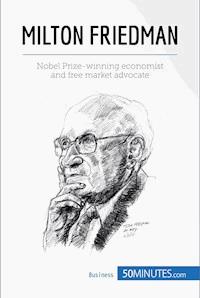
Milton Friedman
Key information
Name: Milton Friedman.Born: 31 July 1912 in New York.Died: 16 November 2006 in San Francisco.Context: he lived during a time that was marked by a liberal revival that aimed to reduce state intervention.Economic ideology: liberal inspiration, Chicago school of economics, monetarism.Notable works:Income from Independent Professional Practice, 1945 (with Simon Kuznets)Essays in Positive Economics, 1953Studies in the Quantity Theory of Money, 1956Capitalism and Freedom, 1962Monetary History of the United States, 1963 (with Anna J. Schwartz)Free to Choose, 1980.Key words:Floating exchange rate: unlike a fixed exchange rate, a floating exchange rate evolves freely according to supply and demand. Imagine that a European citizen wishes to take a loan from a US bank. Therefore, the repayment of the loan will require an exchange of currency to pay the banker in dollars. If the latter offers a loan with a floating exchange rate, this means that the amount of the loan to repay will vary depending on the rate offered by the market.Free trade: free trade is a theory which advocates the removal of all borders to trade and the freedom of international transactions. This system opposes protectionism, which protects its own economy against foreign competition by means of tariff and non-tariff barriers to trade, through measures such as taxes. For example, Country A which finds difficulties within its borders in the production and sale of milk, will protect itself by introducing a tax on any other country B wishing to produce and sell milk in country A at a lower price. Free trade aims to remove any possibility of protection against competition.Market economy: a system in which economic agents (companies and individuals) have the freedom to buy and sell goods, services and capital. Everyone then acts according to their own interests: profit, considered positive, is the reward for the risk here.Neoclassical theory: dating from the late 19th century, this theory aimed to strengthen the liberal ideas of classical economists such as Adam Smith (British economist, 1723-1790) or David Ricardo (British economist; 1772-1823) which had recently been challenged.Permanent income hypothesis: this is a theory developed by Milton Friedman in 1957 which assumes that consumer behaviour depends not on their current income, but their estimated long-term income.Planned economy: an economy where investment choices, production and pricing are decided by the state or its authorised agencies. A planned economy is the opposite of a market economy.Shares: in the stock market, shares are the stocks owned by a company. Investors are encouraged to buy shares in one or more companies to receive dividends and see their value increase, thus securing a profit on the sale. The value of the stock and the dividends together form the Return on Investment (ROI) of the share.Stock exchange mechanism: if the bank loan rate is low, more people borrow in order to invest more in the stock market. When it goes up, people then sell their stock investments (e.g. shares) to settle their debt with a remaining profit. For this mechanism to work, it is necessary for the borrowing rate to be low and the stock market to be continually growing.Stock exchange: a meeting place between supply and demand for a financial product (a company share, for example).Wall Street Crash of 1929: