


Erhalten Sie Zugang zu diesem und mehr als 300000 Büchern ab EUR 5,99 monatlich.
- Herausgeber: Books on Demand
- Kategorie: Geisteswissenschaft
- Sprache: Englisch
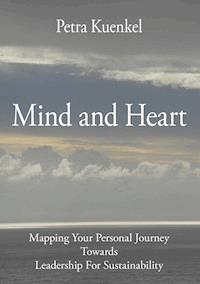
This book shows how leaders can use life and leadership experience to make a more meaningful contribution to the world It leads us into the inner world of leadership that we often tend to deny: the intuitive insight that at the core of our leadership journey is our contribution to the collective evolutionary process. What if we all knew the place within that is at home with the universe? What if we all knew how it feels to tend the common, the very force that nurtures all of us? Building on her own leadership journey and intensive conversations with 14 leaders from eight different countries around the world, Petra Kuenkel shows us how we can reconnect with the deeper theme of our journey and develop our own humanity as a gateway to leadership for sustainability.
Sie lesen das E-Book in den Legimi-Apps auf:
Seitenzahl: 370
Veröffentlichungsjahr: 2015
Das E-Book (TTS) können Sie hören im Abo „Legimi Premium” in Legimi-Apps auf:
Ähnliche



















To my daughter För,
and all people – young and old –
who believe that our
contribution to making this world more
sustainable counts.
CONTENTS
ABSTRACT
ACKNOWLEDGEMENTS
INTRODUCTION
CHAPTER ONE
UNFOLDMENT
CHAPTER TWO
PARTICIPATION
CHAPTER THREE
COHERENCE
CHAPTER FOUR
AWARENESS
CHAPTER FIVE
CONTRIBUTION
CHAPTER SIX
SUSTAINABILITY
BIBLIOGRAPHY
ILLUSTRATION OF MODELS
This book shows how leaders can use life and leadership experience
to make a more meaningful contribution to the world.
ABSTRACT
What if we all knew the place within that is at home with the universe? What if we all knew how it feels to tend the common, the very force that nurtures all of us? This book leads us into the inner world of leadership that we often tend to deny: the intuitive insight – called initial deeper intention – that at the core of our leadership journey is our contribution to the collective evolutionary process. It matters what we do and how we think. The leadership journey, in this view, is a process of unearthing one’s true nature in a spiralling movement, a growing self-expression in a gesture of responsiveness to what needs doing in the world.
Building on her own leadership journey and intensive conversations with 14 leaders from eight different countries around the world, Petra Kuenkel shows us how we can reconnect with the deeper theme of our journey and develop our own humanity as a gateway to world-consciousness. In this process lies a promise: the concern for the future of humanity is a consequence of cultivating one’s own humanity. In a globalized and yet endangered world, the individual’s insight and the world’s enlightenment are intrinsically linked.
ACKNOWLEDGEMENTS
A book like this takes shape long before the first word is written. It begins even before the idea is born. Events happen, insights mature, encounters develop and life teaches unexpected lessons. Above all, writing is a creative act that involves the thoughts, words and actions of many people. All of these things are mixed in a sea of consciousness, out of which the writer selects what makes most sense to her. This book is a product of encounters over time with people, thoughts and events. Of all those who have helped to shape this book, I can only name those who contributed directly and those of whom I have become aware as indirect contributors.
For me, the wealth of this book lies in the many conversations I have had with leaders. In particular, I want to thank Tina Orlando, Dorian Baroni, Lechesa Tsenoli, Ayalew Zegeye, Nancy Clay, Marianne Isaakson, Gilles Desorbay, Elke Geising, Murray Low, Ahmed Ashaibani, Milda Zinkus, Martha Morris-Graham, Wayne Bush and Tom Robison for sharing their insights with me.
I am grateful to Peter Garrett for the insights into the deeper structures of life that have inspired the chapters of this book, and for his unshakeable belief in dialogue and inquiry. His library encouraged me to journey deeper into the literature of consciousness. I am grateful, too, to Bill Isaacs, for giving me the opportunity to learn about leadership and the role of dialogue. Thanks also to Beth Jandernoa and Glennifer Gillespie for their open support of women leaders.
I want to thank Christine Nachmann, Ryan Lemmer, Dave Bond and Kristiane Schäfer for their active support and encouragement; Robert Cran for the inspiring thoughts, and Vipassana for the practice of meditation that gave me practical insight into the development of consciousness.
INTRODUCTION
In the early 1960s, a girl grew up in the West of the divided city of Berlin. She lived with her parents in a beautiful area near the river from which she could, at times, hear shooting from the border – East German soldiers trying to prevent people from escaping the communist system. As a child, full of dreams, she battled with this reality. She never quite believed it, although each time her parents took the road along the terrifying fenced border, she almost stopped breathing for the ten frightening minutes it took to travel from her village to the big streets of the city. At the age of eight, she saw in a repeated daydream how all people, including East Germans and West Germans, took each other by the hand and walked over the border. And she saw how nothing terrible happened once this border was crossed. Rather, people celebrated peace, and the girl saw herself giving speeches about the possibility of all people living in harmony.
Some parts of her daydreams came true. I call this faculty of dreaming the initial deeper intention: the intuitive, half-rational, half non-rational feeling or insight, during childhood or adolescence, that the world can be a different place. It is an unconscious response to a call that is deeper than surface reality. It is almost a knowing that comes from a timeless place, a place that contains the eternal potential for humanity’s reconciliation. If only we all nurtured our initial deeper intention. But the world outside us does not favour this inner knowing. Rather, the world often ignores it and educates it away.
When I became an adult, I remembered the story of my daydream when I began to talk with leaders about their young leadership stories. Only then did I realize the immense role of this earlier intention. For others, too, there was at least a trace of a memory of wanting to change the world or of wanting to be a force for good.
In ways that were not always conscious or consistent, this knowledge informed the professions I chose and the path my life took. It became an often-silent thread throughout my life and career. It was lost, found, then lost again, until it finally made its way back into mind and heart.
What if we all knew this place, the place within that is at home with the universe? What if we all knew how it feels to tend the common, and, in so doing, to nurture the very force that nurtures all of us? This book invites you on a journey into the inner world of leadership that we often ignore: the intuitive insight that, at the core of our leadership endeavour, is our contribution to the collective evolutionary process, a contribution to the sustainability of our world. It matters what we do and how we think. The personal leadership journey, in this view, is a process of unearthing our true nature, a growing self-expression that responds to what needs doing in the world.
The Berlin Wall fell because an uncounted number of people did what needed doing. With all shortcomings acknowledged, this was one of the moments in history when peaceful collective action changed the world.
Between the girl’s daydream and the writing of this book lie years, journeys, experiences, aspirations, dreams and disappointments. But the core theme – the healing of fragmentation – has persistently presented itself to me as a call to action, no matter which form it took. It could not be silenced, not even in the most demanding of careers. I never consciously heeded the call. But it must have been at the centre of my decision to study medicine (a disappointing experience, because I found no healing of fragmentation in Western medicine). It must have been there when I attempted to understand people and the world by studying psychology and political science, in my frustration with traditionally fragmented Western science, in the insights I gained from my work in Africa, and finally in my work in leadership development and change management for sustainability.
I was not always aware of the fact that the theme of my journey kept re-emerging. But it did, in questions, crises, contentment. It was only when I began to look at other people’s journeys more consciously that I saw my own, reflected in their endeavours to realize not only their own potential as leaders, but also in their unique paths based on dreams, insights, revelations and authentic values. I realized that I was not the only one journeying on this path and not the only one with a leadership model that was constantly under construction. I began to see leadership journeys in a different light and thought there was something to be discovered about the initial deeper intention, the internal development of consciousness in individual leaders, and the impact this has on the world outside. I became interested in understanding leaders’ concerns about making a wider contribution to the world. I decided to embark on a more structured inquiry into leadership journeys and their potential role as a gateway to increasing world-consciousness and more responsible business action.
But why leadership journeys, rather than ordinary life journeys? Because I do not see leadership as being separate from the rest of one’s life. I believe that, because of their formal or emotional position of power, leaders influence the course of reality decisively. So their states of mind have an impact that is, conceivably, greater than others’. Leaders have raised their voices or have been given the authority to speak, and they influence reality because of this. Sometimes the mere fact that leaders hold positions of power makes them nodes in a larger network – and sometimes it is their resonance with others that places them there. The way they connect and communicate affects other people. No matter how conscious they are of this, a leader’s actions are highly visible to others. Their behaviour affects areas beyond the obvious, areas often found beyond their official tasks. I therefore assume that leaders, regardless of their official capacity, have a special obligation, an almost undeniable responsibility – they need to become conscious of how they influence reality.
I see the leadership journey as a process of unfolding consciousness in response to one’s impact on the world. It is a growing expression of a person’s individuality, gifts and experienced-based wisdom that leads to an increasing awareness of what needs doing. This usually develops in a domain of influence that goes beyond the private sphere, and includes a relational position of power. In my view, the leadership journey holds, at its core, the deeper initial intention – and its underlying theme is uncovering a deep-rooted concern for humanity through becoming aware of one’s own humanity. This, in turn, creates authentic value and has a potentially positive impact – on the world, for other people, for humankind. It is the cornerstone for leadership for sustainability.
The process of unfolding towards greater awareness of one’s true responsibility in the world is the thread that runs through this book. The significance of this process is clearly evident when seen against the backdrop of the evolution of human consciousness.
Despite the fact that the world is hugely fragmented, that the problems causing war and poverty are far from being solved, and that disparity and an endangered environment are the order of the day, there is also a slow but growing movement towards a more sustainable world. From all walks of life, from business, civil society, governments, spiritual communities and committed individuals, comes a sincere attempt to put the future of humankind and of this planet on the agenda and to keep it there. Often fragmented, sometimes in competition, at times with little real effect, the call for change is becoming noticeably stronger. Despite the still-widespread feeling of powerlessness regarding the course the world takes with all its suffering and atrocities, consciousness seems to be changing and gradual changes in concern and responsibility are being brought to, or forced into, the world of business.
It is likely that the kind of leadership in international businesses today will decisively influence how the world develops. It would seem, then, that big business, more than any other factor, will determine the world’s course, and, therefore, the future of humankind.
But every change in an organization results from the choices made by dedicated people. Leaders who examine their lives, their choices, and their values can begin to experience themselves as co-creators of an interconnected reality. There is hope that the leadership in global as well as local organizations will respond, out of a sense of interconnectedness and co-responsibility, to questions about human dignity, inclusiveness, and fairer distribution of wealth. It might finally respond to the call for a sustainable world. However, since every business, every organization is made up of individuals, there is very little chance of a change in consciousness unless the change also takes place within each individual.
The collectively expressed need for sustainable action surely supports the inner process of accessing one’s own potential to contribute to humanity. But the process remains particular to each leader, and neither its form nor its timing can be predicted. The road to humanity is different for each leader – there are no shortcuts or recipes. I believe that accessing one’s own humanity is crucial to the development of world consciousness and to a deeper compassion for the world.
From the many encounters I have had with leaders from various parts of the world, I have noticed a remarkable aspect of today’s reality: the desire to make a difference is present in many leaders, however deeply buried. I met very, very few who, if sincerely questioned, would not find deep in their heart the aspiration to contribute to a better world.
Beneath the surface, there is an unexpressed need to create more meaning, more connectedness, and more relatedness, and to help improve the lives of others. Wanting to make a difference in the world by serving humankind is probably the most widely suppressed desire in organizations and among leaders. A senior manager from a multinational company phrased it like this:
What I feel is that every person actually has a core that wants to serve … and it is more about uncovering it, because this gets silenced, cut off, nobody is asking for it, nobody is rewarding it in the organization. You almost have to do it against all odds.
This latent desire is what I would like to encourage you to rediscover, explore and cultivate. If you don’t do it, nobody will do it for you. And the world’s course depends on each person’s contribution.
If my assumption is correct, if, at the bottom of a leader’s aspiration, is the desire to serve the world, accessing such aspiration cannot only free you to follow your authentic self, it will also open the way to more responsible and responsive leadership. The change out there in the world cannot be separated from the change inside you. Issues of sustainability need a response from each person’s heart, or they won’t be sustainable. At the same time, the personal development of leaders needs to reflect more than effectiveness and performance. It needs to become a pathway to sustainable future action in this world. Inspired by one another, mind and heart will develop in unison.
In 2003 I encountered a book in a little bookstore in Bombay, India. There on the shelf was a booklet made of inexpensive material entitled The Future of Humanity. It was a book documenting a dialogue between two people that took place twenty years earlier – the Western physicist David Bohm and the Eastern metaphysician J. Krishnamurti. The conversation centred on the fact that the contributions of modern science and technology never seemed to be used for the greater good of humanity. In the end, they were always used for destruction, and that this had its origins in the distorted mental activity that formed the basis of human behaviour and not in the technology itself (Krishnamurti & Bohm, 1986).
Krishnamurti’s base assumption is that human thought creates divisions – between ‘me’ and ‘you’ and between ‘me’ and ‘the world’. It then acts on these divisions as if they were facts. To nobody’s surprise, the mental activity that continues to fragment shows up as polarization in the world: difference, disparity and conflict. The way Krishnamurti saw it, we all live in a world of illusion, thinking that ‘my’ consciousness is different from another person’s consciousness, and, in doing so, we constantly recreate the illusion of separation we see in the world. In the booklet David Bohm poses a crucial question: ‘Do you want to say there is one consciousness of mankind?’ (Krishnamurti & Bohm, 1986, p. 24) and Krishnamurti responds in his straightforward way: ‘It is all one.’(ibid.). For him, at the core of the human condition is the illusion of separation, in which each person struggles alone, trying to fulfil himself or herself to achieve peace, happiness and security. And yet, if consciousness is all one, no one can win the struggle for fulfilment in isolation.
The very attempt to separate one’s own happiness from the suffering of others would be a reinforcing activity that would maintain separation and create more suffering, more disparity and more conflict. Hence, only the understanding, or, rather, the experience, of reality as being composed of one consciousness of humankind can pave the way for the liberation of the human mind. The transformation of human thought would require overcoming the illusion of separation, individually and collectively. For Krishnamurti, only this radical transformation of thought patterns could effect real change in the world. For him, the future of humanity depends on this transformation of the human mind (Krishnamurti & Bohm, 1986). And he is convinced that a different collective outcome is only possible if this process takes place within the individual.
This particularly radical view inspired me to explore my own and other leaders’ journeys in terms of their interaction with memory, thought, insight, transcendence of experience, and bringing forth enactment of reality. That humble little booklet had posed a challenge to my busy consultancy work in the world: that the transformation of collective thought patterns towards sustainable action in the world is highly dependent on the authentic transformation of the individual mind. This is why the inner transformative process of leaders is the starting point for my writing. My base assumption is that in the process of bringing oneself into the world, the increasingly authentic self-expression of a leader is inextricably linked to and influenced by human consciousness as a whole. And vice versa – the development of consciousness within the individual has an influence on human consciousness as a whole. Thus, in terms of human consciousness, it does matter what leaders think and how they evolve internally. The world, if I adopt the thinking of Krishnamurti, is co-created by consciousness, by collective and individual thought, and only subsequently by action. Thus, more conscious participation by leaders in the movement towards the regeneration and sustainability of life on this planet could engender hope for the future of humanity.
Based on my own leadership journey and on extensive conversations with 14 leaders from eight different countries, this book invites you to reconnect with the deeper theme of your journey and to develop your own humanity as a gateway to world-consciousness and leadership for sustainability. The leaders I spoke with came from various cultures: American, European, Arabic, African. They were of different ages (28 to 58); male and female; and they held different leadership positions in multinational companies, governments, unions, NGO s and their own small companies. All of them had begun to ask questions regarding their leadership contribution, the kinds of questions that do not have ready answers, great stories or wise speeches, but were worth pondering for a while. What started out as a three-month enquiry ended up taking six to nine months in most cases. In the various conversations, patterns of thought and experience became evident and insights emerged in partial response to the question: What prompts us to access our humanity on a deeper level and subsequently to become more concerned about humanity as a whole? The key to understanding our leadership role could not be found on the surface by looking at our activities and tasks. Below the surface, we found an inner world with a leadership model constantly under construction in response to inner experiences and outside events. This deeper source within, that nurtures and informs the way in which we collectively bring forth a world, is essential for the journey. Leading can take place anywhere, from within or outside an organization, and from different levels of the organization’s hierarchy. Positional power and roles of leadership can change, but the journey of leading from within continues.
Both the struggles and achievements of leaders count. It is the way in which we try to make sense of our path towards maturity that becomes the essence of our journey. Inspired by Krishnamurti’s suggestion that consciousness is one (Krishnamurti, 1978), I realized that when we acknowledge, support and understand the maturing awareness of one another, we begin to glimpse the whole of consciousness. As awareness expands, so the desire to contribute grows. Leading from a deeper place within values the individual, while encompassing the interests of the collective and of the greater good. This book assumes that the very inner quality of leadership, the expression of one’s particular voice, is, in its deepest essence, always based on an intention to favour life. Providing leadership that is in tune with the greater good is a quality available to all people. Leading consciously and for the benefit of humanity is not about gaining yet another set of skills, acquiring more interpersonal capabilities, or adding a new leadership strategy to our repertoire; rather, it is a process of dropping a load, of peeling off the layers of memory and expectation, of freeing oneself from the demands of normative behaviour, and of finding home, of unearthing what is, and always has been, there. Only then do we feel closest to the Universe, to others, and to ourselves, and can lead from an inner centre that is not fragmented, not separated from the world ‘out there’. In this state of heart and mind, acting in a way that benefits the world and humanity seems less ambitious, less demanding. It seems to be the natural way. Compassion becomes a constant companion, and so does the desire to contribute. There is lightness about leading more consciously, even though it is often gained through hard experience. There are helpful skills, things one can learn, discover, or acquire on the road to more conscious leadership, but none of these ingredients are a substitute for the personal transformative process we experience in its particular form, shape and sequence. The essence of our leadership journey is about growing into our true identity as a leader and, by doing so, accessing an intelligence that is greater than ourselves and encompasses the whole. In a globalized yet endangered world, our individual insight and the world’s enlightenment are intrinsically linked.
This book invites you to review your own leadership journey in the light of other people’s experiences. It offers you the stories, thoughts and insights of fellow travellers that can inspire, console or encourage you. It will also offer you passages of theory that might help to relate insights to recent or timeless scientific thought, as well as suggestions for further reading. You can choose to ignore the theory – it will be clearly marked! There is a summary at the end of each chapter and a passage for reflection. My advice: do not answer the questions diligently. Take them with you, on a plane, into the next stressful meeting, on a holiday. Just carry them around so that they pop up in your mind every now and then. If you wish, take notes. But do not force yourself. Let the process be organic rather than structured, and the questions might just trigger questions of your own.
Questions are there to transform the mind. Or as Rainer Maria Rilke said in his ‘Letters to a Young Poet’:
I want to beg you, as much as I can, to be patient toward all that is unresolved in your heart and try to love the questions themselves like locked rooms and like books that are written in a very foreign tongue. Do not seek the answers, which cannot be given to you because you would not be able to live them. And the point is to live everything. Live the questions now. Perhaps you will then, gradually, without noticing it, live along some distant day into the answers.
Reflections
If you see your life as a journey with places you have been and places you might still go to, where do you think you are at this moment?
What is the question that is currently uppermost in your mind?
If you had no security or money constraints, what would you most like to do?
CHAPTER ONE
UNFOLDMENT
I do not know where this book found you – in an airport bookstore just before embarking on a business trip, at your favourite holiday resort, on the shelf next to your bed in winter time, or among your birthday presents. Lives are different and so are leadership journeys. But I do know that if you’re reading this book, a question is taking form in your mind or in the mind of someone close to you. It may not be well formulated, it may be vague, reluctant to be expressed, or it may have been hammering in your mind loudly enough to stop ignoring it. You might feel lonely at times with this question and experience increasing alienation, as if you were the only one who thinks or feels like this, the only one who does not feel entirely at home in this world. Or it may be less than the seed of a question; it may simply be a vague feeling of tiredness, a fear of insignificance, a hurtful absence of meaning in your life, a feeling of being lost, an inner numbness, or a palpable sense of rising emptiness. Or you might have picked up this book because it resonated with you, because it expressed the feelings you have had for some time.
Maybe this book has found you in the middle of a real crisis, in an experience of loss or disappointment, in the wake of a change that you did not initiate, or in a time when you feel undeniably stuck. Or maybe you’re content with the achievements in your life, but you sense faint anxiety because you suspect they may not last.
There are innumerable ways in which the human mind and heart prompt us to pay attention and to ask ourselves where to go from here. And there are as many ways of ignoring the cues. Whether you’re paying attention or ignoring the cues, please consider simply observing. Just that: observe what is happening. You aren’t the only one on this journey. There are many others travelling this path. But it is your mind and your heart responding to something that is no longer lying dormant within you. It is a reminder that your leadership journey is a quest, that it always has been and always will be one. There is no guarantee that you’ll ever reach the final destination – but there is a promise that the longer the journey is, the more you will have understood about the human mind and the human heart, and the nature of consciousness. There may never be an answer to the question of what exactly your contribution is, but, with a bit of luck, you may well come closer to a feeling of being at home in the Universe.
Not long after his dialogues with Krishnamurti, David Bohm developed his theory about the ‘implicate and explicate order’. In a conversation with the leadership thinker Joe Jaworsky, he explains:
Yourself is actually the whole of mankind. That’s the idea of the implicate order – that everything is enfolded in everything. The entire past is enfolded in each of us in a subtle way. If you reach deeply into yourself, you are reaching into the very essence of mankind. When you do this, you will be led into the generating depth of consciousness that is common to the whole of mankind and that has the whole of mankind enfolded in it. The individual’s ability to be sensitive to that becomes the key to the change of mankind. We are all connected. If this could be taught, and if people could understand it, we would have a different consciousness. (David Bohm, cited in Jaworsky. 1996, p. 80)
Whether you recognize it or not, there is an unfolding taking place through you in your leadership journey. It may not be entirely in your hands, but it is not happening without your permission either – you aren’t passive in this process.
A Glimpse into Theory: David Bohm’s Theory of the Implicate and Explicate Order
The quantum physicist David Bohm describes the order that underlies all visible order (understand: visible physical and mental structure), as the ‘implicate order’. The implicate order (from Latin ‘to be enfolded, to fold inward’) is a level of reality that can be imagined as lying beyond our normal everyday thoughts and perceptions, and also beyond any of the models of reality offered by traditional scientific theory. What we see as well as what we construct mentally belongs to the ‘explicate order’ (Jaworsky, 1996, p. 78). In the implicate order, one could say that everything is enfolded into everything, invisibly, very much like Krishnamurti’s concept of one consciousness. In this deeper order of nature, everything is interwoven with everything else, forming the underlying source of what we see as manifest reality – the explicate order, where things are physically or mentally manifested. Each such manifested entity is perceived as existing in its own particular region of space (and time) and outside the regions belonging to other things (Bohm 1996, p. 177). Quantum physicists look below this surface reality into sub-atomic reality with its field of potentiality that gives rise to the physical world. What they find is only potential and constant change.
David Bohm believes that our organs of perception cause us to fall prey to an illusion, thinking that not only are the things we see and the thoughts we have separate from each other, they also seem to be all there is to reality. Buddhist philosophy is founded on a similar conclusion. Physical reality is called maya (illusion), which we believe is all there is, ignoring the vast underlying interconnected reality. Bohm suggests that if we became aware of the oneness of all things on a deeper level, including the oneness of all humankind, we would see that ill will, competition, hatred, violence, and conflict are nothing more than unconscious acts of self-destruction (Bohm, 1996).
Another quantum physicist, Dana Zohar, describes this underlying reality as a kind of undercurrent, almost like a vast sea (Zohar & Marshall, 1994, p. 331). As human beings we are like excitations, ripples on the surface of the quantum vacuum’s sea of potentiality (ibid, p. 274). We are temporary yet relatively stable structures over a certain period of time, like temporary forms to be seen on a surface. Like everything else, we are part of nature’s evolving reality. Life is a never-ending flux of enfoldment and unfoldment. Everything undergoes constant change. Even what we see as manifest and stable is constantly under reconstruction: we ourselves, mind and body, the world.
When you find yourself in any of the states I mentioned above, I believe it is worth looking at the early part of your journey. Your memory might be scattered or faint. It might take time to remember anything at all. But I am sure there were secret daydreams, fairy encounters, heroes you admired, books you were fascinated by, a painful experience that triggered a quest, a silent promise to yourself, dreams of discovery, visions of being a saviour, empathy with suffering, an identification with heroes who represent deeper human values. No two young leadership stories are the same. So don’t expect grand visions. Look for the value beneath your memories, the emotionally charged insights. Take your time to unearth the ordinary details. Collect the scraps of memory patiently. Gradually begin to listen to your leadership journey, as if there were a connection to a great underlying tune that is constantly playing yet so difficult for us to hear. While you begin to search your memory, listen to this.
In the early 1950s in rural Ethiopia, a boy named Samson had reached school-going age. He had grown up with a father he admired for his strong character:
He never submitted to power and went every mileage after the truth. He loved human beings, irrespective of their social status, and he had a way of simply acknowledging your existence and giving the required space for whatever was there to exist.
His father proposed that he go to a modern school. But, at the age of seven, Samson violently opposed this – he refused to attend a modern school. Ethiopia was predominantly Orthodox Christian and for a long time, the traditional church had been the only source of education. At that time, modern schools were associated with nonorthodox Christian religion. Samson with his bright seven-year-old mind concluded that going to a modern school would mean that he would have to change his faith and convert to modern Catholicism. His father, a peasant in a traditional culture, could have forced the boy, but he did not. Samson says:
He acknowledged me as an equal because I existed and I needed to be given the space I deserved. So what he did was to take me to the head of the Orthodox Church in our neighbourhood to convince me that going to a modern school would not mean I had to change my faith. This experience – to be treated like an equal by my father – was absolutely crucial for me. It lives with me and in me.
There it is – a strong and deep value, timeless, resiliently placed in the collective human consciousness: the conviction that people are equal and should be treated as equals. Implicit in this conviction is an intuitive knowing that borders separate what belongs together; the insight that the world needs tolerance and enlightenment; the desire to experience and create harmony; an admiration for people who fight for justice; and a fascination with the diversity of the human race.
Children have innumerable ways of relating to eternal human values. Edith’s parents lived in the country side in southern Germany. Her mother and father had a hard time. Edith’s mother didn’t come from the ‘right’ social class. Her father should not have married her and people made sure she was always aware of this. It was 1960 and Germany had not entirely recovered from the Second World War. At the age of 14, Edith began to escape into books and music: Beethoven and Simone de Beauvoir. She wrote in her diary:
I have a dream to change the world. Tolerance, tolerance, tolerance. I want to be the most tolerant person, and enlightened, really have clarity, and really understand how the world functions. Equality, and respect, respect for the dignity of a human being, no matter what race or colour or religion.
This intention stayed with her and became a driving force throughout her life.
At the core of what I call the initial deeper intention is a perception of incoherence – the world is different from one’s intuitive insight, it contradicts the deeper value one has experienced in insights, dreams, and admirations. Here the initial deeper intention develops: this has got to change. This needs healing. The world needs to become how it is meant to be. I want to understand how the world works. The intention is intuitively geared to healing, to contributing to life, to serving, to wanting to create change for the better. There is, at times, a frightening element of loneliness – the child or young adult senses that this deeper feeling of how things ought to be is not widely acknowledged. It might be better to keep it a secret, this stuff of dreams, diaries, and journeys of the mind. But even though it is buried, the intention has formed and it begins to form the mind in subtle ways.
How this happens depends on the mind and circumstances of the young person. And it is not always a conscious process. The pieces of the puzzle that you might be able to see in retrospect might have been there all along. There is no way of knowing how accessible this intention is to the growing mind of an adolescent, and no way of telling how it will influence choices and how resilient it will become. But I believe that many more people than we think are aware of the whole and have an intuitive feeling about what is needed in the world.
Lucia, the child of mixed Italian and English parentage, grew up in London. In the early 1980s, there was a TV series she loved very much. Her absolute super heroine was Wonder Woman.
Wonder Woman was very cool, she was such a superhero and she would save whoever was in trouble. As soon as she was needed she pulled a lasso out of her belt and she would swing the lasso over her head and become Wonder Woman, the saviour.
In her dreams Lucia was Wonder Woman. At the age of 11, Lucia knew that she wanted to become a lawyer. She loved debates, she loved arguing, and she wanted to fight for the underdog. She wanted to help people who did not have a voice, who were condemned for the wrong reasons or who could not get themselves out of difficulties.
I believe that the initial intention is the starting point for your leadership journey. It is a resilient underlying theme, not necessarily rational and seldom realistic, but nonetheless a deeply held emotional thread that informs your journey into adult life. For some people it grows into a clear vision for change in the outer world during adolescence, following a realization about what the world seems to need, and, subsequently, about what one needs to do in the world to help it to become a better place. For other people, it remains a vague underlying rhythm, masked by the experience of its irrelevance in the outer world. The intention too often gets lost in the turmoil of finding one’s place in private and professional life – even the strongest of visions is sometimes dismantled by the impossibility of its implementation, and the intention is slowly buried by disappointments and disillusionments. But, somehow, it surfaces again in different guises throughout the journey until it makes itself known as questions that turn up at different points of the journey. This thread consciously or unconsciously informs the choice of profession, places, organizations, tasks.
During the years in which he grew, Samson’s deeply held conviction about respect and dignity for each and every person in the world became an unconscious guiding force. Education and exposure to the world made him see that the value he so strongly internalized was not at all commonly applied. This triggered deeper questions in life. As a young adult, he wanted to know how the world works, so he plunged into philosophy and politics. The more he saw of the world, the more he knew that it did not operate according to his deeper values – neither the world at large nor Ethiopian society. He dreamt of changing his society, thinking that there must be a way of overcoming the misery and destitution. His bright mind gravitated to the revolutionary writings of Marx, Lenin and Mao. The warrior in him adopted the commitment to change and took on the Marxist resolve to struggle. He believed this was the only way of bringing about transformation. Samson joined the political party whose strategy was to fight for political power and thus to change society. But his dream got lost – the movement was crushed by the brutal force of Ethiopia’s military dictatorship. Samson was imprisoned. He spent four years of his young life behind bars, in conditions that most of his fellow prisoners did not survive. Samson later said:
Like any inexperienced young person, I used to believe that it is possible to change the world into what you want it to be. From the prison experience, I understood what power can do, what it can be used for, and that changing the world to your ideal is not such an easy task. I learned that social change requires something beyond wishes and desires.
A willingness to understand the world or to change it goes hand in hand with a growing need to participate in the world. If you care to look for it, the urge to create change, to bring forth the world, to express one’s gift, to invent helpful things, underpins a young person’s desire to understand the world and fascination with difference. Although it may differ in intensity, form and content, this urge fuels young people’s excitement about moving forward in life, taking a stand, and taking the lead. This does not mean that it works the way we intend it to. The world does not want to be changed. People do not understand our intention. Others do not necessarily agree with our vision. Those we want to help do not want to be helped. Sometimes, what we choose to do, inspired by our intention, ends up failing to support our values.
Edith left the narrow-minded German countryside where life and the Catholic convent school kept forcing her to conform, and she set out to discover the world. Reading Simone de Beauvoir had opened up her mind to a different world, a world that was to be explored and changed. She stayed faithful to her deeper values and her desire to understand the human condition. She studied psychology and social work, only to confront the rigidity and conformity of academia when she became a member of a university faculty in Switzerland. Her dreams of a free and equal world still called her, and she went to New York to work in the Bronx. She says:
I took my psychology into the black community in New York, and worked for seven years in Harlem in the Bronx. I discovered many things: I could organize, I could brand social services, but I could only do these things because I was accepted. And they accepted me certainly not because I was a psychologist or because I was white, or because I could organize, they accepted me because I accepted them, just that, the way they were, as equals.
I believe that the leadership journey begins long before we ever get the chance to move into an official leadership position. There is a perceptible search for coherence that is fuelled by the initial deeper intention. Both engender the beginnings of a quest, and are probably the most underestimated or neglected forces in a leadership journey. The quest contains the deeper values. For some, it becomes a set of very strong political or moral values; for others, it is transformed into passionate work or high achievement. It is influenced by education, politics, and experience. And it strengthens and weakens according to how the world receives – or rejects – its nature. The quest arises from, and is continually nourished by, a repeated return to the deeper core values. These are not the morally imposed values we internalize through religious exposure or by being in a particular political context; neither are they the values taught by society, parents, schools, higher education or organizational cultures.
A quest based on an early intention is nourished by a deeper ground of knowing. We have all experienced such knowing – through other people, nature, books that resonated with our hearts, movies that touched our souls. Nobody taught us. It did not reach us through the intellect. We knew it when we felt it. And we usually know when the quest gets lost, when it withers, when it fades.




