


3,49 €
Mehr erfahren.
- Herausgeber: Sofia Madsen
- Kategorie: Ratgeber
- Sprache: Englisch
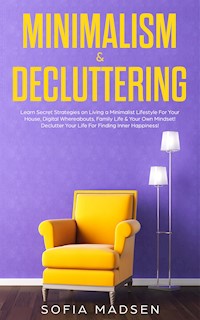
Do you want to live a happier and more fulfilling life with less? If so then keep reading…
Do you have problems not knowing where to start on your minimalist journey? Convincing a spouse or family about the benefits of simpler living? Teaching your children about having less? Or finding you keep things “just in case”? If you do, within this book many minimalist experts have discussed their knowledge on how to overcome these problems and more, most of which have been living a minimalist lifestyle for 10+ years.
In Minimalism & Decluttering, you will discover:
- A simple trick you can do to learn that our worth is not tied up in our possessions!
- The best way of convincing loved ones of a minimalist lifestyle!
- The one method to use to find every item a new home!
- Why minimalism helps to reduce stress and other mental problems!
- Understanding why some people will fail with minimalism and how you can use that to succeed!
- And much, much more.
The proven methods and pieces of knowledge are so easy to follow. Even if you’ve never heard of minimalism before, you will still be able to get to live a minimalist lifestyle.
So, if you want to transform your life, then click “Buy Now” in the top right corner NOW!
Das E-Book können Sie in Legimi-Apps oder einer beliebigen App lesen, die das folgende Format unterstützen:
Veröffentlichungsjahr: 2020
Ähnliche













Sofia Madsen
Minimalism & Decluttering
Table of contents
Introduction
Chapter 1: What Is Minimalism?
Chapter 2: Relationships
Chapter 3: Time Management
Chapter 4: Goals and Gains
Chapter 5: Technology
Chapter 6: Travel
Chapter 7: Optimizing Your Plate
Chapter 8: A Steady Minimalist Mind
Chapter 9: Clearing Your Mental Clutter
Conclusion
Introduction
When you were to walk into a room, what is the first thing you would see? A painting? The decor? The leftover sandwich wrapper on the coffee table?
Of all the things you saw, what sticks with you the most? The painting may have been beautiful; it may have even shocked you. The decor may have been relaxing, but it is the wrapper that sticks in your mind. Moreover, why is that exactly? Why do clutter and disorganization remain in our mind’s eye long after we have left a room or destination?
Are we secretly neat freaks on the hunt to clear all the trash in the world away? Alternatively, are we programmed to find what does not belong?
I would vote the latter to be safe. From the time we are born, our brains undergo a specific chemical phenomenon called categorization. We seek to organize, collect, and simplify all information that comes in contact with our being. So when a small child cries due to the peas touching the carrots, it’s not a huge disaster, just a brief signal to the brain screaming “Error, Error, Error!!!.”
As we grow, our brains seek to correct these errors, sometimes we acknowledge them, but more often than not, we completely ignore them, leaving our lives in chaos. We accumulate, collect, and spiral into a continuous mode of “but it’s pretty” or “Yes, I need it” when we don’t. The clutter and unnecessary items build up over time, and when we look around, we are surrounded by so many things that do not bring us freedom, add value or beauty to our lives.
Life is too short to live with the clutter and too beautiful to be stuck with the extra baggage. Millions have people have come to the same conclusion and have decided to try minimalism.
To understand the facets of why we aim to minimize both our impact on the earth and maximize our impact on each other; each chapter will tackle an essential aspect of our lives and how applying minimalism principles improves your overall quality of life. Gaining insight into the core concept of minimalism is supported by three simple questions: Does it add value to your life? Do you find it beautiful? Does it grant you freedom?
With these three questions, you will gain a better understanding of why we choose to live a minimalistic life and hope you will as well.
Does It Add Value To Your Life?
“ The ultimate value of life depends upon awareness and the power of contemplation rather than upon mere survival.”
Aristotle
Chapter 1: What Is Minimalism?
Minimalism has a long history, but the name itself is fairly new. For the last 8,000 years or more different religions and cultures have practiced the concept of “Letting go to attain spiritual wisdom and understanding.” This will be fully discussed in chapter 12, as for now, the name minimalism came about in the 1950s and 60s. It was first used to describe art in the early 1700s and design, later it made its way to define the lifestyle of a small group of people.
Over the last ten years, it has taken off with many considering the catalysis to be the crash of the housing market in 2008. We as a society have made it acceptable to have more than we need with no regard to simply giving away the old when the new is introduced. This is not to say that there aren’t kind souls in the world who go above and beyond to make the world a better place, there are, but there are also individuals who choose to reduce their impact on the world by making better overall choices.
Knowing the history of something does not always constitute to you knowing the current trends and the way if affect individual lifestyles. Minimalism is the practice of focusing on the items or people that bring value, beauty, and freedom into our lives and reducing the factors the hold us from attaining a life of essentials. Minimalism is more than just a trend when you consider the deep facets and the teachings grounded in history. If you still need a bit of convincing, think about what we learned of the early nomadic tribes of the world, they only carried around what they needed to survive rather than a whole year worth of food and clothing. They adapted to their environment to make the best of their lives in the wild.
Myths about Minimalism
It’s easy to misunderstand the message that Minimalism hopes to share with the rest of the world. There are so many theories and opinions on how it works and whether or not it is sustainable in the long run. Minimalism, unlike fad diets, has been around since the dawn of time with a constant focus of making people’s lives simpler.
Despite its long history, there are still plenty of myths about minimalism and why people decide to take the “path less traveled by”.
The Four Myths of Minimalism
Myth 1: Minimalist only own a set number of items.
There is and never will be a set number of items a minimalist can own. Each person’s approach to the lifestyle differs from the other. While some follow the “One In, One Out” Rule, others may follow the “One In, Two Out” Rule. These rules, like many others regarding the lifestyle, are not set in stone, but they do allow for us to reduce the clutter we are prone to have in our surroundings.
Myth 2: Minimalism is a nomadic lifestyle
Minimalists are often confused as nomads, this like many other myths and misconceptions about them are false. Some minimalists are nomads, some nomads are not minimalists. Instead, they are travelers exploring the world and the mysteries of the people and places that they visit. Nomads like the freedom that they have to both travel and work at the same time, a lot of minimalists like their steady jobs and abode to come back to each and every day. They are not to be confused.
Myth 3: Minimalists are vegan/vegetarian
There is nothing wrong being a vegan or vegetarian, but most minimalists eat whatever they want, whenever they want to. They are people just like the rest of us living their lives in a fashion befitting their ideals. It would be rude to condemn an individual based on what they do not eat. Choosing to live an alternate/sustainable lifestyle is about whether you eat meat or not and more about how it benefits you and those around you.
Myth 4: Minimalists must live in a tiny house
It is a common myth to believe that the majority of minimalists live in tiny houses with a garden and a solar roof. The only correct part of the previous statement is that it is a myth. Many people who do not practice minimalism have taken to the trend of tiny houses and why not, they are creative outlets for the cluttered mind. Tiny houses are the culmination of months of planning followed by a dedication to a smaller lifestyle. Minimalists can have tiny houses but a large majority live in a normal size house with their family and pet.
Beyond The Myth
Rather than believe everything you hear about Minimalism; it is best to take a moment and understand why the value of space and time has become such an important concept in today’s society. It is time to change the narrative of our world and disregard the myths that separate people and believe in the tales that bring us together. That should be the true goal of our minimalism practice.
Misconceptions about Minimalism
There are plenty of misconceptions, myths, and even some lies about minimalism. None of them are quite true, but they all have a bit of the truth in their origin. Minimalism, like many alternate lifestyles, seeks to have a smaller impact on the world around us. We seek to minimize the time spent on non-essential things and take a look at the bigger picture. We want to emphasize the value of people, things, places, and feelings to get back to a community mindset rather than individualism. We can accomplish so much more when we work together rather than working against each other in our lives.
The Four Major Misconceptions About Minimalists
Since there are a lot of misconceptions about minimalism, it is best to correct them before we go any further. We want to present the truth behind why we live this lifestyle and how applying it to different areas of your life will help you to live a calmer and simpler life. Yes, you will still have stress and the world may get a bit more chaotic as life goes on but think about what you can accomplish by only getting by with your essentials. This means your essential relationships, connections, books, and household items. Minimalism could change your life in such a powerful way, but only if you let it.
Misconception 1: Minimalists are not sentimental.
Call me crazy but as a minimalist, a lot of things are either given away or thrown away. That shirt from second grade when you got an “A” on your math test, gone. The hat you got your first kiss in, gone. With so many things that we give away or donate it may come across that we lack sentiment. This is simply not true, minimalists are some of the most sentimental people I know, they just choose to place value in different areas.




