


90,99 €
Mehr erfahren.
- Herausgeber: John Wiley & Sons
- Kategorie: Fachliteratur
- Sprache: Englisch
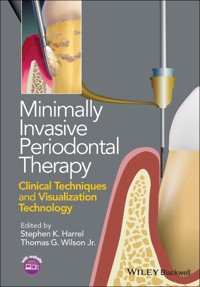
The long-term success of periodontal therapy is dependent on proper diagnosis and removal of subgingival tooth-borne accretions in the form of calculus and bacteria. From a clinical perspective, better visualization during the diagnostic and therapeutic phases has been shown to yield better results compared to traditional approaches. Minimally Invasive Periodontal Therapy evaluates the advantages of using minimal invasive techniques, the technologies available for enhancing visualization during minimally invasive therapy, and step-by-step illustrates the clinical use of each technique. Each chapter addresses the advantages and disadvantages of minimally invasive therapies, rationale for the approach, and the advantages and limitations of each of the current methods of improving visualization. The chapters then provide an evidence-based review of the technologies and procedures, and end with case studies for each visualization procedure, featuring clinical photographs.
Sie lesen das E-Book in den Legimi-Apps auf:
Seitenzahl: 248
Veröffentlichungsjahr: 2014
Ähnliche



















CONTENTS
Cover
Title page
Copyright page
Contributors
Introduction
1 Overview of Minimally Invasive Therapy
References
2 Visualization for Minimally Invasive Periodontal Therapy: An Overview
Visualization for closed root planing procedures
Visualization for minimally invasive periodontal surgery
Summary
References
3 Ultrasonic Endoscopic Periodontal Debridement
Introduction
Indications for the use of the endoscopic technique
Exploring the subgingival environment
Conclusions
Description of dental endoscopic technique
Decisions in selecting nonsurgical endoscopic treatment
Summary
References
4 Endoscope Use in Daily Hygiene Practice
Advantages
Learning curve
Anesthetic-local versus subgingival topical anesthetic
Diagnostic
Increase in pocket probing depth
Implants
Limitations
Conclusion
5 The Use of the Dental Endoscope and Videoscope for Diagnosis and Treatment of Peri-Implant Diseases
Overview
Chapter objectives
Diagnosis and technique
Description of the mechanics of the procedures to be performed
The cement problem
Example cases
Conclusions
References
6 Development of Minimally Invasive Periodontal Surgical Techniques
References
7 The MIS and V-MIS Surgical Procedure
Introduction
Surgical principles
Steps in V-MIS or MIS
Postoperative instructions
Summary
Case Study 1
Case Study 2
V-MIS Gallery
References
8 Minimally Invasive Surgical Technique and Modified-MIST in Periodontal Regeneration
Introduction
Clinical studies and outcomes
Clinical indications and diagnostic procedures
Postsurgical protocols
Postoperative period and local side effects
Conclusions
References
9 Minimally Invasive Soft Tissue Grafting
Indications for soft tissue grafting
Evolution of soft tissue grafting
The tunnel technique
Surgical procedure
Advantages of MI soft tissue grafting
Application of the tunnel concept for ridge augmentation
Summary
References
10 Future Potential for Minimally Invasive Periodontal Therapy
Goals and pitfalls of periodontal therapy
Nonsurgical therapy
Surgical therapy
Goals for minimally invasive periodontal therapy
Index
Access the Companion Website
End User License Agreement
List of Tables
Chapter 08
Table 8.1 Minimally invasive surgical technique (MIST): clinical studies.
Table 8.2 Modified-minimally invasive surgical technique (M-MIST): clinical studies.
List of Illustrations
Chapter 02
Figure 2.1 The glass fiber endoscope for use in nonsurgical minimally invasive periodontal therapy is shown.
Figure 2.2 The single-use sterile disposable sheath for the glass fiber endoscope is shown.
Figure 2.3 A surgical telescope or loupe with an integral light is shown.
Figure 2.4 The surgical microscope used with MIST and M-MIST procedures.
Figure 2.5 The videoscope for use in videoscope-assisted minimally invasive surgery (V-MIS) is shown in use.
Figure 2.6 The handpiece for holding the videoscope used in V-MIS. The rotating carbon fiber retractor is shown surrounding the camera of the videoscope.
Figure 2.7 A schematic of the gas shielding device is shown. The videoscope is held within a “shield” of turbulent surgical gases to avoid fouling or fogging of the videoscope optics.
Lesen Sie weiter in der vollständigen Ausgabe!
Lesen Sie weiter in der vollständigen Ausgabe!
Lesen Sie weiter in der vollständigen Ausgabe!
Lesen Sie weiter in der vollständigen Ausgabe!
Lesen Sie weiter in der vollständigen Ausgabe!
Lesen Sie weiter in der vollständigen Ausgabe!
Lesen Sie weiter in der vollständigen Ausgabe!
Lesen Sie weiter in der vollständigen Ausgabe!
Lesen Sie weiter in der vollständigen Ausgabe!
Lesen Sie weiter in der vollständigen Ausgabe!
Lesen Sie weiter in der vollständigen Ausgabe!
Lesen Sie weiter in der vollständigen Ausgabe!
Lesen Sie weiter in der vollständigen Ausgabe!
Lesen Sie weiter in der vollständigen Ausgabe!
Lesen Sie weiter in der vollständigen Ausgabe!
Lesen Sie weiter in der vollständigen Ausgabe!
Lesen Sie weiter in der vollständigen Ausgabe!




