


Erhalten Sie Zugang zu diesem und mehr als 300000 Büchern ab EUR 5,99 monatlich.
- Herausgeber: Crown House Publishing
- Kategorie: Fachliteratur
- Sprache: Englisch
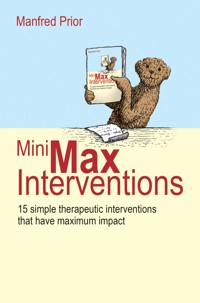
In MiniMax Interventions, Manfred Prior presents therapeutic communication strategies that are designed to achieve a lot with just a few linguistic alterations: maximum results for minimal effort. These tried-and-tested communication strategies can be used in an effective way by any therapeutic practitioner, in almost any kind of session. The step-by-step methods can make a huge contribution to helping patients and clients solve their problems and clarify their goals more quickly. They are easy to understand and put into practice and, as such, their profound effect will be readily observable. It takes a lot of time and experience to condense such a lot of information into such a short book, and such powerful transformative effects into short therapeutic phrases. Manfred Prior has studied the speech patterns of successful communication in psychotherapy, medicine and counselling for more than 30 years. As one of the most renowned hypnosis instructors in the German-speaking world, he has taught effective communication techniques and methods to psychotherapists, doctors and dentists since the mid-eighties. For the first time, his insights are now available in the English-speaking world. The book, originally published in German as the bestselling MiniMax-Interventionen: 15 minimale Interventionen mit maximaler Wirkung, is translated by Professor Paul Bishop. MiniMax interventions provide the basis for efficient communication as well as human encounter. They help reduce resistance from patients or more precisely do not let it build up. They strengthen the relationship between therapist and patient and build motivation and willingness to cooperate. Finally, they demonstrate time and again how a few short words can have long-lasting therapeutic consequences. Suitable for psychotherapists, counsellors, supervisors, coaches and organisational consultants. If you want to improve your communication skills in a decisive yet practical way this succinct, accessible book is for you.
Sie lesen das E-Book in den Legimi-Apps auf:
Seitenzahl: 98
Veröffentlichungsjahr: 2017
Das E-Book (TTS) können Sie hören im Abo „Legimi Premium” in Legimi-Apps auf:
Ähnliche



















Praise for MiniMax Interventions
Manfred Prior is the most popular and well-known trainer in the use of precise language in hypnotherapy and counselling in Germany. His book, MiniMax-Interventionen, is one of the most amazing bestsellers in the field of psychology in the German language. It has sold so many copies that it can’t only be psychotherapists and MDs who are using it to enhance their communicative skills, most probably a lot of lawyers, politicians, executive managers and school teachers have spotted the immense value of this book for professional communication.
Bernhard Trenkle, President-elect, International Society of Hypnosis
I am an advocate of simple tools because they are so easy to integrate into one’s life. They have a direct path to the heart and soul. Manfred Prior has done an amazing job of creating exactly that - plus, his tools are adaptable to every walk of life. As the Apple slogan said, ‘Simplicity is the ultimate sophistication.’ Congratulations Dr Prior, you are a wonderfully simple and ultimately sophisticated creator!
Danie Beaulieu, PhD, author of Impact Techniques for Therapists
Manfred Prior is one of the pre-eminent practitioners of psychotherapy in Europe. In MiniMax Interventions he offers practical, immediately applicable techniques that promote the change process. This book offers a clear path to being a more effective therapist or coach.
Jeffrey K. Zeig, PhD, The Milton Erickson Foundation
I have no doubt that this book will be a wonderful reference tool that all therapists will dip into on a regular basis within their practice.
Melanie Phillips, Cognitive Hypnotherapist, Lothian Therapy
Good therapeutic work is about creating fluid possibilities where only rigid fixed patterns existed. This delightful book by Manfred Prior is an elegant guide to how to communicate in a way that helps people do just that. I highly recommend it!
Stephen Gilligan, PhD, author of Generative Trance and The Courage to Love
Dr Prior’s MiniMax Interventions is a wonderfully concise and clear toolbox of verbal interventions that will greatly enhance the therapeutic management in every patient and client interview. His tools should become adopted and used by any psychotherapist, psychiatrist, social worker or physician who wants to shorten the duration and improve the effectiveness of treatment. Furthermore, counsellors, nurses and teachers will benefit highly from reading the book.
Stephen Lankton, Editor, American Journal of Clinical Hypnosis, Fellow, American Society of Clinical Hypnosis
To my father, Edmund Prior
Contents
Foreword
In a famous anecdote, an American president is asked how long he needs to prepare an hour-long speech. The president declares he is ready now. The questioner is surprised and wants to know how long it will take to prepare a five-minute speech. The answer is a week. This is similar to the quotation often attributed to Goethe: ‘I’m writing you a long letter because I don’t have time to write a short one.’
Only those who have a lot of experience and have put a lot of time into the study of a specific topic can provide a great deal of content in a book of very few pages. Manfred Prior has studied the speech patterns of successful communication in psychotherapy, medicine, and counselling for more than 30 years. As one of the most renowned hypnosis instructors in the German-speaking world, he has taught psychotherapists, doctors, and dentists effective communication techniques and methods since the mid-eighties. In his workshops, as in this book, Manfred Prior impresses with his didactically precise teaching style, not to mention his humour and his smile.
When teaching dentists to use hypnosis I have repeatedly heard some interesting feedback: ‘I do not trust myself to draw a tooth without anaesthetic or perform dental procedures under hypnosis, but since coming to these few hypnosis seminars, I have no more difficult patients.’ How can this be explained?
The Formula 1 driver Emerson Fittipaldi once defined the art of racing as going as slow as possible in order to still be the fastest. In many ways, this characterises the situation of the doctor, dentist, or psychotherapist who has to fulfil the demands of their job in an ever cheaper and quicker way and live up to their ideals in the eyes of their clients and patients.
The results summarised in this book provide the basis for efficient communication as well as human encounter. The interventions help reduce resistance or – more precisely – do not let it build up. They strengthen the therapeutic relationship and build motivation and willingness to cooperate. Finally, they demonstrate time and again how a few short words can have long-lasting therapeutic consequences.
This is a valuable and entertaining book for therapists, physicians, educators, and consultants – basically for anyone who has to deal with people. Once you have read it, give it to your children. Maybe it will help them achieve a more subtle ‘handling’ of teachers and better grades in English!
Incidentally, I can recommend asking for the book back to re-read it yourself. If only because you will then realise how your children succeeded in imposing the recent increase in pocket money.
Bernhard Trenkle, President-elect of the International Society of Hypnosis (ISH)
Introduction
When I was at school, I pursued many different interests. I was a very enthusiastic gymnast. I played the cello in two youth orchestras. In addition, I belonged to the local Scout troop, and I was in the youth organisation of a political party. In the evenings, once a week or so, I would sell programmes for events in the local concert hall. At the same time, however, I had the ambition of going to university. I had to somehow combine my many and varied extracurricular interests, and my part-time work, with completing the schoolwork I needed to do to get the required grades. As a result, I developed the ambition and capability to get the best possible results with the least amount of effort.
In my capacity as a psychotherapist, counsellor, and coach, I am always trying to find new possibilities, ways to improve, and workable solutions to problems through conversation. As an instructor, I aim to describe each step in the simplest possible way. In these roles I always ask myself: how can the greatest possible success be achieved with the least amount of effort?
In this book I want to offer you the results of my quest for maximum results with minimal effort. With these MiniMax interventions, it is my goal to draw to your attention communicative strategies that:
can be used in an effective way by any practitioner of any therapeutic approach in almost any kind of session
are hardly noticeable (and so do not provoke ‘resistance’)
are easy to describe
can be quickly learned by everybody
These MiniMax interventions are intended to be immediately understandable and put to good practical use.
The 15 MiniMax interventions presented in the pages that follow are aimed, first and foremost, at psychotherapists, counsellors, supervisors, coaches, and organisational consultants. These people deploy strategies that are often successful, but very complex. MiniMax interventions are aimed at those professionals who want to improve their communicative skills in a decisive, yet practical, way. These MiniMax interventions draw attention to aspects of apparently minor ‘detail’ which professionals can, regardless of their theoretical allegiance, improve in order to communicate more successfully. I will focus less on the overall strategies involved in psychotherapy, counselling, and solutions-focused conversations, and more on the niceties or finer points of linguistic communication. Taken together, these ‘details’ can deliver a special quality that leads to considerable improvements in the counselling and therapeutic process.
I am not claiming to offer something startlingly novel with these MiniMax interventions. The contexts in which the interventions are to be used are, as already mentioned, psychotherapy, counselling, supervision, coaching, and organisational consultancy. Over time, however, it will become clear that these MiniMax interventions can be used successfully in other situations too. There are no contraindications for MiniMax interventions, nor have there been any bad side effects to date. You are invited to help discover where and how MiniMax interventions can be profitably deployed. Moreover, I am assuming that the collection of MiniMax interventions presented here is by no means complete – doubtless there remain many more to be discovered.
As an old proverb says: it is easy to make things difficult and difficult to make things easy. I would be the first to admit that it took me a lot of time to formulate these MiniMax interventions in a definitive and ever more compact way. In this respect I could sense a proximity to Goethe, who is supposed to have said, ‘I’m writing you a long letter because I don’t have time to write a short one.’ It has been worth the effort to concentrate and reduce these MiniMax interventions to what is essential about them. Over recent years they have been tried and tested over and over again. Today I take it for granted that they will automatically play an important part in my own work as a psychotherapist and counsellor. Thousands of colleagues are also using them to great success in all kinds of areas, making their work easier – and better. With the attention to detail described in these pages you too can make a huge contribution to helping clients solve their problems and reach their goals more quickly.
Thanks to their concise and comprehensible presentation, you can easily read and understand the 15 MiniMax interventions in the course of just one evening. But the more you actually use the MiniMax interventions, the more you, and your patients or clients, will feel their full benefit.
Each intervention is commentated by a small, ursine reader – a cartoon bear. In an impartial way, and unburdened by any specialised knowledge of the field, he will take a close look at every MiniMax intervention and share his insights in the form of critical commentaries. You can accompany him in his therapy and experience how he gets a handle on his problems in his own, sometimes highly idiosyncratic, way. His experiences tell their own story. Apart from MiniMax intervention 9 – ‘Step-by-step constructive questions’, which builds on MiniMax intervention 8 – ‘Constructive questions’, each intervention can stand on its own. You can determine for yourself the order in which you read each of the interventions and create your own personal pattern of MiniMax interventions, just like a mosaic.
Because the 15 MiniMax interventions are presented in a clear and concise way, you could easily read them all through in an evening and understand them. It would be better, however, not to just read this book from cover to cover in one sitting. Someone who likes chocolate blancmange would not eat ten bowlfuls of it in one go. Have a spoonful here and there, and enjoy the taste. Take your time to digest the information.
Let me wish you much enjoyment as you read the following pages – and many exciting discoveries as you put what they contain into practice.




