


180,99 €
Mehr erfahren.
- Herausgeber: John Wiley & Sons
- Kategorie: Fachliteratur
- Sprache: Englisch
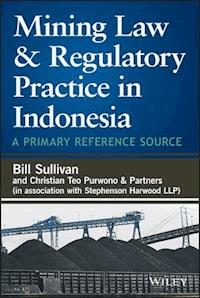
The first and only English-language reference to the laws and regulations of the booming Indonesian mining sector As the growing Indonesian mining industry attracts new investment from foreign mining companies, those companies are faced with the daunting challenge of unraveling the hugely confusing and complex plethora of local laws and regulations that govern the industry. Until now, there has been no comprehensive English-language guide to Indonesia's mining laws that western companies could turn to for reliable guidance and advice. This detailed reference fills that gap for the mining companies, advisors, and consultants who must navigate this confusing and growing web of regulation on a daily basis. * The only English-language reference on the subject of Indonesian mining law * A valuable guide for anyone in the mining industry currently doing business or intending to do business in Indonesia * Written by a highly regarded legal expert with deep experience in the Indonesian mining industry * Combines all the relevant regulations in one comprehensive guide Ideal for professionals in the mining industry, as well as academics, government institutions, policy makers, and industry associations, Mining Law & Regulatory Practice in Indonesia is the perfect guide for an underserved market.
Sie lesen das E-Book in den Legimi-Apps auf:
Seitenzahl: 605
Veröffentlichungsjahr: 2013
Ähnliche



















Contents
Foreword
Preface
Acknowledgments
Chapter 1: Overview of Mining Regime
I. Prevailing Laws and Regulations
II. Former Mining Regime
III. CoWs/CCoWs
IV. Regional Autonomy
V. Mining Activities
VI. Mining Areas
VII. Mining Licenses
VIII. Procedures for Obtaining WIUPs and IUPs
IX. Rights and Obligations of IUP Holders
X. Domestic Market Obligation
XI. Divestiture of Shares Requirement
XII. Procedures for Minerals and Coal Benchmark Price Determination
XIII. Domestic Processing and Refining
XIV. Direction and Supervision of the Management and Implementation of Mining Business
XV. Transitional Provisions for Existing KPs, CoWs, and CCoWs
XVI. Mining Services
Chapter 2: 2009 Mining Law
I. Executive Summary
II. Details of Main Provisions
Chapter 3: Mining Area Determination
I. Executive Summary
II. Details of Main Provisions
Chapter 4: Mining Services Regulation
I. Executive Summary
II. Details of Main Provisions
Chapter 5: Affiliated Mining Services Provider Regulation
I. Executive Summary
II. Details of Main Provisions
Chapter 6: Prioritization of Domestic Interest Regulation
I. Executive Summary
II. Details of Main Provisions
Chapter 7: Domestic Coal Supply Decree 2013
I. Executive Summary
II. Details of Main Provisions
Chapter 8: Coal and Mineral Mining Enterprise Activities Regulation
I. Executive Summary
II. Details of Main Provisions
Chapter 9: Mining Direction and Supervision Regulation
I. Executive Summary
II. Details of Main Provisions
Chapter 10: Benchmark Price Determination Regulation
I. Executive Summary
II. Details of Main Provisions
Chapter 11: Benchmark Price Formulae Regulation
I. Executive Summary
II. Details of Main Provisions
Chapter 12: Reclamation and Post-Mining Activities Regulation
I. Executive Summary
II. Details of Main Provisions
Chapter 13: CoW and CCoW Change of Investment Regulation
I. Executive Summary
II. Details of Main Provisions
Chapter 14: Extractive Industry Income Transparency Regulation
I. Executive Summary
II. Details of Main Provisions
Chapter 15: Increase of Added Value of Minerals through Processing and Refining of Minerals Regulation
I. Executive Summary
II. Details of Main Provisions
Chapter 16: Regulation Amending Mineral and Coal Mining Enterprise Activities Regulation
I. Executive Summary
II. Details of Main Provisions
Chapter 17: Mineral Products Export Requirements Regulation
I. Executive Summary
II. Details of Main Provisions
Chapter 18: Export Tax Regulation
I. Executive Summary
II. Details of Main Provisions
III. Attachment IV of MoFR 75/2012: Certain Mineral Products Subject to Export Tax
Chapter 19: Regulation Amending Mining Services Regulation
I. Executive Summary
II. Details of Main Provisions
Chapter 20: Acceleration of Domestic Processing and Refining Instruction
I. Executive Summary
II. Details of Main Provisions
Chapter 21: Draft Procedures for Issuing Special Production IUPs for Processing and Refining and Transportation and Sales Regulation
I. Executive Summary
II. Details of Main Provisions
Chapter 22: Draft Guidelines for Licensing of Metal Mineral and Coal Business Activities Regulation
I. Executive Summary
II. Details of Main Provisions
Chapter 23: Draft Guidelines for Licensing of Nonmetal Mineral and Rock Mining Business Activities Regulation
I. Executive Summary
II. Details of Main Provisions
Chapter 24: Draft Mining Business Employees, Goods, and Services Procurement Regulation
I. Executive Summary
II. Details of Main Provisions
Chapter 25: Draft Community Development and Empowerment Regulation
I. Executive Summary
II. Details of Main Provisions
Chapter 26: Draft Coal Value Added Regulation
I. Executive Summary
II. Details of Main Provisions
Chapter 27: Overview of the Forestry Regime
I. Relevant Laws and Regulations
II. Categorization of Forest Areas in Indonesia
III. The Key Definitions for Forest Areas
IV. Key Licenses for Forest Activities
V. Carrying on Mining Activities in a Forest Area
VI. General Description of Rent Use Permits
VII. Steps Involved in Obtaining a Rent Use Permit and Related Licenses
Chapter 28: Forest Area Function and Purpose Regulation
I. Executive Summary
II. Details of Main Provisions
Chapter 29: Forest Area Utilization Regulation
I. Executive Summary
II. Details of Main Provisions
Chapter 30: Rent Use Permit Regulation
I. Executive Summary
II. Details of Main Provisions
Chapter 31: Forest License Moratorium Instruction
I. Executive Summary
II. Details of Main Provisions
Chapter 32: Forest Area Utilization for Underground Mining Activities Regulation
I. Executive Summary
II. Details of Main Provisions
Chapter 33: Procedures for Alteration of the Usage and Function of Forest Areas Amendment Regulation
I. Executive Summary
II. Details of Main Provisions
Chapter 34: Usage of Forest Areas Amendment Regulation
I. Executive Summary
II. Detail of Main Provisions
Chapter 35: Second Amendment Regulation re Guidelines for Rent Use of Forest Areas
I. Executive Summary
II. Details of Main Provisions
Glossary of Defined Terms
Index
Copyright © 2013 by Bill Sullivan and Christian Teo Purwono & Partners
Published by John Wiley & Sons Singapore Pte. Ltd.
1 Fusionopolis Walk, #07–01, Solaris South Tower, Singapore 138628
All rights reserved.
No part of this publication may be reproduced, stored in a retrieval system, or transmitted in any form or by any means, electronic, mechanical, photocopying, recording, scanning, or otherwise, except as expressly permitted by law, without either the prior written permission of the Publisher, or authorization through payment of the appropriate photocopy fee to the Copyright Clearance Center. Requests for permission should be addressed to the Publisher, John Wiley & Sons Singapore Pte. Ltd., 1 Fusionopolis Walk, #07–01, Solaris South Tower, Singapore 138628, tel: 65–6643–8000, fax: 65–6643–8008, e-mail: [email protected].
Limit of Liability/Disclaimer of Warranty: While the publisher and author have used their best efforts in preparing this book, they make no representations or warranties with respect to the accuracy or completeness of the contents of this book and specifically disclaim any implied warranties of merchantability or fitness for a particular purpose. No warranty may be created or extended by sales representatives or written sales materials. The advice and strategies contained herein may not be suitable for your situation. You should consult with a professional where appropriate. Neither the publisher nor the author shall be liable for any damages arising herefrom.
Other Wiley Editorial Offices
John Wiley & Sons, 111 River Street, Hoboken, NJ 07030, USA
John Wiley & Sons, The Atrium, Southern Gate, Chichester, West Sussex, P019 8SQ, United Kingdom
John Wiley & Sons (Canada) Ltd., 5353 Dundas Street West, Suite 400, Toronto, Ontario, M9B 6HB, Canada
John Wiley & Sons Australia Ltd., 42 McDougall Street, Milton, Queensland 4064, Australia
Wiley-VCH, Boschstrasse 12, D-69469 Weinheim, Germany
Library of Congress Cataloging-in-Publication Data:
ISBN 978–1–118–61318–4 (Cloth)
ISBN 978–1–118–61319–1 (ePDF)
ISBN 978–1–118–61321–4 (ePub)
Foreword
In January 2009 the Indonesian government introduced a new mining law for the development of mines in Indonesia. This new law replaces the 1967 law that was designed to attract large international mining companies to develop large world-scale mines in one of the world’s most geologically prospective environments while smaller and medium-scale mines were the exclusive perview of Indonesian companies. The 2009 mining law does not deal comprehensively with all aspects of the requirements for exploring, developing, and building new mines; this was deliberately left to Ministerial Regulations to be handed down at later dates. In addition, the new mining law provided a number of inconsistencies and contradictory statements that caused confusion among existing and potential new mining entrants; these anomalies have, to some extent, been dealt with by the ensuing mining regulations. The undertaking of exploration, development, and mining is further complicated by the deregulation of government that has taken place over the past fifteen years with approvals for different aspects of a development being required at multiple levels of government, that is, central, provincial, and regency.
Sullivan’s work attempts to unravel the multicomplex rules, regulations, and reporting requirements proposed by the new mining law, and while it is still a very dynamic situation, Sullivan’s work is extremely comprehensive in its understanding and analysis. The work is factual, with little opinion or commentary, which is appropriate for such a work. It is essential reading, not only for potential new entrants to Indonesian mining but also to those already operating in Indonesia seeking to understand the new landscape and the complexity of all the rules and regulations that can be somewhat confusing. Sullivan’s work, while written from a legal perspective, is easy to read, thorough in its analysis, and provides clarity and understanding to the reader.
Indonesia is geologically one of the most prospective environments on the planet. The Indonesian government recognizes this and recognizes the tremendous potential that sensible and sustainable mining can bring to the economy, the local communities, and the long-term strategic goals of the country. The new mining law, while not perfect, is a significant step forward in the long-term development of this strategic industry. Sullivan’s work will contribute significantly to the understanding and the ability for companies to steer and maneuver their way through the multiplicity of regulations that currently exist.
This book will be a mandatory textbook for those involved in the mining industry, probably for years to come. Although it will undoubtedly require revisions as new regulations are issued in an attempt to deal with the continuing uncertainty in a number of areas, it will be the reference text of choice for anybody interested in the Indonesian mining industry.
—Peter Albert
CEO of G-Resources
Preface
This book is the first comprehensive survey of Indonesia’s legal and regulatory regime in respect of mining. It is intended to provide a basic reference source for business people, legal and other professional advisers, and others interested in understanding the complex and sometimes confusing regulatory environment that domestic and foreign participants in the Indonesian mining industry face.
This book has been authored, prepared, and edited by Bill Sullivan (BCom (with merit), MCom and LLB (University of New South Wales), LLM (Harvard Law School), MBA and SJD (University of Sydney)), and Licensed Foreign Advocate with Christian Teo Purwono & Partners (in association with Stephenson Harwood LLP).
Christian Teo Purwono & Partners is a leader in Indonesian mining law and regulatory practice. Our firm acts as Indonesian legal counsel for a wide cross-section of foreign and domestic business interests in the Indonesian mining industry, including mining project owners, investors, and financiers; mining product traders; mining services providers; and mining equipment suppliers.
Christian Teo Purwono & Partners operates in association with international law firm Stephenson Harwood LLP, which has eight offices across Asia, Europe, and the Middle East in Singapore, Hong Kong, Guangzhou, Shanghai, London, Paris, Athens, and Dubai.
This book reflects our firm’s current understanding only of Indonesia’s legal and regulatory regime in respect of mining, which is still very much a work in progress. Accordingly, the law and regulation summaries and detail that follow are subject to change as that understanding develops and evolves.
Many of the points made in this book are necessarily speculative in nature and subject to further clarification and confirmation. Accordingly, it would be prudent not to rely solely on this book but, rather, to seek specific legal advice with respect to any technical legal or regulatory issue related to mining in Indonesia before making a material business decision regarding the same. Christian Teo Purwono & Partners would be pleased to assist you in this regard. Our contact details are set out below.
Please contact, in the first instance, Bill Sullivan, Licensed Foreign Advocate (e-mail: [email protected] and mobile: [62–21] 81585060978) or Nurvita K. Siregar, Senior Associate (e-mail: [email protected] and mobile [62–21] 818482777).
• • •
The current legal and regulatory regime for mining in Indonesia has its basis in Law No. 4 of 2009 re Minerals & Coal Mining (“2009 Mining Law”), which was introduced in January 2009 after many years of debate and discussion.
The 2009 Mining Law is augmented by (i) six basic implementing regulations on mining area determination, (ii) mining services, (iii) prioritization of domestic interest, (iv) coal mining enterprise activities, (v) mining direction and supervision, and (vi) reclamation and post-mining activites (“Basic ML Implementing Regulations”) as well as various other decrees, guidelines, regulations, and other instruments (“ML Supporting Materials”).
As of the date of publication of this book, the Basic ML Implementing Regulations have been finalized and issued. However, the ML Supporting Materials have not been finalized, and a significant number of additional ML Supporting Materials are expected to be issued in 2013 and subsequent years.
The use of implementing decrees, guidelines, regulations, and other instruments to augment a law is a very common practice in Indonesia. Laws are passed by the Indonesian Parliament with the intention they will set out the broad parameters only of a new regulatory regime. Meanwhile the details of the new regulatory regime will be provided in one or more implementing decrees, guidelines, regulations, and other instruments issued by the Ministry and/or officials of the Ministry with primary responsibility for overseeing the application of the new regulatory regime.
This book (i) provides an overview of the Indonesian legal and regulatory regime for mining and (ii) summarizes, in detail, the principal provisions of the 2009 Mining Law and each of the Basic ML Implementing Regulations as well as a number of the more important ML Supporting Materials some of which are currently only available as drafts.
Forestry issues assume great importance in many Indonesian mining projects because, notwithstanding a valid mining license, additional forestry permits are required to carry out mining activities on any part of a mining concession that is a designated forest area. Accordingly, this book also (1) provides an overview of the Indonesian legal and regulatory regime for forestry and (2) summarizes, in detail, the principal provisions of the various forestry regulations that are particularly relevant to mining.
The objective of this book is to, for the first time, (1) bring together in one publication, (2) all or, at least, most of the laws and regulations relevant to mining, (3) in English and (4) in a format that is user friendly for all English-speaking participants in the Indonesian mining industry whether professionals, business people, academics, government officials, journalists, or just interested observers.
In the case of individual regulations and where appropriate only, literal translation of the relevant articles has been forsaken in favor of an augmented translation, which is intended to assist the reader in understanding the presumed intention of the drafter of the relevant articles. This approach is desirable and arguably, necessary because of the serious deficiencies, inconsistencies, and confusion evident in the drafting of the Basic ML Implementing Guidelines and the ML Supporting Materials. Where the presumed intention is particularly uncertain, square brackets [ ] are used to bracket the augmented translation.
A glossary of the more important defined terms used in this book is also provided in the last chapter so as to avoid the need to repeatedly provide the definitions of those terms that appear in multiple chapters.
Acknowledgments
I gratefully acknowledge that much work and otherwise invaluable contributions in respect to this book have originated from various lawyers and staff of Christian Teo Purwono & Partners without whom this book would not have been possible. I wish to acknowledge, in particular, the contributions of Senior Associates Nurvita K. Siregar and Claudius Novabianto as well as of Associates Denny Ngadimin, Anton Lai, Anya Y. Aritonang, and Devyta Wijaya. I am also indebted to my secretary, Vony Marbun, and to Januar Gulo for their good humor and patience in making the endless changes and edits required to bring this book to fruition.
Bill Sullivan
March 31, 2013
Chapter 1
Overview of Mining Regime
Chapter 1 provides an overview of Indonesia’s legal and regulatory regime for mining business activities.
I. Prevailing Laws and Regulations
The more important laws and regulations currently governing Indonesian minerals and coal mining and their related activities are as follows:
There are also a number of advanced drafts of other regulations available which, if and when finalized and issued, will significantly impact minerals and coal mining activities in Indonesia. These draft regulations relate, among other topics, to (i) coal upgrading (ii) the procedures for issuing new mining licenses, (iii) procurement of goods and services, and (iv) community development and empowerment.
Each of the above referenced laws and regulations (including some of the draft regulations but excluding MoEMRD 617/2011, DGoMCR 999/2011, MoEMRR 11/2012, DGoMCD 644/2013 and DGoMCR 614/2013) is the subject of a separate chapter that sets out the details of the main provisions of the relevant law or regulation as well as provides an executive summary of the relevant law or regulation.
II. Former Mining Regime
Under Law No. 11 of 1967 re the Main Provisions of Mining (“Old Mining Law”), foreign parties could participate in large-scale mining projects through Contracts of Work (“CoWs”) and Coal Contracts of Work (“CCoWs”) whilst relatively small- and medium-scale mining projects could only be conducted by Indonesian national parties by virtue of Mining Licenses (“KPs”).
In other words, neither (i) a foreign entity nor (ii) an Indonesian foreign investment company, in which a foreign party is able to legally hold shares (“PMA Company”), could hold a KP under the Old Mining Law. A PMA Company could, however, hold a CoW or a CCoW.
On January 12, 2009, the Old Mining Law was replaced by the 2009 Mining Law. Unlike the Old Mining Law, the 2009 Mining Law allows a Mining Business License (“IUP”) to be held by any type of Indonesian business entity, including a PMA Company, without any initial restriction or limitation on share ownership.
The Indonesian Government has issued Presidential Regulation No. 36 of 2010 dated May 25, 2010, on the List of Business Fields Closed and Open for Investment with Requirements for Investment (“Negative List 2010”). Negative List 2010 confirms that general mining is open for 100% foreign investment. This has also been verbally confirmed by the Capital Investment Coordinating Board (“”). In other words, PMA Companies (wholly owned by foreigners), are now allowed to engage in general mining business activities in Indonesia (“”).
Lesen Sie weiter in der vollständigen Ausgabe!
Lesen Sie weiter in der vollständigen Ausgabe!
Lesen Sie weiter in der vollständigen Ausgabe!
Lesen Sie weiter in der vollständigen Ausgabe!
Lesen Sie weiter in der vollständigen Ausgabe!
Lesen Sie weiter in der vollständigen Ausgabe!
Lesen Sie weiter in der vollständigen Ausgabe!
Lesen Sie weiter in der vollständigen Ausgabe!
Lesen Sie weiter in der vollständigen Ausgabe!
Lesen Sie weiter in der vollständigen Ausgabe!
Lesen Sie weiter in der vollständigen Ausgabe!
Lesen Sie weiter in der vollständigen Ausgabe!
Lesen Sie weiter in der vollständigen Ausgabe!
Lesen Sie weiter in der vollständigen Ausgabe!
Lesen Sie weiter in der vollständigen Ausgabe!
Lesen Sie weiter in der vollständigen Ausgabe!
Lesen Sie weiter in der vollständigen Ausgabe!
Lesen Sie weiter in der vollständigen Ausgabe!
Lesen Sie weiter in der vollständigen Ausgabe!
Lesen Sie weiter in der vollständigen Ausgabe!
Lesen Sie weiter in der vollständigen Ausgabe!
Lesen Sie weiter in der vollständigen Ausgabe!
Lesen Sie weiter in der vollständigen Ausgabe!
Lesen Sie weiter in der vollständigen Ausgabe!
Lesen Sie weiter in der vollständigen Ausgabe!
Lesen Sie weiter in der vollständigen Ausgabe!
Lesen Sie weiter in der vollständigen Ausgabe!
Lesen Sie weiter in der vollständigen Ausgabe!
Lesen Sie weiter in der vollständigen Ausgabe!
Lesen Sie weiter in der vollständigen Ausgabe!
Lesen Sie weiter in der vollständigen Ausgabe!
Lesen Sie weiter in der vollständigen Ausgabe!
Lesen Sie weiter in der vollständigen Ausgabe!
Lesen Sie weiter in der vollständigen Ausgabe!
Lesen Sie weiter in der vollständigen Ausgabe!
Lesen Sie weiter in der vollständigen Ausgabe!




