


139,99 €
Mehr erfahren.
- Herausgeber: John Wiley & Sons
- Kategorie: Fachliteratur
- Sprache: Englisch
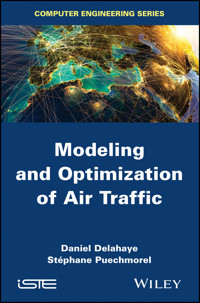
This book combines the research activities of the authors, both of whom are researchers at Ecole Nationale de l'Aviation Civile (French National School of Civil Aviation), and presents their findings from the last 15 years. Their work uses air transport as its focal point, within the realm of mathematical optimization, looking at real life problems and theoretical models in tandem, and the challenges that accompany studying both approaches. The authors' research is linked with the attempt to reduce air space congestion in Western Europe, USA and, increasingly, Asia. They do this through studying stochastic optimization (particularly artificial evolution), the sectorization of airspace, route distribution and takeoff slots, and by modeling airspace congestion. Finally, the authors discuss their short, medium and long term research goals. They hope that their work, although related to air transport, will be applied to other fields, such is the transferable nature of mathematical optimization. At the same time, they intend to use other areas of research, such as approximation and statistics to complement their continued inquiry in their own field. Contents 1. Introduction. Part 1. Optimization and Artificial Evolution 2. Optimization: State of the Art. 3. Genetic Algorithms and Improvements. 4. A new concept for Genetic Algorithms based on Order Statistics. Part 2. Applications to Air Traffic Control 5. Air Traffic Control. 6. Contributions to Airspace Sectorization. 7. Contribution to Traffic Assignment. 8. Airspace Congestion Metrics. 9. Conclusion and Future Perspectives. About the Authors Daniel Delahaye works for Ecole Nationale de l'Aviation Civile (French National School of Civil Aviation) in France. Stéphane Puechmorel works for Ecole Nationale de l'Aviation Civile (French National School of Civil Aviation) in France.
Sie lesen das E-Book in den Legimi-Apps auf:
Seitenzahl: 329
Veröffentlichungsjahr: 2013
Ähnliche



















Table of Contents
Introduction
PART 1: Optimization and Artificial Evolution
Chapter 1: Optimization: State of the Art
1.1. Methodological principles in optimization
1.2. Optimization algorithms
Chapter 2: Genetic Algorithms and Improvements
2.1. General points
2.2. Classic improvements
2.3. Our contributions
2.4. Conclusion
Chapter 3: A New Concept for Genetic Algorithms Based on Order Statistics
3.1. Introduction
3.2. Order statistics
3.3. Estimating the probability that the global optimum belongs to a given domain
3.4. Genetic algorithms and order statistics
3.5. Application to test functions
3.6. Conclusion
PART 2: Applications to Air Traffic Control
Chapter 4: Air Traffic Control
Chapter 5: Contributions to Airspace Sectorization
5.1. Introduction
5.2. Modeling in 2D
5.3. Continuous modeling
5.4. Discrete modeling
5.5. Extension 3D
5.6. Accounting for the dynamic aspect
Chapter 6: Contribution to Traffic Assignment
6.1. Summary of traffic assignment methods based on transportation network theory
6.2. Other approaches to traffic assignment
6.3. Using artificial evolution in all-or-nothing traffic assignment
6.4. Allocation of routes and slots using artificial evolution
6.5. Modification of the algorithm – adaptive modifications
6.6. Sequencing flights for landing
6.7. Trajectory planning
6.8. Conclusion
Chapter 7: Airspace Congestion Metrics
7.1. Introduction
7.2. Flow-based approach
7.3. Geometrical approaches
7.4. Approach based on dynamic systems
Conclusion and Future Perspectives
Bibliography
Index
First published 2013 in Great Britain and the United States by ISTE Ltd and John Wiley & Sons, Inc.
Apart from any fair dealing for the purposes of research or private study, or criticism or review, as permitted under the Copyright, Designs and Patents Act 1988, this publication may only be reproduced, stored or transmitted, in any form or by any means, with the prior permission in writing of the publishers, or in the case of reprographic reproduction in accordance with the terms and licenses issued by the CLA. Enquiries concerning reproduction outside these terms should be sent to the publishers at the undermentioned address:
ISTE Ltd27-37 St George’s RoadLondon SW19 4EUUKwww.iste.co.uk
John Wiley & Sons, Inc.111 River StreetHoboken, NJ 07030USAwww.wiley.com
© ISTE Ltd 2013The rights of Daniel Delahaye and Stéphane Puechmorel to be identified as the authors of this work have been asserted by them in accordance with the Copyright, Designs and Patents Act 1988.
Library of Congress Control Number: 2013936316
British Library Cataloguing-in-Publication DataA CIP record for this book is available from the British LibraryISBN: 978-1-84821-595-5
Introduction
This book presents the main research topics that we have worked on over the last 15 years. Research is a fascinating occupation that allows permanent enrichment of knowledge and sustains rich intellectual activity. Moments of doubt do arise when a problem seems impossible to solve, but this is intrinsically linked to one of the great advantages of research: the feeling of satisfaction when a solution is finally found. As researchers at the Ecole Nationale de l’Aviation Civile (French Civil Aviation University), our research activity focuses on the theme of air transport and, specifically, on the domain of mathematical optimization. It is always fascinating to look at real problems taken from the operational domain as their characteristics are often complex, representing a significant challenge with applicable results. When observing real situations, we note that they are often considerably different from theoretical models, and our mathematical tools are of limited use when attempting to tackle a complex problem as a whole. These practical problems present a certain interest for researchers as they require the development of new tools.
Our research focuses on issues linked to reducing congestion in airspace. These types of problems are generally not only found in Western Europe and the United States, but also in Asia.
Our main research topics in recent years have been the following:
The structure of this book broadly reflects the four main topics of our research:
The main focus of our current research activity is on functional optimization using artificial evolution. The aim of this research is to synthesize a set of airplane trajectories (four-dimensional) allowing us to maximize or minimize a criterion. When dealing with a functional optimization problem (in a space of infinite dimensions), it is naive to attempt to discretize the trajectory in order to replace it in a state space of finite dimensions. This approach produces moderate results and it is preferable to search for a decomposition basis adapted to the problem in question. In the case of air traffic, for example, an airplane trajectory is a succession of segments of constant curve and torsion. For this specific case, we have developed a decomposition principle which allows effective and efficient synthesis of this type of trajectory using a limited set of coefficients. We may then simply run these coefficients using artificial evolution in order to synthesize the optimal trajectory. Other more traditional bases, such as wavelets and splines, may also be envisaged.
1 Applied Mathematics Laboratory of Ecole Polytechnique.
2 In mathematics, a Voronoi diagram is a particular decomposition of a metric space determined by the distances of a discrete set of objects in space, generally a discrete set of points.
3 European organization for the management of air traffic control.
PART 1
Optimization and Artificial Evolution
Chapter 1
Optimization: State of the Art
In this chapter, we present the methodological principles involved in optimization, before introducing the main optimization methods used in an industrial context.
1.1. Methodological principles in optimization
This section presents the main characteristics of modeling of industrial optimization problems.
1.1.1. Introduction
When faced with a real optimization problem, we must analyze the problem in a precise manner in order to choose the best method to use. Real optimization problems correspond to needs observed in industrial or operational contexts, and aim to improve the performance of an economic process connected with an operational company or management organization. In practice, these problems are identified by domain experts who wish to develop an optimization principle in order to improve the performance of a system.
1.1.2. Modeling
The first stage in the optimization process consists of modeling the real problem using a mathematical abstraction that is as efficient as possible (see Figure 1.1). Using this abstraction, it is possible to develop solution algorithms that can be executed on a computer. This optimization process produces a set of solution points, which can then be implemented in the real world. In the past, there were few choices of optimization algorithms and it was necessary to use models that were somewhat different from reality but for which solution methods existed. Therefore, the solutions produced could be different from the true solution in the real world. A classic example involves linear programming (LP) for which we have efficient solution algorithms, but which requires linear modeling of the problem.
Figure 1.1.Modeling process
The modeling stage, then, consists of characterizing the state space and the objective space.
1.1.2.1. State space
The state space represents the set of parameters of the system upon which we may act in order to optimize one (or more) objective(s). Examination of the properties of the state space then helps us in choosing a suitable optimization method.
In most industrial optimization problems, the variables of the state space must remain within a subdomain defined by a set of constraints. We obtain the following general model:
Lesen Sie weiter in der vollständigen Ausgabe!
Lesen Sie weiter in der vollständigen Ausgabe!
Lesen Sie weiter in der vollständigen Ausgabe!
Lesen Sie weiter in der vollständigen Ausgabe!
Lesen Sie weiter in der vollständigen Ausgabe!
Lesen Sie weiter in der vollständigen Ausgabe!
Lesen Sie weiter in der vollständigen Ausgabe!
Lesen Sie weiter in der vollständigen Ausgabe!
Lesen Sie weiter in der vollständigen Ausgabe!
Lesen Sie weiter in der vollständigen Ausgabe!




