


112,99 €
Mehr erfahren.
- Herausgeber: John Wiley & Sons
- Kategorie: Fachliteratur
- Sprache: Englisch
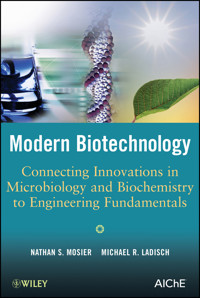
A unique resource for the next generation of biotech innovators Enabling everything from the deciphering of the human genome to environmentally friendly biofuels to lifesaving new pharmaceuticals, biotechnology has blossomed as an area of discovery and opportunity. Modern Biotechnology provides a much-needed introduction connecting the latest innovations in this area to key engineering fundamentals. With an unmatched level of coverage, this unique resource prepares a wide range of readers for the practical application of biotechnology in biopharmaceuticals, biofuels, and other bioproducts. Organized into fourteen sections, reflecting a typical semester course, Modern Biotechnology covers such key topics as: * Metabolic engineering * Enzymes and enzyme kinetics * Biocatalysts and other new bioproducts * Cell fusion * Genetic engineering, DNA, RNA, and genes * Genomes and genomics * Production of biopharmaceuticals * Fermentation modeling and process analysis Taking a practical, applications-based approach, the text presents discussions of important fundamentals in biology, biochemistry, and engineering with relevant case studies showing technology applications and manufacturing scale-up. Written for today's wider, more interdisciplinary readership, Modern Biotechnology offers a solid intellectual foundation for students and professionals entering the modern biotechnology industry.
Sie lesen das E-Book in den Legimi-Apps auf:
Seitenzahl: 714
Veröffentlichungsjahr: 2011
Ähnliche



















Contents
Preface
Acknowledgement
List of Illustrations
Figures
Tables
CHAPTER ONE BIOTECHNOLOGY*
INTRODUCTION
GROWTH OF THE ANTIBIOTIC/ PHARMACEUTICAL INDUSTRY
GROWTH OF THE AMINO ACID/ACIDULANT FERMENTATION INDUSTRY
REFERENCES
HOMEWORK PROBLEMS
CHAPTER TWO NEW BIOTECHNOLOGY
INTRODUCTION
GROWTH OF THE BIOPHARMACEUTICAL INDUSTRY
IMPACTS OF THE NEW BIOTECHNOLOGY ON BIOPHARMACEUTICALS, GENOMICS, PLANT BIOTECHNOLOGY, AND BIOPRODUCTS
REFERENCES
HOMEWORK PROBLEMS
CHAPTER THREE BIOPRODUCTS AND BIOFUELS
INTRODUCTION
BIOCATALYSIS AND THE GROWTH OF INDUSTRIAL ENZYMES
GROWTH OF RENEWABLE RESOURCES AS A SOURCE OF SPECIALTY PRODUCTS AND INDUSTRIAL CHEMICALS
BIOPROCESS ENGINEERING AND ECONOMICS
BIOSEPARATIONS AND BIOPROCESS ENGINEERING
REFERENCES
CHAPTER FOUR MICROBIAL FERMENTATIONS
INTRODUCTION
FERMENTATION METHODS
MICROBIAL CULTURE COMPOSITION AND CLASSIFICATION
MEDIA COMPONENTS AND THEIR FUNCTIONS (COMPLEX AND DEFINED MEDIA)
REFERENCES
HOMEWORK PROBLEMS
CHAPTER FIVE MODELING AND SIMULATION
INTRODUCTION
THE RUNGE–KUTTA METHOD
KINETICS OF CELL GROWTH
SIMULATION OF A BATCH ETHANOL FERMENTATION
LUEDEKING–PIRET MODEL
CONTINUOUS STIRRED-TANK BIOREACTOR
BATCH FERMENTOR VERSUS CHEMOSTAT
REFERENCES
HOMEWORK PROBLEMS
CHAPTER SIX AEROBIC BIOREACTORS
INTRODUCTION
FERMENTATION PROCESS
CHAPTER 6 APPENDIX: EXCEL PROGRAM FOR INTEGRATION OF SIMULTANEOUS DIFFERENTIAL EQUATIONS (BY CRAIG KEIM, 1/29/99)
REFERENCES
HOMEWORK PROBLEMS
CHAPTER SEVEN ENZYMES
INTRODUCTION
ENZYMES AND SYSTEMS BIOLOGY
INDUSTRIAL ENZYMES
ENZYMES: IN VIVO AND IN VITRO
FUNDAMENTAL PROPERTIES OF ENZYMES
CLASSIFICATION OF ENZYMES
SALES AND APPICATIONS OF IMMOBILIZED ENZYMES
ASSAYING ENZYMATIC ACTIVITY
BATCH REACTIONS
THERMAL ENZYME DEACTIVATION
REFERENCES
HOMEWORK PROBLEMS
CHAPTER EIGHT ENZYME KINETICS
INTRODUCTION
INITIAL RATE VERSUS INTEGRATED RATE EQUATIONS
BATCH ENZYME REACTIONS: IRREVERSIBLE PRODUCT FORMATION (NO INHIBITION)
IRREVERSIBLE PRODUCT FORMATION IN THE PRESENCE OF INHIBITORS AND ACTIVATORS
INHIBITION
EXAMPLE OF REVERSIBLE REACTIONS
KING–ALTMAN METHOD
IMMOBILIZED ENZYME
REFERENCES
HOMEWORK PROBLEMS
CHAPTER NINE METABOLISM
INTRODUCTION
AEROBIC AND ANAEROBIC METABOLISM
CITRIC ACID CYCLE AND AEROBIC METABOLISM
METABOLISM AND BIOLOGICAL ENERGETICS
REFERENCES
HOMEWORK PROBLEMS
CHAPTER TEN BIOLOGICAL ENERGETICS
INTRODUCTION
REDOX POTENTIAL AND GIBBS FREE ENERGY IN BIOCHEMICAL REACTIONS
HEAT: BY PRODUCT OF METABOLISM
REFERENCES
HOMEWORK PROBLEMS
CHAPTER ELEVEN METABOLIC PATHWAYS
INTRODUCTION
AMINO ACIDS
ANTIBIOTICS
REFERENCES
HOMEWORK PROBLEMS
CHAPTER TWELVE GENETIC ENGINEERING: DNA, RNA, AND GENES
INTRODUCTION
DNA AND RNA
GENES AND PROTEINS
REFERENCES
HOMEWORK PROBLEMS
CHAPTER THIRTEEN METABOLIC ENGINEERING
INTRODUCTION
BUILDING BLOCKS
L-THREONINE-OVERPRODUCING STRAINS OF E. coli K-12
REFERENCES
HOMEWORK PROBLEMS
CHAPTER FOURTEEN GENOMES AND GENOMICS
INTRODUCTION
POLYMERASE CHAIN REACTION (PCR)
CONCLUSIONS
REFERENCES
HOMEWORK PROBLEMS
Index
Copyright © 2009 by John Wiley & Sons, Inc. All rights reserved
Published by John Wiley & Sons, Inc., Hoboken, New Jersey
Published simultaneously in Canada
No part of this publication may be reproduced, stored in a retrieval system, or transmitted in any form or by any means, electronic, mechanical, photocopying, recording, scanning, or otherwise, except as permitted under Section 107 or 108 of the 1976 United States Copyright Act, without either the prior written permission of the Publisher, or authorization through payment of the appropriate per-copy fee to the Copyright Clearance Center, Inc., 222 Rosewood Drive, Danvers, MA 01923 (978) 750-8400, fax (978) 750-4470, or on the web at www.copyright.com. Requests to the Publisher for permission should be addressed to the Permissions Department, John Wiley & Sons, Inc., 111 River Street, Hoboken, NJ 07030, (201) 748-6011, fax (201) 748-6008, or online at http://www.wiley.com/go/permission.
Limit of Liability/Disclaimer of Warranty: While the publisher and author have used their best efforts in preparing this book, they make no representations or warranties with respect to the accuracy or completeness of the contents of this book and specifically disclaim any implied warranties of merchantability or fitness for a particular purpose. No warranty may be created or extended by sales representatives or written sales materials. The advice and strategies contained herein may not be suitable for your situation. You should consult with a professional where appropriate. Neither the publisher nor author shall be liable for any loss of profit or any other commercial damages, including but not limited to special, incidental, consequential, or other damages.
For general information on our other products and services or for technical support, please contact our Customer Care Department within the United States at (800) 762-2974, outside the United States at (317) 572-3993 or fax (317) 572-4002.
Wiley also publishes its books in a variety of electronic formats. Some content that appears in print may not be available in electronic formats. For more information about Wiley products, visit our web site at www.wiley.com.
LibraryofCongressCataloging-in-PublicationData:
Mosier, Nathan S., 1974-
Modern biotechnology: connecting innovations in microbiology and biochemistry to engineering fundamentals/Nathan S. Mosier, Michael R. Ladisch.
p. cm.
Includes index.
ISBN 978-0-470-11485-8 (cloth)
1. Biotechnology. I. Ladisch, Michael R., 1950- II. Title. TP248.2.M675 2009
660.6-dc22
2009001779
PREFACE
Biotechnology has enabled the development of lifesaving biopharmaceuticals, deciphering of the human genome, and production of bioproducts using environmentally friendly methods based on microbial fermentations. The science on which modern biotechnology is based began to emerge in the late 1970s, when recombinant microorganisms began to be used for making high-value proteins and peptides for biopharmaceutical applications. This effort evolved into the production of some key lifesaving proteins and the development of monoclonal antibodies that subsequently have provedn to be effective molecules in the fight against cancer. In the late 1980s and early 1990s biotechnology found further application in sequencing of the human genome, and with it, sequencing of genomes of many organisms important for agriculture, industrial manufacture, and medicine.
The human genome was sequenced by 2003. At about the same time the realization developed that our dependence on petroleum and other fossil fuels was beginning to have economic consequences that would affect every sector of our economy as well as the global climate. Modern biotechnology began to be applied in developing advanced enzymes for converting cellulosic materials to fermentable sugars. The process engineering to improve grain-to-ethanol plants and the rapid buildout of an expanded ethanol industry began. This provided the renewable liquid fuels in small but significant quantities.
Thus biology has become an integral part of the engineering toolbox through biotechnology that enables the production of biomolecules and bioproducts using methods that were previously not feasible or at scales previously thought impossible. We decided to develop this textbook that addresses modern biotechnology in engineering. We started with the many excellent concepts described by our colleagues by addressing bioprocess engineering and biochemical engineering from a fundamental perspective. We felt that a text was needed to address applications while at the same time introduce engineering and agriculture students to new concepts in biotechnology and its application for making useful products. As we developed the textbook and the course in which this textbook has been used, the integration of fundamental biology, molecular biology, and some aspects of genetics started to become more common in many undergraduate curricula. This further expanded the utility of an application-based approach for introducing students to biotechnology. This book presents case studies of applications of modern biotechnology in the innovation process that has led to more efficient enzymes and better understanding of microbial metabolism to redirect it to maximize production of useful products. Scaling up biotechnology so that large quantities of fermentation products could be produced in an economic manner is the bridge between the laboratory and broader society use.
Our textbook takes the approach of giving examples or case studies of how biotechnology is applied on a large scale, followed by discussion of fundamentals in biology, biochemistry, and enzyme or microbial reaction engineering. Innovations in these areas have occurred at an astounding rate since the mid-1990s. The current text attempts to connect the innovations that have occurred in molecular biology, microbiology, and biochemistry to the engineering fundamentals that are employed to scale up the production of bioproducts and biofuels using microorganisms and biochemical catalysts with enhanced properties.
The approach that we take treats microorganisms as living biocatalysts, and examines how the principles that affect the activity of microorganisms and enzymes are used in determining the appropriate scaleup correlations and for analyzing performance of living and nonliving biocatalysts on a large scale. Our textbook will hopefully provide the basis on which new processes might be developed, and sufficient background for students who wish to transition to the field and continue to grow with the developments of modern biotechnology industry. While we cannot hope to teach all the fundamentals that are required to cover the broad range of products that are derived using biotechnology, we do attempt to address the key factors that relate engineering characteristics to the basic understanding of biotechnology applied on a large scale.
NATHAN MOSIER AND MICHAEL LADISCH
October 7, 2008
ACKNOWLEDGMENTS
We wish to thank our family, colleagues, and Purdue University for giving us the time to focus on developing an organized approach to teaching the broad set of topics that define biotechnology. This enabled us to transform our teaching into a format that others may use to lecture and to gain from our experience. Special thanks go to Carla Carie, who worked diligently on preparing drafts of manuscripts, and assisted with the many processes involved in finalizing the manuscript for publication. We thank Dr. Ajoy Velayudhan for his development of the Runge-Kutta explanation and our many students, especially Amy Penner and Elizabeth Casey, for inputs and suggestions as well as assisting with making improvements in the various sections of the book. We also thank Craig Keim and Professor Henry Bungay (from RPI) for contributions to the Runge-Kutta code. We also thank the Colleges of Agriculture and Engineering, and specifically Dr. Bernie Engel, head of the Agricultural and Biological Engineering Department, and Professor George Wodicka, head of the Weldon School of Biomedical Engineering, for granting us the flexibility to complete this textbook and for providing encouragement and resources to assist us in this process.
One of the authors (Michael Ladisch) wishes to convey his appreciation to the heads of the Agricultural and Biological Engineering Department and Weldon School of Biomedical Engineering at Purdue University for facilitating a partial leave of absence that is enabling him to work as Chief Technology Officer at Mascoma Corporation. As CTO, he is a member of the team building the first cellulose ethanol plant. It is here that some of the lessons learned during the teaching of this material are being put into practice.
Most of all, we would like to thank the students in our mezzanine-level course ABE 580 (Process Engineering of Renewable Resources) with whom we developed the course materials. Their enthusiasm and success makes teaching fun, and keeps us feeling forever young. We also wish to thank John Houghton from the U.S. Department of Energy Office of Biological and Environmental Research for his review of a draft of this textbook and his helpful comments and suggestions.
LIST OF ILLUSTRATIONS
Figures
1.1.Example of Process Improvements of Biotechnology Product and Impact on Cost1.2.Hierarchy of Values Represented as a Log–Log Plot of Price as a Function of Volume for Biotechnology Products1.3.Log–Log Plot of Concentration as a Function of Selling Price for Small and Large Molecules; and Products Used in a Range of Applications from Food to Therapeutic2.1.Conceptual Representation of Biotechnology Industry Life Cycle2.2.Cash Flows for Amgen During Its Early Growth2.3.One Common Way to Genetically Engineer Bacteria Involves the Use of Small, Independently Replicating Loops of DNA Known as Plasmids2.4.To Produce Monoclonal Antibodies, Antibody-Producing Spleen Cells from a Mouse that Has Been Immunized Against an Antigen Are Mixed with Mouse Myeloma Cells2.5.A Mouse Spleen Cell and Tumor Cell Fuse to Form a Hybridoma3.1.Unit Operations of a Biorefinery3.2.Schematic of Pretreatment Disrupting Physical Structure of Biomass3.3.Schematic Diagram of Combined Immobilized Enzyme Reactor and Simulated Moving-Bed Chromatography for Producing 55% High-Fructose Cor Syrup (HFCS)3.4.Trends in Sugar Prices and Consumption3.5.Chart Showing Industrial Chemicals Derived from Starches and Sugars3.6.Chart Showing Products Derived from Renewable Sources of Fats and Oils4.1.Schematic Diagram of Incubator-Shaker Used for Shake Flask Culture of Microbial Cells4.2.Picture of a Laboratory Fermentor Showing Major Components4.3.Diagram of an Instrumented Fermentor for Aerated Fermentation of Products Generated under Sterile Conditions in a Closed, Agitated Vessel4.4.Schematic Representations of a Eukaryote and a Prokaryote and Woese Family Tree Showing Relationship between of One-Celled Life and Higher Organisms4.5.Overlap of pH Optima for Hydrolysis and Fermentation Are Needed for Efficient Simultaneous Saccharification and Fermentation (SSF)4.6.Schematic Illustration of Several Phases of Growth Showing Cell Mass Concentration4.7.Linearized (SemiLog) Plot of Cell Mass as a Function of Time4.8.Comparison of Linear and Semilog Plots of Cell Mass versus Time from Fermentation4.9.Schematic Representation of Characteristic Cell Mass, Product, and Sugar Accumulation for Types I and II Fermentations4.10.Schematic Representations of the Three Stages of Catabolism, Glycolysis, Citric Acid Cycle, and Products from Pyruvate Anaerobic Metabolism of Pyruvate by Different Microorganisms that Do Not Involve the Citric Acid Cycle4.11.Schematic Representation of Curves for Characteristic Cell Mass, Product, and Sugar Accumulation4.12.Characteristic Cell Mass, Product, and Sugar Accumulation for Type III Fermentation Where the Product Is Not Produced Until an Inducer Is Added5.1.Schematic Diagram of Numerical Integration by Simpson’ s Rule5.2.Schematic Representation of Inverse Plot of Monod Equation that May Be Used to Represent Microbial Growth Data5.3.Concentration of Substrate and Cells as a Function of Time5.4.Schematic Representation of Definition of Ks5.5.Inhibitory Effect of Ethanol on Specific Ethanol Production by Saccharomyces cerevisiae5.6.Process Flow Diagram for Molasses Fermentation System5.7.Graphical Representation of Luedeking-Piret Model5.8.Schematic Representation of a Continuous Stirred-Tank Bioreactor (CSTB)5.9.Biomass as a Function of Dilution Rate6.1.Change in Xylose and 2,3-Butanediol Concentration as a Function of Time6.2.Accumulation of Cell Mass and Protein as a Function of Time6.3.Changes in Dissolved Oxygen as % Saturation, CO2, Oxygen Uptake Rate, and Respiratory Quotient6.4.Schematic Representation of Xylose Metabolism in Klebsiella oxytoca during Oxygen-Limited Growth6.5.Plot of Simulation of 2,3-Butanediol Fermentation Showing Cell Mass, Substrate Concentration, and Product Accumulation as a Function of Time6.6.Schematic Representation of an Air Bubble in a Liquid6.7.Rate of Oxygen Absorption as a Function of Concentration Gradient in Liquid Phase6.8.Schematic Representation of Measuring Holdup H Based on Differences in Fluid Level in Tanks with and without Aeration6.9.Oxygen Transfer Coefficient as a Function of Oxygen Diffusion6.10.Correlation of Power Number as a Function of Reynolds Number for Flat-Blade Turbine in a Baffled Reactor6.11.Gassed Power as a Function of Ungassed Power, Turbine Configuration, and Air (Gas) Volumetric Throughput6.12.Power Number as a Function of Reynolds Number for an Agitated Tank with Six-Blade Turbine and Four Baffles7.1.Schematic Representations of Immobilized Enzymes7.2.Representation of Three-Point Attachment of a Substrate to a Planar Active Site of an Enzyme7.3.Bond Specificity of β-Glucosidase7.4.Illustration of Peptide Bond Cleavage Sites for Chymotrypsin and Trypsin7.5.Relative Velocity (v/ Vmax) as a Function of Substrate Concentration for Different Values of Km7.6.Percentages of % Relative and Residual Enzymatic Activity as a Function of Temperature and Time, Respectively7.7.Schematic Illustration of Anson Assay7.8.Absorption Spectra of NAD+ and NADH for 44 mg/ml Solution for a 1 cm Path Length7.9.Coupled Assay for Hexokinase Activity and Assay of an NADH-or NADPH-Dependent Dehydrogenase7.10.Calibration Curve for Enzymatic Analysis7.11.Schematic Diagram of Principal Components of the Original Beckman Glucose Analyzer7.12.MutaRotation TimeCourse for Glucose7.13.Oxidative Stability of Subtilisins, with Comparison of Wild Type to Leu-222 Variant7.14.The Polypeptide Chain of Lysozyme From Bacteriophage T4 Folds into Two Domains7.15.First-Order Deactivation Curve for Cellobiase from Trichoderma viride8.1.Examples of Lineweaver–Burke Plots for Competitive Inhibition8.2.Timecourse of Cellobiose Hydrolysis by Endoglucanase8.3.Double-Reciprocal Lineweaver–Burke Plot with Range of Substrate Concentrations Chosen to Be Optimal for Determination of Km and Vmax; Double-Reciprocal Plot Where the Range of Substrate Concentration S Is Higher than Optimal and Reaction Velocity V Is Relatively Insensitive to Changes in S8.4.Illustration of Hofstee or Eadie Plot of Rectangular Hyperbola and Hanes Plot of Rectangular Hyperbola8.5.A Schematic Illustration of Pseudo-Steady State Assumption8.6.Schematic Diagram of Competitive Inhibition Where I3 > I2 > I18.7.Schematic Representation of Replot of Slope as a Function of Inhibitor Concentration8.8.Schematic Representation of Uncompetitive Inhibition for I3 > I2 > I18.9.Schematic Diagram of Replot of Inhibitor Effect8.10.Schematic Diagram Showing Pattern for Noncompetitive Inhibition Where Inhibitor Concentrations Follow the Order I3 > I2 > I8.11.Schematic Diagram of Curve for Substrate Inhibition with Respect to Slope B8.12.Schematic Representation of Membrane Reactor9.1.Diagrammatic Representation of Some of the Metabolic Pathways in a Cell9.2.Structures of Important Energy Transfer Molecules in the Cell9.3.Metabolism Follows Catabolic (Energy-Generating) and Anabolic (Synthesizing) Pathways Connected through Amphobilc Pathways9.4.Oxidases Catalyze the Oxidization of Compounds Using O2; Ethanol Dehydrogenase Uses NAD+ to Oxidize Ethanol to Acetaldehyde9.5.NADH Acts as a Reducing Agent in the Synthesis of β-Lactam for the Synthetic Production of Antibiotics9.6.An In Vitro Membrane Bioreactor to Generate Precursors for the Synthetic Production of Antibiotics9.7.Structure of Acetyl-CoA9.8.Simplified Diagram of Three Stages of Catabolism9.9.First Half of Glycolysis Where α-d-Glucose Is Phosphorylated and Broken Down into a Three-Carbon Molecule9.10.Second Half of Glycolysis9.11.The Product of Glycolysis (Pyruvate) Is Further Processed to Ethanol in Order to Recycle NADH to NAD+ to Allow Glycolysis to Continue9.12.The Product of Glycolysis (Pyruvate) Is Further Processed to Lactate in Order to Recycle NADH to NAD+ to Allow Glycolysis to Continue9.13.Overall Stoichiometry of Lactic Acid Fermentation from Glucose9.14.Formic Acid Fermentation Showing Electron Transfer Driven by External Reduction of Formate9.15.Succinic Acid Fermentation9.16.Partial Diagram for Glucose Monophosphate Pathway9.17.Partial Diagram of Entner–Doudoroff Pathway9.18.Metabolic Pathway for the Mixed-Acid Fermentation of Bifidobacterium9.19.Minimum Economic Values of Ethanol and Ethylene Derived by Fermentation of Glucose to Ethanol Followed by the Catalytic Dehydration of Ethanol to Ethylene9.20.Simplified Representation of Citric Acid Cycle9.21.Conversion of Phosphoenolpyruvate (PEP) to Oxalacetate9.22.Conversion of Pyruvate to Oxalacetate9.23.Properties, Structures, and Nomenclature for Uncharged Amino Acids9.24.Properties, Structures, and Nomenclature for Charged Amino Acids, and Uncharged Polar Amino Acids9.25.Glycerol Forms the Backbone for Triglyceride Fats9.26.Pathways for Growth of Microorganisms on Fat and n-Alkanes, and Oxidation of Fat HP9.4. Central and Anaplerotic Pathways and Regulation Patterns in Glutamic Acid Bacteria10.1.Pathway Showing Glycolysis and Products from Anaerobic Metabolism of Pyruvate by that Do Not Involve the Citric Acid Cycle10.2.Structures Representing ATP, ADP, and AMP; and Partial Representation of ATP Synthase10.3.Equilibrium Reaction between Glyceraldehyde 3-Phosphate and Dihy-droxyacetone Phosphate10.4.The Redox Reaction for NAD+ to NADH10.5.The Redox Reaction for FAD+ to FADH10.6.Cell Mass and Heat Generation by Klebsiella fragilis10.7.Rate of Heat Production and Total Heat Produced as Function of Oxygen Consumption; and Rate of Heat Production and Total Heat Produced as Function of CO2 Generation11.1.Intermediate Metabolite P of an Unbranched Pathway Is the Product in Controlled Fermentation11.2.Supplementation of Metabolite in Fermentation Crosses Cell Membrane of an Auxotrophic Cell11.3.Intermediate Metabolite P of a Branched Pathway Is the Product in Controlled Fermentation11.4.Metabolic Control for the Production of Purine Nucleotides11.5.End Metabolite of Pathway 1 Represents the Desired Product P in Controlled Fermentation11.6.Branched Metabolic Pathway with Complex Feedback Inhibition11.7.Inhibition of Amino Acid Production by Analog Compound11.8.Culture Screening for Desired Auxotrophs11.9.Isomerization of d-Methionine to l-Methionine by a Two-Step Enzyme-Catalyzed Process11.10.Overproduction of Glutamate by Limiting the Expression of α-Ketoglutarate Dehydrogenase11.11.Synthesis of Biotin11.12.Auxotrophs for Producing Threonine and Methionine11.13.Cell Fusion for Developing Lysine-Producing Microorganism11.14.Metabolic Pathway for the Production of Penicillin from Amino Acid Precursors in Penicillium chrysogenum with Feedback Inhibition by Lysine of Homocitrate Synthetase11.15.Benzyl Penicillin Is Synthesized from Two Amino Acids11.16.Streptomycin Is Synthesized from Sugars11.17.Fermentation Timecourse for Penicillin Production HP11.9.1. Antibiogram — Graphical Representation Mapping Susceptibility of Different Microorganisms to Antibacterial Drugs HP11.9.2. Molecular Logic of Vancomycin Resistance12.1.Unique Cleavage Sites for pBR32213.1.Metabolic Reprogramming Inferred from Global Analysis of Changes in Gene Expression13.2.Metabolic Pathways to 1,2-and 1,3-Propanediol from Dihydroxyacetone (DHAP), a Common Intermediate in Sugar Metabolism13.3.Schematic Representation of Separation Sequence for Fermentation-Derived 1,2-Propanediol13.4.Effect of Acrylamide on the Activity of Nitrile Hydratases from Pseudomonas chlororaphis B23 and Brevibacterium R31214.1.Genetic Map of Drosophila Chromosome 2L Showing Location of Alcohol Dehydrogenase with DNA Sequence14.2.Graphical Illustration of Gel Electrophoresis of DNA14.3.Southern Blotting of DNA Fragments Separated by Gel Electrophoresis14.4.Schematic Illustration of Single-Nucleotide Polymorphisms14.5.Schematic Representation of Oligonucleotide Array14.6.Schematic Representation of DNA Chip for Detecting Mutations14.7.Graphical Representation of Amplifying a Target DNA Sequence Through the Polymerase Chain Reaction (PCR)Tables
1.1.Timeline of Major Developments in Biotechnology Industries Through 19982.1.Progress in Sequencing Genomes of Microorganisms4.1.Total Weights of Monomer Constituents that Make Up Macromolecular Components in 100g Dry Weight of E. coli K-12 Cells4.2.Prokaryotes and Eukaryotes Used as Microbial Industrial Organisms4.3.Inorganic Constituents of Bacteria and Yeast4.4.Composition of Molasses from Sugar Beet and Cane Processing4.5.Comparison of Major Components in Selected Fermentation Media Components4.6.Composition of a Defined (Synthetic) Medium for Ethanol Production5.1.Kinetic Constants for Ethanol Fermentation5.2.Byproduct Inhibition Summary6.1.Composition of Media6.2.Values of Parameters Used in Simulation of 2,3-Butanediol Production by Klebsiella oxytoca 87246.3.Equations for Simulation of 2,3 Butanediol Fermentation7.1.International Classification of Enzymes (Class Names, Code Numbers, and Types of Reactions Catalyzed)7.2.Industrial Uses of Carbohydrate-Hydrolyzing Enzymes, Proteolytic Enzymes, Other Types of Hydrolytic Enzymes, Oxidoreductases, Isomerase, and Other Enzymes; and Selected Research, Medical, and Diagnostic Use of Enzymes8.1.Examples of Molecules Utilized in Anaerobic Regeneration of NAD+8.2.Correspondence between Parameters Used in Several Equations10.1.Concentrations of Macromolecular Cellular Components of E. coli K–12 Based on Analysis of their Constituent Monomers10.2.Redox Potential of Selected Reaction Pairs10.3.Comparison of Heats Associated with Growth of E. coli10.4.Measured Yield Coefficients for Klebsiella fragilis Grown in Batch Culture on Different Carbon Sources11.1.Toxic Analogs (Px) Used to Select for Microorganisms that Overproduce Metabolites11.2.Toxicity of Selected Amino Acids in Mice and Rats as Measured by Oral Administration12.1.Properties of Natural Plasmids for Cloning DNA12.2.Examples of Type II Restriction Enzymes and Their Cleavage Sequences12.3.Major Fermentation Products13.1.Examples of Genetically Altered Brevibacterium lactoferrin with Enhanced Amino Acid Production13.2.Typical Compositions of Selected Biomass Materials (Dry-Weight Basis)13.3.Comparison of In Vitro Enzymatic Activities in Yeasts13.4.Comparison of Nitrile Hydratase and Amidase from Pseudomonas chlororaphis (Amidase Activity that Hydrolyzes the Desired Acrylamide Product Is Negligible)14.1.Selected Examples of Genes Identified by Sequence-Tagged Sites (STSs) for Selected Chromosomes; Summary Generated from a Human Transcript MapCHAPTER ONE
BIOTECHNOLOGY*
INTRODUCTION
By 2008, biotechnology touched the major sectors that define human activity: food, fuel, and health. The history of biotechnology starts with breadmaking, utilizing yeast, about 8000 years ago. Fermentation of grains and fruits to alcoholic beverages was carried out in Egypt and other parts of the ancient world in about 2500 bc. Other types of food fermentation practiced for thousands of years include the transformation of milk into cheeses and fermentation of soybeans. However, it was not until 1857 that Pasteur proved that alcoholic fermentation was caused by living cells, namely, yeasts. In the ensuing 100 years, the intentional manipulation of microbial fermentations to obtain food products, solvents, and beverages, and later, substances having therapeutic value as antibiotics gave rise to a large fermentation industry (Hacking 1986; Aiba et al. 1973; Evans 1965). Biotechnology emerged as an enabling technology defined as “any technique that uses living organisms (or parts of organisms) to make or modify products, to improve plants or animals, or to develop microorganisms for specific uses” (Office of Technology Assessment 1991).
A sea of change in biotechnology occurred in the midtwentieth century with discovery of the molecular basis of biology—DNA—and again in the twenty-first century, when it began to be used for obtaining renewable biofuels and enhanced production agriculture (Houghton et al. 2006). Biotechnology has helped to catalyze the growth of the pharmaceutical, food, agricultural processing and specialty product sectors of the global economy (National Research Council 1992, 2001). The scope of biotechnology is broad and deep. Biotechnology encompasses the use of chemicals to modify the behavior of biological systems, the genetic modification of organisms to confer new traits, and the science by which foreign DNA may be inserted into people to compensate for genes whose absence cause life-threatening conditions. Twenty-five years later the science of genetic engineering is finding applications in enhancing microbial and plant technologies to directly or indirectly fix CO2 into renewable fuels (Kim and Dale 2008).
The engineering fundamentals required to translate the discoveries of biotechnology into tangible commercial products, thereby putting biotechnology to work, define the discipline of bioprocess engineering (National Research Council 1992). Bioprocess engineering translates biotechnology into unit operations, biochemical processes, equipment, and facilities for manufacturing bioproducts. The biotechnology addressed in this book provides a foundation for the engineering of bioprocesses for production of human and animal healthcare products, food products, biologically active proteins, chemicals, and biofuels. Industrial bioprocessing entails the design and scaleup of bioreactors that generate large quantities of transformed microbes or cells and their products, as well as technologies for recovery, separation, and purification of these products. This book presents the principles of the life sciences and engineering for the practice of key biotechnology manufacturing techniques and economic characteristics of the industries and manufacturing processes that encompass biotechnology, agriculture, and biofuels (Ladisch 2002; Houghton et al. 2006; NABC Report 19 2007; Lynd et al. 2008).
Lesen Sie weiter in der vollständigen Ausgabe!
Lesen Sie weiter in der vollständigen Ausgabe!
Lesen Sie weiter in der vollständigen Ausgabe!
Lesen Sie weiter in der vollständigen Ausgabe!
Lesen Sie weiter in der vollständigen Ausgabe!
Lesen Sie weiter in der vollständigen Ausgabe!
Lesen Sie weiter in der vollständigen Ausgabe!
Lesen Sie weiter in der vollständigen Ausgabe!
Lesen Sie weiter in der vollständigen Ausgabe!
Lesen Sie weiter in der vollständigen Ausgabe!
Lesen Sie weiter in der vollständigen Ausgabe!
Lesen Sie weiter in der vollständigen Ausgabe!
Lesen Sie weiter in der vollständigen Ausgabe!
Lesen Sie weiter in der vollständigen Ausgabe!




