


19,99 €
Mehr erfahren.
- Herausgeber: John Wiley & Sons
- Kategorie: Geisteswissenschaft
- Serie: Cultural History of Literature
- Sprache: Englisch
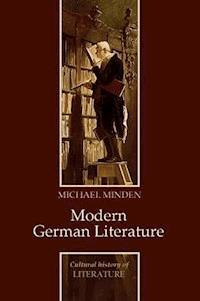
This accessible and fresh account of German writing since 1750 is a case study of literature as a cultural and spiritual resource in modern societies.
Beginning with the emergence of German language literature on the international stage in the mid-eighteenth century, the book plays down conventional labels and periodisation of German literary history in favour of the explanatory force of international cultural impact. It explains, for instance, how specifically German and Austrian conditions shaped major contributions to European literary culture such as Romanticism and the ‘language scepticism’ of the early twentieth century.
From the First World War until reunification in 1990, Germany’s defining experiences have been ones of catastrophe. The book provides a compelling overview of the different ways in which German literature responded to historical disaster. They are, first, Modernism (the ‘Literature of Negation’), second, the literature of totalitarian regimes (Third Reich and German Democratic Republic), and third the various creative strategies and evasions of the capitalist democratic multi-medial cultures of the Weimar and Federal Republics.
The volume achieves a balance between textual analysis and cultural theory that gives it value as an introductory reference source and as an original study and as such will be essential reading for students and scholars alike.
Sie lesen das E-Book in den Legimi-Apps auf:
Seitenzahl: 535
Veröffentlichungsjahr: 2013
Ähnliche




















Table of Contents
Cover
Cultural History of Literature
Title page
Copyright page
Dedication
Acknowledgements
Introduction: Cultural History of Literature
1 A European German Literature
Enlightenment identities
The virtue of sexuality
The German idea of literature
A German Shakespeare
Greece comes to Germany
Casualties of Idealism
Infinity for all
The consolation of philosophy
Irony
Spilt religion
What Germans really read
Spirit in the age of modern literature
2 Poetry and Politics
The classical inheritance in the modern world
German realism
An affirmative literature
The German literature myth and what Germans really read
The Novelle
Problematic affirmative literature
Overture to the future
3 Imperial Modernity
The revolution that never was
The social question
The German claim to art
Literature on the ground
The world of publicity
The marketing of exclusivity
German art meets advertising
Publicity as a creative force
Language becomes self-conscious
Literature and technology
4 The Literature of Negation
The Great War
Fort/Dada
The broken subject
Fascist negation
Negation in the dialectic
Negation and the Holocaust
The lyric of negation
5 The Fate of Affirmative Literature
The Third Reich
The German Democratic Republic
6 Literature in Democratic Capitalism
From Erlebnis to Erfahrung
Old literature adapts to the new world
Testimony, market, society
Exile
The economic miracle
Medial hybridity
Conclusion: The End of the Age
References
Index
Cultural History of Literature
Ann Hallamore Caesar and Michael Caesar, Modern Italian Literature
Christopher Cannon, Middle English Literature
Sandra Clark, Renaissance Drama
Glenda Dicker/sun, African American Theatre
Alison Finch, French Literature
Roger Luckhurst, Science Fiction
Michael Minden, Modern German Literature
Katie Normington, Medieval English Drama
Lynne Pearce, Romance Writing
Charles J. Rzepka, Detective Fiction
Jason Scott-Warren, Early Modern English Literature
Charlotte Sussman, Eighteenth Century English Literature
Mary Trotter, Modern Irish Theatre
Andrew Baruch Wachtel and Ilya Vinitsky, Russian Literature
Andrew J. Webber, The European Avant-Garde
Tim Whitmarsh, Ancient Greek Literature
Copyright © Michael Minden 2011
The right of Michael Minden to be identified as Author of this Work has been asserted in accordance with the UK Copyright, Designs and Patents Act 1988.
First published in 2011 by Polity Press
Polity Press
65 Bridge Street
Cambridge CB2 1UR, UK
Polity Press
350 Main Street
Malden, MA 02148, USA
All rights reserved. Except for the quotation of short passages for the purpose of criticism and review, no part of this publication may be reproduced, stored in a retrieval system, or transmitted, in any form or by any means, electronic, mechanical, photocopying, recording or otherwise, without the prior permission of the publisher.
ISBN-13: 978-0-7456-2919-3
ISBN-13: 978-0-7456-2920-9 (pb)
ISBN-13: 978-0-7456-5726-4 (Single-user ebook)
ISBN-13: 978-0-7456-5725-7 (Multi-user ebook)
A catalogue record for this book is available from the British Library.
The publisher has used its best endeavours to ensure that the URLs for external websites referred to in this book are correct and active at the time of going to press. However, the publisher has no responsibility for the websites and can make no guarantee that a site will remain live or that the content is or will remain appropriate.
Every effort has been made to trace all copyright holders, but if any have been inadvertently overlooked the publisher will be pleased to include any necessary credits in any subsequent reprint or edition.
For further information on Polity, visit our website: www.politybooks.com
For Mary and Joe
Acknowledgements
In writing this book I have often had cause to remember with fondness and gratitude the supervisions on German literature I had from Traudl Herbert in the 1960s. Many colleagues and friends have helped me with its actual composition. I should especially like to thank Anita Bunyan, Ian Cooper, Stephen Fennell and Andrew Plowman for reading parts of earlier drafts, and Nicholas Boyle, Paul Connerton, Peter Hutchinson, Hunter Steele and Jo Whaley for reading whole chapters in draft. James Bowman provided substantial help throughout, giving feedback, listing references and translating quotations. Finally, I should like to thank Sally-Ann Spencer and Andrea Drugan, the two editors I have worked with at Polity, who have been so patient and supportive, and the two anonymous readers who subjected an earlier draft to some salutary hard love. The idiosyncrasies and shortcomings of the finished book are my responsibility alone.
Michael Minden
Cambridge
Introduction: Cultural History of Literature
This book is as much about literature as it is about Germany. As a ‘cultural history’ of German literature, it is a study of literature in German as a variety of social and artistic practices. It is neither literary criticism nor literary history but something in between. I ask what kind of resource many different kinds of writing in German from many different parts of Europe have been in the period one could roughly describe as ‘modernity’. I understand this to mean the part of European history that goes from the high tide of the Enlightenment in the middle of the eighteenth century to the end of the Cold War in 1989, when it finally ceased to be possible to believe that capitalism meant freedom simply because it was not state controlled.
Of course, there are aspects of German literature that mark it out as German. Many of these will be highlighted in the pages that follow (and readers can find diverse accounts of the Germanness of German literature in the Further Reading section at the end of the book), but one particular complex of issues bears upon my method, and so it will be mentioned, briefly, here.
The Reformation began in Saxony in the early sixteenth century. Its extraordinarily rapid repercussions throughout the Holy Roman Empire were in part the effect of Gutenberg’s invention around the middle of the previous century, elsewhere in Germany, of movable metal type (the basis of printing technology for the next three hundred years). The relevance of this to literature is manifold, not least in the importance Luther attached to reading the Bible and in the introduction of hymns in the vernacular, sung by the congregation, both of which encouraged a direct relationship between words and the experience of ordinary people, no longer mediated by priests. The breaking down of the strict boundary between ministers and their congregation, for instance in the abandonment of celibacy and the existence of households in which the spiritual and secular meshed, and from which children imprinted with this spiritual–secular coding issued, created the conditions for the emergence of a modern literature in German.
There are many reasons why the realization of this potential was delayed by three hundred years, for instance the wars of religion, the attitude of the German nobility to literature in German, and the Protestant distrust of pleasure. But the crucial factor is that the European Enlightenment unlocked it. As we shall see, it was theologians and the sons of pastors who made the new secular German literature of the 1770s, bringing to the Enlightenment carnival of emancipation remarkable powers of introspection and abstraction long held back by piety and political servitude.
These powers of thought, rooted in experience yet turned towards the absolute, liberated the diversity that dwells within the specific experience of individuals and collectives, and thus sanctioned a modern literature as a resource for secular society. Such is the contribution of the East Prussian Protestant minister and theologian Johann Gottfried Herder (1744–1803; see chapter 1). Furthermore, they delivered a power of abstraction that could situate this lived diversity between the human mind and the absolute truth, and such is the extraordinary contribution of the East Prussian Protestant philosopher Immanuel Kant (1724–1804).
The point for my method is that this remarkable culture of critical consciousness not only in effect created modern German literature but covered it up again. In the nineteenth century, post-Kantian Idealism – that is, the systematic power of ideas or the organizing power of human consciousness – was enlisted for the purposes of nation-building. In this vast project, the specificity of literature, with its links in modernity to complex individual pleasure and to the marketplace, was neglected in favour of the ideas that might dwell within it and require uncovering, especially if they served the purpose of constructing a usable national identity or adding to its prestige.
It is often said that German literature is more philosophical than other comparable modern literatures. This may or may not be true, but my aim has been to correct, as far as I am able, the ‘philosophical’ distortion suffered by specific works and writers in German resulting from the process I have just described. This is not to say that I make no use of social and other sorts of theory where they are helpful and relevant, but they, and I, are there to serve the literature, and not to make it mean anything other than what it says. For this reason also, my interest in questions of German national identity takes second place to my interest in what German literature was actually like, what was written, what was read, what mattered to it (which certainly was sometimes national identity) but, most importantly, what was and is great literature.
A word about the tension between literature and history. My guiding principle in writing has been to navigate a way between two competing contemporary perils. These are, on one side, the subordination of history to literature that I was brought up to regard as natural, to which I unfortunately incline personally, and that, on a sophisticated level, vitiates much theoretical discourse of recent decades. On the other side, there is the temptation to contextualize away the specificity of literary ‘events’, to fall victim to the delusion that the responsible and life-affirming duty of the scholar in the humanities can only be discharged by the kind of ‘research’ that in fact takes its template from the natural sciences (where it has an entirely different modality and function) because that is the template grant-awarding bodies most readily understand.
It comes down to a question of narrative, and here we may engage again in some specifics of German history. The first two chapters deal with literature as a more or less defined (if varied and changing) entity from about 1750 to about 1890. The third, on the transition between 1890 and 1916, begins to register how any seamless literature–history narrative would distort the true facts of the matter. The national narrative points, under Prussian leadership, towards European dominance, while culture, resonating with the cultural Modernism elsewhere in Europe (particularly in those parts of the German-speaking lands not following Prussia into the sunset), begins to dispute the ineluctable quality of this narrative and insist instead upon the need to think, feel, see and do otherwise. The last three chapters then abandon chronology – not, paradoxically, to downplay the importance of historical events, but on the contrary to give them their real due. The Great War revealed how precarious European institutions, both visible and invisible, both political and moral, were. In this context, the German experience was one of a story traumatically and incomprehensibly interrupted. These chapters – on the Literature of Negation, literature under totalitarian regimes, and literature under democratic capitalism – chart the fate of the oppositional tendency that became dominant in literature at the end of the nineteenth century. This tendency could do nothing tangible to prevent or correct the calamities consequent upon the hypertrophy of technology or value-neutral economic processes. Instead, literature was subordinated and scattered, but took new forms and continued to provide testimony to human resilience and to the will to live and make new values among the wreckage of the old.
1
A European German Literature
Towards the end of the nineteenth century, the best-selling novelist and theorist of realism Gustav Freytag described the earlier Golden Age of German literature as a soul without a body. He regarded it as miraculous that the writing of Johann Wolfgang von Goethe (1748–1832), Friedrich Schiller (1759–1805), and the whole ensuing cultural attitude that became famous in Europe by the name of ‘Romanticism’ could have come about before there was a definable Germany. It was surprising that this could have happened in advance of the subsequent political maturity of modern Germany with which Freytag and his colleagues identified themselves. Yet, despite the late feudalism of small duchies, bishoprics and principalities and the sclerotic institutions of the Holy Roman Empire (to which Napoleon finally put an end in 1806), there was a German cultural identity, based upon a shared language, that went back in various ways to the Middle Ages, and which had been particularly strong since the Protestant Reformation. The very social and political deficits of the German lands in relation to France and Great Britain were the strongest elements in a powerful desire for a public German culture that transcended random political and national boundaries.
The desire among educated Protestant Germans for a modern cultural identity realized through the resource of the German language coincided with the wider European interest of the late eighteenth century in individualism and interiority. This coincidence is behind the particularly intense and fertile symbiosis between German writers and European culture from the 1770s onwards. Several factors are at play here. First, there is the pressure-cooker effect of this urge for collective and personal identity, each intensifying the other, pushing up against social and political forms generally uncongenial to it. With the French Revolution and the Napoleonic wars, however, local allegiance to progressive states, of which Prussia and Weimar are different kinds of example, gave shelter from the storm, both politically and financially. They provided a base from which to rein back the alarming results of the revolution, aesthetically at least, without discarding the ideals that inspired the revolution in the first place.
At the same time, the efflorescence of German writing represented in successive waves by Friedrich Gottlieb Klopstock (1724–1803), Gotthold Ephraim Lessing (1729–1781), Herder, Goethe, Schiller, Heinrich von Kleist (1777–1811), Friedrich Hölderlin (1770–1843) and others, coincided more immediately than could be said to be the case with the original Golden Ages of France, Britain or Spain with the modernization of the publishing industry. A self-consciously aspirational literary culture therefore sought to find an accommodation with the new market for literature. In this it was not entirely successful, yet this lack of success highlights a discrepancy between cultural values and pragmatic circumstances immanent in European cultural history to this day.
These factors make of the first great phase of German literature – before its ‘soul’ becomes ‘embodied’, to recall Freytag’s simile, in modern German political nationalism – a magnification of the hopes, tensions and accommodations within post-Enlightenment modernity more generally. Under the name of ‘Romanticism’, what one might term the first symbiosis of German literature with that of Spain, France and Britain offers the rest of Europe after 1815 not only a model for nationalism, but also an alternative to the rise of industrial culture and utilitarianism, which is paradoxically at the same time a sphere of activity and production – modern literature – admirably suited to capital exploitation.
Lesen Sie weiter in der vollständigen Ausgabe!
Lesen Sie weiter in der vollständigen Ausgabe!
Lesen Sie weiter in der vollständigen Ausgabe!
Lesen Sie weiter in der vollständigen Ausgabe!
Lesen Sie weiter in der vollständigen Ausgabe!
Lesen Sie weiter in der vollständigen Ausgabe!
Lesen Sie weiter in der vollständigen Ausgabe!
Lesen Sie weiter in der vollständigen Ausgabe!




