


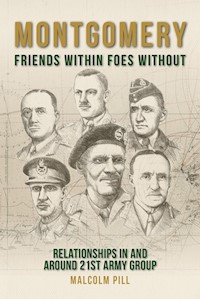
Erhalten Sie Zugang zu diesem und mehr als 300000 Büchern ab EUR 5,99 monatlich.
- Herausgeber: Uniform
- Kategorie: Geisteswissenschaft
- Sprache: Englisch
In this new study of personal relationships within the British (including Canadian) Command in 21st Army Group during the campaign in North-West Europe in 1944-1945, Malcolm Pill considers the scope and depth of these relationships, ranging from those of the Secretary of State for War to the Corps Commanders. Montgomery is central. His great success in the management of his own multinational team is contrasted with the hostility created and lack of success achieved with those outside his team. Pill explores the importance of his great skill with the written word. The relevance of these personal relationships to the success of Britain's last major campaign as a great power is assessed as are the post-war consequences for those involved.
Sie lesen das E-Book in den Legimi-Apps auf:
Seitenzahl: 565
Veröffentlichungsjahr: 2019
Das E-Book (TTS) können Sie hören im Abo „Legimi Premium” in Legimi-Apps auf:
Ähnliche




















• • • • •
This book is dedicated to my father R.T. Pill
• • • • •
‘Once you can get the confidence and trust of your subordinates, then you have a pearl of very great price’.
General Montgomery to Lieutenant-General Crerar, 26 July 1944
• • • • •
‘[Montgomery] liable to commit untold errors in lack of tact, lack of appreciation of other’s people’s outlook … He wants watching and guiding continually’.
(General Brooke’s diary, 3 June 1943.)
• • • • •
‘The senior British officers at SHAEF must realise that, in addition to being good allied chaps, they have loyalties to our side of the house’.
(General Montgomery to Field-Marshal Brooke, 8 August 1944.)
• • • • •
‘Such men as Tedder, Morgan, Whiteley and Strong [at SHAEF] possess great ability and are absolutely unimpeachable in their objective approach to every question’.
(General Eisenhower to General Marshall, 7 April 1945.)
CONTENTS• • • • •
ACKNOWLEDGEMENTS• • • • •
My thanks to the Trustees of Liddell Hart Centre for Military Archives, King’s College, London (LHC) for use of their research facilities and for permission to publish photographs from their archives. The Centre houses the library and papers of B.H. Liddell Hart, who was of course an influential author and military analyst, and his correspondence with other prominent figures. Also lodged there are the papers of prominent soldiers including Field Marshall Alanbrooke. My thanks to the staff at the Centre, in particular Lianne Smith, now at Manchester University, for their consistent help.
Thanks to the Imperial War Museum (IWM) and staff, in particular Owen Van Spall and Anthony Richard, for use of facilities and guidance, and to the National Archives at Kew.
The Trustees of Field Marshal Viscount Alanbrooke, deceased, are thanked for permission to use extracts from Lord Alanbrooke’s published diaries. The Diaries are published in War Diaries, Weidenfeld & Nicolson, London, 2001, edited by Alex Danchev and Daniel Todman. In their Acknowledgements, the editors themselves thank the Alanbrooke Trustees for ‘unrestricted access’ to the Alanbrooke Papers at the LHC and also thank the Trustees and archive staff at LHC.
My thanks to the copyright holder of the papers of Field Marshal Viscount Montgomery of Alamein for permission to use extracts from the collection of Montgomery’s papers held at the IWM.
My thanks also to Col. Rupert Prichard, OBE, grandson of Lt.-Gen. F.E. Morgan, for permitting me access to the General’s personal papers in his possession and permission to quote from these and from Morgan’s other writings.
I am grateful to Lt.-Gen Sir James Bucknall, KCB, CBE, for permission to quote from the personal papers of his grandfather, Lt.-Gen G. C. Bucknall held at the IWM and also for providing comments on aspects of the Battle of Normandy.
Dr Michael Neiberg and Charles M. Saunders of the United States Army Military History Institute, Carlisle, Pennsylvania are thanked for supplying transcripts of Forrest C. Pogue’s interviews with Lt.-Gen. F. E. Morgan and Wing Commander Leslie Scarman respectively.
References to the sources of the photographs published are given as a part of each caption. Thanks to the Trustees of LHC for permission to publish photographs held there. Other photographs are in the public domain and some are held at IWM, Library and Archives Canada/Department of National Defence, US National Archives and Records Administration and at the National Library of Australia.
Attempts have been made to trace photograph 13. A copy appears in Sir John Baynes’, The Forgotten Victor, his biography of General R. O’Connor, where thanks for the photograph are given to Major W.J. O’Connor the General’s stepson, who has since died. The photograph is not held at LHC where General O’Connor’s papers are lodged. Major J.K. Nairne, formerly of the Seaforth Highlanders and the General’s literary executor, has catalogued and annotated his papers at the LHC. He has kindly sought to trace the photograph but without success. He tells me that the search by Mrs Iona O’Connor, Major O’Connor’s widow, was unsuccessful as was an earlier search by him at the IWM. The copyright in The Forgotten General is held by Sir John’s widow, Lady Shirley Baynes, who has kindly agreed to the publication of the photograph.
The books identified in my Introduction (Historiography section) are of course all valuable sources for research and references to them appear in endnotes and in the Bibliography. I should like to pay particular tribute to the authors who undertook, long after the events in which the generals were involved, biographies of important generals who had been somewhat neglected in the literature: chronologically, Sir Charles Richardson for Send for Freddie (1985) (de Guingand), Sir John Baynes for The Forgotten Victor (1989) (O’Connor), Dominick Graham for The Price of Command (1993) (Simonds), Sir Julian Paget for The Crusading General (2008) (Paget, father of the author), Paul Dickson for A Thoroughly Canadian General (2007) (Crerar), Peter Rostron for The Life and Times of General Sir Miles Dempsey (2010) and Douglas E. Delaney for Corps Commanders (2011) (including Crocker, Simonds and Horrocks).
On a more personal level, I offer thanks to Peter Ledger, author of City Boys at War recently published by Unicorn, Wing Commander Graeme Morgan and David Lermon, for their help and encouragement. My wife, Dr Roisin Pill, has endured my alleged monopolisation of her computer and, with more publishing experience than I have, made many helpful suggestions.
PREFACE• • • • •
Mine has been a fortunate generation. Following unsettled wartime years, we enjoyed the benefits of secondary education, and the prospect of higher education, that followed the Education Act 1944 and the growth and opportunities of the post-war period. We have enjoyed the fifty and more years of peace in Europe that was made possible and initiated by the successful campaign of the British and American armies in the campaign to liberate North-West Europe in 1944 to 1945 and by the steadfastness of their governments thereafter.
My interest in the campaign was kindled by the daily maps of Normandy in the newspapers of Summer 1944 and a Saturday morning visit at that time to Camberley Staff College while my father was a student there. A patriotic man, he had joined the Territorial Army in 1939, aged almost thirty and without civilian qualifications or military connections. His first fortnight camp was converted into over six years service in the Royal Artillery. After spending the first winter of the war digging gun pits and peeling potatoes on the coast in the south-east of England, he served with the guns of the City of Edinburgh Yeomanry (TA) in North Africa and as a staff officer in a brigade commanded by Brigadier P.G. Calvert-Jones and and by Brigadier Mortimer Wheeler, himself a Territorial Officer, in North Africa and Italy. That led to a mention in dispatches, appointment as MBE, and selection for staff training at Camberley. Service at HQ 21st Army Group in North-West Europe followed.
Interest in the campaign was kept alive not only by my father’s successful, if modest, participation but by published post-war accounts, in particular Chester Wilmot’s The Struggle for Europe, that demonstrated the magnitude of the operation and the significance for my generation of the success achieved. I looked to the generals who had achieved it. The qualities and outlook of the British generals had been tempered, and also enlightened, by tough experiences in the horrors of the First World War and by a wide range of military duties between the wars. The generals then had the opportunity to plan and execute Britain’s last major campaign as a Great Power.
The roots of its success were in the planning in London and Washington, the training in Britain and the experience of successful operations in North Africa and Italy. The battles in North-West Europe have been well described; this study focuses on and analyses aspects of the campaign often receiving only cursory attention in the literature, the personalities and command relationships of the senior officers, British and Canadian, involved in and around 21st Army group. It is an opportunity to consider newly available and rarely cited records and to approach them and more familiar records and accounts from a different viewpoint. It is hoped that fresh insights are provided.
ABBREVIATIONS• • • • •
THE CAST WITH PRINCIPAL OFFICES HELD• • • • •
WASHINGTON
US Gen. of the Army G. Marshall, Chairman Combined Chiefs of Staff (CCS).
F.-M. J. Dill, Chief of the British Joint Staff Mission to Washington, died November 1944.
LONDON
P.J. Grigg, S of S for War.
F.-M. A. Brooke, Chief of the Imperial General Staff (CIGS).
Gen. H. Ismay, Prime Minister’s Chief of Staff.
Lt.-Gen. A. Nye, Vice-Chief of the Imperial General Staff (VCIGS).
Maj.-Gen. F. Simpson, Director of Military Operations, War Office.
BRITISH COMMANDERS
Gen. B. Paget, GOC-in-C 21st Army Group to December 1943.
F.-M. B. Montgomery, GOC 8th Army, August 1942-December 1943, GOC-in-C 21st Army Group from January 1944.
Gen. M. Dempsey, GOC 2nd British Army.
Lt.-Gen. J. Crocker, GOC 1st Corps.
Lt.-Gen. N. Ritchie, GOC 8th Corps.
Lt.-Gen. R. O’Connor, GOC 12th Corps to November 1944.
Lt-Gen. E. Barker, GOC 12th Corps from November 1944.
Lt.-Gen. G. Bucknall, GOC 30th Corps to August 1944.
Lt.-Gen. B. Horrocks, GOC 30th Corps from August 1944.
Lt.-Gen. F. Browning, GOC 1st British Airborne Corps.
BRITISH STAFF OFFICERS
Maj.-Gen F. De Guingand, Chief of Staff 21st Army Group.
Maj. Gen. H. Pyman, Chief of Staff 30th Corps then of 2nd British Army.
Maj.-Gen. M. Graham, Head of Administration 21st Army Group.
Brig. R. Belchem, BGS Operations 21st Army Group.
Brig. C. Richardson, BGS Plans 21st Army Group.
Brig. E. Williams, Head of Intelligence 21st Army Group.
CANADIAN COMMANDERS
Gen. H. Crerar, GOC 1st Canadian Army.
Lt.-Gen. C. Foulkes, GOC 1st Canadian Corps, in N-W Europe from February 1945.
Lt.-Gen. G. Simonds, GOC 2nd Canadian Corps.
MONTGOMERY’S PERSONAL STAFf
Lt. Col. C. Dawnay, Military Assistant.
Capt. J. Henderson, ADC.
SHAEF
US Gen. D.D. Eisenhower, Supreme Commander Allied Expeditionary Force.
A.-M. A. Tedder, Deputy Supreme Commander.
Admiral B. Ramsay, C-in-C Allied Naval Expeditionary Force, died January 1945.
A.-M. T. Leigh-Mallory, C-in-C Allied Expeditionary Air Force, until October 1944.
Lt.-Gen. W. Bedell Smith, Chief of Staff at SHAEF.
BRITISH OFFICERS AT SHAEF
Lt.-Gen. F. Morgan, COSSAC, then Deputy Chief of Staff.
Lt.-Gen. H. Gale, joint principal Logistical Officer (G-4).
Maj.-Gen. K. Strong, Head of Intelligence (G-2).
Maj.-Gen J. Whiteley, Deputy Chief of Operations (G-3).
RANKING US ARMY OFFICERS
Gen. O. Bradley, GOC 1st US Army, then GOC-in-C, 12th Army Group.
Lt.-Gen. C. Hodges, GOC 1st US Army from August 1944.
Gen. G. Patton, GOC 3rd US Army
Lt.-Gen. W. Simpson, GOC 9th US Army.
Lt.-Gen. L. Brererton, GOC 1st Allied Airborne Army.
OTHER BRITISH OFFICERS WHO FEATURE SIGNIFICANTLY
F.-M. H. Alexander, C-in-C 15th Army Group, June 1943, Supreme Allied Commander, Mediterranean, November, 1944.
Admiral of the Fleet Lord Louis Mountbatten, Chief of Combined Operations 1941-1943, Supreme Allied Commander, South-East Asia, August 1943.
Gen. C. Auchinleck, C-in-C Middle Eastern Command, June 1941-August 1942, GOC 8th Army, June-August 1942.
INTRODUCTION• • • • •
SYNOPSIS
This is a study of relationships between senior British and Canadian army officers involved in the planning and execution of the invasion of North-West Europe during the Second World War. Many studies have been devoted to studying the battles fought during the Allied campaign, Britain’s last major military role on the world stage. The performance in battle of the British generals involved in the campaign has also been examined closely, as have the tensions between the Supreme Commander, US General Dwight D. Eisenhower, and British General (later Field Marshal) Bernard Law Montgomery, who commanded all land forces during the battle of Normandy and British 21st Army Group thereafter.
What is now examined are the relationships between the senior British and Canadian army officers involved in the planning and carrying out of the campaign. As one of those involved, Lt.-Gen. Brian Horrocks, when considering how the ‘higher formations … worked in this campaign’, wrote that ‘the quality of the personalities concerned and of their relationships with each other was of immense significance’.1 The focus is on relationships and those included in the study are:
Relationships between Montgomery, Field Marshall Brooke, Chief of the Imperial General Staff (CIGS) and Maj.-Gen. Simpson, who became Director of Military Operations at the War Office. There were many written communications between them.Relationships between Montgomery, his chief of staff and his army and corps commanders and their relationships with each other.Montgomery’s relationships with the senior British officers at Eisenhower’s Supreme Headquarters Allied Expeditionary Force (SHAEF). The Secretary of State for War, P.J. Grigg, is included in the study because of his role and his involvement with the most senior officers.The study involves consideration of the generals’ backgrounds and personalities and the situations in which they found themselves and dealt with each other. Performance in battle inevitably affects relationships. Conversely, success in relationships may affect operational success and this may emerge from the evidence. The battles themselves, already very well documented, will be described only in so far as necessary to provide the context in which the relationships developed and the interaction occurred.
Primarily concerned with relationships, the study will throw light on the character, performance and reputations of officers who played important roles in a major conflict. Consideration will be given to how well the officers at 21st Army Group performed as a team and to what their level of performance as a team should be attributed. Reliance is placed on contemporaneous and later documents and on the narratives of those involved and the interviews they gave.
Central to the study is Montgomery. As team leader, Montgomery created and fostered team spirit in his command and thereby developed an efficient fighting instrument for his use. Montgomery’s management and treatment of his subordinates will be analysed with reference to the great care, sensitivity and insight that earned their ‘confidence and trust’. His own management skills contributed to their working together as a team quite remarkably well. The part played by his high skills as a report and letter writer in achieving his success will be considered. Montgomery was equally successful in his relations with his two British superiors and supporters, the civil servant turned politician Grigg and Brooke, the CIGS.
A stark contrast emerges between Montgomery’s attitude to and conduct towards his British superiors and to members of his own team and his attitude and conduct towards those he regarded as outside it. His views on British officers outside his team were harsh, often gratuitously so, readily categorising them as ‘useless’. His strained relations with SHAEF included extremely poor relations with senior British officers at that headquarters. Their roles will be examined and the reasons for his attitude to them. It is difficult to understand how a commander so accomplished in the management of his own team was so gauche in dealing with those outside it.
Conclusions on these issues require study not only of the conduct in 21st Army Group when a part of the expeditionary force during the campaign but examination of the processes by which and by whom the campaign was planned and prepared. They require study of how and why the senior officers occupied the roles they did and the process by which the Army Group took the form it did. The post-war lives of the principal actors will be considered not primarily with a view to describing careers in detail but in order to consider the extent to which their relationships persisted and how their lives were affected by wartime relationships and attitudes. As CIGS from 1946 to 1948, Montgomery was in a strong position to influence those lives in the immediate post-war years.
BACKGROUND
For present purposes the context in which the campaign was fought can be re-stated briefly. During the first year of the Second World War, the German Army was triumphant in Northern and Western Europe as well as in Poland. By June 1940, the British Expeditionary Force (BEF) had been expelled by German arms from North-West Europe and Germany controlled France, Belgium, the Netherlands, Norway and Denmark, with Spain a not-unfriendly neutral. Britain and its Empire stood alone against the Axis powers, Germany and Italy. With Winston Churchill as Prime Minister from May 1940, Britain resolved to fight on against the Axis Powers.
When the United States, with Franklin D. Roosevelt as President, entered the war in December 1941, liberation of Western Europe became a realistic, though not an imminent, possibility. Churchill and Roosevelt decided to plan for that liberation, a task made easier by the involvement of most of the German Army in fighting the Soviet Army, whose territory it had invaded. Overall strategy for the invasion of Western Europe was planned by Churchill, Roosevelt and the Combined Chiefs of Staff based in Washington, with US General Marshall presiding.
In January 1943, Churchill and Roosevelt decided to set up an allied planning staff for the proposed operation and Lt.-Gen. F.E. Morgan of the British Army was selected to lead the staff. The head of the British Army throughout the process, as CIGS, was F.-M. Brooke, later Lord Alanbrooke. His predecessor as CIGS, F.-M. Dill, became Head of the British Joint Staff Mission in Washington and served there until his death in November 1944.
Following the Battle of Alamein and the expulsion of Axis forces from North Africa, Italy was invaded by the Allies in late 1943 and the invasion of Western Europe was planned. On 6 June 1944, D-Day, an Allied force under the overall command of Eisenhower landed in Normandy, Operation OVERLORD. His Deputy was Air Chief Marshall Tedder and the naval and air commanders were also British, Admiral Ramsay and Air Marshall Leigh-Mallory.
Eisenhower defined OVERLORD as ‘Plan and operation for the invasion of France in spring of 1944’.2 Montgomery, who had formerly commanded the British 8th Army in North Africa and Italy, initially commanded all land forces. Eisenhower assumed command of land forces on 1st September 1944. His force comprised 21st Army Group, 12th Army Group and later 6th Army Group. Complete victory over the Germans in Western Europe was achieved by May 1945 and the allied forces met up with victorious Soviet forces advancing into Germany from the east.
During the build-up, and until 1944, the composition of the proposed invasion force had been predominantly British. In the summer of 1943, there was only one American field division in the United Kingdom;3 there could have been more but for the British preference for operations in the Mediterranean theatre. By D-Day and during the early part of the campaign, the British and Canadian land forces involved were about equal in size to the American forces, the naval contribution was mainly British, and Britain provided the base for the operation. In the later stages, the American contribution to the force became overwhelming. After Normandy, Montgomery remained in command of 21st Army Group under the overall command of Eisenhower.
METHODOLOGY
Where possible, particular relationships are considered in a specific section of the study. While the order in which relationships are considered has regard to chronology, this approach makes a strictly chronological account of relevant events impossible. In some cases, relationships emerge and are best considered in the course of the narrative or in the context of specific operations and events in which a number of officers were involved. These events, of varying importance, are given separate sections and identified by name. Interposing them puts additional strain on the chronology. Their places in the campaign will be known to most readers but, it may be helpful to list them chronologically:
Following the capture of Caen in July 1944, British armoured forces in 8th Corps, in Operation GOODWOOD on 18 July 1944, conducted a major attack in the eastern part of the lodgement area in Normandy to the south-east of Caen and towards Bourgebus Ridge.On 30 July 1944, British 8th and 30th Corps, in Operation BLUECOAT, attacked southwards from Caumont. In the course of the operation, on 2 August, Lt.-Gen. Bucknall was dismissed from command of 30th Corps.After the breakout from Normandy, and the rapid advance across France and Belgium, British 30th Corps captured Antwerp Docks intact on 4 September 1944.On 17 September 1944, Operation MARKET GARDEN involving the 1st Allied Airborne Army and British 30th Corps was launched in the Netherlands.In the Autumn of 1944, 1st Canadian Army was involved in operations to clear the Scheldt Estuary of the enemy and thereby allow the port of Antwerp to become operational.Following Eisenhower’s assumption of command of all land forces on 1 September 1944, Montgomery conducted a prolonged campaign for the Allied offensive to be concentrated on a single thrust, under his command, in the northern part of the front.On 16 December 1944, the Germans launched a major counter offensive in the Ardennes. It achieved initial successes and had a significant impact on the Allied command structure.Montgomery’s continuing campaign to promote a single thrust into Germany, under his command, led to a confrontation between him and Eisenhower in events culminating on 31 December 1944.Operation VERITABLE, the main set piece offensive of 1st Canadian Army during the campaign, was launched on 9 February 1945ASSESSMENT OF EVIDENCE
Max Hastings’ Armageddon, which includes much valuable oral history, has a section entitled ‘Sources and References’.4 In it, Hastings makes the broad assertion that ‘written evidence’ about matters of life and death … should be treated with at least as much caution as interviews with witnesses’. In support, he makes the statement, notoriously true, that minutes of meetings reflect the ‘personal prejudices of whoever was responsible for keeping the record’. In the assessment of evidence, however, such generalisations are not particularly helpful. It depends on the document and depends on the oral evidence what degree of caution is required, what weight can be given to it and what assessment can be made on the basis of it. It also depends on the nature of the issue on which a judgment is to be made.
Some documents will be conclusive of some issues, others will require analysis of the motives and reliability of the document-maker and the circumstances in which the document was made. Hastings rightly recognises what another has called the ‘self-mythologising retrospect’5 that is revealed, on assessment, in some documents. Oral evidence is, however, subject to the fallibility of human memory and to an assessment of the maker’s credibility. The mindset of the interviewer may also be a factor in assessing the value of oral statements made during the interview. The manner of assessment needs to be specific to the particular evidence assessed.
The point is not laboured further. Military historians are not alone in having to assess all kinds of evidence. Judges have been doing it day by day for centuries. In this study, the aim is to examine evidence objectively and without pre-conceptions.
HISTORIOGRAPHY: WHAT HAS BEEN SAID.
A good starting point for a study of the Allied campaign in North-West Europe in 1944–1945 is still Chester Wilmot’s The Struggle for Europe,6 published in 1952. (Particulars of the editions of publications consulted are given in the endnotes; dates of first publication, where different, appear in this text.) One of the best and bravest BBC correspondents reporting from Europe, Wilmot landed in Normandy by glider on D-Day with the British 6th Airborne Division and sent dispatches throughout the campaign.7 Wilmot’s stylish narrative combines a flavour of the times with a blend of ‘lucid narrative, close analysis and judicious character studies’.8
While he was an ‘eloquent advocate’9 for Montgomery, who became a Field Marshal on 1 September 1944, Wilmot’s ‘honesty and integrity made the book a classic’.10 He did interview some of those involved in the campaign during and shortly after the war. Wilmot’s analysis of the wealth of material which became available after the publication of The Struggle for Europe, with his further judicious character studies, would have been most valuable but, sadly, he died, aged forty-two, in January 1954 when a passenger on a Comet airliner which disintegrated over the Mediterranean Sea. That was a great loss to fuller analysis of the campaign and the personalities.
Anyone writing now must of course have regard to material and analysis not available in 1952. One can only speculate as to whether Wilmot’s advocacy of Montgomery would have survived it. For its quality as campaign historical literature The Struggle for Europe is unsurpassed.
Montgomery has of course been the subject of many biographies, the most comprehensive being Nigel Hamilton’s three volumes, published in 1981, 1983 and 1986.11 Of the others, Alan Moorhead’s Montgomery12 had appeared in 1946, Ronald Lewin’s13 in 1971 and Alistair Horne’s, with David Montgomery,14 appeared in 1994. T.E.B. Howard edited a series of essays by those closest to Montgomery during the war in Monty at Close Quarters, 1985.15 They wrote with great style and insight:
Despite his claim to the contrary,16 Montgomery did keep personal diaries throughout the campaign. These were found by David Montgomery at Isington Mill, Montgomery’s home, after his father’s death in 1977. These diaries were not available to earlier biographers. A selection of them appears, with letters he received and other relevant papers, in Montgomery and the Battle of Normandy, 2008, edited by Stephen Brooks.17 The papers were lodged at the Imperial War Museum (IWM) by 2004 and sorted and catalogued by Brooks who thought the combination of papers was Montgomery’s ‘sitrep for posterity’. Brooks estimates that the personal diaries from June 1944 to May 1945 amount to about 50,000 words. His choice of documents for the book, and his endnotes, demonstrate his insights into the qualities of the protagonists and the problems of the time. Brooks had previously edited Montgomery and the Eighth Army, which performs the same service for the period between August 1942 and December 1943.18
Consistency between the contents of Montgomery’s personal diaries and other contemporaneous documents is good but, as Brooks writes in his ‘Notes’, it does not follow that ‘Montgomery always wrote the entries on a daily basis’.19 Brooks accepts that they were written ‘very much with future historians in mind’.20 The diary does not have the contemporaneous flavour of the CIGS’s diary, mentioned below, and its orderliness and coherence are such that it is unlikely that he did write it up each day. However, Brooks expresses the opinion, in relation to the Normandy sections, that ‘the entries have a degree of detail and immediacy that precludes their being written up much later with the benefit of hindsight’. As with all diaries, the entries are revealing for what they omit as well as for what they say. On at least one dramatic post-Normandy occasion, for example, while the contents of the diary are accurate, they are incomplete to the point of being misleading as an account of events.21
Studies of the relevant wartime events appeared not long after the war in autobiographies of some of those principally involved. Capt. Harry Butcher, Supreme Commander Eisenhower’s military assistant, was first with Three Years with Eisenhower22 published in 1946 and provided insight into Eisenhower’s views. Eisenhower’s own Crusade in Europe appeared in 1948.23 US Gen. Omar Bradley, commander of 12th Army Group, produced A Soldier’s Story in 1951.24 Maj.-Gen. Francis de Guingand, Montgomery’s Chief of Staff, published Operation Victory25 in 1947. The account of Air Marshal (A.-M.) Arthur Tedder, Deputy Supreme Commander, With Prejudice,26 appeared much later, in 1966.
Montgomery presaged a future career as an author when writing from Italy to Simpson at the War Office in November 1943. Having said that he would ‘want some leave’ when Rome was captured, he wrote: ‘I shall probably write a book entitled Alamein to Rome I don’t think’.27 His account of the war, Memoirs of Field-Marshal Montgomery,28 was published in 1958. While it has the merit of setting out some important contemporaneous documents in full, Montgomery did himself less than justice in Memoirs, described by Bedell Smith’s biographer D.K.R. Crosswell as ‘inflammatory’.29 David Fraser thought Montgomery ‘a better general than autobiographer’.30 Montgomery considered Memoirs definitive. When the official British war historian, Maj. L.F. Ellis, submitted a draft of his work to Montgomery for comment, he replied that ‘most of [his] views’ had been expressed in Memoirs.31
A much better general and person emerges from Montgomery’s voluminous contemporary writings, his reviews of the military situation and, in particular, his letters to Brooke and to Simpson at the War Office, and from his personal diaries. To write as much as he did under the pressures of the campaigns, was a remarkable achievement. The reports reveal a brilliant military mind. That he wrote consistently with coherence, an economy of language and with style magnifies the achievement.
Brig. Edgar (Bill) Williams, Montgomery’s Chief Intelligence Officer, puts the best face on Memoirs by saying the book has ‘a highly personal flavour’,32 an indication that the fairness and objectivity of earlier writings was missing. Vanity had taken hold. Montgomery wrote several other books and said in 1966 that he had come to the conclusion ‘that writing books is far more lucrative than soldiering – but not so enjoyable’.33 More is said about Montgomery’s writing in later sections.
Brooke did not write an autobiography but his War Diaries, edited by Alex Danchev and Daniel Todman, were published in 2010. The publication includes an edited version of Brooke’s commentary on the diaries, written by him in the early 1950s.34 Arthur Bryant’s The Turn of the Tide35 had in 1957 provided a less comprehensive study based on the diaries. A biography of Brooke by David Fraser, Alanbrooke, with prologue and epilogue by Bryant, was published in 1982.36 Fraser was granted access to detailed notes kept by Brooke during the earlier part of his life and to other family documents.
Attitudes to fellow officers emerge from the autobiographies, sometimes expressly, sometimes by inference or implication. Important general accounts of the campaign in North-West Europe are provided in Carlo D’Este’s books Decision in Normandy (1983)37 and Eisenhower (2002)38 and, of the campaign in Normandy, in Max Hastings’ Overlord (1984).39 British historians have, in the opinion of the present author, tended to underrate D’Este’s skills. His and Hastings’ works have been described as ‘revisionist’ in providing a more critical account of the Allied performance.40 More recently, Anthony Beevor has written books about stages in the campaign, D-Day (2009), Arnhem (2018) and Ardennes 1944 (2015). They are particularly strong on front line action and the effect of the hostilities on the civilian population.41 D.K.R. Crosswell’s Beetle (2010) is a thorough study of the life of General Bedell Smith, Eisenhower’s Chief of Staff42 and a major figure in the Allied command.
Stephen Hart’s Colossal Cracks (2007)43 provides an analysis of the leadership and techniques of Montgomery’s 21st Army Group during the campaign and the reasons for the adoption of those techniques. The historical literature, he thought, ‘may now enter a post-revisionist phase’. John Buckley’s Monty’s Men (2013) describes the British contribution to the campaign. Interviews of those involved by Chester Wilmot and by Forrest C. Pogue, US Official Historian, are valuable sources. The official British history of the campaign, Victory in the West44 was published in two volumes in 1962 and 1968. Drafts were submitted by the author, Maj. L.F. Ellis, to some of those involved for their comment.
Gen. Bernard Paget was Commander-in-Chief (C-in-C) Home Forces from December 1941 to July 1943 and the first C-in-C of the newly formed 21st Army Group from July until December 1943. He did not write an autobiography but his son Julian Paget, who soldiered in the campaign with the Coldstream Guards, wrote a biography in 2008,45 forty-seven years after his father’s death. Julian Paget of course had access to Paget’s unpublished personal papers, including the diary he kept during the Second World War.
In 1946, the wartime Secretary of State for War, P.J. Grigg, wrote six articles for the Sunday Times, each of them about a soldier Grigg considered to have been ‘most worthy of praise’ (his ‘Big Six’). Paget was one of his more exclusive ‘Big Three’, Brooke and Montgomery being the other two.46 Grigg’s autobiography, Prejudice and Judgment, was published in 1948. As an important cog in Britain’s war machine, he too is to be considered in the present context. There is no biography.
Lt.-Gen. Frederick Morgan, having commanded 1st Corps in 1942–1943, was appointed Chief of Staff Supreme Allied Commander (COSSAC) in April 1943 to plan for the invasion of Europe but without a Supreme Commander being appointed. On Eisenhower’s belated appointment as Supreme Commander for Operation OVERLORD in December 1943, Morgan became Deputy Chief of Staff (deputy to Bedell Smith) at Supreme Headquarters Allied Expeditionary Force (SHAEF). He wrote two autobiographical works, Overture to Overlord (1950),47 an account of his work as COSSAC, and Peace and War, A Soldier’s Life (1961),48 a more general autobiography. The accuracy of Morgan’s account of events is not challenged in later works. His writings are conspicuously frank and lacking in self-regard and conceit. There is no biography.
Morgan was interviewed by Pogue in February 194749 and, by Wilmot in August 1944 and November 1945.50 Also lodged at the IWM are diaries kept during a visit to the United States in 1943,51 a partial draft of an autobiography,52 his responses of 30 September 195653 to Ellis’s draft official history and letters to B.H. Liddell Hart in 1959.54 His personal papers, still in family possession, include post-war correspondence with the War Office and Cabinet Office (Historical Section), a post-war BBC interview and the diaries of his ADC, Capt. R.C. Jenkinson, Royal Artillery.55
Dealing first with the British officers, the other officers considered in this study were Army or Corps Commanders, or senior staff officers, in North-West Europe. The Army Commander is Gen. Miles Dempsey, who commanded 2nd British Army, the British Army in 21st Army Group. He wrote no autobiography and indeed ordered most of his personal papers to be burned. The reticence was not total, however, in that he was prepared to be interviewed in detail by Chester Wilmot. And, enigmatically in view of his general attitude, he wrote in his Foreword to the two-volume account of the operations of 2nd Army, prepared by its Chief of Staff, that he had intended to add to the account his own notes ‘showing why operations were undertaken’ and ‘what their objects were’ but that ‘appointment to another theatre [South-East Asia] had ‘prevented’ him.56
It was in 2010, over forty years after Dempsey’s death, before a biography, written by Peter Rostron, was published.57 In 2005, Peter Caddick Adams had written a full biographical note about Dempsey in the Journal of the Royal United Services Institute (RUSI).58 Dempsey commanded Britain’s most powerful army in Britain’s biggest campaign in the Second World War and the absence of an earlier biography is, on the face of it, surprising.
As has been pointed out, of the twenty military careers described in Churchill’s Generals, edited by John Keegan (1991),59 Dempsey’s is not one and neither is Paget’s, despite their wartime prominence and status. Rostron has spared Dempsey what Stephen Hart described as the ‘ignominy’ of there being ‘no major biographical work on him’.60 Montgomery and Horrocks are the only operational commanders in North-West Europe to appear in Churchill’s Generals, an indication of Montgomery’s perceived dominant role in the British campaign. O’Connor and Ritchie do appear but only for their roles in North Africa.
There were four British Corps Commanders in 21st Army Group, Lt.-Gens. John Crocker (1st Corps), Richard O’Connor (8th Corps), Neil Ritchie (12th Corps) and Gerard Bucknall (30th Corps). (The usual description of that Corps as 30 Corps, or XXX Corps, does roll off the pen but for consistency 30th has been retained.) Bucknall was replaced by Lt.-Gen. Brian Horrocks on 4 August 1944. In November 1944, Lt.-Gen. Evelyn (‘Bubbles’) Barker, who until then had commanded 49th (West Riding) Infantry Division in the campaign, replaced O’Connor in 12th Corps.
During the campaign, organisational boundaries were porous so that there were transfers of Divisions within Corps, Corps within Armies and Armies within Army Groups. After O’Connor’s departure, 8th Corps was not involved in major operations until March 1945 when it was in the lead in the race across Germany, capturing Osnabrook, Minden and Luneberg, and consideration of Barker’s role is limited. Lt.-Gen. C. Foulkes arrived even later, bringing 1st Canadian Corps from Italy in March 1945.
Horrocks wrote two autobiographical works, A Full Life in 196061 and Corps Commander in 1977,62 the latter with Eversley Belfield and Maj.-Gen. H. Essame. After the war, he also became a ‘TV performer’, a self-description,63 as well as Black Rod in the House of Lords. He features as one of the five Corps Commanders considered in Corps Commanders, a Canadian study by Douglas E. Delaney (2011),64 strong on personalities as well as on operations. While three of the commanders considered are Canadian, Horrocks features because, at an important time in 1945, Horrocks’ 30th Corps was a part of 1st Canadian Army. Horrocks by Philip Warner appeared in 1984.65 Horrocks co-operated in the work, written not long before his death in 1985.
There is no full biography of Crocker, but he too features in Corps Commanders because 1st Corps was a part of 1st Canadian Army for much of the campaign. His career in North-West Europe is also considered in some detail in Colossal Cracks. Bucknall and Ritchie are the least well described of the group. Ritchie’s performance in North Africa, where for a time he commanded 8th Army, is considered by Michael Craster in Churchill’s Generals.
O’Connor’s biography, belated as were some of the others, The Forgotten Victor by John Baynes, was published in 1989.66 (After the war, Baynes, while serving with O’Connor’s former Regiment the Cameronians, was ADC to O’Connor.) O’Connor’s campaign in North Africa in early 1941 is also described in Correlli Barnett’s The Desert Generals.67 After his retirement, O’Connor’s papers were lodged at the Liddell Hart Centre, King’s College, London (LHC) and catalogued, in meticulous fashion, by Maj. J.K. Nairne, formerly of the Seaforth Highlanders. O’Connor also answered, in detailed handwritten notes placed with the collection, written questions put to him by Nairne about his career.68 O’Connor was an enthusiastic correspondent and, while he did not keep copies of his own letters, the papers include letters written to him over a long period by a range of friends and former colleagues.
The other army in 21st Army Group, 1st Canadian Army, was commanded by Canadian Gen. Henry Crerar. It became operational as a unified force in France on 23 July 1944. In 1944, the other Corps in that Army with 1st Corps, was 2nd Canadian Corps commanded by Canadian Lt.-Gen. Guy Simonds. A biography of Simonds, The Price of Command by Dominick Graham, appeared in 1993.69 Graham had access to a draft unpublished autobiography that Simonds had completed in 1939. Simonds of course features, along with Crocker and Horrocks, in Delaney’s Corps Commanders.
A biography of Crerar, A Thoroughly Canadian General, by Paul Dickson, was published in 2007.70 Dickson also wrote a very full biographical note on Crerar in the Dictionary of Canadian Biography, Vol. 19.71 Crerar did not write an autobiography.
De Guingand’s biography was written by Gen. Charles Richardson, 1908–1994, and published in 1987.72 Richardson was a close colleague of de Guingand and himself a distinguished staff officer. Commissioned into the Royal Engineers and a Cambridge graduate, he was an important member of the 8th Army/21st Army Group team. He served as Brigadier-General Staff (BGS) 8th Army in North Africa and Sicily and as BGS Plans 21st Army Group. The work put him in close contact with de Guingand as well as Montgomery and his insights into relationships at headquarters are valuable.
Another staff officer who appears in the narrative is Gen. Frank Simpson, 1899–1986. He too was a Cambridge graduate and Royal Engineer. Simpson was Deputy Director and, from October 1943 Director, of Military Operations at the War Office and a Major-General. He was a confidant of Montgomery who sent him many handwritten letters containing material he could not send in official communications with the War Office. When Montgomery was CIGS, Simpson became VCIGS. His personal papers are lodged at the Imperial War Museum.73
Gen. Harold Pyman, 1908–1971, was an important staff officer during the campaign, being successively Chief of Staff to Bucknall and Horrocks at 30th Corps and to Dempsey at 2nd Army. Like Richardson, he was a graduate of Clare College, Cambridge. He had served in the Royal Tank Corps and Royal Tank Regiment and attended Quetta Staff College, Baluchistan, India, in 1939. In 1945, he became a Major General at the age of thirty-seven. Pyman, who could have reached the top of the profession, took premature retirement in 1964 having suffered a stroke. He wrote an autobiography, Call to Arms, in 1971.74 Autobiographies were also written by commanders of Divisions in the Army Group including Maj.-Gen. Allan Adair, Guards Armoured Division (A Guards General, 1986) and Maj.-Gen. G.P.B. Roberts, 11th Armoured Division (From the Desert to the Baltic, 1987).
Of course, for mention is The Second World War by the wartime Prime Minister, Winston S. Churchill.75 Along with his other writings, it earned him the Nobel Prize for Literature in 1953. Its six volumes were published between 1948 and 1954 while Churchill was either Leader of the Opposition in the House of Commons or had again become Prime Minister. Paraphrasing Balfour’s reference to Churchill’s book about the First World War, The World Crisis, Danchev and Todman say that Churchill ‘wrote an enormous book about himself and called it The Second World War’.76 The diaries of Churchill’s Private Secretary, John Colville, (Fringes of Power, 1987) provide supplementary material. Roosevelt, who died suddenly in April 1945, did not write an autobiography.
Another post-war Prime Minister, Harold Macmillan, was Minister Resident at Allied Headquarters, North-West Africa from January 1943. His War Diaries appeared in 198477 and his comments on those who subsequently served in North-West Europe are relevant to this study. Macmillan knew soldiering, he had been wounded three times during the First World War while serving in the Grenadier Guards.
Also mentioned, because of its emphasis on relationships, is Stephen Badsey’s Faction in the British Army: Its Impact on 21st Army Group Operations in Autumn 1944. The study, published in 1995, seeks to deal with the ‘internal structure and political dynamics of the British Army’. Badsey hoped the article would be ‘an inspiration to a further generation of scholars’ and that ‘future research will provide a more accurate and complete picture’ of those dynamics during the Second World War.78 That is a daunting challenge with which to turn to dramatis personae. The cast list is now limited to accord with the study’s sub-title but other commanders and staff officers, and their relationships, emerge in the course of the narrative.
Notes
1 Horrocks, Sir Brian, Corps Commander, Magnum Books, London, 1979, page 25.
2 Eisenhower, Dwight D., Crusade in Europe, Heinemann, London, 1948, page 558.
3 Bryant, Sir Arthur, The Turn of the Tide 1939–1943, The Reprint Society, London, 1958, page 539.
4 Hastings, Max, Armageddon, Pan Books, London, 2015, Macmillan, London, 2004, page 599.
5 Expression used in book review by Christopher Silvester, Financial Times, 1 March 2014.
6 Wilmot, Chester, The Struggle for Europe, The Reprint Society, London, 1954; Collins, London, 1952.
7War Report D-Day to VE-Day, Aeriel Books, London, 1985; Oxford University Press, 1946.
8 McDonald, Neil, Australian Dictionary of Biography, Melbourne University Press, 2002, Vol. 16.
9 D’Este, Carlo, Decision in Normandy, Penguin Books, London, 2001, page 207; Collins, London, 1983.
10 Entry for Wilmot in Australian Dictionary of National Biography.
11 Hamilton, Nigel, Monty: The Making of a General 1887–1942, Hamlyn Paperbacks, London, 1982. Hamilton, Monty: Master of the Battlefield 1942-1944, Sceptre, London, 1987. Hamilton, Monty: The Field Marshal 1944–1976, Sceptre, London, 1987. (all cited as ‘Hamilton vol.–’).
12 Moorehead, Alan, Montgomery, Landsborough Publications, London, 1958. (‘Moorehead’).
13 Lewin, Ronald, Montgomery as Military Commander, B.T. Batsford, London, 1971 (‘Montgomery’).
14 Horne, Alistair, with David Montgomery, Monty 1944–1945, The Lonely Leader, Pan Books, London, 1995 (‘Horne’).
15Monty at Close Quarters, ed. T.E.B. Howarth, Leo Cooper, London, 1985
16 Imperial War Museum (IWM), Montgomery Papers, BLM 74.
17Montgomery and the Battle of Normandy, ed. Stephen Brooks, The History Press, Stroud, for the Army Records Society, 2008. The ‘mystery’ of the non-disclosure of a part of the personal diary is considered by Brooks at pages 5 to 8, ‘Montgomery and his Papers’.
18Montgomery and the Eighth Army, ed. Stephen Brooks, Bodley Head, London, for the Army Records Society, 1991.
19 Brooks, page xi. References to Brooks are to Brooks’ Normandy unless otherwise stated.
20 Brooks, page 8.
21 See section entitled ‘31 December 1944’.
22 Butcher, Captain Harry C., Three Years with Eisenhower, William Heinemann, London, 1946.
23 Eisenhower, Dwight D., Crusade in Europe, William Heinemann, London, 1948.
24 Bradley, Omar N., A Soldier’s Story, The Modern Library, New York, 1999: Henry Holt, New York, 1951.
25 De Guingand, Major-General Sir Francis, Operation Victory, Hodder and Stoughton, London, 1947.
26 Tedder, Lord, With Prejudice, Cassell, London, 1966.
27 IWM, Montgomery Collection, Ancillary Collection 18, 1/24.
28The Memoirs of Field-Marshal Montgomery, Fontana Books, London, 1960; Collins, London, 1958 (‘Memoirs’).
29 Crosswell D.K.R., Beetle, The Life of General Walter Bedell Smith, The University Press of Kentucky, 2012, page 103 (‘Crosswell’).
30 Fraser, David, And We Shall Shock Them, Book Club Associates, London, 1983, page 336.
31 The National Archives, Kew, (TNA), CAB 101/309.
32Monty at Close Quarters, page 29.
33 Liddell Hart Centre for Military Studies, King’s College, London (LHC), O’Connor Personal Papers, 10/22.
34War Diaries 1939–1945, Field Marshal Lord Alanbrooke, ed. by Alex Danchev and Daniel Todman, Weidenfeld & Nicolson, London, 2001, (‘War Diaries’); Note on the Text, pages xxxi to xxxiv.
35The Turn of the Tide 1939–1943, The Reprint Society, London, 1958; Collins, London, 1957.
36 Fraser, David, Alanbrooke, Hamlyn Paperbacks, Feltham, Middlesex, 1983; Collins, London, 1982. (‘Alanbrooke’)
37 D’Este, Carlo, Decision in Normandy, Penguin Books, London, 2001; Collins, London 1983.
38 D’Este, Carlo, Eisenhower, Cassell, London, 2004; Henry Holt, New York, 2002.
39 Hastings, Max, Overlord, Book Club Associates, London, 1984 (‘Overlord’).
40 Hart, Stephen Ashley, Colossal Cracks, Stackpole Books, Mechanicsburg, PA, 2007.
41 Beevor, Antony, D-Day, The Battle for Normandy, Penguin Books, London, 2012; Ardennes 1944, 2015, and Arnhem, 2018, both Viking, London.
42 Crosswell, D.K.R., Beetle, The Life of General Walter Bedell Smith, The University Press of Kentucky, 2012.
43Colossal Cracks, including page 17.
44Victory in the West, 2 vols., Ellis, L.F., HMSO, London, 1962 and 1968.
45 Paget, Julian, The Crusading General, Pen and Sword Military, Barnsley, 2008.
46 Reprinted in the Appendix to Grigg, P. J.’s, Prejudice and Judgment, Jonathan Cape, London, 1948.
47 Morgan, Lt.-Gen. Sir Frederick, Overture to Overlord, Doubleday and Co, New York, 1950 (‘Overture’).
48 Morgan, Lt.-Gen. Sir Frederick, Peace and War, A Soldier’s Tale, Hodder and Stoughton, London, 1961.
49 United States Military History Institute (USMHI), Carlisle, Pennsylvania, Pogue, box 2.
50 LHC, LH 15/15/24.
51 also at USMHI.
52 IWM, FM 4.
53 The National Archives, Kew (TNA), CAB 101/309.
54 LHC, Liddell Hart correspondence with Morgan.
55 Colonel Rupert Prichard, grandson of Lt.-Gen. F.E. Morgan, holds personal papers of Morgan to which he has kindly allowed the author access.
56 LHC, Pyman Papers, 5/24/102.
57 Rostron, Peter, The Life and Times of General Sir Miles Dempsey, Pen and Sword Military, London, 2010 (‘Miles Dempsey’).
58Not a Popular Leader, Peter Caddick-Adams, RUSI Journal, October 2005.
59Churchill’s Generals, ed. John Keegan, Warner Books, London, 1992; Weidenfeld & Nicolson, London, 1991.
60Colossal Cracks, page 125.
61 Horrocks, Lt.-Gen. Sir Brian, A Full Life, Fontana Books, London, 1962, Collins, London, 1960.
62 Horrocks, Lt.-Gen. Sir Brian, Corps Commander, with Eversley Belfield and Maj.-Gen. H. Essame, Magnum Books, London, 1979; Sidgwick & Jackson, London, 1977.
63A Full Life, page 309.
64 Delaney, Douglas E., Corps Commanders, Five British and Canadian Generals at War, UBC Press, Vancouver, 2011. Not to be confused with Horrocks’ Corps Commander, in the singular.
65 Warner, Philip, Horrocks, Pen and Sword Military, Barnsley, 2005.
66 Baynes, John, The Forgotten Victor, Brassey’s (UK), London, 1989.
67 Barnett, Correlli, The Desert Generals, Pan Books, London, 1983, Second Edition.
68 Lodged at LHC.
69 Graham, Dominick, The Price of Command, Stoddart, Toronto, 1993.
70 Dickson, Paul, A Thoroughly Canadian General, University of Toronto Press, 2007
71Dictionary of Canadian Biography, Vol. 19, 1961–1970, University of Toronto, 2013.
72 Richardson, Charles, Send for Freddie, William Kimber, London, 1987.
73 IWM, Montgomery Collection, Ancillary Collection 18.
74 Pyman, Gen. Sir Harold E., Call to Arms, Leo Cooper, London, 1971.
75 Churchill, Winston S., The Second World War, vols. 1 to 6, Cassell, London; Reprint Society, London, 1948–1954.
76War Diaries, page xxi.
77 Macmillan, Harold, War Diaries 1943–1945, Papermac, London, 1985; Macmillan, London, 1984. Described as ‘Macmillan War Diaries’ to distinguish from Alanbrooke’s diaries.
78 Badsey, Stephen, Faction in the British Army: Its Impact on 21st Army Group Operations in Autumn 1944, War Studies Journal, Department of War Studies, Kings College London, Vol. 1, no. 1, 1995.
1
EARLIER LIVES• • • • •
In giving short descriptions of the generals’ lives before the campaign in North-West Europe, the purpose is to draw attention to those aspects of their characters and experiences that may throw light on the nature and working of their wartime relationships. Contacts between them prior to their coming together in planning and carrying out the campaign are considered but analysis of the relationships while involved in the campaign in North-West Europe will be deferred. Montgomery’s relations with the senior British army officers at SHAEF during the campaign are to be considered but, apart from Morgan, who was involved in planning the campaign, they do not appear in the cast at this stage. The officers’ ranks stated are those by which the generals were known at the relevant time without reference to the frequently temporary or acting nature of those ranks as described in Who’s Who entries.
ALAN BROOKE (BROOKIE)
Alan Brooke, an Ulsterman born in 1883, was the oldest of those considered. He was much the youngest child of Sir Victor Brooke, of Fermanagh, 3rd Baronet of Colebrooke Park, Brookeborough. The family were nicknamed ‘the Fighting Brookes of Colebrooke’.1 Brooke was never sent to a British public school and did not play team games. He was educated in France and at the Royal Military Academy, Woolwich, ‘The Shop’. Brooke was commissioned into the Royal Field Artillery in 1902, having failed to pass sufficiently high to join the Royal Engineers. Married to Jean Richardson on 28 July 1914 in County Fermanagh, after an engagement of six years, he received a telegram on 5 August requiring him to pack to go to India. Having reached Port Said, he sailed back to France with a Horse Artillery Battery that was passing through the port.2
Brooke served in France during the First World War, including service in the Indian Royal Horse Artillery, the Canadian Corps and as a senior staff officer in 1st Army. He was awarded the Distinguished Service Order (DSO), with bar, and was mentioned in dispatches six times. He developed very considerable expertise in the employment of artillery, about which he thought deeply, and also developed a high reputation as a staff officer. He described German activity ‘objectively, with soldierly appreciation’.3 ‘In truth,’ say Danchev and Todman, ‘he was an unhappy warrior … he did not suffer from the disease of military ardour’.4 On leave in London on the day of the Armistice, he ‘was swamped with floods of memories from those years of struggle. I was filled with gloom that evening and retired to sleep early’.5
Clearly destined for high office, Brooke attended and then taught at the Camberley Staff College. His lectures formed the basis of a series of articles published in the Journal of the Royal Artillery on developments in artillery organisation and equipment.6 From 1923 to 1927 Montgomery was a fellow instructor. Brooke was then one of the first intake at the Imperial Defence College. That was followed by three years as Commandant of the School of Artillery. He was Commander of 8th Infantry Brigade 1934–1935, the Mobile Division 1937–1938 and Anti-Aircraft Command, 1939.7
Brooke commanded 2nd Corps in the British Expeditionary Force (BEF) in France, 1939–1940. One of the Divisions in his Corps was 3rd Infantry Division, commanded by Montgomery. Following the evacuation from France, Brooke was C-in-C Home Forces, with Paget as his Chief of Staff. Brooke was an admirer of Gen. John Dill, later F.-M. Dill, who was CIGS. Dill was, Brooke wrote in his post-war notes, ‘the essence of straightforwardness, blessed with the highest of principles and an unassailable integrity of character’. He was ‘far and away the best man we had in the army for the post of CIGS’8 and was Brooke’s ‘trusted friend and ally’.9
Dill’s relationship with Churchill was far from easy and, in late 1941, Churchill decided to relieve him. Dill then achieved great success as Chief of the British Joint Staff Mission to Washington, where he died in 1944. Churchill would never recognise the services Dill gave. In his post-war notes, Brooke wrote that he would ‘never be able to forgive Winston for his attitude towards Dill’. The American Joint Chiefs of Staff had complete confidence in Dill and his relationship with Marshall was as good as that with Brooke.10 On his death, he was the subject of Resolutions of both Houses of Congress. He was buried in Arlington National Cemetery, commemorated by an equestrian statue.
As a possible successor to Dill as CIGS, Churchill was extremely wary about Brooke who, he knew, would not easily be bullied. ‘He was one of the few men who proved capable of fighting Churchill on his own terms’, writes Daniel Todman.11 Churchill described the Brookes as ‘stiff-necked Ulstermen’.12 Other candidates considered were Paget, Pile (Gen. Frederick (Tim)), and Nye (Lt.-Gen. Sir Archibald), a brilliant man and a barrister. Dill reported to Brooke that ‘the PM had taken a great fancy’ to Nye. In his post-war notes, Brooke said: ‘From many points of view he would have made an excellent CIGS’ but would have had ‘the serious handicap of being on the junior side’ when handling more senior men, including Paget and Montgomery. Montgomery later wrote of Nye that he was ‘a very clever officer but he knows nothing whatever about what goes on in battle’.13




