


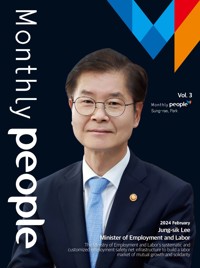
2,99 €
Mehr erfahren.
- Herausgeber: Monthly People
- Kategorie: Fachliteratur
- Serie: Monthly people
- Sprache: Englisch
Connecting people to people,
Connecting people and values.
We see the future through people. We interview entrepreneurs, scientists, government officials, politicians, and others to see a better vision.
We hope that you, the reader, will use us as a medium to create better opportunities.
We hope that the stories of the people introduced through Monthly People will inspire you to have a better future and vision.
We bring to life the stories of people who are responding to the issues of the day and making innovations in various fields through on-site interviews.
Through our content, we aim to provide our readers with forward-thinking insights and inspire them to create their own lives and opportunities.
Das E-Book können Sie in Legimi-Apps oder einer beliebigen App lesen, die das folgende Format unterstützen:
Seitenzahl: 131
Veröffentlichungsjahr: 2024
Ähnliche



















CONNECTING
PEOPLE TO PEOPLE,
CONNECTING
PEOPLE AND VALUES.
We see the future through people.
We interview entrepreneurs, scientists, government officials,
politicians, and others to see a better vision.
We hope that you, the reader,
will use us as a medium to create better opportunities.
We hope that the stories of the people
introduced through Monthly People
will inspire you to have a better future and vision.
We bring to life the stories of people
who are responding to the issues of the day
and making innovations in various fields through on-site interviews.
Through our content, we aim to provide our readers
with forward-thinking insights and
CONTENTS
6
Jung-Sik Lee
Minister of Employment and Labor
The Ministry of Employment and Labor's systematic and customized employment safety net infrastructure to build a labor market of mutual growth and solidarity
12
Deok-Ho Kim
Standing Member of the Committee
on Economic, Social and Labor Affairs
Laying the foundation for labor reforms that labor and management can agree on through sufficient social dialogue
16
Jun-Young Kim
CEO of KCMT
GFRP, a lighter, semi-permanent, eco-friendly rebar alternative, accelerates construction's path to carbon neutrality and a circular economy
22
Hyun-Chul Kim
President, Korea Testing
and Research Institute (KTR)
KTR, a trusted partner in Korea's industrial development, boldly challenges and innovates to shape the country's industrial future
28
Soo-Bok Lee
CEO of ECOEYE
Ekoi, an integrated carbon credit solution company that provides a platform for carbon credit market participants and builds a global carbon neutral ECOEYE
34
Sung-Beom Pyun
Dean, Korea University School of Medicine
The best medical schools with the best research pioneering the future of medicine medical school with the best research capabilities
38
Dr. Seung-Hyun Lee
Professor of Cardiovascular Surgery,
Severance Hospital
'Even if it's just a minute', doctors' efforts to shorten surgical time can help patients return to normal life sooner
42
Tae-Yu Kim
President, Korean Cancer Society
Strengthening global capabilities, the Korean Cancer Society grows with a new 100-year history
44
Byung-Gun Kim
President of the Korean Society of Balance Disorders
Korea's only academic organization specializing in dizziness and balance disorders to protect the lives of healthy people by striving for technological advancement and strengthening academic projects
MONTHLY PEOPLE |COVER STORY
Jung-Sik LeeMinister of Employment and Labor
The Ministry of Employment and Labor's systematic and customized employment safety net infrastructure to build a labor market of mutual growth and solidarity
In 2023, when global economic uncertainty increased, the Korean labor market remained strong. Employment growth was particularly strong among women and the elderly. According to the Employment and Labor Brief released by the Korea Labor Institute, the number of employed people increased by 336,000 from January to October compared to the same period in 2022. As of October, the unemployment rate was 2.1% and the employment rate was 63.3%. This year, the number of employed people is expected to increase by 257 thousand year-on-year, with an annualized employment rate of 62.9% and an annualized unemployment rate of 2.7%. Currently, South Korea is experiencing a shift in the labor force by industry due to demographic changes. This is expected to lead to a slowdown in employment growth and a long-term decline in the labor force, causing significant changes in the size of employment in the future. This is a time when the need to improve the productivity of the available workforce and prepare labor input measures is constantly being raised. The Ministry of Employment and Labor is also preparing advanced policies aimed at responding to the rapidly changing labor market. In particular, it is focusing on establishing an employment forecasting system, which is the coordinate of job policy. This is to ensure that the labor market situation is properly understood and responded to proactively. In addition, based on the data and forecasts of the labor market, the government plans to upgrade the 'labor supply and demand forecast for new technologies' and 'mid- to long-term labor supply and demand forecast' to be used to establish policies such as the scale of foreign labor introduction considering future demographic factors and the dynamic outlook for each industry. Now that economic growth is facing a red light due to a decline in labor supply due to low birthrate and population decline, we look at the policies and infrastructure of the Ministry of Employment and Labor, which are playing a crucial role in proactively responding to structural changes in the labor market.
So Yeon [email protected]
Building a labor market of coexistence and solidarity through targeted and sector-specific employment policies
The 2024 budget of the Ministry of Employment and Labor has been finalized at KRW 33.6825 trillion. This is the result of reviewing all projects at the source to cut off factors that cause financial waste, especially those that were customarily supported without sufficient verification of necessity and appropriateness, and those that were excessive and ineffective. Savings will be used to support labor reforms and focus on future growth and sustainable job creation, including investing in youth and training key workers. We will focus on the "three tasks of building a labor market of shared prosperity and solidarity," such as creating fair and safe workplaces, supporting sustainable job creation centered on private sector-led jobs, and promoting labor market participation in response to the declining birthrate and aging population, and prepare related policies.
In particular, the budget for youth support has been increased. The youth work experience support project, which helps young people enter the labor market, has increased from 55.3 billion won last year to 171.8 billion won this year. The program aims to help young people develop job skills before entering the labor market. The budget for the Youth Challenge Support Project, which helps young people who are currently struggling to find a job (NEET, Not in Education, Employment or Training) to smoothly enter the labor market, was increased from 40.8 billion won last year to 70.9 billion won this year. There are an estimated 410,000 youth NEETs nationwide.
Support will also be strengthened to help workplaces with five or more employees and fewer than 50 employees respond to the Severe Disaster Punishment Act from January 27, 2024. The government has previously announced that it will invest KRW 1.5 trillion to prevent serious accidents at workplaces with fewer than 50 employees, while making every effort to build a safety and health management system. In line with this policy, this year, the Ministry of Employment and Labor's budget for strengthening the safety capabilities of SMEs has increased by KRW 12.6 billion to provide consulting for workplaces with fewer than 50 employees through joint safety management experts. In addition, a new budget of KRW 1.8 billion will be allocated to support local governments to help foreign workers stay in Korea, and a total budget of KRW 35 billion will be allocated for specialized training courses for caregivers and child care, which are in increasing demand due to the declining birthrate and aging population. In addition, a new salary support system for fertility treatment leave has been established, with a total budget of KRW 3.7 billion, and the budget for reduced working hours during the parental period has been increased from KRW 93.7 billion last year to KRW 149 billion this year. The government said it will continue to streamline the employment safety net and service support system and focus on supporting vulnerable groups.
The Ministry of Employment and Labor is promoting targeted employment policies for youth and prudent people, people with disabilities, women, and foreigners. First of all, it is operating projects such as the Youth Friendly Enterprise ESG Support Project, the Youth Daily Filling Credit, and the Youth Job Leap Incentive to support youth employment activation and asset formation, while various laws and job seeker rights and interests protection systems are in place to spread a merit-based, transparent, and fair recruitment culture, including overseas employment.
To cope with an aging society, Korea also focuses on employment security and reemployment support in the prudent years. In addition to the Senior Citizens' Continued Employment Incentive and Senior Citizens' Employment Support Grant, there are the Senior Citizens' Tomorrow Center for middle-aged and older adults who want to reenter the workforce, the Lifelong Career Design Service, the Senior Citizens' Finance Bank, and the Senior Career-type Job System for social contribution and job support after retirement. To expand employment opportunities for people with disabilities, there is the Disabled Employment Incentive Fund and the New Employment Incentive Fund for the Disabled. In addition, there are programs to support the establishment of standardized workplaces for the disabled, support for the establishment of subsidiary standardized workplaces, support for assistive technology devices for the disabled, support for employment management costs for the disabled, free support for employment facilities and equipment for the disabled, supported employment for the severely disabled, vocational skill development support for the disabled, and employment success packages for the disabled.
The government also strives to prevent career breaks for women and support their re-employment. Major programs include maternity care childcare support to support childbirth and childcare, employment stability support during the maternity and childcare period, recruitment support services for substitute labor such as childcare, and support for workplace daycare centers. While expanding the employment of foreign workers is being considered as one of the responses to demographic changes, policies are also in place to harmonize foreigners with the domestic labor market. These include a workplace transformation map for foreign workers, an employment permit system, a special employment system for foreign workers for re-entry, and a foreign worker support center.
There are also customized employment and recruitment support services to help job seekers find jobs that match their skills and companies find the talent they need quickly and easily. In the employment support sector, the government operates the Job Seekers' Leapfrog Guarantee Package, the Job Seekers' Employment Capacity Building Program, and the National Employment Support System Work Experience Program, while in the recruitment support sector, the government offers the Enterprise Leapfrog Guarantee Package, employment incentives, and support for employment in jobs suitable for people in their prudent years. In addition, it is promoting employment welfare+ centers and financially supported job projects. Efforts are also being made to build a strong employment security network and ensure work-life balance. In addition to operating the employment insurance system and job search benefits, the government is promoting policies such as the Durunuri project to eliminate blind spots in social insurance, job promotion allowances, and unemployment credit support, and supporting the National Next Day Learning Card, training for occupations in national strategic industries, training for digital core workers in high-tech industries, and the National Human Resource Development Consortium to support vocational skills development. In addition, to improve the working environment, the government provides support for shortening working hours, prohibiting harassment in the workplace, protecting and supporting essential workers, guaranteeing minimum wage, retirement pension system, and labor welfare fund. In addition, we operate systems such as industrial accident prevention by industry, improvement of hazardous working environment, worker's compensation insurance system, and vocational training for injured workers to create a healthy and safe workplace, and strive to build a solid foundation for a stable job market by establishing systems to support rational labor-management relations and win-win labor-management cooperation.
The move to respond to the changes of the digital transformation era also stands out. In the future, companies are expected to experience a shortage of new workers by 2027 in four major new technology fields, including AI, cloud, big data, and nano. In response, the government is actively reflecting the results of the forecast on the supply of manpower in the field of new technologies into the scale and content of government training programs, such as training for digital core practitioners in the high-tech industry, and is actively supporting the development of manpower in the field of new technologies by forming a cross-ministry 'High-tech Industry Talent Development Task Force'. In November last year, the ASEAN+3 Vocational Skills Development Forum, co-hosted by the Ministry of Employment and Labor and the World Bank under the theme of 'Digital Transformation for Innovative Human Resource Development', shared cases of digital transformation in vocational education and training and social transformation using artificial intelligence in Asia-Pacific countries, discussed achievements and ways to develop, and explored digital action plans for ASEAN countries. Korea introduced policies to support customized training in new technologies and industry-oriented digital competency enhancement to cope with the surge in demand for digital talent, and shared future initiatives and expressed its willingness to actively support and cooperate with industries facing labor shortages due to new digital technologies.
Rule of law and dual labor market reform to open a new phase of economic growth
The rapid technological advancements represented by the Fourth Industrial Revolution and the rapid demographic changes of declining birth rates and aging population amplify the urgency of finding solutions to labor issues. Unlike in the past, the rapid and unpredictable changes in the labor environment are characteristic of recent changes. The Economist, a British business weekly, said in its "World War 2024" that this year will be characterized by a "bizarre economy" in which high prices and high interest rates will coexist with strong employment, and that traditional analysis is no longer meaningful. The rapidly changing employment environment requires sober diagnosis and rapid response. Therefore, labor reform has emerged as a critical issue of the times to create a sustainable workplace for future generations and people, and as an engine to drive the growth of our economy. It is time to build a new growth model by addressing structural problems in the labor market and labor relations, such as labor market rigidity and dual structure, labor-management distrust and confrontation, and lack of social safety net.
Having set 2023 as the year of labor reform for rational labor-management relations and the labor movement, the Ministry of Employment and Labor focused its efforts on delivering reform results so that working people can be properly respected. This year, the ministry will strive to build a labor market where the rule of law is firmly rooted, a vibrant labor market where the supply and demand for jobs are smooth, and a labor market that is fair, common sense, and safe, in order to achieve the goal of creating quality jobs for future generations.
Above all, the government, which has set a two-track task of establishing labor-management relations based on the rule of law and reforming the dual structure of the labor market, has been weighing in on improving illegal acts and wrong practices of labor and management. The government is determined to establish the rule of law as the starting point of labor reform to normalize abnormal behavior in the field, and to lay the foundation for a fair and predictable relationship between labor and management and between labor and management based on laws and principles. As a result of the strict response to illegal acts by both labor and management, the number of days lost due to strikes has decreased to 38.6% of the average of previous administrations, and the number of days of labor disputes has decreased to 9 days. The government will continue to protect the rights and interests of workers, the source of corporate growth and competitiveness, through the rule of law, and improve illegal practices that hinder corporate activities and development to create a future-oriented labor market that is win-win for both labor and management. Ultimately, it aims to create a win-win industrial-labor ecosystem by implementing rule-of-law-based, field-oriented employment and labor administration, with a focus on protecting the rights of the weakest members of the labor market, such as early-career women and retired middle-aged and elderly people.




