


10,00 €
Mehr erfahren.
- Herausgeber: Ithaca Press
- Kategorie: Geisteswissenschaft
- Sprache: Englisch
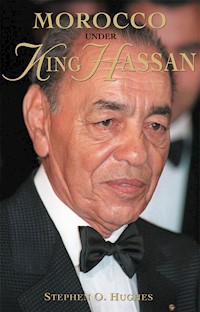
Written by a foreign correspondent resident in Morocco since 1952, "Morocco under King Hassan" is an impartial chronicle of all the major events in the North African kingdom during this period, relating how the king, who claimed to be a direct descendent to the Prophet Muhammed, reigned for more than 30 years, despite attempts by leftists, the military and Muslim fundamentalists to overthrow him. Due to strict press laws, no Moroccan has ever published a dispassionate account of the country and its monarchy. Most books on the subject tend to fall into one of two categories - those that are hymns of praise for the Moroccan monarchy, and those arguing that it is one of the most despotic and reactionary regimes in the world. Morocco under King Hassan is a journalist's objective view of a country he has lived in for nearly 50 years. The book covers the nationalist struggle for independence, conflicts with neighbouring Algeria, the guerrilla war in Western Sahara and all other major political, economic and social developments that have turned Morocco into a multiparty democracy with a liberal economic system that makes it unique in the Arab world. Under King Hassan Morocco was modernized while retaining its ancient traditions and culture and, at the same time, promoting religious tolerance. Political stability at home and the king's moderating influence in the Middle East and foreign affairs generally, have won Morocco many Western friends. This book provides an insight into the inner workings of an endearing and gripping country which will provide the reader with a better understanding and appreciation of Morocco and the Moroccans. Consisting of 37 chapters, it is designed as a handbook for both the specialist and general reader.
Das E-Book können Sie in Legimi-Apps oder einer beliebigen App lesen, die das folgende Format unterstützen:
Veröffentlichungsjahr: 2001
Ähnliche




















MOROCCO UNDER KING HASSAN
Stephen O. Hughes
ITHACA PRESS
.
PREFACE
Colleagues have urged me to write this chronicle of events since 1952 when I first arrived in Morocco as a journalist. They seemed to think I had become an expert but I do not claim to be one, just an observer. On one of the rare occasions when I met King Hassan informally, it was remarked that I had been in the country for a long time and therefore knew a lot about it. He smiled and said: ‘And the more you know, the less you understand, n’est-ce pas?’
This may well be, so I have confined myself to telling what I know, what I have seen as an independent observer, who originally planned to stay for a couple of years but lived and worked in the country for more than four decades, waiting to see what would happen next.
Another reason for my labours is that, as many friends have pointed out, no detailed history of contemporary Morocco has been published recently. Certainly no Moroccans have published dispassionate accounts, and I have been told often that this is because they are afraid to tell the truth. The press laws being what they were for over thirty years, telling the truth could be interpreted as a crime.
Books that have been published, including two by the king himself, can be divided roughly into two categories: those that are hymns of praise for the Moroccan monarchy, and those arguing that it is one of the most despotic and reactionary regimes in the world. The truth of course lies somewhere in between.
Finally, many friends have told me to write my mémoires because I am not a Moroccan, nor a citizen either of France or Spain, the former colonial powers, supposedly biaised or with an axe to grind. Thus, the following account of events I have witnessed is my modest contribution to the contemporary history of an endearing and fascinating country. It is based almost entirely on personal experience, on the files I have kept of dispatches – probably millions of words – which constitute a first rough draft of history. I hope it will help readers to better understand and appreciate Morocco and the Moroccans.
1 THE GREAT SURVIVOR
At a banquet in his ornate Marrakesh palace, 25 years after his accession, King Hassan told King Juan Carlos of Spain: ‘When I ascended the throne, people said I would not last more than six months.’ He meant that he was either very clever or very lucky to survive for a quarter of a century. So many people had tried to make his reign as brief as possible, it seemed almost miraculous as the years went by that he was still on the throne. Indeed, as I watched him for more than forty years, the question visitors asked me most often was: ‘How long will King Hassan last?’
They began calling him ‘The Great Survivor’. He escaped plots by left-wing revolutionaries and Islamic fundamentalists, his army tried at least twice to kill him, and for 15 years guerrillas waged a desert war they claimed would bring the monarchy to its knees. As he once said himself, his reign resembled a Shakespearean drama.
When he succeeded his father King Mohammed V in 1961, the 31-year-old heir to the throne was seen as a self-indulgent playboy, more interested in having ‘affairs’ than in directing affairs of state. The consensus seemed to be not just that he could not reign for long, but that he should not reign at all.
It is often assumed that monarchy is unfashionable, to say the least, reactionary, despotic, nepotic or feudal. The list of derogatory epithets is almost endless. There was a widely held belief that because autocrats were deposed in Eastern Europe, Iran and the Arab world, those who survived were inevitably doomed, and anything done to hasten their departure would be another step in the inexorable march of history.
If there are still monarchies in Europe, and even a restoration when Juan Carlos became King of Spain in 1975, they are considered acceptable because they are powerless figureheads; they reign but do not rule. They are accepted as harmless national symbols, and for the regal pageantry that brightens humdrum lives. Of course, even the figureheads are opposed by socialists or communists and the like, although their main arguments seem to be either that crowned heads cost the taxpayer too much money, as if a republic would reduce taxes, or that they are meddling in state affairs when they express a political opinion in public, instead of mumbling the hollow platitudes expected of them.
But these are mere murmurs compared to the contumely and abuse often heaped on King Hassan, on crowned heads who rule as well as reign, and who in fact do not wear crowns at all but turbans or fezzes. Wearing the traditional red fez and ankle-length jellaba robe when he made a state visit to London in 1987, King Hassan was insulted by the British popular press. Some described him as a tinpot potentate. The liberal Earl of Winchelsea and Nottingham called him a bloody tyrant.
They had their reasons. The British press could not forgive him for keeping Queen Elizabeth II waiting when she visited Morocco in 1980. Punctuality is not a Moroccan virtue. The popular papers made cheap jibes about his manners or dress. There was something condescending and racist in their attitude towards the man in a ‘long white night-gown with a red flower pot on his head’. British newspapers reported that fifty peers from all parties signed a petition denouncing King Hassan as a despot waging a bloody colonial war in Western Sahara. Among them was Winchelsea who, in the throes of righteous indignation, said it was monstrous that the Queen should play host to a mass killer.
However, the young earl’s attitude is nothing compared to the fiery and frenzied campaigns of vilification aimed at King Hassan by other individuals and regimes, in the Muslim world, and by Marxists dedicated to the ultimate triumph of socialism. For decades I saw King Hassan arouse passionate reactions abroad to whatever he said or did, and get little sympathy when he was in trouble.
Attacks against him were not only verbal. Some tried to transform their words into deeds with assassination attempts or popular uprisings, apparently convinced they would be doing the Moroccans an immense service by helping to get rid of their monarchy. Such views were held in Iraq, Egypt, Libya and Iran after their monarchs were eliminated, and the new rulers set about trying to export their revolution to what they considered less happier lands, like Morocco.
Apart from saying that the monarchs they overthrew were tyrants or autocrats, immoral, greedy, selfish or feckless, much was also made of their illegitimacy, by painting them as megalomaniac upstarts like the Shah of Iran, or as fabrications of colonialism like Kings Faisal of Iraq, Farouk of Egypt and Idris of Libya. Pursuing this line of logic, Gamal Abdel Nasser, Muammar Gaddafi, the Ayatollah Ruhollah Khomeini and other self-styled revolutionaries saw King Hassan as a detestable anachronism to be eradicated in the name of progress.
In the socialist camp, where left is automatically right and right is inevitably wrong, right-wing regimes in general are systematically opposed, but when such a regime is led by a king, and in the Third World to boot, opposition is instinctive and automatic. In red eyes there can be no extenuating circumstances for rulers like King Hassan.
Furthermore, although King Hassan claimed descent from the Prophet Muhammad, and as such was revered by his people, even this attribute was turned against him, by Islamic fundamentalists who denounced what they considered his unholy behaviour and said they would not rest until an Islamic republic was proclaimed.
How King Hassan managed to survive is often explained by the baraka or aura of divine protection said to be inherent in his function as Amir al-Moumineen or Commander of the Faithful, roughly equivalent to the head of the Church, which made him both a spiritual and temporal ruler. The sanctity of his person as a descendant of the Prophet Muhammad, something approaching the divine right of kings, could not be discounted. Religious reverence for the Alawite dynasty’s holy origins is still strong among the majority of Moroccans, although baraka is also perceived as just a matter of good luck.
An important consideration is that, in times of political and religious fanaticism, stirring up regimented rabbles with clenched fists, King Hassan lived in constant fear for his life, obliged to surround himself with a costly and complicated security system, bulletproof cars, bodyguards, food tasters and the like. For years his movements were kept secret, often announced only after he had arrived at his destination.
Royal cortèges resembled battleships cruising along streets lined with armed guards every few yards, the crowds held back by steel barriers, while windows and balconies along the route had to be closed. It was awesome in a way, and doubtless created some sense of inaccessible grandeur. But it also made him remote, and events have shown that his protectors were potential enemies as well. It would not be surprising if he had developed a chronic persecution complex.
The secrets of King Hassan’s success in mastering the Moroccan mosaic were a complex combination of natural gifts and political skills which earned him the friendship of many statesmen, besides the grudging admiration even of enemies. The erstwhile playboy proved to be a masterful manipulator, playing one group off against another in a delicate balancing act, to establish his authority over 26 million Moroccans. This was by no means easy in such a diverse country, the land of contrasts of the tourist brochures, where there is a constant ferment of sometimes conflicting regional, religious, political, ethnic or tribal aspirations.
As with all autocrats, King Hassan’s main weakness was that he was too powerful. Despite the principles of a constitutional monarchy, the legislative and executive structures, the multi-party system, and the ideals of freedom and democracy enshrined in the constitution, his reluctance to delegate any real power made him vulnerable. Consequently, plotters believed that all they had to do was eliminate one man. Like the queen in Alice in Wonderland, self-styled revolutionaries thought the simplest solution was: ‘Off with his head!’ It also meant that in a segmented society with a fragmented political opposition, he had to operate like a one-man band, or a juggler trying to keep numerous balls in the air at once.
Hence there were also those who supported him because they believed that if the keystone king was eliminated, the whole edifice would collapse, with unpredictable consequences. Those who prefer political stability, however achieved, say the devil you know is better than the devil you don’t know. When the military tried to overthrow King Hassan, the leader of the socialist opposition party told me, ‘My God, we would much rather have a king than a general.’1
So much depended on a single man that Morocco was intimately identified with its king. The so-called symbiosis between the monarch and his people was a major propaganda theme, disgorged by the palace on all occasions when it was felt that royal decisions needed to be ratified by something like a popular plebiscite.
Four constitutions were written without consulting either the people or parliament, and then adopted with over 90 per cent of the vote in referendums by a population which was 70 per cent illiterate. All important decisions in domestic and foreign affairs were taken by the king and approved post facto by parliament. It was democracy of a kind, in which the king was an all-powerful autocrat.
Meanwhile, even those who admired King Hassan’s intellect were appalled by his entourage of sponging sycophants, Evelyn Waugh’s ‘cringing whey-faced poltroons’. Westerners scoffed at the way both high-ranking dignitaries and humble domestic servants rushed to kiss his hand, ‘as if there was gravy on it’, as a foreign journalist remarked.The constantly repeated gestures of feudal fealty or religious fervour struck onlookers as undignified, quaint or slavish. At best they gave the impression that the throne was cut off from reality by a phalanx of flatterers, isolated from the people. The problem was the king’s obvious reluctance to accept criticism, and ‘It is a pity that rulers see their critics as their enemies, when it is so obviously their flatterers who destroy them, or, rather, encourage them to self-destruct.’2
King Hussein of Jordan, another Muslim ruler assailed by enemies, earned the sobriquet ‘the plucky little king’ for his courage when everything seemed against him. A visitor, who knew the Hashemite ruler well, concluded that Hussein’s friend Hassan was ‘the cocky little king’ because of his superb self-assurance in adversity and his angry reactions to criticism.
The kings of Saudi Arabia had been close friends of King Hassan, but there were enormous differences between them also. While the Wahabites wallow in wealth, the Alawites are paupers in comparison, even though royal palaces in Morocco may recall something out of The Arabian Nights. Moreover, the Saudis’ religious prestige as Guardians of the Holy Places in Mecca and Medina is tempered by their puritanical brand of Islam, whereas King Hassan’s was much more tolerant, and unlike the Saudis he said many times he was not only a friend but also an admirer of the Jews. In addition, they were poles apart on the cultural and intellectual levels. For example, Hassan was a gifted orator with a quick and analytical mind, rolling off flowing phrases in Arabic or French without any notes, to the extent that even his cleverness exasperated less gifted contempories. But, despite these and other differences, the Alawites and Wahabites are thought to belong to the same reactionary band, fighting a rearguard action against ‘inevitable progress’.
Observers found King Hassan alternately patient and impulsive, moderate and excessive, cautious and audacious, ruthless and magnanimous, generous and selfish. The consensus, after averaging out all the vices and virtues, could be that he was a relatively benign but very determined autocrat and a patriot with a deep commitment to defend the honour, dignity and integrity of one of the oldest nations in Africa or the Arab world. In his later years he confessed that 60 per cent of his choices had been wrong and only 40 per cent right, but ‘I have had the courage to find my faults and to correct them.’3
Neither can his legitimacy as the scion of a dynasty in power for centuries be questioned. He was not a colonial fabrication. He was disliked, even despised by the French until he became king, and worked devotedly with his father to bring the colonial era to an end. This did not prevent him from admiring France, its culture and language, which he spoke brilliantly. US Secretary of State George Shultz once told me: ‘King Hassan is a very sophisticated gentleman.’
In a remarkable tribute, Alexandre de Marenches, the chief of the French Secret Service for eleven years until 1981, described King Hassan as
A lover of life in all its forms, a geostrategist gifted with one of the most brilliant intellects I have ever met, a prodigious memory, a sixth sense of extreme sensibility and keen perception, and one of the rare statesmen of our time. Due to circumstances and setbacks he has acquired an understanding, a vision of world affairs … He has understood everything. He grasps global problems as well as questions concerning the Mediterranean, the Near East and Middle East, among others. At the present time he is one of the finest orators in the French language. He perceives the problems of the West. He has a knowledge of internal French politics which is extremely rare, even among French specialists. In addition, as shown during the various attacks in which he could have lost his life, he has uncommon courage and spirit of decision.4
Such admiring opinions are not rare. Nor are they always mere flattery, although some critics have said that in the case of de Marenches, a count from a distinguished family with a record of centuries of public service, his judgements are those of a fellow aristocrat, a personal friend to whom he said he was grateful for valuable cooperation in engineering covert operations in various parts of Africa.
While many admired King Hassan for his perseverance and fortitude, his modern and moderate outlook, and his grasp of international affairs, much of the criticism is often due either to ignorance, or sheer ill-will as a matter of political principle. Thus, the admiration has be to set against a great deal of hostility, even when mitigated by diplomatic humbug or hypocrisy. In sum, King Hassan aroused such passionate reactions because he was an exceptional personality and in many ways Morocco is quite unique.
Despite all the handicaps, King Hassan’s first six months ran on for over 38 years. It was a remarkable achievement. Certainly he was very clever, and quite lucky, to survive for so long. The final judgement must be that the kingdom also made substantial progress in many fields during his long reign.
Notes
1 Abderrahim Bouabid, leader of the Socialist Union of People’s Forces.2 Stephen Vizinczey, an authority on pre-Bolshevik Russia, writing of the czars.3 La mémoire d’un roi, interviews with Eric Laurent, Paris, Plon, 1993.4 Alexandre de Marenches with Christine Okrent, Dans le secret des princes, Paris, Stock, 1986.
2 FIRST IMPRESSIONS, CASABLANCA
Casablanca had the buzz and bustle of a boom town when I arrived in the summer of 1952, later to witness the end of the French and Spanish protectorates and Morocco’s return to independence in 1956. The city has become bigger and in some ways better since then. It still palpitates as the country’s business and industrial capital, spreading out from high-rise office blocks near the harbour to the slums or luxurious villas on the outskirts, but then as now it is a small part of the Moroccan picture.
The picture was distorted by the Hollywood movie named after the city. I found the movie-makers had very little idea what the place was really like. There was no Rick’s café and no bead curtains or ceiling fans. One could find portly people wearing a fez like Sydney Greenstreet, perhaps some shifty-eyed characters playing Peter Lorre’s role, or men with a hunted look who could be taken in the dark for Humphrey Bogart. The remark ‘round up the usual suspects’ by the French police officer was, however, quite pertinent during the protectorate, and remained so for years afterwards.
There were many Americans in Casablanca at the time, which was why I had come to Morocco, a country I knew only from the movie. A chance acquaintance in a sidewalk café in Paris told me he had just ridden his motorbike back from Morocco where he had been selling carbon paper. He said one of his clients was a newspaper editor who was looking for an English-speaking journalist. As I had just had a row with my boss Harold King at Reuters in Paris, I felt a change of scene would be welcome so I booked a call to Casablanca from the café. Numerous beers later the call came through and to this day I cannot remember what I said.
I must have been persuasive because next day a one-way air ticket to Casablanca was delivered to my hotel. I was hired as editor of a daily newspaper in English, the Atlantic Courier, published for thousands of US military personnel and civilians working on four airbases being built for the Strategic Airforce Command. It was after the Korean War, amid fears of a major East–West conflict. Their presence added more urgency to an atmosphere already electrified by political problems and tensions between the Moroccans and the French.
The tension was tangible. On arrival I was sermonised by Marcel Peyrouton, the bluff and beefy director of the Atlantic Courier and its parent paper Maroc Presse, who told me to keep out of politics, ignore local events, and confine myself to the foreign news we received by cable from the Associated Press. Lawrence Craig, an American businessman who was one of the Courier’s directors, told me that, on the contrary, my job was to tell Americans about the country they were living in. Within months the American and French directors had a row over articles I had written about Morocco, and the paper was closed down.
Peyrouton was Resident-General or chief French protectorate administrator for six months in 1936. George Spillmann, an officer who worked under him, wrote that he was ‘heavy-handed, forceful, even brutal’. He resigned when the left-wing Front Populaire came to power in France, to resurface during World War II. In Nazi-occupied France he distinguished himself as interior minister in 1940–41 by signing anti-Jewish laws that resulted in massive deportations to death camps in Germany. He later became Vichy ambassador in Buenos Aires.
I found that a fair number of Vichy regime collaborators had taken refuge in Morocco, perhaps to escape retribution from the French resistance movement. There were also uneasy French investors who took their capital to Morocco seeking a safe haven at the time of the Korean War, when there was a widespread fear that World War III was about to break out. (I personally shared some of that fear, which was one of the reasons why I left England to spend a year editing a newspaper in Libya in 1949–50.) Many such people held influential positions in Morocco during the French protectorate. Their politics were rather reactionary.
Under Peyrouton Maroc Presse was fiercely anti-nationalist, as were the other French daily newspapers, Le Petit Marocain and La Vigie Marocaine owned by Pierre Mas, another right-wing zealot. They were constantly denigrating the nationalists of the Istiqlal Party which had issued a manifesto in 1944 demanding independence. They described the patriots as terrorists or communists, while trying to present the French protectorate regime as a model of paternal benevolence.
In April 1955 Maroc Presse passed into the hands of a liberal, Jacques Lemaigre Dubreuil, owner of the French edible oils corporation Huiles Lesieur. He had collaborated with the Allies in North Africa. Under him the paper’s tone became more moderate, going so far as to suggest that the Istiqlal’s grievances were legitimate. Such views so angered colonialist extremists that they had Dubreuil murdered in June 1955. Perhaps I was lucky – the Atlantic Courier was closed down before my articles in English attracted the attention of French fanatics.
Anti-nationalist feeling ran high in the French community, among wealthy settlers and businessmen and in the administration. It was also racist, particularly among the poorer whites. At a lodging house where I stayed with my wife on arrival, when I offered a cigarette to the Moroccan handyman, the landlady snatched it out of my hand and threw it on the floor, obliging him to pick it up. On another occasion when I came in late she took me into the kitchen to show me the maid who was lying asleep on the floor under a table. Her kaftan robe had fallen open revealing her breasts. The ignoble landlady said: ‘If you like, you can jump her.’
We moved into another house on what was then the Boulevard de la Gare now named after King Mohammed V, Casablanca’s main thoroughfare, as paying guests of a Jewish family. They were quiet and discreet people, my first close contact with Jews. The mother of the family came into my bedroom one afternoon. Without saying a word, she pulled a crucifix from under her robes and hung it on the wall over the bed, immediately rushing out of the room in confusion.
Many of Morocco’s 275,000 Jews could be found in the sidewalk cafés, but there were few Muslims to be seen in the big, brash bars like the Roi de la Bière patronised almost exclusively by French and American drinkers. We learned that this was not because Muslims are forbidden by their religion to drink alcohol – the cafés also served soft drinks – but because of a tacit policy of segregation. Muslims were clearly not welcome. When not about business, café conversation was often a tedious litany of the so-called faults of the Muslims.
In the medina, behind the walls of the old city near the harbour, in the slums and shanty towns on the outskirts, I was treated with civility and apparent indifference. But I found that if this attitude concealed a certain hostility during colonial times, it also hid the courtesy and generosity of a people who are heirs to a centuries-old civilisation. My first contact in a bazaar was with a white-bearded old merchant who wanted to sell me a pair of yellow leather slippers. I told him I had no money (I had been warned against pick-pockets), but he wrapped them up in a newspaper and thrust them into my hands, saying I could bring the money next day.
When I wandered around the shanty towns of the Carrières Centrales (usually followed by French policemen), along dusty alleys lined with rickety shacks made of cardboard and oil cans beaten flat, the crowds of ragged people would open and close around me as I passed, as if I were wading a stream. I was often followed by a string of barefooted children chanting: ‘Bonjor m’siou! Bonjor m’siou!’, who scattered like startled sparrows when the police caught up with us.
One day I remarked to Peyrouton that the police seemed to be following me everywhere. ‘That’s because you’re a foreigner,’ he said. When I pointed out that the French were also foreigners in Morocco and the police did not follow them, he almost exploded. ‘Les Français sont chez eux ici!’ he bellowed.
Most of the women to be seen were veiled, wrapped in voluminous white haiks with only one eye visible, or wearing embroidered veils and ankle-length jellaba robes with hoods. Their smoky eyes lowered to the ground as they passed. They often had a baby strapped in a towel to their backs. We were given various explanations, usually that women were required to be veiled in Islam, but also that the all-enveloping dress was a cache-misère favoured by poor peasants who could not afford Western clothes. Most of the slum-dwellers were from rural areas where veils were generally not worn.
A French journalist who showed me another side of the female coin said jealous fathers, brothers or husbands obliged their womenfolk to wear veils if they were very pretty, while other women wore them because they were ugly. He implied that picking up a veiled girl in the street was something of a lottery. He recommended a visit to the Bousbir, or what the French called the quartier réservé, an enclosure reserved for prostitutes. There was also a Bousbir in cities like Fez and Marrakesh, apparently tolerated by the French as an amenity for their troops, including Senegalese soldiers in the French army stationed in Morocco. In April 1947 a Senegalese soldier was beaten to death by a mob after he slapped the face of a Bousbir girl. His comrade ran back to barracks to alert his fellows and soon 250 Senegalese soldiers armed with rifles and sub-machine guns went rampaging through the area. They shot dead 59 Moroccans and wounded 98.
Most of the Bousbir women were illiterate young peasants who had fled poverty in the countryside, part of the massive rural exodus to the cities that continues even today. For the majority, the Bousbir was a refuge from the squalor of the shanty town hovels where their menfolk formed a huge reservoir of uprooted people who were an easy prey for political agitators.
In sharp contrast to the demure demeanour of women outside, the girls inside the Bousbir wore no veils, and very little else in warm weather. Having escaped, if that is the word, the cloistered life, they went to the other extreme with wild abandon, albeit virtually locked up in the quarter with guards at the gateways. It seemed like a huge harem, a cacaphony of oriental music and jazz blaring from dozens of small cafés, customers of many nationalities, but mostly Moroccans, strolling up and down the narrow streets before choosing a girl from the horde of hoydens and houris.
One of the first things the government did after independence was to close down all the Bousbirs as despicable colonialist vestiges. Taking their cue from Sultan Mohammed ben Youssef ’s eldest daughter, Princess Lalla Aisha, and her sisters, who appeared in public without veils, women of all classes began abandoning traditional dress for Western clothes as a mark of emancipation. After about 25 years, attempts to reverse the trend were made by Islamic fundamentalists who invented a new kind of garb for their women: the hijab, a shapeless sack-like garment, with a kerchief knotted tightly around the head, so that only the face and hands are visible.
Behind my superficial first impressions was political turmoil which suddenly erupted into bloody rioting in December 1952 a few months after my arrival. The previous month, the labour leader Ferhat Hashed had been murdered in Tunis, allegedly by Europeans, and Moroccan trade unionists, members of the Union Générale des Syndicats Confédérés au Maroc (UGSCM), an affiliate of the French communist-dominated Conféderation Générale de Travail (CGT), decided to stage a protest demonstration. The protest was brutally broken up by French police commanded by Philippe Boniface, a Corsican hardliner, who was to make a notorious name for himself. He helped to engineer the departure of the sultan into exile, and later connived with right-wing French death squads set up to combat Moroccan terrorists or patriots when they began an armed resistance campaign.
The labour union protest snowballed into riots in the teeming Carrières Centrales, populated by 65,000 people, and other slum areas. Police and troops fired on the mob. French officials said 34 Moroccan demonstrators and three Frenchmen were killed, while local Moroccan accounts put the figure as high as 490 dead. In this case, as in subsequent riots in Casablanca, before and after independence, it was almost impossible to establish the truth. Mawlay Ahmed Alawite, a medical student in France at the time, who was to become a prominent figure in independent Morocco, distributed Istiqlal statements to the press in Paris claiming that Casablanca’s gutters ran with blood. He said there were heaps of corpses lying in the streets after up to a thousand people had been killed.
The protectorate authorities blamed the violence on the Istiqlal (independence) Party. They ordered it to be dissolved after arresting about eighty of its leaders, by no means either the first or the last time mass arrests followed any political development. It recalled the movie line: ‘Round up the usual suspects.’ Among those arrested were young intellectuals who were destined for high office in independent Morocco. Most of them were French-educated, imbued with the spirit of Liberté, Egalité et Fraternité, and had a modernist outlook. Other Istiqlal leaders like the party’s founder, Allal al-Fassi, who was living in exile in Cairo at the time, were steeped in Arab culture at the ancient Kairouyine University in Fez, and their politics were strongly influenced by pan-Arabism in the Middle East. After independence, the party split along these political and cultural lines into conservative and progressive factions.
Reports of the riots caused an outcry in France where the author François Mauriac, who had just won the Nobel Prize for literature, severely criticised the protectorate’s handling of the situation in a series of articles published by the Parisian daily Le Figaro. Mauriac, a devout Catholic, along with French liberals, socialists and communists, also condemned a plot to dethrone the sultan being hatched by die-hard settlers and their Moroccan collaborators, allegedly with the help of some protectorate officials.
That plot was destined to succeed. About a year before the riots the sultan’s opponents had set up what they called the Movement of Opposition and Reforms (MOR). As its name suggests, it was in favour of gradual reform instead of the immediate independence demanded by the Istiqlal. They demanded that the sultan publicly disavow the nationalists and accept reforms, implying that if he refused to do so they would get rid of him.
General Alphonse Juin, who had earned a reputation as a distinguished soldier with the Allies in World War II, for which he was promoted to the rank of Field Marshal, served as Resident-General in Rabat from 1947 to 1951. During his term in Rabat he acted as the defender of settler interests, being himself a pied noir, born in Algeria. He was tempted to dethrone the sultan because he thought he was stubborn and obstructive by refusing to sign dahirs or decrees submitted for the royal seal. The sultan, who had developed close ties with the Istiqlal, went on a ‘seal strike’. Among his objections was that one of the decrees would allow French residents to be elected to municipal assemblies. He considered this a violation of Moroccan sovereignty and of the Protectorate Treaty. In an effort to intimidate him, Juin ordered tribes to march on Fez and Rabat, but he recalled them when the sultan signed some decrees under duress.
Juin was succeeded by another World War II veteran, General Augustin Guillaume. He shared many of Juin’s views, notably that ‘good’ Moroccans were Berbers who lived in the mountains, and ‘bad’ ones were Arabs or urban intellectuals of the nationalist parties, an opinion shared by many settlers. Guillaume once expressed his disdain for the nationalists by saying he would ‘make them eat straw’.
The insulting implication that straw was the proper diet for mules and donkeys, or nationalists, was shared by some of the wealthier colons or settlers who believed that tough tactics were the only way to deal with the sultan and the Istiqlal. Their principal ally was Thami El-Glawi, the Pasha or governor of Marrakesh, an unscrupulous Berber chieftain noted for leading the life of a medieval potentate. He amassed great wealth by mercilessly exploiting Atlas mountain tribes, while the protectorate authorities turned a blind eye.1
Thami El-Glawi led MOR. It was supported by numerous tribal leaders, army veterans and functionaries who, for a variety of reasons, but mainly that they considered their positions depended on it, were pro-French and anxious to maintain the status quo. Among them were a few religious leaders such as Abdelhay El-Kettani, a white-bearded patriarch who had a personal grudge against the Alawite dynasty. His brother Mohammed was flogged to death in 1909 on orders from Mawlay Hafid, the sultan who was forced to sign the Protectorate Treaty which brought colonialism to Morocco in 1912.
The Istiqlal branded them all traitors, collaborators or feudal reactionaries. The palace tended to share this view, and when Thami El-Glawi demanded that he disavow the party, Sultan Mohammed ben Youssef ordered him out of the palace, telling him never to come back again, and making it clear he would not take orders from a subordinate.
At the end of 1952, battle lines were clearly drawn, the sultan and the nationalists on one side, the tribal overlords and die-hard settlers on the other, in the middle a protectorate regime dominated by hard-liners and, over the horizon, a wavering, unstable government in Paris trying, in vain as it turned out, to avert a major crisis.
After the riots, Casablanca became an uncomfortable place to live. It was difficult not to lose one’s sangfroid while constantly assailed by strident, opinionated settlers who aired their prejudices on every occasion. They also had a mania for demanding to know what visitors thought of the situation, and any hint of sympathy for the nationalists brought sneers or violent verbal abuse. One felt that their hysteria was also infecting Moroccans in the teeming shanty towns, the poverty-stricken people with little to lose, whose patience and forbearance were shortly to be provoked into violence, to ultimately sweep away the protectorate.
As the storm clouds gathered, we moved to Rabat. I had been offered a job in the French press department as a translator. In the capital near the palace, I was to learn something about the workings of a colonial system which was in the process of digging its own grave.
Notes
1 The story of the Glawi and other Grand Kaids or Berber chiefs is told by Gavin Maxwell in Lords of the Atlas, London, Longmans, 1966.
3 IN LYAUTEY’S BUNGALOW
We moved into a small hotel outside the walls of Salé, on the north bank of the Bou Regreg River, opposite Rabat. Run by a French couple, Albert Aubert and his frizzy red-haired wife Georgette, the Bagatelle Hotel was near a hospital for the Foreign Legion. Soldiers would sing bawdy ballads almost every night in the hotel bar. On leave from outposts in the desert, the tanned troops attracted all kinds of hangers-on, mainly women, and some male characters who evidently liked soldiers too. ‘Fifi’, as he was known, was a tiny tailor with butterfly-like hands that flitted over soldiers while he talked to them, as if measuring them up for a suit. There was also a tall, straw-haired American in cowboy boots who said he was a radio network correspondent. He always referred to the sultan as ‘the emperor’, since guide books at the time described Morocco as the Sharifian Empire, derived from shareef or descendant of the Prophet.
Unlike Casablanca, our stay in Salé hotel was pleasant most of the time. There were arguments in the bar, and occasional fights, but politics seemed to be taboo. A crackling radio was turned on by a buxom barmaid usually to hear the French football or horse racing results, and switched off whenever la politique was mentioned. Apparently nobody knew, or cared, about what was going on across the river in the protectorate offices or the palace. It was like living on a little island, with a barely perceptible storm raging beyond the horizon.
It was a change from the stress of newspaper work to stroll down to the river bank and be rowed slowly across in a small boat by a passeur who bent into his oars standing up. The information department’s office was in a creaky wooden bungalow, with a corrugated iron roof, a verandah running around it, hidden behind acacia trees, in a garden in the middle of which was a white cube with a green-tiled dome – the tomb of Marshal Louis Hubert Gonzalve Lyautey, the first French Resident-General.
Lyautey, who died in France in 1934 and was buried in Rabat at his request, was said to represent the epitome of France’s civilising mission in Morocco. His many admirers, among them many distinguished Moroccans, including the sultan himself, credited him with guiding the country out of anarchy into an orderly state while Resident-General from 1912 to 1925. We were told that before the Residency and protectorate administrations were built, our bungalow was his headquarters.
The tomb and the bungalow, both later demolished and replaced by an office block, were monuments to an idealist who believed in association with rather than subordination of colonial territories. ‘One must restore governments, employ the elites, render service and not be self-serving,’ he wrote at a time when, during the last scramble for Africa, the European colonial powers were contriving to exploit their colonies or ‘milk them like dairy cows’, a favourite nationalist cliché.
He believed the protectorate should assist the sultan and the legitimate government, the Makhzen, in modernising Morocco by introducing a series of reforms. At the beginning of the twentieth century, the country had no roads or harbours. It took ten days to travel 300 kilometres on horseback from Tangier to Fez. It was deeply in debt thanks to the usury of European bankers. Chaos reigned outside the cities due to dissidence and revolts by tribes defying the weak central government. Lyautey wanted France to help the Moroccans to remedy this situation themselves. He opposed the influx of settlers and the creation of a plethoric colonial administration which he believed were only pretexts for employing foreigners instead of the native population.
Lyautey’s numerous colonialist critics sought to discredit him by claiming he squandered French lives by using force as little as possible and was merely propping up a medieval monarchy. Some said the aristocratic officer’s sympathies for the sultan and the local elite were a form of political snobbery. Later, radical nationalists said Lyautey’s policies perpetuated an unpopular and despotic regime under a ‘French sultan’.1
The powerful colonialist lobby, in France and Algeria, was bent on pure and simple annexation, convinced that France had a right to extend her ‘sphere of influence’. This arrogant attitude was, of course, typical of all the colonial powers at the turn of the century. But in Morocco’s case, because France was invading an independent nation, she had to resort to diplomatic manoeuvres to justify her incursions into Moroccan territory from bases in Algeria. As the conquest advanced, Moroccan resistance was presented as the work of unruly tribal raiders bent on pillage and plunder.
France was able to act with impunity because Britain, Germany and Italy had been bought off. In return for a free hand in Morocco, France agreed to let Italy colonise Libya. Then, as part of the Entente Cordiale, she signed a similar agreement with Britain who in return was given carte blanche in Egypt. This left Kaiser William II of Germany who landed in Tangier and later sent the gunboat Panther to Agadir to assert his ‘interests’. He withdrew as World War I loomed, after receiving Kamerun in West Africa as a ‘gift’. Meanwhile, France signed a secret agreement with Spain delimiting their respective spheres of influence in Morocco, assuming that Spain could have the northern part around its enclaves of Ceuta and Melilla, and a stretch of desert in the south opposite the Canary Islands, while France would take the lion’s share in between.
The scene was set for what the French socialist government of Jean Jaurès called ‘peaceful penetration’, a formula which was interpreted very freely. A French ambassador, the Count de Saint Aulaire, related how Doctor Jaffary, assigned to Sultan Mawlay Abdul-Aziz as his personal physician in Fez, sent a message to the French Legation in Tangier by carrier pigeon which read: ‘I was called in yesterday to administer suppositories to two of His Majesty’s negresses. One cannot do better in the way of peaceful penetration.’ The Count blunted the joke by adding: ‘It was revenge for Waterloo, or at least for Fashoda.’
Peaceful penetration in reality meant that French forces nibbled away at Moroccan territory in the east until 1907 when Lyautey first arrived at the head of an army to occupy the Moroccan town of Oujda near the Algerian border, in reprisal for the murder of a French doctor, Emile Mauchamp, in Marrakesh. The town was occupied without a shot being fired. Lyautey became famous for his dictum: ‘Show force to avoid having to use it.’
A few months later the French navy bombarded Casablanca and landed three thousand troops after nine European workers were slain, apparently because they were laying a railway line across a Muslim cemetery, touching off a local revolt against foreigners in general. The revolt eventually spread to the whole country. A jihad or holy war was proclaimed. Sultan Abdul-Aziz was deposed by his brother, Mawlay Hafid, but in the end the latter was forced to sign the protectorate treaty on 30 March 1912 and then abdicate in favour of another brother, Mawlay Youssef.
Lyautey was named the first Resident-General or chief administrator under the French protectorate treaty which gave France control of foreign affairs, defence and finance. France also undertook to preserve the throne and dynasty and guarantee the exercise of the Islamic religion. But it did not allow the sultan to take part in negotiations with Spain over the northern zone, or the status of Tangier, which was to become an international zone, so that it permitted France to dispose of Moroccan territory without the sultan’s consent.
The American historian Edmund Burke III remarked: ‘The treaty of Fez in sum emptied the authority of the sultan and the Makhzenof all substance and created alongside their authority a highly ramified protectorate government with complete control in all the areas which counted.’2
For the first time in over a millennium, Morocco was subjugated by a foreign power. It had resisted Spain and Portugal when they were at their zenith at the time of the discovery of the Americas, and held off the Turks who dominated the rest of North Africa until France replaced the declining Ottoman empire in the area.
The ignominy of the situation was traumatic for Moroccans of all classes. Their pride and dignity were grievously wounded. It provoked fierce reactions which the French told themselves were merely examples of Muslim fanaticism or xenophobia, conveniently forgetting their own resistance to invasions. Sultan Mawlay Hafid abdicated in disgust. Before he left the country he destroyed the imperial parasol, the symbol of his authority, no doubt realising that his jihad had failed and he had been unable to fulfil his duty to his people.
When Lyautey arrived in the ancient capital of Fez to take command, the city was besieged by hostile tribes and he remarked: ‘I feel as if I am in enemy territory.’ A contemporary photograph shows forty ‘dissidents’ lined up against the city’s wall in front of a French firing squad. Peaceful penetration had come to an end. It was replaced by ‘pacification’, another euphemism for subjugation. Pacification took 24 years to complete, but even before peace came, a nationalist movement was born to triumph with the return to independence twenty years later in 1956.
The difficulties of the pacification were apparent as early as November 1914, just after the declaration of war, at the battle of El-Herri in the mountains near Khenifra south of Fez. A column of 43 French officers and 1,232 heavily-armed men was moving down a valley when they were slaughtered by Berber warriors on horseback. Led by the Zaiyan tribal chief Moha ou Hammou, they killed 33 officers and 590 men, wounded 176 others, and captured all their artillery, machine guns and rifles, according to contemporary accounts. It was probably one of the last cavalry victories in modern times.
In the rugged Rif mountains after the European war, the exploits of Mohamed ben Abdulkrim al-Khattabi astounded the world. On 22 July 1921 his warriors, armed mostly with flintlock rifles, inflicted a disastrous defeat on a modern Spanish army of 26,000 men at the battle of Anual, a tiny locality in the Spanish zone between Al-Hoceima and Melilla. The rout was complete. The commander of the Spanish army, General Manuel Sylvestre, committed suicide to avoid capture. A report to the Spanish parliament, the Cortès, said 13,192 Spanish troops were slain. Abdulkrim’s men captured practically all their arms and equipment, enabling them to continue the war for more than four years.
By 1924 Abdulkrim controlled practically the whole of the Rif area. Spain was reduced to footholds in her enclaves of Ceuta and Melilla on the Mediterranean and on the Atlantic coast at Larache and Azilah. The ‘Rif Republic’ was proclaimed and Abdulkrim assumed the title of Amir, implying a challenge to the authority of Sultan Mawlay Youssef in Fez. The challenge almost materialised when his guerrillas entered the French zone and got as far as Tissa, only 48 kilometres from Fez.
He was finally defeated only after Spain and France coordinated their military operations and moved in huge reinforcements to launch a general offensive in May 1926. Fearing Spanish retribution and certain execution, Abdulkrim surrendered to two French army envoys in his last stronghold at Ajdir. Escorted to Fez, he was later sent into exile with his family on the Indian Ocean island of La Réunion, a French possession. In 1947 it was agreed to let him settle in France, but he left the ship in Port Said and spent the rest of his life in Cairo, refusing to return to Morocco until the last foreign soldier left the country. When King Mohammed V visited Cairo in January 1960, after another Rif revolt had been put down by the independent government, Abdulkrim at first refused to see him, and it was only on the insistence of President Gamal Abdel Nasser that he finally agreed to receive the monarch. The old warrior chief died peacefully in 1963 over eighty years old and is buried in Cairo.
Abdulkrim’s exploits had an important impact on the cowed in the colonial empires, and particularly among Arab nationalists in the Middle East, who came to realise that the colonial powers were far from invincible. He is still a hero in Morocco, especially among the people of the Rif. Abdessalem, one of his sons, lived for several years in Rabat after serving as an officer in the Egyptian army. He became a close friend of mine and, years after independence, he would spend hours telling me how outraged his father would be to see the corruption and petty politicking in modern Morocco.
Another consequence of the Rif war was that Lyautey was dismissed in semi-disgrace. His military superior, Field Marshal Philippe Pétain, the hero of the battle of Verdun, was brought in with reinforcements to save the situation after a dozen French outposts were overrun by Abdulkrim’s men. Lyautey was replaced in 1925 by Theodore Steeg, a former Governor-General of Algeria, who ‘is generally considered to have taken the opposite stand to that of his predecessor’, according to a contemporary, General Georges Spillmann.3
There were 13 Residents-General in 44 years. This tended to cause bewildering policy shifts and an atmosphere of uncertainty, except for one thing: apart from Lyautey, most of them were convinced that France was in Morocco to stay. The conviction grew after one of the last pockets of resistance was wiped out in 1933 at the battle of Bou Gafer in the remote Jebel Sargho mountains. A small force of 1,200 Ait Atta warriors led by Assou Ba-Slam was obliged to surrender when surrounded by thousands of French troops armed with artillery and aircraft. French accounts admit their resistance was heroic. Despite overwhelming odds, half-starved and deprived of most of their meagre water supplies, the Ait Atta held fast until they ran out of powder for their muzzle-loaders and were reduced to throwing rocks. Ba-Slam, who died in 1960, was treated with respect by his captors. As if to atone for his failure to defeat 20,000 French troops, he told the women of his tribe never to sing or dance again.
Even before the end of the pacification, the process of direct administration was accelerating under cover of the military state of siege in force until the end of the protectorate. A heavy-handed bureaucracy was set up, staffed by French functionaries who had a mania for codifying everything, even the profession of snake charmer. A judicial system based on the Napoleonic Code was introduced and applied through a civil administration represented by Contrôleurs Civils and Officiers des Affaires Indigènes of the military administration. The police, gendarmerie and customs were also run by the French. Under their protection, thousands of settlers moved in, many of them from Algeria. A census taken in 1947 showed there were just over 8 million Muslims in the French zone alone, 203,840 Moroccan Jews, and 324,997 foreigners. The latter included wealthy entrepreneurs and poor peasants, who ultimately took over nearly 2 million acres of the best farmland.
Economic development forged ahead. Phosphate, iron, anthracite, manganese, lead and silver mines were opened up. Morocco’s only gold deposit was discovered in Ba Slam’s Jebel Sargho. Roads, railways, harbours, new towns and irrigation dams were built, and modern agricultural methods transformed the coastal plains. It would be churlish to belittle these great achievements as some writers have done. They changed the face of Morocco out of all recognition and brought immense benefits to the population. They also benefited the French, because the economic structures favoured the settlers with production geared for export.
A modern education system brought French culture and the ideals of Liberté, Égalité et Fraternité which the few Moroccans who were able to attend modern schools absorbed enthusiastically, with results rather the opposite of what most protectorate officials hoped. The country was transformed into a modern state, while at the same time ancient cities like Fez and Marrakesh were preserved, the traditional Makhzen government remained nominally in place, as well as local Moroccan government officials such as the pashas, kaids and sheikhs, although the latter were chosen by their French masters.
In the Spanish zone development was much less pronounced. Visitors travelling north were amazed by the contrast. The few roads were narrow and badly built, towns like Tetuan had a woebegone air, and there was hardly any industry apart from iron mines near Melilla. The Spanish zone was a poor place for several reasons. The Rif mountain range is difficult terrain with poor soil unsuitable for intensive agriculture, and there is only one permanent river of any consequence, the Loukkos near Larache, unlike the vast fertile plains and half a dozen rivers in the French zone. The Spanish Civil War, launched from the zone by General Francisco Franco, also seriously depleted Spain’s economic and financial resources, a situation worsened by West European ostracism. Finally, centuries of Muslim domination of Spain – and Abdulkrim – were still remembered. Los Moros were not thought worthy of generosity, although Franco’s ‘anti-communist crusade’ succeeded in part thanks to Moroccan troops he enlisted in the northern zone. However, the poverty of the northern zone was not restricted to the Moroccan population. At a Tetuan café in 1954, a Moroccan sitting at the table next to mine was having his boots polished by a ragged Spaniard who must have been fifty years old, a scene which would have been unthinkable in Casablanca where all shoeshine boys were Moroccans.
In the French zone, Moroccans were given only subaltern jobs in the army or administration, as farm labourers or industrial workers. Figures in the 1950 budget showed there were 21,300 foreign civil servants, of whom 556 were in the lowest grades, and 20,197 Moroccans, of whom 14,416 were in the lowest grades. Lyautey’s warnings went unheeded. ‘One can be sure,’ he wrote, ‘that without our realising it, a movement of ideas, secret conversations and commentaries on world events and the way Islam is treated, will arise in our midst, and one day it will take shape and explode … We can be sure that an ambitious younger generation will emerge, considering itself insufficiently employed, educating itself, learning French and, as soon as it realises its value and strength, demanding why it is kept out of the management of public affairs.’4
His words proved prophetic. In 1934 as the pacification was drawing to a close, nationalists formed the Action Committee in Fez, published their first newspaper, L’Action du Peuple, and submitted a plan of reforms to the Resident-General and Sultan Mohammed ben Youssef who had succeeded his father in 1927 at the age of 18. The plan of reforms was a long document that can be resumed as a moderate demand for greater Moroccan participation in government and administration and greater access to education. It was backed by a group of French intellectuals, among them Robert-Jean Longuet, great-grandson of Karl Marx, who edited the pro-nationalist magazine Maghreb in Paris; his role led French politicians to say the nationalists were inspired by communism, although lawyer Longuet was not a communist but a moderate socialist, his slight silhouette a marked contrast to his famous ancestor’s. The plan was drafted by nationalist leaders who were to spearhead the independence campaign, among them Mohamed Hassan Al-Wazzani who was to form the Parti Democrate de l’Indépendance (PDI), Allal Al-Fassi and Ahmed Balafrej, the founders of the Istiqlal Party.
The French reaction was lukewarm, almost dismissive. So little was done to satisfy even these moderate demands, couched in courteous language, that frustration grew steadily in the following years. On 11 January 1944 the nationalists issued an Independence Manifesto which was delivered to the Sultan, Resident-General Gabriel Puaux, and American, British and Soviet diplomats. Signed by 58 Moroccan personalities, it was the first formal nationalist demand for outright independence. It called for territorial integrity (i.e. unity of the French and Spanish zones and the international zone of Tangier), and the creation of a democratic regime under the aegis of the sultan. It also suggested that Morocco join the Allies’ Atlantic Charter and take part in the peace conference which was to end World War II.
The reference to the Allies was not by chance. President Franklin D. Roosevelt, Sir Winston Churchill and General Charles de Gaulle met at the Anfa conference in Casablanca in January 1943 to issue their unconditional surrender ultimatum to the Axis powers. It was shortly after Operation Torch, code-name for the Allied landings in Morocco (which Resident-General Charles Nogues ordered to be opposed). In a private conversation, Roosevelt gave Sultan Mohammed ben Youssef to understand that the United States would support Moroccan independence. Roosevelt’s son Eliott, who was also present, related that the monarch’s ‘eyes shone’ at the prospect.
The sultan espoused the Allied cause. During the war he refused to apply to his Jewish subjects the anti-Semite edicts of the French Vichy government. After the landings he encouraged large numbers of Moroccans to join the Allied forces for the campaigns in North Africa and Europe, where they distinguished themselves for their bravery. For this, General de Gaulle awarded the sultan a rare honour by making him a Compagnon de la Libération at a ceremony in the Hotel Talleyrand in Paris in June 1945 after the liberation.
These circumstances led the French colons to say that Washington was one of the main causes of their troubles. Spillmann divided the protectorate into two periods: before and after Anfa. He wrote: ‘The United States of America bears heavy responsibility for the disorderly haste of decolonisation, which they openly encouraged during and after the last war. By their fault, any dialogue became impossible in Morocco.’ But the essential point of the Manifesto did not escape him: ‘The big word independence was pronounced and the sovereign embraced it.’
A broad streak of anti-Americanism ran through French protectorate propaganda. I remember being asked to translate into English a document which drew a parallel between the behaviour of the early colonists in America and French protectorate policies. The argument was that the Pilgrim Fathers and settlers who came after them massacred the Indians and robbed them of their land, whereas the French civilised the Moroccans and brought them economic prosperity, justice and health so that the population increased.
Non-French visitors to Morocco encountered suspicion bordering on paranoia. I was once shown a confidential report about myself with a list of Americans I knew, and the remarks: ‘Also has several Moroccan friends. No known contacts with British intelligence. Peu sûr.’ Thus I was considered unreliable by the Protectorate authorities, probably because I had Moroccan and American friends. One of the latter, a visiting journalist, told me he was contacted several times by young Moroccans in Tangier and Casablanca who asked him if he could obtain arms for the resistance movement. He told them the only weapon he had was a ballpoint pen. It was clear from another confidential report his contacts were working for the French and a note said: ‘He pretended he was not an arms salesman.’




