


9,49 €
Mehr erfahren.
- Herausgeber: Sonicbond Publishing
- Kategorie: Geisteswissenschaft
- Serie: On Track
- Sprache: Englisch
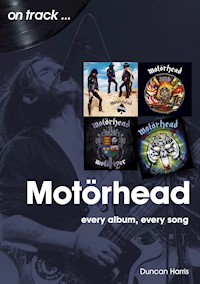
Motorhead were arguably the greatest rock and roll band in history, but it took many years to win that accolade. As a result, this is the story of the band that refused to die. The band had to deal with wayward producers, hostile record companies, a couple of false starts and even the ignominy of being proclaimed the Worst Band in the World by the NME!
Famed for their loudness and their singular anthem, ‘Ace Of Spades’, Motorhead not only proved inspirational for a host of newer bands but also, accidentally, created two sub-genres of heavy music - speed and thrash metal. Not bad for a band who announced themselves with: ‘We are Motorhead, and we play rock and roll.’ at live gigs.
This book covers every studio album, combined with many rarities and the more significant solo work from Lemmy. Beginning with the highly regarded trio of albums that ended the 1970s, the book continues through the line-up hardships and turmoil of the 1980s to the occasionally awkward musical experiments of the early 1990s. It finally closes with the band’s triumphant two-decade-long career revival, making this book an essential companion to the entire studio output of a unique and iconic band.
Duncan Harris started as a music journalist and interviewer in the 1980s, writing for fanzines and magazines. He contributed to the Rough Guides music series and, until recently, maintained a long series of reviews for the Internet website The Dreaded Press. This book is the result, a labour of love for an iconic band. Duncan continues to live in Wiltshire, UK, with his remarkable wife, their dog Willow and their cat Lily.
Sie lesen das E-Book in den Legimi-Apps auf:
Seitenzahl: 310
Veröffentlichungsjahr: 2022
Ähnliche




















Sonicbond Publishing Limited
www.sonicbondpublishing.co.uk
Email: [email protected]
First Published in the United Kingdom 2022
First Published in the United States 2022
This digital edition 2022
British Library Cataloguing in Publication Data:
A Catalogue record for this book is available from the British Library
Copyright Duncan Harris 2022
ISBN 978-1-78952-173-3
The right of Duncan Harris to be identified
as the author of this work has been asserted by him
in accordance with the Copyright, Designs and Patents Act 1988.
All rights reserved. No part of this publication may be reproduced, stored in a retrieval system or transmitted in any form or by any means, electronic, mechanical, photocopying, recording or otherwise, without prior permission in writing from Sonicbond Publishing Limited
Printed and bound in England
Graphic design and typesetting: Full Moon Media
For my wonderful Ma, who side-stepped my teenage rebellion phase by saying ‘I rather like Motörhead...’
Acknowledgements
The author thanks the estimable Alan Burridge, Mick Stevenson, Joel McIver, Mick Wall and the other chroniclers of Lemmy’s life and work.
Special love and thanks to my wife, Sammie, for her constant love, support and encouragement and, most of all, for getting me in front of the keyboard.
Contents
Author’s Note
Cast of characters
Introduction
Motörhead (Chiswick, August 1977)
Overkill (Bronze, March 1979)
Bomber (Bronze, October 1979)
Ace Of Spades (Bronze, November 1980)
St Valentine’s Day Massacre EP
Iron Fist (Bronze, April 1982)
Stand By Your Man EP
Another Perfect Day (Bronze, June 1983)
No Remorse (Bronze, September 1984)
Orgasmatron (GWR, August 1986)
Rock ‘N’ Roll (GWR, September 1987)
Treading Water
1916 (WTG/Epic/Sony, February 1991)
March Or Die (WTG/Epic/Sony, August 1992)
Bastards (ZYX, November 1993)
Sacrifice (Steamhammer/SPV/CBH, March 1995)
Overnight Sensation (Steamhammer/SPV/CBH, October 1996)
Snake Bite Love (Steamhammer/SPV/CBH, March 1998)
We Are Motörhead (Steamhammer/SPV/CMC, May 2000)
Hammered (Steamhammer/SPV, April 2002)
Inferno (Steamhammer/SPV/Sanctuary, June 2004)
Kiss Of Death (Steamhammer/SPV, August 2006)
Motorizer (Steamhammer/SPV, August 2008)
The World Is Yours (Motörhead Music/UDR/EMI, December 2010)
The HeadCat - Walk The Walk...Talk The Talk (Niji Entertainment, July 2011)
Aftershock (Motörhead Music/UDR, October 2013)
Bad Magic (Motörhead Music/UDR, August 2015)
The End
Author’s Note
Motörhead have released a shelf full of official studio and live albums. In addition, there have been a trickle of ‘grey area’ and bootleg albums that are, at best, only marginally worthwhile and are left to collectors.
This book covers all 22 studio albums and the extra songs recorded by the band throughout their career. In addition, Lemmy’s prolific solo appearances will be discussed. The criterion for inclusion of any Lemmy solo work is that it must have a significant vocal from him. This means that, surprisingly, the Michael Monroe/Lemmy co-written song ‘Debauchery As A Fine Art’(fabulous title) is excluded as Lemmy only contributes distant backing vocals on the chorus. Appearances where he just played bass, produced or provided backing vocals will not be covered.
In addition, all of Lemmy’s extra-curricular lyric-writing work for the likes of Skew Siskin, Doro, Ozzy Osbourne, Lita Ford, Huntress, Girlschool, Meldrum and others is discounted.
Lemmy’s film and television career (!), including adverts for AXA Equity & Law, Kit Kat chocolate bars and Kronenbourg 1664 lager and even the Simpsons comic strip that he wrote, are entirely beyond the scope of this book. Just accept that Lemmy couldn’t really sit still for long, except when he was playing the fruit machines wherever he was.
Cast of characters
Ian ‘Lemmy’ Kilmister (born 1945, died 2015)
From the moment Lemmy heard rock and roll, he was lost to music. He was also lost to the power of his libido. Seeing the girls in school clustered around musicians, he acquired a battered Hawaiian guitar and, without knowing how to play a note, he turned up at school with his prize. He was surrounded by his female classmates and Lemmy had found his chosen path. At the same school, he also acquired his nickname, although even at the end of his life, he said he had no real idea why they started calling him Lemmy. Various theories have been put forward (the most common being that he was nicknamed Lemmy during his Hawkwind days when he was constantly trying to cadge money with his oft-repeated phrase ‘lemme a fiver’), but he was credited as Ian ‘Lemmy’ Willis on Sam Gopal’s 1969 album Escalator before Hawkwind had even formed. In retrospect, it seems obvious that his school friends were all fans of the BBC Radio science fiction serial Journey Into Space (1953-1958) and cast the seven-year-old Ian as amiable radio operator Lemuel ‘Lemmy’ Barnet in their playground games.
When he was 16,ahe saw the Beatles at the Cavern Club in Liverpool and that settled his desire to be a musician. He learnt how to play the guitar, merely adequately as he himself would admit, and set about pursuing his dream. When he ended up as the bass player in Hawkwind, he found his true musical niche. He played it with an attack and a uniqueness that never emerged from his six-string antics.
He was a man of remarkable and brazen contradictions: the lyrical thrust of his songs is always anti-war, but he collected a vast amount of war memorabilia, particularly items related to the Nazis, and was a renowned reader and authority on all sorts of historical wars, Civil and otherwise.
There’s no getting away from the fact that Lemmy wrote some profoundly misogynistic lyrics, and yet he was a huge supporter of women in rock (witness his championing of Girlschool, Doro Pesch and Skew Siskin’s Nina C. Alice to name a few) and appeared rather chivalrous in his actions, illustrated in the Lemmy movie documentary and on the word of Coleen Nolan following his death, for example. He was a man of paradoxes in a world of hegemony.
Lemmy was already well-known for his use of speed by the time he put together Motörhead, as it was a utilitarian drug that allowed him to stay awake for long periods of time. He had taken it for many years as it had been introduced to him while playing in the Rocking Vicars. His drug use may well have started before that, but it became habitual once he was in a band. He was careful to say, throughout his life, that it suited him, but it wasn’t for everybody. After a short series of also-rans, Lemmy joined The Rocking Vicars, the definitive ‘huge up North’ band (who couldn’t get arrested in the South, even though they tried!). When The Rockin’ Vickers (a name change forced upon them because the original was too incendiary even for the 1960s) folded, Lemmy moved down to London to try his luck there. He found himself staying in Noel Redding’s flat for a time, and inevitably that led to his stint as a roadie (and drugs procurer) for Jimi Hendrix. Lemmy found himself joining (and then writing much of the material for) tabla player Sam Gopal and his debut album Escalator. He was in psychedelic blues rockers Opal Butterfly for a short stint but recorded nothing with the band, narrowly missing out on the strangely prophetic ‘Groupie Girl’ single.
He fell into Hawkwind by accident but immediately made his mark providing the definitive vocals for the hit single ‘Silver Machine’.Bass was to be his defining sound and he played it with a rhythmic rumble that was addictive, a sound which he’d honed after years of playing rhythm guitar. He was fired from Hawkwind in 1975 (the culmination of years of lateness and band friction) and he returned to the UK from an American tour and wondered what to do next...
Larry Wallis (born 1949, died 2019)
The very first Motörhead guitarist brought both his own songs and a fiery psychedelic blues style to the original line-up. He had been the second guitarist/vocalist to enlist with underground proto-punk legends Pink Fairies, becoming their chief songwriter and vocalist on the rather more structured and melodic Kings Of Oblivion album. He assisted Mick Farren (of ‘Lost Johnny’ fame) and the Deviants on several albums over the decades. He departed fairly smartly from the Pink Fairies as he didn’t want ‘to get up and jam for ten minutes’, preferring to play songs. Suggesting that he wanted to join a ‘two-guitar rock band’, he was snapped up for the embryonic Bastard, although that plan subsequently went somewhat awry...
Larry resigned from Motörhead after their debut album was aborted by the record company. Larry continued to play and produce throughout his life, even managing two solo albums in the 2000s, but he never became a household name.
Lucas Fox (born 1955)
Lucas was a young friend of Lemmy’s who happened to play drums. His recorded contribution to Motörhead is surprisingly sparse (comprising just one song on the original debut album, On Parole, and a couple of bonus tracks on the same remaster). For two decades, Lucas lived and worked in France, promoting French music and acting as technical director for various large events. So it came as a shock to discover that he had reappeared, along with ex-Hawkwind bass player Alan Davey, in the rhythm section for the Paul Rudolph-fronted re-activated Pink Fairies on their 2018 hard rock comeback album Resident Reptiles.
‘Fast’ Eddie Clarke (born 1950, died 2018)
Eddie acquired his nickname early on in his career and it referred to his ability to pick at his tremolo bar quickly during his soloing. Eddie started his professional career with Curtis Knight’s band Zeus. He recorded an album with them in 1974, providing the music to one song. Eddie had given up playing music and, by all accounts, was working on refitting a houseboat when he was invited to join Motörhead. Of course, memory being what it is, both Philthy and Lemmy claim to have found Eddie and introduced him to the band.
Following his early ‘retirement’/enforced departure from Motörhead, he found further success with blues/hard rockers Fastway, a band supposed to have included Pete Way (ex-UFO) but, er, didn’t. Fastway recorded seven albums in their lifetime and Eddie produced two solo albums before his demise. He made several guest appearances in the 2000s, both on album recordings and live, but the fire of creation largely seemed to lapse once the earliest version of Fastway collapsed.
Phil ‘Philthy Animal’ Taylor (born 1954, died 2015)
It is no stretch to suggest Philthy had undiagnosed ADHD (Attention Deficit Hyperactivity Disorder), given the somewhat manic way he lived his life. Motörhead were his first real band and he provided the engine that threw them from surprisingly lumpy pub rock to the ferocious speed freak rock and roll band that they will always be remembered as. When Philthy left to join with Brian Robertson in the ill-fated Operator venture, he appeared to be searching for both kudos and recognition as a serious musician. The failure of that project sent him back to Motörhead, but the hiatus had disappointed him and Lemmy said that, from his side, taking Philthy back had been a mistake. After he was fired again in 1992, Phil ducked out of music until the 2000s, when he began jamming and recording with James A Childs (of nearly huge UK band Airbus) in L.A. This set the scene for the recordings to be completed (adding bass and vocals and hammering them into the shape of songs) and then posthumously released under the name Little Villains. So far, two albums have appeared, making the most of the drummer’s input, called Philthy Lies(2019) and Taylor Made (2020). You can probably see what they did there.
Brian ‘Robbo’ Robertson (born 1956)
Boasting a remarkably strong track record prior to joining Motörhead, Brian was an alumnus of the hugely successful twin-guitar era of Thin Lizzy, joining the band when he was only 18. When Brian was fired from Thin Lizzy, he returned to his own group, Wild Horses. The two albums they released were moderately successful but lacked the spark that had ignited Thin Lizzy in their heyday.
Brian joined Motörhead as a favour to ‘some friends’ and it should have been regarded as a significant coup obtaining his services. Unfortunately, Brian played and dressed (!)as if he was in a different band. His departure was inevitable.
When Brian was let go from Motörhead, after only 18 months, he took Philthy with him to Operator. They signally failed to attract any attention and the lack of a record deal put paid to their grand ambition. Brian found himself making guest appearances both live and on record for over two decades, but the first new music heard from him was a solo album, Diamonds and Dirt, eventually released in 2011.
Phil ‘Zoom’/‘Wizzo’/‘Lord Axesmith’Campbell (born 1961)
Phil Campbell was relatively young when he joined Motörhead, although he had previously been in little known Welsh rockers Persian Risk and he became the de facto mainstay of the band for three decades, writing the majority of the music on the albums when they reverted to their trio line-up in 1996.
When Motörhead disbanded, Phil regrouped and carried on creating music. He has produced a solo album and several band albums under the name Phil Campbell and the Bastard Sons, with his musician progeny. His initial idea, to call this group Phil Campbell’s All-Starr Band, foundered on the rocks of irony when people asked what Ringo Starr was doing in the group! Actually, it had been named after the singer the band had recruited, Neil Starr. The potential for confusion was too much, so the new name was hastily inserted onto tour posters and the first studio release from the band.
Michael ‘Wurzel’ Burston (born 1949, died 2011)
Wurzel was an entire unknown when he auditioned for the second guitarist role in 1983. He had played in nothing more than pub bands, but Lemmy liked what he heard and, more importantly, enjoyed Wurzel’s company from their first meeting. Wurzel’s background as a soldier appealed to Lemmy immensely. During his tenure in Motörhead, Wurzel did manage to release one solo 12’ single, ‘Bess’, as an adjunct to the soundtrack of the 1987 film Eat the Rich, which Motörhead provided. Following his departure, Wurzel virtually retired from music. In 1998 he reportedly produced a limited edition improvised ambient album entitled Chill Out or Die (!) but otherwise largely stayed away from music for almost another decade before co-founding and recording with rock/metal band Leader Of Down, who posthumously released their debut album in 2018. Lemmy was obviously saddened by Wurzel’s untimely death and frequently referred to him as a close friend, even during Wurzel’s wilderness years after he had left Motörhead.
Pete Gill (born 1951)
Pete has a long and distinguished history as a drummer: he was initially one of the two drummers in The Glitter Band (following their split from Gary Glitter) before becoming a founding member of Saxon in 1978 and appearing on their first four landmark albums. He was brought in to Motörhead when Mikkey Dee declined the band’s first offer. Pete didn’t really live Motörhead’s hedonistic lifestyle, preferring, it is said, a cup of tea and an early night in contrast to the rest of the band, and was ousted when Philthy decided to return. Pete went quiet after he was ejected from the group, only performing in local pubs and with cover bands. He did appear on an album by Son Of A Bitch in 1996, but little was to follow because, unfortunately, Pete was forced to retire from drumming due to severe arthritis in his hands, legs and back. Reportedly he had to detox from alcohol in 2004, obviously self-medicating the pain from his chronic disease, and little has been heard of him since.
Mikkey Dee (born 1963)
Micael Kiriakos Delaoglou plays under the stage name Mikkey Dee. A remarkable rock drummer, he has worked with King Diamond and Dokken. Mikkey was asked to join the band before Pete Gill but declined as he felt he wasn’t up to the standard they required, which immediately endeared him to Lemmy. Don Dokken’s solo career petered out and the band again saw their opportunity to bag a world-class drummer, so they offered the role again and this time, he accepted. After Lemmy’s death, he and Phil Campbell jointly stated that Motörhead were over. Mikkey then briefly joined the reactivated Thin Lizzy, but personality clashes led to his swift departure. Instead, Mikkeywas headhunted to join hugely successful German rockers Scorpions, although this was largely for touring commitments until 2022 when they finally released an album of new material.
Joe Petagno (born 1948)
Forever associated with Motörhead, Joe has been a sought-after artist and graphic designer for decades. His ultimate claim to immortality is surely the creation of the iconic Motörhead graphic that adorns their debut album. Oddly, the armoured and tusked pig skull has gone under many names: Snaggletooth (my personal favourite), the War Pig (a blatant lift from Black Sabbath too far), the Iron Boar (Sabbath territory again?), the Bastard or the Little Bastard (Joe’s preferred monikers, undoubtedly because of the band’s original name). Joe has illustrated many album and single covers and has also produced science fiction book covers as well as other paintings. After apparently falling out with Motörhead’s management, Joe ceased to produce cover art for them beyond Kiss of Death in 2006.
Introduction
If we moved in next door, your lawn would die!
Motörhead were the greatest rock & roll band ever. Fact. The Rolling Stones may have branded themselves with that coveted accolade, but Motörhead never veered into disco or flirted with reggae and they stayed entirely true to their musical principles. It took some time for Motörhead to win that honour, though. Firstly they had to deal with wayward producers, hostile record companies, more than a couple of false starts and even the ignominy of being proclaimed the Worst Band in the World by the NME!
Having been so humiliatingly fired from Hawkwind for, as he put it, ‘doing the wrong drugs’, Lemmy set about creating Bastard, the ultimate rock ‘n’ roll band figuring, correctly, that he was unlikely to sack himself from his own band.
Lemmy’s initial idea was a four-piece rock and roll band with twin guitarists in the mould of Thin Lizzy. He had struck up a friendship with Lucas Fox and they scouted out possible guitarists, Lemmy deciding that bass playing was where he really belonged. He noted in his autobiography:
I really found myself as an instrumentalist in Hawkwind. Before that, I was just a guitar player who was pretending to be good, when actually I was no good at all. In Hawkwind, I became a good bass player. It was where I learned I was good at something.
Next to join the nascent Bastard was seasoned musician Larry Wallis. The final piece of the quartet was due to be guitarist Luther Grosvenor (aka Ariel Bender), fresh from his time in Mott The Hoople. Had he joined, the name might have changed to the Four L’s (Lemmy, Luther, Larry, Lucas), which became the Four Hells and might have been the Four Horsemen thereafter. It was not to be as Luther started his own band, Widowmaker, at precisely the same time as Bastard were looking for that all-important second guitarist. Luther even went so far as to recruit ex-Hawkwind alumnus Huw Lloyd Langton for the supporting guitar slot in Widowmaker, cutting off another option for Bastard. In the mid-1970s, the pool of talent was surprisingly thin.
The Name
First off, the name Bastard was deemed too brazen and confrontational for comfort, band manager Doug Smith (inherited from Hawkwind) pointing out to Lemmy that a vast number of shops would be unlikely to stock anything with that band name and gig posters were likely to be removed immediately.
Accepting the negative advice (‘you can’t call yourselves Bastard!’), and realising that the quartet would only be a trio, Lemmy had a quick rethink and settled on the name Motörhead. It was, after all, the final song he had written and recorded for Hawkwind, but it also had a huge resonance with him as it was an American slang term for a speed (amphetamine) freak.
The stuttering start of Motörhead (1975-1977)
Taking advantage of his Hawkwind leftovers (he was still signed to a manager, he still, staggeringly, had a recording contract), the band went to Rockfield Studios in Wales in October of 1975 and set about recording with gusto. They had secured, via their United Artists record company, the services of Dave Edmunds as their producer and they were delighted. Edmunds had come up through rock and roll and rockabilly and was a veteran of his own hit singles and producing hits for others. Unfortunately, he found himself in the middle of negotiations to sign with Led Zeppelin’s record label Swan Song and didn’t have his mind on the job. Concurrently, Lemmy and Larry were engaged in an unlikely duel to see who could stay awake for the longest. Rather predictably, this hamstrung the sessions and very little was completed before Dave Edmunds departed. The staff producer at Rockfield, David ‘Fritz’ Fryer, was drafted in at short notice to helm the rescheduled sessions, starting in December 1975, and then had to contend with the decision that Lucas Fox wasn’t up to the task and the band needed a new drummer. Lemmy almost immediately recruited Philthy (based entirely on Philthy’s boast that he was a bloody great drummer) and was floored when Philthy re-recorded the drums for almost the entire album during January and February 1976. This was akin to taking out the load-bearing walls in a house and then rebuilding them from the inside. Philthy was unable to overdub new drums onto every track, however, as he missed the session for ‘Lost Johnny’ when he was arrested and locked up for being drunk and disorderly. Philthy’s reputation for unconstrained ‘larking about’ started early on.
Once all that had been completed, the album was presented to United Artists and...shoved in the back of a dusty cupboard. The label were reportedly horrified by the lack of commercial prospects from this scuzzy and low rent slice of biker rock and shelved the album indefinitely.
In the meantime, the band struggled to carry on. Larry suggested that they add a second guitarist, as originally intended, and either Philthy or Lemmy came up with ‘Fast’ Eddie Clarke for the post. Larry, for reasons that remain unclear, decided that he was out of the group after Eddie had auditioned and so the first stable line-up was accidentally created.
By the time Motörhead were a touring proposition, Lemmy had already instigated one of several changes from the norm: in this case, it was placing his microphone at an unusually high position then angling the microphone downwards so he could sing to the rafters of any venue. There were questions about whether he was trying to blot out the audience or if he could play his bass without seeing it, but he always replied that he used the stance purely because he felt it was the most comfortable.
When the reconstituted band reconvened after the On Parole debacle, it was simply to tour consistently. A lifeline was offered in the form of a one-off single for the now-legendary and then fashionable, Stiff Records. The band and their management paid for the session and added their first self written song, ‘White Line Fever’, as the b-side. With the whole band clattering bravely through the unlikely a-side, Lemmy sang the Motown standard ‘Leavin’ Here’ as if he was gargling glass while sitting in a dingy pub in London. It appears that United Artists got wind of the release and, rather than seeing any value in promoting the band, actually stopped the single from being distributed in the UK. Bummed out, as the band later put it, that their recording career hadn’t even got off the starting blocks, the band ploughed on with any live work that they could pick up.
Around March 1977, the band were seriously thinking of calling it a day, having had no luck attracting any record company support, so they decided they should record their final gig and asked Ted Carroll if he would be interested, having finally seen the end of their United Artists contract. Ted was eager and the plans were set to record at the Marquee Club in April 1977. A gigantic snag cracked the horizon when the Marquee Club informed the band and management that they required a fee to ‘facilitate’ the recording. The paltry budget was barely enough for the recording tape and the hire of Eddie’s friend, ‘Speedy’ Keen, to produce it,so the idea, like so many of Motörhead’s early plans, collapsed. Instead, Ted suggested they record a single and try to rearrange the live recording for another venue. Ted waved the band off cheerily to Escape Studios in Kent and then followed them down a day later to pay part of the fee for the studio time. He was astounded when Eddie told him they had already put down twelve backing tracks and rough mixes were being produced, remembering that the band had only been there for 24 hours. Ted, not without trepidation at the cost implications, agreed to the completion of the album if they could ensure it was done within another two days, to which the band agreed.
The lack of songwriting in the intervening couple of years is surprising but perhaps not unjustified: the band always felt they were on the verge of splitting up or falling apart and saw no need to create more songs that might be lost to posterity. Aside from re-doing ‘White Line Fever’, the extra songs recorded at these sessions were cover versions and one trio-written instrumental (they, inevitably, didn’t have time to add the vocals).
Immediately upon receiving the tapes, Chiswick Records set about mixing and releasing their debut single: ‘Motörhead’ (an easy choice given the band’s name and the desire to get that name out into the world), backed with their version of the Pink Fairies ‘City Kids’. The single charted, albeit stalling at #51, which was enough impetus to get the album finished and issued.
Almost in spite of themselves, the band couldn’t help but cause more difficulties by changing management during the run-up to the album release. Doug Smith was ousted and Tony Secunda(of industry heavyweights Wizard Management, who had previously represented the Move, the Moody Blues, Procol Harum and Marc Bolan) was instated and the band looked forward to superior representation and, therefore, a major record deal following their first release. The debut album was more successful than anticipated and it earned them a high enough chart placing that they felt re-invigorated and gave them the impetus to forge on.
Motörhead (Chiswick, August 1977)
Personnel:
Lemmy Kilmister: vocals, bass
Fast Eddie Clarke: guitars
Philthy Animal Taylor: drums
Produced at Escape Studios, Kent in April 1977 by (the aptly named) ‘Speedy’ Keen.
Highest chart place: UK: 43
Running time (approximate): 32:52
‘Motörhead’ (Ian Kilmister)
When the title track was initially recorded for the cruelly shelved first album, this ode to amphetamines opened with the sound of throaty motorbike engines revving up. These were from a local Hell’s Angels chapter who were quite upset when the record didn’t appear for several years. This engine revving is a nice little piece of misdirection by the early band to disguise the lyrics, which aren’t about motorcycles so much as they concern the speed-fuelled touring by Hawkwind. Lemmy wrote a scuzzy counterpart to Hawkwind’s blatant ‘Kings of Speed’ song, and used it as the b-side for the last single he would play on for them. Delighting in the fact that this is the only rock and roll song to feature the word ‘parallelogram’, Lemmy also relished the chance to re-record the song as Motörhead were playing it at a much faster tempo and favoured a far dirtier sound. It all hangs on the initial bass riff and the shouted chorus, but it wouldn’t reach its apotheosis until it turned up on No Sleep ‘til Hammersmith where it finally ends up as the surging embodiment of drug-fuelled abandon it was always intended to be. The band make a pretty good attempt to capture that on Motörhead, but the rolling drum introduction doesn’t quite capture the sheer pace that they were looking for. Ultimately it is the drumming that, strangely, lets the side down. Philthy is needlessly restrained and loves that breathless tour of his kit so much that he repeats it far too often. There’s always the definitive version on No Sleep ‘til Hammersmith to keep everyone happy, though.
‘Vibrator’ (Derek Brown/Larry Wallis)
Hardly subtle in its subject matter, this ode to battery-assisted female orgasms at least has a great deal of verve and doesn’t take itself too seriously (it’s not possible to sing along with ‘V-v-v-vibrator’ without laughing). Originally this was sung by Larry Wallis for the stillborn debut, where it sounded like a good demo but lacked the polish and sharpness of this re-recording. This was co-written by Larry and band roadie Derek ‘Des’ Brown while no one was looking. Certainly, no one was much in the mood for writing new songs. With a sped-up rock and roll undercarriage and a sterling main riff, this had potential but, aside from the chorus, this is musically unmemorable. This comically scabrous tune was largely forgotten once it appeared here, disappearing from the setlists almost the moment it had been finally laid to tape.
‘Lost Johnny’(Mick Farren/Kilmister)
Although a musical nod back to Lemmy’s rock and roll roots, this has Mick Farren writing disquieting words to a spirited bass-heavy tune. Mick throws in a mish-mash of ideas lyrically (werewolves, vampires, crocodiles living in the sewers of New York, characters named Sally and Simon, and mentions of morphine, tuinal and valium) but fails to tie the song together with a single theme or statement. It is very atmospheric lyrically and that can often make up for any shortcomings. Lemmy gives his utmost in the vocals, even dropping in a high-pitched cry of sheer abandon, and the band give this old warhorse of a Hawkwind tune its final epitaph in glorious style, Eddie stylishly adding some lovely parting guitar figures. Deliberately, the band and producer finish this with the old live flourish technique and then head straight into...
‘Iron Horse/Born To Lose’ (Brown/Guy ‘Tramp’ Lawrence/Phil Taylor)
After the breezy gallop of the previous songs, it is curious to hear the pace slowed to a gentle canter at this point. However, the rolling groove of the music captures the mood nicely and the verse guitar riff is addictive. In stark contrast, the chorus music is unprepossessing and somewhat forgettable and works in contradiction to the sturdy chorus vocals. The words concern an outlaw motorcycle gang and carry a mythological weight to them that isn’t necessarily noticeable on first hearing but start to infect your head once played a few times. The ‘Iron Horse’ is the motorbike and the ‘Born to Lose’ axiom is the pessimistic result of their belief that these guys won’t last long. The song was brought to the sessions by Philthy and was co-written by him, roadie ‘Des’ Brown and a Hell’s Angel friend of the band (‘Tramp’). It pulses along inventively and became an unexpected highlight on No Sleep ‘til Hammersmith, as it is here, even with the lacklustre chorus tune.
‘White Line Fever’ (Eddie Clarke/Kilmister/Taylor)
This is a simple but expressive road song which is the first song the band wrote together. Inevitably it concerns touring and live gigs. The white line they are referring to being the one in the middle of the road, as they constantly travel around the country playing every pit, dive and toilet that was around in 1976. The connection with cocaine cannot be ignored either, the feverish abandon brought on by that line of white powder fuelled many a band through many a live appearance and beyond.
Boasting a heavy and crunchy guitar riff, Lemmy’s vocals sound like they were recorded in a tin box rather than a studio, but the sheer bravura chutzpah of the band gets them through this brief, almost punk length, debut at songwriting. Barring the clichéd ‘live’ finale, used to better effect on ‘Lost Johnny’ earlier, this is a brilliant hint that the band are not entirely reliant on covers (and their own old songs) for their repertoire.
‘Keep Us On The Road’ (Clarke/Kilmister/Taylor)
Placing two self-written touring songs next to each other is an interesting gambit. This time the lyrical focus is on the dogged persistence of the band to just keep going, given the hardships and setbacks they have already suffered and the transient delights of groupies. The song perhaps shows a lack of variety in subject matter, but it also predicts the majority of Lemmy’s life from here on in – touring his arse off throughout the world for decades to come.
Stretching this song out to almost six minutes, the band opt for the slow-burning blues-rock epic rather than speeding up the tempo for a quintessential Motörhead charge. Thrashing about for another fake live ending, the band lack any hint of inventiveness and illustrate, once and for all, that these backing tracks were recorded as if the band were at a gig.
‘The Watcher’ (Kilmister)
This ancient song, even at the time of this album, was retooled for the umpteenth time to find its final resting place here. When Lemmy first wrote this for Sam Gopal’s 1969 album Escalator, it was called ‘You’re Alone Now’ and lacked a drummer. Lemmy kept the brooding melody and downbeat outlook but changed everything else when he repurposed the song for Hawkwind in 1972, renaming it ‘The Watcher’. Lemmy opted for an ominous warning of the Big Brother state and its blanket CCTV surveillance in his rewritten lyrics, while the dour chords suggested a much darker and more miserable future.
Not handicapped by having to overdub new drum tracks onto already recorded rhythm tracks, Lemmy and Philthy could lock together and tear through this golden oldie with aplomb, intending to race through it as if they were teenagers. Lemmy, in particular, glories in the driving bass he can now equip the song with. The problem is that this song just doesn’t suit this rockier approach. All the atmosphere, all the brooding menace that made the Hawkwind version so special, has been lost and only a pale shadow remains. On the verses, Lemmy double-tracks his voice to make it sound robotically inhuman, which fits admirably with the lyrical content, but the intermittent phasing (that whooshing sound) and the inevitable counterfeit ‘live’ ending, coupled with the psychedelic Hawkwind production tricks, make this final studio version a sad disappointment.
‘Train Kept A-Rollin’’ (Tiny Bradshaw/Howard Kay/Lois Mann [aka Syd Nathan])
Placing this remarkably tired standard of a song at the end of the album seems flawed at best. Originally recorded in 1951 (Lemmy was only five at the time!), this was a staple of rhythm and blues bands for decades (The Yardbirds, Led Zeppelin and even Aerosmith covered it before Motörhead joined in), and it had undoubtedly reached saturation point by the time Lemmy and crew trawled through their collective memories to find another song for the album. Lemmy provides a strained weather-beaten vocal and the band thrash through the tune, but it’s just a little too ‘heard-it-all-before’ given its prominent position. Bowing out on echo and brio, this is a poor finish to a promising debut. Lyrically it sits in the band’s milieu well, predicting songs like ‘Locomotive’ and ‘Ridin’ With The Driver’, with the train/sex metaphor making its first appearance in the Motörhead oeuvre, but it does sound just a little desperate.
Related recordings
‘City Kids’ (Duncan Sanderson/Wallis)
This was a relatively recent Pink Fairies song (from 1973) that almost completed the re-recording of the entire first album, although it only managed to sneak out as a b-side. Some spirited playing from all involved, particularly Eddie, again playing on someone else’s song, can’t disguise the basically ramshackle nature of the tune, although it shines a little brighter than the original. It continues to reference the late 1960s production values with more phasing and echo, and this leaves the listener feeling that this version is actually older than the original. Lemmy’s vocals are thoroughly dreadful; it is almost as if he is trying to remember the words while he is slurring his way through them. Part of the problem is that there is no multi-tracking of the vocals, which leaves Lemmy’s croak worryingly bare. He does sound like he is enjoying himself, with all his extraneous cackling, but it is nowhere near his finest performance.
‘Beer Drinkers and Hell Raisers’(Frank Beard/Billy Gibbons/Dusty Hill)
This, and the following three songs, eventually saw the light of day some years into the band’s success (joining On Parole in that regard), although they were recorded at the same sessions as the rest of their self-titled album. This, the title track of the EP, is a very quirky duet between Lemmy and Eddie (who sounds like he’s channelling a cut-price Glenn Hughes here) of an ancient ZZ Top song where Eddie takes the high notes as Lemmy can’t quite reach those heights without grabbing his bollocks to a painful degree. It doesn’t sound much like the original, for what that’s worth, but it certainly doesn’t bode well for the apparent lack of songwriting going on. Lyrically, of course, it fits Motörhead like a glove. Lemmy may have preferred Jack Daniels and coke, but the band were all drinkers of one sort or another and, more than a decade away, there would be a song called ‘Hellraiser’ brought into the Motörhead fold.
‘On Parole’ (Wallis)




