


139,99 €
Mehr erfahren.
- Herausgeber: John Wiley & Sons
- Kategorie: Fachliteratur
- Sprache: Englisch
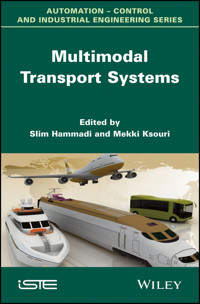
The use and management of multimodal transport systems, includingcar-pooling and goods transportation, have become extremelycomplex, due to their large size (sometimes several thousandvariables), the nature of their dynamic relationships as well asthe many constraints to which they are subjected. The managers ofthese systems must ensure that the system works as efficiently aspossible by managing the various causes of malfunction of thetransport system (vehicle breakdowns, road obstructions, accidents,etc.). The detection and resolution of conflicts, which areparticularly complex and must be dealt with in real time, arecurrently processed manually by operators. However, the experienceand abilities of these operators are no longer sufficient whenfaced with the complexity of the problems to be solved. It is thusnecessary to provide them with an interactive tool to help with themanagement of disturbances, enabling them to identify the differentdisturbances, to characterize and prioritize these disturbances, toprocess them by taking into account their specifics and to evaluatethe impact of the decisions in real time. Each chapter of this book can be broken down into an approach forsolving a transport problem in 3 stages, i.e. modeling the problem,creating optimization algorithms and validating the solutions. Themanagement of a transport system calls for knowledge of a varietyof theories (problem modeling tools, multi-objective problemclassification, optimization algorithms, etc.). The differentconstraints increase its complexity drastically and thus require amodel that represents as far as possible all the components of aproblem in order to better identify it and propose correspondingsolutions. These solutions are then evaluated according to thecriteria of the transport providers as well as those of the citytransport authorities. This book consists of a state of the art on innovative transportsystems as well as the possibility of coordinating with the currentpublic transport system and the authors clearly illustrate thiscoordination within the framework of an intelligent transportsystem. Contents 1. Dynamic Car-pooling, Slim Hammadi and Nawel Zangar. 2. Simulation of Urban Transport Systems, Christian Tahon,Thérèse Bonte and Alain Gibaud. 3. Real-time Fleet Management: Typology and Methods,Frédéric Semet and Gilles Goncalves. 4. Solving the Problem of Dynamic Routes by Particle Swarm, MostefaRedouane Khouahjia, Laetitia Jourdan and El Ghazali Talbi. 5. Optimization of Traffic at a Railway Junction: SchedulingApproaches Based on Timed Petri Nets, Thomas Bourdeaud'huyand Benoît Trouillet. About the Authors Slim Hammadi is Full Professor at the Ecole Centrale de Lille inFrance, and Director of the LAGIS Team on Optimization of Logisticsystems. He is an IEEE Senior Member and specializes in distributedoptimization, multi-agent systems, supply chain management andmetaheuristics. Mekki Ksouri is Professor and Head of the Systems Analysis,Conception and Control Laboratory at Tunis El Manar University,National Engineering School of Tunis (ENIT) in Tunisia. He is anIEEE Senior Member and specializes in control systems, nonlinearsystems, adaptive control and optimization.The multimodal transport network customers need to be orientedduring their travels. A multimodal information system (MIS) canprovide customers with a travel support tool, allowing them toexpress their demands and providing them with the appropriateresponses in order to improve their travel conditions. This bookdevelops methodologies in order to realize a MIS tool capable ofensuring the availability of permanent multimodal information forcustomers before and while traveling, considering passengersmobility.
Sie lesen das E-Book in den Legimi-Apps auf:
Seitenzahl: 295
Veröffentlichungsjahr: 2013
Ähnliche



















Table of Contents
Preface
Chapter 1: Dynamic Car-pooling
1.1. Introduction
1.2. State of the art
1.3. Complexity of the optimized dynamic car-pooling problem: comparison and similarities with other existing systems
1.4. ODCCA: an optimized dynamic car-pooling platform based on communicating agents
1.5. Formal modeling: for an optimized and efficient allocation method
1.6. Implementation and deployment of a dynamic car-pooling service
1.7. Conclusion
1.8. Bibliography
Chapter 2: Simulation of Urban Transport Systems
2.1. Introduction
2.2. Context
2.3. Simulation of urban transport systems
2.4. The types of modeling
2.5. Modeling approaches
2.6. Fields of application
2.7. Software tools
2.8. Simulation of the Valenciennes transport network with QUEST software
2.9. The QUEST software
2.10. Network modeling in normal mode
2.11. Network modeling in degraded mode
2.12. Simulation results
2.13. Conclusion/perspectives
2.14. Self-organization of traffic – the FORESEE simulator
2.15. Conclusion – perspectives
2.16. Bibliography
Chapter 3: Real-time Fleet Management: Typology and Methods
3.1. Introduction
3.2. General context of RTFMP
3.3. Simulation platform for real-time fleet management
3.4. Real-time fleet management: a case study
3.5. Conclusion
3.6. Bibliography
Chapter 4: Solving the Problem of Dynamic Routes by Particle Swarm
4.1. Introduction
4.2. Vehicle routing problems
4.3. Resolution scheme of the dynamic vehicle routing problem
4.4. Adaptation of the PSO metaheuristic for the dynamic vehicle routing problem
4.5. Experimental results
4.6. Conclusion
4.7. Bibliography
Chapter 5: Optimization of Traffic at a Railway Junction: Scheduling Approaches Based on Timed Petri Nets
5.1. Introduction
5.2. Scheduling in a railway junction
5.3. Petri nets for scheduling
5.4. Incremental model for TPNs
5.5. A (max,+) approach to scheduling
5.6. Conclusion
5.7. Bibliography
List of Authors
Index
First published 2014 in Great Britain and the United States by ISTE Ltd and John Wiley & Sons, Inc.
Apart from any fair dealing for the purposes of research or private study, or criticism or review, as permitted under the Copyright, Designs and Patents Act 1988, this publication may only be reproduced, stored or transmitted, in any form or by any means, with the prior permission in writing of the publishers, or in the case of reprographic reproduction in accordance with the terms and licenses issued by the CLA. Enquiries concerning reproduction outside these terms should be sent to the publishers at the undermentioned address:
ISTE Ltd 27-37 St George’s Road London SW19 4EU UK
John Wiley & Sons, Inc. 111 River Street Hoboken, NJ 07030 USA
www.iste.co.uk
www.wiley.com
© ISTE Ltd 2014
The rights of Slim Hammadi and Mekki Ksouri to be identified as the authors of this work have been asserted by them in accordance with the Copyright, Designs and Patents Act 1988.
Library of Congress Control Number: 2013947315
British Library Cataloguing-in-Publication Data A CIP record for this book is available from the British Library ISBN: 978-1-84821-411-8
Preface
Transport engineering is the set of functions characterizing the specifications of user needs, the study and design of technical and industrial solutions, as well as the implementation and monitoring of these solutions within the field of transport.
A user of a transport system could be a network controller or a traveller who requires information for his journey. In all cases, the idea is to provide a “client” with advanced mobility services.
Transport engineering is a field of interest for researchers all over the world. Their work aims to improve existing solutions or bring new and effective solutions to functional problems.
New methods for solutions have been developed relative to the emerging needs of users as well as to recent communication technologies and travel within an ergonomic, socio-economic and ecological context.
It is due to the grouping of the best research teams within CISIT, the International Campus for Security and Intermodality of Transport1, and the innovation of the northern French region of Nord Pas de Calais that numerous long-term partnerships have been developed between the industry and transport operators, as well as international researchers who have been invited to join. From these partnerships, rich in research and innovation, the idea of writing a reference book was born in order to give value to the results obtained.
These works refer to the CISIT project “Urban and interurbanmultimodal networks”, which was set up in order to respond to the strategic objective “Optimal management of multimodal chains”. This objective, which is associated with CISIT’s three big strategic objectives: “New challenges for clean, light and safe vehicles”, “Intelligent, safe and secure mobility” and “Morpho-adaptive security and human factors”, contributes to the challenge of sustainable mobility of people and goods.
The authors of this reference book contribute to this challenge directly: they offer the reader an update of the state of the art of all the techniques, approaches and methods for the specification, design, optimization and implementation of advanced mobility services.
We would hereby like to gratefully acknowledge all contributors to this book, for the most part members of CISIT and researchers in the various fields related to Transport Engineering and Advanced Mobility Services.
Slim Hammadi
Mekki Ksouri
October 2013
__________
1http://www.cisit.org.
Chapter 1
Dynamic Car-pooling
1.1. Introduction
In order to mitigate the negative impact of private cars and thus heal the environmental image of a personal vehicle, car-sharing systems were born. Within this context, car-pooling in particular has been a notable success thanks to the contributions it brings mainly by reducing the number of cars on the road. Indeed, making the personal car a common mode of transport, car-pooling plays a role in the reduction of harmful gas emission rates. The contributions are quantifiable in terms of “non-emitted” CO2, in addition to the many advantages it offers on both an individual and a collective level (e.g. reduction of budgets allocated for transport, time-space flexibility, comfort, social balance, etc.). Thus it has made its entrance into the field of research, and numerous systems have since emerged. Several studies have been conducted in a manner that draws on the fields of computer science, artificial intelligence, GIS (Geographical Information Systems), the Internet and telecommunications, etc. Making use of new technologies and the establishment of a more or less evolved system has precedence over any other goal in existing approaches. Web-based media are today operational and allow the general public to register and benefit from fairly limited services such as publications and consultation of offers and demand, as well as acquisition of contact details for potential car-poolers. Unfortunately, this type of system is the only one that deserves recognition because the rest, despite their openness to advanced features such as the integration of real time and the automation of allocation tasks based on multi-agent systems, have remained at the “idea” or “draft” stage, and are not liable to improvement. Irrevocably launched onto the road towards improvement, in this chapter we propose the implementation of an optimized dynamic car-pooling system. Two main concepts will be discussed in particular, namely the modeling of the problem as a distributed dynamic graph, on the basis of which distributed software architecture is established, and the deployment of a multitude of autonomous entities under this architecture. The combination of multi-agent systems with the foundations for optimization has thus been put in the service of effectiveness of processing for the establishment of an approach in the context of distributed artificial intelligence.
Lesen Sie weiter in der vollständigen Ausgabe!
Lesen Sie weiter in der vollständigen Ausgabe!
Lesen Sie weiter in der vollständigen Ausgabe!
Lesen Sie weiter in der vollständigen Ausgabe!
Lesen Sie weiter in der vollständigen Ausgabe!
Lesen Sie weiter in der vollständigen Ausgabe!




