


31,99 €
Mehr erfahren.
- Herausgeber: John Wiley & Sons
- Kategorie: Geisteswissenschaft
- Sprache: Englisch
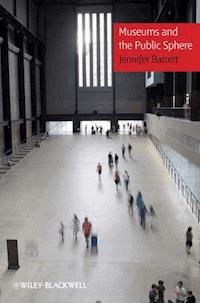
Museums and the Public Sphere investigates the role of museums around the world as sites of democratic public space.
- Explores the role of museums around the world as sites of public discourse and democracy
- Examines the changing idea of the museum in relation to other public sites and spaces, including community cultural centers, public halls and the internet
- Offers a sophisticated portrait of the public, and how it is realized, invoked, and understood in the museum context
- Offers relevant case studies and discussions of how museums can engage with their publics' in more complex, productive ways
Sie lesen das E-Book in den Legimi-Apps auf:
Seitenzahl: 375
Veröffentlichungsjahr: 2011
Ähnliche




















Contents
List of Images
Introduction
Being Public
Public Space
Methodology and Structure
1 The Public Sphere
Habermas and the Public Sphere
Public Sphere/Private Sphere
Habermas on Art and the Public Sphere
Contested Boundaries and Cultural Spheres
The Role of Space and Vision in the Public Sphere
Conclusion
2 Historical Discourses of the Museum
The Development of Museums
Museums and the Public Sphere
Aesthetics, Vision, and the Public Sphere
Art History and the Public Sphere
Conclusion
3 The Museum as Public Space
Public Space
Locating Public Space in Modernity
Space for the Public – The Public Museum
Space and Institutions of the Public Sphere: Habermas and Foucault
New Spatial Practices in Museums
Conclusion
4 Audience, Community, and Public
Introduction
The Influence of Pierre Bourdieu
Ways of Knowing the Visitor
Critiquing Visitor Studies
The Concept of Community and its Application to Museums
Conclusion
5 The Museum as Public Intellectual
The Curator
The Curator and the Public Revisited
A Selection of Disciplinary Approaches
Conclusion
Conclusion
Museums and the Public Sphere
Museum Futures
References
Acknowledgments
Index
To Caitlin Miranda
This edition first published 2011
© 2011 Jennifer Barrett
Blackwell Publishing was acquired by John Wiley & Sons in February 2007. Blackwell’s publishing program has been merged with Wiley’s global Scientific, Technical, and Medical business to form Wiley-Blackwell.
Registered Office
John Wiley & Sons Ltd, The Atrium, Southern Gate, Chichester, West Sussex, PO19 8SQ, United Kingdom
Editorial Offices
350 Main Street, Malden, MA 02148–5020, USA
9600 Garsington Road, Oxford, OX4 2DQ, UK
The Atrium, Southern Gate, Chichester, West Sussex, PO19 8SQ, UK
For details of our global editorial offices, for customer services, and for information about how to apply for permission to reuse the copyright material in this book please see our website at www.wiley.com/wiley-blackwell.
The right of Jennifer Barrett to be identified as the author of this work has been asserted in accordance with the UK Copyright, Designs and Patents Act 1988.
All rights reserved. No part of this publication may be reproduced, stored in a retrieval system, or transmitted, in any form or by any means, electronic, mechanical, photocopying, recording or otherwise, except as permitted by the UK Copyright, Designs and Patents Act 1988, without the prior permission of the publisher.
Wiley also publishes its books in a variety of electronic formats. Some content that appears in print may not be available in electronic books.
Designations used by companies to distinguish their products are often claimed as trademarks. All brand names and product names used in this book are trade names, service marks, trademarks or registered trademarks of their respective owners. The publisher is not associated with any product or vendor mentioned in this book. This publication is designed to provide accurate and authoritative information in regard to the subject matter covered. It is sold on the understanding that the publisher is not engaged in rendering professional services. If professional advice or other expert assistance is required, the services of a competent professional should be sought.
Library of Congress Cataloging-in-Publication Data
Barrett, Jennifer.
Museums and the public sphere/Jennifer Barrett.
p. cm.
Includes bibliographical references and index.
ISBN 978-1-4051-7383-4 (hardcover: alk. paper)
1. Museums–Social aspects. 2. Museums–Philosophy. 3. Public spaces–Social aspects. 4. Public spaces–Philosophy. 5. Community life.
I. Title.
AM7.B35 2011
069’.68–dc22
2010011916
List of Images
1Thomas Struth, Hermitage 1, St Petersburg, 20051.1Louis-Léopold Boilly, The Public in the Salon of the Louvre, Viewing the Painting of the “Sacre” begun 1808, Woodner Collection1.2Étienne-Louis Boullée, Cénotaphe de Newton, 17841.3Hubert Robert, Projet d’aménagement de la Grande Galerie du Louvre en 1796, 17961.4Honore Daumier, Free Admission Day – Twenty-Five Degrees of Heat, 18522.1John Tenniel, The Sunday Question. The Public-House; or, The House For The Public?, 18692.2Louis-Léopold Boilly, Interior of a Parisian Café, c.18152.3Edgar Degas, Mary Cassatt at the Louvre: The Etruscan Gallery, 1879–802.4Jacques-Louis David, Le Serment des Horaces, 17842.5Jacques-Louis David, The Tennis Court Oath, 20th June 1789, 17913.1Forecourt, British Museum, 20053.2Turbine Hall, Tate Modern, 20044.1Installation view, The Arts of Islam: Treasures from the Nasser D Khalili Collection5.1Belongings homepage 2009. Migration Heritage Centre New South Wales5.2Talkback Classroom ‘Political Satire’ forum with John Safran and cartoonist David Pope5.3Garden of Australian Dreams, opening day at the National Museum of Australia5.4Jean-Marie Tjibaou Cultural Centre, New Caledonia5.5Exhibition People, Power, Politics: The first generation of anthropologists at the University of Sydney, 20085.6Makarr-garma: Aboriginal collections from a Yolngu Perspective, Macleay Museum 20095.7Book cover The Changing Presentation of the American Indian: Museums and Native Cultures by the National Museum of the American Indian 162 6.1 Thomas Struth, Tokyo National Museum, 1999, TokyoIntroduction
Museums are highly visible institutions in contemporary societies and their ongoing existence and claims for resources are often justified on the grounds of “relevance.” To what, and to whom, are they relevant? The common answer is “the public.” Within the museum context the term public is often used to invoke a generalized body of people: an audience, a represented community or certain non-visitor interest groups. It is employed to lay claim to and convey the museum’s status as an open, democratic institution for and of “the people.” However, for all its centrality to the museum sector’s talk about itself, the term “public” is often used loosely. At other times it is used strategically, with a particular political purpose that may suggest clarity, even precision, but is actually tendentious, even opportunistic. In the literature, one finds a surprising lack of sustained critical reflection upon the term: little awareness of its etymology, its political meaning, or the reasons why it has had such an expansive influence upon the museum world.
This book seeks to offer such a reflection. What are the many ways in which the museum is, or is not, public? How can the museum be understood as a critical sphere of public debate? How do museums facilitate, respond to, support, and intersect with wider public discourse? These questions are the key to understanding and redefining the very parameters of the museum.
Reworking the idea of the museum is critical in a world in which museums compete for the representation and interpretation of cultural heritage with other related “public” forums and sites, including community cultural centers, public halls and the Internet. In this world of increasingly diversified media, what can museums offer to our experience of being in public? This book examines the implications of a more complex understanding of how the public is realized, invoked, and understood in the museum context. An examination of the way museums themselves use the term “public,” as well as other critiques of the public, will enhance the capacity for museums to engage with “publics” in more complex, productive ways.
Image 1 Thomas Struth, Hermitage 1, St Petersburg, 2005. C-print, 114.0 × 144.5 cm. © 2010 Thomas Struth. (Image from Struth’s project, Museum Photographs, where he foregrounds the public in iconic museums.)
This book emerges from my long-term engagement with what constitutes public culture, who produces it, where is it represented and by whom. My interest in this area has included community cultural practices, where communities of interest engage, practice, and produce culture, both for themselves and sometimes others. The museum was not always present in these practices, or surrounding discourses. In recent years, however, sites of community culture have also attracted museum professionals. Communities are identified as a new audience, or alternatively as producers of culture with the potential to renew the role of the museum. What this shift implies about the pre-existing location and nature of community cultural practices is often left unspoken in museum studies.
Lesen Sie weiter in der vollständigen Ausgabe!
Lesen Sie weiter in der vollständigen Ausgabe!
Lesen Sie weiter in der vollständigen Ausgabe!
Lesen Sie weiter in der vollständigen Ausgabe!
Lesen Sie weiter in der vollständigen Ausgabe!
Lesen Sie weiter in der vollständigen Ausgabe!
Lesen Sie weiter in der vollständigen Ausgabe!
Lesen Sie weiter in der vollständigen Ausgabe!
Lesen Sie weiter in der vollständigen Ausgabe!




