


7,49 €
Mehr erfahren.
- Herausgeber: Open Book Publishers
- Kategorie: Geisteswissenschaft
- Sprache: Englisch
The composer Sir James MacMillan has often referred to music as ‘the most spiritual of the arts’, and for many people, regardless of religious affiliation, this rings true. In listening to music, we are drawn to dimensions of human experience beyond the material. This collection brings together leading scholars from various disciplines – including Christian theology, musicology, and psychology and neuroscience – to interrogate the intimate relationship between music and spirituality.
Organised in three parts – theological approaches, empirical methods, and Christian worship – the volume covers a vibrant array of topics. From examining how the Covid-19 pandemic has reshaped the profile of contemporary worship to investigating the spiritual effects of bodily positioning in liturgical spaces, from exploring spiritual experience through heart and breathing activity, electrodermal activity, and saliva samples to comparing the spiritual experiences of British Methodists with Welsh sporting fans, these essays attend to the lived reality of people’s perceived spiritual experiences through music.
This collection will be an invaluable resource for scholars in the growing field of Christian theology and music, and will serve as a cornerstone for future research at the intersection of theology, music, and psychology and neuroscience. It will also appeal to anyone curious about why music consistently, across cultures, occupies a unique space bridging the material and spiritual dimensions of human life.
Das E-Book können Sie in Legimi-Apps oder einer beliebigen App lesen, die das folgende Format unterstützen:
Veröffentlichungsjahr: 2024
Ähnliche


















MUSIC AND SPIRITUALITY
Music and Spirituality
Theological Approaches, Empirical Methods, and Christian Worship
Edited byGeorge Corbett and Sarah Moerman
https://www.openbookpublishers.com
©2024 George Corbett and Sarah Moerman (eds). Copyright of individual chapters is maintained by the chapter’s authors.
This work is licensed under an Attribution-NonCommercial 4.0 International (CC BY-NC 4.0). This license allows you to share, copy, distribute and transmit the text; to adapt the text for non-commercial purposes of the text providing attribution is made to the author (but not in any way that suggests that they endorse you or your use of the work). Attribution should include the following information:
George Corbett and Sarah Moerman (eds), Music and Spirituality: Theological Approaches, Empirical Methods, and Christian Worship. Cambridge, UK: Open Book Publishers, 2024, https://doi.org/10.11647/OBP.0403
Copyright and permissions for the reuse of many of the images included in this publication may differ from the above. This information is provided in the captions and in the list of illustrations. Every effort has been made to identify and contact copyright holders and any omission or error will be corrected if notification is made to the publisher.
Further details about CC BY-NC licenses are available at https://creativecommons.org/licenses/by-nc/4.0/
All external links were active at the time of publication unless otherwise stated and have been archived via the Internet Archive Wayback Machine at https://archive.org/web
Updated digital material and resources associated with this volume are available at https://www.openbookpublishers.com/product/0403#resources
ISBN Paperback: 978-1-80511-302-7
ISBN Hardback: 978-1-80511-303-4
ISBN Digital (PDF): 978-1-80511-304-1
ISBN Digital eBook (EPUB): 978-1-80511-305-8
ISBN HTML: 978-1-80511-307-2
DOI: 10.11647/OBP.0403
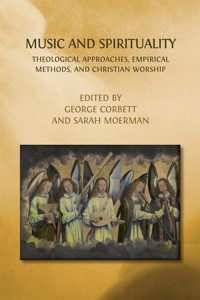
Cover image: Hans Memling, Christ with Singing and Music-Making Angels (1483–1494), Royal Museum of Fine Arts Antwerp, Wikimedia, https://commons.wikimedia.org/wiki/File:Musicerende_engelen,_Hans_Memling,_(1483-1494),_Koninklijk_Museum_voor_Schone_Kunsten_Antwerpen,_779.jpg
Cover design: Jeevanjot Kaur Nagpa
Acknowledgments
Sarah and I would like to thank the Templeton Religion Trust for a project grant contributing to its research cluster Art Seeking Understanding. As part of our project, we sought to develop a three-way interdisciplinary conversation between theology, musicology, and psychology and neuroscience, which led to an international workshop on Music and Spiritual Realities, as well as, in due course, to this volume. We would like to thank Christopher Brewer and all the staff of TRT and the wider ASU ‘community of practice’ for their help and advice on our project.
Our project team in the University of St Andrews brought together colleagues from the Institute for Theology, Imagination and the Arts (ITIA) in the School of Divinity; the Music Centre; and the School of Psychology and Neuroscience. We would like to thank especially our two senior research collaborators—Michael Ferguson (musicology) and Ines Jentzsch (cognitive neuroscience)—as well as our advisors—David Brown, James MacMillan, Andrew Torrance, and Brendan Wolfe—who contributed invaluably at different stages of the project. We are also particularly grateful for their assistance, in different ways, to Christopher Bragg, Oliver Crisp, Kate Dove, Michael Downes, Tania Holland Williams, Claire Innes-Hopkins, Susan Millar, Lyndsay Mitchell, Elizabeth O’Keeffe, and Deborah Smith.
Our workshop formed part of the annual meeting of the European Academy of Religion at the University of St Andrews in June 2023, and we are grateful to the organisers, and especially Brendan Wolfe and Sterling Yates, for their collaboration. We would like to thank all the speakers at our workshop (and contributors to this volume), as well as the many workshop attendees who contributed to the rich intellectual conversations both inside and outside the scheduled sessions. We hope you will continue to be part of the ongoing scholarly conversation which this volume seeks to foster.
We were delighted to collaborate with Open Book Publishers on this project, and we are grateful to the OBP team for their support in developing this edited volume. Thank you, in particular, to Alessandra Tosi, Adèle Kreager, Jeevanjot Nagpal, and to the two anonymous peer reviewers. Finally, I would like to thank the School of Divinity’s Deas Fund for funding a research assistant, and Rosemary Williams for her meticulous work in preparing the bibliography, as well as the University of St Andrews’ Institutional Open Access Fund which co-funded, with TRT, the subvention grant.
Contents
Acknowledgments
Notes on Contributors
Introduction
George Corbett and Sarah Moerman
Foreword: A Composer’s Perspective
James MacMillan
I. THEOLOGICAL APPROACHES
1. Encountering the Uncontrollable: Music’s Resistance to Reductionism and Its Theological Ramifications
Jeremy Begbie
2. Cross and Consolation: Music’s Empathic Spirituality
Peter C. Bouteneff
3. Music, Breath, and Spirit
Michael O’Connor
4. An Adorative Posture towards Music and Spiritual Realities
Férdia J. Stone-Davis
5. Religion, Science, and Music: An Augustinian Trinity
Bennett Zon
6. Dissonant Spirituality: A Hermeneutical Aesthetics of Outlaw Country
C.M. Howell
II. EMPIRICAL METHODS
7. From the Sacred to the Ordinary through the Lens of Psychological Science
Yeshaya David M. Greenberg
8. An Inquiry into Musical Trance
Dilara Turan
9. An Ethnomusicology of Spiritual Realities
Jeffers Engelhardt
10. The Concept of‘Atmosphere’ as a Bridge between Music and Spirituality
Bernard Łukasz Sawicki OSB
11. Spiritual Subjects: Musicking, Biography, and the Connections We Make
Maeve Louise Heaney VDMF
12. The Impetus to Compose: Where is Fantasy Bred?
Richard E. McGregor
III. CHRISTIAN WORSHIP
13. Music in Christian Services as a Means to Induce Religious Feelings
Melanie Wald-Fuhrmann
14.Spiritual Cultures: Innovations in Choral and Classical Music
Jonathan Arnold
15. Listening to the Lived Experiences of Worshippers: A Study of Post-Pandemic Mixed Ecology Worship
Elspeth Manders
16. An Abductive Study of Digital Worship through the Lenses of Netnography and Digital Ecclesiology
Tihomir Lazic´
17. Choral Singers and Spiritual Realities:A Perspective from St Mary’s Catholic Cathedral
Michael Ferguson
18. Music and Spirituality in Communal Song: Methodists and Welsh Sporting Crowds
Martin V. Clarke
Afterword: A Psychologist’s Perspective
John Sloboda
List of Figures and Tables
Bibliography
Index
Notes on Contributors
Jonathan Arnold is Executive Director of the Social Justice Network in the Diocese of Canterbury. Prior to this, he was Dean of Divinity and Fellow of Magdalen College at the University of Oxford, and, for many years, a member of the professional choir The Sixteen. His publications include The Great Humanists (2011), Sacred Music in Secular Society (2014), and Music and Faith: Conversations in a Post-Secular Age (2019).
Jeremy Begbie is Thomas A. Langford Distinguished Research Professor of Theology at Duke Divinity School, and the McDonald Agape Director of Duke Initiatives in Theology and the Arts (DITA). His publications include Theology, Music and Time (2000), Resounding Truth: Christian Wisdom in the World of Music (2007), and Abundantly More: The Theological Promise of the Arts in a Reductionist World (2023).
Peter C. Bouteneff is Professor of Systematic Theology and Kulik Professor of Sacred Arts at St Vladimir’s Orthodox Theological Seminary, where he is also founding director of the Institute of Sacred Arts. His publications include Sweeter than Honey: Orthodox Thinking on Dogma and Truth (2006), Arvo Pärt: Out of Silence (2015), and How to Be a Sinner: Finding Yourself in the Language of Repentance (2018).
Martin V. Clarke is Senior Lecturer in Music at the Open University. He is the author of British Methodist Hymnody: Theology, Heritage and Experience (2018), editor of Music and Theology in Nineteenth-Century Britain (2012), and he co-edited, with Trevor Herbert and Helen Barlow, A History of Welsh Music (2022).
George Corbett is Professor of Theology at the University of St Andrews. His publications include Dante and Epicurus (2013), Dante’s Christian Ethics (2020), and, as editor, Annunciations: Sacred Music for the Twenty-First Century (2019).
Michael O’Connor is Associate Professor at St Michael’s College in the University of Toronto, and former Director of St Michael’s Schola Cantorum. He is the author of Cajetan’s Biblical Commentaries: Motive and Method (2017) and co-edited, with Hyun-Ah Kim and Christina Labriola, Music, Theology, and Justice (2017).
Jeffers Engelhardtis Professor of Music at Amherst College. He is the author of Singing the Right Way: Orthodox Christians and Secular Enchantment in Estonia (2015), and he co-edited, with Philip V. Bohlman, Resounding Transcendence: Transitions in Music, Religion, and Ritual (2016) and, with Andrew Mall and Monique Ingalls, Studying Congregational Music: Key Issues, Methods, and Theoretical Perspectives (2021).
Michael Ferguson is Lecturer and Coordinator of Academic Music at the University of St Andrews, and Director of Music at St Mary’s Catholic Cathedral in Edinburgh.
Yeshaya David M. Greenberg is a psychologist and social neuroscientist. He is the founding director of CHIME (Center for Health Innovation, Music, and Education), and an honorary research associate at the Autism Research Centre at Cambridge University. He has published the largest studies to date on autism (Proceedings of National Academy of Sciences, 2018), on music and culture (Journal of Personality & Social Psychology, 2022), and on theory of mind (Proceedings of the National Academy of Sciences, 2022).
Maeve Louise HeaneyVDMF is Associate Professor in the Faculty of Theology and Philosophy, and the Xavier Chair for Theological Formation, at Australian Catholic University. She is the author of Music and Theology: What Music Says about the Word (2012) and Suspended God: Music and a Theology of Doubt (2022).
C.M. Howell is a doctoral researcher at the University of St Andrews, where he is working on the theological aesthetics of Eberhard Jüngel.
Tihomir Lazić is Senior Lecturer in Systematic Theology at Newbold College of Higher Education, a musician and worship leader, and the author of Towards an Adventist Version of Communio Ecclesiology: Remnant in Koinonia (2019).
James MacMillan is one of today’s most successful composers, whose works are performed and broadcast around the world, and he is also internationally active as a conductor. He is Professor of Theology and Music at the University of St Andrews, founder of The Cumnock Tryst, and was awarded a knighthood for his services to music in 2015.
Elspeth Manders is a doctoral student at the University of St Andrews. Prior to this she obtained an MLitt in Sacred Music from the University of St Andrews, and a BA (Honours) in Music from the University of Oxford.
Richard E. McGregor is Professor Emeritus of Music at the University of Cumbria, and he currently lectures at the Royal Conservatoire of Scotland. He edited Perspectives on Peter Maxwell Davies (2000), and he is the author, with Nicholas Jones, of The Music of Peter Maxwell Davies (2020).
Sarah Moerman is a Research Fellow in Theology and Music at the University of St Andrews. She also holds a research fellowship in social cognition from the University of Birmingham which provides psychology cross-training for theologians. Her research focuses on the various intersections between music, theology, and psychology.
Bernard Łukasz Sawicki OSB is Associate Professor in Theology at the Pontifical University of Saint Anselm in Rome. His publications include The Concept of the Absurd and its Theological Reception in Christian Monasticism (2005), W chorale jest wszystko [In Gregorian Chant Is All] (2014), and The Music of Chopin and the Rule of Saint Benedict (2014).
John Sloboda is Emeritus Professor at the University of Keele, where he founded and directed the Study of Musical Skill and Development, and at the Guildhall School of Music and Drama. His publications include The Musical Mind: The Cognitive Psychology of Music (1985), Exploring the Musical Mind: Cognition, Emotion, Ability, Function (2005) and, as co-editor with Patrik N. Juslin, Handbook of Music and Emotion: Theory, Research, Applications (2009).
Férdia J. Stone-Davis is Senior Scientist for the Austrian Science Fund (FWF) Research Project ‘The Epistemic Power of Music’, and Director of Research at the Margaret Beaufort Institute, Cambridge. She is the author of Musical Beauty: Negotiating the Boundary between Subject and Object (2011), editor of Music and Transcendence (2015), and co-editor, with M. J. Grant, of The Soundtrack of Conflict: The Role of Music in Radio Broadcasting in Wartime and in Conflict Situations (2013).
Dilara Turan is a Research Assistant in the Department of Music, Istanbul Bilgi University, Turkey, where she also received her doctorate. Her current research focuses on the spirituality of music and the cultural study of avant-garde music practices.
Melanie Wald-Fuhrmann is Director of the Department of Music at the Max Planck Institute for Empirical Aesthetics (MPIEA) and Professor of Systematic Musicology at the Goethe University, Frankfurt/Main. Her publications include Welterkenntnis aus Musik: Athanasius Kirchers ‘Musurgia universalis’ und die Universalwissenschaft im 17. Jahrhundert [Knowledge of the World from Music. Athanasius Kircher’s ‘Musurgia universalis’ and Universal Science in the Seventeenth Century] (2006), ‘Ein Mittel wider sich selbst’: Melancholie in der Instrumentalmusik um 1800 [‘A Means Against Itself’: Melancholy in Instrumental Music around 1800] (2010), and as co-editor, with Klaus-Peter Dannecker and Sven Boenneke, Wirkungsästhetik der Liturgie: Transdisziplinäre Perspektiven [Aesthetics of Liturgy: Transdisciplinary Perspectives] (2020).
Bennett Zon is Professor of Music at Durham University. He is Founding Director of the International Network for Music Theology and Inaugural President of the International Nineteenth-Century Studies Association. His publications include Music and Metaphor in Nineteenth-Century Britain (2000), Representing Non-Western Music in Nineteenth-Century Britain (2007), and Evolution and Victorian Musical Culture (2017).
Introduction
George Corbett and Sarah Moerman
©2024 George Corbett & Sarah Moerman, CC BY-NC 4.0 https://doi.org/10.11647/OBP.0403.20
The composer Sir James MacMillan has called music ‘the most spiritual of the arts’, and for many people, both religious and non-religious alike, this rings true.1 But what do people mean by ‘music’ and ‘spiritual’ in this context, and what is the nature of their perceived relationship? Do certain kinds of music more readily afford spiritual experiences than others? What do psycho-physiological measures—such as heart and breathing activity, electrodermal activity, and saliva samples—reveal about perceived spiritual experiences? What are the practical implications of all this in the musical programming of Christian worship services? How has online Christian worship changed the dynamic between music and spiritual experience? These are just some of the questions that scholars explored at an interdisciplinary workshop on Music and Spiritual Realities co-hosted by the University of St Andrews’ School of Divinity, Music Centre, and School of Psychology and Neuroscience in June 2023.2 As co-organisers and editors, we issued all contributors with a core challenge, from which these further questions emerged: how would you, with your own area of expertise, your own research experience, and your own research methodologies, address or seek to demonstrate the commonly-perceived connection between music and spiritual realities?This volume, the fruit of that workshop, brings the interdisciplinary field of Christian theology and music into conversation with new musicology, ethnomusicology, and congregational music studies, as well as with psychology and neuroscience, in order to respond to this challenge.
Since its foundation in 2000, the Institute for Theology, Imagination, and the Arts (ITIA), in the University of St Andrews’ School of Divinity, has pioneered research exploring the relationship between Christian theology and music.3 The interdisciplinary field of Christian theology and music is now well-established with centres, graduate programmes, research networks, and publications, including a forthcoming Oxford Handbook of Music and Christian Theology in five volumes.4 As this field first developed in Schools of Divinity and Faculties of Theology, rather than in Religious Studies programmes, this has affected its methodological approaches and areas of focus; thus, for example, Christian theologians have tended to have a pastoral concern for the music of their own immediate denomination and culture, whereas, in the field of religious studies, there has been more scholarly attention to world Christianities and to world religions.5 While there have been invaluable contributions to the study of the relationship between Christian theology and music historically and in practice, as well as in relation to individual composers, there has heretofore been little engagement with empirical and scientific perspectives.6
Just as there has been a growing attention in Christian theology to the arts in general, and to music specifically, as a source of spiritual understanding, insight, and growth, so developments in musicology have made the field more open to an engagement with Christianity and with theological concerns. ‘New’ or ‘critical’ musicology shifts scholarly attention from a traditional focus on representing and reproducing a particular composer’s intention embodied in the score, to a focus on how music is perceived or experienced. While leading proponents have typically excluded any possibility of transcendence or religious meaning in music,7 more recent scholarship has challenged this ‘illiberal exclusion’, and shown how ‘new musicology’ does indeed open a productive space to explore the spiritual dimension of music.8 In ethnomusicology, scholars have highlighted that music is ultimately something that is done—enacted and embodied—and that any search for meaning in music must necessarily take this into account. Christopher Small’s widely-adopted neologism ‘musicking’ helpfully points to music as an activity (a verb) rather than a static thing (a noun), whether practising, rehearsing, performing, listening, or otherwise participating in the social, cultural, and communal dimensions of music.9 These ideas have been at the core of the emerging interdisciplinary field of Christian congregational music studies, which has sought to understand music as lived action in the specific realm of Christian religious practice.10
While psychologists and neuroscientists have conducted extensive research on music or musicking, they have tended not to explore music’s relationship to spirituality, whether in explicitly Christian contexts or not.11 The interdiscipline of cognitive musicology, for example, has begun to integrate psychological approaches to both musical production and consumption, exploring the neurological processes impacted by both music-making and music-listening. However, computational cognitive modelling of emotional and mental processes is limited to directly observable and quantifiable effects, and ‘in-the-moment’ experience, missing the depth of experience that may come in time; it has also not explored music’s affordance for deeper understanding of spiritual realities. While psychologists have identified the need for an experiential, phenomenological approach to advance understanding that is more gradual, holistic, and embodied in nature—rather than the mere accumulation of factual or propositional knowledge—this, again, has rarely taken into account the relationship between music and spirituality. As Yeshaya David M. Greenberg remarks in this volume, ‘when it comes to the realm of science, the terms “music” and “spirituality” are rarely uttered in the same breath and almost never appear together in any title or abstract in a peer-reviewed empirical study.’ Likewise, John Sloboda commented at our workshop, ‘the number of psychologists who are studying music and religion, you can count them on one hand’, while ‘something is happening here that is pushing forward the field in a way that I don’t think has been pushed forward in any other arena that I know of’.12
Our workshop thus set these three broad fields in dialogue with each other, drawing together and evaluating existing methodologies, as well as suggesting and pioneering new ones. Contributors to Part II and Part III of this volume present new psychological and empirical research on music and spirituality, as well as providing their own constructive reviews of the extant scholarly literature in these areas. In opening up these interdisciplinary conversations, this volume does so predominantly in relation to Christian theological approaches to music (as in Part I), and to worship practices of music in Western Christianity (as in Part III). While there is a considerable diversity of denominational perspectives and contexts presented (including Catholic, Orthodox, Anglican, Methodist, and Pentecostal), the anchoring of the conversation in the Western Christian tradition allowed for some common points of reference and discussion, and provided a necessary focus to the volume. Nonetheless, as indicated by Greenberg’s empirical study of the psychological effects of singing wordless sacred melodies called nigunim on a large group of Jewish participants (just one of his case studies involving participants from multiple religions and faith traditions in Chapter 7) or by Dilara Turan’s empirical research on the musical trance scene of modern-day Turkey (Chapter 8), it would be beneficial, in a future workshop or volume, to anchor the interdisciplinary conversation in another religious tradition, or in relation to musical practices from other parts of the world. Likewise, while most contributors to our volume refer exclusively to a Western classical understanding of music, and are concerned with notated music, many of their conclusions and methodological approaches might be qualified, enriched, and advanced by an engagement with non-Western understandings, as well as with oral singing traditions or improvised traditions.13
While necessarily limited in scope, our volume contributes distinctively, indeed, to a much broader discussion of music and spirituality in contemporary scholarship, one which encompasses different religious and faith traditions, as well as secular forms of spirituality.14 This scholarly and lay discussion has been a pre-eminent concern of June Boyce-Tillman, whose series ‘Music and Spirituality’ (numbering sixteen volumes since 2014) is especially valuable to research in the field, ensuring a range of experiences and voices are heard and represented, and decentring fields which otherwise typically centre particular doctrinal, ethnic, and musicological foci.15 Two volumes in the series are particularly pertinent to our own. Noting that experiencing music is often considered ‘the last remaining ubiquitous spiritual experience in Western culture’, the second volume of her series—Experiencing Music—Restoring the Spiritual—takes a similar starting point.16 In this monograph, Boyce-Tillman decouples ‘religion’ from ‘spirituality’, describing the ‘development of a spirituality based on process rather than the dogmas and creeds of the defined world religions’; and she explores how music can be a ‘trigger’ for the spiritual, including outside the realm of explicitly religious or sacred music.17 The ninth volume, Enlivening Faith, is more narrowly focused on music and spirituality in different Christian contexts, including prayer, liturgy, and education.18 The series as a whole is notable for the breadth and range of religious and non-religious beliefs and practices, and of musical genres and styles, covered. Boyce-Tillman’s series also programmatically critiques imbalances in the scholarly literature—as in relation to gender,19sexuality,20 and race21—as well as effectively addressing the complex capacities of music and spirituality for healing from abuse and trauma.22 Our volume—with its thematic focus on Christian music in Western contexts—has somewhat conformed to type in some of these areas, and Boyce-Tillman’s series is, in this respect, a useful point of contextual correlative and potential critique.23 The question of positionality is, nonetheless, the central concern of Maeve Louise Heaney, in her discussion of our scholarly status as ‘spiritual subjects’ with our own partial lenses (Chapter 11), and this concern recurs in the volume, and is underlined by John Sloboda in his Afterword as well.
As organisers and editors, we provided all contributors with a provisional definition of ‘spiritual’ as ‘a perceived area of human experience beyond the material’. Thus, in the context of Christian theology, one might distinguish between spiritual realities (such as God, angels, the human soul), spirituality (which we might think of as a person’s disposition or openness to the spiritual, as someone may identify as ‘spiritual’, or as having a ‘spirituality’), and spiritual experience (a state of a person, as when someone experiences ‘the presence of God’ or being ‘closer to God’, or an altered state of consciousness). However, we left it to each contributor to interrogate this definition in their own way, or to work with another approach to spirituality, and we were intentionally open to a more ‘thin, vague, and useful understanding of spirituality’, as advocated by John Swinton, for example, in the practical context of medical care.24 The first step, for us, was to name and recognise the lived reality of people’s perceived spiritual experiences through music. Each scholar in this volume addresses this spiritual experience through music in different ways, and with different levels of conceptual precision. The volume’s tripartite division—Theological Approaches, Empirical Methods, and ChristianWorship—is likewise intended to be suggestive and indicative, rather than exclusionary. Thus, in terms of content, the first six chapters are more theological, and yet contain insights about methodology and worship practice, while many chapters in the other two sections have strong theological components. This division may also serve readers coming to the volume for the first time: a linear progression is but one way through: thus, for example, those readers concerned more with questions of method (especially empirical methods) might be advised to start with Part II, those with questions about the practice of music in Christianworship with Part III.
In the volume’s first chapter, Jeremy Begbie underlines music’s resistance to those reductionist habits of thought and language which would pre-emptively exclude discussion of ‘spiritual realities’, before providing a renewed theological account of both music and language as vital means of ‘sense making’ which can direct our access to spiritual concerns. In Chapter 2, Peter C. Bouteneff similarly focuses on sacred music (with its balance of sacred text and music) as a productive site for considering music’s ‘empathetic spirituality’, which he does with specific reference to the music of Arvo Pärt. Liturgical singing is also the focus of Michael O’Connor’s chapter, which explores the spirituality of music—a spirituality which is through, with and in, the material and physical body and not beyond it—in light of the work of the Holy Spirit, and with particular attention to the theological-musical writings of Hildegard of Bingen. In Chapter 4, Férdia Stone-Davis argues that to grasp at religious knowledge or music, or religious knowledge through music, in a purely rational or demonstrative way is, ultimately, to avoid it; instead, she proposes an ‘adorative posture’ to both music and spiritual realities, where the affective and intellective powers are together necessary for our experience and understanding. While the first four chapters take predominantly emic perspectives, Bennett Zon tackles head on atheistic scepticism about God and spiritual realities per se, let alone their purported relationship with music. Zon argues, though, that music—considered as an ‘experimental constant’—might help us to understand better the complex historical relationship between religion and science, with specific reference to Augustine’s theo-psychological understanding of music, which leads us from ordinary music (which we compose and listen to) to extraordinary music (the harmony of the universe). In Chapter 6, C.M. Howell similarly addresses the question of secularity in the contemporary West, in which ‘spirituality’ can be radically reoriented to socio-cultural conditions within a closed ‘immanent frame’, with no reference to the transcendent or supernatural. Methodologically, Howell draws on German aesthetics to propose a holistic approach to the phenomenon of music reception, which allows the immaterial (and unquantifiable) to be appreciated alongside its material (and quantifiable) counterpart, taking as his case study ‘outlaw country’ music, a ‘dissonant’ form of American country music which emerged towards the end of the long 1960s.
A core theme running through this volume is the strange lack of empirical research on spiritual experience through music, despite it being a widespread sociological phenomenon. In Chapter 7, the psychologist and social neuroscientist Yeshaya David M. Greenberg documents this lacuna before giving case studies of his own pioneering empirical research while, in Chapter 8, Dilara Turin analyses the neurological and cognitive processes involved when rhythmic units, pitch, tempo, and communal chanting induce altered states of consciousness in participants of the musical trance scene. In Chapter 9, Jeffers Engelhardt addresses critically the secular and positivist methodological presuppositions of ethnomusicology, and of the social sciences more broadly, according to which ‘other-than-human’ agency, or the position of a religious insider, have traditionally been framed out of the discipline; he also gives examples of new ethnomusicological methods which seek to include, or entangle, the emic perspective. While, in Chapter 10, Bernard Łukasz Sawicki argues for a methodological focus on ‘atmosphere’—the reciprocal relationship with the environment, including its mood, presence, inhabitation, and landscape—as a necessary bridge to understand the relationship between music and spiritual experience, Maeve Louise Heaney, in Chapter 11, privileges attention on the spiritual subjects themselves, cautioning against the scholarly tendency to assume uncritically an ‘objective’ perspective. In Chapter 12, Richard E. McGregor describes his methodological attempts—as musicologist and composer—to understand ‘what “happens” during the composition of a musical work’, a happening commonly referred to in spiritual terms, as an ‘inspiration’.
The third part of the volume turns specifically to the context of Christian practice and worship. While a core purpose of music in Christian services is to facilitate access to spiritual realities and to induce religious feelings—such as love of God, devotion, gratefulness, and contrition—there have been strikingly few empirical studies to investigate whether, in practice, worshippers experience such feelings through music and, if so, to what degree. In Chapter 13, Melanie Wald-Fuhrmann analyses the results of two empirical studies involving Catholic congregations in Germany as well as proposing new lines of inquiry, while, in Chapter 14, Jonathan Arnold, surveys the results of three empirical research projects in England and the Netherlands on the spiritual effects of Anglican Evensong. The COVID-19 pandemic, with its temporary restrictions on in-person Christianworship, has dramatically changed the profile of contemporary worship for good, with in-person, online, and mixed-ecology worship now the norm for many communities. In Chapter 15, Elspeth Manders charts the theological and musicological implications of these changes, and analyses the results from two local empirical studies in the Chelmsford diocese; in Chapter 16, Tihomir Lazić deploys netnography—ethnographic principles to study digital communities and the collection of data from online spaces—to explore the theological, ecclesiological, and moral implications of online worship. But what of the spiritual experience of singers themselves? In Chapter 17, Michael Ferguson draws on his perspective as Director of Music at St Mary’s Catholic Cathedral in Edinburgh to explore the spiritual effects of bodily positioning in the liturgical space, clothing and robes, and the relationship of individual singer to the ensemble on the spiritual experiences of choral singers; in Chapter 18, Martin V. Clark examines comparatively the spiritual experiences of British Methodists and Welsh sporting (rugby and football) fans, in which music-making appears to give spiritual expression to the function or purpose of the communal gathering.
The volume opens with a Foreword by Sir James MacMillan, whose faith has been so central to his own compositional process, and closes with an Afterword by John Sloboda, who reflects on the progress, or its lack, in the study of music and religion since his seminal paper ‘Music and Worship: A Psychologist’s Perspective’ of 1998.25
1 James MacMillan, ‘The Most Spiritual of the Arts: Music, Modernity, and the Search for the Sacred’, in Annunciations: Sacred Music for the Twenty-First Century, ed. by George Corbett (Cambridge, UK: Open Book Publishers, 2019), pp. 9–16, https://doi.org/10.11647/OBP.0172
2 For an introduction to the research project, see the short film by Templeton Religion Trust, ‘Music as a Bridge to Spirituality’, online video recording, YouTube, 16 March 2023, https://www.youtube.com/watch?v=ei0mPuJBnUI&t=8s; for a short film about the workshop itself, see University of St Andrews, ‘Music and Spiritual Realities: International Workshop’, online video recording, YouTube, 16 November 2023,https://www.youtube.com/watch?v=uWfXQGYYPO0&t=10s. One of the speakers at the workshop (and author of Chapter 10 in this volume) wrote up his own reflections on the workshop: see Bernard Sawicki, ‘Music and Spiritual Realities International Workshop (University of St Andrews, 19th-21st June 2023) The Main Topics and Outlook: the Perspective of New Horizon of the Sacred Music’, Ecclesia orans, 41 (2024), 155-77.
3 The scholarship of Jeremy Begbie—the Co-Founder, with Trevor Hart, of ITIA—has been especially influential on the field. See, for example, Jeremy Begbie, Sounding the Depths: Theology through the Arts (London: SCM Press, 2002); Idem, Resounding Truth: Christian Wisdom in the World of Music (London: SPCK, 2007); and Idem, Music, Modernity, and God: Essays in Listening (Oxford: Oxford University Press, 2013). See also, in particular, David Brown and Gavin Hopps, The Extravagance of Music (Cham: Palgrave MacMillan, 2018), and Corbett, ed., Annunciations.
4 See Oxford Handbook of Music and Christian Theology, ed. by Steve Guthrie and Bennett Zon (Oxford: Oxford University Press, forthcoming), 5 vols.
5 For an introduction to the study of music and world Christianities, see The Oxford Handbook of Music and World Christianities, ed. by Jonathan Dueck and Suzel Ana Reily (Oxford: Oxford University Press, 2013). To address the relative dearth of scholarship analysing the relationship between music and world religious traditions, Guy Beck has recently proposed a new interdisciplinary field—‘musicology of religion’—to advance scholarship in this area (Guy Beck, Musicology of Religion: Theories, Methods, and Directions (New York: State University of New York Press, 2023)).
6 The scholarship in the field of Christian theology and music is now considerable. In addition to the forthcoming Oxford handbook, see, for just a few examples, Creative Chords: Studies in Music, Theology and Christian Formation, ed. by Jeff Astley et al. (Leominster: Gracewing, 2000); the expansive corpus by Jeremy Begbie including Resonant Witness: Conversations between Music and Theology, ed. by Jeremy Begbie and Steven Guthrie (Grand Rapids, MI: W. B. Eerdmans, 2011); Maeve Heaney, Music as Theology: What Music has to say about the Word (Eugene, OR: Pickwick Publications, 2012);and Music and Transcendence, ed. by Férdia J. Stone-Davis (Burlington: Ashgate, 2015). Heidi Epstein’s Melting the Venusburg: A Feminist Theology of Music (New York: Continuum, 2005) continues to be the seminal feminist work in the field. The theology of composers, as diverse as Richard Wagner, Olivier Messiaen, and Arnold Schoenberg, has begun to receive significant scholarly attention (for examples, see, respectively, Richard Bell, The Theology of Wagner’s Ring Cycle: The Genesis and Development of the Tetralogy and the Appropriation of Sources, Artists, Philosophers, and Theologians (Eugene, OR: Cascade, 2020); Messiaen the Theologian, ed. by Andrew Shenton (Abingdon: Routledge, 2010); and Julie Brown, Schoenberg and Redemption (Oxford: Oxford University Press, 2014)).
7 See, for example, Lawrence Kramer, Expression and Truth: On the Music of Knowledge (Berkeley, CA: University of California Press, 2012).
8 Brown and Hopps, Extravagance. See also Gavin Hopps, ‘Music and Theology: Some Reflections on “the Listener’s share”’, in Corbett, ed., Annunciations, pp. 337–62.
9 See, especially, Christopher Small, Musicking: The Meanings of Performing and Listening (Middletown, CT: Wesleyan University Press, 1998); and Tia DeNora, Music in Everyday Life (Cambridge, UK: Cambridge University Press, 2000).
10 See, for example, Christian Congregational Music: Performance, Identity and Experience, ed. by Monique Ingalls et al. (Abingdon: Routledge, 2013) and Studying Congregational Music: Key Issues, Methods, and Theoretical Perspectives, ed. by Andrew Mall et al. (Abingdon: Routledge, 2021).
11 For helpful overviews, see, for example, The Cognitive Neuroscience of Music, ed. by Isabelle Peretz and Robert Zatorre (Oxford: Oxford University Press, 2003) and The Oxford Handbook of Music Psychology, ed. by Susan Hallam et al. (Oxford: Oxford University Press, 2008).
12 See University of St Andrews, ‘Music and Spiritual Realities: International Workshop’.
13 On spirituality and oral singing, see, for example, Nancy L. Graham, ‘Spirituality by Heart’, in Living Song—Singing, Spirituality and Wellbeing, ed. by June Boyce-Tillman et al. (Oxford: Peter Lang, 2021), pp. 67–82; on spirituality and improvisation, see, for example, Bruce E. Benson, Liturgy as a Way of Life: Embodying the Arts in Christian Worship (Grand Rapids, MI: Baker Academic, 2013).
14 See, for example, Sacred Sound: Music in Religious Thought and Practice, ed. by Joyce Irwin (Chico: Scholars Press, 1983); Guy L. Beck, Sonic Theology: Hinduism and Sacred Sound (Charleston, SC: University of South Carolina Press, 1993); Jacob Neusner, Judaism’s Theological Voice: The Melody of the Talmud (Chicago, IL: University of Chicago Press, 1995); and Experiencing Music in World Religions, ed. by Guy. L. Beck (Ontario: Wilfrid Laurier University Press, 2006).
15 The series ‘Music and Spirituality’ is published by Peter Lang. In addition to being the overall editor of the series, June Boyce-Tillman is author or co-editor of twelve of the sixteen volumes published thus far.
16 June Boyce-Tillman, Experiencing Music—Restoring the Spiritual: Music and Well-Being (Oxford: Peter Lang, 2016), p. 7.
17 Ibid., p.4.
18Enlivening Faith: Music, Spirituality and Christian Theology, ed. by June Boyce-Tillman et al. (Oxford: Peter Lang, 2019).
19 Thus the first volume of the series, In Tune with Heaven or Not: Women in Christian Liturgical Music (Oxford: Peter Lang, 2014) takes its title from a Church of England report on Church Music from 1992, and critiques the gendered perception of church leadership, questions the absence of women’s voices from the 1992 report, and highlights women’s contributions in Christian liturgical music from Hildegard to the present.
20 See, especially, volume 7 of the series, which brings together queer studies and discussions of music and spirituality: Queering Freedom: Music, Identity and Spirituality (Anthology with Perspectives from Over Ten Countries), ed. by Karin Hendricks et al. (Oxford: Peter Lang, 2018).
21 See, for example, Nancy L. Graham, They Bear Acquaintance: African American Spirituals and the Camp Meetings (Oxford: Peter Lang, 2017); and Ritualised Belonging: Musicking and Spirituality in the South African Context, ed. by June Boyce-Tillman et al. (Oxford: Peter Lang, 2021). For an exploration of issues of gender expression, sexuality, and race in the specific context of Black Pentecostal congregations, see also Alisha Lola Jones, Flaming? The Peculiar Theopolitics of Fire and Desire in Black Male Gospel Performance (Oxford: Oxford University Press, 2020).
22 For example, well-being, abuse, and trauma are addressed in volumes 2, 3, 6, 11, 13, 14, and 16 of the series. Boyce-Tillman charts her own autobiographical account of music, abuse, and vocation to the Anglican priesthood in June Boyce-Tillman, Freedom Song: Faith, Abuse, Music and Spirituality: A Lived Experience of Celebration (Oxford: Peter Lang, 2018).
23 Thus, for example, although the editorship is gender balanced, the contributing authors are not. This is partly generational. We did, however, approach other female scholars who were unable to contribute, and, in our open call, we accepted all papers by female contributors, as well as inviting an early-career female postgraduate student to contribute. Although there are a series of initiatives seeking to address historical imbalances, there are wider gender and ethnicity imbalances in theology relative to other disciplines, and this has also been true of theology and music. On theology and gender, see, for example, Mathew Guest, Sony Sharma, and Robert Song, Gender and Career Progression in Theology and Religious Studies (Durham: Durham University, 2013), https://www.durham.ac.uk/media/durham-university/departments-/theology-amp-religion/GenderCareerProgressioninTRS-ProjectReport.pdf; on theology and race, see, for example, the initiatives within the Society for the Study of Theology at https://www.theologysociety.org.uk/initiatives/theology-and-race/.
24 Medical practitioners are increasingly aware of patients’ need for spiritual care, and of the reality of their spiritual concerns, and yet this spiritual exigency has historically been overlooked, in part due to an uncomfortableness with something so difficult to pin down precisely. See John Swinton, Spirituality and Mental Health Care: Rediscovering a ‘Forgotten’ Dimension (London: Jessica Kingsley Publishers, 2001); see also Ewan Bowlby, ‘From Beaune to “Breaking Bad”: Using the Arts to Meet Cancer Patients’ Need and Desire for Spiritual Care’ (unpublished doctoral thesis, University of St Andrews, 2022), https://doi.org/10.17630/sta/243
25 The paper is reprinted as John A. Sloboda, ‘Music and Worship: A Psychologist’s Perspective’, in Astley, ed., Creative Chords, pp. 110–25.
Foreword: A Composer’s Perspective
James MacMillan
©2024 James MacMillan, CC BY-NC 4.0 https://doi.org/10.11647/OBP.0403.00
The inspiration for my third symphony, subtitled ‘Silence’, comes from the novel of the same name by one of Japan’s greatest twentieth century writers, Shūsaku Endō, who died in 1996.1 His book—made into a film by Martin Scorsese2—asks profound philosophical questions and resonates with one of the most anguished questions asked some 2,000 years ago ‘My God, my God, why have you abandoned me?’ It is a question that has been asked continuously since, right through Auschwitz and into our own time. Endo’s ‘silence’ is the silence of God in the face of terrible events springing from the merciless nature of man: torture, genocide, holocaust. One of Endo’s characters comments, ‘I cannot bear the monotonous sound of the dark sea gnawing at the shore. Behind the depressing silence of this sea, the silence of God… the feeling that while men raise their voices in anguish, God remains with folded arms, silent’. For Endo—a Christian convert—this silence is not absence, however, but presence. Rather than ‘nihil’, it is the silence of accompaniment, as Christ accompanies us in our via dolorosa, through the valley of tears, suffering with us as one of us. But the notion of silence as presence—as mystical or metaphysical substance—is one that has many musical analogies. The emptiness and solitude of a composer’s silence is pregnant with the promise of possibility and potency, and music itself grows out of silence.
Descend into silence, indeed, and you become an extension of it. A composer should feel the silence adhering to him. And yet, we fill our worlds with everything that will challenge, contradict, and ultimately kill this precious silence. Music itself has been harnessed and co-opted as a weapon in this elemental war, transformed as it is into muzak—everywhere. Musicians should not collude with this. The war against silence is also a war against us, and against the interior life, from where spring our inspirations to create. In the early 1600s, the philosopher and boredom theorist Blaise Pascal wrote, ‘All of humanity’s problems stem from a man’s inability to sit quietly in a room alone’. Since this is what composers do a lot of the time, in following our vocations as creators, we should ask, and we should be asked, ‘why are we different? Are composers’ problems different? Why are we able to sit quietly in a room alone? Are we more fortunate than everyone else? Are we the most fortunate of the fortunate?’ On one level we are, but the descent into silence comes with a price. There is a deep fear of silence. And it is natural for composers to feel it too. This disquiet at being alone, at holding our tongues, at being starved of distraction has been with us, all of us, from the beginning—it is our natural state. More so today than ever. So we wage war on it. Silence is almost extinct.
Why do we resist going there? There is clearly a fear of nothingness—the abyss of non-being. That is completely natural. We avoid thinking about our own deaths, for example—the deep scandal of being irrelevant to this exciting, throbbing, living world. How dare they imagine going on without me? But what if there is something even more terrifying than nothing at the heart of this silence? What if Endo is right—that this silence is not absence? But presence? If it’s not ‘nihil’ that is there, but ‘accompaniment’? What are we being accompanied by? When stoics, mystics, saints, and composers dig deep into this silence searching for what is there, what if they meet that which searches in the opposite direction? Something that is searching for us? Coming back at us… I don’t know if that is what John Cage had in mind when he devised his 4’33”—that is, 4 minutes and 33 seconds of silence—a kind of provocation to our listening sensibilities, or lack of them: a kind of goad to make us hear music and other things better, a kind of challenge perhaps to our ‘Entertain me and entertain me now’ culture. It may come as a surprise to some that his original title for this apparently jocular little slice of aesthetic naughtiness was ‘Silent Prayer’.3
This silent ‘place’ is not necessarily a happy or contented ‘place’. Sometimes the silence is dreadful and terrifying. No wonder Beethoven raged against his dying of the sound. What a frightening place to travel into, for anyone who has ever heard, never to emerge again. What an especially vile place for a musician and composer to go to and never return from. But go he did. A prison from where the condemned man will never exit. And the condemned man was Beethoven. Not just hell on earth, but hell in his own soul. And in that soundless, airless vacuum of nothing what did the composer meet? We will never know, of course, but we have messages from that deep impact, postcards from the other planet, air from this harrowed, empty place that now fills our planet with sound. His silence was pregnant. His nihil was accompanied. What became present in that ghastly absence of sound were some of the greatest masterpieces a human being has ever composed. If you want to know what is there, in that silence, what awaits, searching back at you, have a look and listen again to Beethoven’s late string quartets.
I tell the young composers that I meet that this is the ‘place’ where we must go. Not deafness, not airlessness, not outer space. But silence. It calls us from its depth—deep calling on deep—like a monstrous ocean. It is imperative that we obey its command. It’s as simple as that. Because when all the lessons are over, when you’ve completed your last counterpoint exercise, when you’ve learned all you can about how to orchestrate, when you’ve done modernism, postmodernism, minimalism, neo-complexity, and musica negativa until you can’t think straight, there is only one other place to go. It is perfectly understandable if one chooses to get off the boat now. But for those who have to continue, how should we travel into this unexplored domain?
Have you ever gazed into the eyes of another person for a long time? I suppose husbands, wives, and partners do it. I suppose parents do it with their children. But otherwise it’s weird, uncomfortable, unnatural. Twenty years ago, the psychologist Arthur Aron did an experiment. He was able to get complete strangers to fall in love in his laboratory. The participants sit and look into each other’s eyes for four minutes (or maybe four minutes, thirty-three seconds!) without saying a word. Two of the subjects got married six months later. In this scenario, four minutes becomes a very long time—it is as though one is being pulled towards the other. Is this, perhaps, like staring into a religious icon? What actually is staring back at us? What does it see in our eyes, looking in? Gazing silently into the blind eyes on an icon is meant to let us see into the beauty of the divine presence. Icons are very important objects in the Greek and Russian Orthodox spiritual tradition. They are considered as windows into the soul of God. But God looks back. Silently. Some of the most powerful artistic representations of the nature of Heaven depict the Father staring into the eyes of the Son—for ever. Silently.
I’ve come to realise, then, that it is this ongoing encounter with silence that is the necessary state for a composer. Both eyes and ears turn to this empty place in an apparent and paradoxical search for sounds. Sounds which germinate in a place empty of sound. Sounds which are quickened into existence in a state of sonic vacuum—an apparent absence which brings forth presence. There is obviously a religious dimension to this but I’m keen to speak of it in ways that people and composers of very different worldviews and understandings can adapt to their own creative searches. For some, gazing at and listening for beauty is a matter of belief, but the composer’s search for the numinous can take many forms—a deep, attentive looking and listening—and can be integrated into our lives as a spiritual practice, or perhaps simply as an imaginative discipline and search for the inner imagination, a search for the interior life.
My analogy with gazing at icons is intended to be helpful to my fellow composers. The composer John Tavener told me that in the Orthodox tradition icons are a form of prayer. He said to me, ‘Jesus is the image (icon) of the invisible God’. When you look at an icon, it is meant to make you aware that you are in the presence of the divine. Icons, then, are not just art with a religious theme. Instead, they are sacred art because they bring the viewer into the presence of the holy. When one fixes one’s undivided attention on these images over a substantial period, the images may come to life and enter into animated dialogue with the practitioner, or so the thinking goes. Painters and creators of icons say that the image being gazed at seems to look at you, coming nearer and nearer, even into your soul. Notice how prominent the eyes are in icons. The understanding is that heaven is looking back at you.
It is said that icons are designed to be doors between this world and another world. And my suggestion is that the musical analogy of this—which does not necessarily involve or need a specific image—brings the composer to an ambiguous hybrid place where his or her world comes into contact or communion with another state, and where the mysterious silent encounter sparks sonic life and compositional possibilities. The new music that we—as composers—are always seeking thereby arises from deep within our creative imaginations and, if you like, from deep within our souls. It is music that emerges when the silent composer descends into a deeper silence, an objective other place or state to which he or she adheres and of which he or she has become an extension. Silence listening to silence.
1 James MacMillan, Symphony No. 3: ‘Silence’ (London: Boosey & Hawkes, 2002); Shūsaku Endō, Silence, trans. by William Johnston (London: Peter Owen, 1976).
2Silence, dir. by Martin Scorsese (Paramount Pictures, 2016).
3 See James Pritchett, The Music of John Cage (Cambridge, UK: Cambridge University Press, 1993), p. 59: ‘“Silent Prayer,” as it was thus described in 1948, is clearly the first glimmer of an idea that, four years later, would become 4’ 33”; while “Silent Prayer” is not 4’ 33’’ itself, it is its ancestor’.
I. THEOLOGICAL APPROACHES
1. Encountering the Uncontrollable: Music’s Resistance to Reductionism and Its Theological Ramifications
Jeremy Begbie
©2024 Jeremy Begbie, CC BY-NC 4.0 https://doi.org/10.11647/OBP.0403.01
In this chapter, I explore the way in which the practices of music press against reductionism, and the theological resonances this provokes. I suggest that music is especially effective in countering reductionist habits: more than any other art form, it stubbornly refuses to be treated as an equivalent or merely an instance of something else, or as nothing but its component parts. Music makes sense, certainly, but in and through the distinctiveness of its own forms of life. I home in on one form of reductionism that I suspect lies behind many of the concerns of this volume—‘naturalistic reductionism’—and on the paradigm of language that regularly attaches to it. I argue that music’s challenge to the impulses that propel this reductive outlook (and its favoured language) pushes us in decidedly theological directions—although perhaps not in the ways that we might expect.
To begin with, however, a little throat-clearing. We have been asked to consider the ways in which music might connect with ‘spiritual realities’. And we have been told that the term is to be taken as referring to ‘a perceived area’ or ‘dimension of human experience beyond the material’.1 I offer three comments on this.
First, if music is regarded in thissense as supremely spiritual (‘the most spiritual of the arts’, as some would say), the implication might be that music is uniquely able to lead us beyond the physical in such a way as to leave the physical behind. This clearly carries some difficulties. In recent years, the philosophy of music has seen what Julian Johnson has called a ‘lurch’ towards the body: a fresh recognition of music’s bodily entailments, the physiological processes that make music possible, the ways our bodies interact musically with other bodies and the physical world at large.2 Further, it hardly needs to be said that in many religious traditions, materiality is regarded as intrinsically valuable, with its own ineradicable goodness. If we are to attend to the ‘spiritual’ in our encounter with music, then care is needed over what ‘beyond the material’ may imply (even if inadvertently).
Second, though I am a musician, I come to this discussion primarily as a Christian theologian. This does not for a moment preclude the value of non-theological perspectives on our theme. Numerous disciplines are currently illuminating the links between music and what is spoken of as ‘the spiritual.’ But since it is far from obvious that ‘the spiritual’ is understood in anything like a univocal sense in contemporary discourse, it seems wise to have at least a measure of clarity about what we might be investing in the phrase. And here my own interests are unashamedly theological: they concern how talk of ‘spiritual realities’ might relate to the ‘spiritual reality’ of overriding concern to theology, namely God (as distinct from all that is not God).
Third, in exploring why it is that the language of ‘spiritual’ and ‘spirituality’ is so readily and widely used in relation to the world of music, we would do well not to jump to theological conclusions too quickly. So, for example, it may well be that we are aware of dimensions of musical experience that consistently resist exhaustive explanation in terms of the natural sciences, or features of musical experience that radically exceed the expressive power and scope of language. And it may well be that many will draw on ‘spiritual’ language to speak of such intuitions. But to assume that music’s inexplicability and ineffability can straightforwardly be aligned with, say, the Christian God, is questionable. For the cynic may well respond: these phenomena only show that the world is a lot more interesting and mysterious than we thought; they do not have to be intimating anything directly about God. After all, in the Jewish, Christian, and Muslim traditions, God is not ‘another’ reality within the created world alongside others—a spiritual reality, filling the gaps left by explicable physical things or the spaces that language cannot reach. Rather, God is the origin and sustainer of all things, of all that is not God, whether physical or non-physical, speakable or unspeakable. If we are to make fruitful theological connections between music and ‘spiritual realities,’ it is worthwhile being alert to this kind of category error.
I. Reductionism and Its Drives
With these caveats in mind, let me turn to a few comments about reductionism and its characteristic moves.3Reductionism is often signalled by the presence of words such as ‘just’, ‘only’, ‘merely’, ‘really’, and (especially) ‘nothing but’. To say A reduces to B is to say that A is nothing over and above B, nothing but B. Much of the energy behind the work of the Templeton Foundation has been directed against what we might call naturalistic reductionism (NR), which I take to be characterised by at least three commitments. First, there is a denial of the reality of any non-physical entity or property, including, of course, God—a view sometimes known as ‘physicalism’.4 Second, there is a supreme confidence in the universal reach of the ‘hard’ or natural sciences—physics above all—to secure reliable knowledge. And third, NR will typically seek to account for complex wholes entirely in terms of their constituent parts: a rainbow is nothing but water droplets refracting light of different wavelengths, the mind is nothing but billions of neurons firing, and so on.5
In late modernity there are many signs that this outlook is waning. There is after all nothing in the natural sciences that requires any of these commitments (a repeated refrain in Templeton literature). And the resurgence of interest in ‘spirituality’ (broadly understood) is widely regarded as evidence of at least a general dissatisfaction with NR. But here I want to focus on the drives that propel NR rather than NR itself, drives which are arguably still pervasive across many domains of culture.6 I highlight three of these. First, there is a drive toward ontological singularity—an aspiration to identify one class of existing entities that can be considered fully and properly real. In NR, the favoured ontological type will typically be some kind of microphysical particle, the basic unit of matter. Second, there is the drive toward favouring one type of language as the sole means to engage truthfully with the authentically real. In the case of NR, the assumption is that language at its purest takes the form of denotation and assertion, picking out things for attention and affirming things about them. These two drives are often harnessed to a third: a pressure toward control and mastery. One of the main attractions of reductionism, of whatever type, is that it purports to give us access to what is really the case, along with the language to identify and commandeer it. And this in turn—at least in principle—opens up immense possibilities for managing and manipulating anything we encounter, from sub-atomic particles to the person next door.
The potential negative consequences of such a drive toward mastery hardly need to be pointed out: they are epitomised in the late modern ethos of instrumentalisation, domination, and possession—something recently explored in an especially pointed way by the German sociologist, Hartmut Rosa.7 All three of these drives (much simplified here) are closely associated with NR, but they can be found far beyond those who consciously seek to take their cues from the natural sciences. And, of course, all three make it exceedingly hard to talk of ‘spiritual realities’. As far as ontological singularity is concerned, unless ‘spiritual realities’ are regarded as themselves the ‘real’ realities (as in some venerable philosophical traditions), they will likely be shoe-horned into accounts of entities that are regarded as properly real (in the case of NR, physical entities and properties). Further, ‘spiritual realities’ will almost certainly be seen as breaking out of the protocols of declarative-assertive language, and very likely as exceeding control and mastery. Further, these drives would seem to be foreign to what we have come to call ‘the arts’, especially the non-verbal arts. Many have claimed that the arts offer distinctive and potent counter-pressures to the singularising, one-language-fits-all, and controlling momentum of reductionism.8 For rather than singularise, the arts typically open up multiple levels of meaning. They do not easily submit to the demands of straightforward depiction and assertion, and they certainly kick against being controlled (have you ever tried organising artists?).
II. Music, Language, and Reductionism
Our particular focus here, however, is on music. Music seems to pose an especially strong challenge to reductionist drives. Indeed, in modernity music has often been called upon to provide a counter-reductionist imagination of the world. A striking example is the exaltation of instrumental music we find in some of the German Romantics of the late eighteenth and early nineteenth centuries, against the background of what they saw as the closed and de-sacralising worldview associated with the ever-expanding natural sciences.9 Wordless music becomes elevated to a quasi-divine status, in some instances furnishing an entire metaphysics of the infinite.10 And since then there have been numerous attempts to advance theological or ‘spiritual’ agendas by harnessing music’s potent anti-reductionist capacities. But what are these capacities? For the remainder of this chapter, I concentrate on one that many would see as key to music’s resistance to reductive ambitions, and thus to its theological/spiritual potential. It concerns music’s relation to language.
It is a truism to say that hearing a piece of music outweighs anything we could ever say about it. Music makes us acutely aware of the inadequacies of language. As George Steiner comments: ‘In the face of music, the wonders of language are also its frustrations’.11 Indeed, many would claim that language is not only inadequate in the presence of music but distorts and cramps music’s possibilities through its tendency to tie down, foreclosing meaning.12 How many liner notes or concert programmes have actually helped listeners to hear more, and to want to hear more? Here I shall argue that music does indeed resist wholesale assimilation to language (both in what music evokes and the ways it evokes it), and that this can indeed have theological ramifications. However, we need to avoid mistaken contrasts between language and music—especially those that trade on shrunken (reductive!) views of the former, and there needs to be due attention to the roles that language is called upon to play within specific theological traditions.




