


Erhalten Sie Zugang zu diesem und mehr als 300000 Büchern ab EUR 5,99 monatlich.
- Herausgeber: THP Ireland
- Kategorie: Geisteswissenschaft
- Sprache: Englisch
On 15 March 1817 the convict ship the Chapman departed from Cork with 200 male prisoners on board. When it dropped anchor off Sydney Cove four months later, its prison doors opened to reveal 160 gaunt and brutalised men. Twelve were dead and twenty-eight lay wounded in the hospital below deck. As officials pieced together the horrors of the voyage many questions arose. Why did Michael Collins claim that his fellow convicts conspired to take the ship? Why was Captain Drake unable to rein in the violent and sadistic Third Mate Baxter? Was there really an attempted mutiny on the Chapman? Or was this cold-blooded murder? Using daily journals from the crew, detailed testimony from several convicts and official colonial government correspondence, this book unravels what happened during those four months at sea. Tarnished by intrigue, suspicion and mutual hatred, this is the story of one of the darkest episodes in the history of penal transportation between Ireland and Australia.
Sie lesen das E-Book in den Legimi-Apps auf:
Seitenzahl: 338
Veröffentlichungsjahr: 2018
Das E-Book (TTS) können Sie hören im Abo „Legimi Premium” in Legimi-Apps auf:
Ähnliche




















Dedicated to my wife Kathleen
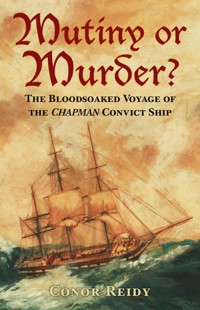
Front cover: Unfortunately there are no images of the Chapman that reflect the turmoil of the voyage as effectively as the one on the front cover. This ship, the Lady Blackwood, is a slightly later model than the Chapman, but is from the same era and very similar in make and design.
First published 2018
The History Press Ireland
50 City Quay
Dublin 2
Ireland
www.thehistorypress.ie
© Conor Reidy, 2018
The right of Conor Reidy to be identified as the Author of this work has been asserted in accordance with the Copyright, Designs and Patents Act 1988.
All rights reserved. No part of this book may be reprinted or reproduced or utilised in any form or by any electronic, mechanical or other means, now known or hereafter invented, including photocopying and recording, or in any information storage or retrieval system, without the permission in writing from the Publishers.
British Library Cataloguing in Publication Data.
A catalogue record for this book is available from the British Library.
ISBN 978 0 7509 8882 7
Typesetting and origination by The History Press
Printed in Great Britain
eBook converted by Geethik Technologies
Contents
About the Author
Acknowledgements
Chronology
Preface
Introduction
1 The Countdown to Chaos
2 Bloodshed in a Tropical Climate
3 Escalation
4 Shockwaves at Sea
5 Aftershocks
6 Judgement
7 After the Chapman
8 Conclusion
Appendices
Notes
Select Bibliography
About the Author
DR CONOR REIDY is a specialist in Irish penal and criminal history. He holds a PhD from the University of Limerick and a BA from NUI Galway. He has held lecturing positions at the University of Limerick and Mary Immaculate College Limerick. His previously published books include Criminal Irish Drunkards and Ireland’s ‘Moral Hospital’: The Irish Borstal System 1906-1956. He is the author of numerous chapters in edited volumes on subjects including juvenile crime, alcoholism and criminality, and gender history. He has appeared many times in local and national media in Ireland including on RTE Radio, TG4 and Newstalk. Dr Reidy is a former Honorary Secretary of the Women’s History Association of Ireland and now works full-time as a freelance editor.
Acknowledgements
I extend my gratitude to the organisations and individuals who, through their efficiency and creativity, preserved and provided the source material upon which this book is based. These include the National Archives of Ireland, State Library of New South Wales and the National Maritime Museum at Greenwich.
I would like to thank my friend and colleague Dr Mary McCarthy for introducing me to Australian history ten years ago and ultimately encouraging me to write what is, for me, a very different type of book. I also thank her and Michael Roycroft for reading early drafts of various chapters. Naturally, any errors, omissions or inaccuracies are mine only. I sincerely appreciate the support of The History Press Ireland, particularly Ronan Colgan and Nicola Guy, for putting faith in my work once again.
As always, a number of friends and family have provided a world of moral support along the way. Special thanks to Edel and Kevin Copeland, Brendan Murphy, Ellen Murphy, Gerard and Heather Reidy, Maura Reidy, and Michael, Ellen and Cáit Healy. To the May 2010 Club, thank you! I am deeply indebted to my cousin Michelle Duckett for always providing a much-needed boost of confidence.
I continue to be inspired by the strength and courage of my parents, John and Betty Reidy, and I thank them for always promoting the importance of the written word from the beginning.
Once again, I could only make this happen with the support of my greatest champion and source of strength. I reserve my warmest thanks to my wife Kathleen for her boundless patience, belief and great humour.
Chronology
13 May 1787
The First Fleet departs from Portsmouth bound for New South Wales
10 April 1791
The Queen is the first convict transport to leave Ireland for Australia
1 January 1810
Lachlan Macquarie sworn in as governor of New South Wales
28 November 1816
Alexander Dewar is appointed surgeon-superintendent of the Chapman
11 December 1816
The Chapman departs the naval dockyard at Deptford
9 January 1817
The Chapman arrives at the Cove of Cork
5 February 1817
The first convicts board the ship
15 March 1817
The Chapman departs Ireland for New South Wales
22 March 1817
Soldiers and crew are called to arms as a result of a false alarm on deck
4 April 1817
The ship anchors in Porto Praya
7 April 1817
The Chapman resumes the journey to New South Wales
17 April 1817
A prolonged shooting incident leaves several convicts dead in the evening
18 April 1817
Three convicts are discovered dead from the shooting; twenty-two wounded
21 April 1817
Convict Thomas Mulholland dies from his wounds
23 April 1817
Convict James Roberts dies from his wounds
25 April 1817
Convict Daniel Parker dies from his wounds
27 April 1817
Soldiers and crew are called to arms following a false alarm
28 April 1817
A second gunfire incident is launched, killing the convict John McArdell
28 April 1817
In a separate incident, convict Bryan Kelly is shot on the poop deck
28 April 1817
Convict Oliver Wallace dies from his wounds in the first shooting episode
5 May 1817
In the worst day of mass punishments on the voyage, fifteen prisoners are flogged
25 May 1817
Sailor Francis Lucy dies following a shooting against the jolly boat
26 May 1817
Convict John Malone dies from gunshot wounds in an earlier incident
29 May 1817
Convict John Jackson dies from wounds sustained in the jolly boat shooting
29 May 1817
Convict James Collins dies from unspecified causes
27 June 1817
Convict Christopher Kelly dies from unspecified causes
27 July 1817
The Chapman arrives at Port Jackson, New South Wales
31 July 1817
Colonial Secretary John Campbell begins a routine inspection of the Chapman
2 August 1817
Campbell notifies Captain Drake of his intention to pursue criminal charges
8 August 1817
The register of the Chapman is seized by the New South Wales government
13 August 1817
Governor Macquarie signs warrant appointing a committee of inquiry
16 August 1817
The Wylde-Wentworth-Campbell committee begins investigations
15 November 1817
Wentworth, Wylde and submit their reports to Governor Macquarie
21 December 1817
The Chapman departs New South Wales for India
22 December 1817
The Harriet departs New South Wales for London
11 January 1819
Clements and Drake appear at the Admiralty Sessions at the Old Bailey
12 January 1819
Drake, Dewar and Busteed appear at the Admiralty Sessions
12 April 1819
Governor Macquarie is reprimanded by the London government
Preface
The first course I taught during my former career as a university lecturer was the history of modern Australia. One of the first things I was confronted with was the fact that a belief once existed among historians that Australian history begins in 1776 or 1788. Knowing that human beings walked on that continent for more than 40,000 years discredits that notion as a fantasy that was probably driven by some motivation other than the promotion of historical accuracy. To study the modern history of Australia, however, is to witness what was arguably one of the most audacious feats of nation-building that has been undertaken by human beings in the past 250 years. What began as a collection of flimsy wooden shacks constructed on the banks of Botany Bay by the first European settlers who landed in 1788 went on to become a fully functioning world power by the beginning of the twentieth century. Teaching the history of this achievement, I was confronted with the obvious fact that my own core research interest was the key driver of this new colonial society and its economy for the first several decades.
When we take a step back and examine the broader scenario we can appreciate the complex thought processes that went into using the detection and punishment of everyday crime in one part of the world as a means of populating a vast land mass many thousands of miles away. My academic career has been built on the study of crime and its punishment, and I have long been particularly interested in understanding prison reform and the evolution of the penal process. Transportation to Australia was a new concept when it began at the end of the 1780s. Transportation as a means of punishment was not new, however, with the American colonies having provided a useful dumping ground long before Captain Cook sighted Botany Bay.
In taking this first step into the study of Australian history I am not so much concerned with the development of those early colonies – something that continues to be examined most effectively by many others – as I am with the vehicle of transportation. This book has its genesis in a chance discovery at the National Archives of Ireland. Buried in the developing catalogue of the Chief Secretary’s Office Registered Papers was an obscure letter to an official in Dublin Castle from some unknown figure in the government of New South Wales. The letter mentioned two villainous convicts on the transportation ship the Chapman and their scheme to sow discontent on the journey to New South Wales by spreading false tales of a planned prisoner mutiny. The consequence of this was the death of twelve prisoners and the wounding of many more. At this stage the story was vague and the investigations were not yet completed. Ironically, as significant as this letter was in sparking my interest in learning more about this voyage, it was deemed worthy for only minimal use as a primary source in the book. This is an example of how a story from the past can blossom from the tiniest seed.
While the story of the 1817 voyage of the Chapman as told in this book is not limited by any archival rules restricting access to sources, there are some limitations. Some material simply does not survive and certain individuals have remained stubbornly elusive. What I have attempted to capture insofar as the available sources allow, is the first-hand point-of-view of life on board a convict ship. The perspectives are mixed. Sometimes we hear from inside the prison on the ship and at other times we hear from the senior command structure of the voyage. The story tries to illustrate the ordinary lived experience from multiple viewpoints and does not just focus on the dramatic and salacious moments of the journey.
This book is not intended as an in-depth academic examination of a convict voyage or the transportation system as a whole. Such analysis is purposely limited in favour of telling a story. To provide the broadest possible context the book is developed across three stages, opening with the best available accounts of the months before the ship departed on the journey. Once the voyage begins the reader will join the crew as they make a routine stop at the port of St Jago in the Cape Verde islands. The purpose of including moments like this is to weave the full tapestry of the convict voyage. The final section of the book deals with the aftermath of the voyage. What were the consequences? What became of the main players? What became of the system? The function of illustrating the ‘before and after’ histories of the voyage is to demonstrate that it did not happen in isolation. This is a story of brutality and killing that did not begin with the departure from one port and embarkation at another. As well as recalling the horrors that unfolded during the sailing, the book offers some insight into the world of the ordinary criminal. The stories, profiles and anecdotes that permeate the book are intended to continue to broaden our understanding of the criminal poor in early nineteenth-century Ireland.
Introduction
During the eighteenth and nineteenth centuries the ritual of convict transportation became a fully embedded component of the structure of penal discipline in Ireland. Men and women who were deemed to have contravened the norms of society by breaking the law were legally expelled from their home country for periods of seven or fourteen years, or life, the sentence depending upon the severity of their deviant act. The pattern was familiar. The police, or those configurations that preceded their creation, detected a criminal act. The accused was brought before a magistrate and questioned. He or she had almost certainly emerged from the impoverished and low-income classes. They were subjected to a trial where, if they were found guilty, a sentence was passed. A sentence of transportation was the common fate for what by modern standards would be seemingly innocuous crimes. From stealing animals to passing forged currency, from picking pockets to basic theft, the likelihood of exile to the newly colonised territory of New South Wales on the eastern side of what would later become Australia, became a real possibility for the average Irish petty criminal.
Shiploads of men and women were discarded from Irish society, beginning with the departure of the first convict transportation ship from the country in 1791. The overwhelming majority of those voyages departed from the Cove of Cork, known today as the town of Cobh, adjacent to modern-day Cork city in the south of Ireland. Designed to punish, eliminate and deter criminality from ordinary life, the reality of transportation brought with it a whole range of new social problems and many of those unfolded on the journey to the other side of the world. This book will explore the way in which many of those problems were played out on one voyage that departed from the Cove of Cork in March 1817. During the four-month voyage of the Chapman, the convicts, sailors, soldiers and officers variously experienced prolonged light-deprived incarceration, starvation, torture, suspicion, a real or perceived threat of mutiny, and death by gunfire. The story of the voyage and its aftermath will be told using the words of those who were there. Although their versions were often conflicting, the voices of convict witnesses, officers and sailors are worth hearing for the sense of despair and fear that is conveyed from what became a blood-soaked voyage.
The book attempts to accurately record the story of the voyage at all possible stages. The real story of such journeys usually begins before the ship even sets sail and so we first encounter the Chapman as it leaves the naval dockyard at Deptford on the Thames. After many weeks of preparation in Cork we begin the journey proper, crossing some of the great waterways of the world, stopping for refreshment and resupplying at the exotic port of Porto Praya, before continuing alongside the mysterious continent of Africa, around the Cape of Good Hope and onwards towards the east side of the land mass that would become known as Australia. After the voyage is over we will examine the aftermath. Insofar as is possible, we will try to determine what became of the main players. Did the voyage have an impact on the transportation process? How, if at all, did any of the Chapman convicts make their mark on their new homeland? How did the system progress in the Cove of Cork long after the Chapman was just a footnote in popular memory?
The Transportation System
To describe the practice of convict transportation as a means to an end in ridding a given jurisdiction of its more deviant inhabitants would be to simplify a phenomenon that was somewhat more complex in its origins. Emsley considers exile in the early modern period where the forced removal of an individual from a city state was seen as a considerable punishment. He cites the example of Russia, where penance was achieved through flogging but redemption would mean banishment. There was some permanence to this, however, because in the Russian context, banishment was used as a way of populating Siberia.1 In Britain – and by extension Ireland – transportation as an alternative form of penal discipline and punishment had its origins in the seventeenth century. It was enshrined in legislation in the Transportation Act in 1718.2 Until the 1770s this meant that Britain’s convicts were despatched to the American colonies but following the War of Independence this avenue was closed. With the ‘discovery’ of Australia for Britain in 1776 came the opportunity for new colonial adventures and a so-called dumping-ground for criminals. Between 1788 and 1868 a total of 825 transportation ships carried in excess of 167,000 convicted criminals from England and Ireland to Australia.3 Scholars appear somewhat divided on the overall numbers transported. For example, Hirst argues that 187,000 were exiled in this way, the majority after 1815.4 Most agree that the system peaked in the 1830s with around 5,000 individuals transported each year. During the seventy-seven-year period from 1791 to 1868 some 37,432 Irish men and women were transported to the colonies of New South Wales, Van Diemen’s Land and Western Australia.5 Irish-born convicts arrived in Australia from the very beginning due to the fact that an estimated 4 per cent of those convicted in Britain originate from Ireland.
The first prisoners taken directly from Ireland left the southern port of Cobh on board the Queen in 1791 with 155 convict passengers and four of their children.6 It is believed that over 1,300 convicts were transported from places other than Great Britain or Ireland, including India, Canada, the Cape of Good Hope, Bermuda and Mauritius, among others. O’Toole suggests that many of these were soldiers transported for mutiny, desertion or other military-related offences.7 Morgan defines transportation as a ‘halfway house between sentencing to hanging and recommendations for whipping and branding’.8 Indeed the somewhat patchy records for capital punishment in nineteenth-century Ireland show a growing reliance on the option to commute a sentence of hanging to one of transportation.
Transportation from Ireland
When a sentence of transportation was handed down, a convict was typically sent back to the nearest local or county gaol until the authorities were ready to put the process in motion. Those to be transported from the southern Irish counties awaited their fate inside the city gaol in Cork. In 1817 a convict depot or type of holding prison was established in Cork to provide interim accommodation for the increasing numbers awaiting transportation.9 A government investigation into alleged financial abuses within the prison system in Cork was published just eleven days prior to the departure of the Chapman in March 1817 and provides a useful window into the pre-transportation experience. Specifically, the commissioners were appointed to look into the prison in Cork city and any transportation ships awaiting departure in Cork harbour. The inquiry began with the convict ships because any delay caused by an awaited investigation might cause a financial burden to the transportation voyage. The investigators considered it would be judicious not to examine the convicts under oath as with close investigation the truth could be obtained without resorting to the usual formality.10 The resulting testimony confirms much about the somewhat chaotic early nineteenth-century prison as it reveals about the pre-transportation process.11 The detail provided in the report provides much of the backdrop for chapter one of the book. While the Chapman prepared to set sail, the convicts must surely have been pondering their future in a land far removed from anything they could possibly imagine.
The Composition of New South Wales
Prior to the arrival of Captain Cook in 1776 it is widely accepted that human beings lived in and around the colony that would be called New South Wales for some 40,000 years. The society encountered by Cook and later the First Fleet in 1788 was essentially hunter-gatherer in nature: the first proper European settlement was not the beginning of Australian history, it was merely the beginning of modernisation. By the beginning of the second decade of the nineteenth century the known districts of New South Wales were growing in population and sophistication. In 1810 Sydney had 6,158 inhabitants. Paramatta was home to 1,807, Hawkesbury to 2,389 and Newcastle to 100 people. This brought a total of 10,454 residents, 2,220 of whom were women, 5,513 were men and 2,721 children. It was estimated that a quarter to a third of the population was convict. The 1810 count also included data on Port Dalrymple and Hobart’s Town in Van Diemen’s Land, which was south of Sydney and was home to some 1,321 people. An additional 177 people lived at Norfolk Island.12 The inhabited portion of the land mass that came to be known as Australia was tiny by comparison to what it would be during the following century.
New South Wales was bordered to the north, west and south by the Blue Mountains and in 1810 the land beyond that range had not yet been explored by the settlers. Official accounts stated that the farthest distance travelled thus far was about 100 miles but only the first 60 could be described as suitable for agriculture. About half the land in the settled territory was believed to be barren, with 21,000 acres in cultivation and 74,000 in pasture. A government census of livestock shows an impressive supply of animals. There were over 1,000 horses, 193 bulls, 6,351 cows, 4,732 oxen, 33,818 sheep, 1,732 goats and 8,992 hogs.13 A small percentage of these were held by the government and converted to meat for the public supply. Apart from natural crop failures and other incidental interventions it appears that the colony was self-sufficient in most ways.
The journey between Europe and New South Wales was fraught with many dangers and challenges, not least of which was the threat of mutiny against a cold-blooded or cruel captain and his officers.
Mutiny at Sea
Adams points out that the conditions under which sailors and prisoners served, worked and lived on convict voyages between 1787 and the final such sailing in 1868 fed into the unceasing rumours of mutinies by both cohorts of passenger.14 The subject of convict mutiny on the voyage to Australia has not been widely explored by historians for the reason that only one vessel is known to have been successfully seized in this way during the transportation period. The Lady Shore was a female convict vessel that left the port of Falmouth in England on 8 June 1797 bound for Port Jackson, New South Wales. According to an account by one of the officers, John Black, who remained loyal to the captain, the mutiny began at about a quarter past four in the morning of 1 August when the chief mate, named Lambert, entered his cabin. Black grabbed his pistol and fired but only managed to shoot the hat off the head of one of the mutineers.15 In this case it was not the convicts but the guards, a detachment from the New South Wales Corps who, according to Hughes, rose up in the name of the French Republic. After a relatively bloodless takeover of the ship they sailed to Montevideo, where they were accepted as political refugees. They handed over the female prisoners to Spanish colonial ‘ladies of quality’.16 The takeover was executed by twenty-two of the soldiers and crew, nine of whom were previously French prisoners of war. The female convicts later described how the plot was ‘carefully timed’ and well carried out. Maxwell-Stewart argues that the voyage of the Lady Shore was ‘hardly typical’ but in fact revealed the thin line between convict, soldier and sailor. It was believed that the female convicts below deck were not ‘innocent bystanders’ but were involved sexually with the soldiers and crew. This theory claims that when attempts were made to discontinue this interaction the mutiny was the outcome.17
The opportunity to pre-plan a mutiny was something that was to be expected for two reasons. The majority of those on board were there against their will and existed in poor and often unsanitary conditions on their way to a place of exile. Secondly, it is likely that in the months prior to the voyage the convicts were holed up either in a hulk, in the case of England, or a prison, in the case of Ireland. In such circumstances the combination of apprehension and resentment could easily give way to conspiracy and plotting. This appears to be the situation in the case of the vessel the Argyle. Significantly, it emerged later that the ship’s surgeon, Henry Brock, was tipped off about a possible plot to seize the vessel before the voyage commenced. While the ringleader of the plotters did not set sail, five of his conspirators did and so Brock took the initiative of distributing them across the ship and out of physical proximity with each other, to lessen the opportunity for conspiracy. In fact, the conspirators had previously been incarcerated on the Captivity hulk, where the plot was allegedly hatched.18 This was one of the central accusations against the alleged mutineers on board the Chapman, which will be examined later.
Citing Bateson, Adams points out that compared with shipwreck and disease, the number of those injured or killed in mutinies was small but the number of riots and other disturbances was probably greater than what was reported. It was not in the interest of a ship’s master to report every incident or suspected attempt to overtake a ship because it would reflect poorly on him and his officers. He noted that the mutiny with the highest number of fatalities appears to have been on another ship departed from Cork. The Hercules left Ireland on 29 November 1801 with fourteen rioting prisoners killed exactly one month later.19
The Chapman
The Chapman was built at Whitby dockyard in 1777 and consisted of two decks. The vessel was just over 119 ft long with a keel of over 95 ft. The principal managing owner of the ship was Abel Chapman and the maiden voyage appears to have taken place in 1780–81.20 Now in service to the East India Company, that first journey took the vessel to Madras and Bengal. From then until 1817 it toured the world visiting such diverse locations as China, North America and the Cape of Good Hope. Rebuilt in 1811 and refurbished in 1815 the next phase of life would be altogether different for the Chapman.21 Around 1815 the ship appears to have been decommissioned for use as a military support vessel before being hired out to the Royal Navy for the purposes of convict transportation. Not originally constructed for this purpose, it would be a further two years before the experienced ship set sail for New South Wales, albeit guided by very inexperienced hands.
A note on the sources
The story of the 1817 voyage of the Chapman as told in this book is revealed where possible through the words of those who made the journey. To that end it is worth repeating that the people on the ship had differing perspectives on the course of the many events that marked those four months. The captain of the ship and his senior officers were all professional seaman. They were not professional gaolers. Every time a transportation ship set sail to New South Wales, these two professional worlds collided. The mediator between the gaoler and the gaoled was usually a small military detachment. The viewpoints that tell the story of this voyage, therefore, are sometimes fundamentally different. Where possible, the common threads have been identified and put forward as agreed facts. Elsewhere, where the facts around some event or controversy were contested, this is put forward as a perspective.
The central set of sources that drives our knowledge of the Chapman episode comes in the form of documents held within a volume of correspondence known as the Historical Records of Australia. These items were copied by the governing authorities in New South Wales and sent to London at regular intervals, presumably to provide accountability on the administration of the colony. Among the packages returned to London were the daily logs or journals of the captain of the ship and his surgeon-superintendent. These were seized by the authorities when problems were identified at the end of the journey in Sydney. They give only a ‘bare-bones’ account of the day-to-day events on the ship and investigators noted key omissions such as the lack of a reference to a shooting incident on the Chapman around 17 April 1817. When added to other documents in the volume including lines of correspondence between the ship commander and officers, as well as with government officials, they do assist in forming a context for some of the more dramatic events of the voyage.
As the story unfolds it will become obvious that much of the narrative is drawn from the different investigations that took place during the months of September and October 1817. During these weeks, many of the significant actors in the drama were questioned at length by investigators. From a command point of view, this included all of the senior officers including the captain, surgeon-superintendent, three mates, military leaders, several soldiers and a number of regular sailors. On the prisoner side was lengthy testimony from multiple convict witnesses, some of whom were believed to be alleged conspirators and others who were known to have witnessed certain occurrences with their own eyes. While these accounts would be expected to offer not only differing perspectives and contradictory intelligence, closer inspection finds that there are many points of agreement. For the historian and the reader of these documents it is essential to remember that an awareness of perspective is fundamental to the most accurate interpretation of the material. The concluding chapter of the book will summarise and address the most disputed questions still outstanding at the end of the voyage and the subsequent legal investigations.
We come to know the 200 men transported on the Chapman far better than we would if they had remained at home within the prison system of Ireland. This comes through a process of familiarisation and is not unique to every individual, nor is it exhaustive. Our first encounter with the convicts is through the standard list of names that was generated at the time the ship left port in Cork. This document recorded data such as name, age, place of birth, place of trial and ultimate fate. For this voyage, the latter was only noted if the person died at sea. The next encounter with the transported men happens usually by working backwards in time to the register of inmates for the Irish-based prison in the jurisdiction where their offence was committed and prosecuted. Prison registers prove an effective window into a sizeable and vibrant element of society in nineteenth-century Ireland. As well as the details provided in the transportation list, we have some additional data on the convicts such as physical features, religion, next of kin and criminal act. With a profile of each man gradually forming, the next logical step is to trace his criminal act through contemporary newspapers in an effort to find reporting on his trial. This line of enquiry has only moderate success. Not every stolen beast was the subject of a lengthy court proceeding and subsequent newspaper report. Not every forged note was deemed worthy of inclusion in the national press. When the criminal adventures of these low-level deviants were reported, however, it tended to be in great detail. Not only do we learn about the wicked exploits of the thief or the vandal but we peek through a window into the world of the ordinary Irish poor, urban and rural. We learn something about a way of life, a struggle for existence, a journey along that fine line between right and wrong. These are the Chapman convicts whose stories can be told in the greatest detail.
The appendices to this book will present some ‘bare bones’ data on the fate of the convicts who were fortunate enough to survive the voyage in 1817. The criminal classes banished to New South Wales from Ireland and England experienced different fates once their sentences expired. They generally passed through a set procedure that included the possibility of a conditional or absolute pardon, a ticket of leave or a land grant. Built into all of this was the option to return home or indeed to bring family members to the colony from Europe. Where the records survive, the names of Chapman convicts who availed of pardons, land grants and an eventual certificate of freedom, are included in the appendices. It must be stated at the outset that while these records are far from complete they do provide something of an insight into the general fate of the convicts, all of whom were witnesses to horror on the high seas en route from Cork to Port Jackson. Including these incomplete records in the appendices is intended to demonstrate some level of continuity to a post-voyage existence.
1
The Countdown to Chaos
In March 1817 a convict transportation ship left the Cove of Cork bound for New South Wales. As it left the port that is known today as Cobh there was little to set the Chapman apart from the many other vessels that transported the disgraced and the sinful to their exile in Australia. On board were 200 male convicts, thirty-two soldiers of the 46th Regiment and a crew of forty men under the leadership of the allegedly drunken and incompetent Captain Drake. Yet when the ship anchored in Sydney Cove on 27 July 1817, it laid bare the story of a nightmarish four-month voyage that was marred by unrelenting horror, torture, starvation, death, and tales of a mutiny that never happened. Convict transports had long been known as ‘hell-ships’ but this voyage was different. When the doors were opened at the end of the journey, 160 gaunt and emaciated men emerged from the prison below deck where they were dazed and blinded by the sunlight of a strange new world. Of the original convict cargo, twelve died in violent circumstances at the hands of the soldiers. Close to thirty lay wounded in the ship’s hospital. While the surviving convicts and the crew told conflicting stories of their voyage, all of the accounts had certain features in common. The storm that consumed the journey of the Chapman from Cork to Sydney was not one brought about by nature but by a climate of fear, degradation, intrigue and misplaced vengeance. For the government officials who routinely inspected arriving convict transports in Sydney, the bloodstained decks of the Chapman summoned up terrifying images of a voyage that went horribly wrong.
The Guardian of the Night – Dublin, June 1816
In the newspapers and in the courtrooms they were known as the Guardians of the Night. For decades the men of the parish watch were a key line of defence for the citizens of Dublin against the invisible forces that threatened them during the hours of darkness. In early June 1816, sometime between the hours of one and two in the morning, the watchman doing his nightly round on Bishop Street stopped in his tracks. Despite the late hour, the elderly Ferdinand Mervin was accustomed to noticing anything out of place. His eyes were trained to the darkness and at this moment they were fixed on the suspicious looking fellow outside the home of the tallow-chandler Ann Butler. Mervin approached the man, who was carrying a bundle in his hand. ‘What are you up to at this hour of the morning?’ It was a reasonable question from a watchman whose duty it was to patrol the streets in the days when professional policing was still a work in progress. Before his quarry had an opportunity to respond, Mervin noticed two violins and a hat lying on the ground near the man’s feet. At this moment several other watchmen appeared and together they apprehended the man, whose name was Peter Allen. They took him to the nearest watch-house.
Along with Robert Gilbert, the constable on duty that night, some of the watchmen headed back towards Mrs Butler’s house, where they found another suspicious character, John Ennis. He too was conveyed to the watch-house and upon ‘questioning’ he confessed to having robbed Mrs Butler’s and passed on the spoils of his exploits to a number of accomplices. Acting on information from Ennis, the constable and his watchmen hurried to a house on nearby Kevin Street, where they encountered a man coming out the front door. Instantly reversing course, the man rushed upstairs and onto the roof of the house, where his journey was halted by Constable Gilbert. In the room from which the man entered the roof the officers discovered a woman, who was in the process of concealing various objects under the straw of her bed. A search of the space uncovered nine shirts, a brown greatcoat, four hams, a piece of bacon, the pattern of a new muslin gown, some portions of new linen, a grey cloak and a blanket, among other items.
Back at the watch-house the man apprehended on the roof named himself as Michael Kennedy and the woman identified herself as Mary Neill. By the early hours of the morning Mrs Butler, the owner of the house on Bishop Street, was at the watch-house; where she identified some of the stolen items found in the possession of Peter Allen, the man first spotted by Watchman Mervin. Items not belonging to Mrs Butler personally were claimed by her lodgers. It was later observed that the thieves were only beginning the robbery on Mrs Butler’s house when they were interrupted by the watchmen. Indeed, hers was not likely to be the only house they targeted that night.22
Peter Allen, who was apprehended whilst standing guard during the break-in, was sentenced to seven years’ transportation. John Ennis, who was caught red-handed inside the house, was sentenced to death. This was later commuted to transportation.23 Anyone who doubted the potential of the watchman only needs to look at the fate of Allen and Ennis. Neither vigilante nor professional policeman, the watchman was an early version of the constable on his beat. His power was limited but his reach was far. The parish watch had a reputation for being ineffective and this was probably well-founded. The actions of the aging Ferdinand Mervin, however, proved that there were exceptions. He had a keen eye and good local knowledge. His decisive action resulted in a pair of low-level petty burglars finding themselves at the centre of a ghastly four-month nightmare that played out across oceans and seas on both hemispheres of the earth. Their minds would be forever stained with the blood of a dozen murdered cell-mates. The stench of a floating prison whose doors never opened would haunt their senses. The journey would have enormous implications for a colonial government and its masters at the heart of the British Empire. They were only a part of that journey because they decided to break into the home of Ann Butler. Was it carefully planned in advance or another sudden impulse of the petty criminal classes? They were only there because the watchman noticed something out of place on a dark night on Bishop Street.
Six months later
The fateful journey from Cork to New South Wales began not in Ireland but on the River Thames in London. Before leaving for Australia it was typical for transportation vessels to undergo preparation at one of the royal dockyards of the British Navy. The Chapman was anchored at the dockyard at Deptford, which had become known as the ‘cradle of the Navy’ due to its importance to exploration and the empire since it was founded in 1513 by Henry VIII. Deptford dockyard was somewhat of a crossroads of the world. The facility comprised a sprawling array of docks, warehouses and workshops, all necessary to maintain the fleet of a successful seafaring nation. The dockyard workers not only carried out any essential repairs to the ships but also re-fitted them with necessary equipment such as cables, sails or bedding. Alongside the dockyard was a victualling yard, itself a type of dock where the many ships that passed through Deptford were supplied with all manner of necessities including dry food and meat, alcohol and bread. On 11 December 1816 the Chapman




