


9,99 €
Mehr erfahren.
- Herausgeber: Mercier Press
- Kategorie: Fachliteratur
- Sprache: Englisch
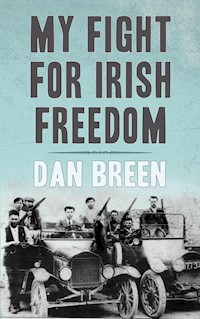
In 1919 a group of young men barely out of their teens, poorly armed, with no money and little training, renewed the fight, begun in 1916, to drive the British out of Ireland. Dan Breen was to become the best known of them. At first they were condemed on all sides. They became outlaws and My Fight describes graphically what life was like 'on the run,' with 'an army at one's heels and a thousand pounds on one's head'. A burning belief in their cause sustained them through many a dark and bitter day and slowly support came from the people.
Das E-Book können Sie in Legimi-Apps oder einer beliebigen App lesen, die das folgende Format unterstützen:
Veröffentlichungsjahr: 1981
Ähnliche



















My Fight for Irish Freedom
Dan Breen
MERCIER PRESS
3B Oak House, Bessboro Rd
Blackrock, Cork, Ireland.
www.mercierpress.iehttp://twitter.com/IrishPublisherhttp://www.facebook.com/mercier.press© Mercier Press, 2011
ISBN: 978 0 947962 333
Epub ISBN: 978 1 78117 028 1
Mobi ISBN: 978 1 78117 029 8
This eBook is copyright material and must not be copied, reproduced, transferred, distributed, leased, licensed or publicly performed or used in any way except as specifically permitted in writing by the publishers, as allowed under the terms and conditions under which it was purchased or as strictly permitted by applicable copyright law. Any unauthorised distribution or use of this text may be a direct infringement of the author’s and publisher’s rights and those responsible may be liable in law accordingly.
Contents
Chapter One : Childhood and Youth
Chapter Two : Sworn in by Sean Treacy
Chapter Three : Our Munition Factory
Chapter Four : Soloheadbeg
Chapter Five : The Rescue at Knocklong
Chapter Six : Wanted for Murder
Chapter Seven : In Dublin’s Fair City
Chapter Eight : Ambush at Ashtown
Chapter Nine : Convalescence
Chapter Ten : Smoking Out The Ric
Chapter Eleven : General Lucas
Chapter Twelve : Fernside
Chapter Thirteen : Reprisals
Chapter Fourteen : The Third Tipperary Brigade
Chapter Fifteen : The Truce
Chapter Sixteen : Civil War
Epilogue
Political Background
About the Publisher
About the Author
CHAPTER ONE
CHILDHOOD AND YOUTH
I was born on 11 August 1894 in my father’s cottage at Grange, one mile south of Donohill, Co. Tipperary. I received the name Daniel at my christening, which took place two days later at Solohead parish church. My parents were Daniel Breen and Honora Moore. My mother was a native of Reenavana, Doon, Co. Limerick. The children born to them in order of seniority were Laurence, Mary, John, Winifred, Catherine, Patrick, Dan and Laurence (Junior). The firstborn, Laurence, died when I was about four years old. He was eighteen at the time of his death. He and two other lads of about the same age had spent some hours fishing the Multeen brook on a night of dense fog. All three of them contracted pneumonia and died a couple of weeks later. A superstitious old woman spread the tale that the young fellows had watched a hurling match between two teams of fairies in the rath field and thereby forfeited their lives.
My father died from blood-poisoning at the age of sixty. A thorn pierced his finger when he was scarting a fence. The wound turned septic and he was laid up for more than one year before his death. He was a pleasant-looking, bearded man of middle height. I was about six years old at the time of his death and I have only a faint recollection of him. I remember one sunny day when he took me by the hand and led me through the fields. When I got tired he lifted me on to his shoulders and brought me home pick-a-back. I have a distinct memory of the coffin being brought into the room in which he was waked. The womenfolk set up such a keening that Martin Breen, my father’s cousin, ordered them to go down to the kitchen.
My father’s death must have been a great blow to my mother who had to provide for a houseful of children, the youngest of whom was still in the cradle. My mother was a midwife and managed to make ends meet even though she was hard pressed at times. Her meagre earnings were supplemented by Mary and John. Mary was hired as a general servant in a neighbour’s house at a wage of six pounds a year. John went to work for a farmer. They brought home every penny that they earned.
Even though I was very young at the time of the Boer War, I can still remember the neighbours sitting round the fire, listening to someone reading aloud the news from The Irish People. I recall their exultation over the victories gained by the Boer Generals, Cronje and de Wit, and how thrilled they were by the British defeat at Spion Kop.
I remember the last eviction which took place one mile from Grange. Michael Dwyer Ban, a relative of ours, was ejected from his home and died on the roadside. This event left an indelible impression on my mind.
The Land Act of 1903, which enabled tenants to purchase their holdings, brought–great joy to the farmers. They seemed to have entered an utopia where the threat of famine no longer existed. In a short time, however, they began to complain of the high rent, £2 to £2-5-0 an acre. I often heard my godfather, Long Jim Ryan, and my uncle, Lar Breen, talking about this high rent and also the poor price paid for milk delivered to the new Cleeve’s factory. They considered that threepence a gallon was not an economic return. I did not know the meaning of the word ‘economic’ but I received the impression that everything was not tinted with a colour of rose. Their chief grievance was that no ‘back-milk’ was given to the suppliers.
Our family barely existed above the hair-line of poverty. Most of the neighbours were in a similar plight. Potatoes and milk were our staple diet. On special occasions we had a meal of salted pork but the luxury of fresh meat was altogether beyond our reach.
I went to Garryshane school at the age of four. Even though the building was in the village of Donohill, the national school had to take its title from the name of the field on which it was built. The Protestants objected to the school being called Donohill National School; they claimed exclusive right to the prefix Donohill because it was the official name of their parish.
The school was a drab two-storey building with no playground for the pupils. The girls occupied the upper floor, the boys the ground floor. The principal of the boys’ school was James Power, a kinsman of the Breens. He died about the time that I was in the fourth class. Charlie Walshe, a Kerryman, was appointed to act as substitute teacher pending the appointment of a new principal. He was better known in later years as Cormac Breathnach, Lord Mayor of Dublin. Charlie had been engaged by the Gaelic League to teach Irish in the rural areas. He did relief work in several national schools of our district. It may be of interest to learn that he also taught Sean Treacy, Dinny Lacey, Packy Deere, Sean Hogan and a lot of my pals who are now dead. Some of those lads did not belong to our parish, but all of them lived within a two-mile radius. He did not confine his history lesson to the official textbook. He gave us the naked facts about the English conquest of Ireland and the manner in which our country was held in bondage. We learned about the Penal Laws, the systematic ruining of Irish trade, the elimination of our native language. He told us also of the ruthless manner in which Irish rebellions had been crushed. By the time we had passed from his class, we were no longer content to grow up ‘happy English children’ as envisaged by the Board of Education. To the end of his days Charlie was in the habit of boasting of his rebel past pupils.
When I reached my fourteenth year, my schooldays came to an end. I had to go out and earn my bread. Father Martin Ryan, our parish priest, gave my my first job on the renovation of our old school. Laurence Dwyer was foreman and carpenter, Pat O’Neill did the plastering, Mylie Carew and I did the rough labour. Father Ryan paid me nine shillings a week, no mean sum in the eyes of a young gossoon. I was a proud boy on that first Saturday night when I handed my pay-packet to my mother. When the renovation of the school had been completed, I worked for farmers in the district.
In the spring of 1913 I got a job as linesman on the Great Southern Railway. My wages were eighteen shillings a week, plus a living-out allowance of nine shillings (even in Dublin lodging-houses we got the best of grub at nine shillings a week). My work took me to Mallow, Cork and Dublin, because the maintenance gangs had to move from place to place as their services were required. My work made me familiar with the railway network and this knowledge served me well in later years when I was an outlaw. I was employed at the laying of the yard at Inchicore when the Great Strike of 1913 occurred. I walked round the streets of Dublin after the day’s work had finished and saw the police wielding their batons in frenzied charges, felling strikers and sightseers indiscriminately.
CHAPTER TWO
SWORN IN BY SEÁN TREACY
Sickened to death by British duplicity, cant and humbug, and by all the sham talk about a home rule measure that would give only a vestige of self-government to my country, I decided to join the Irish Republican Brotherhood. I was sworn in by Seán Treacy. I was Seán’s most intimate friend and we shared all our secrets. I am concerned that full justice has not been done to his memory.
Seán was still in swaddling clothes when his father, Denis Treacy, died. His mother took the little lad and moved to Lackenacreena near Hollyford. When her brother, Jim Allis, got married, Mrs. Treacy changed residence once more. She and her son, now aged eleven, went to live with her sister, Maryanne Allis.
Seán attended the Christian Brothers’ school at Tipperary, and was marked down as a very promising pupil who showed a special proficiency in the Irish language. He was an eager student of the history of his country. Seán’s aunt did not approve of his budding patriotic sentiments. While my mother taught me to lóve my country and be prepared to fight for its freedom, Maryanne Allis tried to put a brake on Seán’s youthful zeal. She had a hard outlook on the world. For this I do not blame her, because she had to toil and moil from morning to night for a mere existence.
Seán thought out all matters by himself. Of him we might use the term, a self-made patriot. Maryanne blamed me for leading her nephew astray. There was not a man on this earth who could lead on Seán Treacy to any course which he did not wish to follow. The truth is that in the matter of patriotic endeavour he was the leader, and I was his willing disciple.
Even though our houses were less than one mile apart, we did not meet face to face until we were in our eighteenth year. From the moment of my first meeting with him, I felt that I had known Seán Treacy all my life. He was the very soul of sincerity, and for that reason our kindred spirits clicked from the beginning. He had been delicate during his boyhood because of his fast rate of growth. He was almost a six-footer, slightly stooped in carriage. He weighed about twelve stone, and in an emergency manifested the strength of a lion; this was chiefly due to his amazing will-power. His movements were brisk, as if he were in a constant hurry. His hair was of very fine texture like spun-silk, almost mouse-coloured. He was short-sighted and wore glasses.
On first sight one would take Seán to be a foreigner. I remember one night when we came to a farmer’s house at Deerpark, near Carrick-on-Suir, the man of the house, Paddy Arrigan, looked at the grandfather clock which showed that it was bed-time. The family were about to kneel down for the Rosary, but were slightly uneasy because of the foreigner who might not be a Catholic.
‘Have you any objection, Mister, to our saying the Rosary?’ Paddy asked. Seán put everyone at ease by taking from his pocket a very long beads which was a gift from a Sister of Mercy. Paddy drolly observed: ‘If we are to judge your holiness by the length of your beads, a walking saint of God you must be.’
Shortly after the inauguration of the Volunteers in Dublin, a company was formed in Donohill. Some British army reservists put us through a course of drill. These fellows were called up at the outbreak of the Great War and, as a consequence, we had no one to train us in the approved methods of warfare.
In the early days of the Volunteers a great wave of enthusiasm swept over the country and this enthusiasm was inspired chiefly by the antics of the Orangemen in the North. Then came the disastrous cleavage in the ranks; nearly all of the Volunteers of our area followed John Redmond, with the result that Seán Treacy and I and a couple of others found ourselves odd men out.
The Redmondite or National Volunteers flourished for a time and then fizzled out completely in 1915. There were so few of our crowd left after the ‘split’ that we had not sufficient numbers to form a local unit of the Irish Volunteers. We could be counted on the fingers of your two hands: Paddy Ryan of Doon, Seán Treacy, me and my young brother, Laurence, Packy Deere, Mike Ryan and Éamon O’Dwyer. I must include also Dinny Lacey and Mick Callaghan from Tipperary town.
We tried to keep in touch with the Volunteer movement by subscribing to patriotic journals, and also by attending Volunteer gatherings which were not too far distant. As the war developed, a close watch was kept on us by the police. We became known as the ‘pro-Germans’. The majority of the people, carried away by British propaganda, hoped and prayed for victory for Britain and her allies. The landed gentry, the well-to-do merchants and most of the ‘strong’ farmers supported the drives that were organised to provide comforts for British soldiers. We did our best to frustrate such activities. I was still working as a railway-linesman, and the police notified my superiors about my disloyal tendencies.
The police did not confine themselves to the ordinary duties of custodians of law and order. The Royal Irish Constabulary, in familiar jargon the RIC, was a semi-military force, trained in the use of arms. The main duty of the police was to spy not only on the Irish Volunteers but also on all who were known to lend their support to the movement for Irish independence. They numbered about 12,000 in 1914, and were posted in garrisons of a strength numbering from two to about twenty, according to the population of the village or town in which they were located. They served as the eyes and ears of the British intelligence. Being natives of the country, they had an intimate knowledge of the people and ferreted out vital information for the British army of occupation.
From the outbreak of the Great War I continued to work on the railway and took no more active part than an ordinary member of the Irish Volunteers. We used to meet in Burke’s wood, near Coolnagun, twice a week. Our company then numbered thirteen; none of us with any military knowledge. Those of our neighbourhood who would have been competent to instruct us had either joined the British army or were not considered by us to be trustworthy for any perilous enterprise. Still we got on very well at physical drill, scouting, signalling, revolver practice, close-order drill and such work. We had to rely mainly on military manuals. By a strange irony the books which we found most helpful were the official manuals issued to the British troops. We were often seemingly innocent spectators of British manoeuvres, and I can assure you that we kept our eyes open. If the chance of picking up an odd revolver came our way, we managed somehow to find the purchase money for a further addition to our meagre armament. The best tribute to our proficiency in warfare was paid by officials of the British Government when they later described our little band as ‘the crack shots of the IRA’.
We went to Limerick on Whit Sunday, 23 May 1915, to take part in a big parade of Irish Volunteers organised by the Dublin Brigade. Pádraic Pearse was present. Special trains had brought about 600 men from Dublin, and there were contingents from many other places, including 250 from Cork. We marched at the rear of the Tipperary column and we were sorely tempted to open fire on the hostile crowd that pelted us with garbage as we paraded through the streets.
Treacy and I had many a chat about national matters. We were completely frank with each other. Neither of us was blessed with an abundance of money, Treacy being even poorer than myself. Whenever it was possible, I used my railway-pass to come home for the week-end. If Treacy wanted to go to Dublin, he travelled to and from that city on my pass. He had to return in good time so that I might have the pass for getting to my work.
Shortly before Easter of 1916 Treacy and I often discussed the prospect of an armed rising. I was working at that time on the line about Kilmallock. When I came home for Easter, Treacy told me that he expected a rising to take place on Easter Sunday. When the cancellation messages were received I returned to my job. The gang with which I was working consisted of about 150. Of that number I knew only one, Mick Ryan, to be a member of the Irish Republican Brotherhood. On Easter Monday night we heard about the fighting in Dublin, and I decided to go home for a word with Treacy. Limerick Junction was being held by British forces, but when I showed my railway pass I was allowed to continue on my journey. I did not make contact with Treacy until Friday. By the end of the week we learned of the surrender in Dublin. Seán had left his home on the first news of the Rebellion and cycled from one centre to another, urging the Tipperary Volunteers to take action.
On the following Sunday, Treacy, Éamon O’Dwyer and I met at our house. We were bitterly disappointed that the fighting had not extended to the country. We swore that, should the fighting ever be resumed, we would be in the thick of it, no matter where it took place.
A short time later we were giving each other the benefit of our views of the British justice that had tried by court martial and sentenced to death all the members of the Irish Provisional Government, which had been established in Dublin on 24 April 1916. They were shot at Kilmainham jail, Dublin, between 3 and 13 May, ‘in the most brutally stupid manner’, wrote Major Sir Francis Vane, one of the British officers who had fought against them.
With bitterness in our hearts, we contrasted their fate with that of the Ulster Provisional Government, the Government which a couple of years previously had been openly preaching rebellion, drilling and arming Volunteers in defiance of the British Crown and Parliament, invoking the aid of the Kaiser, and seducing British army commanders from their allegiance. These gentlemen, not one of whom had even been prosecuted, were now posing as pillars of law and order, and acting as guardians of the State. Three of them, Sir James Campbell, John Gordon, KC MP, and William Moore, KC MP, were afterwards made judges of the High Court, Campbell eventually becoming Lord Chancellor of Ireland. Carson, having entered the British Government, was made Attorney-General, and later Lord of the Admiralty and a member of the War Cabinet. James Chambers rose to be Solicitor-General for Ireland; Sir John Lonsdale had to be satisfied with his peerage. Campbell was actually Attorney-General when Pearse and the other members of the Irish Provisional Government were executed. Executed also were Major John McBride for having fought on the side of the Boers in the South African War; Willie Pearse for the crime of being Pádraic’s brother; and Thomas Kent of Bawnard, Co. Cork, for defending his home against the RIC. In all, fifteen were shot between 3 and 12 May. Roger Casement was hanged in Pentonville prison on 3 August. Sir F. E. Smith who led for the Crown at the trial of Casement, had been ‘galloper’ to General Richardson, Commander of the Ulster Volunteers, during the phoney war waged by the Covenanters against home rule. As Earl of Birkenhead, a unionist member of Lloyd George’s coalition cabinet, he signed the Treaty on the early morning of 6 December 1921. He was the Lord Chancellor. Amongst other notorious British agitators and leaders of the Ulster ‘revolution’, Walter Long was to be First Lord of the Admiralty, and Bonar Law became Leader of the House of Commons and Lord Privy Seal.
So much for the British concept of justice for the Irish and their concern for the freedom of small nations.
‘… It is believed that most of the ring-leaders are dead or captured,’ the Irish Times exulted in a leading article after the fighting had ended. ‘The outlaws who still “snipe” from roofs may give a little more trouble, but their fate is certain … The State has struck, but its work is not finished. The surgeon’s knife has been put to the corruption in the body of Ireland, and its course must not be stayed until the whole malignant growth has been removed. In the verdict of history, weakness today would be even more criminal than the indifference of the last few months. Sedition must be rooted out once and for all’.
The Irish Independent cried out for the blood of James Connolly, leader of the Citizen Army. Thirteen executions had taken place but the holocaust was not deemed sufficient. The editor did not mince his words: ‘We cannot agree with those who insist that all the insurgents, no matter how sinister or abominable the part they played in the rebellion, should be treated with leniency. Certain of the leaders remain to be dealt with, and the part they played was worse than that of some of those who have paid the extreme penalty … no special leniency should be extended to some of the worst of the leaders whose cases have not yet been disposed of.’
When I had finished with the railway-work in Kilmallock, I returned to my own gang at Limerick Junction which was quite close to my home. We set about reorganising the Volunteers in our area. By that time, the men who had been deported after the Easter Week Insurrection had been released. Meanwhile, two by-elections, in North Roscommon and in South Longford, in February and May 1917 respectively, had resulted in a triumph for Republican candidates. A few months later Éamon de Valera, on his release from Lewes jail on 17 June, had been chosen as candidate for West Clare. Wearing the Volunteer uniform which had been proclaimed to be illegal, he contested the election. He had pledged that if his candidature proved to be successful he would not attend the British Parliament. He won the seat by a huge majority.
Shortly after his election Mr. de Valera addressed an enormous meeting in Tipperary town on 19 August. The members of our company, wearing the dark green uniforms of the Irish Volunteers, acted as his bodyguard. The town was occupied by a garrison of over one thousand British soldiers. We did not carry rifles; instead we carried hurleys, thereby committing a threefold act of defiance. It was unlawful to march in military formation; it was a still more serious offence to wear uniforms; greatest offence of all, we were violating a recent edict against the carrying of hurleys.
Some weeks previously, on Sunday afternoon 10 June, a meeting had been convened in Beresford Place, Dublin, to protest against the detention in British jails of Volunteers who had taken part in the 1916 Insurrection. The assembly was addressed by Cathal Brugha and Count Plunkett. Major Mills, an Inspector in the Dublin Metropolitan Police, ordered his men to disperse the crowd which included several young men who were returning from a hurling game. The police used their batons, and in the melée which ensued the Inspector was struck on the head with a hurley and received fatal injuries, the first casualty amongst the British forces of occupation since the Rising of 1916. Thereupon General Sir Bryan Mahon, Commander-in-Chief of British troops in Ireland, issued a proclamation which prohibited the carrying of hurleys in public. The result, as one would have expected from the Irish temperament, was that hurleys were brazenly carried in districts where the game of hurling had never previously been played.
Our military display in Tipperary town did not cause a bigger shock to the enemy than it did to the local Sinn Féiners, many of whom were not in favour of any stronger weapons than resolutions. They were exasperated by our audacity. We should not have acted in such a manner until the matter had been solemnly discussed in advance. A formal long-winded proposition would then be put before the meeting and a decision arrived at on a majority vote. Such timid souls often hampered our line of action, but we were not prone to worry. The political wing of Sinn Féin criticised us severely. We just listened to all the orations and prognostications and made up our own minds.
The Tipperary police informed their superiors of the open defiance of British law, and were ordered to place the culprits under arrest. Seán Treacy and I became separated in the crowd on the evening of the Volunteer meeting, and I did not learn of his arrest until nightfall. I kept well out of the way of the Peelers. Seán was taken to Cork jail where he had as fellow prisoners the well-known brothers, Austin, Paddy and Michael Brennan of Meelick, Co. Clare. He was summarily tried and sentenced to six months’ imprisonment. Such trials had become a mere formality; the political prisoners refused to recognise the British courts, and turned the proceedings into a farce by reading newspapers or singing treasonable ballads while the evidence was being produced. At the end of August or early September, Seán and a number of other prisoners were transferred from Cork to Mountjoy jail, Dublin. On 20 September Seán and his comrades went on hunger-strike in protest against the treatment meted out to them by their jailers. It was one of the first occasions on which Irish political prisoners made use of this procedure. Five days after the hunger-strike began, Tom Ashe died as a result of the efforts made by the prison doctor and his attendants to use forcible feeding. The tragedy infuriated the whole Irish nation, and two days afterwards the British gave in and accorded prisoners in Mountjoy the conditions for which they had campaigned. Forcible feeding of political prisoners on hunger-strike was never again attempted.
From Mountjoy the prisoners were removed to Dundalk jail about the middle of November, and the terms of the Mountjoy undertaking were immediately broken. They were again treated as criminals and a new hunger-strike began. It continued for eight days, after which the prisoners were released under the ‘cat and mouse act’.
Meanwhile, we had been amassing a fair supply of arms and ammunition. Contact had been established with a soldier in Tipperary barracks from whom revolvers and bullets could be bought for ready cash. When Seán returned from Dundalk, we began the recruiting of earnest and trustworthy men. Our small Volunteer unit, once composed of those who lived in the environment of Solohead (13 in all), now blossomed into the Donohill Company. It had a strength of approximately 27, and the members came from within a radius of seven miles. Nowadays people would consider a distance of seven miles of no great consequence; but in those days such a journey over bad roads was no easy matter. A bicycle was looked on as a rare possession, and most of the men had to make their way on foot to the venues fixed for drill and route marches. Towards the close of 1917 we had extended the organisation of Volunteer companies into the surrounding districts. During this process we made contact with Galbally which is on the borders of Tipperary and East Limerick. The general framework of the organisation was fairly well defined when we formed the South Tipperary Brigade in the spring of 1918. I was elected Commandant in the absence of Seán Treacy who had been arrested for the second time on 28 February 1918. An election of Brigade officers was urgent as an attempt by the British to impose conscription in Ireland was expected.
The last great German offensive of World War I commenced in March 1918, and the British lines were penetrated in depth. In this dire plight the cry was raised throughout Britain, ‘Conscript the Irish’. Within a few weeks, on 16 April, the British parliament passed the Conscription Act, and preparations were made to enforce it. Sinn Féin, the Irish Parliamentary Party, Irish Labour and the All For Ireland League, which included many men who had been in conflict for years, united in the national danger and convened to devise ways and means of resisting the order. They were supported by the Catholic bishops.
All eyes were turned to the Volunteers. The British became aware that the Irish Volunteers would resist to the death before they would allow a single Irishman to be conscripted. The great handicap was the scarcity of arms; of men we had a superabundance. To remedy this shortage, we decided to make raids for arms. We knew that there were fowling-pieces, revolvers, bayonets, swords and an occasional rifle in the houses of loyalists. We had very little trouble in collecting the arms. We had accurate information regarding the houses in which the weapons were secreted. It was our practice to call by night and demand the arms. Some householders were unwilling to hand them over but dared not refuse. Many gave them willingly; some even sent us word to call; in not a single instance was it necessary to fire a shot but we had to proceed with all speed. The moment that the British got wind of our scheme, they forthwith ordered that all arms should be handed over to the police for safe keeping. We usually got there first. On some occasions our men had collected the arms only a few minutes before the Peelers arrived on a similar mission.
Seán Treacy had been taken to Dundalk jail where he had once more the pleasure of Michael Brennan’s company, and also that of Séamus O’Neill, a professor at Rockwell College and later OC of the Cashel Battalion. At first they were the only three prisoners in Dundalk, and they at once went on hunger-strike for the terms that had been won in Mountjoy the previous autumn. The strike continued for ten days, and ended only after the prisoners had won their demands. By the end of March other political prisoners began to arrive in Dundalk, and generally the British jails were becoming known as ‘universities for rebels’. The prisoners attended lectures by experts on military tactics, and those in Dundalk were given a special course on the making of explosives.
When word reached us that Seán had gone on another hunger-strike, we felt that some drastic action should be taken to secure his release. We decided to capture a Peeler, put him on short rations, and hold him as hostage for Seán’s safety. A mountain covert was selected as a secure hiding-place. We were aware that a posse of police usually went on night-patrol along the railway close to Limerick Junction. Forty of our men were mobilised to carry out the job, but all the police were confined to barracks on that night. They had scented trouble. Some time later I learned that our plan did not meet with the approval of the Irish Republican Brotherhood. From that day I severed my connection with the IRB.
On Seán’s release from jail, in June 1918, Mick Collins asked him to take the post of full-time Volunteer Organiser for Co. Tipperary. Brigade officers were to be elected in October, and we called a meeting of all active officers of our Brigade so that the situation might be reviewed. The six battalions which then made up the South Tipperary Brigade were represented: Clanwilliam, Kilnamanagh, Cashel, Clonmel, Cahir, and Drangan. Seán considered that it would not be compatible with his appointment as a paid organiser to hold in addition the post of Commandant which he was urged to accept.
Seán and I had previously discussed this matter of the selection of a brigadier. Seán suggested that as we were just two country lads with neither financial nor social standing we should look about for someone whose qualifications would provide the necessary prestige. The proposition was mooted that we should ask GHQ to send down from Dublin some notable officer who would take over the command of our area. Our dilemma was suddenly resolved on hearing that a man, not a native of our county , who had taken part in the Easter Week Rising was working at Éamon O’Dwyer’s. We went to interview this man whose name was Séamus Robinson. We made no mention to him of the purpose of our visit. On our return to my house at Grange we held a discussion and concluded that he would be suitable.
A few evenings later we went back to Éamon O’Dwyer’s and asked Séamus if he would agree to become Commandant of our Brigade. I well remember the night on which we called. We found him milking a cow, and our acquaintance with him was so slight that we addressed him as Mr. Robinson. Treacy and I kept on talking to him while he continued with his milking. When he had finished milking the cow, we expected that he might stand up to talk to us, but he took his bucket of milk and walked away, saying over his shoulder as we followed him that he would do whatever we wanted him to do, but that he could not afford to idle as he might lose his job. We went away satisfied that he would serve our purpose.
While the threat of conscription remained, young and old were lining up to join the Volunteers. It is safe to estimate that at that time nine-tenths of all able-bodied Irishmen between the ages of sixteen and fifty were Volunteers of a kind; the women had their own association, Cumann na mBan, and the boys were joining the Fianna or Boy Scouts. All were ready to co-operate with the Irish Volunteers. As most of our officers were in jail, having been picked up on one charge or another, those who were at liberty were busily working by day and by night. There was great enthusiasm. If the British tried to enforce conscription, a glorious opportunity would be presented of uniting the Irish people. Though poorly armed, we had made up our minds to fight; if the fight took place, the survivors would bind themselves together in bonds of steel.
Seán Treacy had had enough of prison life, and I had no desire to enjoy the hospitality of his Britannic Majesty. We went on the run and kept moving from the house of one trusted friend to another. On fine days we helped the farmers with the hay. At night-time Seán usually took a corner seat under the kitchen lamp and pored over an Irish textbook or A. M. Sullivan’s history of Ireland. He liked to sing an Irish song as we went through the fields. His favourite was Óró sé do bhatha ’bhaile, but he had not a note of music and his singing of The Wearing o’ the Green did not sound differently from The West’s Awake. His monotone never varied.
In his serious mood Seán was ever harping on the fight which was bound to come. He compared the Rising of 1916 to the Rebellion of 1798, both apparent failures. Confident that all had not been lost, he set his heart on the reorganisation of the Volunteers. He felt certain that Tipperary would yet distinguish itself when the fighting began. Do not come to the conclusion that his outlook was parochial. His vision took in the entire country, but he often said that if one belongs to a certain parish one must strive to make it the best parish in the country. If everyone was to view the matter in that light, the entire country would be renewed in spirit.
Seán Treacy considered that the good name of our county had been saved during Easter Week by Michael O’Callaghan of Tipperary town. Mick shot and mortally wounded two policemen, Sergeant O’Rourke and Constable Hurley, who tried to arrest him in the house of his father’s first cousin, Peter Hennessy, at Moanour, Kilross, on a bleak mountain side about six miles from Tipperary town. O’Callaghan escaped to the United States of America, and the following year was arrested by Federal agents and held prisoner in the notorious Tombs prison of New York. Extradition proceedings were instituted against him. Treacy and I made up our minds that if he was brought back for trial in Ireland, we would do our utmost to rescue him.
Meanwhile, though the Conscription Act had become law, Britain, fully conscious of the determination of the Irish people to resist the measure, postponed its enforcement. On 20 September an official announcement was made that the period within which Ireland must provide 50,000 recruits for the British army, as an alternative to conscription, had been extended from 15 September to 15 October. Still the recruits did not present themselves. Cathal Brugha was prepared to go to London to shoot the ministers responsible if conscription was enforced. Lloyd George, the Coalition Premier, realised that it would be ‘suicidal’ to attempt it, but he was under pressure from Sir Henry Wilson and other die-hards of the Orange Order and unionist party. Eventually he promised to act if all hope of an armistice disappeared. The story goes that a British officer who had just arrived in Dublin went to a DBC (Dublin Bread Company) café for a meal. He asked a waitress the meaning of the letters DBC and was given the answer, Death Before Conscription.
Our forces made sham attacks on Tipperary town; certain roads were proclaimed as military areas; British soldiers and police and civilians were forbidden to enter those areas during the ‘operations’. Such exercises were carried out by a few hundred Volunteers, while the town was occupied by a garrison of over a thousand British soldiers. On these occasions we made no display of arms; some of us carried revolvers in our pockets.
The armistice came on 11 November 1918, and with it the threat of being conscripted disappeared overnight. So, too, did our great army! The small number that remained was of more use than a conglomeration of half-hearted soldiers. This select few meant to fight for independence. The others had been thinking only of saving themselves from the trenches of France; they believed, as did the old political leaders, that Ireland’s freedom was not worth the shedding of one drop of blood.
CHAPTER THREE
OUR MUNITION FACTORY
Seán Treacy’s head was full of plans for organising. I had had an overdose of it during his absence in Mountjoy and Dundalk. I urged him to begin the fight immediately. He favoured delay and we agreed to differ. In partnership with my friend, Paddy Keogh, I started a ‘munition factory’. Many a lively dispute we had on the best method of manufacturing explosives. Seán had to pour oil on the troubled waters.
It would be a mistake to imagine that our factory was an exact replica of the Krupp works at Essen. We set up our paraphernalia in a little cottage owned by Tom O’Dwyer of the Boghole. Three rooms were let to Denis O’Dwyer of Dervice. Denis and Tom were both well-known characters. Our equipment was of the crudest, for we had no machinery. It was a simple matter to make black gunpowder. We also turned out hand grenades by filling tin canisters with blasting-powder. These had to be ignited before being thrown; you can imagine what a risky matter it would be if those grenades had to be brought into action on a windy night. We collected every available sporting cartridge, and refilled them with buckshot.
My first encounter with the enemy took place one night as we were returning from a raid for arms. We were cycling home from Tipperary, and the front tyre of my bicycle went flat; I told the others to go on ahead and that I would overtake them. They passed the police barracks which was situated on the outskirts of the town. The police may have heard them go by, and then come out to have a look around. Perhaps they were actually on the road and were afraid to confront six Volunteers. When I had pumped the tyre and mounted the bicycle, I was immediately pulled off by a burly Peeler. In my left hand I carried a small iron bar which was useful for forcing locks. I tried its magnetic effect on the crown of his head. The bar got the better of the argument.
After that I whipped out my revolver and held it at the ready.
‘Surrender, or I shoot,’ their officer commanded.
‘Put up your hands, or I’ll shoot the lot of you,’ I replied.
They complied instantly. I then stepped backwards wheeling my bicycle, with my gun still levelled at the Peelers, until I reached a laneway. I dashed up the lane, mounted the bicycle and made my escape. The alarm was raised and the whole town was surrounded. Every street and lane was searched. By this time I had reached the safety of our factory and rejoined my comrades.




