


4,99 €
Mehr erfahren.
- Herausgeber: COMMUNE WRITERS INT'L
- Kategorie: Fachliteratur
- Sprache: Englisch
My Hospitality is a curated account of professional perspectives on the true meaning of hospitality.
Beyond its conventional definition, hospitality is about empathy, service, and the right attitude. This book details all that and more, illustrating the very essence on which the industry was founded.
This book will appeal to industry practitioners for several reasons but particularly that it speaks to the realities of hospitality, and addresses the business side of things, showing readers how excellent service can spur profitability.
Das E-Book können Sie in Legimi-Apps oder einer beliebigen App lesen, die das folgende Format unterstützen:
Veröffentlichungsjahr: 2023
Ähnliche




















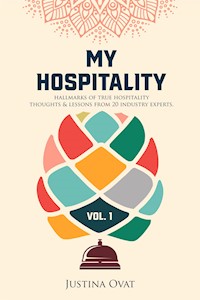
MY
HOSPITALITY
HALLMARKS OF TRUE HOSPITALITY: THOUGHTS & LESSONS FROM 20 INDUSTRY EXPERTS
JUSTINA OVAT
MY HOSPITALITY
WRITTEN BY
JUSTINA OVAT
COPYRIGHT (C) 2023
ALL RIGHTS RESERVED. No part of this book may be reproduced or transmitted in any form or by any means, electronic or mechanical, including photocopying, recording, or by any information storage and retrieval system, without written permission from the author or publisher.
Published by:
COMMUNE WRITERS INT’L
www.communewriters.com
+234 8139 260 389
6 Amusa Street, Agodo-Egbe, Lagos
Published in the Federal Republic of Nigeria
INTRODUCTION
The hospitality industry encompasses businesses involved in the provision of care, comfort, leisure, food, drinks, etc. These include businesses such as hotels, motels, fast food, restaurants, public houses, hostels, cafes, hospitals, old peoples’ homes, and prisons.
The industry also expands its coverage to industrial and institutional catering services, such as consultancy, tour and travel operations. And for the first time, the hospitality industry is including the aviation and transportation industries as part of its niches.
Anyone involved in caring for others is said to be in the hospitality business. This includes housewives whose aim may not be to make financial profits but to maximise the available resources in satisfying their numerous household needs.
Isn’t everyone in the hospitality industry?
— W. A. Babalola
As a passionate hospitality practitioner who is interested in raising quality manpower for the industry, I strongly believe that the sector’s success lies largely in the hands of the employees above all else. Not just any employee, but especially those who come in close contact with guests, and are responsible for interpreting the Standard Operating Procedures (SOPs) of the establishment. Ironically, I believe that what the hospitality industry lacks most is ‘hospitality’.
I battled with this reality for ages, pondering how best to communicate it to hospitality practitioners. Eventually, I stumbled upon John Montgomery’s research on the service industry. His research validated my fear - the industry is relenting in its efforts at ‘true hospitality’; hospitality that enhances interaction, taking it from a mere service to an unforgettable moment.
According to Montgomery, “Hospitality exhibits itself in interaction. It could be by checking in a guest, cleaning the guest’s room, taking a meal order in the restaurant, taking a beverage order in the lounge, or any other opportunity that may arise as a guest need.”
See your guest as a damsel in distress and see yourself as the knight who swoops in to save the day. You must assume that your guest is new to your facility and needs your assistance to navigate seamlessly.
As people spend more money on their experiences, they consciously, and sometimes subconsciously, expect more. Guests are not only expecting tangible accommodations. They expect the intangible experiences to also be unforgettable — those services that are taken to the next level. This is hospitality. This is where a hotel’s value comes from.
Example
A guest enters the reception of a hotel and proceeds to the front desk.
Front Desk Agent: Can I help you?
Guest: I have a reservation.
Front Desk Agent: Your name? I need an ID and a credit card.
From stepping through the entrance to receiving his key, the entire process may have taken 2-3 minutes. Although the front desk agent did his job — checking in the guest — the service is incomplete and lacks the essence of true hospitality.
To emphasise this inefficiency, one can ask some pertinent questions, such as, “was there an effort at ‘true hospitality’?” or “did the clerk take a minute or two to engage the guest?” The answers are obvious. If an effort at true hospitality was lacking, the hotel offered just another service, which makes no difference. We must always remember that hospitality exhibits itself in interaction.
Maya Angelou once said, “I’ve learned that people will forget what you say, people will forget what you did, but people will never forget how you made them feel.” In what reads like a hospitality industry iteration to Maya’s words here, John Montgomery writes: “What guests remember about a hotel is not just the service (the task that is expected), but the hospitality exhibited. They remember the smile and the care, those moments that made them feel like they belonged somewhere.”
It is against this background that this book is written. It captures the various experiences of professionals in the hospitality space while exploring what hospitality has come to mean to them. I expect students, hospitality practitioners, and everyone who loves and has a keenness for the industry to benefit from this book.
CHAPTER ONE
AN UNFORGETTABLE EXPERIENCE
My hospitality is a culture where the service experience is unforgettable for both you and the consumer.
— Amaka Amatokwe-Ndekwu
Profile: Amaka Amatokwue-Ndekwu is a dedicated, America-based hospitality professional who has worked with international and indigenous hotel chains for over 10 years. She has a proven history of good leadership, tenacity, and a strong drive. She is constantly contributing to reforms, advocating for Nigeria's hospitality and tourism industry's growth and socio-economic development. Her impact has earned her several nominations and an award from the Global Leadership Institute for her work and numerous contributions.
She obtained a Management Acceleration Programme (MAP) certificate from Lagos Business School, where she majored in Business Management and Marketing. She has a certificate in Business Management from the European School of Economics, London, and a bachelor’s degree in accounting from Madonna University, Okija, Nigeria. She holds an e-certification on Hotel Distribution Fundamentals from the ESSEC Business School and is a 2019 alumnus of The Castell Project Leadership Program, Atlanta.
Amaka is the Founder/President of Women in Hospitality Nigeria (WIHN). She started The Pyne Awards; the first hospitality and tourism awards in Nigeria. She is also a board member of various hospitality and tourism organisations, and a mentor with the Lagos Business School and the Cherie Blair Foundation for Women in Business, United Kingdom. She is a Tony Elumelu Foundation influencer and a partner with Interswitch Group on their payment system for hospitality and lifestyle companies.
What Hospitality, According to Amaka, Means to Me
When you hear the word hospitality, what comes to mind? Kindness? Care? The ‘Good Samaritan’ maybe?
I see hospitality as an unforgettable experience for both the service provider and the customer.
The culture in the way we approach situations has become a core value in various industries. From food to hotels, customers are seeking the best experience wherever they find themselves; whether on the Amalfi Coast in Italy or the busy streets of Victoria Island in Lagos. A customer’s experience (good or bad) could make or mar a business.
Example
Annabel is visiting Cancun for the first time. She is excited as she lands on the beautiful island of Mexico and is driven to her hotel. At the hotel, she finds that there is no one to assist with her luggage. ‘No big deal’, Annabel mutters to herself. Taking in the scenery of the beautiful hotel, she makes her way to the reception. She is treated rudely by the hotel staff, who could care less if she came from the ends of the earth to Mexico or just strolled down from her house for a quick weekend getaway. She is also left to ask for every piece of information, including the simple ones that could have been made available to her at the reception. Worse still, after booking her room, Annabel drags her suitcase up to her assigned room by herself, only to meet an unmade bed and a leaking toilet.
The hotel has made a lasting impression on Annabel. She does not think ‘maybe it’s just this hotel’ but assumes that all hotels in Mexico are the same. The services of this hotel have left a bad taste in her mouth. Guess what Annabel will do next? She will probably leave a bad review on the hotel’s website. When she is in a position to suggest exotic destinations for vacations, Cancun will probably not be on her list. Due to bad customer service, the hotel loses potential customers and, most likely, other potential Cancun tourists who could patronise their services.
Courteous treatment will make a customer a walking advertisement.
— James Cash Penney
James Cash Penny is an American businessman, famous for his numerous departmental stores around the United States. From the quote above, he believes that when a customer enjoys your service experience, you do not need to remind them to spread the gospel. They do it on their own accord.
Think about a time when you enjoyed exceptional service from a restaurant, hotel, or amusement park. Were you quick to recommend it to your family and friends?
Satisfied customers are great assets to any organisation, as no one has to pay them for advertisement. This is why organisations in the hospitality industry should spend time and resources to educate their staff on the importance of rendering exceptional services to both customers and potential customers.
Staff members are required to leave their attitudes at the door, wear a smile always, and be available to give their customers an experience of a lifetime. This is the reason hospitality practitioners have often been described as theatre artists.
An Unforgettable Experience for the Customers
We first listened to the customer and their expectations. Meeting those expectations means reducing friction and increasing the level of their experience.
— Michael Levie, Partner and CEO of CitizenM
Another way to increase the likelihood of customers having an unforgettable experience is by listening to them. How do they feel about the service you rendered to them? What do they require from you to enjoy their stay on a second visit? Would they recommend your services to someone else? When consumers feel they are listened to, it encourages them to give honest feedback, and an organisation can use this feedback to improve its service delivery.
There is a feeling of fulfilment when an organisation has a satisfied customer; they feel on top of the world, ready to conquer whatever obstacle lies ahead. As the popular saying goes, ‘happy wife, happy life’. In this context, the saying would be, ‘happy employees, happy customers, happy life’.
An angry customer can ruin your business. Just one bad publication from a customer can cause everything to crash. Therefore, organisations must listen to their customers and tweak their business model where necessary.
An Unforgettable Experience for the Employee
When employees are happy, they do their jobs to the best of their abilities. Just as employees need to make sure that customers get the best experience, organisations should also prioritise keeping their employees happy. This is possible through various means such as compensation for a job well done and a conducive work environment that gives them room to thrive.
Ironically, the employees who interface directly with customers are among the most underpaid people in the service/hospitality industry. Waiters/waitresses are paid below the minimum wage and rely on tips to fill the pay gap. This, primarily, is because there are no entry barriers into the industry. The majority of the employees are mainly unskilled and at the bottom of the food chain; therefore, they can be easily acquired as cheap labourers.
No matter how unskilled an employee is; when he is underpaid and unhappy, he brings that negative energy to work and passes it on to the customers; a typical case of ‘if you pay peanuts, you get monkeys’. This is not good for business.
In as much as organisations want their customers to be happy, their employees’ happiness should also be a priority. This is the second Return on Individuals (ROI); the first is caring for your customers. Ask your employees the same questions you would ask your customers: what can we do to make your stay with us a pleasant one?
However, employees should bear in mind that no organisation can meet every need. Compromises and adjustments have to be made by both parties to make the employee’s experience pleasant.
Charity Begins at Home
If a hospitality organisation wants to create an unforgettable experience for its customers, it must begin internally. An organisation cannot build a successful business if it does not practice what it preaches. The charity has to begin at home for a hospitality business to thrive.
I know that it may be difficult for the industry to reach the point where cheap labour is not leveraged. Still, the least we can do is ensure that we develop a solid selection process to bring in people who, first, are passionate about the industry, have the right temperament, are naturally polite, and possess the right disposition to serve.
One of the minimum requirements for recruitment into the hospitality industry should be empathy. According to Brooke Cade, “In the world of hospitality, creating deep connections with your guests is important. Your hotel is their home away from home, and making sure your guests feel comfortable and welcome is a vital part of the experience. Ensuring your guests have a positive and personalised visit depends strongly on the staff and how your establishment is being operated”.
Through empathy, people who work in the hospitality industry can provide better service and deeper connections with their guests. By putting yourself in your guest’s shoes, you will be able to anticipate their needs, deliver your services proactively, and develop new ideas to improve the overall hospitality experience.
Beyond trade skills, we should also hire based on life skills. Providing exceptional customer service experience is multidimensional and requires a constellation of skills, of which communication (interaction) is critical. The ability of employees to communicate with empathic and supportive words contributes largely to the positive interaction between them and the customers.
Because guests are interacting with staff, face-to-face conversations are standard in the hospitality industry.
— Brooke Cade
There has been some disturbing news making the rounds about the cruise industry lately. After years of research and careful analysis, they seem to be getting a lot of bad press. A November 2019 episode of Patriot Act with Hasan Minhaj revealed how the multibillion-dollar industry pays little attention to its customer’s needs and safety and underpays its staff who work crazy hours.
These reports made potential consumers reconsider the idea of taking their families to the sea during the holidays. Imagine the untapped market the cruise companies are missing due to bad employee/customer experience. As mentioned earlier, one bad publication can cause your business to slump.
Hospitality should be an unforgettable experience for both the employee and the customer. Hospitality starts from within. When an organisation invests in positive interactions from the inside out, it will thrive on all fronts.
CHAPTER TWO
CUSTOMER SATISFACTION
Hospitality is being able to predict and anticipate your guest’s needs. If you can get that right, half the battle of making their experience truly delightful is done.
— Dhiren Pawar
Profile: Dhiren Pawar is currently the Director of Operations at Hard Rock Café and Shiro. He holds a bachelor’s degree in Hotel Management. He has several years of experience in the food and beverage business.
How It Began
Ever since I can recall, I have been interested in the hospitality industry. This interest stemmed from my dad being an exceptional cook, with a keen sense of flavour, a nose for ingredients, and a penchant for taste, as well as the pleasure he derived from having a satisfied dinner guest. He could taste anything and replicate it. If you were not invited to my dad’s parties, you were missing out! In essence, I got my love and passion for hospitality from my dad, who got immense joy from entertaining people.
I pursued a diploma in Bakery and Confectionery at Food Craft India, Pune. I then joined one of the top colleges in India, the Welcome Graduate School of Hotel Administration (WGSHA), to do my bachelor’s in Hotel Management. That covered all aspects of leadership in the hospitality industry.




