


20,99 €
Mehr erfahren.
- Herausgeber: Robert Hale Non Fiction
- Kategorie: Geisteswissenschaft
- Sprache: Englisch
The Battle of Hastings is one of the key events in the history of the British Isles. This book is not merely another attempt to describe what happened at Hastings - that has already been done supremely well by many others - but instead to highlight two issues: how little we actually know for certain about the battle, and how the popular understanding of 14 October 1066 has been shaped by the concerns of later periods. It looks not just at perennial themes such as how did Harold die and why did the English lose, but also at other crucial issues such as the diplomatic significance of William of Normandy's claim to the English throne, the Norman attempt to secure papal support, and the extent to which the Norman and Anglo-Saxon armies represented diametrically opposed military systems. This study will be of great interest to all historians, students and teachers of history and is illustrated with 10 colour and 10 black & white photographs.
Das E-Book können Sie in Legimi-Apps oder einer beliebigen App lesen, die das folgende Format unterstützen:
Veröffentlichungsjahr: 2017
Ähnliche




















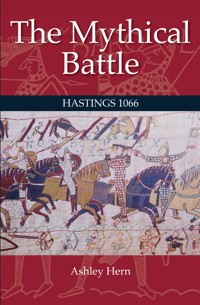
The Mythical Battle
HASTINGS 1066
Ashley Hern
ROBERT HALE
First published in 2017 by Robert Hale, an imprint of The Crowood Press Ltd, Ramsbury, Marlborough Wiltshire SN8 2HR
www.crowood.com
This e-book first published in 2017
© Ashley Hern 2017
All rights reserved. No part of this publication may be reproduced or transmitted in any form or by any means, electronic or mechanical, including photocopy, recording or any information storage and retrieval system, without permission in writing from the publishers.
British Library Cataloguing-in-Publication Data
A catalogue record for this book is available from the British Library.
ISBN 978 0 71982 476 0
The right of Ashley Hern to be identified as author of this work has been asserted by him in accordance with the Copyright, Designs and Patents Act 1988.
Contents
Acknowledgements
List of Illustrations
Introduction
1. Defending the Church
2. There’ll always be an England
3. An English Army?
4. Deconstructing the Armies
5. Reconstructing the Battle
6. The Arrow in the Eye
7. The Lost Battlefield
8. Locating the Battlefield
9. Mythologizing the Battle
10. Conclusion
Notes
Bibliography
Index
Acknowledgements
My sincere thanks go to Dr Glenn Foard of the University of Huddersfield, for generously sharing with me his research on his excavations at Hastings and his extensive experience of battlefield archaeology. Alan Larsen shared his enthusiasm for the battle and his unique insights into the culture of the Hastings re-enactments. Jack Edwards of University College, Oxford, kindly allowed me to look at his thesis on Danish settlement. The staff at the Battle of Bosworth Visitor Centre responded helpfully to my many enquiries. My colleagues in the History Department at the Manchester Grammar School have tolerated my distraction and mental absences while writing this book with their customary grace – particular thanks go to Simon Orth for reading some of the chapters. Alexander Stilwell has been a patient and supportive editor, and his perceptive comments have greatly improved the book.
This book would not have been possible without several years of teaching the Battle of Hastings to Sixth-formers at Manchester Grammar School, each of whom have subjected me to that idiosyncratic mixture of cynicism and curiosity that the British education system seems to provoke in later adolescence.
In many ways this book is also a testament to the inspirational history teaching of John Croasdell and Bill Reed, who eschewed modern teaching methods and instead used enthusiasm and an emphasis on knowledge and set me on the path to spending the majority of my life contemplating the past.
Above all else, I am grateful to Anne, Felix and Rufus for their love and encouragement.
List of Illustrations
Illustrations within the text (by Anne Crofts)
p.8. Map of England in 1066 with key location mentioned in the book.
p.23. Anglo-Saxon royal houses in the 10th and 11th centuries.
p.48. The English kingdoms of the Anglo-Saxon period, c. AD800–1066.
p.54. The aristocratic dynasties of Godwin of Wessex and Leofric of Mercia.
p.91. Anglo-Saxon soldiers: peasant militia or light infantry? From the Bayeaux Tapestry.
p.117. Traditional map of the battle’s locations with modern features.
p.138 The Montfaucon engraving of King Harold II of 1732.
p.139 The Stothard engraving of King Harold II of 1819.
Colour plate section
1. Stone marking the traditional site of King Harold II’s tomb at Waltham Abbey.
2. Rear view of Harold’s tomb (foreground) at Waltham Abbey in the shadow of the east end of the church.
3. Inscribed memorial stone marking the traditional location of Harold II’s death in the abbey church of Battle Abbey, which was moved in 2016. The outline of the now-demolished church can be seen marked on the grass in concrete and gravel.
4. Nick Austin’s proposed location of the battlefield at Crowhurst, East Sussex.
5. View of Caldbec Hill looking north from the Battle Abbey gatehouse
6. The south-facing slope of the traditional battlefield with the abbey at the summit of the hill, looking northwest to the English right flank.
7. The hill on the west side of the battlefield suggested as the site where the English victims of the ‘feigned retreat’ sought refuge.
8. Looking north to the slope towards Battle Abbey across the nineteenth-century fishponds.
Map of England in 1066 with key locations mentioned in the book.
Introduction
BEING FACTUAL
‘What is a fact?’ This is a question I often ask any Sixth-form student if they tell me that they want to study history at university. A look of bemusement on the student’s face usually results, an expression that seems to appear with increasing frequency as the years pass. ‘We know what a fact is, sir,’ they reply. ‘It’s what you always demand we put more of in our essays. Are you finally losing it, sir? We have had our suspicions for some time!’
After some cautious discussion, I can usually persuade them to humour me and we then collectively attempt to take an empirical approach to the matter.
‘What about the Battle of Hastings?’
There are nods of agreement. Like most school pupils in England, they studied this particular battle when they began their history education at secondary school. Some studied the battle at primary school; a few studied it again in their Sixth-form studies. Nor is this a parochial concern: teaching about the Battle of Hastings is a national phenomenon. History teachers, just like King Harold II, will never escape the battle unless they leave the classroom and ascend to greater things, like Duke William of Normandy.
Below is a composite version of a classroom exchange on this issue in the form of a dialogue (with apologies to Plato).
ME: Where did the battle take place?
PUPILS: Hastings, of course, sir!
ME: Did it?
PUPILS: Well, alright. It took place at Battle – but that’s near Hastings.
ME: So, why do we call it the Battle of Hastings then? One could argue that by the standards of modern warfare, it would not be considered a battle at all – it lasted a day and we can’t be sure how many people were fighting on both sides. The Battle of the Somme in 1916 involved millions of soldiers, resulted in hundreds of thousands of casualties and lasted for four months. Would it not be better to refer to what happened in 1066 as ‘a skirmish in Sussex’? Skirmishes can have devastating political consequences, after all. Look at Prince Llewellyn ap Gruffudd, whose death in a skirmish at Builth in 1282 heralded the conquest of Wales by Edward I of England.
PUPILS: But the battle led to the conquest of England. You can’t dismiss it as just a skirmish. We should call it the Battle of Hastings as that’s what people have always called it. It’s traditional. People know what you are referring to.
ME: Who decided this tradition? When did it begin?
PUPILS: We don’t know! Ask us another one.
ME: OK, so when was the Battle of Hastings actually fought?
PUPILS: 1066!
ME: What date?
ONE VERY BRIGHT PUPIL: Fourteenth of October? It was the anniversary a few months ago! [This conversation usually occurs in January]
ME: Officially – but that was according to the old Julian calendar. When this was revised and Britain was brought into line with the Gregorian calendar in 1752, the anniversary of the battle officially became the twenty-fifth of October. OK, what about the year 1066 – what dating system does this use?
PUPILS: The Christian dating system.
ME: Doesn’t this reflect one cultural perspective? According to the Islamic dating system, the year the battle took place was AH 459. In the Jewish calendar, the year was 4827. In the Mayan Long Count, the date was 0.12.0.0.18 ….
I will allow the rest of the scene to unfold in your imagination. Confusion and irritation are the two principal emotions this conversation provokes amongst my pupils, but before being accused of semantic pedantry and postmodern flippancy, there is a serious point to be made as part of a wider attempt to make my pupils think more critically about the information that they think they know. We believe that the Battle of Hastings is an important event because of the way our understanding of the past has been organized. The famous ‘Whig’ interpretation of history, which emerged in the eighteenth century, remained a standard view amongst professional historians well into the twentieth century. ‘Whig’ is the term given to a loose affiliation of individuals with common political beliefs that developed in support, amongst other things, of constitutional monarchy, the Hanoverian succession and parliamentary sovereignty. This viewpoint saw the Norman Conquest as the end of a ‘Golden Age’ in which native English customs of freedom and equality were destroyed by the oppressive rule of foreigners. For writers such as Thomas Macaulay and his successors, English history after 1066 consisted of a series of struggles to regain these lost freedoms, through Magna Carta, the Reformation, the Civil War and the Glorious Revolution of 1689.
This is, of course, nonsense. Anglo-Saxon England was not a paragon of proto-parliamentary sovereignty and freedom. According to Domesday Book, slaves made up between a tenth and a quarter of the rural population. The English law codes from the earliest surviving examples of the seventh century to those of Edward the Confessor all made it clear that status was the most important principle in assessing justice, not a universal conception of human rights. A landowner’s word was worth more than the word of someone of humbler origin, and the value in blood money compensation correlated to one’s social status. There was no equality before the law. Nevertheless, these romantic notions of the past are extremely potent because tradition is one of the most powerful means of legitimizing political ideas.
It is easy to spot when authoritarian regimes manipulate history to justify their rule. In modern China, the ruling Communist Party manipulates the history of the Sino-Japanese War (1937–45), which the party claims to have won for China, and keeps alive the memory of very real Japanese atrocities to stoke up nationalist feelings that distract popular anger from the corruption and scandal that dogs party rule. In 2016, the Russian President Vladimir Putin was acting very deliberately when, in Moscow, he unveiled a giant statue of another Vladimir, the prince of the Kievan Rus’ who adopted Orthodox Christianity (ruled 980–1015) and who is seen as the father of modern Russia; this Vladimir is also regarded by Ukrainians as the founder of Ukraine. Hence, unveiling a statue of the prince was a strong message explaining and justifying Russia’s determination to prevent Ukraine moving away from Russian influence on the grounds of their shared historical development.
We are less able to see when our own society behaves in a similar way. Interpreting the past through the lens of contemporary concerns is a universal aspect of human behaviour when we form complex societies. Contemporary debates about how society should change, or not, are reflections of what we believe about the past, whether those beliefs are positive or negative. Discussions over the future of the NHS reflect views towards its founding principles of the 1940s and whether they are relevant today. One’s position on Britain’s relationship with the European Union depends on one’s view of Britain’s record as a nation-state: is this something to be proud of or are supra-national institutions the future for human government? The Battle of Hastings is not an axiom. How it has been understood has been shaped and altered by the generations that followed.
The Battle of Hastings, 1066, remains a key date in British collective memory and an important part of the shared understanding of British history. It has been drummed into school-children as an easily memorable phrase and a major turning point in the story of Britain ever since a national education system was created in the late nineteenth century. This was, in turn, a product of the creation of university history courses, which primarily focused on the history and evolution of the British constitution. It was the earlier Whig belief that the Battle of Hastings had introduced important changes by paving the way for the subsequent Norman Conquest that was refined and documented in a more systematic way by the likes of Bishop Stubbs. Stubbs’ Constitutional History of England (3 vols, 1874–78) was one of the foundational texts of the History School at the University of Oxford that has shaped subsequent debate, whether through acceptance or rejection. The battle has never failed to find an audience from the medieval period through to the 900th anniversary, which was marked by a series of celebrations across England and a new wave of television documentaries, heritage events, newspaper columns, and reprinted editions of numerous academic and more popular history books that have been written in the past few decades. However, the question remains: what do we actually know about the battle itself? Is our knowledge of it entirely derived from the concerns of the present?
We tend to think of history as events that have happened in the past, but the more one attempts to study these events, the more one realizes how elusive the key details are. Human history is never preserved intact, but is reflected through a series of individual experiences, which are recorded directly or indirectly through written and oral records. An historian has to sift through this mass of confusing, and often contradictory, information in an attempt to reconstruct what they believe to be the most feasible interpretation, taking into account the more obvious attempts by those who would prefer a certain interpretation favoured. The Battle of Hastings was one of those events where an official version became imperative. Our most detailed source, the Norman author William of Poitiers, can be considered to have been writing what would today be recognized as propaganda. There are many problems with the use of that word for the eleventh century, but whatever the size of the reading public then, it seems clear to me that authors such as William of Poitiers were writing with posterity firmly in their sights. William had studied the classics and was impressed that he could know of the deeds of Julius Caesar a millennium after they occurred; he was determined that a similar fate should befall his patron, Duke William of Normandy – and in many ways William of Poitiers succeeded.
The other key word in this book’s title is ‘mythical’, from ‘myth’. ‘Myth’ is often misused in historical writing as a simple synonym for ‘false’ or ‘untruth’; sometimes even a ‘lie’. While the aphorism that ‘the first casualty of war is truth’ is a useful corrective when dealing with official accounts of conflict, one has to be careful not to base one’s entire epistemology upon such a phrase. ‘Myth’ is a polymeme – a word with multiple meanings. Theorists have disagreed over the word’s precise meaning ever since the subject became grounds for intellectual investigation in the nineteenth century. At this point, the focus, led by pioneers such as J.G. Frazer, was on the physical world and myths were believed to function as a way of explaining this. Myth was thus the counterpart to modern science and had no place in modernity. In the twentieth century, anthropologists and other social scientists began to broaden the term beyond the limitations set by this narrow definition, and increasingly read it symbolically as a way to understand how society functioned or human psychology. My definition is to see a myth as the way that an event is remembered and adapted to place the differences and similarities of the past, and understand it through immediate human experience. This transforms a single episode into a narrative that becomes a credo or cherished conviction. The idea of ‘rags to riches’ in the United States of America is a myth, which exists independently of any particular story or reality. Nevertheless, it is a myth that many Americans believe in, even if its validity is challenged. The story can be true or false, but it must have a powerful hold over its adherents. As we will see, our understanding of the Battle of Hastings has been deeply shaped by its ever-evolving mythical nature.
This book is, therefore, more than merely another attempt to reconstruct a narrative about what happened at Hastings that day in October in 1066. This has already been done supremely well by several other authors. Instead, this book is an attempt to highlight two issues: how little we actually know for certain about the battle, and how the popular understanding of the battle has been shaped by the debates and concerns of later periods. This is important as there are certain debates about the Battle of Hastings that are perennial, reoccurring regularly in the modern media when the topic is discussed: how did Harold die and why did the English lose?1 There are a variety of possible answers to these questions, but while assessing the interpretation that best suits the evidence is fundamental, it is also crucial to examine the context for the alternative answers that have been proposed.
The other issues that will be discussed in this book include the diplomatic significance of Duke William of Normandy’s claim to the throne of England and the Norman attempt to secure papal support for this claim. The major issue here is the way that William – to use a term with contemporary resonance – created a ‘dodgy dossier’ to bolster his military support and how that shaped Norman representations of the battle. Another issue is the extent to which the Norman and Anglo-Saxon armies represented diametrically opposed military systems. The usual view is that the battle represented a conflict between cavalry and infantry, heralding three centuries of the dominance of the horseman over the foot-soldier that would only end in the fourteenth century. Finally, the book will examine the way in which the battle has become woven into the established narrative of British history, and the changing role it has played as a perceived turning point in the national story.
That this can be claimed to be a ‘British’ story is problematic. I grew up in Scotland and it was attending primary school when I first came across the story of Hastings. The vagaries of memory make reliance on such anecdotes difficult, but I seem to remember a teacher consciously drawing out the contrasting significance of the battle for those of English descent in the class as opposed to those whose families had their origins in Scotland. This can be seen in the reactions of contemporary authors. The Welsh Chronicles of the eleventh century make little of the events of 1066: they are dealt with in one sentence by the Brut chronicler of West Wales. A contemporary, the Irish author of the Annals of Innisfallen, does not mention it at all. For both authors, the year 1093 was far more significant, for in that year the Normans killed Rhys ap Tewdwr, king of Deheubarth (or South Wales), while in the north of Britain Malcolm Canmore, king of the Scots, died with his eldest son, Edward, in an ambush by Robert de Mowbray, the Norman earl of Northumbria. Some Scottish historians agree there was a ‘Norman Conquest’, but interpret this as a peaceful assimilation of northern French aristocrats by the Scottish monarchy in the twelfth century as part of a strategy to maintain a degree of political autonomy from England.2 This academic scepticism is also reflected in popular opinion. A recent survey showed that only 64 per cent of respondents in Scotland felt the Norman Conquest was significant as opposed to 83 per cent in England.3 While clearly there is variation, the acknowledgement of over two-thirds of respondents shows that the Battle of Hastings still plays a part in the country’s collective memory. The main problem is that most people have little contextual knowledge of what came before and only slightly more awareness of what came afterwards.
Even the notion of ‘Englishness’ is not straightforward. We use the short-hand terms of ‘English’ and ‘Norman’ to describe the main political units involved in the story, but fail to appreciate how problematic these terms are. Both terms were used by the priests and monks who wrote our history to convey a sense of a distinctive people who probably did not exist in reality. R.H.C. Davis’ famous book The Normans and their Myth, published in 1976, represented a devastating assault on the nation of a distinctive ‘Norman’ contribution to European history. Harold Godwinson is often referred to as the ‘last English king’, but this idea depends on a rather selective view of ‘Englishness’. Harold was not part of the royal house of Wessex, which had ruled a kingdom ‘of the English people’ since the ninth century, and which arguably was really a Greater Wessex rather than England as we understand it today. This was Edward the Confessor, who had spent most of his adult life in Normandy and probably spoke French as his first language. Harold had a Danish mother and a Danish name, having been part of a family that rose to power under the dynasty created by Cnut, the king of Denmark who conquered England in 1016. When Duke William of Normandy became king of England after the battle, this event is usually portrayed as a rupture in the chronology of the English monarchy; in fact, it was in itself nothing extraordinary. The notion of Englishness itself evolved after the Conquest, and within a generation the descendants of the Norman conquerors identified more with the territory they had taken over than with the land their families came from. The term ‘Anglo-Saxon’ is itself a relatively modern coinage and would have meant little to anyone standing in the vicinity of the battle in October 1066.
Thus, the most illuminating thing we can learn from the Battle of Hastings is what it tells us about the evolution of our collective identity and the relationship of England – and, more broadly, Britain – in relation to Europe and the wider world. It has been suggested that the battle is merely a footnote in British history and plays quite a different role from other battles, such as the Battle of Kosovo in 1389, which has played such a central part in Serbian identity, to the extent that it has fundamentally shaken the geopolitics of the Balkans since the late 1980s by facilitating the rise of Slobodan Milosevic. While it is certainly true that the Battle of Hastings has not produced a comparable reaction of such visceral intensity, I will suggest that the difference is not as great as it first appears.
THE SOURCES
We possess more information about the Battle of Hastings than almost any other medieval battle, but our sources are not straightforward and their interpretation has been subject to considerable debate. Medieval history writing came in a range of different forms, from those written in careful Latin using classical models taken from Roman historiography, to vernacular poems using strings of staccato sentences that barely use any grammatical rules. While much of the work strictly contemporary to 1066 was written by monks, the cloister lost its monopoly during the twelfth century and secular clergy (i.e. priests) became increasingly involved in producing historical writing on behalf of aristocratic patrons who were interested in their families’ past. When discussing the medieval world, we often use the term ‘chronicler’ to be synonymous with ‘historian’, though there was a formal difference. The monastic historian Gervase of Canterbury, writing c. 1200, made a famous distinction between the two: chroniclers compiled a chronologically correct order of events while historians were there to ‘instruct truthfully concerning the deeds, manners and the life which he describes’. Gervase had to admit, however, that in practice, ‘the intention of each was the same, for each seeks the truth’.
As with the modern professional study of history, medieval writers were very concerned with presenting the truth about the events they described. The modern understanding of truth is conformity to fact, by which we mean exactitude, precision, correct chronology, accurate names, dates and places. This was something that historians living in the Middle Ages also strived for. Usually, they would outline their qualifications for writing in a prologue. In the introduction to his ‘Deeds of the Norman Dukes’, the eleventh-century Norman historian William of Jumièges explained that he had gathered material:
partly related by many persons trustworthy on account equally of their age and their experience, and partly based on … what I have witnessed myself.
However, history in the medieval world did not exist simply to preserve information; history possessed a moral function and was a didactic tool. There were certain deeper ‘universal truths’ that could be deduced from every event in the past and which were just as important to elucidate as simply list a dry factual account. This is a particular issue when it comes to battles. Medieval chroniclers undoubtedly were keen to present ‘facts’ about the different engagements they described, in terms of number, principal manoeuvres, tactical decisions and casualties, yet most accounts in surviving texts are very similar.4 Victorious armies always maintain good discipline as they approach the battlefield and arrive in order under a unified and purposeful command, which maintains strict discipline, devoutly subjecting themselves to the arbitration of God. At the last minute, a rousing speech by the leader will prepare the men for the ordeal ahead. In contrast, the defeated armies are always ill-disciplined in the run-up to the battle, and arrive in confusion due to the divisions and uncertainties of their commanders, whose quarrelling or irresolution undermines any advantages they originally had. It is clear, therefore, that medieval authors followed a formula that allowed them to reveal deeper, universal truths about battles and the way that men ought to approach them and how they ought to conduct themselves. A battle was not just an event to be described, but an exemplar for emulation by others.
The most famous evidence that survives for Hastings is primarily visual: the Bayeux Tapestry. This 70-metre long embroidery was produced soon after the battle, possibly being associated with the dedication of Bayeux Cathedral in 1077, though much about its production is obscure. It plays a key role in any understanding of the Battle of Hastings, as the second part of the tapestry’s narrative is dedicated to the campaign and its denouement at Battle. As such a rich and unique source, full of images rarely accessible to the medieval historian, it has been the subject of exhaustive study, which can be seen in the enormous bibliography that accompanies any study. Even in the last decade, at least three large collected volumes of essays have been produced on the basis of conferences dedicated to the Bayeux Tapestry.5 There is still no consensus on who produced it and what its message actually was. The traditional belief was that it had been commissioned by William’s wife Matilda, but more recently some historians favour William’s half-brother, Odo of Bayeux, due to his very prominent role in the narrative; and, again, others have suggested Eustace of Boulogne may have been responsible. The location of its production is also disputed, with candidates including Bayeux in Normandy and Canterbury in England. The usual argument is that the source reflects an interpretation that is favourable to the Normans, given that it supports the story of Harold’s journey to Normandy and the swearing of an oath to William that is found in contemporary Norman accounts and not in Anglo-Saxon sources. On the other hand, it is possible to argue that Harold is portrayed in a sympathetic light as a heroic figure, which reflects certain aspects of his claim to legitimacy, such as receiving Edward’s deathbed approval and his acclamation by the Anglo-Saxon council or Witan in Harold’s coronation scene. Establishing anything certain about the tapestry is very difficult.
The best English source that reproduces views contemporary to the battle is the Anglo-Saxon Chronicle. This work is of crucial importance for English history as it provides a chronological framework for the Anglo-Saxon period that we would otherwise lack. The title is misleading as it is not one text but a series of annals that were constantly read, edited and updated well into the twelfth century. There are seven different manuscripts – assigned the letters ‘A’ to ‘G’ by scholars – but these only represent a small proportion of those that would have existed. They originate with a chronicle produced in the 890s, probably produced by the Wessex court of Alfred the Great and then sent to different religious houses for copying. The relationship between the different versions is complex and the subject of much scholarly argument.
There are three recensions that deal with the events of 1066: the ‘C’, ‘D’ and ‘E’ versions. Version C dates to the mid-eleventh century and contains entries relating to the monastery at Abingdon, though establishing that this was where it was written is very difficult. Both Versions D and E derive important information from a text that is concerned with the history of Northumbria, the so-called ‘northern recension’, but we cannot be sure that the text was actually composed in the north. This reflects the attempts of the southern-based English kings to extend their control into the north in the late tenth century onwards. Version D was produced either at York or Worcester, probably during the episcopate of Ealdred, who held both offices in plurality. It has strongly been argued by several scholars to have been composed very soon after 1066, though several later events were later interpolated into it. The final version (‘E’) was written in Peterborough from 1121 to 1154, but the main text was composed at St Augustine’s monastery in Canterbury around 1066. These laconic accounts are invaluable as a corrective to the florid Norman versions, but have their own problems of interpretation as they often describe events in a cryptic manner, which suggests wider circumstances that would be understood by contemporaries but which have been lost to us. Their different regional perspectives are invaluable as they reflect the political debates of the period rather than presenting a monolithic view of the past. This can be seen most particularly in the years 1035– 66 where Version C shows marked preferences for the family of Earl Leofric of Mercia while Version E favours Earl Godwin of Wessex and his family.
We have two Norman sources written within a decade of the battle. The first of these, Gesta Normannorum Ducum (‘Deeds of the Dukes of Normandy’), was finished in 1060 by the monk William of Jumièges. This was an update of an earlier work on the origins of the Norman duchy by Dudo of St Quentin (965–1026). Unlike Dudo, who had composed his work at the request of Duke Richard the Good (996–1026), there is no evidence that William of Jumièges wrote his work at the direct command of Duke William, though we know that it was in response to a ducal request that he extended his account to cover events leading up to 1070, and includes his account of the Battle of Hastings. This implies that the purpose of the Gesta Normannorum Ducum was the legitimization of the ruling duke, which strongly affects the reliability of its narrative.
A second source, Gesta Guilelmi ducis Normannorum et regis Anglorum (‘Deeds of William, Duke of the Normans and King of the English’), was finished c. 1071 by William of Poitiers, who originally trained as a knight and served Duke William as a chaplain before entering a monastery. William of Poitiers’ military experience has been used to suggest that his account of the Battle of Hastings – the most detailed contemporary version we possess and the source of most of the details used by historians – is realistic. His account is clearly written with the aim of magnifying William’s achievements, and its heavy use of classical models from the Latin literature of imperial Rome means that there is a fundamental question over whether his account is actually an attempt to compare William with ancient heroes such as Julius Caesar. John Gillingham has famously characterized the work as being ‘nauseatingly sycophantic’ in its treatment of Duke William. It is such an important source that most scholars are willing to accept its fundamental reliability, but this is a dangerous assumption. While both accounts do portray William in different ways, ultimately these authors need to be treated with considerable caution given that they are deeply entwined with William’s diplomatic initiatives and attempts to bolster his image as the divinely sanctioned, legitimate ruler of England.
A third detailed narrative that survives is the Carmen de Hastingae Proelio (‘the Song of the Battle of Hastings’). This work has been subject to intense debate. R.H.C. Davis famously rejected the Carmen in the late 1970s, arguing that it is a literary exercise from one of the schools of northern France or southern Flanders and written between 1125 and 1140. Its champions have argued that it is a contemporary account written by Bishop Guy of Amiens around 1068. Frank Barlow has recently argued strongly in favour of its authenticity and that it was a source for William of Poitiers, while L.J. Engels has pointed out that the poem addresses Duke William as a living person, thus implying that the work is contemporary. The debate remains deadlocked. What is useful about the Carmen is that it is not a straightforward account from a Norman perspective and so provides a corrective to the views of William of Poitiers and William of Jumièges. This is best illustrated in the different treatment of Eustace of Boulogne, who is portrayed as the hero of the Carmen, whereas in William of Poitiers he is portrayed as a coward.
There are other sources that date from the late eleventh and twelfth centuries that we will use – sources such as the accounts of John of Worcester, Eadmer of Canterbury, Orderic Vitalis, William of Malmesbury, Henry of Huntingdon, Gaimar and Master Wace, but these are all written later and essentially use the sources we have already discussed for the bulk of their material. Thus, they are far more useful as evidence for how the battle was perceived in subsequent decades rather than as evidence for the battle itself, and we shall focus on this, particularly in the second half of the book.
CHAPTER 1
Defending the Church
BEING AWARE OF BIAS
A particular vice of some historians of the pre-modern world is their use of the word ‘propaganda’ when discussing the presentation of information that reflects an attempt to present events in a way that is politically advantageous. Some modern authors have even argued that monastic chroniclers can be seen as ‘spin doctors’ and their abbots were, therefore, the ‘press barons’ of the period.6 Framing the past in a way we can understand is perfectly commendable, and our contemporary world constantly witnesses information being shaped to fit narratives for political, commercial or cultural purposes that, as good citizens, we must be conscious of. But our world is also very different as it operates in a context of mass literacy and an instantly accessible mass media, which was certainly not the case in the eleventh century. Our language reflects the way we classify the world and reflects our specific cultural viewpoint (e.g. the UK in the early twenty-first century). It would, therefore, be both misleading and arrogant to transpose this viewpoint onto other cultures rather than attempt to appreciate those cultures on their own terms. Carelessness causes misunderstanding. Reading Ian Sharman’s attempts to present medieval popes as the Rupert Murdoch of their day would appear to reflect the transient concerns with the political and media culture of the first New Labour government (1997–2001) more than it helps us to understand a remote past.
Lesen Sie weiter in der vollständigen Ausgabe!
Lesen Sie weiter in der vollständigen Ausgabe!
Lesen Sie weiter in der vollständigen Ausgabe!
Lesen Sie weiter in der vollständigen Ausgabe!
Lesen Sie weiter in der vollständigen Ausgabe!
Lesen Sie weiter in der vollständigen Ausgabe!
Lesen Sie weiter in der vollständigen Ausgabe!
Lesen Sie weiter in der vollständigen Ausgabe!
Lesen Sie weiter in der vollständigen Ausgabe!
Lesen Sie weiter in der vollständigen Ausgabe!
Lesen Sie weiter in der vollständigen Ausgabe!
Lesen Sie weiter in der vollständigen Ausgabe!
Lesen Sie weiter in der vollständigen Ausgabe!




