


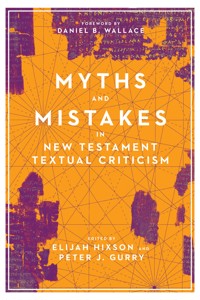
Myths and Mistakes in New Testament Textual Criticism E-Book
Erhalten Sie Zugang zu diesem und mehr als 300000 Büchern ab EUR 5,99 monatlich.
- Herausgeber: IVP Academic
- Kategorie: Religion und Spiritualität
- Sprache: Englisch
Biblical Foundations Award Finalist and Runner Up Since the unexpected popularity of Bart Ehrman's bestselling Misquoting Jesus, textual criticism has become a staple of Christian apologetics. Ehrman's skepticism about recovering the original text of the New Testament does deserve a response. However, this renewed apologetic interest in textual criticism has created fresh problems for evangelicals. An unfortunate proliferation of myths, mistakes, and misinformation has arisen about this technical area of biblical studies. In this volume Elijah Hixson and Peter Gurry, along with a team of New Testament textual critics, offer up-to-date, accurate information on the history and current state of the New Testament text that will serve apologists and Christian students even as it offers a self-corrective to evangelical excesses.
Sie lesen das E-Book in den Legimi-Apps auf:
Seitenzahl: 849
Veröffentlichungsjahr: 2019
Das E-Book (TTS) können Sie hören im Abo „Legimi Premium” in Legimi-Apps auf:
Ähnliche




















To our teachers
Contents
LIST OF FIGURES AND TABLES
FIGURES
1.1
P.Oxy. 83.5345
1.2
7Q5
2.1
P.Oxy. 18.2192
2.2
P.Mich.inv. 1436
2.3
P.Mich.inv. 1440
3.1
Greek New Testament manuscripts by century for first millennium
3.2
Greek New Testament manuscripts by contents for first millennium
3.3
Greek New Testament manuscript contents by century
3.4
Percentage of Mark’s Gospel preserved
3.5
Percentage of John’s Gospel preserved
5.1
GA 1415 (Athens, National Library of Greece, Ms. 123), f. 189r
5.2
P.Ryl. 16
5.3
Comparison of P.Ryl. 16 and scribe A of Codex Sinaiticus
6.1
Genealogy of minuscule 1739
6.2
Genealogy of 1582
6.3
Genealogy of 2138 and close relatives
6.4
Genealogy of Family 13
8.1
Revelation 1 in Codex Montfortianus
8.2
Mark 1:1 in Codex Sinaiticus
8.3
P.Köln VI 255
14.1
Codex Bobiensis
14.2
GA 05, MS Nn.2.41; Codex Bezae f. 133v
14.3
GA 05, MS Nn.2.41; Codex Bezae f. 134r
14.4
Sinai syr. NF 37, f. 2v
14.5
BnF ms. syr. 296, no. 1º
14.6
BL Or. MS 5707
TABLES
6.1
Primer on textual tendencies of important minuscule manuscripts
13.1
Manuscripts with Matthew and other Gospels or Acts
13.2
Manuscripts with Matthew and books outside New Testament
13.3
Manuscript with Mark and John
13.4
Manuscripts with Luke and John or Luke and books outside New Testament
13.5
Manuscripts with John and books outside New Testament
13.6
Manuscripts with four Gospels (and Acts)
13.7
Manuscripts with Pauline Epistles
13.8
Manuscripts with Pauline Epistles and non-Pauline books or material
13.9
Manuscripts with Acts and Catholic Epistles
13.10
Manuscripts with Catholic Epistles or Catholic Epistles and non-New Testament books
13.11
Eastern canon lists up to AD 400
13.12
Latin canon lists up to AD 400
FOREWORD
Daniel B. Wallace
WE NO LONGER LIVE IN A BLACK-AND-WHITE WORLD. We never did really, but those who are embroiled in debates about the Bible have often viewed things in such binary hues. These achromatic ideologies can be found on both sides of the theological aisle.
Many who have abandoned the unreflective beliefs they grew up with now cling—just as unreflectively—to unmitigated skepticism toward the New Testament text. The Dan Browns and Kurt Eichenwalds of our world can liken, with a straight face, the scribal copying of Scripture to the parlor game of Telephone. To them, the text has been corrupted so badly that attempting to recover the original wording is like looking for unicorns. It’s an impossible task because the search is for something that does not exist.
On the other hand, some apologists for the Christian faith speak of (nearly) absolute certainty when it comes to the wording in the New Testament. And laypeople routinely think of their Bible as the Word of God in every detail. They are blissfully unaware that Bible translations change—because language evolves, interpretations that affect translation become better informed (and all translation is interpretation), and the text that is being translated gets tweaked. Biblical scholarship is not idle. Yet even the publisher of the ESV translation, extremely popular among evangelicals, contributed to this fictive certitude when it declared in August 2016 that “the text of the ESV Bible will remain unchanged in all future editions printed and published by Crossway.” The next month it admitted, “This decision was a mistake.”1 When a publishing house tries to canonize its Bible translation, what does this say to the millions of readers who know nothing of Greek, Hebrew, or Aramaic?
These two attitudes—radical skepticism and absolute certainty—must be avoided when we examine the New Testament text. We do not have now—in our critical Greek texts or any translations—exactly what the authors of the New Testament wrote. Even if we did, we would not know it. There are many, many places in which the text of the New Testament is uncertain. But we also do not need to be overly skeptical. Where we should land between these two extremes is what this book addresses.
The new generation of evangelical scholars is far more comfortable with ambiguity and uncertainty than previous generations. They know the difference between core beliefs and those that are more peripheral. They recognize that even if we embrace the concept of absolute truth, absolute certainty about it is a different matter.
One word kept coming to mind as I read this book: nuance. The authors understand what is essential and of vital significance in the Christian faith and what is more peripheral. As Stephen Neill argued over fifty years ago and Peter Gurry affirms in this book, “The very worst Greek manuscript now in existence . . . contains enough of the Gospel in unadulterated form to lead the reader into the way of salvation.”2 Andrew Blaski shows that the patristic writers, too, recognized this. Origen, whose concern to recover the original wording of the Bible was worked out with indefatigable exactness, had an even deeper concern. Many Fathers understood that the New Testament—highly valued, revered, even apostolically authoritative—nevertheless pointed ultimately to what is more revered, more authoritative, and more central to our faith: our God and Savior, Jesus Christ.
THE CHASM BETWEEN SCHOLARS AND APOLOGISTS
The authors in this book offer a necessary corrective to decades of overly exuberant apologetic arguments—arguments that have actually hurt the Christian faith. The writers are refreshingly honest, and they do not pull their punches. They observe poignantly that apologetic works on the reliability of the New Testament text have been drifting away from a proper, well-researched, accurately documented scholarship that is anchored to actual data. Apologists have had a tendency to regurgitate other apologetic works, which in turn are based on other apologetic works. Meanwhile, the scholarship that is supposedly behind the popular declarations in many an evangelical trade book is out of date, misunderstood, or simply ignored.
A classic example of the disconnect between scholarship and apologetics is how textual variants are (mis)counted. A steady stream of apologists for more than half a century have been claiming that variants are counted by wording differences multiplied by manuscripts attesting them. Neil Lightfoot’s How We Got the Bible, a book first published in 1963 and now in its third edition with more than a million copies sold, seems to be the major culprit.3 Lightfoot claims:
From one point of view it may be said that there are 200,000 scribal errors in the manuscripts, but it is wholly misleading and untrue to say that there are 200,000 errors in the text of the New Testament. This large number is gained by counting all the variations in all of the manuscripts (about 4,500). This means that if, for example, one word is misspelled in 4,000 different manuscripts, it amounts to 4,000 “errors.” Actually, in a case of this kind only one slight error has been made and it has been copied 4,000 times. But this is the procedure which is followed in arriving at the large number of 200,000 “errors.”4
The only problem with this statement is that it is completely wrong. Chief among the errors, as Elijah Hixson and Peter Gurry point out, is that textual critics “are not counting the number of manuscripts that attest a variant; we are counting the number of variants attested by our manuscripts.” If variants were actually counted the way Lightfoot suggests, the number of variants among the Greek New Testament manuscripts would be in the tens of millions. That this miscalculation has seeped its way, unchecked, into several apologetics books for more than five decades is a telling indictment on the uncritical use of secondary sources by many in this field.
An example of using out-of-date statistics is found in the comparative argument—that is, the argument that compares the number of New Testament manuscripts with those of other Greco-Roman authors. As James Prothro notes, several popular apologists have claimed that there are only 643 manuscripts of Homer’s Iliad. This number got into apologists’ hands, according to Prothro, most likely via a technical book Bruce Metzger authored in 1963. But Metzger repeats the same number of Iliad manuscripts in the far-more-accessible first (1964), second (1968), and third edition (1992) of his The Text of the New Testament. The fourth and latest edition (2005), coauthored with Bart Ehrman, continues to speak of only 643 manuscripts for the Iliad! It is not just apologists, then, but sometimes even top-flight scholars who have added to text-critical myths. On the other hand, in the latest edition of Evidence That Demands a Verdict, published in 2017 and coauthored with his son Sean, Josh McDowell did his due diligence to update the number of Iliad manuscripts by consulting classicists and the Leuven Database of Ancient Books—exactly the right approach.
Other myths that are often touted get some schooling. Jacob Peterson goes into impressive detail on why the “official” number of Greek New Testament manuscripts (i.e., the tally made by adding all the catalogued numbers of papyri, majuscules, minuscules, and lectionaries by the Institut für Neutestamentliche Textforschung), often cited as the actual number, is way too generous. But the stats are not static. Peterson commends the work of the Center for the Study of New Testament Manuscripts for adding significantly to our fund with its digitizing of dozens of newly discovered manuscripts.
Gregory Lanier bursts some bubbles about the supposed inferiority of later manuscripts, as though age necessarily corresponds to intrinsic value. He adds that even the later Byzantine manuscripts speak well of “the fidelity of the entire textual tradition.” Lanier gives a quite helpful table on the most significant minuscules and, in the spirit of Günther Zuntz, puts forth diagrams that illustrate many facets of transmissional fidelity.
The number of versional manuscripts (those written in other than Greek) has been routinely specified without documentation by apologists and some scholars. Jeremiah Coogan reels back the sensationalism and grounds the numbers in what is known. He also addresses some key issues in what the versions can and cannot do to aid us in recovering the autographic wording of the Greek New Testament.
Demonstrating sensitivity to the priorities of scholars, translators, and faith communities, Edgar Ebojo discusses the dialogue that takes place behind the scenes. The scholarly guild has a say, but it is not the only say in how translations should look and what texts should be included in the translation.
MYTHS AND MISTAKES MADE BY SCHOLARS
Hixson and Gurry tell us that the authors of this book “write primarily as a self-corrective to Christian speakers and writers.” As I was perusing the manuscript, I came to the conclusion that the editors have defined their readership too narrowly. Precisely because the contributors are up-and-coming scholars—with PhDs (earned or in process) from Birmingham University, Cambridge University, Dallas Seminary, University of Edinburgh, New Orleans Baptist Seminary, University of Notre Dame, and Southern Baptist Seminary—they are up to date on the state of their disciplines. Many have written their doctoral theses on the very topics they explore in this book. These young scholars have something to say—not only to Christian speakers and writers but to non-Christian speakers and writers, and even to New Testament scholars of all stripes.
I have been working for several years on an introduction to New Testament textual criticism. Many of the topics discussed in Myths and Mistakes are those I have felt needed some treatment in such an introduction. I was happily stunned to see the depth of discussion, the candid examination, and the up-to-date bibliography in each chapter. Although Myths and Mistakes is written in clear, user-friendly prose, the contents are well grounded and perspicacious. I intend to use this volume unapologetically in my introduction as a primary source for several analyses.
There are no sacred cows here. Occasionally, even scholars who have delved into the realm of apologetics have been a bit too enthusiastic, naive, or biased. All of us can learn something from this volume. Craig Evans’s view on the longevity of the autographs is perceptively analyzed by Timothy Mitchell; Michael Kruger’s link between canon and codex is critiqued by John Meade; Philip Comfort’s early dating of papyri is challenged by Elijah Hixson; and I am not immune from censure. Chief among such criticisms (but by no means the sole issue) is my mention of a first-century fragment of Mark’s Gospel in one of my debates with Bart Ehrman. I had it on good authority that the date was firm and that the papyrus would be published in a year. But at the time I had not seen the manuscript, which should have been critical for me in making any statements about its date. Six years later (!) the fragment was published (April 2018), and it turned out not to be from the first century but was dated to the second or third century by the editors.
Bart Ehrman, a first-rate scholar and an outspoken skeptic about recovering the original New Testament text, comes in for some specific criticisms too. His “early orthodox corruptions” are seen to be less frequent and less severe when Robert Marcello applies a more rigorous method to some key textual problems.
Ehrman’s claim that the early scribes were not professionally trained and therefore did not make careful copies is handled by Zachary Cole. Ehrman’s view is overly simplistic, presenting a multicolored reality as black and white, and is often factually wrong.
Peter Malik boldly takes on E. C. Colwell, whose studies on method are legendary, by documenting corrections in papyri that “show that scribes strove to improve and revise their work before they handed it to posterity.” It is not just what the scribe originally penned but the corrections he or she made to the codex before releasing it to other readers that demonstrate this care.
REQUIEM FOR A DISCIPLINE?
Forty years ago, Eldon Epp published a disturbing article in the Journal of Biblical Literature, in which he predicted the end of text-critical studies in America. “New Testament Textual Criticism in America: Requiem for a Discipline” canvasses the trends of a downward spiral pertaining to detailed study of the text and the lack of opportunity for writing a dissertation in textual criticism.5 He concluded his essay with this gloomy outlook: “I may have pushed too far the figure of speech in the subtitle of this paper when I chose the expression, ‘Requiem for a Discipline.’ Yet, that ominous eventuality is all too likely should the clear trends of the recent past continue even into the near future.”6
Just a decade back, the field appeared almost desolate. At a two-day colloquium held in August 2008 at the Institut für Neutestamentliche Textforschung in Münster, at most a few dozen New Testament textual scholars were present.7 I inquired from one of the organizers of the event about the list of those invited. She informed me that all textual critics worldwide were on the list and that only one had declined the invitation. To be sure, the American representation had improved since Epp’s requiem, but the numbers were still small.
Samuel Clemens, when rumors that he was on his deathbed were circulating, wrote, “The report of my death was an exaggeration.”8 The same can be said of American—as well as international—scholarship in New Testament textual criticism. A sea change has transpired in the last ten years. Not all the contributors to Myths and Mistakes are Americans, of course, but most are. Further, evangelicals in particular have dedicated themselves to this discipline.
Epp spoke of “the growing lack of concern and support for NT textual criticism in America.”9 I was finishing my ThM degree when he wrote these words. As I’m sure that several other graduate students did, I took his requiem to heart. It was a sobering and swift kick in the derrière! I am delighted to report that, forty years later, the scenery has improved markedly. Four of my former students have contributed to this publication: Peter Gurry, Zachary Cole, Robert Marcello, and Jacob Peterson. They either interned at CSNTM, wrote their master’s thesis on an aspect of New Testament textual criticism, or both. Elijah Hixson also worked for CSNTM on a digitizing project. Peter Malik collaborated with CSNTM at the Chester Beatty Library as we digitized P47, the topic of Malik’s doctoral thesis. Two other interns, Matthew Larsen and Brian Wright, whose doctoral dissertations earn a shout-out or rebuttal in Timothy Mitchell’s chapter, also earned their PhDs in New Testament textual criticism or its kin. A certain paternal pride comes with these declarations, but I am hardly alone. Other American professors who specialize in textual studies can claim a measure of mentorship to several of these authors.
One of Epp’s complaints in his requiem is that “the company of trained collators rapidly has disintegrated.”10 Collation is an accurate recording of the exact wording of each manuscript via registering its differences from a base text. At the time that Epp filed this complaint, the number of New Testament books whose manuscripts had been completely collated was one. Only the Apocalypse received this honor, a monumental task accomplished by Herman Hoskier in 1929 after thirty years of painstaking labor.11 Furthermore, virtually nothing has been published on the text of the great majority of codices of the New Testament. A look at Elliott’s Bibliography of Greek New Testament Manuscripts reveals that less than one-fourth of all extant Greek New Testament manuscripts have even a paragraph published on them. Collations are necessary for every one of these documents.12
A collation of a given manuscript not only reveals the differences between said codex and the chosen base text but also unmasks scribal proclivities. The latter is a methodological sine qua non for assessing theological and other tendencies among the manuscripts, as Robert Marcello articulates in his chapter, “Myths About Orthodox Corruption.”13
Complete collations are not only necessary for individual manuscripts; they are also necessary for each New Testament book. Since Hoskier’s work on Revelation some ninety years ago, exhaustive collations have been produced for only two other New Testament books. Tommy Wasserman published his doctoral thesis on the text of Jude in 2006, and Matthew Solomon completed his dissertation on the text of Philemon in 2014.14 Solomon summarizes his findings in the ninth chapter of Myths and Mistakes. Among other observations, he reminds readers that the NA28 apparatus displays a small fraction of the textual variation in the manuscripts.
Collations of individual documents, when coupled with those of known manuscripts, can reveal something of the rich tapestry of textual history seen in each codex. The textual relations often hint at generations of mixture and influence, opening up intriguing questions on the document’s transmission history. One of the priorities in collations is work on newly discovered codices. CSNTM posts the images of many such manuscripts, often before they are given a Gregory-Aland number. Graduate students interested in doing original research in the New Testament are encouraged to collate these documents.15 A recent collation of one of these discoveries, a tenth-century Gospels text, was even used by the editors of the Tyndale House Greek New Testament, published in 2017.16
COMPLIMENTS AND CAVEATS
I have touched on just a few highlights in Myths and Mistakes. There is much, much more here than this bird’s-eye view can display. Κῦδος to Hixson for conceiving this work, to both Hixson and Gurry for selecting the contributors, and to all for their unstinting devotion both to this arcane discipline and especially to “the faith that was once for all entrusted to the saints” (Jude 3 NET). The takeaways at the end of each chapter summarize well its relevance for apologetics and anchoring the Christian faith in the text.
Yet the authors do not advance a lock-step apologetic. No doubt, there are several points in this volume that any careful reader will take issue with. More than that, I am sure that not one of the authors will completely agree with all the others. That is part of the book’s strength. The pursuit of truth holds greater capital than unity in presentation. The very nature of such a compilation models what the editors intend for the readers to grasp: we may not have an absolutely pure text, nor can we have certainty about everything we do have, but “even the most textually corrupted of our manuscripts and editions still convey the central truths of the Christian faith with clarity and power.”
As Michael Holmes has articulated and Zachary Cole attested, the New Testament manuscripts exhibit a text that is overall in excellent shape, but certainly not in impeccable shape; it manifests “microlevel fluidity and macrolevel stability.”17 What the authors of Myths and Mistakes insist on is that it is neither necessary nor even possible to demonstrate that we can recover the exact wording of the New Testament. But what we have is good enough.
ACKNOWLEDGMENTS
THIS BOOK STARTED LIFE AS AN IDEA during our PhD programs. We love the Bible and are fascinated by how it came to be, especially at the level of its textual history. But as we progressed in our studies, we began to see a troubling trend among others who also loved the Bible and wanted to explain how it came to be. What we saw repeatedly were statistics, facts, and arguments meant to bolster confidence in the Bible that were actually having the opposite effect because they were misinformed, misapplied, or misstated. From that experience, Elijah had the idea of putting together a book to help reverse the trend.
One thing became clear: someone needed to produce a good resource to correct these errors and provide updated information. Such a task, we quickly realized, was too complex for a single person to be able to handle all of the issues well, and it would be too important to settle for less. We resolved to produce such a book, and we decided that a team effort was the only way to approach the task.
We will say much more about our goal in the following pages, but here we simply want to say thanks to the many others who helped us along the way.
In the first case, our editors at InterVarsity Press have been encouraging from day one—and that despite some hurdles presented by our approach to the book. A special thanks to all who attended and gave us feedback when we presented a preview of the book at the Evangelical Theological Society annual meeting in Rhode Island in 2017, including two distinguished guests from Germany, Holger Strutwolf and Klaus Wachtel. We were especially helped by the feedback from our esteemed panel, which included Peter J. Williams, Michael J. Kruger, Charles E. Hill, Peter M. Head, Timothy Paul Jones, and Daniel B. Wallace. These latter two deserve special thanks for being some of the first to see value in such a book as this and for going the extra mile in helping two greenhorns navigate the wild world of publishing. Other people who encouraged the idea deserve a mention as well, including Amy Anderson, Jeff Cate, Jeffrey D. Miller, and Tawa Anderson. Still others—too many to mention by name—gave of their time and expertise to read individual chapters and offer suggestions. For that, the contributors and we are grateful. Naturally, none of those scholars are responsible for anything they dislike about the resulting book.
Last and most important, we must mention our wonderful wives, whose patience, steadfastness, and joy has come in measure equal to their husband’s long hours, eccentricities, and occasional discouragement. For them we are grateful well beyond any words we could write here.
ABBREVIATIONS
ANCIENT
Att.
Cicero, Epistulae ad Atticum
De libr. propr.
Galen, De libris propriis
Doctr. chr.
Augustine, De doctrina christiana
Ep.
Epistula(e)
Epig.
Martial, Epigram(s)
Fam.
Cicero, Epistulae ad familiares
Haer.
Irenaeus, Adversus haereses
Hist. eccl.
Eusebius, Historia ecclesiastica
Hist. rom.
History of the Roman Empire
Hom. Jos.
Origen, Homiliae on Josuam
Inst. Or.
Quintilian, Institutes of Oratory
P.Amh.
Amherst Papyri
P.Ant.
Antinoopolis Papyri
P.Beatty
Chester Beatty Biblical Papyri
P.Bodm.
Papyrus Bodmer
P.Egerton
Egerton Papyri
P.Köln
Kölner Papyri
P.Mich.
Michigan Papyri
P.Oxy.
Oxyrhynchus Papyri
P.Ryl.
Catalogue of the Greek and Latin Papyri in the John Rylands Library, Manchester
Vir. ill.
Jerome, De viris illustribus
MODERN
AB
Anchor Bible
ACW
Ancient Christian Writers
Aeg
Aegyptus
AJP
American Journal of Philology
AnBib
Analecta Biblica
ANRW
Aufstieg und Niedergang der römischen Welt: Geschichte und Kultur Roms im Spiegel der neueren Forschung. Part 2, Principat. Edited by Hildegard Temporini and Wolfgang Haase. Berlin: de Gruyter, 1972–
ANTF
Arbeiten zur Neutestamentlichen Textforschung
AÖAW
Anzeiger der Österreichischen Akademie der Wissenschaften
APF
Archiv für Papyrusforschung und verwandte Gebiete
ASP
American Studies in Papyrology
ASV
American Standard Version
Aug
Augustinianum
BASP
Bulletin of the American Society of Papyrologists
BBR
Bulletin for Biblical Research
Bib
Biblica
BibInt
Biblical Interpretation
BibOr
Biblica et Orientalia
BICS
Bulletin of the Institute of Classical Studies Supplement
BSac
Bibliotheca Sacra
BT
The Bible Translator
BTNT
Biblical Theology of the New Testament
BZNW
Beihefte zur Zeitschrift für die neutestamentliche Wissenschaft
CBQ
Catholic Biblical Quarterly
CBR
Currents in Biblical Research
CEB
Common English Bible
CEV
Contemporary English Version
ChrÉg
Chronique d’Égypte
ClQ
Classical Quarterly
ConBNT
Coniectanea Biblica: New Testament Series
CRBR
Critical Review of Books in Religion
CRJ
Christian Research Journal
CSB
Christian Standard Bible
CSNTM
Center for the Study of New Testament Manuscripts
DSD
Dead Sea Discoveries
Dynamis
Dynamis: Acta Hispanica ad medicinae scientiarumque historiam illustrandam
EC
Early Christianity
ECM
Editio Critica Maior
ESV
English Standard Version
ETL
Ephemerides Theologicae Lovanienses
ExpTim
Expository Times
FC
Fathers of the Church
GA
Gregory-Aland
GEgerton
Egerton Gospel
Gn
Gnomon
GRBS
Greek, Roman and Byzantine Studies
GRM
Graeco-Roman Memoirs
HCSB
Holman Christian Standard Bible
HibJ
Hibbert Journal
HTR
Harvard Theological Review
HTS
Harvard Theological Studies
INTF
Institute for New Testament Textual Research
JB
Jerusalem Bible
JBL
Journal of Biblical Literature
JBTR
Journal of Biblical Text Research
JEA
Journal of Egyptian Archaeology
JETS
Journal of the Evangelical Theological Society
JGRChJ
Journal of Greco-Roman Christianity and Judaism
JR
Journal of Religion
JRS
Journal of Roman Studies
JSNT
Journal for the Study of the New Testament
JSNTSup
Journal for the Study of the New Testament Supplement Series
JSSSup
Journal of Semitic Studies Supplement
JTS
Journal of Theological Studies
KJV
King James Version
LCL
Loeb Classical Library
LEB
Lexham English Bible
LEC
Library of Early Christianity
LNTS
Library of New Testament Studies
LSTS
Library of Second Temple Studies
MAAR
Memoirs of the American Academy in Rome
MH
Museum Helveticum
NA
Nestle-Aland Novum Testamentum Graece
NA26
Novum Testamentum Graece. 26th ed. Edited by Kurt Aland, Matthew Black, Carlo M. Martini, Bruce M. Metzger, and Allen Wikgren. Stuttgart: Deutsche Bibelgesellschaft, 1979
NA27
Novum Testamentum Graece. 27th ed. Edited by Barbara Aland, Kurt Aland, Johannes Karavidopoulos, Carlo M. Martini, and Bruce M. Metzger. Stuttgart: Deutsche Bibelgesellschaft, 1993
NA28
Novum Testamentum Graece. 28th ed. Edited by Barbara Aland, Kurt Aland, Johannes Karavidopoulos, Carlo M. Martini, Bruce M. Metzger, and Institute for New Testament Textual Research. Stuttgart: Deutsche Bibelgesellschaft, 2012
NABre
New American Bible revised edition
NASB
New American Standard Bible
NET
New English Translation
NETR
Near East School of Theology Theological Review
NHS
Nag Hammadi Studies
NIV
New International Version
NKJV
New King James Version
NLT
New Living Translation
NovT
Novum Testamentum
NovTSup
Supplements to Novum Testamentum
NRSV
New Revised Standard Version
NSD
New Studies in Dogmatics
NTAbh
Neutestamentliche Abhandlungen
NTS
New Testament Studies
NTTS
New Testament Tools and Studies
NTTSD
New Testament Tools, Studies, and Documents
OCT
Oxford Classical Texts
OECS
Oxford Early Christian Studies
OrChr
Oriens Christianus
PL
Patrologia Latina [= Patrologia Cursus Completus: Series Latina]. Edited by Jacques-Paul Migne. 217 vols. Paris, 1844–1864
PNTC
Pillar New Testament Commentary
PTMS
Princeton Theological Monograph Series
RCT
Revista catalana de teología
RevExp
Review and Expositor
RSV
Revised Standard Version
RV
Revised Version
SAAFLS
Studi archeologici, artistici, filologici, letterari e storici
SBL
Society of Biblical Literature
SBLDS
Society of Biblical Literature Dissertation Series
SBLMS
Society of Biblical Literature Monograph Series
SBLNTGF
Society of Biblical Literature: The New Testament in the Greek Fathers
SBLRBS
Society of Biblical Literature Resources for Biblical Study
SD
Studies and Documents
SIL
Summer Institute of Linguistics
SNTSMS
Society for New Testament Studies Monograph Series
SO
Symbolae Osloenses
SP
Sacra Pagina
SSEJC
Studies in Scripture in Early Judaism and Christianity
STAC
Studien und Texte zu Antike und Christentum
StPatr
Studia Patristica
SVTQ
St. Vladimir’s Theological Quarterly
TC
TC: A Journal of Biblical Textual Criticism
TCNT
Text and Canon of the New Testament
TCSt
Text-Critical Studies
TENTS
Texts and Editions for New Testament Study
TEV
Today’s English Version
TLZ
Theologische Literaturzeitung
TRev
Theologische Revue
TS
Texts and Studies
TynBul
Tyndale Bulletin
UBS
United Bible Societies
UBS3
Greek New Testament. 3rd ed. Edited by Kurt Aland, Matthew Black, Carlo M. Martini, Bruce M. Metzger, and Allen Wikgren. New York: United Bible Societies, 1968
UBS4
Greek New Testament. 4th ed. Edited by Barbara Aland, Kurt Aland, Johannes Karavidopoulos, Carlo M. Martini, and Bruce M. Metzger. New York: United Bible Societies, 1993
UBS5
Greek New Testament. 5th ed. Edited by Barbara Aland, Kurt Aland, Johannes Karavidopoulos, Carlo M. Martini, Bruce M. Metzger, and the Institute for New Testament Textual Research. New York: United Bible Societies, 2014
VC
Vigiliae Christianae
VCSup
Vigiliae Christianae Supplements
VL
Vetus Latina: Die Reste der altlateinischen Bibel
WBC
Word Biblical Commentary
WTJ
Westminster Theological Journal
WUNT
Wissenschaftliche Untersuchungen zum Neuen Testament
ZECNT
Zondervan Exegetical Commentary on the New Testament
ZNW
Zeitschrift für die neutestamentliche Wissenschaft und die Kunde der älteren Kirche
ZPE
Zeitschrift für Papyrologie und Epigraphik




