


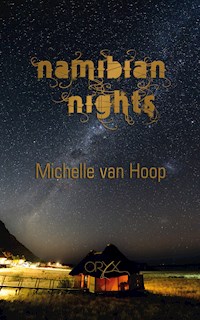
Erhalten Sie Zugang zu diesem und mehr als 300000 Büchern ab EUR 5,99 monatlich.
- Herausgeber: Oryx Publishers
- Kategorie: Gesellschafts- und Liebesromane
- Sprache: Englisch
Years before, Vanessa and Kian had been together - in Germany. After a terrible lovers' quarrel, Kian returned to his homeland Namibia, without leaving a trace. Vanessa, in spite of her deep regret, successfully builds her own business as a graphic designer. She has occasional relationships, but deep down the only man she has ever loved has been Kian - the big, blond, suntanned man from Namibia. She has long since given up hope of ever seeing him again. But then, on the spur of the moment, she books a holiday in Namibia. Here she meets Kian again, but apparently as a married man - with a wife and children. Fighting her own emotions, Vanessa tries to accept the facts as they are, but Namibian nights under the clear, starry skies of Africa have their own magic ...
Sie lesen das E-Book in den Legimi-Apps auf:
Seitenzahl: 395
Veröffentlichungsjahr: 2015
Das E-Book (TTS) können Sie hören im Abo „Legimi Premium” in Legimi-Apps auf:
Ähnliche




















Michelle van Hoop
NAMIBIAN NIGHTS
A Love Story in Africa
© 2015Oryx Publishers Windhoek, Namibia
www.oryx-publishers.com [email protected]
All rights reserved, including the right to reproduce this book, or portions thereof, in any form whatsoever.
ISBN 978-99916-786-7-2
Cover photo:
1
It was dry, that year. The tall man with blue eyes looked up at the cloudless sky. He was standing on a small rise in the middle of the bush and, in his khaki clothes, blended entirely into the landscape. The grass was yellow now, in the dry season, winter here in southern Africa. A season when it never rains and the nights make you shiver with cold.
During the day, though, there was sunshine, and the man’s tanned skin showed that he was outdoors a great deal. His straw-blond hair appeared bleached, as he took off his broad-brimmed hat to wipe the sweat from his forehead. Now, at noon, it was hot, but at night the temperatures fell at times to below freezing. This was Namibia, land of contrasts, big and wide, a dream of endlessness.
In the north there were rivers, with enough water to keep the fields and pastures green, but in the south the desert dominated. The Namib in the west, that stretched until it met the long Atlantic coast, and in the east the Kalahari, reaching far beyond Namibia’s borders, into South Africa and Botswana. Here the prevailing topic was the struggle to survive without water.
The man let his glance travel over the arid savannah where there were only a few dry shrubs dotted here and there. Apart from the small rise where he was standing there was no other elevation as far as the eye could see.
He frowned. He had seen something move behind one of the bushes. An animal, perhaps? His eyes contracted to narrow slits and he concentrated his gaze to a single point. The shrub was too far away to see anything clearly, and in the noonday heat the animals stayed in the shade. Only at twilight would they come out again, but he was used to reading the smallest signs. The long, sharp horn just appearing from the shadows told him that an oryx was resting there.
Even under the harshest conditions in the desert, without water, the oryx could survive, and so the oryx antelope was the National Animal of Namibia. Not a rare animal, its distinctive markings made it easy to tell apart from the other kinds of antelope native to the country.
The man tried to make out the beautiful grey animal with its black and white face mask, but the harsh African shadows wouldn’t allow him to. Where there were shadows, there was night. He shifted the weight of his weapon, which hung loosely on a strap from his shoulder. They didn’t need meat today. The antelope could continue to doze in the noonday heat.
He turned and went back to the old Land Rover at the foot of the rise. Its sand-coloured contours were also hard to make out in the shimmering sunlight. Not even the rubber of the tyres, covered with desert sand, stood out. Vehicle and driver blended in perfectly with the desert.
When he started the car the loud roar of the engine broke the silence brutally. But no bird flew up, no animal ran off. There were no birds here, and all the animals were hidden somewhere waiting for the heat to abate, for the night to come, so that they could look for food and water. Even the tok-tokkie beetles were not to be seen. They had buried themselves deep in the desert sand, to escape the midday heat.
The Land Rover ploughed through the sand until it reached firmer ground, when the driver increased his speed, leaving a dense cloud of dust behind him that covered his passage like fog.
After a while the dust settled, and every trace of human presence disappeared.
The desert lay there quietly; it had no need of human beings.
2
Brrring! Brrring! – Brrring! Brrring!
Vanessa sat up with a start. Demanding rings from two telephones at once made her look around hectically. Then she picked up the land line and took her mobile in the other hand to look at the display and find out who the caller was.
She groaned quietly. On my last day! I’m going on holiday!
“Yes, Mr. Peters?” she answered in a friendly and professional tone. “How can I help you?”
As she listened, she stared at the screen on her mobile. It was still ringing, but the ring tone had stopped.
“Today is my last day,” she answered Mr. Peters, with a rather exasperated look on her face, which he happily did not see. “I’m on holiday starting tomorrow.” She listened for a little while. “Two weeks,” she then answered. “Can’t it wait that long?”
As a flood of words came over the telephone, she had a look around the office. Piled on the table that she used as a desk, but also as a place to offload all kinds of things, were printouts, messages she had dealt with and hadn’t, an odd collection of company fliers, books – a pile that was clearly about to fall over – and several coffee cups and small plates. She had done away with larger plates as she couldn’t find room for them any more on her desk.
“I don’t know if I can manage it today,” she interjected, as Mr. Peters paused a little and gave her an opportunity to speak. But that didn’t convince him. “All right.” She tried to suppress a sigh. “I’ll finish it. You’ll have it by tomorrow.”
As she hung up, she looked at her mobile again. The caller had given up.
The light on the printer was flashing. She remembered vaguely having requested a print job before she answered the telephone. Why wasn’t it already finished by now?
She bent over the flashing light. That too! The printer couldn’t print as it had run out of ink. “Can’t you print without ink?” she growled at it. “And they say women are fussy.”
The printer didn’t answer, just kept on flashing.
“Damn!” Vanessa swore and ran her hands through her hair. She had no spare ink cartridge and would have to go and buy one. There was nothing else to be done. If she wanted to get Mr. Peters’ job, and everyone else’s, done today, she would have to leave the office. She would lose even more time, although she already had too little.
At this moment her mobile went again. “Yes?” Her expression became harder. “I’m flying today,” she said in answer to a question that clearly did not make her happy. “You know that . . . at ten-twenty tonight . . . no, I won’t have time. I’m drowning in work here. I have to get all of it done before I go to the airport” – the caller was as persistent as Herr Peters had been. “But I told you.” The corners of Vanessa’s mouth sagged. “Weeks ago.” She stared into space for a while, as she listened. “I really can’t help it,” she said then. “Sorry, I have to go out and get an ink cartridge.” She terminated the call.
She took a deep breath, as she looked through the mess on the table for her purse. No time, no time, no time. That was the only thing that ran through her head. How could she get everything done? It was impossible, simply impossible. All this running around, all this stress.
She just wanted to get away from it all.
3
Hours later, Vanessa sat at the departure gate in the airport. She had just managed to check in before the counter closed for the day.
With a sigh, she took her laptop out of her rucksack and opened it. Now she had a little time again and could send off a few things by email. There was no problem doing this at the airport, with its Wi-Fi connection. Her work day was still not over.
Would there be an internet connection in the bush? She frowned – maybe she could contact a few clients from there –
Didn’t you want to have a holiday? For at least two weeks? For just two weeks?
She knew that her inner voice was right. She had looked forward to this holiday so much, had worked like crazy to be able to afford it, to satisfy all her customers before she left, and now she was imagining herself sitting in front of the computer all the time she was away, writing emails and sending out proposals?
No. She closed her computer. And then opened it again. She wasn’t on holiday just yet, she was still in Germany, and that meant that she could still take care of a few things. As a graphic designer with her own small company, in which she was the only employee, she couldn’t afford to lose any clients.
“Anything interesting to see in there?” Somebody leaned over her from behind.
Vanessa jumped a little. She smelled the man’s aftershave before she saw him. Unpleasantly surprised, she leaned to one side to escape the pungent, musky scent and the man’s proximity. She closed the laptop as she said, “No”.
“I don’t agree,” he answered. He climbed over the back of the row of seats where Vanessa was sitting, and looked at her with a grin. “Are you flying to Windhoek?”
Vanessa could only keep herself from rolling her eyes with great difficulty. Any other questions? “If I’m not sitting at the wrong gate . . .” she answered.
He flopped down next to her. “Happen to you a lot?” he asked in an arrogant tone. “That you wait at the wrong gate?”
Vanessa felt uncomfortable. This guy was coming on to her in a way that usually made her run the other way, but she had to remain in this area, she couldn’t leave. Even if she stood up, he would certainly do this same. “No,” she said.
“That’s your favourite word, isn’t it?” He showed a set of yellow-tinged teeth. Clearly a smoker. The smell of cigarettes combined with the aftershave and the smell of sweat to create a penetrating odour.
Vanessa glanced at him. Like many of her fellow passengers waiting to depart for Africa, he was already dressed for his final destination: khaki shirt, khaki waistcoat, khaki trousers, broad-brimmed hat – a wannabe Indiana Jones.
“Yes, under certain circumstances, it is,” she answered. She hoped that the cool note in her voice would serve to discourage him, but he wasn’t the kind of man who noticed subtleties like that. And if he did, it only made him worse.
“Are you always so uptight?” he asked impertinently. “It’s going to be a long flight. We could have a lot of fun together.”
“I’ll definitely do that. When I’m asleep,” replied Vanessa. “It is a night flight.”
“You don’t have to just sleep, at night.” His grin took on a more brutish aspect.
Vanessa looked around. In the meantime all the seats had been occupied, and a few passengers were standing as well. On the other side of the lounge there was a family. They occupied five seats, but the children kept getting up and running around.
She put her laptop back in her rucksack and got up and went over to the family. “Pardon me, may I join you?”
The children’s mother looked up, somewhat irritated, as she had just been busy with one of her children. Then she took a look at the area behind Vanessa, where ‘Indiana Jones’ still sat, grinning, with his arms stretched out over the backs of the seats. “Sure, come on,” she said, with an understanding smile.
“Thanks.” Vanessa sat down, pulled her laptop out again and opened it.
But this time she couldn’t really concentrate, as pictures ran through her mind of Namibia that she had seen while surfing the Net. Instead of opening one of the graphic designs that she wanted to work on, she opened her browser and entered the internet address once more.
Pictures of giraffes, elephants, lions and leopards spread out before her. Black people, almost naked, with red paint on their bodies. The women wore wonderful hairdos, decorated with jewellery that shimmered reddish brown like their bodies and their hair.
Then, pictures of the landscape appeared on the screen. Wide, empty savannahs, hardly a shrub or a tree, and if there were any, then they looked just like the ones in Out of Africa.
It must be splendidly isolated there. Sheer rejuvenation.
Not that isolation was her primary objective in life. She had wanted to have a family, a husband, children and a little house with a garden. She smiled a little ironically. Dreams of a teenager.
Well, for a while it had not been merely a dream, or at least, the dream had come close to fulfilment. Back then, with Kian . . .
But after Kian, there hadn’t been anyone else with whom she had wanted to share this dream. And not with Steffen, either. She took a deep breath. He had called her just before her departure and practically forgotten that she was flying to Namibia.
She had to admit, she had often talked of taking a holiday, only to keep putting it off. Too much work. Building up her own small company had taken a lot of time and energy. Graphic designers were like sand in the sea, and it had been hard to convince clients that out of all designers she was the right one for them.
But she had made it, in the end. She had more work than she could manage. She should actually have hired someone else, but with the costs involved in employing someone in Germany that was impossible. And so she had worked around the clock in order to fulfil all her clients’ wishes.
At one point though, lying totally exhausted on her couch, she had watched a programme on television about Namibia. She had hardly had time to take it in before it had finished. But this programme had reminded her of something, of something that she thought she had already forgotten long ago.
She had tried to forget it again, but it didn’t work. Again and again, she saw these pictures in her mind.
Until, one day, she had booked this flight, on a whim.
Even she had considered it a crazy idea, coming close to cancelling the flight – until Steffen had laughed about it. What did he think she was? A little girl, who didn’t know what she wanted? She was thirty-three years old, a grown woman with her own company.
She had invited Steffen to come with her. She had only known him for half a year, but they had never taken a holiday together, and it would have been an opportunity to get to know each other better. They usually saw each other at the weekends, sometimes in the evening during the week, when they went out for a meal and then went afterward to Vanessa’s or Steffen’s flat. Except in bed, they hadn’t really got very close to each other.
And when the opportunity came, Steffen hadn’t taken advantage of it. Vanessa hadn’t considered herself committed to anyone, even after Steffen had appeared on the scene. Their rather open-ended meetings hadn’t demanded any commitment. But Steffen was certainly a very pleasant man. He did not expect Vanessa to be always there for him, just as she did not expect that from him, either. They met whenever they felt like it.
Yet Vanessa had imagined that a holiday might deepen their connection to one another, that perhaps it would develop into something more, even though she wasn’t in love with Steffen.
No, she hadn’t been in love since . . . Kian. If she ever dreamed about a man, it was him, even though their break-up had been so awful. It had taken her a long time to recover from it.
But that was years ago. There were other men, and after a while she had no longer closed herself off to them, but no one had made her feel the way she had with Kian. That feeling of being at one with him, of not being able to let go of one another.
Yes, she had seen herself with Kian, with children, in a house with a garden, laughing and forever happy.
But it hadn’t worked out that way.
“Are you flying all by yourself?” The mother who had provided her with such a friendly refuge, looked at her enquiringly from the side.
Vanessa nodded. “Yes, by myself.”
“Do you have a man waiting for you, in Namibia?”
“No.” Vanessa smiled, unpleasantly piqued. Why did a woman always have to have a man at her side? Wasn’t she worth anything, by herself?
“You’re visiting people you know?”
“Not that, either.” Apparently this clever family despot – it really had taken something to keep her three unruly children under control, as they became livelier and livelier – could not imagine anything except Vanessa’s belonging to someone else.
“You’re not really taking your work with you?” The woman raised her eyebrows and pointed to the laptop.
“No.” Vanessa laughed, and this time she was happy to be able to say No. “I actually don’t intend to. I’m going on holiday.”
The woman smiled. “I would never take a computer with me on holiday, especially to Namibia. There’s so much to see there. Have you been to Namibia before?”
Vanessa shook her head. “No.”
“We’ve been to Namibia a number of times,” said the woman. “It’s wonderful – and gigantic, twice as large as Germany. But with very few people.”
Vanessa nodded. “I know.”
“It’s just not for people who are looking for non-stop partying during their holiday,” the woman continued. “They’d be disappointed.” She threw Vanessa a look of mild enquiry.
“I don’t need anything like that.” Vanessa smiled. “Just the opposite; I’m looking forward to peace and quiet. I’ve being working pretty hard lately. It will be enough for me to lie around the pool somewhere.”
“Just lie around the pool?” asked the woman, bewildered. “You can do that on Mallorca or somewhere like that. Everyone has a pool in Namibia, but what’s interesting is the country itself, the animals. We’re going to drive around for six weeks, we’re going to camp, and be in a different place every day.”
That sounded like stress again, to Vanessa, like the hustle and bustle she wanted to leave behind her. “Sounds nice,” she said. “I will certainly go on a few excursions.”
The woman sighed. “Hopefully we’ll see some lions. It’s not always so easy. And the children are wild about them.”
Vanessa looked at the children, who were now beginning slowly to take everything apart. Wild was actually the right word for it. “I’m only staying for two weeks,” she said. “I won’t have that much time to drive around.”
“Only two weeks? For Namibia?” The woman appeared to be horrified. “That’s nothing at all.”
She was probably right, but Vanessa was happy to have two weeks at all. “I can’t stay any longer, unfortunately,” she answered, and at that moment the metallic voice from the tannoy announced that they could board their plane.
In the wind tunnel leading to the plane someone pushed up against her. Vanessa recognized the smell right away.
“How would it be with a little glass of rotgut, soon as we’re inside the plane?” he asked.
Happily, they were a few steps from the door of the plane, and Vanessa handed the flight attendant her boarding card without answering the question.
“To the right, please,” said the neatly dressed young woman and smiled.
As Vanessa tried to manoeuvre her hand luggage through the narrow aisle she heard the flight attendant tell the next passenger “Straight ahead and to the right, please.” At least she didn’t have to fear sitting next to her persistent admirer.
She found her seat next to the window, put her hand luggage in the overhead bin and pushed her way in with “Pardon me, pardon me, please” past her neighbours, who were already seated in the row. It would not be a comfortable flight, with these narrow seating arrangements, but her income really wasn’t large enough for First Class.
She put the blanket and the pillow that had been lying on her seat onto her lap and looked out at the runway. The ground was wet and glistening. It had rained almost nonstop in the last few days. And it was cold. November.
She shivered a little and pulled her jacket closer around her. It wasn’t exactly warm here in the plane, either. She felt along the arm rest for the buttons to adjust the seat and let it incline a bit, leaning back and closing her eyes. Hopefully they would start soon.
Although quite a number of people had been waiting in the departure lounge, it didn’t take long before all had boarded. A group of men in the middle rows were carrying on loudly. They had clearly had a good deal of alcohol while waiting.
That could get loud, thought Vanessa. But just then the announcement came to fasten seatbelts and place seatbacks in the upright position.
As Vanessa did so the excitement slowly began to take hold of her. Up to now she had had no time for that, or had been distracted by other things, but now, it was really happening.
In nine and a half hours she would be in Namibia.
4
Vanessa was woken by mild turbulence. She had been so exhausted that she had fallen asleep right after dinner, and had hardly taken in any of the flight. Now, above the clouds, the sun was rising.
It was a splendid view. The horizon turned a shimmering red, and right after that the light of the sun struck her eyes. She turned her gaze away. It was impossible to keep looking into it. The air was so clear that nothing toned down the splendour of the glow.
Vanessa looked in her handbag and took her sunglasses out. Protected in that way she could now watch, fascinated, as the sun rose.
Then she noticed that above the clouds had been a false impression. When she looked down she didn’t see any clouds at all. How was that possible? This wasn’t her first time in a plane but she had never landed anywhere without clouds.
“I am happy.” The older man next to her sighed. “I’ll be home soon.”
Vanessa looked at him with interest. “You live in Namibia?”
“I was born there.” The man laughed softly. “Did you think I should have darker skin?”
“No, no.” Vanessa smiled a little in embarrassment. “I know that there are many different variations of skin colour in Namibia, black and white, and many shades in between.”
“And everyone lives in peace together,” said the man. “We’re proud of that. It’s not always the case, if you look at our neighbours, Zimbabwe, for example.” He looked past Vanessa and out of the window. “But even Mugabe can’t take his people’s good will away.”
In the meantime the sun had risen high and bright in the sky, white-gold in the clear air, and the red shimmer had disappeared.
A flight attendant came by with a bag. “Blankets, please.”
Vanessa freed herself from her blanket and gave it to her. The next flight attendant collected the pillows and it was clear that they were nearing their destination. The passengers were getting restless; a few got out their mobiles and video cameras and took pictures from the windows, which hardly seemed suited for it. Maybe they were ‘first timers’, like Vanessa, as a great number of others were ignoring the sunrise and the cloudless sky. It all seemed to be familiar to them.
Finally, they began their descent and as the ground came nearer, Vanessa made out a landscape that seemed to be made up of just brown earth and a few clumps of dried grass. She saw no buildings, until the end, when the airport pavilions came into view. They looked like a place that children had built with Lego. She wondered if the runway was long enough.
Her worries were unfounded. The plane touched down, slowed, and the pilot turned in order to taxi to the right place.
The passengers applauded. Several were already beginning to take their luggage out of the overhead bins and there was a general feeling of departure. Many of the holiday makers seemed to be in a great hurry to get to their destinations.
“Hurry, hurry,” remarked the man next to Vanessa, shaking his head. “That’s the way you Germans are.”
Vanessa smiled. “I’ve come with the intention of finally taking my time, a little.”
“Good.” The man stood up slowly from his seat and by doing so made it possible for Vanessa to get up as well. “Here in Africa, we always have time. There’s nothing that could be that important, that we couldn’t wait a while.”
Now Vanessa had to laugh, as the man courteously helped her to retrieve her luggage from the overhead bin. “I should tell some of my clients that!”
He glanced at the passengers pushing and shoving at the exit. “Or those people there.”
They tried together to find a way into the line. Slowly, the crowd began to thin; most people had left the plane.
Then Vanessa stepped hesitantly onto the top step of the stairs that led to the tarmac. Here there was no wind tunnel as in Frankfurt. Vanessa remained standing, as though she had run into a wall. The warmth assaulted her unexpectedly, after the cool interior of the plane.
She looked up at the blue sky. In spite of her sunglasses she had the impression that the light was very bright, as though she weren’t wearing sunglasses at all. When she pushed them up a little, however, she let them fall right back onto her nose. Without sunglasses it was impossible to see anything.
The warm air caressed her, and she saw that many people were too heavily dressed. Even now, in the early morning, the sun at the international – even if it was hard to believe – airport of the capital of Namibia had an unbelievable power.
“Are you going to stand here much longer?” The voice of her friendly neighbour from before woke Vanessa from her trance.
“No, of course not. Sorry.” She threw him a glance and started down the stairs. Her steps echoed metallically on the perforated iron steps.
But she didn’t notice. She was too fascinated by her surroundings. The wind blew sand over the tarmac and over her hand luggage and over the other passengers who were moving in a straggling line towards the airport building. There was only the one, low building; there was no doubt about where one had to go. Otherwise there was only the wide countryside and the bush, spread out around them.
From there rose the dark hills that Vanessa had already seen from the plane as they were landing. They weren’t really very high, but high enough to remind Vanessa of the Taunus Mountains, which she knew so well. But here the mountain sides weren’t green, but strewn with clumps of grass that were just as dry and yellow as the grass in the lowlands below. Among them were rough, stony slopes, looking as though torn off at some point, and thousands of years old.
Vanessa could hardly look enough at these configurations in the landscape. She had the feeling that she was stranded in a country before time itself began, where any minute a dinosaur might come tramping out of the bush. Nothing was as she had expected it to be and yet – yes, nevertheless she had the feeling that she had come home.
She shook her head in irritation, as she pulled her hand luggage trolley with some difficulty over the cracked concrete surface. What nonsense.
But she couldn’t shake the feeling, as she entered the airport pavilion.
As soon as she got into the line that had formed for immigration, she noticed that things were much more relaxed here than in Europe. Nobody seemed to be in a hurry to process the passengers, to the vexation of some of the holiday makers, who were eager to get to their final destinations and who were politely but firmly told to wait their turn. Next to the line.
Vanessa had to smile. Apparently people here did not appreciate rude and pushy customers. The slow pace of life mustn’t be disrupted.
Finally her turn came, and she presented her passport and the immigration form that she had had to fill out in the plane.
“Holiday?” asked the ebony-black face of the immigration official, and didn’t crack a smile.
“Yes.” Vanessa nodded.
“Fill this out.” The uniformed official pushed the form back to Vanessa over the high desk behind which she sat, and pointed to the section that Vanessa had not completed. “Where are you staying?” she asked rather rudely, perhaps even more rudely than before, as though Vanessa had not treated the form with sufficient respect.
Or so it seemed to Vanessa. She hadn’t understood the question very well, as the official spoke English with a very pronounced accent. “At a guest farm,” she answered quickly. Her heart was beating fast, for some reason. There were only a few true borders in Europe, these days. To be treated as though one intended to invade a country as a conqueror was very unusual.
“Name? We have a lot of farms here.”
“Oh. Yes.” Vanessa hurried to enter the farm’s name into the form. “Of course. Sorry.” She didn’t want to suffer the same fate as the woman before her, who still stood, impatient and stressed out, next to the line.
After Vanessa had filled out the form completely she got a stamp in her passport, a tourist visa for ninety days. If only I could stay here for that long, she thought for a moment, with longing.
But she had to move on to the baggage claim, to wait for her suitcase.
It was a lesson in patience, as the suitcases just didn’t come; the carousel kept moving around senselessly without producing a single piece of luggage.
A woman, also in uniform, but not the same as the immigration official’s, came up to the carousel, threw it a disapproving glance and then asked the passengers, “Aren’t the suitcases here yet?” She got a unanimous shake of the head in reply and, suddenly resembling a locomotive, snorting in fury, she went out to the tarmac, where a number of black men were standing and sitting around in a leisurely way, laughing with one another, and yelled at them in an incomprehensible language, after which the men jumped up like rubber balls and quickly ran off.
Vanessa had to smile. It seemed women had more to say in this place than men. She hadn’t expected that. She looked through the glass pane at the Airbus they had come in. It stood lonely and abandoned on the broad airport premises in front of the panorama of the African highland. It looked as though the big aeroplane was standing in the middle of the bush itself. There wasn’t much business here.
No large train station, no gate, no tunnel leading to the plane, just some stairs that a few of the men who had been brought into action had rolled up to the plane and then were holding underneath it, so it wouldn’t roll away. It felt like being in a film from the 1930s.
“The only thing she still needs is a whip, right?” An unpleasant voice, that she would gladly have never heard again, grated on Vanessa’s ear. And she recognized the unpleasant odour, too. “Black women.” It sounded very scornful, but Vanessa had the impression that it had nothing to do with skin colour. This wannabe Indiana Jones considered women in general to be a lesser species.
She didn’t acknowledge him with an answer and continued to stare in front of her in the hope that the men would now bring the luggage. And, finally, there was a luggage transporter to be seen on the tarmac, on its way to the hatch through which the suitcases would be placed on the carousel.
A few minutes later the first piece of luggage appeared. The passengers gave a collective sigh of relief, and one had the feeling they might even have applauded.
The man next to Vanessa made a disdainful sound. “Africa. The most inept continent in the world.”
She actually hadn’t wanted to respond to that, but his arrogance made her blood boil. “And so why are you here?” she asked with eyes that flashed with anger.
He grinned. “Trophy hunter. I’m just going to get my gun from customs, and then get on my way. I hope I get an elephant in my sights. That’s what’s missing from my collection. But if not, there are plenty of other animals.”
Vanessa turned away in disgust. Happily in that moment she saw her suitcase appear on the carousel. She went towards it quickly, took it off and pulled it together with her trolley toward the exit.
As she passed through customs – nobody was interested in her luggage, they just waved her through – a door opened into an amazingly large lobby. Up to now Vanessa had had the impression that everything here was very small.
Sure, this hall could not compare to the one in Frankfurt, but nevertheless it had something very modern about it: shiny metal seats for those waiting, such as could be found in Europe as well, the familiar signs for car leasing companies, an ATM, a souvenir shop, and even a café.
She looked around. They had told her that she would be met.
Close to the exit that she had just come through there were a number of people with signs bearing names. A few of the men holding up signs were calling out the names as well.
Suddenly Vanessa seemed to hear her own name. She tried to figure out who the speaker was, and approached him. “I am Vanessa Kluge.”
The man had dazzling white teeth in a shiny black face that seemed very friendly. “I am Johannes.”
He spoke in German, which made Vanessa do a double take.
“We have to wait for the others,” Johannes explained to her. “Two more.” He let his gaze travel to the exit again.
Vanessa nodded, still quite surprised. “You speak very good German.”
“The Baas is German,” replied Johannes, showing his white toothpaste smile. “And I was in Otjimbingwe as a child.”
Vanessa looked at him in confusion. “Otjim- . . .” She couldn’t pronounce the name. It sounded very foreign to her. “That doesn’t sound very German.”
“But the German missionaries were,” he grinned, pleased as punch. “I grew up on the missionary station.”
An older couple approached them. “Hello, Johannes. How nice to see you again.” The woman was positively beaming, while the man was clearly trying to contain his own emotions, and greeted Johannes with a very masculine handshake.
Johannes, however, was beaming for what it was worth all over his face. “Nice that you’re back again,” he replied.
Vanessa noticed that the couple used the familiar form of ‘you’ with Johannes, while he used the formal form. It gave her a strange feeling. She knew that apartheid had been over for a long time, but here, at this moment, it seemed to her as though there were still two classes of people in this country.
Together they went through the hall out to the large car park. Besides Johannes, other drivers had managed to collect their guests, and everywhere there were small groups making their way to various vehicles.
What these vehicles all had in common was their size. Sedans didn’t seem to be in use here. There were a number of minibuses, but most of the cars that stood in the car park were large all-wheel drives. And most looked to be astonishingly new.
Vanessa thought of images that she had seen in films or documentaries that took place in developing countries, of cars held together only by rust. Black drivers, whose clothes seemed to be made more out of holes than cloth, dirt, rubbish, chaos, loud honking, with loud, lively conversations or arguments.
There was nothing like that here. Everything was quiet, inconspicuous, clean and new.
Well, the material on the tarmac that she had walked on, on her way to the airport building, had not seemed particularly new. And the people who worked there didn’t seem to be rich. But they weren’t as poor as Vanessa had imagined it,
either.
She followed Johannes and the other two guests to the car. Here she finally saw something of what she had expected: the car was an old Jeep that looked pretty battered. And Johannes seemed to have driven through mud, at some point. Traces of it hung in the form of high splashes of mud on the car.
Maybe I really am in Africa, thought Vanessa with a smile, and got in the car.
5
The old jeep, with Vanessa and the other two passengers in it, was rumbling over a gravel road, leaving a cloud of dust behind them. Vanessa looked out of the window, fascinated.
Starting at the airport, they had ridden first on a tarred road, but even there only the bush had stretched out to the right and left of them. The road was like a black ribbon between hills that were covered with dried grass.
They had been underway for a while, when Johannes suddenly braked and pointed to the front. “Baboons.” He laughed.
Vanessa had already seen dark shadows from afar, on the edge of the road, but had thought they were bushes. Now she recognized that they were monkeys. Baboons. A large family with adults and many smaller little monkeys that either clung to their mothers or hopped along next to them, with mischief in their minds. Several of the older animals seemed to have found something to eat, squatting on their behinds, chewing leisurely and looking at the car. They didn’t seem to be afraid.
Suddenly the group decided to cross the road, and that happened in a very leisurely fashion, too. A large male went first, looked around, reached the other side and looked back. As though that had been a signal, the other monkeys in the pack set off.
Vanessa could hardly believe it. Baboons were sitting, just like that, at the edge of the road in the wild. They were clearly living in their natural habitat, and the road was only a part of their environment, one that didn’t have that much meaning for them.
Roswitha, one half of the married couple, who sat next to Vanessa, laughed. “The first time, it’s always such a surprise, isn’t it? I also sat there, like you. If you only know animals from the zoo . . .”
Vanessa shook her head. “That is . . . unbelievable. They don’t belong to anyone, and no one takes care of them?”
Johannes shrugged his shoulders. “No, why should they? There are enough baboons. No one has to take care of them.”
Vanessa turned around and watched the baboon family until they had disappeared into the hills next to the road.
It wasn’t long, however, before they had turned off from the tarred road onto a gravel road, and the signs of civilization disappeared completely. The grass was closer to the car, and the road was full of holes that were partially filled with sand, through which the car slid as though on ice.
Vanessa clutched the seat in front of her, as there was no other way to hold on. The suspension of the rustic vehicle was also not up to present-day standards. This was no place for people with bad backs. And seat belts – there weren’t any of those, either. If one thought about it, this car seemed to be from a different era, when people didn’t worry about safety features.
However – or maybe, just because everything was so primitive – she began to feel that exhilaration that she had felt after landing. Along the edge of the road, that actually wasn’t one, people were walking – to be sure, not as Vanessa remembered it from the pictures she had seen. They wore totally normal clothing, t-shirts and trousers, or a kind of bright blue overall. Some women with children had covered their fairly round curves with dresses that looked more African.
Johannes waved to them, stopped the car from time to time and exchanged a few words with them; they all seemed to know each other somehow. Their black faces laughed, and they were obviously making comments about Johannes’s passengers, which they couldn’t understand. The language didn’t sound like anything that Vanessa had heard before. It was made up not only of words but also of clicking and snapping sounds, and Vanessa had to ask herself how they produced them. It seemed that the people could speak and click or snap at the same time.
“I didn’t know that the guest farm was so far from Windhoek.” Vanessa looked at her fellow passengers. “In the description it sounded as if it was quite close.”
Siggi, Roswitha’s husband, laughed. “It is, by Namibian standards. A drive like this isn’t considered long, if you consider that a farm has a few thousand hectares.” He smiled encouragingly at Vanessa. “But we’re nearly there, a half hour at the most.”
Vanessa looked out of the window, as if in a dream. “It’s not that I want to get there any faster. It’s so marvellous here.”
“Yes, it is. That’s why we keep coming back here.” Roswitha was beginning to get the same dreamy expression. “We’ve been coming to Namibia for twenty years. There’s nothing better.”
Vanessa could only share their sentiment. This feeling of being ‘at home’ that had come over her without warning at the airport, became stronger and stronger. As though she had come home, but not to a home she had grown up in. It was more like a memory from a past life.
But Vanessa didn’t believe in things like that. Nevertheless, this feeling bothered her, pleasant as it was. She felt like a stranger here and yet, at the same time, it was all so familiar, in a way she had never experienced before.
They drove on and Vanessa saw that the bush at the edge of the road was becoming thicker and thicker, almost impenetrable. Suddenly, a gigantic machine, which appeared to be parked on the gravel road, came into view. It looked like a combination of bulldozer and combine harvester, but colossal, at that.
Without slowing down at all, Johannes drove past the machine. They almost landed in the bush, and for a moment Vanessa had the feeling that they would turn over, the jeep was leaning so far to one side.
She held on tight and when they were back on the gravel track she asked: “What was that?”
Instead of Johannes, whom Vanessa had asked, Siggi answered her. “That’s how they keep the roads smooth. And deal with the holes. These machines practically shave the top layer off. Then the pad is smooth again for a while, but it doesn’t take long before the holes are there again, especially when it rains.”
Vanessa looked back, to where the machine was getting smaller and smaller. It was strange to be here in the bush and to see such a machine as that. A contrast that couldn’t have been greater. That was definitely not something she had expected.
Then Johannes began to slow down, until he was almost idling.
“Giraffes,” sighed Roswitha in enchantment and peered through the side window, looking upward.
Vanessa couldn’t see anything from her side, but Johannes turned the car around, and as she leaned out a little, she suddenly saw a head floating a few metres above her. The giraffe was half hidden behind a tall bush; only its head could be seen, and it was plucking leaves that it chewed with great enjoyment, all the while looking down at the people in the car with an arrogant, entirely indifferent, gaze.
It was an unbelievable image. It looked as if the tree were the body of the giraffe, its head placed on the topmost leaves. Vanessa took a deep breath. She was waiting next to a giraffe in the bush, and it all seemed quite natural.
Johannes turned the car around again, and as they drove away Vanessa saw that more giraffes had been standing behind this area of the bush, only a little further away. On their long legs they looked like archaic figures. Two of them put their heads together like whispering teenagers, as they watched the jeep moving away.
“They look as though they’re asking themselves what this little car is doing here.” Vanessa laughed.
Roswitha laughed, too. “Yes, I think they always ask themselves that. They consider themselves to be very superior.”
“No wonder, considering their size. We must look pretty small from up there.” Vanessa couldn’t get enough of the majestic, towering animals whose long necks gave them an aristocratic air. Only the small head seemed strangely out of proportion.
As they continued on their way Johannes again and again pointed out animals in the distance, kudus, springboks, wildebeests and warthogs. At one point a sow with a number of smaller pigs behind her crossed the track at a gallop, so that Johannes only barely missed them. They had come from out of nowhere.
Particularly amusing were a couple of ratites, birds about the size of a chicken, but much more slender. They, too, appeared suddenly at the side of the road, out of the dense bush, clearly intending to cross. When they saw the jeep coming, however, they began to run, in a very particular way. They put their heads forward like bulls planning to attack, and scurried along the road in front of the jeep instead of crossing and with a speed one wouldn’t have thought possible.
Johannes enjoyed making them run faster and faster, and laughed.
“Can’t they fly?” asked Vanessa, astonished.
“Yes, they can.” Johannes laughed even harder. “But they always forget how to do it. They only fly in extreme emergencies. Let’s see if we can make them do it.”
He tried to frighten away one of the birds that was running ahead of them, and suddenly, it did flutter and fly off.
Vanessa wondered why the bird hadn’t already done that, instead of running in front of the car like the cartoon Roadrunner with legs that almost seemed to be rotating, they went so fast. On the other hand these birds could run really fast, you had to hand it to them.
Once again Vanessa had to laugh as she thought of the way the creature had started to run, with its head shoved forward like someone running against the wind. And there wasn’t any wind here. But without putting its head forward, the bird apparently could not get started. It just had to stand there. It was all just too funny.
She leaned back in her seat. Even just watching that bird was exciting, here. The animals that one saw in




