


10,00 €
Mehr erfahren.
- Herausgeber: Ithaca Press
- Kategorie: Geisteswissenschaft
- Sprache: Englisch
Reference to either the Persian Gulf or the Arabian Gulf is a source of heavy controversy and tension between Iranians and Arabs, with diplomatic repercussions. The nomenclature is an important element of strategic uncertainty in the region. Kourosh Ahmadi reviews the issue from an Iranian perspective and favours retaining Persian Gulf as the standard term. He presents a serious argument that considers cartographic and historical points of view and factors in geopolitical competition in the region and beyond since the 1950s as well as the rise of Gulf Arab state influence on academics, businesses and the media.
Das E-Book können Sie in Legimi-Apps oder einer beliebigen App lesen, die das folgende Format unterstützen:
Veröffentlichungsjahr: 2019
Ähnliche




















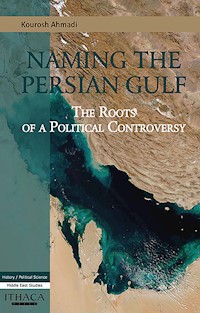
Naming the Persian Gulf
The Roots of a Political Controversy
Kourosh Ahmadi
Naming the Persian Gulf
The Roots of a Political Controversy
Published by
Ithaca Press
8 Southern Court
South Street
Reading
RG1 4QS
UK
www.ithacapress.co.uk
Ithaca Press is an imprint of Garnet Publishing Ltd.
1 2 3 4 5 6 7 8 9 10
Copyright © Kourosh Ahmadi, 2018
All rights reserved.
No part of this book may be reproduced in any form or by any electronic or mechanical means, including information storage and retrieval systems, without permission in writing from the publisher, except by a reviewer who may quote brief passages in a review.
First Edition 2018
ISBN: 9780863725456
British Library Cataloguing-in-Publication Data
A catalogue record for this book is available from the British Library
Typeset by Samantha Barden
Jacket design by Samantha Barden
Cover image by Jeff Schmaltz, MODIS Rapid Response Team, Goddard Space Flight Center
Printed and bound in Lebanon by International Press:
Inhalt
Introduction
Chapter One: The Term ‘Persian Gulf’ in Historical Perspective: Antiquity
Notes
Chapter Two: The Term ‘Persian Gulf’ in Historical Perspective: The Middle Ages and the Islamic Era
Notes
Chapter Three: The Term ‘Persian Gulf’ in Historical Perspective: The Modern Era
Notes
Chapter Four: Geopolitical Rivalries: The Origins of the Gulf Naming Dispute
Notes
Chapter Five: The Legal Status of Geographical Names: The Case of the Persian Gulf
Notes
Chapter Six: Governments and the Gulf Nomenclature
Notes
Chapter Seven: Non-Governmental Entities and the Term ‘Persian Gulf’
Notes
Conclusion
Bibliography
Introduction
One important element of strategic uncertainty in the Persian Gulf region is the tension between Iranians and the Gulf Arab states – expressed, among other ways, in the controversy over the nomenclature of the aforesaid body of water located between the Iranian plateau and the Arabian Peninsula. This issue has persisted since the rise of pan-Arab nationalism in the late 1950s. It includes formal and informal efforts by some Gulf Arab circles to promote the term ‘Arabian Gulf’ or, simply, the generic term ‘the Gulf’, over ‘Persian Gulf’. Certain Arab Gulf states have attempted to establish the convention ‘Arabian Gulf’ locally and internationally, and even enacted laws in the 1960s prohibiting the use of ‘Persian Gulf’ within their territories. These attempts to discourage the term have influenced some organisations, publications, academic institutions, businesses and media in the West and elsewhere; as a result, references abound to ‘the Gulf’, especially in the UK.
The importance of this naming dispute lies, in turn, with the importance of the body of water in question. The Persian Gulf, as a centrally located geographical feature of extensive size, has been one of the most strategic and significant seas since the dawn of history, a site of contact between great civilisations as well as collision of major interests. In the past, it was important as a major avenue of culture and trade; today it is even more valuable, containing a resource that is vital for the countries on its shores as well as the entire world. It is also located at the heart of the world’s most unstable region. The Persian Gulf region itself has suffered from three devastating wars in the past three decades, and is adjacent to and affected by a number of ongoing volatile situations, including the conflict in Israel/Palestine; the ravages of violent extremism and civil war in Syria and Iraq; and terrorist activity across the Afghanistan–Pakistan border.
Enduring and consistent place names are important for many aspects of local, regional, national and global communications. Uncertainty over the Persian Gulf nomenclature, and the extreme sensitivity with which Persians and Arabs, the two major Middle Eastern ethnic groups, approach it, are all the more consequential, with far-reaching effects for the region and beyond.
Up to the mid-twentieth century, the use of ‘Persian Gulf’ was exclusive, echoing conventional practice dating back centuries before the Common Era in the works of ancient Greek, Roman and Islamic geographers, cartographers and authors. There has never been a wider consensus on a place name in the Middle East over the past twenty-five centuries. However, following the rise of Arab nationalism in the 1950s, certain Arab countries – beginning with Iraq after the coup of 1958 – adopted the use of the term ‘Arab Gulf’ or ‘Arabian Gulf’. This development resulted in a highly contentious dispute over the nomenclature, involving states, international organisations, corporations, universities and mapmakers.
Persian and Arab civilisations have lived in close proximity to one another, interacting regularly and positively for centuries; as pan-Arabism gained momentum, naming the expanse of water separating them became a source of friction. The dispute followed political developments, as Iranians and Arabs vied for influence in the region. This ‘cold war’ between royal, conservative Iran and hard-line Arabs, which paralleled the global Cold War, intensified it. Efforts to internationalise the term ‘Arabian Gulf’ were undertaken by certain Arab states that had already prohibited the term ‘Persian Gulf’ internally.
The Gulf naming dispute was one of the side effects of this tension, and fanned it further. It eventually took on a strategic dimension as well as a life of its own, largely irrespective of the ups and downs in the diplomatic relationship between Iran and the Arab world. The conflict is now as fierce under the Islamic Republic in Iran as it had been under the Shah, and has also survived radical changes within and among Arab states.
The dispute can seem like a mere matter of semantics to some, but it is a serious issue in a region marred by ethnic and religious tensions and historic rivalries. (Nor is it difficult to imagine similar tensions arising over nomenclature in other parts of the world, such as the conceivable diplomatic and popular uproar were the US to begin referring to the Gulf of Mexico as the ‘Gulf of North America’.) This naming dispute, the longest-running such conflict in the world, is not insignificant among the current priorities of the region; even the United Nations has weighed in repeatedly.
Grassroots protests from Iranians from all walks of life against what they consider the arbitrary change of a historical name are common. Protestors refer to the term ‘Persian Gulf’ as part of their national heritage as well as an ancient historical reality that should not be tampered with. It is valued for reasons of tradition, and regarded as a matter of pride and prestige. While Iranians are otherwise much divided, they are, as a whole, very sensitive about this issue, to an unprecedented degree. Accordingly, every Iranian government, no matter how it has viewed the case, has had no choice but to follow suit.
One case in point, as we shall see in greater detail in Chapter Seven, was the fierce reaction in 2004 by many Iranians against the use of ‘Arabian Gulf’ as an alternative to ‘Persian Gulf’ by the National Geographic Society in its Eighth Atlas of the World. The Society received a flood of protest letters and negative reviews, and a petition was signed by thousands of Iranians in defence of what they called the ‘Persian Gulf legacy’. The Iranian government entered the fray, banning the Society from Iran. The atlas was later revised.
Another telling development, recounted in Chapter Six, is indicative of the impediment posed by the naming dispute to regional cooperation: the cancellation in 2010 of the Islamic Solidarity Games, which were to be held in Tehran that year. The Riyadh-based Islamic Solidarity Federation took this decision on account of the use by the Iranian organising committee of the term ‘Persian Gulf’ in the logo and on the medals.
To take one more example: the dispute delayed, for several years in the 1980s, the establishment of a regional organisation tasked with looking after environment of the Gulf: the participating countries could not agree on a name for the new body. The name that was finally chosen – the Regional Organisation for Protection of the Marine Environment – gives no hint as to where it belongs.
Thus the dispute over the naming of the Gulf has become a source of tension on its own, and should in no way be considered trivial or superficial. Having begun as a byproduct of Iranian and Arab nationalisms, over the ensuing decades it has become a serious cause for unease in relations between Iran and the Arab world, and an obstacle preventing regional cooperation. Nor does the discord show any sign of letting up.
Place names, in general, are a sensitive issue; they are a source of cultural and national identity. Given the importance of establishing nomenclature standards, specialised national and international organisations must attempt to ensure consistency when fixing geographical names for a variety of purposes. Moreover, the Gulf dispute has widespread consequences, affecting the worlds of diplomacy and academia, media, business and professional sports. The controversy extends far beyond official spheres as well, pitting ordinary people against one another.
Events over the past five decades have demonstrated the persistence of this issue, and highlighted the value of researching it thoroughly. Yet despite its importance and its impact on regional politics, no systematic, scholarly efforts have so far been made to evaluate different aspects of the Gulf nomenclature controversy, including its origins, evolution and impact. No book-length treatment exists in any European language on the subject; there is almost nothing in writing, aside from Internet polemics, in defence of the designation ‘Persian Gulf’ or the need for a suitable replacement thereof.
This study represents the first attempt to discuss the issue in a coherent, scholarly way. Its main purpose is to examine the originofthename in dispute, its evolution over millennia and the context within which the controversy has arisen. Efforts have been made to place the conflict against the background of regional politics, and to review the political and ideological developments that contributed to its emergence in the late 1950s and its subsequent elaboration. The relevant literature dealing with the dispute, as well as the name ‘Persian Gulf’, has been reviewed extensively.
This book also tries to shed light on the ways in which non-Persians perceived the Persian Gulf across different historical eras, and further appraises the Gulf’s physical attributes as well as the people who inhabit its shores and islands.
The following questions will be addressed:
1. What was the historical and traditional name of the body of water separating Iran from Arabia?
2. What was the approach of European explorers, Orientalists and colonialists to the nomenclature of the Gulf?
3. What role did politics – including pan-Arab nationalism – play in initiating the controversy?
4. Why are Iranians so sensitive about the nomenclature, and why do theydemonstrate unparalleled attention to the issue despite their numerous divisions over so many others?
5. Can ‘soft’ laws, as well as regulations concerning name standardisation by the relevant international and national bodies assigned to this task, offset the effect of power politics on the Gulf naming dispute?
The underlying question in this book is whether or not this dispute affects the behaviour of regional and international actors and the conduct of international relations in the area; and, if so, how? I have sought to answer it according to the following methods:
1. Reviewing literary evidence, including classical ancient and medieval works by Greek, Latin and Muslim authors, as well as works on the region by colonial officials, Orientalists, travellers and academics since the sixteenthcentury.
2. Reviewing maps – several hundred of which indicate the Gulf as ‘Persian’, with ten to twelve referring to it as ‘Arabian’ – as well as textual evidence associated with them.
3. Reviewing references to and passages on the Gulf naming dispute in a range of books and articles on a wide spectrum of regional issues.
4. Reviewing relevant political developments in Arab politics and Iranian–Arab relations since the 1950s, with direct bearing on the issue at hand.
5. Reviewing the relevant literature about the naming-dispute controversy over the past several decades from all interested sides, including hundreds of pieces written in English, French, Persian and Arabic.
6. Reviewing the positions of various governments on the controversy, as well as reference books, travel publications, scholarly books and articles, trade publications, academic works, media features, etc.
7. Reviewing works published on general toponymy as well as Gulf toponymy, in particular, by national and international institutions, along with documents released by the United Nations and other multilateral bodies.
The book is divided into seven chapters.
Chapter One looks at the origin of the term in dispute, tracing its evolution through ancient and medieval times.
Chapter Two is allocated to a review of the works and maps of Islamic scholars, seafarers and traders since the eighth century that shed light on the Persian Gulf, the knowledge of the time, its situation and nomenclature.
Chapter Three explores the way colonial powers, orientalists, travellers, diplomats and academics have dealt with the nomenclature of the Persian Gulf since the sixteenthcentury. It reviews the approaches of different cartographic schools in post-Renaissance Europe, which includes hundreds of maps bearing the name ‘Persian Gulf’. A number of maps from this period that refer to the Gulf by names other than ‘Persian Gulf’ will also be discussed.
Chapter Four deals with the origins of the naming dispute, and attempts to place it within the context of regional politics. It opens by noting the suspicion on the part of many Iranians that some British officials and academics in particular have encouraged the adoption of ‘Arabian Gulf’, and sheds light on such claims. The chapter continues by considering the role of pan-Arab nationalism (led by Nasser of Egypt and Qasim of Iraq) in promoting the term ‘Arabian Gulf’, and the impact of political differences between imperial Iran and the radical Arab world – tainted by East–West rivalries – on the genesis of the dispute.
Chapter Five considers the legalaspects of the issue, and takes into account various approaches adopted by intergovernmental organisations and major instruments of international law as well as controversies to which the name dispute has given rise. Efforts undertaken over the past hundred years at national and international levels to standardise geographical names are also examined, including those by British and American agencies and, most importantly, by the United Nations Group of Experts on Geographical Names and its Conferences on the Standardization of Geographical Names. The chapter assesses the decisions they have arrived at that can help tackle the naming dispute in question.
Chapter Six is allocated to the means by which various countries have positioned themselves in the past and present with regard to the dispute, and their roles in the evolution of the case.
Chapter Seven reviews the positions of major private institutions with regard to the controversies that have arisen from the nomenclature dispute, and looks at their roles in further entrenching both parties to the dispute in their respective positions. The means by which Iranians in Iran and abroad deal with the issue is detailed extensively in this chapter as well.
Chapter One The Term ‘Persian Gulf’ in Historical Perspective: Antiquity
The name ‘Persian Gulf’ arose from the Greek usage Persikòs koplos (literally, ‘Persian Gulf’) during the Greek classical era. Greek Hellenistic, Roman and later European historians and geographers followed suit, and the Latin term Sinus Persicus was translated into other living languages. In the mediaeval Islamic period, the term Daryaee fars or Bahr-e fars (‘Sea of Fars’ or ‘Persian Sea’), denoted, at times, a more extended body of water than the present-day ‘Persian Gulf’, while the name ‘Persian Gulf’ for the Gulf proper gradually entered into use at a later time. In the seventeenth century and in parallel to Persian–Ottoman strategic rivalry, few rival designations were put forward, and the standard, traditional term prevailed.
This chapter, along with Chapter Two, aims to verify two assumptions, namely:
1. the term ‘Persian Gulf may be the oldest toponym for a body of water’;1
2. it was the only universally used term to designate the body of water between the Iranian plateau and the Arabian Peninsula up to the 1960s.
To proceed with this task, the documents – including the textual evidence and maps relating to the nomenclature of the Gulf, as well as the relevant historical contexts – are reviewed in a comprehensive but concise manner. The historical continuity of the term since the fifth century bc and the manner in which different linguistic-ethnic groups have dealt with it will figure among the issues discussed. The focus will stay on major and seminal traditions and works of historical significance.
The Early Historical Period
In ancient times, as in the periods that followed, the Gulf region was under the influence of different cultures. Ethnic groups such as the Elamites, Sumerians, Akkadians and Babylonians were the early inhabitants of the Gulf’s coastlands before the establishment of the Persian state in the sixth century bc. The first traces of civilisations in the region date back to more than five millennia bc, when the kingdom of Sumer emerged in Mesopotamia, south of modern Iraq, and to the third millennium bc, when the Kingdom of Elam was established on the shore of the Gulf, towards the southwest of modern Iran.
The most ancient references to the Persian Gulf date to the time of the Sumerians in Mesopotamia during the third millennium bc. A historical text by Lugal-zage-si, King of Uruk (2340–16 bc), refers to the Gulf when it is declares: ‘… then from the Lower Sea, by the Tigris and Euphrates, as far as the Upper Sea, [the god Enlil] provided him with clear routes … referring specifically to the Mediterranean and the Gulf’.2 In his classic book The Persian Gulf, Arnold Wilson concurs, adding: ‘Akkadians called the Persian Gulf “Tamtu Spalitu”, meaning the lower sea, versus “Tamtu Elenitu”, meaning the upper sea, which was used for the Mediterranean.’3 In older Mesopotamian cuneiform sources, the Gulf was always the Lower Sea, and in just one case the ‘Sea of Magan’.4
It is also believed that another term may be the Gulf’s earliest historical name, used by Assyrians before the migration of Aryans to the Persian plateau and the establishment of their domination there: in their inscriptions, the Assyrians called this body of water Nar marratu, meaning ‘Bitter River’.5 In a later time, i.e., in the first millennium bc, the Gulf is referred to not only as a source of tribute brought to the rulers of Mesopotamia but also as a route for naval expeditions by the kings. Thus, Sennacherib (705–681 bc) mentions his campaigns across the Gulf to the land of Elam, referring to it as ‘a rising place of the sun’.6
The Persian Gulf in the Greco–Roman Tradition
The Greco–Roman traditions had a powerful, persistent influence on Western civilisations. Islamic civilisation has also been influenced by ancient Greek and Roman authors to some extent. The precedent set by those traditions is therefore important because of the impact it had on the future formation of human thinking across the globe. Given the significant role played by Greek and Roman authors in laying the foundations of geography, history and many other disciplines, it is necessary to begin an enquiry about the Persian Gulf and its nomenclature by looking at their works.
Greek Tradition
From the sixth century bc, the ancient Greek world began to gain knowledge of the stretch of water between Persia and Arabia. It is from this period that the term ‘Persian Gulf’ or ‘Persian Sea’ came into use in different variations; it proved enduring throughout the ensuing ages. The Persian geographical position, together with Persia’s role as a major power in Antiquity and its relations with the Greeks and Romans, was significant in many ways. The Persians, as the principal settlers of the southern part of modern Iran and on the Gulf’s shores, began playing a prominent role in world history with the establishment of the Achaemenid Empire in the sixth century bc. At the same time, they were the first among eastern ethnic groups to establish a relationship with the West.7
Moreover, the Persian Gulf and Mesopotamia provided the most ancient channels of communication between India and the Mediterranean coasts.8 Susa on the Gulf was also connected to Sardis on the Aegean Sea by the Royal Road, another major conduit that connected the Gulf to the Mediterranean.
To these factors can be added the Greco–Persian wars that began in 499 bc, lasting for several decades. For these reasons, the Greeks sought to know Persia and its environs, and began using the term ‘Persian Gulf’ to refer to the body of water bordering the Persian centre of power, i.e., Persis, or the modern Iranian province of Fars. The main reasons for the adoption and continual use of this toponym are the Persian dominance of the landmass bordering the Gulf, mostly on both sides; the fact that outsiders needed to navigate it to reach Persian territory; and the commercial and seafaring activities of the Persians. Naming bodies of water after ethnic groups living in the vicinity is a principle that has been applied around the world and throughout history.9
Other reasons contributing to the resilience of the toponym ‘Persian Gulf’ include the long-lasting actual or potential ascendency of the Persians in the region throughout history and the resilience of Persian civilisation; intermittent Persian naval and seafaring activities; and the location of major seaports on the Gulf. However, the name ‘Persian Gulf’ was primarily adopted with respect to the presence of the Persians themselves on the Gulf’s shores.
It is important to note that the term originated not with the Persians themselves, but from ancient peoples such as the Greeks and Romans, who were mostly at loggerheads with Persia. As to why the long-lasting toponym in question originated in the works of Greek geographers and not from the peoples living by the Gulf, that is a matter requiring further scrutiny, beyond the scope of this work. Briefly, however: Bosworth invokes the infrequent use of maritime routes for the Persian Achaemenid, Parthian and Sassanid dynasties, as the Persian emperors did not use waterways to project force or direct their dealings to remote regions. Instead, they conducted their trade – and at times made efforts to extend their dominion – across the western and southwestern Asian landmass. For Bosworth, this may clarify why no well-established term designating the Persian Gulf has been passed on to us through either Elamite or Old Persian. In their inscriptions, the Persians usually refer to Persian control over provinces on the land, not to coastlands and seas.10
This view is valid, and partly explains the situation. However, there may be another reason for our lack of knowledge about the way local ancient communities referred to their adjoining sea. In the Middle East, textual evidence and maps were prone to destruction on account of war, infighting and looting, as well as natural disasters such as earthquakes and floods. In ancient Persia, then a vast empire, administration of the land would have been impossible without knowledge of geography and the use of various maps. However, in the course of recurring invasions – especially by Alexander the Great (c. 328 bc) and the Arabs (seventh century) – and unending fighting among regional tribes, many libraries and books and maps were destroyed. In the Islamic period therefore, scholars relied primarily on non-Persian sources such as those of the Greeks and Romans.
Classical Greek Knowledge of the Persian Gulf
Although Classical Greek11 geographers possessed a very fuzzy knowledge of the stretches of waters that surrounded the Arabian Peninsula in the period before Alexander’s eastern campaign, there are signs indicating that the term ‘Persian Gulf’ was coined during this period. It was most likely during the reign of Darius I of Persia (521–485 bc) that the Persian Gulf came to be referred to by this designation. Around 500 bc the Greek geographer and historian Hecataeus of Miletus (c. 550–c. 476 bc), known as the ‘father of geography’, ‘used the term Persikòs kolpos [Persian Gulf]/Persikòs póntos [Persian Sea] in a written source for the first time’.12 As explained later, the distinction he made between the Persian Gulf and the other bodies of water in this period was an exception for the time. Only fragments of Hecataeus’s work have come down to us, having been preserved in the work of the writer Stephanus of Byzantium (sixth century ad).13 In the section of Hecataeus’s work that discusses Asia and Africa, the Caspian Sea is described, Media is designated as a region close to the Caspian Gates and ‘the Persian Gulf is named’.14
The fragments preserved in the works of Stephanus (Ethnika 396:15) confirm that Greek geographers and historians as early as Hecataeus were already familiar with the term ‘Persian Gulf’. There is a passage in Stephanus’s writing in which Hecataeus is quoted describing an island in the Persikòs kolpos or Persikòs póntos. Müller, who collected Hecataeus’s fragments, explains: ‘[O]n the map of Hecataeus, one can see depicted the part of the Earth and sea that, from the east to the west, extends from India to Spain … at the south, the map includes the Persian Gulf [fragment 182] and Arabia [fragments 263 and 264].’15 He continues: ‘In Hecataeus’s fragments, three cities of Persia and one island of the Persian Gulf are named [fragments 180, 181, 182, 184].’16
The term coined by Hecataeus sometime around 500 bc was adopted by later geographers in various forms in different languages. In a schematic representation of Asia and the world based on the data provided later by Greek geographers, a small gulf on the southern coast of the Indian Ocean across from the Caspian Sea should be the Gulf, to which Hecataeus and, later, Eratosthenes, Strabo and others make reference. The Peutinger map, a Roman itinerary map of the fourth century, shows a similar small gulf on the same shores.17
Around the same time, referring to his enterprise to dig a canal connecting the Nile to the Red Sea, Darius I used the phrase ‘the sea that goes from Persia’. He also erected five large stelae of red granite, near modern Zaqaziq, Egypt, to testify to his success. Suez cuneiform inscriptions read, in part:
I am Darius, the Great King of kings, King of the countries containing all [kinds of] men … an Achemenian, a Persian from Fars; I seized Egypt; I ordered the canal to be dug from the river by name Nile, which flows from Egypt to the sea which goes from Persia.18
The reference to ‘the sea which goes from Persia’ is considered by some Iranian authors to be the first reference to the body of water now called the ‘Persian Gulf’. However, it seems that Darius’s usage, implying that the Red Sea and the Persian Gulf were somehow connected, is rather reminiscent of the term Mare erythraeum or ‘Erythraean Sea’,theRomans’ Mare Rubrum, which was applied to the totality of the Persian Gulf, the Arabian Sea, the western Indian Ocean and the Red Sea, as explained later.
Before Alexander’s eastern campaign, a few other endeavours to explore the Gulf’s region are recorded. In this respect, the names of four ancient navigators/explorers stand out. Two of them – Scylax, a Greek of Caryanda in Asia Minor, and Sataspes, a Persian subject – were sponsored by the Persians. The other two, Hanno and Himilco, were of Carthage; they were ‘de facto, if not de jure, allies of Persia against Greece’.19
Determined to extend his dominion eastwards, Darius decided to acquire accurate knowledge of the region. To this end, he put together a fleet and appointed Scylax at the helm. He reached the Red Sea through the Strait of Bab-el-Mandeb, and after a journey of thirty months arrived in Egypt. From there he returned to Susa, and reported on his discoveries to the Persian king.20 According to another author, the report of Scylax’s journey is lost, but from quite a few fragments that came down to us, ‘it is most likely that Scylax also mentioned the Persian Gulf’.21
Sataspes, the Achaemenian (and, according to Herodotus, Darius’s nephew), was the second navigator who started his voyage towards Africa under auspices of an Achaemenid king. He went to Egypt, later sailed southward and, after several months, returned to Egypt.22 Although the Achaemenids did not use maritime routes to extend their dominion, these reconnaissance missions ordered by them are indicative of the importance they attached to such routes for military and/or commercial purposes.
The surviving evidence from the period before Alexander’s expeditions does not reveal any further clue as to the nomenclature of the Persian Gulf in that period. Moreover, there are strong indications that contemporary knowledge of the bodies of water in the wider region, including the Persian Gulf, was vague. The distinction Hecataeus made in the late sixth and early fifth centuries bcremained an isolated case. Generally, Greek scholars and others were yet to distinguish between the different parts of the waters that washed the shores of India, Arabia and northeastern Africa.
Before the maritime exploration set off by Alexander’s eastern campaign, the western part of the Indian Ocean and its branches (i.e., the bodies of water surrounding the Arabian Peninsula) were generally placed under the blanket designation of the ‘Erythraean Sea’. In other words, the Greeks of that period used that name ‘for as much of the adjoining seas, as they became acquainted with: as for instance to the sea of Omman and the gulf of Persia, as parts of it’.23 Reference to the ‘Arabian Gulf’ (the modern Red Sea) and the Persian Gulf, as distinct from the Erythraean Sea, reappeared only later in the works of Arrian.
The great Greek historianHerodotus (c. 484–25 bc), who lived during the transition period between Hecataeus and Arrian, provides us with a good example of this confusion. He noticeably fails to distinguish between the Persian Gulf, the Erythraean Sea and the Arabian Gulf, and applies the name ‘Red Sea’ to the entire Indian Ocean in his works.24 When Herodotus makes reference to the Red Sea’s islands (the residents of which joined Xerxes in his expedition against Greece, and to which exiles were sent), he could only mean, in these circumstances, the islands of the Persian Gulf. He did not follow Strabo and others in making distinctions between the bodies of water in the wider region.25
The Hellenistic Era: Alexander’s Eastern Campaign
During the Hellenistic Era, which followed the conquests of Alexander the Great and ended with the emergence of the Roman Empire, the ancient world’s knowledge of the Persian Gulf received a great boost. Following the successful conclusion of his Indian campaign, Alexander turned his attention to the Arabian Peninsula. This was an opportunity for the Greeks to begin shedding some light on the situation in and around the Persian Gulf. For this purpose, they sent out four intelligence-gathering missions, which greatly improved existing knowledge about the Gulf region. As Arrian explained: ‘Alexander was planning to colonize the coast along the Persian Gulf and the islands there, as he thought that it would become just as prosperous a country as Phoenicia …’26
During these four missions, the voyage of Alexander’s admiral Nearchus in the Persian Gulf was of particular interest in improving the Greeks’ knowledge of the region. In subsequent missions, Archias, Androsthenes and Hieron were assigned by Alexander to explore the Arabian coasts. Although none of the original reports of these expeditions have survived, fragments or excerpts have come down to us in later works by writers such as Eratosthenes (through Strabo), Theophrastus, Pliny and Arrian; of them, Arrian’s Anabasis offers the most complete version available.
The voyage of Nearchus in 325–324 bc was a turning point in geographical conceptions of the Persian Gulf. The five-month journey, from the Indus mouth to Charax, near modern Abadan at the head of the Gulf, provided a great deal information about the topography of the northern shores of the Indian Ocean, the Sea of Oman and the Persian Gulf.27
Eratosthenes and the Persian Gulf
Expeditions and explorations undertaken under Alexander’s auspices allowed geographers of the ensuing period such as Eratosthenes of Cyrene (c. 276–195 bc) to form a reasonable impression of the coastlands’ topography.28 Eratosthenes, who lived near the time of Alexander, benefited broadly from the reports of the latter’s explorers – including the treatise Sailing along the Indian Coast, written by one of Nearchus’s lieutenants, Androsthenes of Thasos. The longest extant fragments of this treatise are derived from the work of Eratosthenes;29 although his own writings have not come town to us, it is possible to determine their content through the works of later authors such as Strabo and Pliny the Elder. Strabo, in his Geographica, recounts extensively what Eratosthenes recorded from the accounts of Nearchus and his companions. They reported on what they saw during their cruise in the Persian Gulf, describing the islands, vegetation, the people they encountered, the distance between places, etc.
Strabo echoes Eratosthenes’s information and understanding of the Persian Gulf proper, including its location and nomenclature. He separates the inhabited world into northern and southern divisions, dividing each into subsections. According to Strabo, Eratosthenes calls India the First Section of the Southern Division, and Ariana30 the Second Section. Then, according to Strabo, Eratosthenes ‘represents [its western] side by a sort of line that begins at the Caspian Gates and ends at the Capes of Carmania that are next to the Persian Gulf. Accordingly, he calls this side “western” and the side along the Indus “eastern”.’31 Strabo goes on to explain that Eratosthenes presents the Third Section much more roughly than the Second, because ‘first … the side common to the Second and the Third Sections has not been determined distinctly; second, the Persian Gulf breaks into the southern side’.32 Elsewhere, Strabo explains: ‘After having thus represented the northern side, Eratosthenes says it is not possible to take the southern side as along the sea, because the Persian Gulf breaks into it.’33 Strabo, quoting Eratosthenes, describes ‘the southern side’, which ‘begins at the outlets of the Indos and at Patalene and ends at Karmania and the mouth of the Persian gulf, having a promontory stretching considerably to the south, and then making a turn into the Gulf towards Persis’.34
In a passage describing the Arabian Peninsula, Strabo quotes Eratosthenes: ‘The northern side is formed by the above-mentioned [Syrian] desert, the eastern by the Persian Gulf, the western by the Arabian Gulf, and the southern by the great sea that lies outside both Gulfs.’35 Strabo concludes: ‘Concerning the region of the Persian Sea, which, as I have said, forms the eastern side of Arabia Eudaimon, this is what Eratosthenes has said.’36
Eratosthenes drew the first world map, based on the findings from Alexander’s sponsored explorations. The Persian Gulf plays an important role therein. An Arabic version of Eratosthenes’s map, as interpreted by Dr Ahmad Suseh and published in his al-Iraq fi al-Khawarit al-Qadima (Iraq in Ancient Maps), was published by the Iraqi Scientific Assembly in Baghdad in 1959; in it, the Arabic term al-Khalij al-Farsi (‘Persian Gulf’) is used.37
Given the important status of Eratosthenes and his pioneering role in the invention of geography as a discipline, the consistent use of the term ‘Persian Gulf’ in his works is an significant development in the history of the nomenclature of this body of water.
Arrian
The Greek historian Flavius Arrianus (86–166 ad), ‘Arrian’ in English, described the Indian campaigns of Alexander the Great in his renowned book Indica. In it, he relayed the accounts of Nearchus and three other explorers regarding their maritime activities. Arrian’s work indicates the extent of knowledge in his time about the Gulf’s designation and geography. J. W. McCrindle stresses that Arrian’s narratives derived from the journal of the voyage written by Nearchus, and that they include ‘minute description of a part of the Erythraean coast’.38 Arrian explains: ‘This narrative is a description of the voyage, which Nearchus made with the fleet, starting from the outlet of the Indus through the Great Sea as far as the Persian Gulf, which some call the Red Sea.’39 He provides a long description of the coasts and islands of the Gulf from the accounts of Alexander’s explorers.
‘Persian Gulf’ is the term Arrian uses everywhere in Indica to designate the waterway between Persia and Arabia. E. J. Chinnock, translator and annotator of Arrian, reminds in a footnote that ‘Arrian calls the Persian Gulf by this name, as do also Xenophon and Diodorus. This Gulf was unknown to Herodotus.’40
According to Arrian, Alexander explained his plans in his address to ‘a council of officers of the brigades’ after he heard about soldiers disobeying and refusing to follow him further. Among other things, he said:
I will also demonstrate both to the Macedonians and the Grecian allies, that the Indian Gulf is confluent with the Persian, and the Hyrcanian Sea with the Indian Gulf. From the Persian Gulf, our expedition will sail round into Libya [Africa] as far as the Pillars of Heracles [Gibraltar]. From the Pillars all the interior of Libya becomes us, and so the whole of Asia...41
In Chapter XIX of Book VI, titled ‘Voyage down the Indus into the Sea’, Arrian describes a ceremony presided over by Alexander. It included the sacrifice of some bulls, cast into the sea as an offering to Poseidon while prayers beseeched the god to safeguard the fleet, ‘which he intended to dispatch with Nearchus to the Persian Gulf and the mouth of the Euphrates and Tigris’.42 According to Arrian:
Nearchus tells us that from this point [a harbour called Mosarna] a pilot sailed with them, a Gadrosian called Hydraces, who undertook to bring them with safety as far as Carmania [modern Iran’s Kerman province]. The course from this place was no longer difficult, and the names of the places are better known, as far as the Persian Gulf.43
In one instance, Arrian explains the practical approach Nearchus took with regard to his mission:
Nearchus indeed in his voyage from India had seen this stretching out not far off, before he turned aside into the Persian Gulf, and he was almost induced to cross over to it. The pilot Onesicritus thought that they ought to have gone thither; but Nearchus says that he himself prevented it, so that after sailing right round the Persian Gulf, he might be able to give a report to Alexander about the things for which he had sent him. For Nearchus said he had not been dispatched to navigate the Great Sea, but to explore the land bordering on the sea, to find out what men inhabit it, to discover the harbours and rivers in it, to ascertain the customs of the people, and to see if any of the country was fertile, and if any was sterile…44
Strabo
Strabo (64/63 bc–c. 24 ad), was a great Greek geographer, historian and philosopher. He drew a world map that depicted the world as a large island situated in the midst of limitless oceans, from which the Persian Gulf and the Caspian Sea derived. The nomenclature of the Persian Gulf is taken for granted in Strabo’s work. He has a clear knowledge of the Gulf, and distinguishes it from the Erythraean Sea and the Arabian Gulf; he also provides explanation for its nomenclature: ‘Next to Carmania is Persis. A great part of it extends along the coast of the Gulf, which has its name from the country, but a much larger portion stretches into the interior.’45 He further explains: ‘The Persian Gulf has the name also of the Sea of Persia [‘la Mer des Perses’ in the French translation].’46 He further displays a good knowledge of the topography of the area: ‘They say that the mouth of [the Gulf] is so narrow, that from Harmozi, the promontory of Carmania, may be seen the promontory at Macae, in Arabia.’47
The elaboration Strabo provides, about the ‘Oceanic Theory’ (later explained further), clarifies the position of the Persian Gulf from his perspective:
I now resume my first sketch of the inhabited world and say that our inhabited world, being girt by the sea, admits into itself from the exterior sea along the ocean many gulfs, of which four are very large. Of these four gulfs, the northern one is called the Caspian Sea (though some call it the Hyracanian Sea); the Persian Gulf and the Arabian Gulf pour inland from the Southern Sea, the one about opposite the Caspian Sea and the other about opposite the Pontus [the modern-day Black Sea]; and the fourth, which far exceeds the others in size, is formed by the sea which is called the Interior Sea, or Our Sea [the Mediterranean]; it takes its beginning in the west at the strait at the Pillars of Heracles [Gibraltar] …48
Later, Strabo demonstrates his era’s relatively good knowledge of the region surrounding the Persian Gulf. Describing the countries and peoples there, he says:
Next after Aria,49 toward the sea, are Persia, Susiana, Babylonia, countries which reach down to the Persian Sea … After Mesopotamia come the countries this side of the Euphrates. These are: the whole of Arabia Felix, which is bounded by the whole extent of the Arabian Gulf and the Persian Gulf, and all the country occupied by the Tent – Dwellers and by the Sheikh-Governed tribes … Then come the peoples who live on the other side of the Arabian Gulf and as far as the Nile, namely the Ethiopians …50
Continuing to describe the area surrounding the Persian Gulf, Strabo gives a description of Carmania:
Carmania is the last portion of the sea-coast, which begins from the Indus. Its first promontory projects towards the south into the Great Sea. After it has formed the mouth of the Persian Gulf towards the Promontory, which is in sight, of Arabia Felix, it bends towards the Persian Gulf, and is continued till it touches Persia.51
Ancient Greek Maps
There are clear indications that ancient Greek and Roman geographers tried to present their knowledge of their region in maps. While many of these maps have not come down to us, later reconstructed versions of them show that many ancient cartographers – including Hecataeus, Eratosthenes and Strabo – depicted the Persian Gulf as ‘a wide gulf or an almost rectangular one, branching out from the Encircling Ocean’.52
The earliest maps of the world, drawn by Hecataeus, Strabo, Posidonius and others, show the universe in the form of a disc floating on the sea. They represent the Greek and later Roman imagination of the waters of the world, the basis of the ‘Oceanic Theory’ or the ‘Theory of the Gulfs’ defended by Eratosthenes, Posidonius, Strabo and Aristotle. According to this theory, the oecumene – the inhabited land or known world, i.e., Asia, Africa and Europe – is an island, floating on the waters and encircled on all sides by the External or Encircling Ocean. Four gulfs branch out of this ocean: the Mediterranean Sea in the west; the Caspian Sea (or Sea of Hyrcania) in the north; and the Persian and Arabian Gulfs, which originated from the South Sea.53 As we shall see later, the notion of the ‘Encircling Ocean’ around the oecumene was also entertained by Muslim geographers such as Yaqut.54
A world map according to the ideas of Posidonius (c. 135–51 bc) was drawn in 1628 by the cartographers Petrus Bertius and Melchior Tavernier. Included in Bertius’s Ancient Geography in Paris, and available in the Library of Congress, it uses Sinus Persicus for the Persian Gulf.55 In an extant fragment, Posidonius provides some hints on the knowledge of his time about the Gulf and his people, when he writes:
When the Poet says, ‘and I came to Ethiopians, Sidonians and Erembians’, people are at a loss in the first place about the Sidonians: should the reference be to a people living on the Persian Gulf, from whom our Mediterranean Sidonians were colonists (as islanders called Tyrians and Aradians are reported in the Persian Gulf, from whom our Tyrians and Arabians are colonists …)?56
Posidonius also says that ‘Seleucus, from the Persian Gulf, reported a certain irregularity in these phenomena [i.e. the tides] and regularity in accordance with the differences of the signs of the zodiac.’57
One map, titled Tabula Universalis and attributed to Samuel Bochart (1599–1667), depicts the world as known between 1500–500 bc. The extant version, based on the interpretation in 1842 by A. Forbiger, was originally published in his Geographia and is housed at Leiden University. On this map, the whole southern sea is called Mare Rubrum, and the Persian Gulf is given the name Mare persicum.58
The term ‘Persian Gulf’ was also used by Dicaearchus (347–283 bc)59 and Polybius, whose map of Africa (c. 143 bc) was interpreted by Bertius in 1628. The original version of this map was published by Bertius in 1630, and is preserved in Leiden University Library.60
Roman Tradition
Early Roman historians, during the first and second centuries ad and in keeping with the traditions of the ancient Greeks, used the terms Sinus Persicus or Mare Persicus as geographical references for the Gulf. Trade relations between the Roman Empire and the East expanded, and exotic commercial goods from China, India, Persia and Arabia were in high demand in the Mediterranean region. Pliny indicates that the Persian Gulf supplied Rome with pearls, which were popular among wealthy Roman women. Eastern and local goods were loaded onto vessels at ports along the Persian Gulf, and shipped north via the Euphrates and Tigris. Accordingly, Sinus Persicus then acquired greater importance as one of the principal routes for commerce from and to the Roman Empire.61
An account attributed to Isidorus of Charax, who lived in the first century ad, holds that Tylos, now Bahrain, was the ‘island in the Persian Gulf where pearls are found in abundance’. The Periplus Maris Erythraei (Voyage around the Erythraean Sea, an anonymous work from the second half of the first century ad) simply refers to a place ‘not far beyond the mouth of the Persian Gulf where there are many pearl-fishers’.62 A reduction in the volume of trade along the Silk Road as a result of Persian–Byzantine competition and war, from the early first century bc through to the seventh century ad, boosted sea trade and drew more attention to the Persian Gulf.63
Periplus Maris Erythraei
Periplus Maris Erythraei is the first record of organised maritime trading with the nations of the East. Translator W. H. Schoff introduces it as ‘one of those human documents, like the journals of Marco Polo and Columbus and Vespucci, which expresses not only individual enterprise, but the awakening of a whole race towards new fields of geographical discovery and commercial achievement.’64 Its author, an anonymous Greek merchant living in Egypt, narrates the first detailed record of his time on trade in the Indian Ocean and with communities living on its coasts. There are indications, as the translator suggests, that the Periplus was written around 60 ad, and that the information it provides is trustworthy. The text makes clear that the author had travelled to India in person.65 (Periplus is also regarded as the earliest first-hand surviving account of the East African coast.)66 Using both ‘Persian Sea’ and ‘Persian Gulf’ as terms, the following is among the several descriptions it provides about the Gulf at the time:
Sailing along the coast, which trends northward toward the entrance of the Persian Sea, there are many islands known as the Calaei, after about two thousand stadia, extending along the shore. The inhabitants are a treacherous lot, very little civilized. At the upper end of these Calaei islands is a range of mountains called Calon, and there follows not far beyond, the mouth of the Persian Gulf, where there is much diving for the pearl-mussel. To the left of the straits are great mountains called Asabon, and to the right there rises in full view another round and high mountain called Semiramis; the passage across the strait is about six hundred stadia; beyond which that very great and broad sea, the Persian Gulf, reaches far into the interior. At the upper end of this Gulf there is a market-town designated by law, called Apologus, situated near Charax Spasini and the River Euphrates.67
Pliny the Elder
Pliny the Elder (23–79 ad) was a commanding officer in both the army and navy of the early Roman Empire. He wrote an encyclopaedic work, Naturalis Historia, which includes vivid descriptions of the Persian Gulf and the coasts of the Arabian Peninsula. In a passage about the nomenclature of the Gulf, he states: ‘The Persians always dwelt about the Red Sea, on which account it was called the Persian Gulf’.68 Pliny uses ‘Persian Sea’ and ‘Persian Gulf’ interchangeably, as the following examples testify:
Moreover, that Mesopotamia by itself is enclosed eastward by the Tigris, westward by the Euphrates; on the North by the Taurus, and on the South by the Persian Sea; being in the Length 800 Miles, and in Breadth 360. Charax is the inmost town of the Persian Gulf, from which Arabia, called Eudaemon (happy) runneth forth in length.69
Regarding the distance between places, he informs us that Susa is 250 miles from the ‘Persian Sea’.70 He quotes Nearchus’s report that ‘from the Persian Sea to Babylon, by the voyage up the Euphrates, is 412 Miles’.71 In Book VI, Chapter XXIV of Naturalis Historia, titled ‘The Persian and Arabian Gulfs’, Pliny clarifies that he uses the term ‘Red Sea’ to refer to the whole of the seas surrounding the Arabian Peninsula:
This Red Sea is divided into Two Gulfs. That from the east is named the Persian Gulf, and is Circuit 2,500 Miles, by the computation of Eratosthenes. Over against this Gulf is Arabia, which is in Length 1,200 Miles. On the other side there is another called the Arabian Gulf, which runneth into the Ocean, called Azanius. The mouth of the Persian Gulf is five miles wide, though some have made it but four. From this to its deepest recess, by a straight course, is known to be 1,125 miles; and it is fashioned like a man’s head.72
He continues referring to a part of the Onesicritus and Nearchus accounts, about the distance from the Indus River to the head of the Persian Gulf and about some of the people living on its coast.73 Elsewhere, he says that ‘[i]t is needful in this place to describe the situation of the Medi, and to discover the face of those countries, as far as to the Persian Gulf …’74
Referring to pearls coming from the East, Pliny relays the knowledge of his time about the sources of pearls available in Europe. He writes that pearls ‘are sent chiefly by the Indian Ocean … the most productive [source] is Ceylon (Taprobane) and also Stoidis [in the Persian Gulf] … and also the Indian promontory of Perimula; those around Arabia on the Persian Gulf of the Red Sea [in Persico Sinu Maris Rubi] are specially praised’.75
Plutarch
Plutarch (c. 46–120 ad) was an ancient Greek and later Roman citizen. In his two major works, Moralia and The Lives of the Caesars, he uses the term ‘Persian Gulf’ invariably for the body of water between Persia and Arabia. According to Plutarch, ‘Cleombrotus of Sparta, who had made many excursions in Egypt and about the land of the Cave-dwellers, had sailed beyond the Persian Gulf.’76 Elsewhere, he discusses Emperor Trajan’s campaign, stating that he ‘pursued his conquests to the Persian Gulf, crossing a great part of India, and subduing countries as fast as he could travel through them …’77
Quintus Curtius
Quintus Curtius Rufus was a Roman historian who lived in the first century ad. His only surviving work, Historiae Alexandri Magni, is a ten-book biography of Alexander in Latin. He is another Roman who refers to the ‘Persian’ Gulf, describing the Pasitigris or Eulaeus (Karun River) very accurately and displaying his knowledge of the region:
Its source is in the ridges of the Uxians; through a thousand strada, between wooded banks, it rushes headlong down a rocky channel. Received on the plains, it assumes a calmer tenor; thence a navigable stream, after gliding six hundred strada over a bed singularly level, it blends its waters with the Persian Sea.78
Claudius Ptolemy
Claudius Ptolemaeus (c. 90–c. 168 ad), an eminent Roman citizen of Egypt, figures prominently among Roman geographers and historians who discussed the Persian Gulf. Ptolemy’s geographic works, including Geographia, compile what was known about the geography of the world in the Roman Empire during the second century ad. His great works on the subject made him the prevailing authority on geographical matters for many centuries. He was gradually overtaken only by major geographical discoveries during the fifteenth and sixteenth centuries.79
In order to draw ‘a sort of map of the entire oikoumenē’, Ptolemy tries to demarcate ‘the part of the world [contained] in our oikoumenē’. He states that it is bounded to the south ‘by the unknown land that encloses the Sea of India and surrounds Aithiopia south of Libyē’. Ptolemy then turns to the seas that are ‘contained by the oikoumenē’. First he describes ‘the Mediterranean, together with the bays that are connected to it’. Then, he mentions ‘the Hyrkanian or Caspian Sea’, which ‘is enclosed on all sides by the land, like an island in reverse’. Here it should be noted that Ptolemy corrects the mistake of earlier geographers, who connected this sea to the ‘External Ocean’. He later turns to ‘the whole sea around the Sea of India, together with the bays connected to it, besides the Arabian and Persian Bays, the [Bay] of Ganges, and the bay that is specifically called Great. This [sea], too, is contained by land on all sides’. (It is a departure from the Greek geographical tradition, which made the Indian Ocean part of the Encircling Ocean.)
Later, describing the size of the bodies of waters, Ptolemy lists some of the more ‘noteworthy’ bays:
… the first and greatest is the Bay of Ganges
the second, the Persian Bay
the third, the Great Bay
the fourth, the Arabian Bay …
He continues ranking six more bays in terms of their size.80
According to Berggren, the translator and interpreter of Ptolemy, ‘his central meridian cuts through the Persian Gulf, passes slightly to the west of Persepolis, and then heads northward through the Caspian Sea and Skythia. The central parallel of latitude is the parallel of soēmē, in Lower Egypt’.81
Ptolemy was also the first geographer to compile an atlas of the world. It included thirty-six maps of different regions, and twelve regional maps of Asia. The fifth depicts Persia proper, drawing on the information available following the long stay of the Greeks in that land. On this map, the shape of the Persian Gulf is nearly rectangular. It is called Sinvs Persicvs/Persici. Inside the Gulf on the lower part of the map, four islands are represented, called, from west to east: Taxiana, Tablana, Spota and Aria Insula/Alexandria.82
Ammianus Marcellinus
Ammianus Marcellinus (c. 330–c. 391 ad) was a Roman historian living in the fourth century. His works recorded the history of Rome from 96 to 378, and contained accounts of Alexander’s eastern campaigns as well as the Perso–Roman wars. Relating the history of these wars, he provides a depiction of the Persian Gulf that indicates good knowledge of this stretch of water at his time. As an example, he states: ‘Now I will, in a few words, describe the situation and position of that country as well as I can. It is a region of great extent both in length and breadth, entirely surrounding on all sides the famous Persian Gulf with its many islands. The mouth of this gulf is narrow…’83 Elsewhere in his book, describing Arabia Felix, he indicates that ‘a great portion of that country reaches on the right down to the Red Sea, and on its left extends to the Persian Gulf, so that the inhabitants reap the benefits of both’.84
The Arabian Gulf
In parallel with the emergence of the toponym ‘Persian Gulf’, Greek authors began using ‘Arabian Gulf’ (Sinus Arabicus) to designate the waterway between the Arabian Peninsula and northeast Africa. This usage was later adopted by the Romans, and subsequently found its way into European maps and texts, persisting until at least the mid-nineteenth century.
Herodotus calls the present-day Red Sea ‘the Arabian Gulf’ everywhere in his celebrated Histories, written in the fifth century bc. In the second book, he situates the Arabian Gulf between northeast Africa and the southern coast of the Arabian Peninsula, writing: ‘Now, if the Nile should choose to divert his waters from their present bed into this Arabian Gulf …’85
Herodotus views the Arabian Gulf as a body of water branching out of the Red Sea, thus applying the term ‘Red Sea’ as a blanket designation for the eastern Indian Ocean (as discussed earlier). This is quite clear when he describes the course of ‘the canal to the Red Sea’ that the Egyptian king Necho II (‘Necos’) attempted to construct – ‘a work completed afterwards by Darius the Persian’. According to Herodotus, ‘the water is derived from the Nile, which the canal leaves a little above the city of Bubastis’; it is ‘carried along the Arabian side of the Egyptian plain … until it enters the Arabian Gulf’.86 He goes on to state:
Necos, when he gave up the construction of the canal, turned all his thoughts to war, and set to work to build a fleet of triremes, some intended for service in the northern sea, and some for the navigation of the Erythraean. These last were built in the Arabian Gulf where the dry docks in which they lay are still visible.87
The waterway located between Arabia and Egypt is also referred to by Strabo, as by all other geographers of Antiquity, as the ‘Arabian Gulf’. In the introduction to the third chapter of Book XVI of Geographia, on the description of the Persian Gulf, Strabo has a passage that reads:
The northern side of this above-mentioned [Arabia] is a desert (éremos); the eastern is the Persian Gulf; the western, the Arabian Gulf; the southern is the great sea which is outside the two gulfs, which as a whole is called erythra (the red).88
In Geographia, Strabo clearly shows that the term ‘Arabian Gulf’ was already emerging as the geographical reference for the body of water separating Arabia from the Horn of Africa, the modern Red Sea. He quotes Eratosthenes as saying: ‘Ailana is a city on the other recess of the Arabian Gulf, the one opposite Gaza called the Ailanitic …’ Strabo also uses the terms Sinus Persicus and Sinus Arabicus at the same time, when, for example, he writes:
The whole of Arabia Felix, which is bounded by the whole extent of the Arabian Gulf and the Persian Gulf, and all the country occupied by the tent-dwellers and by the Sheikh-Governed tribes… Then come the peoples who live on the other side of the Arabian Gulf and as far as the Nile, namely the Ethiopians …89
Arrian’s works further confirm that the body of water known currently as the Red Sea was then labelled the ‘Arabian Gulf’. He uses this term throughout his work, stating, for example: ‘Yet from the Arabian Gulf, which runs along Egypt, people have started and have circumnavigated the greater part of Arabia hoping to reach the sea nearest to Susa and Persia, and thus have sailed so far round the Arabian coast … and then have returned home again.’90
As explained earlier, Ptolemy, too, uses the term Sinus Arbicus – ‘Arabian Bay’ in the English translation – for the present-day Red Sea. He also uses both Sinus Persicus and Sinus Arabicus at the same time.
It is noteworthy that use of the term ‘Arabian Gulf’ for the Red Sea was widespread until at least the early nineteenth century, in academic circles as well as among the people. The Universal Geography,




