


9,99 €
Mehr erfahren.
- Herausgeber: 50Minutes.com
- Kategorie: Sachliteratur, Reportagen, Biografien
- Serie: History
- Sprache: Englisch
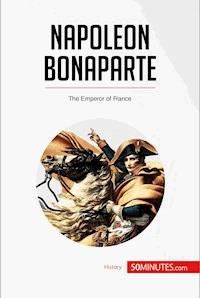
Keen to learn but short on time? Get to grips with the life of Napoleon Bonaparte in next to no time with this concise guide.
50Minutes.com provides a clear and engaging analysis of Napoleon Bonaparte. In the aftermath of the French Revolution, France was in a state of division and anarchy, and in desperate need of a leader. Napoleon Bonaparte, an unlikely candidate from a humble Corsican background, rose through the ranks to rule not only over France, but a large Empire across Europe, and instated many of the laws and institutions that still exist to this day.
In just 50 minutes you will:
• Learn about Napoleon’s modest background and his impressive rise to power
• Understand the impact of the reforms Napoleon instated while in power
• Discover Napoleon’s battles, victories, defeats and expeditions and the legacy they have left behind
ABOUT 50MINUTES.COM | History & Culture
50MINUTES.COM will enable you to quickly understand the main events, people, conflicts and discoveries from world history that have shaped the world we live in today. Our publications present the key information on a wide variety of topics in a quick and accessible way that is guaranteed to save you time on your journey of discovery.
Das E-Book können Sie in Legimi-Apps oder einer beliebigen App lesen, die das folgende Format unterstützen:
Seitenzahl: 44
Veröffentlichungsjahr: 2017
Ähnliche











Napoleon Bonaparte
Key information
Born: 15 August 1769 in Ajaccio (Corsica).Died: 5 May 1821 on Saint Helena (British island in the South Atlantic Ocean).Main achievements: while trying to establish a compromise between the Ancien Régime and the fundamental achievements of the French Revolution (1789), he laid the groundwork for the contemporary world.Introduction
There are similarities between the beginning and end of Napoleon’s life: he was born on an island under Bourbon reign, and he died on another island ruled over by another Bourbon king. However, between those two events he was to change the face of Europe, and practically of the world, following a rapid ascension which in just ten years led him to military, political and administrative domination of an entire continent.
A general during the Revolution at the age of 26, head of government at 30, Emperor at 35: this extraordinary fate for a man from a modest background can certainly be explained by his exceptional qualities, but also by the national and international context of his time. He arrived on the scene in the early 1800s as the saviour of the Revolution, and to secure it from both internal enemies (fierce royalists and uncompromising republicans) and external enemies (Austria, Russia, Prussia and above all Britain), he had no other choice but to seize power, with the support of the majority of French citizens.
He had to tread a fine line and make a series of decisions aimed at placating the royalists – by implementing the Concordat and granting amnesty to émigrés (French aristocrats who had fled following the Revolution) – and at satisfying the republicans – by safeguarding the achievements of the Revolution, whether they were civic, such as equality, or territorial, such as Belgium. He also had to silence any opposition, by executing the Duke of Enghien on the one hand and by eliminating the power of the assemblies on the other. Lastly, he needed to participate in wars with increasing economic, financial and human costs.
In short, Napoleon was unremittingly devoted to establishing and maintaining peace, both outside and inside the borders of his state. His raison d’être began with peace. The French were grateful to him for putting an end to ten years of anarchy and internal divisions, and the European peace treaties he signed were always warmly welcomed by the public. Peace also enabled him to build and reform the country, notably by establishing the civil institutions, such as the Bank of France, on which France still relies today. Napoleon was at least as much an administrator as he was a conqueror.
Unlike a monarch from an established dynasty, or a president whose power is secured by institutions, Napoleon never had any legitimacy other than that which he created for himself. This legitimacy, despite his best efforts to embed it in history, would still remain fragile in the eyes of the French population, and would never be recognised by European monarchies, who would continue to fight him until his eventual downfall.
The life of Napoleon Bonaparte
A childhood in Corsica
Napoleon Bonaparte was born on 15 August 1769 in Ajaccio, Corsica, when the island had just been annexed by France (1768), to a family of the lower nobility, well-off without being rich. His father, re-allied to the French party, was a lawyer for the Council of the Twelve Nobles of Dila then made Deputy of the Nobility of Corsica in 1777. Napoleon went to the continent for the first time in 1778 to begin his military training, first at the royal academy in Brienne, then at the École Militaire in Paris, from where he graduated as an artillery officer in 1785. He was an excellent pupil throughout his studies, but had a melancholy and solitary temperament.
Napoleon’s family
Eight of the fourteen children of Carlo Buonaparte (1746-1785) and Maria Letizia Ramolino (1750-1836) survived. Joseph (1767-1844), future King of Naples and of Spain, was the oldest and Napoleon the second, followed by Lucien (1775-1840), Elisa (1777-1820), Grand Duchess of Tuscany, Louis (1778-1846), future King of Holland, Pauline (1780-1825), Caroline (1782-1839), Queen of Naples and wife of Joachim Murat (1767-1815), and finally Jérôme (1784-1860), future King of Westphalia. The family were sometimes unruly and troublesome for Napoleon, but he used them to cement his power by placing them on the thrones of European monarchies.
From 1785 to 1793, Napoleon, despite being a French officer, was completely focused on Corsica, as he saw his future there. As he was anti-French at this point, he became involved with Pasquale Paoli (1725-1807), leader of the party of patriots who were against French occupation, whom he would break from in 1793 when Paoli became too counterrevolutionary for his liking. From 1789 to 1793, due to military leave of absence and dismissal, he spent the equivalent of three years in Corsica, and thus missed the Revolution that was happening in the capital.
Did you know?
Napoleon initially wanted to become a writer. He wrote a book on the history of Corsica when he was young, as well as two or three works of fiction, including Clisson et Eugénie. He would maintain this passion for writing throughout his life.




