


4,99 €
Mehr erfahren.
- Herausgeber: A.J.Kingston
- Kategorie: Geisteswissenschaft
- Sprache: Englisch
Discover the Untold Stories of America's Indigenous Peoples
Welcome to the "Native American Tribes" book bundle, an immersive journey into the captivating histories of five extraordinary Indigenous nations—the Cherokee, Choctaw, Chickasaw, Creek, and Seminole. This remarkable collection of five books takes you on a profound exploration of their ancient origins, their encounters with European settlers, their struggles during forced removal, and their enduring spirit of resilience and renewal.
Book 1 - The Cherokee Nation: A History of Resilience and Renewal Unearth the roots of the Cherokee people, follow their early encounters with European explorers, and bear witness to the tragic Trail of Tears. But also, discover their remarkable ability to rebound and revive their cultural heritage.
Book 2 - Choctaw Legacy: From Homeland to Removal Embark on an epic journey through the Choctaw Nation, from their vibrant pre-European societies to the challenges they faced during removal. Explore their legacy of adaptability and strength.
Book 3 - Chickasaw Homeland: A Journey Through History Walk in the footsteps of the Chickasaw people, from their ancient origins to their return to their homeland after displacement. Witness the enduring power of cultural identity.
Book 4 - Creek Nation Chronicles: Surviving and Thriving Take a historical odyssey through the Creek Nation, uncovering their ancestral lands, their encounters with European settlers, and the resilience that has defined their journey.
Book 5 - Seminole Nation Saga: Adaptation and Survival Explore the unique culture and unwavering resistance of the Seminole people, who faced removal and the challenges of life in new territories with remarkable resilience.
Why You Should Dive into this Bundle:
- Hidden Histories: These narratives are often overlooked in traditional histories, offering a fresh perspective on America's past.
- Resilience and Renewal: Witness the incredible strength of these Indigenous nations as they adapt and rebuild in the face of adversity.
- Cultural Heritage: Gain a deeper understanding of the rich traditions, languages, and customs that have shaped these tribes.
- Inspiration: Discover how these tribes' stories continue to inspire and shape contemporary Indigenous cultures.
- Educational and Thought-Provoking: Whether you're an educator, history enthusiast, or simply curious about Indigenous cultures, this bundle is a treasure trove of knowledge.
This "Native American Tribes" book bundle is a celebration of heritage, resilience, and the enduring power of cultural identity. Join us on this literary voyage into the heart of Indigenous America and honor the vibrant cultures that continue to enrich our nation.
Get your bundle today and embark on an unforgettable journey through the histories of the Cherokee, Choctaw, Chickasaw, Creek, and Seminole Nations. Don't miss out on this opportunity to delve into the untold stories of America's Indigenous peoples.
Das E-Book können Sie in Legimi-Apps oder einer beliebigen App lesen, die das folgende Format unterstützen:
Veröffentlichungsjahr: 2023
Ähnliche

















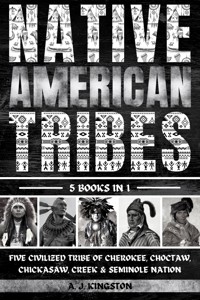
NATIVE AMERICAN TRIBES
FIVE CIVILIZED TRIBES OF CHEROKEE, CHOCTAW, CHICKASAW, CREEK & SEMINOLE NATION
5 BOOKS IN 1
BOOK 1
THE CHEROKEE NATION: A HISTORY OF RESILIENCE AND RENEWAL
BOOK 2
CHOCTAW LEGACY: FROM HOMELAND TO REMOVAL
BOOK 3
CHICKASAW HOMELAND: A JOURNEY THROUGH HISTORY
BOOK 4
CREEK NATION CHRONICLES: SURVIVING AND THRIVING
BOOK 5
SEMINOLE NATION SAGA: ADAPTATION AND SURVIVAL
BY A.J. KINGSTON
Copyright © 2023 by A. J. Kingston
All rights reserved. No part of this book may be reproduced or transmitted in any form or by any means, electronic or mechanical, including photocopying, recording, or by any information storage and retrieval system, without permission in writing from the publisher.
Published by A. J. Kingston
Library of Congress Cataloging-in-Publication Data
ISBN 978-1-83938-485-1
Cover design by Rizzo
Disclaimer
The contents of this book are based on extensive research and the best available historical sources. However, the author and publisher make no claims, promises, or guarantees about the accuracy, completeness, or adequacy of the information contained herein. The information in this book is provided on an "as is" basis, and the author and publisher disclaim any and all liability for any errors, omissions, or inaccuracies in the information or for any actions taken in reliance on such information.
The opinions and views expressed in this book are those of the author and do not necessarily reflect the official policy or position of any organization or individual mentioned in this book. Any reference to specific people, places, or events is intended only to provide historical context and is not intended to defame or malign any group, individual, or entity.
The information in this book is intended for educational and entertainment purposes only. It is not intended to be a substitute for professional advice or judgment. Readers are encouraged to conduct their own research and to seek professional advice where appropriate.
Every effort has been made to obtain necessary permissions and acknowledgments for all images and other copyrighted material used in this book. Any errors or omissions in this regard are unintentional, and the author and publisher will correct them in future editions.
Join Our Productivity Group and Access your Bonus
If you're passionate about history books and want to connect with others who share your love of the subject, joining our Facebook group (search for “History Books by A.J.Kingston”) can be a great way to do so. By joining a group dedicated to history books, you'll have the opportunity to connect with like-minded individuals, share your thoughts and ideas, and even discover new books that you might not have come across otherwise. You can also access your FREE BONUS once you joined our Facebook group called “History Books by A.J.Kingston”.
>> Click Here to Join Our Productivity Group <<
One of the biggest advantages of joining our Facebook group is the sense of community it provides. You'll be able to interact with other history book enthusiasts, ask questions, and share your own knowledge and expertise. This can be especially valuable if you're a student or someone who is just starting to explore the world of history books.
>> Click Here to Follow A.J. Kingston <<
>> Click Here to Download your Free Bonus <<
If you love audiobooks, then joining our YouTube channel that offers free audiobooks on a weekly basis can be a great way to stay entertained and engaged. By subscribing to our channel, you'll have access to a range of audiobooks across different genres, all for free. Not only this is a great opportunity to enjoy some new audiobooks, but it's also a chance to discover new authors and titles that you might not have come across otherwise.
>> Click Here to Join our YouTube Channel <<
Lastly, don’t forget to follow us on Facebook and YouTube by searching for A.J. Kingston.
TABLE OF CONTENTS – BOOK 1 - THE CHEROKEE NATION: A HISTORY OF RESILIENCE AND RENEWAL
Introduction
Chapter 1: Ancient Roots and Pre-European Contact
Chapter 2: Early Encounters with European Explorers
Chapter 3: The Cherokee Nation's Cultural Heritage
Chapter 4: The Trail of Tears: Tragedy and Survival
Chapter 5: Reconstruction and the Post-Civil War Era
Chapter 6: The Cherokee Nation Today: Governance and Identity
Chapter 7: Cultural Revival and Preservation Efforts
Chapter 8: Challenges and Hopes for the Future
TABLE OF CONTENTS – BOOK 2 - CHOCTAW LEGACY: FROM HOMELAND TO REMOVAL
Chapter 1: Ancient Roots and the Choctaw Homeland
Chapter 2: Encounters with European Settlers
Chapter 3: Choctaw Culture and Society
Chapter 4: The Impact of the Trail of Tears
Chapter 5: Struggles and Survival in New Territories
Chapter 6: Rebuilding a Choctaw Identity
Chapter 7: The Choctaw Nation Today: Governance and Identity
Chapter 8: Preserving the Legacy: Language, Arts, and Traditions
TABLE OF CONTENTS – BOOK 3 - CHICKASAW HOMELAND: A JOURNEY THROUGH HISTORY
Chapter 1: The Ancient Roots of the Chickasaw People
Chapter 2: Early Encounters and European Contact
Chapter 3: Chickasaw Culture and Traditions
Chapter 4: The Chickasaw During the Era of Colonization
Chapter 5: The Chickasaw Removal and the Long Walk West
Chapter 6: Rebuilding a Homeland: Chickasaw Nation in Exile
Chapter 7: Return to the Homeland: Reclamation and Resurgence
Chapter 8: The Chickasaw Nation Today: Identity and Prosperity
TABLE OF CONTENTS – BOOK 4 - CREEK NATION CHRONICLES: SURVIVING AND THRIVING
Chapter 1: The Creek People and Their Ancestral Lands
Chapter 2: Early Encounters and the Impact of Colonization
Chapter 3: Creek Culture and the Mound Builders
Chapter 4: The Creek War and Removal
Chapter 5: Life in Exile: The Creek Nation's Struggles
Chapter 6: Rebuilding on New Ground: The Creek's Resilience
Chapter 7: Creek Nation Today: Governance and Identity
Chapter 8: From Survival to Success: Economic Development and Cultural Preservation
TABLE OF CONTENTS – BOOK 5 - SEMINOLE NATION SAGA: ADAPTATION AND SURVIVAL
Chapter 1: Origins and Traditions of the Seminole People
Chapter 2: Early Encounters with Europeans and Africans
Chapter 3: The Unique Culture of the Seminole Nation
Chapter 4: Seminole Resistance and the Seminole Wars
Chapter 5: The Seminole Trail of Tears and Life in Unfamiliar Lands
Chapter 6: Seminole Diaspora and the Struggle for Identity
Chapter 7: A Reclaimed Homeland: The Seminole Nation Today
Chapter 8: Preserving Tradition and Thriving in Modern Times
Conclusion
About A. J. Kingston
Introduction
Welcome to "Native American Tribes: Five Civilized Tribes of Cherokee, Choctaw, Chickasaw, Creek & Seminole Nation," a captivating journey through the rich and diverse histories of some of America's most remarkable Indigenous nations. In this book bundle, we invite you to explore the intricate tapestry of cultures, traditions, and resilience that define the Cherokee, Choctaw, Chickasaw, Creek, and Seminole peoples.
Indigenous communities have played a pivotal role in shaping the story of America, yet their narratives are often overlooked or marginalized. This collection seeks to rectify that oversight by delving deep into the heart of these tribes, highlighting their ancient origins, their encounters with European settlers, the struggles they endured during forced removal, and the enduring spirit that has allowed them to adapt, rebuild, and thrive.
Across the five books that comprise this bundle, we will traverse the landscapes of their ancestral homelands, accompany them through the trials of removal and displacement, and witness their tenacity as they reclaim their identities and cultures in unfamiliar territories. Each tribe's story is a testament to the strength of the human spirit, the resilience of Indigenous cultures, and the importance of preserving these histories for future generations.
Book 1 - The Cherokee Nation: A History of Resilience and Renewal immerses us in the world of the Cherokee people, tracing their roots, their encounters with European explorers, and their tragic journey along the Trail of Tears. But it also showcases their remarkable ability to rebound and revive their cultural heritage.
Book 2 - Choctaw Legacy: From Homeland to Removal unfolds the epic saga of the Choctaw Nation, exploring their vibrant pre-European societies, the challenges they faced during removal, and their legacy of adaptability and strength.
Book 3 - Chickasaw Homeland: A Journey Through History invites us to walk in the footsteps of the Chickasaw people, from their ancient origins to their return to their homeland after displacement, exemplifying the enduring power of cultural identity.
Book 4 - Creek Nation Chronicles: Surviving and Thriving takes us on a historical odyssey of the Creek Nation, revealing their ancestral lands, their encounters with European settlers, and the resilience that has defined their journey.
Book 5 - Seminole Nation Saga: Adaptation and Survival explores the unique culture and unwavering resistance of the Seminole people, who faced removal and the challenges of life in new territories with remarkable resilience.
As you embark on this literary voyage through the histories of these five Indigenous nations, we encourage you to keep an open heart and mind. These stories are not just chapters in history; they are living narratives, illuminating the path forward for these tribes and reminding us all of the enduring power of culture, heritage, and the human spirit.
Join us as we delve into the past and present of the Cherokee, Choctaw, Chickasaw, Creek, and Seminole Nations, and together, let us honor and celebrate the diverse and resilient cultures that continue to enrich the fabric of America.
BOOK 1
THE CHEROKEE NATION
A HISTORY OF RESILIENCE AND RENEWAL
BY A.J. KINGSTON
Chapter 1: Ancient Roots and Pre-European Contact
Ancient Origins and Migration are fundamental aspects of human history and have shaped the course of civilizations for millennia. Our understanding of these topics continues to evolve as archaeologists, anthropologists, and historians uncover new evidence and refine existing theories.
The study of Ancient Origins seeks to uncover the earliest traces of human existence on Earth. It delves into the archaeological record to unearth artifacts, fossils, and other remnants of ancient civilizations. These discoveries provide valuable insights into the lives, technologies, and cultures of our distant ancestors.
One of the most remarkable aspects of human history is our species' ability to adapt and migrate across vast distances. Early humans were nomadic by nature, constantly on the move in search of food, water, and shelter. This nomadic lifestyle played a pivotal role in our survival and eventual dominance on the planet.
The migration of ancient peoples is a fascinating area of study. It involves tracing the movement of human populations across continents and regions over thousands of years. Archaeological findings and genetic research have shed light on these migratory patterns, revealing the complex interplay of factors that drove people to explore and settle new lands.
In the distant past, the movement of ancient populations was often driven by environmental factors. Changes in climate, such as the end of the last ice age, could create new opportunities or necessitate migrations to more hospitable regions. For example, the melting of glaciers led to the opening of new land routes that early humans could follow.
Additionally, the availability of resources played a crucial role in migration. Early humans followed the herds of animals they hunted, as well as the seasonal growth of plants they gathered. This nomadic lifestyle led to the gradual spread of our species across the continents.
As humans migrated, they encountered new environments and adapted to diverse landscapes. This process of adaptation led to the development of distinct regional cultures and technologies. For example, those who settled in fertile river valleys like the Nile or the Tigris and Euphrates developed advanced agricultural practices, leading to the rise of early civilizations.
Ancient trade networks also played a significant role in migration. As people moved, they established trade routes that connected distant regions. These routes facilitated the exchange of goods, ideas, and technologies, contributing to the spread of knowledge and cultural diffusion.
One remarkable example of ancient migration is the peopling of the Americas. For thousands of years, the Americas remained uninhabited by humans until a group of early migrants crossed a land bridge connecting Siberia and Alaska. These pioneers ventured further south, populating the entire continent and giving rise to diverse Native American cultures.
In some cases, ancient migrations were driven by conflict and conquest. The expansion of empires, such as the Roman Empire in Europe or the Mongol Empire in Asia, led to the displacement of populations and the merging of cultures. This resulted in the spread of languages, religions, and governance systems.
Another crucial aspect of ancient migrations is the impact on cultural diversity. As people moved, they encountered new societies and adapted to different ways of life. This process often led to the exchange of customs, languages, and traditions. Over time, these interactions enriched human culture and fostered cross-cultural understanding.
The study of ancient migrations is not limited to prehistoric times. It also includes the movements of ancient civilizations and their interactions with neighboring societies. For example, the Silk Road, which connected China with the Mediterranean world, facilitated trade and cultural exchange between East and West.
In summary, Ancient Origins and Migration are essential components of human history. The study of these topics allows us to trace the footsteps of our ancestors, understand their motivations, and appreciate the rich tapestry of cultures that have emerged over millennia. As our knowledge and technology continue to advance, we can look forward to uncovering even more fascinating insights into our ancient past.
Indigenous Societies of the Cherokee Homeland represent a captivating facet of Native American history. These societies thrived in what is now known as the southeastern United States long before the arrival of European settlers, leaving behind a legacy of rich cultural traditions, complex social structures, and deep connections to the land.
The Cherokee Nation, in particular, was one of the prominent Indigenous societies in the southeastern region. Their homeland encompassed parts of present-day Tennessee, North Carolina, Georgia, and Alabama. Within this vast territory, various Cherokee communities and clans established their unique ways of life.
One key aspect of Cherokee society was its matrilineal kinship system. In this system, descent and clan membership were determined through the mother's lineage. Clans played a crucial role in Cherokee life, governing social and political interactions, and often held their own specific responsibilities and duties within the community.
The Cherokee homeland was characterized by a diverse environment, including mountains, forests, rivers, and fertile valleys. This diversity allowed Cherokee societies to develop a wide range of subsistence practices. They were skilled hunters and gatherers, relying on game like deer and turkey, as well as seasonal harvests of fruits, nuts, and plants.
Agriculture was also integral to Cherokee societies. They cultivated crops like corn, beans, and squash, known as the "Three Sisters," which provided a stable food source. The Cherokee's agricultural knowledge and techniques were passed down through generations and allowed them to thrive in their homeland.
Villages were the central units of Cherokee society. These communities were often situated near rivers or streams, providing access to water for daily needs and transportation. Cherokee villages were typically comprised of communal structures, including council houses, homes, and granaries, reflecting the importance of community life.
Council houses held immense significance in Cherokee culture. They served as gathering places for important ceremonies, councils, and decision-making processes. Cherokee society was governed by a council of elders and leaders, and discussions within these council houses played a critical role in shaping their communities.
Ceremony and spirituality were deeply ingrained in the fabric of Cherokee societies. They held various ceremonies, dances, and rituals throughout the year to honor their connections to the land, their ancestors, and the natural world. These ceremonies were often accompanied by intricate songs and dances, showcasing the Cherokee's artistic and cultural richness.
Trade was another vital aspect of Cherokee society. They engaged in a vast trade network, exchanging goods such as furs, hides, and agricultural products with neighboring tribes. These trade connections fostered intertribal relationships and facilitated the exchange of ideas and technologies.
The Cherokee homeland was not isolated; it was a region where different Indigenous societies coexisted and interacted. The Cherokee had interactions and alliances with neighboring tribes like the Creek, Choctaw, and Chickasaw. These interactions influenced their culture, art, and governance systems.
However, the arrival of European settlers in the 17th century began to alter the dynamics of Cherokee society. The introduction of new diseases, the encroachment of European settlers on their lands, and conflicts over territory led to significant changes in the lives of Cherokee people.
Despite the challenges and hardships they faced, the Cherokee Nation's resilience and determination to preserve their cultural heritage remain evident to this day. Their history serves as a testament to the enduring strength of Indigenous societies and their deep-rooted connections to their homeland.
Pre-European Contact and Cultural Practices are integral parts of the history of Indigenous societies in North America. These eras, often referred to as pre-contact or pre-Columbian times, represent a period of rich cultural diversity, sustainable practices, and complex social structures long before the arrival of European explorers and settlers.
Before the arrival of Europeans, Indigenous societies across North America had developed unique and sophisticated ways of life that were deeply connected to their environments. These societies were highly adaptable and had thrived in a wide range of geographical settings, from the Arctic tundra to the desert Southwest to the temperate woodlands of the eastern United States.
One of the defining characteristics of pre-European contact Indigenous societies was their sustainable and harmonious relationship with the natural world. These societies relied on the land and its resources for their survival, and they had developed intricate systems of resource management and conservation.
Agriculture played a significant role in many Indigenous societies. The cultivation of crops like maize (corn), beans, and squash, known as the "Three Sisters," was a cornerstone of agriculture in regions such as the Eastern Woodlands. This agricultural system was sustainable and provided a diverse and nutritious diet.
In addition to agriculture, Indigenous peoples practiced various forms of hunting, fishing, and gathering based on the ecosystems of their respective regions. These practices were not only essential for food but also deeply intertwined with cultural and spiritual beliefs. Many Indigenous societies had a profound respect for the animals they hunted and the plants they gathered, often incorporating them into their rituals and ceremonies.
Social structures in pre-European contact Indigenous societies were diverse and adapted to the specific needs of each community. In many cases, kinship systems played a central role in organizing society. Clan systems, often matrilineal, were common, and individuals identified with and were loyal to their clans.
Cultural practices and belief systems varied widely among Indigenous societies. These cultures were characterized by oral traditions, storytelling, and the transmission of knowledge from one generation to the next. Spiritual beliefs were deeply connected to the land, the seasons, and the natural world, and ceremonies and rituals played a significant role in maintaining balance and harmony.
Artistic expression was also a vital part of Indigenous cultures. Many Indigenous peoples created intricate and beautiful works of art, including pottery, basketry, beadwork, textiles, carvings, and paintings. These art forms often conveyed stories, symbols, and spiritual meanings.
Trade networks were established among Indigenous societies long before the arrival of Europeans. These networks allowed for the exchange of goods, technologies, and cultural practices over vast distances. Items like shells, obsidian, and copper moved through these networks, connecting different regions and fostering intertribal relationships.
The absence of written languages in many Indigenous societies did not diminish the depth of their knowledge and intellectual achievements. Indigenous peoples developed intricate systems of oral history, passing down knowledge, traditions, and stories through generations. These oral traditions were a testament to the complexity of their societies.
Pre-European contact Indigenous societies also exhibited resilience and adaptability in the face of environmental challenges. They developed strategies for coping with changing climates, resource availability, and natural disasters. These strategies often involved mobility, allowing them to move seasonally to access different resources.
In summary, the era of pre-European contact in North America was marked by the diversity, sustainability, and complexity of Indigenous societies. These societies had developed intricate cultural practices, sustainable resource management, and deeply rooted spiritual connections to the land. The legacy of these pre-contact societies continues to influence and enrich Indigenous cultures and communities today.
Chapter 2: Early Encounters with European Explorers
The arrival of European explorers in Cherokee territory marked a significant turning point in the history of the Cherokee Nation and the broader Southeastern United States. European exploration of the Americas began in the late 15th century, with Christopher Columbus's voyages, and continued throughout the subsequent centuries. Here, we will explore the impact of European explorers specifically in Cherokee territory.
Early Encounters: The earliest European explorers to reach Cherokee territory included Spanish expeditions led by Hernando de Soto in the mid-16th century. De Soto's expedition, which explored parts of present-day Tennessee and the southeastern United States, brought the Cherokee people into direct contact with Europeans. These encounters introduced the Cherokees to new technologies, animals, and diseases.
Trade Relations: European explorers, particularly the Spanish and later the French and English, established trade relationships with the Cherokee people. The Cherokee traded furs, hides, and other valuable resources in exchange for European goods such as metal tools, firearms, cloth, and glass beads. This trade had a profound impact on Cherokee culture, introducing new materials and technologies.
Conflict and Alliances: European colonization efforts often led to conflicts in Cherokee territory. As European powers vied for control of North America, the Cherokee found themselves caught in the middle. They sometimes formed alliances with European colonists, such as the English during the late 17th century, in efforts to gain an advantage over rival Indigenous nations.
Disease and Population Decline: Like many Indigenous peoples, the Cherokee were highly susceptible to diseases introduced by European explorers. Diseases such as smallpox, measles, and influenza decimated Cherokee populations, leading to a significant decline in numbers. This demographic impact was profound and had long-lasting consequences.
Land Disputes and Displacement: As European settlements expanded, land disputes arose in Cherokee territory. European colonists and later American settlers encroached on Cherokee lands, leading to conflicts and negotiations over territory. These disputes eventually culminated in the forced removal of the Cherokee people from their ancestral lands in the early 19th century, a tragic event known as the Trail of Tears.
Influence on Cherokee Culture: European contact also influenced Cherokee culture in various ways. This influence can be seen in the adoption of European-style clothing, the incorporation of European farming techniques, and the use of firearms in hunting and warfare. The Cherokee syllabary, developed by Sequoyah in the early 19th century, was influenced by European writing systems.
Impact on Governance: The introduction of European political systems and concepts of governance had an impact on Cherokee leadership and governance structures. The Cherokee Nation adapted to some aspects of European-style governance, particularly during the 19th century.
In summary, the arrival of European explorers in Cherokee territory brought about significant changes and challenges for the Cherokee people. It initiated a complex interplay of trade, conflict, disease, cultural exchange, and ultimately, the displacement of the Cherokee from their ancestral lands. The history of European exploration and contact in Cherokee territory is a crucial chapter in the broader history of Indigenous-European interactions in North America.
The Impact of Contact and the Fur Trade on Indigenous societies in North America represents a crucial and transformative period in history. The fur trade, which emerged in the 17th century, had far-reaching consequences for both Indigenous peoples and European colonists. Here, we will explore the significant impact of contact and the fur trade on Indigenous societies.
Introduction of European Goods: The fur trade introduced Indigenous peoples to a wide range of European goods. Indigenous communities began to acquire metal tools, firearms, cloth, glass beads, and other items through trade with European fur traders. These goods significantly impacted daily life, altering hunting, cooking, clothing, and other aspects of Indigenous culture.
Transformation of Indigenous Economies: The fur trade became a central component of Indigenous economies in regions where fur-bearing animals were abundant. Indigenous hunters and trappers exchanged furs for European goods, creating a new economic system that influenced social hierarchies and trade networks.
Intertribal Trade Networks: The fur trade fostered intertribal trade networks and alliances. Indigenous groups often specialized in the procurement of specific furs, which they then traded with other Indigenous nations. This intertribal trade led to the exchange of goods, ideas, and cultural practices, strengthening relationships among Indigenous peoples.
Cultural Exchange: The fur trade facilitated cultural exchange between Indigenous peoples and European traders. This exchange included language acquisition, religious syncretism, and the sharing of culinary traditions. Some Indigenous communities adopted aspects of European culture, while European traders adopted elements of Indigenous lifestyles.
Impact on Traditional Hunting Practices: The demand for furs, particularly beaver pelts, led to changes in traditional hunting practices. Indigenous hunters shifted their focus to specific animals desired by European markets, which could deplete local animal populations and disrupt ecological balances.
Disease and Population Decline: Contact with European traders also exposed Indigenous populations to diseases to which they had no immunity, such as smallpox, measles, and influenza. These diseases led to devastating epidemics and significant population decline among Indigenous communities.
Conflict and Alliances: Competition among European colonial powers for control of the fur trade sometimes led to conflicts in Indigenous territories. Indigenous groups often played rival European powers against each other to their advantage, forming alliances when it suited their interests.
Impact on Ecosystems: The fur trade had ecological consequences as well. Overexploitation of fur-bearing animals, such as beavers, led to declines in their populations in certain areas. This, in turn, affected the ecosystems and disrupted Indigenous subsistence practices.
Challenges to Indigenous Sovereignty: The fur trade contributed to challenges to Indigenous sovereignty. European colonists and traders frequently sought to establish control over fur-rich regions, leading to disputes and conflicts over territory and resources.
Legacy of the Fur Trade: The legacy of the fur trade continues to shape Indigenous communities and their relationships with the broader society. Many Indigenous peoples today maintain cultural practices, stories, and art related to the fur trade era.
In summary, the impact of contact and the fur trade on Indigenous societies in North America was multifaceted. It brought about economic changes, cultural exchange, population decline, ecological consequences, and challenges to Indigenous sovereignty. The fur trade era remains a pivotal chapter in the complex history of Indigenous-European interactions on the continent.
Early Diplomatic Relations and Alliances during the period of European exploration and colonization in North America played a pivotal role in shaping the course of history for both Indigenous nations and European colonial powers. This era marked a complex and dynamic interplay of diplomacy, trade, cultural exchange, conflict, and cooperation.
When European explorers first arrived on the shores of North America in the late 15th and early 16th centuries, they encountered a vast array of Indigenous nations, each with its unique cultures, languages, and political structures. These Indigenous nations had established their own complex systems of governance, trade networks, and diplomatic protocols long before European contact.
Diplomacy between Indigenous nations and European explorers was often initiated through the exchange of goods and the establishment of trade relationships. Indigenous peoples possessed valuable resources such as furs, hides, and agricultural products that were highly sought after by Europeans. In return, Indigenous nations acquired European goods like metal tools, firearms, cloth, and glass beads, which significantly impacted their daily lives.
These initial diplomatic encounters were characterized by mutual curiosity and the exchange of gifts. European explorers and Indigenous leaders engaged in negotiations to establish trade agreements. These agreements often laid the foundation for diplomatic relations, as both parties recognized the benefits of continued trade.
However, as European colonization efforts expanded, diplomatic relations became more complex. European colonial powers, including the Spanish, French, Dutch, and English, began to establish permanent settlements in North America. This expansion led to increased competition among European nations for control of territory and resources.
Indigenous nations found themselves in the midst of this competition, and many Indigenous leaders skillfully played European powers against each other to their advantage. Diplomatic alliances were forged strategically, often based on mutual interests and shared goals. Indigenous nations recognized that forming alliances with European colonists could provide military support, access to European trade goods, and a means to resist rival Indigenous nations.
Diplomacy and alliances took various forms. Some Indigenous nations entered into formal treaties with European colonial powers, recognizing their sovereignty and establishing agreements for mutual defense and trade. These treaties often included the exchange of wampum belts, which served as symbols of the agreements and were imbued with deep cultural significance.
Diplomatic councils and gatherings became important venues for negotiations. Indigenous leaders from various nations would convene to discuss matters of mutual concern, including trade, territorial boundaries, and alliances. These councils played a vital role in shaping diplomatic relations in North America.
Cultural exchange was an integral part of early diplomacy. Indigenous peoples shared their languages, knowledge, and customs with European explorers, while Europeans introduced Indigenous nations to new technologies, religious beliefs, and cultural practices. This exchange of ideas and traditions had a profound impact on both Indigenous and European societies.
Despite efforts to establish peaceful alliances, conflicts occasionally arose. Competition for land and resources, misunderstandings, and clashes of cultural norms led to tensions and violence. Many Indigenous nations found themselves facing threats to their sovereignty and ancestral lands as European colonization expanded.
One notable example of diplomacy and alliances was the Treaty of Tordesillas in 1494, which divided the newly discovered lands of the Americas between Spain and Portugal. While this treaty did not directly involve Indigenous nations, it set a precedent for European territorial claims in the Americas.
Another significant diplomatic figure was Powhatan, the paramount chief of the Powhatan Confederacy in Virginia, who maintained complex relations with English colonists, including the famous story of Pocahontas and her interactions with Englishman John Smith.
As European colonization progressed, the dynamics of diplomacy and alliances continued to evolve. Indigenous nations adapted to the changing landscape and sought to protect their interests and cultures. Some alliances were successful in resisting European encroachment, while others faced significant challenges and displacement.
In summary, early diplomatic relations and alliances during the era of European exploration and colonization in North America were marked by a complex interplay of diplomacy, trade, cultural exchange, conflict, and cooperation. Indigenous nations and European colonial powers engaged in negotiations, formed alliances, and navigated the challenges of competing interests and cultural differences. This period of history laid the foundation for the diverse diplomatic and cultural landscape that continues to shape North America today.
Chapter 3: The Cherokee Nation's Cultural Heritage
Language and Writing hold profound significance in human history, serving as vehicles for communication, culture, and the preservation of knowledge. One remarkable example of linguistic innovation and cultural preservation is the Cherokee Syllabary, a script developed by Sequoyah, a Cherokee silversmith and visionary, in the early 19th century.
Before the introduction of the Cherokee Syllabary, the Cherokee people, like many Indigenous nations, relied on oral tradition for the transmission of their language, stories, and history. Their spoken language, Cherokee, is a complex and rich linguistic system, and they had no written script to record it.
Sequoyah, also known as George Guess, recognized the importance of creating a written system for the Cherokee language. Born around 1767 in what is now Tennessee, Sequoyah was raised in a Cherokee-speaking family. His experiences and observations during his travels led him to understand the transformative potential of a written script for his people.
The creation of the Cherokee Syllabary was an astonishing feat of innovation. Sequoyah dedicated years to developing a system that would represent the sounds of the Cherokee language with written characters. He faced numerous challenges, as the Cherokee language has a different structure and sound system than English or other European languages.
Sequoyah's breakthrough came when he realized that the Cherokee language could be represented through a set of symbols, each corresponding to a specific syllable. Unlike alphabetic scripts that use individual letters to represent sounds, the Cherokee Syllabary assigns characters to syllables, making it uniquely suited to the Cherokee language's structure.
The Cherokee Syllabary consists of 85 characters, each representing a different syllable in the Cherokee language. These characters were based on a combination of shapes and symbols from Sequoyah's own experiences, such as elements from nature, the human body, and everyday objects. The process of assigning characters to syllables was meticulous and thoughtful, and it showcased Sequoyah's deep understanding of his language.
Sequoyah's creation of the Cherokee Syllabary was an act of cultural preservation and empowerment. He understood that a written script would not only enable the Cherokee people to record their language but also allow them to document their history, stories, and traditions. This was particularly important in a time of increasing interaction with European settlers and the United States government, as it provided a means for the Cherokee to negotiate, communicate, and assert their identity.
The Cherokee Syllabary's impact was profound and immediate. Sequoyah's invention enabled the Cherokee people to write letters, keep written records, and publish newspapers in their own language. The first Cherokee newspaper, the "Cherokee Phoenix," was published in 1828, and it played a vital role in disseminating news, cultural knowledge, and advocacy for the Cherokee Nation.
One of the most remarkable aspects of the Cherokee Syllabary is its success in achieving widespread literacy among the Cherokee people. Within just a few years of its creation, a significant portion of the Cherokee population had learned to read and write in their own language. This rapid adoption of literacy was unprecedented and demonstrated the practicality and effectiveness of the script.
Sequoyah's legacy extends beyond the Cherokee Nation. His invention of a syllabary influenced other Indigenous nations in North America who sought to develop their writing systems. The Cherokee Syllabary served as an inspiration and a model for these efforts.
In 1825, the Cherokee Nation officially adopted the Cherokee Syllabary as its writing system, recognizing its value and cultural significance. The syllabary's impact on Cherokee society was profound, fostering a sense of cultural pride and identity, even in the face of increasing pressures from European settlers and the U.S. government.
However, the Cherokee people faced significant challenges during this period, including land dispossession, forced removal from their ancestral lands in the southeastern United States, and the Trail of Tears in 1838-1839. Despite these hardships, the Cherokee Syllabary remained a symbol of resilience and cultural preservation.
Today, the Cherokee Syllabary continues to be a vital part of Cherokee culture and identity. It is taught in schools and used in various forms of media, literature, and cultural expression. Efforts to revitalize the Cherokee language and promote literacy in the syllabary remain ongoing, ensuring that Sequoyah's legacy endures for future generations.
Sequoyah's invention of the Cherokee Syllabary stands as a testament to the power of individuals to shape the course of history and preserve their culture. It remains a remarkable example of linguistic innovation and cultural resilience, demonstrating the enduring value of language and writing in the preservation of Indigenous knowledge and identity. The Cherokee Syllabary serves as a reminder that language is not only a means of communication but also a powerful tool for cultural preservation and empowerment.
Religious Beliefs and Practices are fundamental aspects of human culture and have played a pivotal role in shaping societies, worldviews, and individual identities throughout history. Across the globe, diverse religious traditions have emerged, each offering unique perspectives on the spiritual, moral, and ethical dimensions of life. In this exploration, we delve into the multifaceted nature of religious beliefs and practices, examining their significance, diversity, and impact on individuals and communities.
Religious beliefs encompass a wide spectrum of perspectives on the divine, the supernatural, and the meaning of existence. At the core of many religious traditions lies the concept of the divine, which is often characterized as a transcendent and all-encompassing force that shapes the universe and governs the human experience. Believers find solace, guidance, and purpose in their relationship with this divine entity, which may take the form of a single, all-powerful God, a pantheon of deities, or a more abstract and non-personified spiritual presence.
The diversity of religious beliefs is striking, with thousands of distinct traditions practiced worldwide. These encompass major world religions such as Christianity, Islam, Hinduism, Buddhism, Judaism, and Sikhism, as well as countless indigenous, folk, and new religious movements. Each tradition offers its unique interpretation of the divine, creation myths, cosmologies, moral codes, and rituals that guide the lives of its adherents.
Central to religious practices are rituals, ceremonies, and observances that serve as tangible expressions of faith and devotion. These rituals often vary widely between religious traditions, but they commonly serve as a means of establishing a connection with the divine, seeking spiritual insight, and fostering a sense of community. Rituals may include prayer, meditation, worship, pilgrimage, sacrifices, fasting, and rites of passage marking significant life events such as birth, marriage, and death.
In addition to rituals, religious practices often encompass ethical and moral guidelines that inform the conduct of believers. Moral principles guide individuals in making ethical choices and living virtuous lives in accordance with the teachings of their faith. These principles may address issues such as compassion, justice, honesty, kindness, and the treatment of others. The ethical framework provided by religion serves as a moral compass, shaping behavior and fostering a sense of accountability to the divine and one's fellow human beings.
The role of religious leaders and institutions is crucial in many religious traditions. Religious leaders, such as priests, pastors, imams, monks, and shamans, serve as intermediaries between the divine and the faithful. They provide spiritual guidance, officiate ceremonies, and offer interpretations of religious texts. Religious institutions, including churches, mosques, temples, synagogues, and monastic communities, serve as centers of worship, education, and community support. These institutions play a vital role in preserving religious traditions and providing a sense of belonging for believers.
Religious texts and scriptures are foundational to many religious traditions. These sacred writings contain the teachings, stories, and moral guidelines that guide the faith and practice of believers. Examples include the Bible in Christianity, the Quran in Islam, the Bhagavad Gita in Hinduism, the Tripitaka in Buddhism, and the Torah in Judaism. The interpretation and study of religious texts often play a central role in religious education and scholarship, fostering a deeper understanding of the tradition's beliefs and practices.
The impact of religious beliefs and practices on individuals and societies is profound and far-reaching. At the individual level, religion often provides a source of comfort, meaning, and purpose in life. Believers turn to their faith for guidance in times of joy, sorrow, and uncertainty. Religious practices offer a sense of structure and routine, creating opportunities for reflection, meditation, and the cultivation of inner peace.
Religion also plays a vital role in shaping moral values and ethical behavior. The moral principles and teachings of religious traditions influence the decisions and actions of individuals, serving as a framework for addressing ethical dilemmas and promoting social justice. Many religious traditions emphasize compassion, empathy, and the importance of helping those in need, fostering a sense of responsibility to one's community and the broader world.
Furthermore, religious communities often serve as sources of social cohesion and support. They provide a sense of belonging, camaraderie, and shared purpose for their members. Religious institutions are frequently involved in charitable activities, humanitarian efforts, and social outreach, contributing to the welfare of society as a whole.
However, religion's impact is not solely positive, as history has shown instances of religious conflicts, intolerance, and persecution. Differences in religious beliefs and practices have at times led to tensions and conflicts between religious groups. These conflicts underscore the importance of promoting interfaith dialogue, religious tolerance, and respect for diverse beliefs and practices.
In contemporary society, religious pluralism and diversity are increasingly prevalent. Individuals have the freedom to choose their religious beliefs and practices, leading to a rich tapestry of faith traditions coexisting in the same communities. Interfaith dialogue and cooperation have become essential in fostering understanding, respect, and peaceful coexistence among people of different faiths.
In summary, religious beliefs and practices are multifaceted, diverse, and deeply ingrained in human culture and history. They encompass a wide range of perspectives on the divine, ethics, rituals, and community. Religion provides individuals with meaning, guidance, and a sense of belonging while shaping moral values and influencing ethical behavior. The impact of religious beliefs extends to societies, where religious institutions and communities play roles in promoting social cohesion, charitable work, and ethical engagement. In an increasingly pluralistic world, the appreciation of religious diversity and the promotion of interfaith dialogue remain essential for fostering understanding, tolerance, and peaceful coexistence.
Arts, crafts, and ceremonies of the Cherokee people offer a rich and multifaceted glimpse into the culture and heritage of this Indigenous nation. The Cherokee, historically located in the southeastern United States, have a long-standing tradition of artistic expression, skilled craftsmanship, and ceremonial practices that have been passed down through generations.
Art and craftsmanship among the Cherokee encompass a wide range of forms and media, reflecting the creativity and ingenuity of the people. One of the most notable art forms is pottery, which has been crafted by Cherokee artisans for centuries. Cherokee pottery is known for its distinctive designs, often featuring intricate geometric patterns and stylized animal motifs. These designs are created using various techniques, including incising, stamping, and carving, and the pottery is traditionally fired in an open flame or pit.
Basketry is another celebrated craft among the Cherokee. Basket weaving has a long history in Cherokee culture and is considered both a practical and artistic endeavor. Cherokee baskets are renowned for their intricate patterns and natural dyes derived from materials like walnut hulls, bloodroot, and blackberries. These baskets serve a variety of purposes, from carrying and storing goods to being used in ceremonial contexts.
Textile arts are also integral to Cherokee culture. Cherokee women have a tradition of weaving river cane and other materials into textiles, producing items such as mats, belts, and sashes. These textiles often incorporate meaningful designs and colors, reflecting the spiritual and cultural significance of these creations.
Beadwork is another expressive art form within Cherokee culture. Beadwork is used to embellish clothing, accessories, and ceremonial regalia. Traditional Cherokee beadwork often features intricate geometric patterns and vibrant colors, with each bead representing a unique symbol or element of Cherokee cosmology.
Ceremonial regalia holds particular importance in Cherokee culture and is adorned with various artistic elements. Featherwork, for instance, is a notable feature of ceremonial attire. Feathers from birds like eagles and turkeys are carefully selected and arranged to create ornate headdresses and other adornments that hold spiritual significance in Cherokee ceremonies.
In addition to these artistic traditions, storytelling plays a crucial role in Cherokee culture. Oral tradition is central to passing down the history, myths, and teachings of the Cherokee people. Cherokee storytellers, often referred to as "beloved people" or "unolvtana," have preserved the narratives and wisdom of their ancestors through spoken word.
Ceremonies and rituals are deeply embedded in Cherokee life and serve as significant expressions of spirituality and community. One of the most well-known Cherokee ceremonies is the Green Corn Ceremony, also known as the New Moon Ceremony. This annual event marks the beginning of the Cherokee agricultural calendar and involves feasting, dancing, purification rituals, and the offering of thanks to the Creator for the harvest.
The Stomp Dance, also known as the Friendship Dance, is a social and ceremonial dance that has been practiced for generations. It involves rhythmic stomping of the feet, the beating of drums, and the chanting of traditional songs. The Stomp Dance is an occasion for socializing, fostering community bonds, and celebrating Cherokee identity.
The Cherokee Ball Play, known as anetsa, is a traditional game that combines elements of sport and ceremony. Historically played between Cherokee communities or with neighboring tribes, the game involves teams competing to score points by propelling a ball through a goal post. The Cherokee Ball Play has ceremonial aspects, including rituals and prayers associated with the game.
The Brush Arbor Meeting, or the Little Greenbrier, is another significant Cherokee ceremony. This gathering is held in an open-air arbor and involves communal singing, prayer, and the sharing of spiritual experiences. The Brush Arbor Meeting allows Cherokee communities to come together to seek guidance, solace, and spiritual connection.
Sacred fire is central to many Cherokee ceremonies. The lighting and tending of the sacred fire symbolize the presence of the Creator and the connection between the earthly and spiritual realms. The sacred fire is a focal point for prayer, reflection, and purification in Cherokee rituals.
The Seven Clans Dance is a ceremonial dance that pays homage to the seven traditional Cherokee clans: Wolf, Bird, Deer, Paint, Wild Potato, Blue, and Long Hair. Each clan has its own unique dance, and the Seven Clans Dance serves as a way to honor and recognize the ancestral heritage and interconnectedness of the clans.
In summary, the arts, crafts, and ceremonies of the Cherokee people are integral components of their culture and identity. These expressions of creativity, spirituality, and community have been passed down through generations, reflecting the deep-rooted traditions and values of the Cherokee nation. The rich tapestry of Cherokee artistry, craftsmanship, and ceremonial practices continues to thrive and evolve, celebrating the enduring spirit and heritage of this Indigenous nation.
Chapter 4: The Trail of Tears: Tragedy and Survival
The Trail of Tears represents one of the most tragic and devastating episodes in the history of Indigenous peoples in the United States. It was a forced removal of several Indigenous nations, including the Cherokee, Choctaw, Chickasaw, Creek, and Seminole, from their ancestral homelands to lands west of the Mississippi River. The forces behind the Trail of Tears were complex and multifaceted, involving a combination of political, economic, social, and cultural factors.
Land Hunger and Expansionism: One of the primary driving forces behind the Trail of Tears was the insatiable land hunger of European-American settlers and the U.S. government. As settlers moved westward in search of fertile land for agriculture and resources like gold, they encroached on Indigenous territories. The U.S. government, influenced by the ideology of Manifest Destiny, aimed to expand its territory from coast to coast, further intensifying pressure on Indigenous lands.
Political Policies and Legislation: The U.S. government implemented a series of policies and legislation that paved the way for the forced removal of Indigenous nations. The Indian Removal Act of 1830, signed into law by President Andrew Jackson, authorized the removal of Indigenous nations from their lands in the southeastern United States. This legislation provided the legal framework for the subsequent removals.
Economic Interests: Economic factors played a significant role in the forced removals. The lands inhabited by the Indigenous nations in the southeastern U.S. were highly desirable for agriculture, particularly the cultivation of cotton, which was a lucrative crop in the 19th century. The economic interests of planters and land speculators drove the push for Indigenous removal.
Conflict and Treaty Negotiations: Many Indigenous nations had established treaties with the U.S. government, but these treaties were often broken or manipulated to favor American expansion. Conflicts and tensions between Indigenous nations and settlers escalated, leading to negotiations for new treaties that were often coercive and unfair.
Racism and Prejudice: Deep-seated racism and prejudice against Indigenous peoples played a role in the forced removals. Many Americans viewed Indigenous nations as inferior and believed that their removal was necessary for the expansion and prosperity of the United States.
Militarization and Coercion: In some cases, the U.S. government used military force and coercion to enforce the removals. The removal of the Cherokee Nation, for example, involved the use of federal troops to round up and forcibly relocate Cherokee people.




