


74,99 €
Mehr erfahren.
- Herausgeber: John Wiley & Sons
- Kategorie: Geisteswissenschaft
- Sprache: Englisch
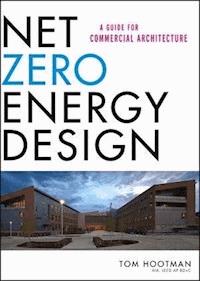
Conveniently organized and packed with robust technical content and clear explanations of key principles Written by an architect who is the director of sustainability at a global architecture firm, Net Zero Energy Design is a practical guide for architects and related construction professionals who want to design and build net zero energy commercial architecture. It offers no-nonsense strategies, step-by-step technical analysis, and valuable examples, in addition to developed case studies. With a focus on application in a variety of building types and scales, the book also develops a broad-based understanding of all the integrated principles involved in achieving net zero energy. This book is an indispensable resource for anyone venturing into net zero energy design, construction, and operation, and it also serves as an excellent resource on a variety of sustainable design topics. Important features include: * Organization based upon the commercial building delivery process * Robust technical content for use in actual project applications * Analysis examples that demonstrate key technical principles * Plenty of design data for use as a valuable design resource * Abundant and sophisticated information graphics and color illustrations and photographs * A distinct design focus on the content that inspires adoption of principles into projects
Sie lesen das E-Book in den Legimi-Apps auf:
Seitenzahl: 780
Veröffentlichungsjahr: 2012
Ähnliche




















Table of Contents
Cover
Acknowledgments
Introduction
My Net Zero Energy Journey
How To Use This Book
Chapter 1: Net Zero Energy Building Overview
The Case for Net Zero Energy Buildings
Defining Net Zero Energy
Classifying Net Zero Energy Buildings
Alternative Approaches to Net Zero Energy
Certifying Net Zero Energy Buildings
Building Industry Research and Trends
Building Industry Programs
Building Industry Codes and Regulations
Building Rating and Energy Labeling Systems
Chapter 2: Project Conception and Delivery
The Net Zero Energy Objective
Project Conception
Project Planning
Project Team Selection
Delivery Methods
Risks and Rewards
Chapter 3: Integrated Process
Integrated Delivery and Management
Project Delivery Phases
Integrated Design Methods
Building Energy Modeling
Chapter 4: Energy
Energy Basics
Energy Use Intensity
Energy Targets
Energy and Thermal Comfort
Chapter 5: Design Fundamentals
Energy Design Conditions
Climate Assessment
Site Assessment
Building Massing and Geometry
Building Type and Zoning
Chapter 6: Passive Architecture
Passive Design
Design Science
Building Envelope
Passive Strategies
Chapter 7: Energy-Efficient Building Systems
Active Systems
Basic Concepts
HVAC Overview
Low-Energy Distribution
Low-Energy Primary Equipment
Domestic Hot Water
Lighting
District Energy
Chapter 8: Renewable Energy
Renewable Energy Basics
Solar Power
Solar Thermal
Wind
Hydro
Geothermal
Biomass
Fuel Cells and Hydrogen
Chapter 9: Economics
Financial Considerations
Financial Models
Financial Analysis
Net Zero Energy and the Real Estate Market
Chapter 10: Operations and Occupancy
Building Operation
Plug Loads
Green Behavior
Net Zero Energy Performance Plan
Chapter 11: Net Zero Energy
Net Zero Energy Balance
Net Zero Energy Measures
Carbon Neutrality
Chapter 12: Case Study: DOE/NREL Research Support Facility
Introduction
Process
Project Economics
Climate, Site, and Program
Design Response
Operation and Occupancy
Performance Metrics
Bibliography
Index
Cover image: NREL/PIX 17613; photograph by Dennis Schroeder
This book is printed on acid-free paper.
Copyright © 2013 by John Wiley & Sons, Inc. All rights reserved
Published by John Wiley & Sons, Inc., Hoboken, New Jersey
Published simultaneously in Canada
No part of this publication may be reproduced, stored in a retrieval system, or transmitted in any form or by any means, electronic, mechanical, photocopying, recording, scanning, or otherwise, except as permitted under Section 107 or 108 of the 1976 United States Copyright Act, without either the prior written permission of the Publisher, or authorization through payment of the appropriate per-copy fee to the Copyright Clearance Center, 222 Rosewood Drive, Danvers, MA 01923, (978) 750–8400, fax (978) 646–8600, or on the web at www.copyright.com. Requests to the Publisher for permission should be addressed to the Permissions Department, John Wiley & Sons, Inc., 111 River Street, Hoboken, NJ 07030, (201) 748–6011, fax (201) 748–6008, or online at www.wiley.com/go/permissions.
Limit of Liability/Disclaimer of Warranty: While the publisher and the author have used their best efforts in preparing this book, they make no representations or warranties with respect to the accuracy or completeness of the contents of this book and specifically disclaim any implied warranties of merchantability or fitness for a particular purpose. No warranty may be created or extended by sales representatives or written sales materials. The advice and strategies contained herein may not be suitable for your situation. You should consult with a professional where appropriate. Neither the publisher nor the author shall be liable for damages arising herefrom.
For general information about our other products and services, please contact our Customer Care Department within the United States at (800) 762–2974, outside the United States at (317) 572–3993 or fax (317) 572–4002.
Wiley publishes in a variety of print and electronic formats and by print-on-demand. Some material included with standard print versions of this book may not be included in e-books or in print-on-demand. If this book refers to media such as a CD or DVD that is not included in the version you purchased, you may download this material at http://booksupport.wiley.com. For more information about Wiley products, visit www.wiley.com.
Library of Congress Cataloging-in-Publication Data:
Hootman, Thomas.
Net zero energy design : a guide for commercial architecture / Thomas Hootman.
p. cm.
Includes bibliographical references and index.
ISBN 978-1-118-01854-5 (cloth); ISBN 978-1-118-34516-0 (ebk); ISBN 978-1-118-34517-7 (ebk); ISBN 978-1-118-34848-2 (ebk); ISBN 978-1-118-34849-9 (ebk); ISBN 978-1-118-34850-5 (ebk)
1. Commercial buildings—Energy conservation. 2. Commercial buildings—Environmental aspects. 3. Architecture and energy conservation. I. Title.
TJ163.5.B84H66 2013
690’.520286—dc23
2012002033
Printed in the United States of America
10 9 8 7 6 5 4 3 2 1
To Jackson and Ray Hootman, for their—and our world’s—net zero energy future. Here comes the sun.
Acknowledgments
This book is important to me. I believe it can play a meaningful role in moving our industry toward a new way of designing and delivering buildings—toward net zero energy architecture. In the process of writing Net Zero Energy Design: A Guide for Commercial Architecture, I was fortunate to be supported by a remarkable network of like-minded, passionate individuals—colleagues, friends, and family—who also believe in the book and the objective of achieving net zero energy buildings.
I would first like to thank my wife, Deonne Hootman, for being the ultimate support system. She not only took up all of the slack around the house, enabling me to work countless hours without worry or distractions, she also served as a fantastic sounding board for my ideas, and often had just the cure for any case of writer’s block. Thanks also to my two children, Jackson and Ray, and to my parents and sister for their support, and for understanding my crazy writing schedule.
I would next like to thank my contributing authors, Shanti Pless, from the National Renewable Energy Laboratory (NREL), and David Okada, who worked at Stantec while contributing to this book and is now with Integral Group. Both were instrumental in the success of the Department of Energy/National Renewable Energy Laboratory (DOE/NREL) Research Support Facility (RSF); they are also passionate and accomplished leaders and experts in net zero energy buildings. This book would not have been possible without their contributions. I am grateful for their hard work and the sacrifices they made to help make this book a reality.
I am fortunate to work at RNL, where net zero energy architecture has become part of our daily practice, and where there is a strong focus on developing the next generation of architecture. I would like to thank everyone at the firm for being supportive of the book and my process of writing it, and specifically, for fostering the kind of creative culture that inspires such undertakings. Thanks to RNL’s CEO, Josh Gould, for his enthusiasm and encouragement during the production of this book, as well as for his tolerance of the demanding schedule I had to maintain to complete the manuscript. Thanks as well to Leslie Alpert and Sarah Rege for their personal support; they stepped in when necessary to keep my projects moving forward when I took time off from them to work on the book. Thanks also to Lisa Glass, for her always-keen writing advice and help in pulling together some of the images for this book. And to Tom Wuertz, for his assistance in providing content from the Eastside Human Services Buildings, a net zero energy-ready building, which could be one of our next zero energy buildings.
I am also grateful to Alecia Huck of Maverick & Company, who has worked with me as a leadership and presentation consultant. She has helped me hone and craft the net zero energy story, particularly in regard to the Research Support Facility project. She has also helped me recognize, and embrace, the important leadership role required to get this message out.
The experience of delivering the Research Support Facility sparked the inspiration for this book. The entire project team, while not all listed here, was made up of some of the most talented and hard-working professionals I have ever worked with. I would like to thank the entire team, and then single out the following individuals from RNL’s internal team of architects, interior designers, and landscape architects: Rich von Luhrte, Craig Randock (now with HDR Architecture), Michael Simpson, Allison Menke, Nathan Gulash, Rachel Petro, Wendy Weiskopf, Michelle Richter, Brian Nicholson, and Steve Breitzka. From Stantec I thank David Okada (now with Integral Group), John Andary (now with Integral Group), Porus Antia, and Lloyd Mariner. From Haselden Construction, I thank Phil Macey, Byron Haselden, Brian Livingston, and Jerry Blocher; and Dana Villeneuve, from Architectural Energy Corporation.
There is a tremendous amount of truth in the saying that it takes a great client to design a great building. The DOE/NREL has been an exceptional client. The professionals there have a strong vision for the future of high-performance buildings, and they wanted their project to show the way to this future. We were fortunate to partner with them along this journey. In the process of delivering the Research Support Facility, I came to be friends with many of the talented staff in the NREL Advanced Commercial Buildings Research Group, many of whom have been instrumental in the development of this book. Thanks to everyone at DOE/NREL, not only for making the Research Support Facility a reality, but for your ongoing research and the development of tools and resources needed by the industry to make a net zero energy future possible. Specifically, I am grateful to Jeff Baker, Bill Glover, Drew Detamore, Ron Judkoff, Paul Torcellini, Shanti Pless, Eric Telesmanich, Bret Cummock, Peter McMillin, Nancy Carlisle, Karen Leitner, Jennifer Scheib, Nicki Johnson, Michelle Slovensky, Frank Rukavina, Rob Guglielmetti, Chad Lobato, Greg Stark, Nick Long, and David Goldwasser.
I thank, too, all of the professionals in the industry who are working hard to make net zero energy buildings a mainstream reality. I interviewed several key individuals from both the owner and developer perspective, as well as from an energy modeling viewpoint. Highlights from these interviews are featured throughout the book. Thanks to Donald Horn of the General Services Administration, Richard Kidd of the U.S. Army, Chris Rogers of Point32, Linda Morrison of Ambient Energy, and Porus Antia of Stantec.
I also conducted many informal interviews, and had numerous discussions and exchanges with various experts in the field, all of which helped me develop specific content areas of the book. It is through their generosity, their willingness to spend time with me and share their knowledge, that I was able to gather the most current and innovative ideas about the myriad challenges and opportunities inherent in any net zero energy project. In this regard, I thank Rachel Petro of RNL, Dean Stanberry of Jones Lang LaSalle, Paul Means of Davis Graham & Stubbs, Ken Urbanek of MKK Consulting Engineers, Cathy Higgins of the New Buildings Institute, and David Lehrer of the Center for the Built Environment.
I want to express appreciation, as well, to everyone who provided the remarkable photographs and images in the book, which do so much to tell the net zero energy story. Notably, Frank Ooms and Ron Pollard, two of the most talented architectural photographers RNL has worked with, graciously granted permission to include many of their exquisite photographs of the DOE/NREL Research Support Facility; Tania Salgado and Pat McKelvey, friends and coworkers at RNL, shared a few of their personal architectural photographs, taken during their extensive travels; and Lisette Lebaillif, a photographer from Dallas/Fort Worth, captured a stunning image of the Kimbell Art Museum, designed by Louis Kahn. Thanks also to all of the talented staff and contract photographers at NREL, and to Mike Linenberger and Shanti Pless for facilitating the use of many photographs from the NREL PIX collection.
I am grateful also to the many firms and individuals who contributed photos and images of their own work. They include Erin Lawrence of The Kubala Washatko Architects, Dawn Porcellato and Ray Sinclair of RWDI, Erin Gehlr of BNIM, Tiffany Lee of Buro Happold, Kevin Nance of Adrian Smith + Gordon Gill Architecture, Doug Spuler of the Beck Group, Jill Badenhop of Westlake Reed Leskosky, Manfred Starlinger, and Martin Read of Colt International and Mike Allen of AWV Architectural, Porus Antia and Liesel Wallace of Stantec, Linda Morrison of Ambient Energy, Tracy Becker and Steve Comstock of ASHRAE, Molly Canales of Weber Shandwick for Bloom Energy, Chris Rogers of Point32, Matt Ellis and Nick Alexander of U.S. Army Corps of Engineers at Fort Carson, Dr. Murray Peel of the University of Melbourne, Michael Holtz of LightLouver, and Gavin Platt of Lucid Design Group. I appreciate both your commitment to contributing quality work and your willingness to share it with me for this book.
In many ways, Net Zero Energy Design began with a coincidental airport reunion I had in 2010, with Jim Leggitt, an architect and Wiley author whom I have known for years. We were both traveling to Miami for the AIA convention and he encouraged me to consider writing a book. He also introduced me to John Czarnecki, who was, at the time, an editor at Wiley and in Miami for the convention. Subsequently, I began writing my book proposal, for which I enlisted help and feedback from Jim Leggitt, Daniel Tal, and Annette Stelmack, all friends and Wiley authors. Thanks to all of you, for your support, encouragement, and great advice.
Finally, I thank John Wiley & Sons, specifically publisher Amanda Miller, for seeing the value and need for this book within the industry, and for making it a reality. I’m grateful to Kathryn Bourgoine, who stepped in when John Czarnecki left Wiley to become the editor-in-chief at Contract magazine. She did a fabulous job as I was putting the finishing touches on the manuscript. I’m also grateful to Mike New and Danielle Giordano for helping me through the publishing process. And finally, thanks to Donna Conte, the senior production editor, who masterfully guided the manuscript and artwork through production of the book.
Image courtesy of RNL; photograph by Frank Ooms.
Introduction
My Net Zero Energy Journey
In my role as director of sustainability at RNL, I have been very fortunate to be involved in a world-changing architectural project. It is the project that inspired the writing of Net Zero Energy Design, and the project that sharply focused the commercial building industry on the goal of achieving net zero energy buildings. This project has been profiled by and featured in building industry conferences across the nation, and covered by building industry media, as well as national publications such as the Wall Street Journal and the New York Times.Metropolis magazine defined it as a game-changer for 2011, by taking net zero energy to scale. The project I am referring to is the Department of Energy’s (DOE) Research Support Facility (RSF) at the National Renewable Energy Laboratory (NREL), shown in Figure I-1.
Figure I-1: DOE/NREL Research Support Facility.
Image courtesy of RNL; photograph by Frank Ooms.
This project demonstrated not only that net zero energy is viable for large-scale commercial buildings, but that it also adds unique value to them. Furthermore, the project revealed the gaps in current conventional building delivery processes, gaps we will need to fill if we are to develop net zero energy solutions. It is one aim of this book is to help fill these gaps in our process—specifically, to answer the question: How do we deliver a net zero energy commercial building?
My involvement in the DOE/NREL Research Support Facility project influenced me greatly; and the “fingerprints” of this project can be seen throughout this book, whether in specific examples from the project or in the form of a general influence on how the delivery process must be retooled. I have been inspired by the amazing results achieved by the project, especially by all the extraordinary individuals on the delivery team who made them all happen. That team included talented professionals from RNL, Stantec, Haselden Construction, and a host of capable and quality design consultants and subcontractors. As you can imagine, having the Department of Energy and the National Renewable Energy Laboratory as a client pursuing net zero energy in a large office building was a profound experience (see Figure I-2). NREL is a remarkable resource for low-energy and net zero energy buildings, supporting some of the best research and thinking in the world. I have come to believe that NREL is one of the nation’s best-kept secrets. In sharing the story of this project with thousands of people in the building industry, I was always surprised by how many were unaware of NREL, one our greatest energy resources. I am certain the DOE/NREL Research Support Facility will do remarkable work in advancing the mission of DOE and NREL, and I sincerely hope that this book will do its part to move our industry to net zero energy.
Figure I-2: DOE/NREL Research Support Facility.
Image courtesy of RNL; photograph by Frank Ooms.
How To Use This Book
The purpose of Net Zero Energy Design is to serve as a design and delivery guide for net zero energy commercial buildings. What distinguishes this book from other sustainable design guides is its singular focus on reaching net zero, coupled with a dedication to the entire comprehensive process it takes to get there. Success for a net zero energy building is rooted in the holistic process, from the conception of the project to its ongoing operation. It’s not just a design problem; it’s an entire delivery problem, one that includes the building’s occupancy and operation. Therefore, this book is meant to advance the most important aspects of each part of the delivery process as it relates to achieving net zero energy. Thus, because the focus is on the entire delivery process, Net Zero Energy Design is not intended to serve as a highly detailed technical guide to specific issues within the delivery process; there are many excellent books and resources available that offer focused guidance on the individual efforts needed to execute the numerous individual net zero energy decisions within the process.
Net zero energy buildings are challenging to complete, and each project has unique issues that must be wrestled with. This book does not aspire to address all conditions and circumstances that a net zero energy building might face. In this sense, then, the book is not an instruction manual; it does not offer a process that guarantees a net zero energy building. Nor is the content of this book meant to replace the expert judgment of design professionals. The book is based on my personal project experience and my ongoing research into the net zero energy process, supplemented by the valuable contributions of my invited contributors, Shanti Pless and David Okada, who share my driving desire to advance a net zero energy building practice. It is written from the point of view of a practitioner, and meant to convey information useful in practice.
Therefore, in it, I have made a conscious effort to introduce tools and resources that I use and am familiar with; I also attempt to set them within the context of their implementation in actual practice. I also mention several software programs that have been valuable to me and, I believe, might be useful to others. Such mention is not, however, intended as an endorsement, or meant to imply that there are not other applications available that satisfy the same need. I also include content on software tools, though I recognize that this information will be outdated at some point in the near future—to be superseded, I hope, by more powerful and capable programs than those currently available.
As an architect I have come to realize that we in the profession have a unique role in making net zero energy architecture possible; we must assume a leadership role in order to transform our industry and the built environment. Furthermore, as a profession, we have some changes to make. Most important, we need to take ownership of the energy design problems inherent in our projects, rather than relegating them to the engineers and energy modelers. As such, though this book is targeted in large part at architects, it is also meant as a guide for all those involved in the entire process of delivering a net zero energy building. My goal is that the content will have value for everyone in the building industry. Thus, while focused primarily on the commercial building sector, many of the ideas and principles presented can be readily applied to the residential sector as well.
And to ensure that the book has something to offer those who are new to the field, as well as those who have substantial experience, I have intentionally provided key introductory concepts as primers for more detailed understanding and project application, and to assist new practitioners in expanding their net zero energy knowledge base. The seasoned practitioner will benefit from the perspective I offer on the delivery process. For the reader’s convenience, I have also compiled essential resources for net zero energy building delivery, to serve as an ongoing project reference.
The book is organized around the net zero energy project delivery process, hence can be used as a road map to help each practitioner develop his or her own process. The chapters address, in turn, each stage in the process, and are generally sequential in terms of the overall delivery process of a net zero energy project.
Of course, in practice, the delivery process is not strictly sequential, but rather may be iterative and cyclical in nature. Therefore, the book may be approached in much the same way: It may be read from start to finish, or approached from a number of different pathways through the book. The chapter “road map” shown in Figure I-3 suggests how the chapters may be organized based on their focus on guidance, design issues, or process issues.
Chapters 1, 4, 11, and 12 are dedicated to overall guidance for net zero energy; they provide definitions, fundamental concepts, and an overall synthesis of concepts. Chapters 5, 6, 7, and 8 provide design guidance; as such, they may be regarded as the core chapters of the book. Chapters 2, 3, 9, and 10 give process guidance for net zero energy commercial buildings.Figure I-3: Chapter Road Map.
One of the ways I have found effective to introduce net zero energy as a concept to new audiences is through a simple conceptual equation, which states that net zero energy equals the accumulation of passive design plus energy-efficient building systems plus renewable energy systems, all over an integrated process. The chapters of this book then may be seen as the building blocks of this conceptual equation, which is shown Figure 1-4.
Figure I-4: Net Zero Energy Concept as an Equation.
Chapter 1
Net Zero Energy Building Overview
The Case for Net Zero Energy Buildings
A Global Solution
The twenty-first century is shaping up to be a transitional era for the way humanity dwells on this earth. The pressure we are placing on the planet’s resources has become increasingly unsustainable. The resulting problems we face, such as water and resource scarcity, increasing energy demands and costs, shrinking fossil fuel reserves, and a changing climate, have sounded a wakeup call heard round the world. Those who are heeding the call and embracing the need for change are finding in the necessary solutions opportunities not only to address this global set of problems but to advance and improve humanity’s relationship with the living world, and improve our quality of life.
Much of the stress we impose on the earth is manifested in the way we design, construct, and use our built environments; that means buildings and cities must play a vital role in shaping our sustainable future. Net zero energy buildings are tools in shaping this future. The buildings themselves offer significant environmental, social, and economic value. They are as much representatives of a global approach to our built environment as they are exemplary buildings (see Figure 1-1). The lessons they can teach us about the power of integrated design and delivery, and about the true interconnectivity between our built environment and the natural world, can be applied to a diverse range of sustainable solutions, such as net zero waste and sustainable water balances in buildings and communities.
There is a powerful synergy between net zero energy objectives and other holistic sustainable goals. They all require a focus on performance and an integrated delivery process. The benefits of a holistic approach are, themselves, synergistic. Many strategies that reduce energy use can also have a positive impact on indoor environmental quality and, thus, the health and well-being of occupants. The net zero energy approach can be taken to any scale and positively affect the way we build and live in communities and cities.
A Vision for the Future
Net zero energy buildings offer a compelling vision for the future, a vision that can be seen as a new direction in architecture. The pursuit of this vision can be technically rigorous; moreover, it requires tremendous creativity and innovation in design. As such, it offers an opportunity for new expressions of form to elegantly resolve energy solutions with program, site, and climate. Net energy design is an architecture that rediscovers the passive strategies of our architectural history and then integrates them into current ideas about contemporary design. It also embraces the best of state-of-the-art technology and renewable energy systems to provide solutions that set new standards for building and occupant performance.
Figure 1-1: View of New York City skyline, with 4Times Square in the center. This building was an early adopter of integrated renewable energy systems in a high-rise.
Net zero energy architecture is also about process, one that requires genuine and intense integration, and takes a long view of the idea of building delivery. The integrated process can lead to the creation of truly holistic buildings, for net zero energy buildings should be more than just exemplary energy performers; they should embrace sustainability, performance, and beauty as well. They should actively work to enhance the human experience and, by connecting to the larger systems of nature, enhance all life. Net zero energy architecture is part of a larger movement to design regenerative buildings, buildings that are part of our living world.
As a new architecture, net zero energy uses data-driven and performance-oriented innovation to yield new forms. It also explores innovative, living connections to a building’s place, its climate, and the people who occupy it. It offers an opportunity to create beauty and meaning in our lives and in our communities. Beauty is particularly important for net zero energy buildings, because beautiful buildings tend to endure and be preserved, in addition to adding cultural and social richness. Net zero energy architecture must, therefore, be as beautiful and meaningful as it is pragmatic and high-performing; most important, it must have a higher purpose. In sum, net zero energy architecture presents a vision for building a better and more sustainable future (see ).
Lesen Sie weiter in der vollständigen Ausgabe!
Lesen Sie weiter in der vollständigen Ausgabe!
Lesen Sie weiter in der vollständigen Ausgabe!
Lesen Sie weiter in der vollständigen Ausgabe!
Lesen Sie weiter in der vollständigen Ausgabe!
Lesen Sie weiter in der vollständigen Ausgabe!
Lesen Sie weiter in der vollständigen Ausgabe!
Lesen Sie weiter in der vollständigen Ausgabe!
Lesen Sie weiter in der vollständigen Ausgabe!
Lesen Sie weiter in der vollständigen Ausgabe!
Lesen Sie weiter in der vollständigen Ausgabe!
Lesen Sie weiter in der vollständigen Ausgabe!
Lesen Sie weiter in der vollständigen Ausgabe!




