


Erhalten Sie Zugang zu diesem und mehr als 300000 Büchern ab EUR 5,99 monatlich.
- Herausgeber: The History Press
- Kategorie: Lebensstil
- Sprache: Englisch
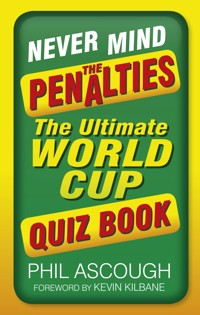
England haven't won it since 1966 but every time the World Cup is played, there's always hope that this year will be the year. The World Cup has its critics but time stands still when your team plays. Hope and horror, passion and pain – and that's just the draw for the final groups! Never Mind the Penalties is the ultimate collection of World Cup teasers, pulling together the highs and lows, the match-winners and the madness, the bizarre and the beautiful from football's greatest tournament. Test your mates in the pub, liven up the pre-match warm-up, deliver a little half-time entertainment, and create your own penalty shoot-out. Keep a copy in your pocket as you count down to kick-off – it's an essential part of your World Cup build-up.
Sie lesen das E-Book in den Legimi-Apps auf:
Seitenzahl: 68
Veröffentlichungsjahr: 2014
Das E-Book (TTS) können Sie hören im Abo „Legimi Premium” in Legimi-Apps auf:
Ähnliche
















This book is for my family, who are typical of so many people from these shores in that they endure the World Cup until the crucial last kick in England’s penalty shoot-out. It is a journey of tolerance, giving way to hope and even occasional flashes of passion and excitement until one of our players kicks high, wide or straight at the keeper, misery kicks in and the iPods and iPads come out again. It’s also for people who make really big TV sets.
Contents
Title
Dedication
Foreword by Kevin Kilbane
Assists
Introduction
Round 1
1966
Round 2
England
Round 3
Northern Ireland
Round 4
Republic of Ireland
Round 5
Scotland
Round 6
Wales
Round 7
Brazil
Round 8
Winners
Round 9
Venues
Round 10
Upsets
Round 11
Controversies
Round 12
Howlers
Round 13
No Easy Games?
Round 14
Open Goals
Round 15
Marksmen
Round 16
Keepers
Round 17
Showmen
Round 18
Bad Boys
Round 19
Memory Matches
Round 20
Biggest Wins
Round 21
Gaffers
Round 22
Group of Death
Round 23
Firsts
Round 24
Club Connections
Round 25
Import Invasion
Round 26
One-Offs
Round 27
Absent Friends
Round 28
TV Teams
Round 29
Name Game
Round 30
Penalties
The Answers
Copyright
Foreword
by Kevin Kilbane
As a young boy growing up in Preston, football was my life. Like so many other kids worldwide I would play whenever or wherever I could, whatever the weather. It would sometimes mean scaling fences with my older brother, looking for somewhere to play without interference.
One of the few things that could interrupt our pursuit of becoming the next Ian Rush or Kevin Sheedy was the next best thing to playing football – watching football.
We always had Match Of The Day, but there were relatively few live games on TV during the 1980s. The only time we saw foreign footballers was if a British club made it to a final in one of the European competitions.
That’s why Mexico 86 will always feel like the perfect time in my childhood. We had Michael Laudrup, Michel Platini and Zico, Josimar, Hugo Sanchez and the incredible Diego Maradona. These were names I’d heard little or nothing about at that time, yet there they were – the best players in the world on the TV almost every day for a month.
I was gutted to have to wait another four years for the next tournament, but when Italia 90 came round it was even better because Ireland had qualified under Jack Charlton. Although I grew up in Lancashire, England, my dream was always to play for Ireland, the birthplace of my mum and dad.
Ireland had a tough group with England, Holland and Egypt but managed to qualify to play Romania – with the brilliant Gheorghe Hagi – in the last 16. Watching Packie Bonner saving the penultimate spot kick in the shoot-out to help Ireland reach the quarter-final was the big high for me during that tournament.
Ireland qualified for USA 94 and although I was on the verge of the first team with Preston North End I didn’t really believe I’d ever get the chance to represent my country in a World Cup. But my dream came true and I was fortunate to play every minute for Ireland during Japan and South Korea in 2002.
I’ll cherish the memories of that month, the highlight of my playing career. We played Cameroon, Germany and Saudi Arabia and then met Spain in South Korea for a place in the last eight. We went out on penalties, with me feeling heartbroken after my shot was saved. I felt we should have beaten Spain, but that’s football. My best and worst memories are about penalty shoot-outs, and while I’ve never been big on swapping shirts I have Carles Puyol’s as a World Cup souvenir.
Most of my time now is spent watching and trying to analyse football in a different way, for viewers and listeners on BBC TV and radio.
I felt incredibly privileged to be invited to join their commentary team for the World Cup in Brazil, covering an occasion which has made a huge impact on my life and given me so many great memories, experiencing a different type of pressure and able to relate to what the players on the pitch are going through. My views aren’t always shared by supporters up and down the country but I try to give an unbiased opinion. Again, that’s football.
I’ve worked closely with The Down’s Syndrome Association since my 9-year-old daughter Elsie was diagnosed with Down’s syndrome at birth. They help so many families like mine by providing help and support during what can be daunting times through various stages of life, and I am proud to help them.
I ran the London Marathon in 2013 and raised around £9,000. It was hard work but worth it. I am continuing my support with all the proceeds from my autobiography going to the Down’s Syndrome Association.
Kevin Kilbane began his career with Preston North End and moved to West Bromwich Albion before making more than 300 Premier League appearances for Sunderland, Everton, Wigan Athletic and Hull City. He is Ireland’s third most-capped player with 110 appearances, a total that includes all four matches at the 2002 World Cup finals. Kevin is now making his mark as a journalist and broadcaster, notably with the BBC. Killa: The Autobiography of Kevin Kilbane is published by Aurum Press and is available in bookshops and online. For more information about football for people with Down’s syndrome please visit www.dsactive.org
Assists
Beyond acknowledging the inspiration drawn as a young sports writer years ago from the late Ian Wooldridge, I don’t often find the need to thank the Daily Mail for anything. But apparently it was Colin Young, their reporter in the north east and a former colleague at the Hull Daily Mail, who was first to reach Kevin Kilbane with my request to contribute to this book.
Many thanks Colin; that’s a pint I owe you. Thanks also to Ash Lord and his colleagues at Hull City AFC who paved the way, to ‘City Till We Die’ stalwart Kate Ogram for helpful information about Down’s syndrome football activities, and to Niall Quinn for his interest.
Thanks most of all though to Kevin, whose help I sought because of the dignity and respect that became his trademark during a career at the top of the domestic and international game, and which he has since taken into the media as a newspaper columnist, national broadcaster and in his acclaimed autobiography. Killa: The Autobiography of Kevin Kilbane, published by Aurum Press, is highly recommended for its honesty and insight, and for Kevin’s decision to donate the royalties to the Down’s Syndrome Association.
It’s not difficult to find information about the World Cup in print or online. The challenge is to sift it, check it, identify the material that can be shaped into questions that will challenge and tease and which will appeal both to casual fans and expert witnesses.
The themes and the questions are all mine, as are any errors and subsequent apologies, and the inspiration is drawn from a small number of reputable sources.
Once again I am grateful to Trevor Bugg and his colleagues at www.11v11.com who work tirelessly to make sure their database on countless football competitions is as accurate and up to date as it can be.
In print, most World Cup compilations of recent years owe something to The Story of the World Cup (Faber and Faber), written by Brian Glanville, first published in 1973 and updated on many occasions since then. It is a compelling read and one in which Glanville uses his presence at the heart of the World Cup cauldron to paint some vivid pictures for his readers.
World Cup’66




