


26,99 €
Mehr erfahren.
- Herausgeber: John Wiley & Sons
- Kategorie: Geisteswissenschaft
- Serie: Blackwell Manifestos
- Sprache: Englisch
NEW ENGLAND BEYOND CRITICISM
“Elisa New’s book is a remarkable achievement. It is very rare that a critic manages to ask what seem exactly the right questions, then to answer them in a lively, brilliant, evocative, and supremely intelligent prose.”
Charles F. Altieri, University of California
“Elisa New is a refreshing voice among critics and historians of literature. She has a keen sense of the nature of New England and its deep spiritual resources, reaching back to the Puritans, moving through the great nineteenth-century expressions of interior landscapes and visions. This is a book I welcome and celebrate.”
Jay Parini, Middlebury College
Literary criticism of the past thirty years has undercut what the canonizers of the nineteenth and early twentieth centuries saw as the fundamental role of early New England in the development of American literary culture. And yet, a determination in literary circles to topple perceived Ivy League elitism and Protestant cultural creationism overlooks the continuing value, beauty, and even practical utility of a canon still cherished by lay readers around the world.
This Manifesto raises questions about how academic specialization and the academic study of New England have affected enthusiasm for reading. Using a range of interpretive practices, including those most often deployed by contemporary academic critics, Elisa New cuts across firmly established subfields, mixing literary exegesis with autobiographical reflection, close reading with cultural history, archival and antiquarian inquiry with experiments in style, and lays bare editorial orthodoxies, raising to question the whole hierarchy of values now governing the study of American and other literatures. Taking New England as a test case for a wider, more accessible set of critical practices, New England Beyond Criticism demands that the domain of literary study be opened further to the tastes of the general reader.
Sie lesen das E-Book in den Legimi-Apps auf:
Seitenzahl: 547
Veröffentlichungsjahr: 2014
Ähnliche




















Table of Contents
Praise for New England Beyond Criticism
Wiley Blackwell Manifestos
Title page
Copyright page
Acknowledgments
1: Introduction: New England Beyond Criticism
Note
Part I: Excitations: Protestant Ups and Downs
2: Variety as Religious Experience: Four Case Studies: Dickinson, Edwards, Taylor, and Cotton
Notes
References
Further Reading
3: The Popularity of Doom: From Wigglesworth, Poe, and Stowe through The Da Vinci Code
Notes
References
Further Reading
4: “I Take—No Less than Skies—”: Dickinson's Flights
Notes
References
Further Reading
Part II: Congregations: Rites of Assembly
5: Lost in the Woods Again: Coming Home to Wilderness in Bradford, Thoreau, Frost, and Bishop
1. Scholar in the Wilderness
2. “Of Plimouth Plantation”
3. “The Village”
4. “Desert Places”
5. “Of Plimouth Plantation” and “Brazil, January 1, 1502”
6. “The Moose”
Notes
References
Further Reading
6: Growing Up a Goodman: Hawthorne's Way
References
Further Reading
7: “Shall Not Perish from the Earth”: The Counting of Souls in Jewett, Du Bois, E.A. Robinson, and Frost
Notes
References
8: Disinheriting New England: Robert Lowell's Reformations
Notes
References
Further Reading
Part III: Matriculations: In Academic Terms
9: Winter at the Corner of Quincy and Harvard: The Brothers James
References
10: Upon a Peak in Beinecke: The Beauty of the Book in the Poetry of Susan Howe
Notes
References
Further Reading
11: Balm for the Prodigal: Marilynne Robinson's Gilead
Notes
References
12: A Fable for Critics: Autobiographical Epilogue
Notes
References
Further Reading
Index
End User License Agreement
Guide
Cover
Table of Contents
Start Reading
CHAPTER 1
Index
Pages
i
ii
iv
vii
viii
ix
x
1
2
3
4
5
6
7
8
9
10
11
12
13
14
15
16
17
18
19
20
23
24
25
26
27
28
29
30
31
32
33
34
35
36
37
38
39
40
41
42
43
44
45
46
47
48
49
50
51
52
53
54
55
56
57
58
59
60
61
62
63
64
65
66
67
68
69
70
71
72
73
74
75
76
77
78
79
80
81
82
83
84
85
86
87
88
89
90
91
92
93
94
95
96
97
98
99
100
101
102
105
106
107
108
109
110
111
112
113
114
115
116
117
118
119
120
121
122
123
124
125
126
127
128
129
130
131
132
133
134
135
136
137
138
139
140
141
142
143
144
145
146
147
148
149
150
151
152
153
154
155
156
157
158
159
160
161
162
163
164
165
166
167
168
169
170
171
172
173
174
175
176
177
178
179
180
181
182
183
184
185
186
187
188
189
190
191
192
193
194
195
196
197
198
199
200
201
202
203
204
205
206
207
208
209
210
211
212
213
214
215
216
217
218
219
220
221
222
223
224
227
228
229
230
231
232
233
234
235
236
237
238
239
240
241
242
243
244
245
246
247
248
249
250
251
252
253
254
255
256
257
258
259
260
261
262
263
264
265
266
267
268
269
270
271
272
273
274
275
276
277
278
279
280
281
282
283
284
285
286
287
288
289
290
291
292
293
294
295
296
297
298
299
300
301
302
303
304
305
306
307
308
309
310
311
312
313
314
315
316
317
318
319
320
321
324
325
326
Praise for New England Beyond Criticism
“Elisa New is a refreshing voice among critics and historians of literature. She has a keen sense of the nature of New England and its deep spiritual resources, reaching back to the Puritans, moving through the great nineteenth-century expressions of interior landscapes and visions. Her readings strike me as passionate, original, and very much at odds with a good deal that is now being said in academic circles. To say she is eccentric means, quite literally, that she stands outside of the center. In this, she seems in keeping with her Puritan fathers and mothers, those dark visionaries who gave birth to Hawthorne, Emerson, Thoreau, Dickinson, and others. This is a book I welcome and celebrate.”
Jay Parini, Middlebury College
“Elisa New's book is a remarkable achievement. It is very rare that a critic manages to ask what seem exactly the right questions, then to answer them in a lively, brilliant, evocative, and supremely intelligent prose. New recognizes the force of criticism's critiques of traditional claims for the importance of New England writing in the shaping of America's images of itself. But she also recognizes how criticism tends to be limited by its academic protocols, so it cannot fully address the urgency of this writing to appeal to the full human being, hungry for meaning and idealization and passion challenged continually by that social reality on which the critics concentrate. New develops a critical stance fully responsive to what she calls the texts' ‘powers’ as they seek to come to terms with demands for conversion, challenges to imagine how people produce values, and the constant worry that these very ambitions may lead imaginations to cross borders where terror seems the dominant affective register.”
Charles F. Altieri, University of California
Wiley Blackwell Manifestos
In this series major critics make timely interventions to address important concepts and subjects, including topics as diverse as, for example: Culture, Race, Religion, History, Society, Geography, Literature, Literary Theory, Shakespeare, Cinema, and Modernism. Written accessibly and with verve and spirit, these books follow no uniform prescription but set out to engage and challenge the broadest range of readers, from undergraduates to postgraduates, university teachers and general readers – all those, in short, interested in ongoing debates and controversies in the humanities and social sciences.
Already Published
The Idea of Culture
Terry Eagleton
The Future of Christianity
Alister E. McGrath
Reading After Theory
Valentine Cunningham
21st-Century Modernism
Marjorie Perloff
The Future of Theory
Jean-Michel Rabaté
True Religion
Graham Ward
Inventing Popular Culture
John Storey
Myths for the Masses
Hanno Hardt
The Future of War
Christopher Coker
The Rhetoric of RHETORIC
Wayne C. Booth
When Faiths Collide
Martin E. Marty
The Future of Environmental Criticism
Lawrence Buell
The Idea of Latin America
Walter D. Mignolo
The Future of Society
William Outhwaite
Provoking Democracy
Caroline Levine
Rescuing the Bible
Roland Boer
Our Victorian Education
Dinah Birch
The Idea of English Ethnicity
Robert Young
Living with Theory
Vincent B. Leitch
Uses of Literature
Rita Felski
Religion and the Human Future
David E. Klemm and William Schweiker
The State of the Novel
Dominic Head
In Defense of Reading
Daniel R. Schwarz
Why Victorian Literature Still Matters
Philip Davis
The Savage Text
Adrian Thatcher
The Myth of Popular Culture
Perry Meisel
Phenomenal Shakespeare
Bruce R. Smith
Why Politics Can't Be Freed From Religion
Ivan Strenski
What Cinema is!
Andrew Dudley
The Future of Christian Theology
David F. Ford
A Future for Criticism
Catherine Belsey
After the Fall
Richard Gray
After Globalization
Eric Cazdyn and Imre Szeman
Art Is Not What You Think It Is
Donald Preziosi and Claire Farago
The Global Future of English Studies
James F. English
The Future of Jewish Theology
Steven Kepnes
Where is American Literature?
Caroline F. Levander
New England Beyond Criticism
Elisa New
This edition first published 2014
© 2014 Elisa New
Registered Office
John Wiley & Sons Ltd, The Atrium, Southern Gate, Chichester, West Sussex, PO19 8SQ, UK
Editorial Offices
350 Main Street, Malden, MA 02148-5020, USA
9600 Garsington Road, Oxford, OX4 2DQ, UK
The Atrium, Southern Gate, Chichester, West Sussex, PO19 8SQ, UK
For details of our global editorial offices, for customer services, and for information about how to apply for permission to reuse the copyright material in this book please see our website at www.wiley.com/wiley-blackwell.
The right of Elisa New to be identified as the author of this work has been asserted in accordance with the UK Copyright, Designs and Patents Act 1988.
All rights reserved. No part of this publication may be reproduced, stored in a retrieval system, or transmitted, in any form or by any means, electronic, mechanical, photocopying, recording or otherwise, except as permitted by the UK Copyright, Designs and Patents Act 1988, without the prior permission of the publisher.
Wiley also publishes its books in a variety of electronic formats. Some content that appears in print may not be available in electronic books.
Designations used by companies to distinguish their products are often claimed as trademarks. All brand names and product names used in this book are trade names, service marks, trademarks or registered trademarks of their respective owners. The publisher is not associated with any product or vendor mentioned in this book.
Limit of Liability/Disclaimer of Warranty: While the publisher and author have used their best efforts in preparing this book, they make no representations or warranties with respect to the accuracy or completeness of the contents of this book and specifically disclaim any implied warranties of merchantability or fitness for a particular purpose. It is sold on the understanding that the publisher is not engaged in rendering professional services and neither the publisher nor the author shall be liable for damages arising herefrom. If professional advice or other expert assistance is required, the services of a competent professional should be sought.
Library of Congress Cataloging-in-Publication Data
New, Elisa.
New England beyond criticism : in defense of America’s first literature / Elisa New.
pages cm
The final chapter, A Fable for Critics: Autobiographical Epilogue, is about the author.
Includes bibliographical references and index.
ISBN 978-1-118-85453-2 (hardback) – ISBN 978-1-118-85454-9 (paper) 1. American literature–New England–History and criticism. 2. Literature and society–United States–History. 3. New England–In literature. 4. New England–Intellectual life. 5. United States–Intellectual life. 6. New, Elisa. 7. College teachers–Biography. I. Title. II. Title: In defense of America’s first literature.
PS243.N49 2014
810.9'974–dc23
A catalogue record for this book is available from the British Library.
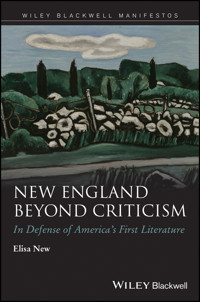
Cover image: Marsden Hartley, The Last Stone Walls, Dogtown, c.1936-7. Photo: Yale University Art Gallery. Gift of Walter Bareiss, B.S. 1940S, 1951.1.2.
Acknowledgments
Like all books of this kind, this one is far better for the support, feedback, interventions, and complaints of colleagues, editors, assistants, anonymous readers, students, friends, and family.
The Harvard English Faculty Colloquium and the Harvard Graduate Americanist Colloquium heard various parts of this book and provided sharp and sympathetic feedback on its strengths and weaknesses, as did thoughtful audiences at the Modern Language Association, the American Literature Association, the University of Utah, SUNY Buffalo, Suffolk University, and the American Academy of Arts and Sciences. Chapters One, Four, Five, Seven, Nine, Eleven and Twelve all appear in print here for the first time. Chapter Three – excepting a few brief sections that appeared first in Early American Literature and the New England Quarterly – is original to this book as well. Earlier versions of Chapters Two appeared in Religion and Literature and then in Infinite Conversations. A version of Chapter Six appeared in The New Republic. A version of Chapter Eight appeared in Reading The Middle Generation Anew.Chapter Ten appeared in American Literature's Aesthetic Dimensions: the current chapter also includes excerpts from an essay originally published in The New Republic. Those chapters previously published are far better for the excellent readings and suggestions offered by editors and readers. I am grateful to Barbara Packer and Roger Lundin for their searching responses to “Variety as Religious Experience” (Chapter Two); to Leon Wieseltier for his smart and lucid editing of what became “Growing up a Goodman”; and I thank Eric Haralson for many excellent suggestions on the book chapter that is here, “Disinheriting New England.” I am grateful to Chris Looby and Cindy Weinstein for helping me with “Upon a Peak in Beinecke”. In a world where disinterested feedback is sometimes hard to come by, these editors provided suggestions both generous and practical. Among colleagues I want especially to thank Ramie Targoff and Stephen Greenblatt, Peter Sacks, Stephanie Sandler, and especially my friend Larry Buell, the most generous of mentors, and friends. Jay Parini was wonderfully supportive; so was Paul Dry. I am grateful to Emma Bennett at Wiley Blackwell for soliciting this manuscript and to Deirdre Ilkson for her skillful piloting of the manuscript through the review process. Combining imagination and efficiency, the Wiley Blackwell editorial team has been exemplary. I am grateful to Annette Abel, Zeb Korycinska, Kevin Fung, Jeffrey Goh, and Sara Henning-Stout for their professionalism and unfailing intelligence.
Most of the insights in this book originated in the classroom. One's best teachers, and critics, are always the students one teaches – or teaches with. Animated discussion – or stony stares – these must be critics' best guide to validity in interpretation. The list of those whose insights, sometimes years and years old, continue to detonate or evolve in my mind is very long. But it must include Gina Bloom, Jeremy Sigler, Jim Dawes, Jennifer Jordan Baker, Mike Magee, Bernie Rhie, Hester Blum, Dan Chiasson, Katie Petersen, Odile Harter, DeSales Harr, Jim von der Heydt, Emily Ogden, Erica Levy, Adam Zalisk, Andrew Goldstone, Adam Scheffler, John Radway, Ingrid Nelson, Martin Greenup, Sharon Howell, Andrew DuBois, Lauren Brozovich, Dave Weimer, Kaye Wierzbicki, Maggie Doherty, Cara Glatt, Leah Reis-Dennis and Orli Levine.
I owe an immense debt to the talented assistants, research and editorial, who worked with the manuscript, in various versions, through a period of years. Sol Kim- Bentley has seen this book through many drafts. She painstakingly deciphered and transcribed penciled, penned, or sticky-noted insertions into some chapters three and four times: Sol sometimes smiles to see the same chapters return again and again to her desk, but she never complains. Still going strong at age 90, my dear friend Charlotte Maurer read and helped me rethink and clarify several parts of this book, some of whose passages I know she found too academic by half. Her wisdom as editor, and reader, will be with me always, although she is now gone. Superb undergraduate research assistants who worked on this book include Madeleine Bennett, Antonia Fraker, Sarah Hopkinson, and Elizabeth Tingue, and, in a break from her own career, my daughter Yael Levine. Through Yael, I am lucky to have found Caroline Bankoff, whose unfailing intelligence, dispatch, and professionalism help me get pages out the door: I count on her. And I owe deep thanks to Yang (Linda) Liu, who began work while writing her senior thesis as my undergraduate research assistant and then, two years into her own graduate training, helped me finish the manuscript. Linda's literary insights and her editorial pen, both delicate and sharp, gave this book a clarity and polish it would not otherwise have had.
I also wish to express my gratitude to the readers, many anonymous, who have liked –and have disliked –this book, in earlier and in later versions. Those enthusiastic about the book's approach helped me to persist in completing it. Those who objected to it have been, in some ways, even more helpful, for from them I learned the real stakes of my argument. But for their objections, I might not have known that what I wrote was a manifesto.
Finally, a different sort of thanks must go to my husband, Larry Summers, for first inviting me to visit, and then inviting me to share with him, James Russell Lowell's – the Harvard President's – house, Elmwood. As I describe in my Epilogue, living at Elmwood and with Larry changed my whole literary disposition; changed the way I see the meaning of what we do as teacher and scholar. No matter where our adventures take us, Larry and I will always share our very own Harvard, along with everything else.
1IntroductionNew England Beyond Criticism
Once, in the mid-twentieth century, children all over North America learned that a nation was born in Plymouth, Massachusetts. On bulletin boards outside classrooms across the continent, Pilgrims, cut out of black and white construction paper, were displayed to represent the purposeful beginnings of the nation. Orange and brown Indians stood by to assist the United States find its destiny. In the classrooms of secondary schools and institutions of higher learning, and in the public culture, the legacy of the doughty Pilgrims furnished the academic, and also the civic, curriculum for the nation. From New England, this curriculum taught, came America's founding rituals and folkways, its most enduring democratic practices, and its greatest, classic works of literary art.1
There are surely classrooms where this story is still being told. But the prestige of New England, in professional literary circles at least, has never been lower. Among the highest priorities of critics working in American literature in the second half of the twentieth century was the unseating of Protestant New England as the capital of American literary culture. As late as the 1960s, it was still axiomatic that the origins of American culture were to be found in this one region, its area extending north and east of Boston to the Canadian border, west and south of Boston to the Connecticut Valley, a region whose civilizational outline was already distinct by the end of the seventeenth century. Never mind this region's size relative to the vastness of the eventual United States. With its twin epicenters at Harvard and Yale, its links to high culture and high office, its roster of Adamses and Websters striding the national stage, this region of subcultures, frequently quite distinctive and frequently quite parochial – Separatist, Federalist, Abolitionist; Cantabridgean, Brahmin, WASP – somehow came to represent the quintessentially American.
But by the time a New England (San Francisco born) icon, Robert Frost, got up on a January day in 1961 to offer poetic tribute to the New England born (Catholic) President, this era was nearly over. Starting in the 1970s, and gathering force through the 1980s and 1990s, a rigorous and exciting revisionist scholarship began to expose the cultural processes and ideological interests by which Pilgrim grit was identified with the national Spirit, the Protestant mind with the national idea, and the New England classic with literary excellence. Distinguished critics joined forces to show how, through sermons, pedagogy, and print networks, through academic dynasties and intellectual oligarchies and self-reinforcing ideological formations, New England's primacy and representativeness were invented, established, and packaged for wide distribution.
Such scholars pointed out the obvious – that New England, an English outpost on a continent the French and Spanish had already explored, was not in any sense “first,” and so could not have struck the template for all American culture. The Americanness of New England literature was revealed as a fiction, a back formation, or, in the catchall phrase, an ideological construction. Indigenous peoples had long populated the “wilderness” which Spanish, French, and English settlers laid claim to, and those settlers were themselves proud subjects of European kingdoms. For its first one hundred and fifty years, New England was in every sense colonial: geographically removed, culturally in thrall. Early modern explorers might have found it expedient to call densely populated Indian lands “howling wilderness,” as, in subsequent decades, and then centuries, their descendants would find it similarly convenient to wrest national integrities, to claim national destinies, out of circumstances even more ambiguous. One simply had to overlook sea trade, slave trade, book trade, and sundry other transatlantic, trans-hemispheric, and transnational complications to claims of discrete and integral nationhood.
New England was always cagey about its associates (bankers in London; middlemen in Africa; sugar planters in the West Indies), self-conscious about its provincialities, insecure about its innovations, and, in the case of literature, deliberate when not outright desperate to show off its local product. Just as early “American” literature's founding texts had been written by the King's loyal subjects, written not only in the language but within the cultural orbit of Europe, so as late as seventy-five years after the Revolution many of the authors best known for establishing New England's primacy – Emerson, Hawthorne, Melville, Longfellow, Stowe – remained completely dependent on publishers and readers in London, Philadelphia, and New York. As New England mills relied on Southern cotton produced by African slaves, so the idea of New England's literary primacy depended upon networks of European distribution and approbation, on transatlantic and also intra-American pirating and reprinting. The premium the Virginia-raised Edgar Allan Poe sought in claiming his first book of poems authored by “A Bostonian” was (as Poe shrewdly surmised) more hype than reality, but it certainly lent cachet.
The academic revisionists who expressed skepticism about New England as founding region were naturally also interested in how New England's special prestige had been constructed; by whom, and to what ends. To be sure, to read the early literary histories of America, especially the criticism produced from the 1880s through World War I, is to encounter learnedness mingled quite noticeably with partisanship. A national literature commensurate with so great a nation had long been wanting, long sought and sometimes despaired of in the period between the 1790s and the 1890s. And so it was perhaps not that surprising that by the turn of the twentieth century the first Ivy League canon-makers would have been delighted to find the requisite materials so close at hand: the canon right outside their windows. But could it really have been the case, as Professor Barrett Wendell of Harvard intimated at the turn of the century, that virtually all of the nineteenth-century poets meriting attention should have had addresses along Brattle Street; that virtually all of the “major” writers of prose could have belonged to that cozy set that drank each other's claret in Cambridge, dug each other's gardens in Concord, and, when summer came, carried each other's picnic baskets up Berkshire summits? Could it have really been, as the critics of the 1930s to the 1950s who founded American Studies as a branch of New England studies implied, that the most salient literary challenges to Massachusetts hegemony should have come from no further than Connecticut, from a set of Hartford and New Haven based “New Lights” (headquarters: Yale) whose major difference from Boston's coastal, more liberal, Christians amounted to their yet fiercer determination to guard orthodoxy's flame? Or that the rigorous clerical literature of frontier Deerfield and Stockbridge was actually more productive of the American spirit than the vigorous and virile writings of Virginia's Tidewater? Could it really have been the case, later revisionists were justified in asking, that an entire national culture should have depended on the lucubrations of a few generations of Congregationalist ministers, Edwards to Emerson, Mather to Niebuhr, their ranks filled out by ministerial womenfolk – Rowlandson, Phelps, Stowe? Not to forget, either, the way these women had, despite immense readerships, received short, and invariably patronizing, shrift. The romanticization and canonization of the homiletic writings of certain Massachusetts Bay, Narragansett, Stockbridge, and New Haven ministers, and then the critical partiality to writers of “lyric” and “romance,” all white men, effectively left out Rowlandson, Stowe and Warner, Child and Sedgwick, left out Wheatley, left out Du Bois, left out Occum; left out race and gender, class and caste; left out slavery and the women's “sphere” and the ubiquitous sway of capital.
Fair enough, then, for critics of the 1980s and 1990s to pursue the question of whether those professors who discovered the roots of American culture in New England had not been themselves somewhat blind to how parochial they were, how chauvinistic even, creating America's canon in their own, in their region's – and, of course, in their gender's – image. White, male, Protestant, and overwhelmingly holding posts in the Ivy League, these had enjoyed a bit too much, and written a bit too much about, the world in which they were ever so comfortably ensconced. The critics who heralded the development of the New England literary tradition as a “flowering,” a “renaissance,” who not only described – but embraced – the idea of New England's “errand” – evinced excessive confidence in their own labors – the professing of literature – and excessive willingness to use the curriculum to shape the very souls of their students. With agendas extending beyond the literary into the civic, they presumed to impose two-semester courses in New England writers, and they had intimated that those who took those courses would be better people, and Americans, for having heard the lectures. Regarding teaching as more than a profession, they had endeavored more than the fostering of aesthetic pleasure – but also less than the inculcation of critical thinking. They had presumed to try to change people, and to change them for good.
Even if one granted their benign motives, were not the methods deployed by these earlier champions of New England themselves part of the problem? Partial to organic unities and pat typologies (delighting in designs and patterns, ready to cut through historical difference in order to suture Pilgrim Fathers to Minute Men to the Greatest Generation) and, what's more, moving with disquieting facility between lectern, pulpit, and Washington DC, had not these canon-makers missed how even the most liberal and dissentient discourses are co-opted by power? Had they not failed to discern that the New England literature they extolled for its rare capacity to preserve ambiguity, complexity, and nuance was, in fact, readily co-opted, and that the premium they placed on spiritual, aesthetic, intellectual, formal, and moral excellence was itself exclusionary, pushing to the “margins” (as came to be said) discourses just as, or more, central and revelatory, if sometimes less refined? The very practice of close reading (its meticulous and time-consuming rhythms indispensable in the classroom) and the discipline of the History of Ideas (its largeness of scope and rhetorical sweep easily pasted verbatim into State of the Union addresses) were Ivory-Tower/Halls-of-Power practices – practices giving undue primacy to highly privileged forms of culture and eventuating in a national canon remarkably unrepresentative. This canon that had pushed other literatures to the margins, this tradition imposed on college students and school children, this region whose values so drowned out other values – if these had circumvented general criticism, literary criticism would put them in their place.
The title of this book, a provocation, is meant to raise the question of whether academic literary criticism can, or should, be left to play that role. Its subtitle – another provocation – is meant to authorize rereadings in the texts of New England fully alert to their claims of cultural priority, yet still open to their primary power. Claims to priority were, from the beginning, constitutive of this tradition fully invested in the text, the Word, as a sort of prime mover: in literature's generative capacities. New England writing is committed to the charisma, the magnetism, and the force of print on a page, and it vests meaning in reading as a revelatory and inspiring experience. This is writing, moreover, that reserves a key cultural role for that literate interpreter (whether minister, essayist, novelist, poet, or professor) who opens the text to others, rehearsing and applying, animating and revitalizing its meaning. Whether they practice homiletics or metrics, write essays or historical narrative, or, even, criticism, these interpreters to do not dissolve into or disappear behind the literature of New England: they often emerge as full-bodied artists of, and characters within, this canon they strove to establish. Thus it is that this book, New England Beyond Criticism, hails many a forgotten, superseded, or rejected critic along its way. Although these pages will adjure readers to risk a re-encounter with the New England canon “beyond criticism,” it will also, by its last pages, have embraced a larger than usual number of critics not much read anymore, the out-of-print and out-of-favor interpreters of remoter periods of literary history. Living and dead, symbols of the passé mingling with stalwarts of the Modern Language Association (MLA) – the critics of New England will receive in these pages attention both critical and uncritical.
Now it is obvious that each scholarly generation brings its own, and its particular historical epoch's, biases to what it reads. It is probably also true that the relatively accelerated history of America's ascent among the cultures of the world lent urgency to the project of canon making, providing fertile conditions for ideological distortions. That the distortions of one period are rarely legible until the next is an argument for the value of vigorous review, for a scrupulous and empirical attitude to prior claims, for a criticism ready to vet and correct. Or so the disposition of our own epoch tells us – an epoch in which the experience of American literature is mediated by the protocols of university research and the exactions of literary scholars, rather than, say, by the tastes or enthusiasms of a large and engaged readership.
Our own biases are best exhibited in, and announced by, the rarely questioned prestige of the very term “critical” – an assurance of probity and care, though not one aspiring to impact, outreach or even accessibility. A fitting term for an ethos rigorous, restrained, and insular, the function of the “critical” is to ground reading, to preserve it from enthusiasms too flighty (aesthetic or pedagogical, institutional or political) and from apprehensions amateurish or personal. This grounding, just as it sounds, safeguards soundness. The prestige of the critical certainly does not require us to cauterize all the surplus feeling that literary texts might evoke (indeed, the classroom functions, for a great majority of literary scholars, as a space of joyful unrestraint, and sometimes a refuge from the strictures of their critical lives). But the latitudes permitted by pedagogy are deemed problematic in criticism – where the task is to delimit and incise, not amplify, the power of the literary text; to contextualize and contain rhetorical strategies, so protecting understanding from mystifications. Implicated in all of these, a primary office of the critical is corrective. Criticism moves forward by detecting, and correcting, misapprehensions that past interpreters have perpetrated.
The very strong tilt toward the contemporary, characteristic of a critical age, is abundantly in evidence in scholarship on New England. Though historicist and materialist in orientation, our criticism maintains a bias toward literary advance, toward new findings, that discourages lending too much credence to the work of prior generations. It is naturally disposed to distrust characteristics that other eras prized: breadth and brio, conviction and accessibility, lyricism and vision, and a readiness to meet readers beyond disciplinary boundaries. Advanced readers of literature, and especially professional scholars of literature, take for granted that they are to maintain a distance from the texts they read, and distance too from the readings of these texts advanced by prior generations. Especially in the case of New England, a case where prior critics – those overzealous canonizers – proved too soft, it is for us to hold the line.
The task is made less simple, of course, by the fact that the New England canon bestowed on us by prior generations continues to have a quite vibrant life in the culture. Like it or not, our predecessors' canon stuck. The disposition of the critical establishment notwithstanding, it is still the case that readers of all kinds, both inside and outside the classroom, reserve special attention, regard, and devotion for the texts of New England and, what's more, for the civilization that these texts invented and continue to represent. Readers look to these texts for aesthetic pleasure, for spiritual succor, and for insight into the common good. They consult them while traveling to historical sites with their children, listening to inaugural addresses, watching John Adams or The Abolitionists on PBS (Public Broadcasting Service), passing through village greens in Vermont or deep woods in Maine. Twenty-first-century novelists and poets continue to mine this archive; the president of the United States and playwright Tony Kushner dine on its wisdom; New Urbanists and Hollywood directors, twentieth-century composers like Ives and Rorem, environmentalists and techies and political consultants all return to New England, confident they will find in its archive the classic, the iconic, American forms. Every public figure confessing to adultery inevitably has to don his “scarlet letter” for several news cycles, the stigma affixed not by literary critics but by the anchors of cable news, and every midlife career changer sees two roads diverging in a yellow wood. Images from Jonathan Edwards's “Sinners in the Hands of an Angry God” enter the cultural mainstream every few years when we count down to the End of the World: again. And one cannot stop at a historic village, Sturbridge or Plymouth Plantation, or walk through Harvard Yard or Mt Auburn Cemetery, or visit a historic writer's house ever so inconspicuously tucked off the highway, without finding tourists there. My physician reports that he took only one book with him on a late adolescent hike through the wilds of the Monongahela Valley – Moby Dick – because he knew that this book, a guide to finding himself, would announce his vocation. College sophomores, New Hampshire ministers and Vermont backpackers, adults in night courses and alumnae returning on tour buses, and visiting scholars from China and Japan and India continue to cherish the literature of New England. When Marilynne Robinson, whose work I treat in Chapter 11, titles a book When I Was a Child, I Read Books, the books she means are New England's.
As for me, the longer I've taught and thought about the literature of New England, the less comfortably I've lived in scholarly harness, the greater elbow room, the wider scope, I've come to feel is due the largeness, the strangeness, the beauty and power, of my subject.
Although the literature of New England was already at the center of my scholarly life before I began to teach at Harvard University in 1999, until that time my attachment to New England – or at least what part I confessed – was perfectly professional; or, even, as we say, academic. When friends and family inquired what I worked on, I'd reply that I worked on early, or classic, American literature, and when pressed further, I'd report that my scholarly specialty, my subfield, was the literature of New England. But, in fact, even before I moved to New England, when I asked myself the question of why I worked on this tradition, my reasons were more along the lines Emily Dickinson had given Thomas Wentworth Higginson for how she recognized a poem: this stuff simply took the top of my head off.
The thinking, the teaching, the writing about literature of the region happened to fill certain criteria for scholarship, happened to contribute to a body of knowledge to be laid up in libraries. But the truth was – as again, I increasingly quoted Dickinson to myself – there was a “palsy” this writing “just relieved,” a species of excitation to be indulged in private sessions of reading, in the woods or leaning over Cape Cod Bay; or, in the classroom. There one found secret sharers. Though my students may have come in believing that the Puritans were “puritanical,” those who left themselves reasonably open were liable to find themselves, as Perry Miller himself had said they would, “staggering and reeling.” The most “puritanical” of writers supplied experiences of sheer aesthetic rapture; and, at the same time, tutored varieties of mental discipline, complex states of consciousness, of alienation and uses of obscurity and difficulty rivaling anything attempted by the Modernists. The psychological intensity and candor of Puritan introspections; the etched sharpness of Transcendental observations of the natural world; the clarity and definition of New England civic precepts; the ferocity, and reach, of New England social strictures; the care in craft, the intrepidness about form, the esteem for creative activity, the honor paid to all literate forms of expression. Add to this the way, as Frost himself promised, certain New England sayings – proverbs, epigrams, bits of vernacular and portable folk wisdom – begin to give a rhythm and organization to the way one thinks (you can't get there from here; if you don't like the weather, wait five minutes; and even the contemporary, local use of wicked – as in wicked cold or wicked smart). And the way certain poems – Dickinson's “There's a Certain Slant of Light” and this one by Frost: “The way a crow / Shook down on me / The dust of snow / From a hemlock tree // Has given my heart a change of mood / And saved some part / Of a day I had rued” – more than once proved their therapeutic utility.
It is popularly thought that the “Protestant ethic” is an ethic of diligence and of duty. And superficially it is. Except, of course, that this ethic's central precept is remembering the barrenness of duty. With its wariness about “works,” New England Protestantism abhors regularity, distrusts norms and protocols, and reserves special suspicion for the self-regard of the specialist. Writing, whether that of a seventeenth-century minister or a nineteenth-century prose writer or a twenty-first-century poet, is not self-justifying and requires a highly paradoxical attitude to the daily round: assiduous, yet – detached; mindful, yet – distrusting mere application; feet on the ground – heart tugging on kite strings. Though the object of knowledge may never be fully known, still the knower's obligation is greater, not lesser, for it. And whether the particular calling be selling nails or sowing beans, whether it be working in a Customs House or on a whale ship, whether standing before the community as a minister or as a lyceum speaker or as a professor of New England authors, the person long exposed to the New England Way will become liable to certain (as Thoreau called them) “extra-vagances.”
I am certain this is why some of the apparently mildest of New England authors turn out to be daredevils when it comes to literary form. Such writers eschew rhetorical elegancies and regularities in favor of “plain” – which is to say frank, stark, immoderate, copious, surprising, improvised, ragged and jagged – modes of expression. Theirs is an art that cuts across the apparent grain of things into deeper tissue – back toward secrets, toward origins and reckonings. These are writers who conceive the relationship of visible to invisible phenomena somewhat as Cubists imagined the relationship of noses to napes, backgrounds to foregrounds. Puritans at their purest, New England writers at their most classic, are less orthodox than avant-garde.
New England Beyond Criticism is a book informed by my own experience as a critic and teacher of the literature of New England, as a transplanted resident and citizen of Massachusetts, and as a member of the faculty of New England's, and America's, oldest institution, Harvard. I hold the chair occupied before me by some of the most renowned, and controversial, New England scholars of the twentieth century, and, in ways I never expected, my personal life has led me deeply into Harvard history. I came to Harvard in 1999, where, by my very good fortune, I met and fell in love with, in 2001, Harvard's new president, Larry Summers. I married him in the Harvard President's house just a few weeks before, in 2006, his turbulent presidency ended: the five years of that term gave me access to, and perspective on, aspects of my University's, and New England's, history and culture I would never have come to see otherwise. Though not without their sting, my institutional adventures with Larry Summers were emancipating, helping me to see my field, my profession, and the meaning of my work in ways that were not hitherto obvious to me. These adventures, I am sure, played their part in inspiring me to step beyond certain disciplinary norms, beyond the mores of the day. They emboldened me to risk, sometimes, what Thoreau called extra-vagance.
I offer in the coming chapters a work of advocacy, an attempt to express, and to foster, a passion for the literature of New England not fully authorized by the protocols of literary criticism. This book is personal, sometimes explicitly so, taking the function of a “manifesto” to be different than that of a monograph or reference work. A manifesto is – it must be, in some significant part – a work of conviction and of emancipated passion. A manifesto must be ready to hazard drama, to suspend critical disbelief, to demonstrate, testify, and sometimes to marvel. Thus, in the coming chapters, I offer rereadings of New England texts open to their experiential potency – and open, too, to their canonical power, the role a given text may play in relation to the larger archive of texts of which it is a part. For canonicity is itself a literary effect, a crucial one, encouraging – and even sometimes commanding – responses not comprehended by a purely critical attitude. While it is certainly appropriate that a canon receive, from time to time, close and even suspicious scrutiny, those valuing its preservation do well, too, to cultivate modes of reading responsive to its influences. In the case of the New England canon, a canon so explicitly invested in the transformative, indeed converting power of the Word, one may as well not read at all as read too guardedly. With such a canon, too fortified an attitude of insusceptibility is, finally, impertinent. The chapters ahead would thus preserve, rather than interrupt, susceptibility to the text's power to excite and stir, its power to summon and convene, its power to touch the present with the very finger of the past. These chapters venture readings open to the spiritual excitations, the civic aspirations, and the institutional influences shaping many of the works produced in New England.
The first section, called Excitations, explores religious experience and its aftereffects in the poetic tradition. This section asks what I take to be the fundamental, though not frequently enough asked, question: Why would anyone have ever wanted to be a Puritan? Are not at least some of the questions we ought to be asking the early literature of New England experiential and aesthetic ones – questions going to the affective power and even appeal of Protestant writing: to how it makes us feel? Thus: what intellectual and spiritual longings did the sermonic and poetic literature of a Protestant establishment actually satisfy? How did beauty figure in texts of Protestant faith, and what were the pleasures of terror? What did it mean to seek to live “in this world but not of it” and how might such a creed have licensed, incubated, and fertilized poetry? What satisfactions were there in imagining the End of Days? Or, in directing attention to Hell, a pit of fire a long way down? Or, to Heaven, which is, and is yet not, in the sky? One answer I propose to all of these questions: for the thrill of it. These three chapters reintroduce Protestant excitations – the ups and downs, the drastic and exhilarating features of a belief system asking, permitting, licensing human beings to stretch their imaginations far beyond what their senses perceived.
In the second section, called Congregations, I pursue matters of community and individuality. Are Americans, as they sometimes like to think, “individuals,” tested by wilderness, tempered by struggle, their individuality forged by their forebears? If so, what has proven so powerful about the New England Town Hall, the Commons, about that idea of the People to whom, and for whom, statesmen still address their rhetoric? How best to describe the role of the podium, stump, and pulpit within New England, and American, civilization? Where do the dead figure in the tally of the People; and in what ways can rhetoric – and art – summon congregations impossible within any one historical moment? And what are individualism's costs; and alternatives? These chapters take us back to some key sites and moments in communal life: to the New England Way as it seeks to forge civic congregations; to artists who find in language itself a space of social converse; and to critiques of the New England flintiness and the Protestant ethic from within. The texts of New England may give sanctuary, and even an honored place, to the individual. Meanwhile, however, human need, human softness and vulnerability will also stake out territory within the very region of Pilgrim fortitude.
In the book's third section, Matriculations, I return to the incubator of the New England canon, and to what are perhaps New England's most hallowed institutions to this day, its universities. In these chapters, I probe the strong role learned culture has played and still plays within New England's literary tradition. These elite institutions – with their great libraries and mythic reputations; with their prestige within, and antagonisms with, the cities they dominate; with their imposing architectures, their eccentric calendars, their rituals and rosters – these enter, bear on, New England literature in quite literal ways. Professors are teachers, icons, gatekeepers, ancestors, heirs; students, members of classes, pass through classrooms over four years, over epochs, over centuries; curricula are evolved and canonized, contested and dislodged; there are reformations and counterreformations of literary fashion and taste; there are in-groups and out-groups, clerics and heretics, and again and again, there is the defense of The University, and its higher calling. The phrase itself, raised by its definite article, looks down from churchly heights. New England's first universities were, not incidentally, Divinity schools; its professors not merely instructors, but moral arbiters and guides. And even now, hundreds of years after their establishment – just how the professor stands behind his lectern, just where the canon stands in the curriculum, just how the oldest rituals stand up to the present's innovations – these questions exercise, stimulate, and imbue the newest writings.
In this third section of the book, and in the Epilogue that finally closes the book, my focus tightens. I keep in view the figure of the scholar, and of the literary critic, and I give increasing attention to those twentieth-century scholars and critics who have left real marks, whose vitality remains, once we open their pages, still bright. Intellectual impact: What is that? How long does it last and how does a field (say, the field of New England studies) accommodate the influences, and personalities, of the past? To be sure, in earlier chapters I will have already endeavored various trans-temporal, trans-disciplinary experiments, working to bring the work of prior critical generations into quite direct communication with those of today. Chapters 2 and 4, for instance, deploy different approaches to representing Emily Dickinson's manuscripts: Chapter 2 employs the typographic conventions contemporary critics prefer – those of R.W. Franklin – while Chapter 4 hews to conventions Thomas Johnson had established in the middle of the twentieth century. Chapter 5, to use another example, makes the legendary critic and teacher Perry Miller, and his student, Ann Douglas – my own graduate mentor – recipients and transmitters of a pedagogical narrative begun by none other than William Bradford. Moreover, this chapter works across period and genre boundaries, putting to the side some of those contemporary methodological protocols that keep discussions of seventeenth-century New World exploration entirely separate from discussions of twentieth-century poetic texts. In this chapter the findings of historicist critics of early America are allowed to penetrate poetry studies, while the surmising of poets – and the music of poetry – are ushered into the precincts of research. And in Chapter 7, on the other hand, I endeavor to treat historical crisis in a particular epoch (post-Civil depopulation) as the thread connecting the work of writers practicing in quite different registers and genres (statecraft, fiction, non-fiction, poetry). Contemporary critical strictures, and especially critical categories, make quite it rare to encounter such writers as Edward Arlington Robinson, W.E.B. Du Bois, and Sarah Orne Jewett together (Du Bois so often placed within African American Writing; Jewett within Regionalism; Robinson among those, alas, of decaying reputation), and yet the writings of these three New England contemporaries describe nothing less than the postbellum rediscovery of poetry's convening power.
Finally, in the book's last (frankly autobiographical) Epilogue, I look back at the intellectual and literary history of New England, and at my Harvard predecessors, a colorful cast of characters! Belletrists and partisans, poetasters and editors, popularizers and obscurantists, New England promoters and New England debunkers, the many figures who appear in this chapter represent the different critical values and priorities. Our idea of the “critical” would have seemed to many of them an anything but essential category – as some of their ideas of New England now seem, from our vantage point, too decorative and dilettantish, or too jingoistic and exceptionalist, now (in the case of late twentieth- and early twenty-first-century work) even perhaps too cool, too surgical, too certain. Not a critical history so much as a critical walking tour or intellectual album, I endeavor in this last chapter to share my own esteem – and my affection – for critical forebears whose wisdom I am sure I have not outgrown.
There is an old Puritan saw – one of the most famous – I've kept in mind as I've completed the chapters of this book. Describing their position in the world, Puritans framed the ideal of living “in this world but not of it.” A mode of double consciousness, this ideal acknowledged one's footing on terra firma and in human history while still evincing faith in meanings less localized, larger and less empirically comprehensible. “In this world but not of it” is the ideal of a profoundly imaginative, and profoundly literary, civilization, one that germinated in orthodox faith, but, when orthodoxy's hold loosened, retained that salutary openness to uncertainty and what William James called the will to believe. This openness is characteristic still, and for those who find the literature of New England worth rereading, it guarantees posterity a New England still beyond criticism.
Note
1
Of the hundreds of books published in the last 30–40 years, those in the chronologically arranged list below are among the most influential and/or characteristic. Generally historicist in orientation, these books nevertheless exhibit a great range of methods, from the archival to the polemical, and they cover a very wide range of subfields, from Native American studies to avant-garde poetry. My larger question as to the drawbacks of our “critical” epoch notwithstanding, these are books reflecting the great fruitfulness of the turn to history for our understanding of the literature of New England. The reader seeking an education in contemporary New England – and Americanist – writing could not do better than to read through this list:
1973: Richard Slotkin,
Regeneration Through Violence: The Mythology of the American Frontier, 1600–1860
1975: Sacvan Bercovitch,
Puritan Origins of the American Self
1977: Ann Douglas,
The Feminization of American Culture
1979: Michael Paul Rogin,
Subversive Genealogy: The Politics and Art of Herman Melville
1981: Carolyn Porter,
Seeing and Being: The Plight of the Participant Observer in Emerson, James, Adams, and Faulkner
1982: Jay Fliegelman,
Prodigals and Pilgrims
1984: Philip Gura,
A Glimpse of Sion's Glory: Puritan Radicalism in New England, 1620–1660
1985: Michael T. Gilmore,
American Romanticism and the Marketplace
1986: Cathy Davidson,
Revolution and the Word: The Rise of the Novel in America
1986: Myra Jehlen,
American Incarnation
1986: Jane Tompkins,
Sensational Designs
1987: Donald Pease,
Visionary Compacts: American Renaissance Writings in a Cultural Context
1988: David S. Reynolds,
Beneath the American Renaissance: The Subversive Imagination in the Age of Emerson and Melville
1989: Nina Baym, “Early Histories of American Literature: A Chapter in the Institution of New England,”
American Literary History
1:3
1989: Andrew Delbanco,
The Puritan Ordeal
1989: Wai Chee Dimock,
Empire for Liberty: Melville and the Poetics of Individualism
1990–2006: Paul Lauter and Juan Bruce Novoa (eds.),
The Heath Anthology of American Literature
(2 vols.)
1990: Michael Warner,
The Letters of the Republic: Publication and the Public Sphere in Eighteenth-Century America
1990: Donald Weber, “Historicizing the Errand,”
American Literary History
2:1
1991: Lauren Berlant,
The Anatomy of National Fantasy: Hawthorne, Utopia, and Everyday Life
1991: Ross Posnock,
The Trial of Curiosity: Henry James, William James, and the Challenge of Modernity
1993: Karen Sánchez-Eppler,
Touching Liberty: Abolition, Feminism, and the Politics of the Body
1993: Eric J. Sundquist,
To Wake the Nations: Race in the Making of American Literature
1994–2006: Sacvan Bercovitch (ed.),
The Cambridge History of American Literature
(8 vols.)
1994: William Spengemann,
New World of Words
1995: Lawrence Buell,
The Environmental Imagination: Thoreau, Nature Writing, and the Formation of American Culture
1995: Walter Benn Michaels,
Our America: Nativism, Modernism, and Pluralism
1995: Laura Dassow Walls,
Seeing New Worlds: Henry David Thoreau and Nineteenth-Century Natural Science
1996: Christopher Castiglia,
Bound and Determined: Captivity, Culture-Crossing, and White Womanhood from Mary Rowlandson to Patty Hearst
1996: Christopher Looby,
Voicing America: Language, Literary Form, and the Origins of the United States
1997: Myra Jehlen and Michael Warner (eds.),
The English Literatures of America, 1500–1800
1998: Susan L. Mizruchi,
The Science of Sacrifice: American Literature and Modern Social Theory
1998: Nancy Ruttenburg,
Democratic Personality: Popular Voice and the Trial of American Authorship
1999: Christopher Irmscher,
The Poetics of Natural History: From John Bartram to William James
1999: Samuel Otter,
Melville's Anatomies
2000: Renée L. Bergland,
The National Uncanny: Indian Ghosts and American Subjects
2000: Sandra Gustafson,
Eloquence Is Power: Oratory and Performance in Early America
2000: Christine Stansell,
American Moderns: Bohemian New York and the Creation of a New Century
2001: Gillian Brown,
The Consent of the Governed: The Lockean Legacy in Early American Culture
2001: Susan Castillo and Ivy Schweitzer,
The Literatures of Colonial America: An Anthology
2001: Russ Castronovo,
Necro Citizenship: Death, Eroticism, and the Public Sphere in the Nineteenth-Century United States
2001: Joseph Conforti,
Imagining New England: Explorations of Regional Identity from the Pilgrims to the Mid-Twentieth Century
2001: Louis Menand,
The Metaphysical Club: A Story of Ideas in America
2002: Kirsten Silva Gruesz,
Ambassadors of Culture: The Transamerican Origins of Latino Writing
2003–2012: Stephen Gould Axelrod, Camille Roman, and Thomas Travisano (eds.),
The New Anthology of American Poetry
(3 vols.)
2003: Lisa M. Gordis,
Opening Scripture: Bible Reading and Interpretive Authority in Puritan New England
2004: Mary Loeffelholz,
From School to Salon: Reading Nineteenth-Century American Women's Poetry
2004: Eliza Richards,
Gender and the Poetics of Reception in Poe's Circle
2005: Jennifer J. Baker,
Securing the Commonwealth: Debt, Speculation, and Writing in the Making of Early America
2005: Anna Brickhouse,
Transamerican Literary Relations and the Nineteenth-Century Public Sphere
2005: Virginia Jackson,
Dickinson's Misery: A Theory of Lyric Reading
2005: Paul Lauter and Sandra Zagarell, “Literature,”
The Encyclopedia of New England: The Culture and History of an American Region
2007: Michelle Burnham,
Folded Selves: Colonial New England Writing in the World System
2007: Max Cavitch,
American Elegy: The Poetry of Mourning from the Puritans to Whitman
2008: Lisa Brooks,
The Common Pot: The Recovery of Native Space in the Northeast
2008: Meredith L. McGill,
The Traffic In Poems: Nineteenth-Century Poetry and Transatlantic Exchange
2013: Caroline Levander,
Where is American Literature?
Part IExcitations: Protestant Ups and Downs
2Variety as Religious ExperienceFour Case Studies: Dickinson, Edwards, Taylor, and Cotton
Open Emily Dickinson's poetic daybooks of 1862–1863 on virtually any page and find the same scene – the light altered, a new array of objects standing at the ready – in process. A reversal of hemispheres is under way. The poet, a student of reversal's laws, is breasting the streams and updrafts of a richly currented environment which the poem fits her to navigate. The transformations find the speaker now liquid, now solid, now diffused in the elements, now given density by their admission. Committed to changes, she uses the poem to make passage from one state to another.
Thus, in #255 (Franklin) she is “The Drop, that wrestles in the sea -” and so “Forgets her own locality.” Knowing herself “an incense small -” she yet “sighs, if all, is all, / How larger - be.” A distinct drop, atomized in “an incense,” occupies a space simultaneously limited and indefinite. The drop's spatial ambiguity evokes a corollary enigma of the emotional life: namely, the power of a sense of insignificance to plumb, then fill, the basin of what's large. The awe that small things feel, that wishful diffidence that releases itself




