


9,99 €
Mehr erfahren.
- Herausgeber: 50Minutes.com
- Kategorie: Religion und Spiritualität
- Serie: History
- Sprache: Englisch
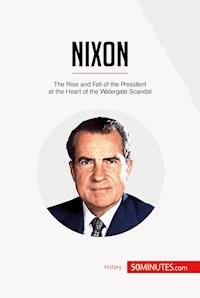
Keen to learn but short on time? Get to grips with the career of Richard Nixon in next to no time with this concise guide.
50Minutes.com provides a clear and engaging analysis of the life and political career of Richard Nixon. In 1974, Nixon made history as the first ever US president to resign from office. Although he is now best known for the Watergate scandal that led to his downfall, he did have some successes as president: in particular, he was responsible for ending US involvement in the Vietnam War and improving relations between America and China.
In just 50 minutes you will:
• Learn more about Nixon’s life, from his childhood to his death, as well as discovering more about his time as President of the United States
• Understand Nixon’s role in the Watergate scandal and the Vietnam War, and how these situations affected his presidency
• Analyse his achievements as well as the mistakes that led to his resignation, making him the only US president in history to resign from his duties
ABOUT 50MINUTES.COM | History & Culture
50MINUTES.COM will enable you to quickly understand the main events, people, conflicts and discoveries from world history that have shaped the world we live in today. Our publications present the key information on a wide variety of topics in a quick and accessible way that is guaranteed to save you time on your journey of discovery.
Das E-Book können Sie in Legimi-Apps oder einer beliebigen App lesen, die das folgende Format unterstützen:
Seitenzahl: 35
Veröffentlichungsjahr: 2017
Ähnliche






Richard Milhous Nixon
Key information
Born: 9 January 1913 in Yorba Linda, California.Died: 22 April 1994 in New York.Political party: Republican Party.Election dates: 5 November 1968.7 November 1972.Time in office: Six years. Main achievements: Ended American military involvement in Vietnam in 1973.Improved diplomatic relations with Maoist China and later with the Soviet Union.Introduction
Richard Milhous Nixon is undoubtedly one of the American politicians who provoked the most passion and hostility during the 20th century. He was brilliant and scheming, a paranoid liar: there is no shortage of adjectives and images to illustrate the complexity of this character. In collective memory, the name of the 37th President of the United States is of course still associated with the Watergate scandal that ended his political career.
Nixon’s swift rise in the world of politics, after starting out with nothing, took place in a context of profound anti-communism. This anti-communism was closely linked to the Cold War (1945-1990), which he supported and which enabled him to stand out. When he became president, American society was suffering a serious crisis and was more divided than ever before.
His foreign policy as president was an undeniable success: he paved the way for détente (1962-1979) and, above all, he managed to put an end to American military intervention in Vietnam. Nevertheless, more questionable and unpopular situations tarnished his mandate, such as his involvement in the fall of Salvador Allende Gossens (Chilean president, 1908-1973) and, within domestic politics, the Watergate scandal.
Either way, his presidency marked a defining stage in American history and international relations.
Biography
Childhood, education and career path
Richard Milhous Nixon, the 37th President of the United States, was born on 9 January 1913 in Yorba Linda, California, to a modest family. Originally from Ohio, his father, Frank Nixon (1878-1956), began as a tram conductor before starting a career in agriculture. He then opened a service station and a grocery shop in Whittier, a suburb of Los Angeles, before marrying Hannah Milhous (1885-1967), a devout Quaker. Nixon was the second of the family’s five sons.
His education was marked by material deprivation and moral austerity. At school, he proved to be a bright and studious child, and an excellent speaker. He graduated from Whittier College (California) in 1934 and went on to Duke University (North Carolina, east coast), where he trained as a lawyer. He got his law degree in 1937. On returning to California, he was admitted to the bar and practiced law in Whittier for four years. It was during this time that he met Thelma Patricia Ryan (1912-1993), whom he married in 1940. They had two daughters, Tricia and Julie.
In 1942, the couple moved to Washington, where Nixon found a job in a federal organisation responsible for price control. Feeling unsatisfied by his professional situation, he joined the Marines that same year. Given the role of doing essentially administrative tasks, he did not have the chance to fight during the Second World War (1939-1945). He left the army, however, having reached the rank of lieutenant.
Entry onto the political scene
His career then took an unexpected turn. After his discharge at the beginning of 1946, he was contacted by the Republicans of California to represent them and to fight their Democrat adversary in the 12th district. After an aggressive campaign, he won the election. Elected as representative of California (1947-1951), he stood out thanks to his fierce anti-communism. His participation in the enquiry led by the House Un-American Activities Committee to find a former diplomat, Alger Hiss (1904-1996), guilty of espionage to help the Soviet secret service, earned him a certain notoriety.
Good to know
The United States experienced a profoundly anti-communist period which gave rise to a witch hunt between 1950 and 1954. This witch hunt took its name from Joseph Raymond McCarthy (1908-1957), Senator of Wisconsin, who tracked down potential communist agents who had infiltrated the administration as well as intellectual and artistic circles. McCarthyism led to the execution of Julius (electrical engineer, 1918-1953) and Ethel Rosenberg (his wife, 1915-1953), who were accused of having given atomic secrets to the Soviet Union, despite an international campaign in their favour.




