


18,99 €
Mehr erfahren.
- Herausgeber: John Wiley & Sons
- Kategorie: Fachliteratur
- Sprache: Englisch
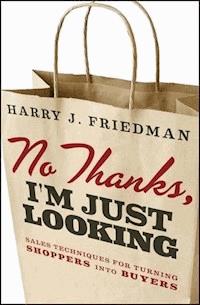
Secrets of the trade from the master of retail selling and sales training
No Thanks, I'm Just Looking gives anyone the inside scoop on how to skyrocket their selling career with a system of easy-to-learn practical money-making steps. By saving countless hours of trial-and-error experience, readers will be able to focus on the things that really work. Considered to be retail guru Harry J. Friedman's personal collection of proven selling techniques, No Thanks, I'm Just Looking includes all the tips and humorous anecdotes that have made him retail's most sought-after consultant.
No Thanks, I'm Just Looking delivers the tricks of the trade from an international retail authority.
- Author is the most heavily attended speaker on retail selling and operational management in the world
- These groundbreaking high-performance training systems have been used by more than 500,000 retailers, from small independents to the likes of Neiman Marcus, Cartier, Billabong, La-Z-Boy and Godiva, to routinely deliver more sales
- Friedman created the number one retail sales and management system used by more retailers than any other system of its kind in the world
Get proven techniques that will increase sales and elevate your staff to a high-performance sales team.
Das E-Book können Sie in Legimi-Apps oder einer beliebigen App lesen, die das folgende Format unterstützen:
Seitenzahl: 354
Veröffentlichungsjahr: 2011
Ähnliche


















Contents
Cover
Title Page
Copyright
Dedication
Foreword Richard Erhart
Acknowledgments
Introduction
Chapter 1: Getting Your Act Together before You Take It to the Selling Floor
The Not-So-Fun Stuff
Customer Service Points
The Four Occupations of the Professional Retail Salesperson
The Daily Precheck
Chapter 2: Opening the Sale
People Behave Reactively
Causing a Negative Reaction from the Beginning
The Primary Goal of Opening the Sale Is to Get Past Resistance
Opening Lines
Opening Moves
Getting into Business: The Transition
Working Two Customers at Once
How Have You Been Opening?
Chapter 3: Probing
Opening as Many Doors as Possible
Knowledge Is Power
Probing Questions
QAS
Logical Sequence
Logical Sequence Guide Chart
Switching—Or Selling What You Have First!
Chapter 4: The Demonstration
The Demonstration Follows What You Learned in Probing
Selling the Value That the Customer Wants
Creating the Desire for Ownership
Covering All the Bases
The Ultimate Demonstration Tool
Avoiding the Comparison Trap
The Expert Kills the Deal
Chapter 5: The Trial Close (Otherwise Known as the Assumptive Add-On Close)
The Dreaded Close
Adding On
Constructing a Trial Close
Chapter 6: Handling Objections
The Trial of Trial and Error
Why Objections Occur
Work with the Customer
The Smoke-Out
Handling the Price Objection
Chapter 7: Closing the Sale
Intent Is Everything
Getting Started
Basic Closing Techniques
Handling Requests for Discounts
Turning Over the Sale
Buying Signals
Chapter 8: Confirmations and Invitations
Buyer's Remorse
The Confirmation: Cementing the Sale
The Invitation: Requesting Another Visit
Building Personal Trade
Final Thoughts
Appendix: Retail Training Resources
About the Author
Index
Copyright © 2012 by National Retail Workshops, Inc. All rights reserved.
Published by John Wiley & Sons, Inc., Hoboken, New Jersey.
Published simultaneously in Canada.
No part of this publication may be reproduced, stored in a retrieval system, or transmitted in any form or by any means, electronic, mechanical, photocopying, recording, scanning, or otherwise, except as permitted under Section 107 or 108 of the 1976 United States Copyright Act, without either the prior written permission of the Publisher, or authorization through payment of the appropriate per-copy fee to the Copyright Clearance Center, Inc., 222 Rosewood Drive, Danvers, MA 01923, (978) 750-8400, fax (978) 646-8600, or on the web at www.copyright.com. Requests to the Publisher for permission should be addressed to the Permissions Department, John Wiley & Sons, Inc., 111 River Street, Hoboken, NJ 07030, (201) 748-6011, fax (201) 748-6008, or online at www.wiley.com/go/permissions.
Limit of Liability/Disclaimer of Warranty: While the publisher and author have used their best efforts in preparing this book, they make no representations or warranties with respect to the accuracy or completeness of the contents of this book and specifically disclaim any implied warranties of merchantability or fitness for a particular purpose. No warranty may be created or extended by sales representatives or written sales materials. The advice and strategies contained herein may not be suitable for your situation. You should consult with a professional where appropriate. Neither the publisher nor author shall be liable for any loss of profit or any other commercial damages, including but not limited to special, incidental, consequential, or other damages.
For general information on our other products and services or for technical support, please contact our Customer Care Department within the United States at (800) 762-2974, outside the United States at (317) 572-3993 or fax (317) 572-4002.
Wiley publishes in a variety of print and electronic formats and by print-on-demand. Some material included with standard print versions of this book may not be included in e-books or in print-ondemand. If this book refers to media such as a CD or DVD that is not included in the version you purchased, you may download this material at http://booksupport.wiley.com. For more information about Wiley products, visit www.wiley.com.
ISBN: 978-1-118-15340-6 (cloth)
ISBN: 978-1-118-20960-8 (ebk)
ISBN: 978-1-118-20964-6 (ebk)
ISBN: 978-1-118-21653-8 (ebk)
For all the retailers—what a journey getting here.
Foreword
Few professionals today have to respond as quickly to changes in consumer demand as does the retail sales professional. What sold like hotcakes yesterday may be dead stock tomorrow. Similarly, salesperson-to-customer retail sales techniques in our fast-paced society now may lead to disastrous results, especially with sophisticated, streetwise consumers who have heard it all and seen it all.
If you're using outmoded techniques, or if you fail to understand the psychology of why people buy, your earning power, your career, and your well-being are in jeopardy. If you lack the proper tools and techniques, the marketplace can quickly become a jungle that will chew you up and spit you out. In fact, personnel turnover in retail selling is among the highest of all industries or professions.
Enter Harry J. Friedman. Harry is president of the Los Angeles–based retail sales and management-training firm The Friedman Group. By his mid-30s, Harry had already built his firm into one of the most successful training firms in the industry.
In his video programs and live presentations, which are in demand throughout the world, and now in this book, Harry strips away conventional wisdom about what it takes to be successful in retail selling. In its place, he lays down a foundation rooted in proven and effective methods that he has personally devised over decades of research, study, and firsthand experience.
This book will save you time and endless hours of frustration. Harry is a master of retail selling and retail sales training, but more important, he is one of those gifted individuals who possess a unique ability to convey his knowledge in an entertaining, yet highly supportive manner. He enjoys helping sales professionals, and they enjoy listening to him. Now, they will enjoy reading what he has to say.
Starting with what to do even before customers walk into the store, progressing through all the critical elements that lead up to the sale and offering coaching through post sales issues, Harry decisively spells out what you need to know to increase your sales results every day, regardless of what you're selling.
Harry wants you to succeed. In this book, he pulls out all the stops, offering both insightful instruction and compelling reading. He opens up his treasure chest of profitable procedures for interacting with prospects. Harry introduces key phrases, appropriate gestures, and effective behaviors for getting the prospect on your side in a hurry. Furthermore, he reveals what the customer is thinking, wants to see, and needs to have confirmed.
His understanding and explanation of customer psychology is, in a word, outstanding. Through dialogues culled from actual sales encounters, from the minuscule to the magnificent, Harry provides the essence of effective retail selling in today's world.
If you read this book, your sales career will take a turn for the better. I predict that you'll pore over the pages time and time again, to squeeze out every golden nugget of Harry's knowledge. If you're in retail selling, or any other profession where favorably influencing others is important, you'll find that this book is more than an instructive guide—it's a chance to change your standard of living forever.
—Richard ErhartFormer Executive Vice PresidentInterTAN (Radio Shack International)
Acknowledgments
For six years, I have wanted to put a book together on retail selling, but it always took a backseat to being out in the field, teaching it. Traveling a quarter of a million miles a year doesn't afford much time to write. Finally, I met Jeff Davidson. He took countless hours of my audio and videotapes and put together a wonderful draft. Marlene Cordry, my right and left hands for many years, along with my very talented staff, helped put the finishing touches on it. To my partner, Jon Dickens, thanks for all your help.
I have always believed I am the result of all my yesterdays. Those days were filled, as I hope my tomorrow will be, with meeting people who have added so much to my knowledge. This book is a result of that learning.
It is sometimes very difficult to acknowledge or remember every source that goes into a book. If I have used a technique or an expression from someone else, it is because that is now what I believe. Sorry, and thanks!
Harry J. Friedman
Introduction
You can't always buy right. But you can always sell right.
No matter how unusual you think your merchandise is or how different you think it is from someone else's wares, the truth is that customers don't appreciate the same distinctions that you do and may regard what you have as just about the same as the next salesperson's. So, if your merchandise is not perceived to be substantially different from that found in other places, why will shoppers buy a product from you, instead of buying it from the store down the street?
It all boils down to you. Success as a salesperson depends entirely on your ability to open up customers, to communicate with them, and to satisfy their needs.
When people choose a doctor or lawyer, their selection is based only in part on that individual's education. Feeling that you can relate person to person is a major factor in choosing and staying with one professional over another. A good professional knows that an excellent education is only a small part of what goes into a prospective client's decision to use him or her. Reputations are built and practices grow as much because of people skills as because of technical skills.
There are no born doctors, lawyers, accountants, or plumbers, and there are no born salespeople either. People in business need technical, personal, and business skills to succeed. Learning these skills is an ongoing process that changes as new information becomes available and new methods of doing things are developed.
Unfortunately, in today's retail environment, salespeople are professionals who often act like clerks. Clerks may do an adequate job of executing routine tasks at work, but they don't develop special skills, go the extra mile, do their homework, or cultivate their customers.
Like clerks, salespeople have frequently let their people skills—and their technical skills—remain uncultivated.
In this book, we'll show you how to develop people skills and selling skills that will not only boost your income but also dramatically increase your job satisfaction. The first chapter, “Getting Your Act Together before You Take It to the Selling Floor,” covers the basics of the Precheck—what to do before the store opens in the morning—in a sense, getting your act together before you take it to the floor.
Chapter 2, “Opening the Sale,” addresses the unconscious things salespeople have been saying to shoppers over the years and offers a professional sales approach to speaking with your customers. It is frightfully true that too many salespeople have resisted doing their homework and refrained from any degree of preparation. This has resulted in ineffective probing and unenthusiastic demonstrations, offered by ill-informed personnel. Chapters 3, “Probing,” and 4, “The Demonstration,” cover the crucial skills of probing and demonstrating.
In Chapter 5, “The Trial Close,” we'll tackle the professional salesperson's mandate to close the sale, with a bonus of adding on to the sale.
In Chapter 6, “Handling Objections,” we'll focus on the all-important skill of handling objections, followed by techniques for closing the sale in Chapter 7, “Closing the Sale.” In the past, salespeople have been happy with the hit-or-miss approach to selling, contenting themselves with intermittent closes and merely respectable sales. The professional salesperson goes for the close every single time, with every single customer. We'll discuss in depth how you can do that, using your own personal style.
Finally, in Chapter 8, “Confirmations and Invitations,” we'll highlight how to use confirmations and invitations to build more sales, encourage repeat business, and generate referrals.
As we proceed throughout the book, remember: If you choose to say hello to a customer, choose to sell and satisfy that person!
Chapter 1
Getting Your Act Together before You Take It to the Selling Floor
It is so very difficult to draw water from an empty well.
In a March 1989 article, Brian E. Kardon spelled out a new retail term called consumer schizophrenia. He noted that it might be the most important revolution in consumer behavior since the mass-marketing movement of the 1950s.
Simply put, the way people buy could be characterized as schizophrenic. For example:
You own an expensive imported car but go to a self-service gas station and pump your own gas.You buy premium, designer ice cream at the market, and at the same time, buy the house brand dog food or unbranded tissues.You buy a custom-made suit, and then go next door and buy toys at discount.Selling today is remarkably different than it has been in the past, for two major reasons. The first is that people tend to be cautious about where they spend their money, wanting the best quality and the best deal. Second, at the same time that people are careful about spending, there are more consumer goods than ever and greater use of the mass media to advertise them. And then there's the Internet. All this, of course, fosters more competition for the customer's disposable income.
People don't really need a luxury car or a diamond bracelet, but they want that kind of merchandise or desire to use it to express their love or their excitement and joy over special occasions. There is, after all, something exhilarating about finding exactly the right gift for someone or precisely the right piece for yourself. Your goal as a professional salesperson is to create a desire in your customers to want what you have. That is retail selling!
Lesen Sie weiter in der vollständigen Ausgabe!
Lesen Sie weiter in der vollständigen Ausgabe!
Lesen Sie weiter in der vollständigen Ausgabe!
Lesen Sie weiter in der vollständigen Ausgabe!
Lesen Sie weiter in der vollständigen Ausgabe!
Lesen Sie weiter in der vollständigen Ausgabe!
Lesen Sie weiter in der vollständigen Ausgabe!
Lesen Sie weiter in der vollständigen Ausgabe!
Lesen Sie weiter in der vollständigen Ausgabe!
Lesen Sie weiter in der vollständigen Ausgabe!
Lesen Sie weiter in der vollständigen Ausgabe!




