


24,99 €
Mehr erfahren.
- Herausgeber: Thieme
- Kategorie: Fachliteratur
- Sprache: Englisch
The information you didn't learn in medical school! "A marvelous and amusing read...memorable anecdotes...I defy you not to laugh out loud." --ENT News Want to get a step up on the competition? This is the book for young doctors trying to bluff their way into erudite otolaryngological circles by giving the impression that their ENT education was not wasted. Knowledge of trivia about a particular subject always gives the impression that the holder of this useless information is also privy to other facts which are just too mundane to mention. While everyone in the field may know what Gradenigo's Syndrome is, you will impress your colleagues by knowing just who Gradenigo was! Learn the fun facts and information you missed in medical school the magic and romance behind acoustic neuroma; madness and anesthesia; famous tracheotomies; the history of nasal polyps; and so much more. Finally, a medical book that makes you laugh! Offbeat Otolarngology is the book you will avidly read at every break, use in speeches, and amuse your friends and colleagues.
Das E-Book können Sie in Legimi-Apps oder einer beliebigen App lesen, die das folgende Format unterstützen:
Seitenzahl: 283
Veröffentlichungsjahr: 2001
Ähnliche



















Offbeat Otolaryngology
What They Didn’t Teach You in Medical School
John DC BennetBSc MB ChB BA MA FRCS DCH DHMSA
John Riddington YoungOStJ TD and bar MB ChB MPhil FRCS DLO
© 2001 John D Courtenay Bennett and J Riddington Young
First published under the title Interesting Otolaryngology in the United Kingdom of uncertain date and under dubious circumstances
Any reference to or mention of manufatures or specific brand names should not be interpreted as an endorsement or advertisement for any company of product.
Some of the product names, patents, and registered designs referred to in this book are in fact registered trademarks or proprietary names even though specific reference to this fact is not always made in the text.
Therefore, the appearance to a name without designation as proprietary is not to be construed as a representation by the publisher that it is in the public domain.
This book, including all parts thereof, is legally protected by copright.
Any use, exploitation, or commercialization outside the narrow limits set by copyright legislation, without the publisher’s consent, is illegal and liable to prosecution. This applies in particular to photostat reproduction, copying, mimeographing or duplication of any kind, translating, preparation of microfilms, and electronic data processing and storage.
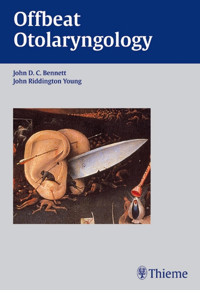
Cover illustration: Hieronymus Bosch: El Jardin de las delicias
© Museo del Prado - Madrid. Derechos Reservados.
Georg Thieme Verlag,
Rüdigerstrasse 14,
D-70469 Stuttgart, Germany
Thieme New York, 333 Seventh Avenue,
New York, NY 10001, USA
Printed in Germany by Gulde Druck, Tübingen
ISBN 3-13-128951-1 (GTV)
ISBN 1-58890-053-3 (TNY) 1 2 3 4 5
THE AUTHORS
PERSONAL MESSAGE
DEDICATION
PROLEGOMENON
THE DEVELOPMENT OF THE SPECIALTY AND RISE OF HOSPITALS
(a) The Ascendency of Specialisation
(b) Climbing the Ladder of the Specialty
(c) The Foundation of ENT Hospitals
(d) The Interface with Radiology
(e) The Role of the Fairer Sex
(f) The Role of the Church
(g) Fear and the Medical Profession
THE GENTLE ART OF BOUGINAGE AND ENDOSCOPY
(a) The Development of Means by which Hitherto Secret Parts of the Body Came to be Revealed.
(b) The TRUTH about Linda Lovelace’s Relations, Revealed for the FIRST Time Through a Thorough Investigation of the FACTS
ANAESTHETIC CORRELATES
(a) The Blossoming of the Art of Anaesthesia Under the Tutelage of Otolaryngology
(b) Why Anaesthetists Should Remember Draffin
(c) The Day the Balloon Went Up
(d) The Surgeons’ Scissor Jaw Reflex
(e) Madness and Anaesthesia
(f) And Much Much More
LOTIONS, POTIONS AND PREPARATIONS
(a) The Role of Tobacco in Otolaryngology
(b) Insights into some Rare and Unusual Therapeutic Substances
(c) Some of the Early Writing into the Technique of Applying Substances Directly into the Circulation by Means of Venepuncture
(d) The TRUTH behind the Surgeons’ Gloves
AUDIOLOGY
(a) The Early Development of the Subject
(b) Noise Induced Hearing Loss
(c) Education of the Deaf
(d) Vertigo
(e) The Science of Audiometry
(f) The World of Hearing Aids
OTOLOGY
(a) The Early Development of the Subject
(b) The History of the Eustachian Catheter
(c) Artificial Perforation of the Tympanic Membrane
(d) The Discovery of Otosclerosis
(e) The Early History of the Mastoid Operation
(f) The Acoustic Neuroma
MILITARY PROWESS WITHIN THE FIELD OF OTOLARYNGOLOGY
RHINOLOGY
(a) The History of Rhinoplasty
(b) The History of Nasal Polyps and their Removal
(c) The Tragedy of Benjamin Babington and his Forgotten Disease
(d) Other Interesting Pickings
SURGERY OF THE HEAD & NECK
(a) The Case of the Gunner with the Silver Jaw
(b) The History of Tonsillectomy and some of the Instruments by which it can be Performed
(c) Some Famous Tracheostomies
(d) Milestones in the Development of Laryngology
(e) Some Highlights of Head and Neck Surgery
PROFESSIONAL RIVALRIES
(a) Pedantry
(b) Remuneration
(c) Faint Praise
(d) Adventures of a Peripatetic Professor
(e) Unsung Heroes and Cock Ups
THE “FRINGES” OF OUR SUBJECT, INCLUDING THE ROLE OF INVALID COOKERY
(a) Homeopathy and Herbalism
(b) Invalid Cookery
EDUCATION AND TRAINING
(a) The Role of the Moustache in Otolaryngology
(b) The Life without Examination is not worth Living
(c) Publish and be Praised
REFERENCES
THE AUTHORS
John D C Bennett is an intensely shy and private individual who spends much of his time wondering why he has ended up where and what he is. In the past few years he has taken to travelling the world researching obscure medical curiosities and unsung heroes, with whom he is beginning to feel a strange affinity. His mother is very worried.
John Riddington Young is a ferret breeder, wood carver, arable farmer and Punch & Judy man who grows prize-winning sweet peas. His main hobbies are kite-flying, cricket-umpiring, otolaryngology and the Territorial Army. Like John Bennett, he is a Yorkshire Chauvinist but is at present doing missionary work in North Devon where he lives with a bull terrier, five children and his wife, who has always been very worried.
PERSONAL MESSAGE
Next to a personal knowledge of men, a knowledge of the literature of the profession of different countries will do much to counteract intolerance and Chauvinism. The great works in the department of medicine in which man is interested, are not so many that he cannot know their contents, though they may be in three or four languages. There is abroad among us a proper spirit of eclecticism, a willingness to take the good where-ever found, that augurs well for the future. It helps a man immensely to be a bit of a hero-worshipper, and the stories of the lives of the masters of medicine do much to stimulate our ambitions and rouse our sympathies.
I commend this book most heartily and wish the young authors every success.
Personal message from Sir William Osier (1849-1919) received in a dream by one of the authors (JDCB).
DEDICATION
The authors respectfully dedicate this slim volume to:
1. HM Queen Elizabeth the Queen Mother
who is not only a constant source of inspiration but also Colonel in Chief of the Royal Army Medical Corps, in which both authors are proud to serve.
2. All poor and distressed bar maids, wherever they may be.
3. Alicia (Berlin, Stoke on Trent and Paris*).
*a city in France
PROLEGOMENON
It is not necessary to know Latin, but merely to give the strong impression that one has forgotten it.
We perhaps ought to start by pointing out for the benefit of our American readers and those poor souls without the benefit of a proper classical education that prolegomenon is derived from the Greek prolegein (to say beforehand), and is a term used in scholarly books to describe prefatory remarks.
One of the reasons Dr Samuel Johnson gives for writing his dictionary is so that people will know how to spell waistcoat, the pronunciation of which had already become weskit, as shown in the Cockney rhyming slang “Jim Prescott” (perhaps American and Australian readers should skip this altogether and proceed directly to the next chapter). Our reason for writing this is to help junior colleagues to bluff their way in erudite otolaryngological circles and be able to give the impression that their ENT education has been properly rounded off.
Knowledge of fascinating trivia about a subject always gives the impression that the holder of this useless information is also privy to all the other important facts which are just too mundane to utter. At the apex of the petrous temporal bone is an almost imperceptible piece of fibrous tissue connecting it to the sphenoid bone. Below this so-called petro-clinoid ligament in Dorello ’s Canal (a channel formed by dura mater) runs the abducent nerve. Its immediate lateral relation is the Gasserian Ganglion which lies in another invagination of dura mater, Meckel’s Cave. What a cornucopia of claptrap! Especially if you know who these worthy anatomists were - but it gets better: although apical petrositis from chronic suppurative otitis media must be about as common as rocking horse manurea, it can be nonetheless confidently diagnosed if Gradenigo’s Syndrome is present! This is otitis media associated with diplopia from weakness of the ipsilateral external rectus muscle (caused by involvement of the abducent nerve in Dorello’s canal), and ipsilateral retro-orbital pain due to irritation of the Gasserian ganglion.2
Is this knowledge useless? Not a bit of it. As Francis Bacon so succinctly put it: “Nam et ipsa scientia potestas est” - or “for knowledge itself is power”, and be advised that notwithstanding its rarity, Gradenigo’s syndrome has already been asked no less than eight times in the Diploma of Laryngology and Otology and Fellowship of the Royal College of Surgeons exams. And that is just the written exams. Think of the one-upmanship when asked “Just who is this Gradenigo, young man?” and be able to be ready with the answer: Guiseppe Gradenigo from Naples was clearly not dearly enamoured by his colleagues. His obituary is a masterly Machiavellian tribute on how to damn your recently demised senior colleague with faint praise. Casually dropping this gem, implying of course that you have personally read the obituary should rattle up your viva score considerably.
One of the authors was asked in a Fellowship viva if he knew who Trotter (of Trotter’s Triad) was; it should be pointed out that the patient under discussion did not actually have the three factors which Trotter had described and it was necessary to inveigle into the answer that Trotter’s Triad was not in fact present! Not that failure would have been inevitable had it not been known, but once it was mentioned that “Wilfred” was from Gower Street, and then the dropping about his friendship with King George whose rib he had resected to drain a royal empyema when the official King’s Surgeon had failed miserably to cure him - and, of course, his later refusal to receive a knighthood (in fact, he refused several times, preferring to be plain old Mr Trotter, which must be very confusing for our American and Australian readers - they should now immediately turn to page 115), the kindly pair of old gentlemen on the far side of the green baize table smiled benignly and all seemed plain sailing afterwards. Indeed, true interrogation ceased and the three chatted on about his amity with the King and how he would “pop in for tea at the Palace” through a special door in Buckingham Palace Road known only to members of the Royal Household and family friends. Then the bell went. This would not have been possible without our dear old chief, Kenneth Harrison, interrupting the dissection of a particularly pungent temporal bone one afternoon with the rather dramatic news that Trotter was a giant. That was all he said initially, “He was a giant you know”! It seemed that something nasty might have been going on within his sella turcicab, but then it was related that Trotter had been described as “an artist with a knife” and subsequently the vignette about the King’s empyema was unfolded. It was the 12th Century monk, Bernard of Chartres, quoted on the title page of Shambaugh’s Surgery of the Ear3, who spoke of giants:
We are all like dwarfs seated on giants’ shoulders If we can see a long way, it is not because we are tall, but it is because we are seated on giants’ shoulders.
The specialty of Otorhinolaryngology is not only well endowed with “giants” but has also provided the founders of two other specialties, paediatric surgery and plastic surgery. The former was developed by Denis Browne, known to all otolarynogologists for his development of tonsillectomy instruments, the latter by Sir Harold Gillies.4
That is not to say that things have always been rosy. Sir Astley Paston Cooper (1768-1841) had a deep interest in conditions of the ear and was awarded the Copley medal after reporting twenty of his cases to the Royal Society, but he soon retired from this work “as he was afraid to be thought an aurist”.5
Our distinguished predecessors have not confined themselves solely to the academic aspects of our specialty. George Cathcart (1861-1951) was always very interested in problems of the voice and suggested that in order to prevent vocal strain orchestral instruments should be tuned to French pitch and not to the higher concert pitch as was customary. In 1894 he founded and financed the first Promenade Concerts at the Queen’s Hall, London, insisting that his friend Henry Wood should be the conductor.6
In summary, there are a lot of interesting things to learn about. Read on!
————————————
a In F.W. Watkin-Thomas’ standard textbook of 1953 (London: H K Lewis) it was quoted as being “rare”, with E.D.D. Davis seeing six in thirty years, the author recalling five in the same period i.e. the 1920s to the 1950s.
b Sella Turcica or Turkish saddle. You may have spent many troubled hours wondering what a turkish saddle is. There are two main types of horse saddle nowadays: the English and the Western. The English saddle (formerly called Hungarian) is for more expert horsemen; the Western or “cowboy” saddle is, not surprisingly, bigger and has a pommel on the front to which one can tie one’s lariat at rodeos. It used to be called a Moorish or Turkish saddle, the pommel being fancifully represented in the skull by the posterior clinoid processes. There are four clinoid processes because a clinos was a bed and of course had four posts (we also get the word clinic from this).
THE DEVELOPMENT OF THE SPECIALTY AND RISE OF HOSPITALS
In which the authors explore:
(a) The Ascendency of Specialisation
(b) Climbing the Ladder of the Specialty
(c) The Foundation of ENT Hospitals
(d) The Interface with Radiology
(e) The Role of the Fairer Sex
(f) The Role of the Church
(g) Fear and the Medical Profession
(a) The Ascendency of Specialisation
During the first half of the nineteenth-century most physicians were generalists who tended to look down on specialists as they were associated with quacks and itinerant healers who performed a single medical procedure. How very different things are today! Specialisation began to develop in the second half of the century on the ideological basis of the anatomic concept that disease attacked and resided in specific places within the body. This was coupled with the absolute increase in medical knowledge fuelled by the great advances made in pathology. Evil humours of vague provenance were replaced by a much more precise localisation of the seat of the trouble afflicting a patient. This process was stimulated by the multiplication of scientific instruments. It was the discovery and, more importantly, the publicising of the means by which indirect laryngoscopy could be performed that gave laryngology such a boost. Manuel Garcia’s story is well recorded in standard texts, but what is perhaps not so well known is that articles on him on his 100th birthday appeared in both The Strand Magazine7 and Punch.8 The skilful use of such instruments required special education and practise, thus fostering specialisation. In addition to these medical and technological factors, the industrialisation and increasing concentration of the population into cities provided areas which could support specialised doctors.
It must, however, be remembered, that there were no barriers preventing such “specialists” from competing with generalists for patients, and many so-called surgeons were little more than general practitioners. The day books of Sir William Fergusson, who was to become Professor of Surgery, King’s College Hospital in 1839 and Surgeon Extraordinary to the Queen in 1855 reveal that though busy with consultations and making over eighty visits to patients a month, he performed only two or three operations over the same period9.This seemed to do him little long term harm, the Lancet writing: “Few men equalled and probably none surpassed him as an operator”10 The generalists faced not only competition from the specialists but also from hospitals and dispensaries which provided free care. To add to their troubles there were groups such as the practitioners of Christian Science, herbalists, and sellers of patent remedies, many of whom encouraged patients to treat themselves. As the reputation of specialists grew, patients would often visit them directly instead of relying on generalists to decide whether a consultation was necessary. Much of this might instil a distinct feeling of déja-vu to the British reader of the 1990s who is beginning to hear similar questions being raised. As these pressures continued there came about an economic disparity between generalist and specialist practice and also between that found in rural areas with practice in the cities.
At the International Medical Congress of Brussels in 1875, eight sections represented the state of scientific medicine at the time; for the Paris Congress of 1900 there had to be seventeen.11. In 1910 the surgeon William Mayo warned that interdependence was an inevitable consequence of medical growth owing to the fact that the sum total of medical knowledge was now so great. In the United States of America an attempt at an alternative to the unifying knowledge provided by a brilliant clinician was found with the proposal to link specialists through formally organised cooperative medical associations. This co-operative specialisation reflected the tendency toward group effort that characterised industry and various social enterprises in the early twentieth century. Although by the 1920s such co-operative approaches to medical care were integral to the functioning of the hospital, it was actually doing more to foster specialism. Other branches of Medicine have not been immune to change and expansion. In 1900 there were no more than 305 Fellows of the Royal College of Physicians of London. By 1940 there were 619, and in 1992,5,736. Members of the College, primarily trainees, rose from 452 in 1900 to 17,616 during the same period. This is especially important when one bears in mind that at the beginning of the century there were only two royal colleges in England - that of the Physicians (founded 1518) and the Royal College of Surgeons, which although with a history dating much longer, only received a royal charter in the nineteenth century. Only one further college emerged before the Second World War, the Royal College of Obstetricians and Gynaecologists which began in 1929. The two other colleges had attempted to prevent this, fearing they would lose their monopoly on qualifying exams, an important source of revenue. In 1952 the Royal College of General Practitioners became established, despite further opposition from the Physicians, to be followed by the Royal College of Pathologists. This was particularly important for this specialty, which feared “becoming mere drudges, purveyors of reports”.12 Of course there are now colleges of radiologists, psychiatrists, anaesthetists and ophthalmologists. One wonders whether there will ever be one for otolaryngologists and in this we are reminded of the dream experienced by His Holiness the Pope, John Paul II. He spoke to God, posing the question as to whether the Church would ever be reunited. The reply came that it would, “but not in your lifetime”. He then asked whether women would ever be ordained into the Roman Catholic Church. God replied again that this would come to pass in the future, “but not in your lifetime”. For the final question of the three he had been allowed he asked whether there would ever be another Polish Pope. The deity replied:
Not in my lifetime.
How, in fact, do specialists come about? Put simply, they possess either skills, such as special techniques of treatment, or have access to special equipment denied the generalist. Of course there is an overlap - the surgeon is unlikely to be able to exercise his surgical prowess without the requisite facilities - which were more and more being provided solely within the hospital setting. Specialties such as radiology developed purely by the expediency of controlling technical equipment, though even with this seemingly straightforward case we find that in the early years many generalists who had enough money to buy the kit lost no time in setting themselves up as “specialists”.
Otologists had been appointed within British hospitals by 1851 but were primarily physicians, as were laryngologists. In 1872 William Dalby (1840-1919), who in 1900 founded the Otological Society of the United Kingdom, was appointed the first aural surgeon to St George’s Hospital, London.13 In that same year, 1872, that doyen-to-be of otolaryngology, Sir Henry Trentham Butlin (1843-1912) was surgical registrar to St Bartholomew’s when the “registrarship” was a relatively new appointment.14 In fact the Committee of Westminster Hospital announced in 1870 that registrars who have hitherto done the duties of these appointments gratuitously will be remunerated; the sum of eighty pounds has accordingly been voted for the purpose, but only for the ensuing year.15 The British Rhino-Laryngological Society was formed in 1888. Sir Felix Semonc (1849-1921) was the first laryngologist to be appointed to a general hospital, in 1882, to St Thomas’ Hospital (in London)16 and established “subsection” status for laryngology at the International Medical Congress in London 1881. Full status was obtained at the next meeting in Copenhagen.17 However the British Medical Journal of 1905 records how plans were laid to boycott the International Medical Congress to be held in Lisbon in 1906 as “the Organizing Committee have placed laryngology, otology and rhinology as one subdivision”.18 To add insult to injury, dentistry formed the other part. Attention was drawn to the fact that on 13th January 1905 the Laryngological Society of London had reaffirmed the resolution passed in 1902 that at all international medical congresses laryngology and otology should both be assigned a full and separate section. It was decided that in default of a definite assurance that laryngology should have the position to which it is entitled, the delegates would take no part in the Congress. The dentists’ view on all this is not recorded but readers should perhaps remember that for a long period throughout post Second World War Great Britain there was only a handful of professors of otolaryngology. It is somewhat ambiguously claimed that F C Ormerod in 1949 “was appointed the first professor of Laryngology and Otology in the first Chair to be created for our specialty in this country”.19 Professor Victor Lambert never had an established chair in Manchester. Phil Stell hat a title a while before a full-time academic post was set up at Liverpool. Nevertheless this is considerably less than the Chairs in dentistry in any one dental school.
At the beginning of the twentieth century the problems facing the specialty were addressed by Patrick Watson-Williams (1860-1938)d. Some of his thoughts might well be applied to the current debates over the training of members of our specialty towards the end of the century. Whilst recognizing that too early a specialization was to be avoided and that a sound up-bringing in the whole range of general medicine and surgery was the only safe foundation for any special branch, he resented the fact that there was a tendency to make another specialty (general surgery) the academic test of fitness. It is quite remarkable that in 1910 he was saying in his presidential address to the laryngological section of the Royal Society of Medicine that “medicine was becoming a secondary consideration with a consequent danger of our becoming too exclusively surgical”20.
Sixty years later, the pioneer of hip replacement surgery, John Charnley, bemoaned the fact that the Royal Colleges could not find a formula to reconcile “their obsession with a broad background of general training with the need to produce adequate numbers of highly competent surgeons”.21 He drew attention to the fact that existing qualifications were being denigrated, a fact only too well known to today’s graduate who is suffering from the “academic inflation” which requires more and more post-nominal letters. As Charnley points out, every decade fewer and fewer postgraduates are regarded as completely trained to do the work required. In an attempt to prevent so wide a field of knowledge being required that it would be spread too thinly, what Charnley referred to as “the British characteristic to prefer amateurism to the intense approach which leads to professionalism”, he advocated more specialisation. Of course one must not forget that no matter which aspect of disease one studies one remains a doctor, and to the patient suffering from something which is to him unique and important it is essential that the humanity, courtesy and common sense which are so often squashed out of individuals during their training are not forgotten. This was brought to the author’s attention by an article by a doctor describing the last days of his grandfather, admitted to a hospital for terminal care.22 The grandson drew the houseman’s attention to the fact that persistent vomiting had been treated only with oral antiemetics and there had been no control of his pain. The reply to this was that he was “entitled to feel angry and distressed, and that analgesia would be discussed with the MacMillan team”. The senior registrar later explained that “they had wanted to give him every chance to recover before starting terminal care”. Clearly we do sometimes get it wrong. Charnley deplored the situation where every surgical specialist had to pass the same postgraduate examination; in this, of course, he was concerned with orthopaedics. However the specialist otolaryngology FRCS exam was established only relatively recently (1947) and even so general surgery constituted a half. The situation in Britain is now changing but progress has been very slow. At present there seems to be no likelihood of our specialty receiving the status of a faculty within the various colleges of surgeons, let alone a separate college and in this respect the dominance achieved by general surgeons this century is likely to continue.
(b) Climbing the Ladder of the Specialty
Lionel Colledge (1883-1948) qualified in 1910 and the following year, at the age of twenty-eight was a fellow of the Royal College of Surgeons. Before the age of thirty he had been appointed assistant aural surgeon to St George’s Hospital and assistant surgeon to the Hospital of Diseases of the Throat, Golden Square.23 Even this rapid acceleration through the ranks can be bettered by William Daggette (1900-1980)f who was appointed to the consultant staff at King’s College Hospital, London at the age of twenty-eight.24 This is just as well since that great medical man, Sir William Osier held that “allprogress was made, or at least started, before forty and a man should retire from active work at sixty”. This was certainly the case for George Huntington, who described the disease known by his name in 1872, as the age of 21. He had become familiar with the genetic disorder during rounds with his father, a general practitioner on Long Island and this was his only contribution to medical research - like his father he was content in a country practice.25 The authors would not like to imply that this constituted “retiring from active work” - but we digress.
It was noted in 1910 at the Presidential Address of the Laryngological Section of the Royal Society of Medicine that there was a tendency in Britain to: carry on examinations unduly, and thus to trench too far on the precious years of early adult life, when a man’s best original ideas are germinating and should be cherished and allowed spontaneous growth, instead of being trammelled and choked out of life by scientific pedagogy.26
What a strange idea!
When proposals were carried in the Lancet in 1958 regarding cardiologists with one being appointed to “every major hospital centre” it was boldly declared that “recommendations are made for a period of at least five years training after registration”.27 This rings with a rather hollow tone to those currently fighting their way from short-term contracts as “juniors” in the National Health Service to tenured posts many years after this period of time. Incidently, the same article ends with the rhetorical question that if specialties continue to “encroach”, “Has the hospital service of the future any place at all in fact for the general physician?”. This was in 1958.
Advice, often given with the best of intentions, can also mislead. The great surgeon Sir William Arbuthnot Lane, Bart had, whilst a student, set his heart upon the study of medicine and was not interested in surgery. He was appointed to Guy’s hospital as a house physician and was befriended by one of the consultant staff, Dr Moxon, who pointed out to him that the prospects of progressing on the medical side were remote; that he, Fagge, Wilks and Pavy were strong healthy people, likely to live a long time. However he considered that every member of the surgical staff at this time suffered from some condition likely to shorten his life. Consequently Lane devoted himself to the study of surgery, determined to overcome his repugnance of it. How wrong Moxon’s forecast was is shown by the fact that owing to the deaths of Fagge, Wilks, Moxon and Pavy, Dr Hale White, who was a year younger than Lane, was appointed to the medical staff in 1886, two years earlier than Lane was appointed assistant surgeon!28 Of course, when it comes to climbing the rungs of any professional ladder, more is required than the convenient death of one’s superiors and rivals. There is that indefinable quality which in some allows a characteristic to be used to advantage, whilst others are damned by it. The diligent reader will find many examples of this in the ensuing pages.
(c) The Foundation of ENT Hospitals
From the last third of the eighteenth century there was a new development - the foundation of medical institutions by medical men. These special hospitals played a key role in confirming the position and power of specialists.29 In the words of an 1860 edition of the British Medical Journal they enabled medical men to “step to fame and fortune by means of bricks and mortar”.30 The fact that they could be a route to power, prestige and wealth is underlined by the vociferous opposition they encountered from much of the medical profession in the mid-nineteenth century. Despite this initial condemnation, by the end of the century, those aspiring to the top of their specialty were applying to join the staff. To set this in some sort of historical context one must remember that in the eighteenth and nineteenth centuries the middle and upper classes were usually treated at home, with hospitals generally being supposed only for the “deserving poor”. Senior doctors would give of their time free of charge in exchange for the prestige and contacts which accrued from such an association; junior medical men used hospitals in order to learn their craft.
Initially these were usually simply outpatient departments, based on that started by John Lettsom in 1770. He was also the founder of the Medical Society of London, from which the Royal Society of Medicine developed. What might be considered the first British hospital specialising in otology was set up in 1816 as a dispensary in Soho Square by John Harrison Curtis (1778-1860) who began his professional life as a dispenser in the Royal Navy. From these humble origins as the Dispensary for Diseases of the Ear arose the Royal Ear Hospital which is now part of University College Hospital, a humble teaching hospital in London.31 The specialist hospitals evolved from these outpatient dispensaries and, once in, the doctor had access not only to wealthy governors and patrons but the basis on which to establish a practice. As an indication of the value of such a position it should be noted that at John Lettsoms’s Aldergate Dispensary two competing applicants paid six hundred guineas between them to secure an entrance.32 The template for otolaryngology was Moorfield’s Hospital, founded in 1805 by John Cunningham Saunders (1773-1810).33 It was originally for both the eye and ear, but treatment of ear conditions ceased after two years.34 Saunders was born in Devon and, after being apprenticed to a barber surgeon, walked the wards in London and became house-pupil to Sir Astley Paston Cooper. Following this, he became a lecturer at St Thomas’ Hospital, no doubt paying for the privilege. However, when his mentor left for Guy’s Hospital in 1800, taking on Benjamin Travers as his apprentice, Saunders was left out in the cold. He departed for the provinces the following year. He was in luck, however, for having worked for Astley Cooper, he could draw on this connection by emphasising a degree of specialisation in otology by publishing a book.35 In 1804 he established his London Dispensary for the Relief of the Poor Afflicted with Ear and Eye Diseases. This was clearly the thing to do - a check of the Medical Directories of the period reveals that by the 1860s there were at least sixty six specialist institutions in London alone.
The loyalty extended to a hospital might reach almost ridiculous proportions. A patient was seen at the Manchester Ear Hospital complaining of a running ear, which was treated. When an attempt was made to examine her other ear, this was refused. This ear was under the care of another hospital, St John’s Dispensary just around the corner! The effort of attending for daily dressings at two different hospitals can be imagined and for those who cannot picture the chaos of the waiting room of such hospitals then Lowry’s Outpatients at Ancoat’s Hospital is an apt visual description. This picture used to hang in the hospital in Ancoats and was coveted by a well-known lady Minister of Health in the 1960s for her Whitehall office. For those of our readers who knew Manchester in the past but have not been back for some time, we have to relate that many of these neighbourhood areas have now changed quite a lot. This has not necessarily been for the better, not obviously for the worse - it all depends on one’s needs. The corner tobacconist is now in the hands of a chocolatier. This is an advantage for those requiring something more than a bar of Fry’s Five Boys Chocolate;




