


0,49 €
Niedrigster Preis in 30 Tagen: 2,49 €
Niedrigster Preis in 30 Tagen: 2,49 €
Mehr erfahren.
- Herausgeber: Booksell-Verlag
- Kategorie: Sachliteratur, Reportagen, Biografien
- Sprache: Englisch
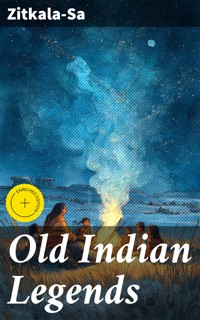
In "Old Indian Legends," Zitkala-Sa masterfully weaves a collection of Indigenous stories that resonate with profound cultural significance and a rich oral tradition. The book presents a series of narratives reflecting the spiritual and moral lessons central to Native American life, infused with her lyrical prose that captures the essence of her heritage. Zitkala-Sa employs a blend of autobiographical elements and folklore, embedding her work within the broader context of early 20th-century American literature, where Indigenous voices were often marginalized. This literary piece challenges those narratives by foregrounding voices from the margins and illuminating the complexities of tribal identities. Zitkala-Sa, a Sioux writer, composer, and activist, draws upon her rich personal history and cultural background to articulate the struggles and triumphs of Indigenous peoples. Her experiences of displacement and education at a Quaker missionary school deeply informed her writing, as she confronted the tensions between assimilation and cultural preservation. With an intimate understanding of both her own culture and the broader American landscape, she emerged as a significant voice advocating for Native rights and representation. I highly recommend "Old Indian Legends" to readers seeking a deeper appreciation of Native American narratives and their intricate worldview. Zitkala-Sa's evocative storytelling not only preserves cultural heritage but also invites readers to engage critically with the histories and identities of Indigenous peoples. This book is a potent reminder of the power of storytelling in reclaiming agency and cultural identity. In this enriched edition, we have carefully created added value for your reading experience: - A comprehensive Introduction outlines these selected works' unifying features, themes, or stylistic evolutions. - A Historical Context section situates the works in their broader era—social currents, cultural trends, and key events that underpin their creation. - A concise Synopsis (Selection) offers an accessible overview of the included texts, helping readers navigate plotlines and main ideas without revealing critical twists. - A unified Analysis examines recurring motifs and stylistic hallmarks across the collection, tying the stories together while spotlighting the different work's strengths. - Reflection questions inspire deeper contemplation of the author's overarching message, inviting readers to draw connections among different texts and relate them to modern contexts. - Lastly, our hand‐picked Memorable Quotes distill pivotal lines and turning points, serving as touchstones for the collection's central themes.
Das E-Book können Sie in Legimi-Apps oder einer beliebigen App lesen, die das folgende Format unterstützen:
Veröffentlichungsjahr: 2019
Ähnliche













Old Indian Legends
Table of Contents
Introduction
This volume presents Old Indian Legends by Zitkala-Sa, a single-author collection first published in 1901. Bringing into print a set of traditional Dakota stories, it offers an enduring introduction to Indigenous narrative art in the author’s distinctive English prose. The scope is not a comprehensive ethnography but a carefully shaped literary gathering, arranged to evoke the cadence of oral storytelling. As a whole, the collection preserves, interprets, and shares community-held tales within a format accessible to readers beyond their original circles. It invites engagement with a living body of tradition while honoring its sources through respectful retellings and a clear, inviting narrative voice.
The contents are short prose narratives: legends, folktales, and animal fables drawn from Dakota tradition and rendered in English. Many center on the trickster Iktomi, whose schemes animate several episodes; others feature powerful beings, talking animals, and human characters encountering moral tests. The pieces are self-contained yet interlinked by recurring figures and motifs. They are not novels or plays, nor are they essays or letters; rather, they are concise storytelling units shaped for reading aloud or in sequence. The collection thus showcases a classic folktale repertoire, balancing humor and caution, wonder and practicality, within brief, lucid narrative forms.
A unifying current throughout is ethical reflection expressed through story. Cunning, pride, hospitality, and restraint are tested again and again, with consequences that are pointed but not didactic. The natural world is animate, a realm of kinship and agency, where animals and humans share a moral field. Trickster episodes illustrate how wit can entertain and expose folly, while other tales weigh courage against rashness, or generosity against greed. The collection emphasizes relational responsibility—to family, to community, to land—without separating amusement from instruction. Its appeal lies in this blend of laughter, suspense, and plainspoken wisdom grounded in Indigenous perspectives.
Stylistically, the prose favors clarity, rhythm, and economy. Sentences flow with the measured pace of an oral narrator, using repetition and parallel phrasing to guide attention and memory. Descriptions are vivid without ornament, and dialogue is spare, letting action carry meaning. The diction is approachable, suitable for younger readers yet resonant for adults. Across the book, named figures recur in a way that recalls a storyteller’s seasonal repertoire, cultivating familiarity and anticipation. The result is a recognizable cadence: direct, musical, and eminently listenable, preserving the energy of performance while remaining fully legible on the printed page.
Old Indian Legends remains significant because it is an early, authoritative presentation of Dakota stories by a Dakota author. Zitkala-Sa, a Yankton Dakota writer, mediates between oral tradition and print culture, offering readers access without reducing the material to mere cultural data. The book’s literary purpose distinguishes it from catalogues or studies: it is storytelling first, grounded in community knowledge. Its continuing value lies in how it broadens the canon, affirms Indigenous voices in English-language literature, and models respectful adaptation. Readers encounter a vital narrative heritage that enriches understandings of North American literature, ethics, and aesthetics.
Coherence across the collection arises from recurring characters and narrative patterns that echo a storyteller’s cycle. Multiple Iktomi episodes sit alongside tales of formidable beings and animal communities, so that mischief, peril, and communal care are seen from varied angles. The table of contents includes well-known pieces such as Iktomi and the Ducks, The Badger and the Bear, Iya, the Camp-Eater, Dance in a Buffalo Skull, and The Warlike Seven, among others. Together, these narratives form a mosaic rather than a linear arc, inviting readers to notice resonances—motifs of hunger, boastfulness, hospitality, and resilience—across changing scenes and voices.
Approach these legends as both literature and legacy. Read them aloud to appreciate their pacing and humor, and linger over recurring images and names that link one tale to the next. Attend to how conflict arises from everyday impulses—hunger, curiosity, pride—and how resolution emerges through community-minded sense as often as through cunning. Without claiming to be exhaustive, the collection offers a durable entryway into Dakota storytelling, hospitable to first-time readers and rewarding on return. Its enduring purpose is to keep these narratives active in memory and conversation, so that their insights on conduct, kinship, and the living world continue to resonate.
Historical Context
Old Indian Legends (Ginn & Company, Boston, 1901) emerged at the turn of the twentieth century from the life and work of Zitkala-Ša (Gertrude Simmons Bonnin, 1876–1938), a Yankton Dakota writer and activist born on the Yankton Reservation in Dakota Territory (now South Dakota). The volume, decorated by Ho-Chunk artist Angel De Cora (Hinook-Mahiwi-Kilinaka, 1871–1919), gathers Plains stories—many centered on Iktomi, the trickster—into an English literary form without surrendering their Indigenous contours. Composed within Boston’s reformist publishing milieu, the book positioned Native storytelling as literature and instruction, insisting that the moral wit of the Plains—coyote, rabbit, buffalo, and monster-beings—belonged to America’s canon.
Zitkala-Ša’s childhood and education formed the crucible for this project. Removed at age eight to White’s Manual Labor Institute in Wabash, Indiana (a Quaker-run boarding school) during the federal assimilation era, she experienced the hair-cutting, uniforming, and language suppression that marked Indian schooling. In the late 1890s she studied violin at the New England Conservatory of Music in Boston and briefly taught at the Carlisle Indian Industrial School in Pennsylvania, then led by Richard Henry Pratt. Her later essays in The Atlantic Monthly (1900–1902) critiqued these institutions. Old Indian Legends answers that regime by preserving oral teachings in print for children and general readers.
The collection took shape amid sweeping federal policies that reconfigured Native lands and lifeways. The Dawes Act (1887) fractured communal holdings; the 1883 Code of Indian Offenses criminalized ceremonies such as the Sun Dance; and the Ghost Dance’s suppression culminated in the 1890 massacre at Wounded Knee in South Dakota. These upheavals shadow the book’s ethical world, where cleverness, reciprocity, and restraint temper danger and scarcity. Across tales of Iktomi, coyote, rabbit, and monstrous eaters like Iya, readers glimpse community rules stressed by crisis: hospitality, respect for animals, and the peril of greed—principles that sustained Plains societies through dispossession.
The stories reflect the ecological and social matrix of the Northern Plains. Before the near-eradication of the bison by the 1880s, buffalo shaped subsistence, ritual, and art; their skulls, robes, and dances resonate throughout these narratives. Seasonal cycles, riverine geographies of the Missouri, and kin-based governance give narrative logic to hunting scenes, feasts, and trickster reversals. Told winter evenings in lodges, these tales trained young listeners to read signs—of weather, animal behavior, and human intention. Iktomi’s mischief, rabbit’s alertness, and coyote’s ambiguity model strategic thinking, while the presence of spirits and giants teaches humility before forces larger than human will.
Old Indian Legends also belongs to a contemporaneous boom in folklore collecting. As the American Folklore Society (founded 1888) and anthropologists like Franz Boas advanced salvage ethnography, Zitkala-Ša offered an insider’s literary alternative. Rather than catalog belief, she shaped idiomatic English prose that keeps oral cadence, Dakota names, and Plains imagery legible to children. Boston’s child-centered pedagogies and textbook markets enabled Ginn & Company to circulate the volume nationally, placing Indigenous narratives in classrooms long dominated by European fairy tales. De Cora’s designs, informed by Ho-Chunk aesthetics and training at Drexel and the Museum School in Boston, affirmed Native modern visual sovereignty.
The author’s broader career threaded arts and advocacy. After marriage to Raymond T. Bonnin (Yankton Sioux) in 1902, she lived on the Uintah and Ouray Reservation in Utah, working among Ute communities and later collaborating with composer William F. Hanson on The Sun Dance Opera (premiered 1913), a syncretic stage work challenging federal bans on ceremony. That cross-media practice illuminates the collection’s dramaturgy: dialogue-driven scenes, songlike refrains, and comic timing suited to performance. At the same time, her literary choices resist ethnological ventriloquism, presenting the Iktomi cycle, buffalo lore, and cautionary monsters as living pedagogy rather than museum specimens.
Political reform animated Zitkala-Ša’s middle years and retrospectively clarifies her early storytelling. A cofounder and later officer of the Society of American Indians (est. 1911), editor of The American Indian Magazine (1918–1919), and organizer of the National Council of American Indians (Washington, D.C., 1926), she campaigned for citizenship (Indian Citizenship Act, 1924) and against exploitation, coauthoring Oklahoma’s Poor Rich Indians (1924) with the Indian Rights Association. The Meriam Report (1928) validated many critiques of allotment and schooling. Within that reform arc, Old Indian Legends models cultural self-definition: a children’s classic that encodes sovereignty, reciprocity, and wit as foundations for collective renewal.




