


Erhalten Sie Zugang zu diesem und mehr als 300000 Büchern ab EUR 5,99 monatlich.
- Herausgeber: Luath Press
- Kategorie: Geisteswissenschaft
- Serie: Open Scotland
- Sprache: Englisch
What does 'masculinity' mean today? On Being a Man brings together four men to consider the condition of Scottish men, reflect on their own backgrounds and experiences, and confront some of the most difficult issues men face. These include the changing roles of men in Scottish society, the role of work and employment. What it means to be a man is very different from forty years ago: in terms of expectations, relationships, how men relate to partners, bring up children and what constitutes a modern family. However, there is a dark side of Scottish masculinity - seen in the drinking, violent, abusive behaviour of some Scots men, and this book addresses this directly, getting into issues many of us often shy away from confronting. Draws on the wide-ranging voices of: journalist, writer and broadcaster, David Torrance; founder of a youth employment and mentoring charity, Sandy Campbell; public health researcher, Pete Seaman; and former policeman and head of the violence reduction unit, John Carnochan.
Sie lesen das E-Book in den Legimi-Apps auf:
Seitenzahl: 228
Veröffentlichungsjahr: 2014
Das E-Book (TTS) können Sie hören im Abo „Legimi Premium” in Legimi-Apps auf:
Ähnliche




















SANDY CAMPBELL is the founder of Working Rite – a youth employment and mentoring charity. His interest in the role of men in today’s society has been a constant since his early adulthood.
JOHN CARNOCHAN was a cop for 39 years. He encountered people at their worst and their best and as a result is an optimistic cynic who likes to keep things simple. He believes in people but is wary of those people who take themselves too seriously. He has been married to the same woman for 39 years and has two grown up daughters.
PETE SEAMAN is a public health researcher based in Glasgow. His current and past research interests include families, alcohol, young people and resilience.
DAVID TORRANCE is a freelance writer, journalist and broadcaster. After being educated in Edinburgh, Aberdeen and Cardiff, he worked as a newspaper and television reporter before taking a brief career break to dabble in politics at Westminister. Like all good Scotsmen, he has lived in London for long stretches, but is currently based in Edinburgh.
All four are writing in a personal capacity.
Open Scotland is a series which aims to open up debate about the future of Scotland and do this by challenging the closed nature of many conversations, assumptions and parts of society. It is based on the belief that the closed Scotland has to be understood, and that this is a pre-requisite for the kind of debate and change society needs to have to challenge the status quo. It does this in a non-partisan, pluralist and open-minded manner, which contributes to making the idea of self-government into a genuine discussion about the prospects and possibilities of social change.
Commissioning Editor: Gerry Hassan
Luath Press is an independently owned and managed book publishing company based in Scotland, and is not aligned to any political party or grouping. Viewpoints is an occasional series exploring issues of current and future relevance.
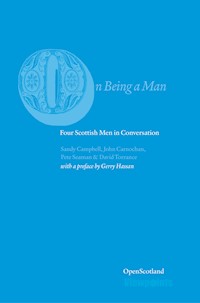
On Being a Man
Four Scottish Men in Conversation
SANDY CAMPBELL, JOHN CARNOCHAN,PETE SEAMAN and DAVID TORRANCE
LuathPress Limited
EDINBURGH
www.luath.co.uk
First published 2014
ISBN (PBK): 978-1-910021-33-0
ISBN (EBK): 978-1-910324-15-8
The authors’ right to be identified as author of this work under the Copyright, Designs and Patents Act 1988 has been asserted.
© The authors 2014
Contents
FOREWORD Scottish Men are Everywhere and NowhereGerry Hassan
CHAPTER ONE Introductions and Personal Stories
CHAPTER TWO Work and Families
CHAPTER THREE Is There a Crisis of Men and Scottish Men?
CHAPTER FOUR Being a Man: Men, Women, Masculinity and Femininity
CHAPTER FIVE Relationships and Professionals
CHAPTER SIX Lads, Laddism and a More Equal Society
AFTERWORD Observations by a Group of Women
David, John, Pete and Sandy’s Replies
FOREWORD
Scottish Men are Everywhere and Nowhere
GERRY HASSAN
MEN ARE EVERYWHERE in Scotland. Talking in positions of power, being loud and noisy in public life, organisations and public spaces.
Yet, amid this noise, there is also a deafening silence, one so powerful that many do not even notice or comment on it, instead seeing it as the natural state of affairs. This silence is of men not talking and being reflective of what it is to be a man.
This book enters into what are, still, in Scotland, uncharted waters by venturing onto the terrain of men talking and engaging as men. It does not aim or claim to cover everything. It is offered as a start and an opening: an invitation to aid and encourage future conversations and considerations about some of the most important issues facing Scotland.
The four men who are involved in this – Sandy Campbell, John Carnochan, Pete Seaman and David Torrance – are not claiming to, or being put up to, speak for all Scottish men. That would be both problematic and counter-productive. Nor are they claiming to represent the different varieties of Scottish men and masculinities. Men across Scotland come in all sorts and types: with a wide spectrum of backgrounds, lives, interests, identities, voices and accents.
The gang of four gathered in this book are all middle class and white. But there are important and revealing differentiations between them. They are aged between 36 and 61 years old, spanning at least a generation. Three are Scots born and one English born, and one of the Scots born has spent a large part of his adult life in England. There are differences in sexuality, and a variety of political persuasions. In the latter, these range from those who have identified with the centre-left and nationalists, to a more sceptical take on Scotland’s progressive credentials.
Looking at the four by their professional careers and chosen work, two have chosen to work in challenging areas which have male behaviour and role models at their essence – police and, in particular, the issue of violence (John) and apprenticeships and how boys become men (Sandy). The remaining two have worked in policy research specialising in public health (Pete) and media and commentary (David). The four are thus a mix of talkers and contemplators, and do-ers, thereby combining those looking for the big picture or pattern, and those trying to aid social and cultural change.
One of the main motivations behind this book is the belief, which I agree with firmly, of all four who took part in these exchanges, that the silences and evasions of too many men in our society contribute to and magnify the problems we face in relation to individual and collective behaviour.
A central strand running through the book and discussions is how do men take responsibility, what should they act on, speak on, and challenge other men on? The conversations range far and wide, starting with a series of autobiographical introductions in which each of the men in turn reflect on their backgrounds, upbringings and how they became the men they are today.
From this, the conversations address some of the key issues of society and men: the violence men do to other men and themselves, the dramatically altering world of work and employment, how male role models have altered profoundly in a generation, and the importance and influence of our fathers and mothers, and how we bring up our children. They talk and reflect on the changing relationships of men and women in society, in work and as partners.
They get into areas which are difficult, ambiguous and often not heard in public. They admit doubts, fears and anxieties, as well as talking about the power of love and the need for empathy. At points they express anger and frustration, or even incomprehension, not claiming to have all the answers.
One tone which emerges amongst the many is that of loss. By this I mean loss of past worlds of supposed certainties, where we are led to believe it was somehow simpler to be a man and express masculine traits. This lost world – of traditional industries and often gruelling and demanding work produced a culture of what some call ‘big men’ – but which was a mosaic of many different types of men, including that of working class self-educated, politically literate men.
There was no ‘golden age’ in any of this, yet its passing has led in some places to a lament for the importance it put on a certain version of masculinity. The exchanges on this reflect on the different nuances of that loss, and the world that has emerged in its place: a sense of elegy, but also exploration, of what this all amounts to as a new generation grows up, compared to their dads and grandfathers.
The debate about the roles, views and behaviours of men in Scotland cannot be seen as a marginal one, or a sideshow to the real business: politics or jobs and the economy. All of these areas and more – work, how we raise and support children, looking after aging relatives, the nature of public sector employment, and the realities of a decade of Tory inspired austerity, all have a gender dimension.
None of this can be ignored, left in silence or subsumed in what are meant to be ‘bigger’ political issues. For too long, parts of Scotland have got away with arguing that these real live issues have to be relegated below the important subjects, whether it is the Left’s view of the world or the national question. It is a little wonder that Scotland has a gender gap in how it does politics or how independence is seen, for until these areas tackle the thorny, complicated issues of how men and women live together better, then these will seem less real and connected to many people.
This means that men need to start speaking up as men, changing themselves and challenging other men to take responsibility. This means taking risks, not only by being brave and bold, but also admitting insecurities and vulnerabilities. It means having no ‘no-go areas’ of debate in Scottish society, and demanding that men talk about their roles, hopes and fears, and the gender dimensions of so much of Scottish society.
This book is a contribution to starting that. It does not claim to have the final word on everything or indeed anything, but where there was once silence, there is now the prospect of the beginning of a debate.
For taking those brave steps, I want to thank Sandy, John, Pete and David, for being prepared to give their time and views in this fascinating and important set of exchanges. It has been long overdue. Now we have an opportunity to use their reflections to facilitate a wider and much needed debate about Scottish men.
Gerry HassanMay 2014
CHAPTER ONE
Introductions and Personal Stories
PETE SEAMAN
I GREW UP IN a place called the Wirral. My early years feel inseparable from the geography of an unremarkable place which, undergoing the seismic shifts the 1970s and 1980s brought, defined my particular sense of normal. Perhaps it is also a particularly male place to start, on a map rather than in the expressive warmth of a home or relationships, but I will come to those later.
The Wirral usually needs some explanation for people who have not spent time there. Located in the North West of England it is defined by its neighbours. Through either of the Mersey tunnels sits the more recognisable city of Liverpool and to the south east the county of Cheshire. The Wirral exists between these two relatives with its affiliation in confusion. I grew up in a town that seemed to capture the uncertainty of this place, a new build overspill of homes affordable to skilled manual workers employed in car plants or light engineering. In those days it would require one income, usually the male one, to pay the mortgage (£5,000 for the home I grew up in). Today, it is more likely to require two. Then, it offered young couples somewhere green, clean and beyond the expectations of their own parents.
In this place you were never sure of whom you were. You were neither ‘from’ Liverpool nor not from there. ‘Over the water’, Liverpudlians fiercely defended the gates of who was in and out of the Scouser club. Lads growing up on the Wirral wanted to be in it but weren’t allowed. We were ‘plastic Scousers’. My father was a proud Liverpudlian who never quite adapted to life over the water and the future it represented. He was a precision engineer who caught the downward trajectory of Merseyside’s manufacturing base. His father owned an engineering firm when local engineers built the world. My dad became self-employed as the docks and heavy engineering that fed the smaller firms began to struggle and collapse. ‘Never get into engineering’ he solemnly told me (the only career advice I ever received). I saw his hands every day with fingerprints etched out in black, and his clothes smelt of something we all knew as ‘solly oil’. Curled shards of metal (‘swarf’ – the fact that I have to put these words in quotes shows the distance between our working worlds) were pressed into every shoe he owned. I overheard stories of horrific accidents, usually involving eyes and fingers. I remember the orchestra of lathes, mechanical saws and other machinery producing an unceasing rhythmic pounding my brother believes caused my dad’s current dementia. Not a standard medical opinion but when I heard that Lou Reed produced an avant garde record called metal machine music to get out of a record contract, I had a fair idea of what it might have sounded like. My dad worked hard for little reward, he was swimming against an economic and political tide. His experience and those of many other men he knew has left me with a sense of never being able to take our livelihoods for granted, not just our jobs but the entire sectors we work in.
The map my dad inherited didn’t fit the post-industrial landscape he found himself in. Elements of the 1980s seemed alien to him. His sons appeared molly coddled at home and school, with posters on their bedroom walls of men with striking haircuts. At least the football offered a masculinity he could recognise. My dad, my brother and I bonded over football. It offered a link we could all understand to the old city that shaped him. First sitting in the stands and then, we when he felt we were old enough, introduced to ‘the parapet’, our particular inherited corner of the famous Kop. It was unspoken that the things we did and witnessed there, the flouting of suburban standards of hygiene, health, safety and decorum, would not be reported when we returned home. The lines of men taking a piss against the back wall of the stand and the resulting waterfall down the terrace. The excitement of a crowd surge lifting you off your feet and depositing you yards from where you started. We would shout ourselves hoarse in support of men from Scotland, Ireland, Wales and Scandinavia. Not a Scouser amongst them but they had a commitment to the people who watched them that still moves me. It felt like the Kop had been there forever, a fixed reference point across generations, that I might have believed could never vanish.
The Kop’s loss of first its innocence, and then of its recognisable physical form, was perhaps the only one of my father’s bereavements I could understand and share. Not that we talked about such things. The day after Heysel I remember him asking me to change out of my Liverpool T-shirt before going out to play. The night before, he had taken no interest in the game. A small argument took place that summer between my parents about the appropriateness of my brother taking a Liverpool kit on holiday to Italy. Our making friends with two Italian boys in the resort seemed to bring peace to both of them. I don’t remember how or if we spoke about Hillsborough. It is my mum I remember then. The only time I remember her at the ground was a fine summer’s evening when we stood silent looking toward the flower decked terrace. The last time I remember the four of us going somewhere together. There were tears but we didn’t have the skills in our family to talk about this. Perhaps no one did back then. We were all beginning to feel a bit lost. My dad’s dismissive one-liners to describe just about any category of person or event were useless in explaining something of this magnitude. So was his lexicon of 1950s Liverpool, full of words such as ‘spinster’, ‘bachelor’, ‘nesh’, ‘clown’, ‘cack-handed’. Words used neutrally but had such a damning, definitive quality to them they made me flinch. Words people could never recover from.
My mum represented the future, much more comfortable in both her suburban surroundings and the times. She was the opposite of my dad: sociable, talkative, outgoing, expressive, and open. She was the one I wanted to be like. The one whose sense of right and wrong was the one I would try to live by. She ran the youth club and taught school leavers at the local technical college, both roles giving her the genuine love of countless teenagers. Seriously, being my mum’s son got me respect and credit I scarcely deserved. Word was she was ‘sound’. Whereas my dad closed off to the problems the 1980s brought, my mum faced them head on. She wanted to go to Greenham Common but didn’t want to leave two young boys in the care of my dad (‘why didn’t you just take us!’ me and my brother cried when we heard, sorry to have missed out). At one point she wanted us all to go and live on a commune but then thought we would be better carrying on at school. We marched for miners and stood in vigil for John Lennon. My mum was on TV when a school closed by the council was re-opened by volunteers. My dad was a socialist too but my mum had more hope, believing in everyone’s inherent humanity and that one day soon, good would prevail. My dad was being ground down. His livelihood, the one he had not chosen but was given to him, was becoming something men used to do.
My dad left home when I was 17 on a sunny day after school. I remember he left us a five pound card for the electricity meter. Confusingly, typically, this was both thoughtful and misjudged. I felt a sense of relief. Not that he had gone but that it had finally happened. I grew in my dad’s absence. Not that he was in anyway abusive but his presence had a way of making me feel awkward about who I was and who was becoming. My mum worked hard to keep the roof over our head. I was proud of what she was doing and of being a single parent household. But my mum was devastated by the betrayal ‘your father’ (as she could only ever describe him) represented. Alcohol became more and more ubiquitous. My dad’s increasing emotional distance actually made it easier for me when he did leave. For many years after, I suppressed elements of my personality I felt were inherited from him or were like him. I wanted to do masculinity in a way different from him, if I was going to have to do it all. The irony is that now my dad, with severe dementia, possesses a sense of vulnerability he can accept, he is coming to terms with his own fallibility. Now, I would be happy to be like him.
SANDY CAMPBELL
When I think of introducing myself as a writer about Scottish men or manhood, I waver. Not because of any false modesty; nor for any inverted feminist or quasi-internationalist excuse. I am a proud male and a proud Scot, but here’s the rub: am I Scottish and male enough, and what’s more – in equal doses?
Can you imagine that kind of conundrum on the female side? (Am I female enough? As if… ) Maleness seems to demand certainty. So does Scottish-ness for that matter. I’ve always believed that male identity is strangely fragile alongside female identity. A bit of ‘bum fluff’ on your upper lip and unpredictable pitch in your teens, but with girls, they physically and visually change into women! No question about it.
On the nationality thing, what does it mean to be Scots? Maybe you just kinda know it when you’ve got it. I’ve known it consciously since I was ten. My dad was swept up by the SNP in 1966. I was too. Winnie Ewing won Hamilton and I won the school mock election for the SNP, all in the same year. Unusual behaviour for a boy of that age, I know. I did other things too, like wedding myself fatefully to lifelong raised hopes and disappointment; namely being cursed with supporting Hibs.
Scottishness and maleness. They seem to sit together in some archetypal way. I think of the kilted Scottish soldier – with his white spats and glengarry. Who could be more male – and who more like a strutting peacock? A skirt as a national emblem, yet the women seem to love a man in a kilt.
But really my claim to speak on Scotland with any authority is mixed. I left Scotland for England-Yorkshire when I was aged 17 and didn’t come back until I was 43 – in the year of the reconvened Scottish Parliament. It is now fifteen years on. My knowledge of Scotland, apart from in my soul, is either post-devolution or drawn from a childhood from the late ’50s, ’60s and early ’70s. It’s limited to South Edinburgh as a boy and Leith as a middle aged man. In between it was Yorkshire.
So, Yorkshire it was for the next quarter century. That makes me some kind of Anglo-Scot, or maybe now a ‘Scots-Returnee’. I admire Alex Ferguson on many levels and his recent pronouncements on being Scots in England are worth a listen. He’s one of the few Unionists that make me stop and think. Like thousands and thousands of Scots, I, too, made England my home and was happy there.
What does it mean to introduce yourself anyway? Apparently when North American Indians (they called them that in my boyhood) do so, they describe themselves by going back eight generations. For me, part of becoming a man is paying due respect to your elders and family ancestors. I continue to be surprised by how many people quite casually declare that they don’t know anything of their grandparents. Sad how irrelevant the past has become to so many of us.
My dad, James Valentine Campbell, was Scots to his core – back to the dawning of time. There were McPhersons, Camerons and Andersons in the family tree. My dad was the youngest of eight and became a third generation painter and decorator along with most of his brothers. We used to joke about it being paint, not blood, in the Campbell family veins. I was named after my grandfather – Alexander. My grandmother, the daughter of a cobbler orphan from Deeside, was the only one of my grandparents still alive when I was born.
My mum, Perla, was a different kettle of fish. Born in Edinburgh, but of Anglo-Argentine stock, her parents were married in Buenos Aires in 1910. An unlikely match was the family wisdom. My grandmother was second generation Argentine, descending from the Scots and Welsh who went out in the mid 19th century to build the railways. In her 20s, whilst performing missionary work amongst the Guarani Indians of Paraguay, she met my grandfather. He was a Cockney adventurer 15 years her elder – an actual cowboy no less, but when he started trading in Guarani Indian silverware it all went wrong. Fast forward through their return to the UK, the shame of bankruptcy and the birth of my mum. He died when she was seven and the family got by thanks to money and parcels from back home – the Argentine.
Stories from before I was born but as an only child they had huge impact. Just five years ago I visited my Argentine relatives for the first time. Impossible to explain but it truly felt like a completion of a circle stretching back generations. This was the family that had stood behind my mum. But for quirks of fate my mum would never have left Buenos Aires; never met my dad; and never have produced me. I know the same goes for everyone but it doesn’t stop it being a profound and humbling moment.
Then, on the sixth day of Christmas 1955, I enter the world – ‘from my mother’s womb untimely ripped’. My mum was 41. My dad was 42. They had met on outings of the Edinburgh Sketching Club in the years after the war. Two souls who thought their chances of married life, indeed parenthood, had gone. My dad had done okay for himself after being de-mobbed. Decorators were busy as post-war Edinburgh painted itself back together again.
They scrimped and saved and bought a dry rot-ridden house near the Meadows, and with my dad’s skills, turned it into a very well presented middle class family home. My dad worked six days a week and we had summer holidays in Peebles or North Berwick. They chose to send me to a fee paying grant-aided school, which came to an end when the Heath Tory government gave schools like mine the ultimate choice: charge the full fees or join the state sector. Needless to say mine, Daniel Stewarts, was never in any doubt that full public school status was in their stars. That was when I left.
I had a mixed childhood emotionally. I have happy memories, but I remember a lot of sadness too. I felt the loneliness of being an only child with most of my class mates living on the other side of the city. I remember the shock of landing as an ‘adolescent’ and the whole struggle of those teenage years. I remember it suddenly coming together when I was 16 and then I remember a year later, when on 3 September 1973, I propelled myself into the adult world on the 11 o’clock south from Waverley – destination Yorkshire.
I left Auld Reekie in the early ’70s to do a nine month work placement as a junior care assistant in a Dr Barnardo’s home for disabled kids near Harrogate. I was paid £3 a week plus board and lodgings. I loved it. In Working Rite, the charity I set up and now run, we say ‘everyone remembers their first boss’. Well mine was a woman, Margaret Frost, 13 years my senior, and really quite a force.
The ‘kids’ I was supposed to be looking after were just a year or two younger than me. They had spina bifida and muscular dystrophy, and it was the muscular dystrophy guys (Adrian, Robert – also known as Stan, and Stephen) who became good and close mates. I bathed, toileted and dressed them for nearly three years. Then one by one they died; bitter sweet years.
I may well have been young and in deepest Yorkshire, but nevertheless I left no one in any doubt that Scotland was where I came from. It was the early ’70s. Jobs were a plenty and I went through a few. I particularly remember as a bus conductor on the run from Doncaster to Sheffield one summer morning, meeting the city that was to become home for the next 20 years. Sparks to the left, fiery molten metal to the right. A world that is now well gone but there I was standing awestruck beside the driver as our double decker confidently cruised through the Attercliffe steel works on the final run into Pond Street bus station. Upright proud and purposeful South Yorkshiremen became my role models as I groped my way into manhood.
I remember a National Union of Public Employees (NUPE) trade union official who took me under his wing – Ken Curran. He had more effect on the path of my life than he could ever realise. I remember my years as a gardener. Those guys knocked the edges off me in a really sound way. I was fit and I had fun. For three years not a day went by without laughing until my belly hurt.
And I remember that politics was never far behind and it was these passions that brought me ultimately into the centre of the early ’80s Labour v Thatcherite struggles. As an eager and confident young trade unionist I got a job of a lifetime right in the middle of the miners’ strike: as a professional political campaigner and assistant to a man who was for me in my late 20s and early 30s, an inspiration to work for – David Blunkett.




