


1,99 €
Mehr erfahren.
- Herausgeber: Quickie Classics
- Kategorie: Geisteswissenschaft
- Sprache: Englisch
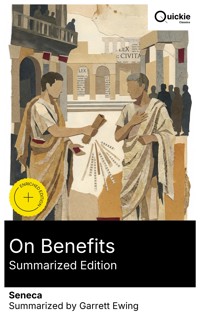
On Benefits (De Beneficiis) probes the ethics of giving, receiving, and reciprocating within Rome's patronage culture. In seven books to Aebutius Liberalis, Seneca defines a benefit as the giver's intention (animus), not the thing, and weighs timing, proportion, and decorum. He distinguishes gratitude from repayment, rebukes ostentation and calculation, and analyzes ingratitude as a civic toxin. Composed in tight, aphoristic prose enlivened by historical exempla and probing distinctions, the treatise marries Stoic moral theory to the practical social economy of the early Principate. Lucius Annaeus Seneca—philosopher, dramatist, and statesman—wrote amid Nero's court after exile and a return to immense influence. Schooled by Stoics like Attalus, he reflected on power, liberality, and obligation in works including On Mercy; De Beneficiis extends that counsel to the gift economy sustaining amicitia and imperial rule. Scholars of classical ethics, historians of Roman society, and readers interested in leadership or philanthropy will find this a lucid, bracing guide. It models generosity governed by character rather than cost, and invites reflection on how gifts forge—and poison—community. Quickie Classics summarizes timeless works with precision, preserving the author's voice and keeping the prose clear, fast, and readable—distilled, never diluted. Enriched Edition extras: Introduction · Synopsis · Historical Context · Author Biography · Brief Analysis · 4 Reflection Q&As · Editorial Footnotes.
Das E-Book können Sie in Legimi-Apps oder einer beliebigen App lesen, die das folgende Format unterstützen:
Veröffentlichungsjahr: 2026
Ähnliche

















On Benefits (Summarized Edition)
Table of Contents
Introduction
On Benefits wrestles with how gifts can bind people together without turning generosity into domination, staging a sustained inquiry into freedom, gratitude, and power in the exchange of favors that holds society together, asking when giving honors both parties rather than indebting them, how intention outweighs outcome, why timing and tact matter more than price, and what it means to return a favor without keeping accounts, so that beneficence becomes not a subtle coercion but a practice that preserves dignity, relieves need, strengthens community, and trains the soul to value character above the glitter of material transfers.
Written by Lucius Annaeus Seneca, a Stoic philosopher and statesman of the early Roman Empire, On Benefits is a prose treatise on moral conduct composed in Latin in the mid–first century CE, during the principate that shaped the social and political horizons of its arguments. Set against the pervasive networks of patronage and obligation in imperial Rome, the work examines the ethics of giving and receiving within households, friendships, and public life. Traditionally addressed to Aebutius Liberalis, it belongs to Seneca’s mature reflections, where philosophical analysis serves civic education and personal reform rather than abstract system-building.
Readers encounter not a narrative but a principled conversation carried forward through pointed questions, illustrative cases, and lucid distinctions. Seneca’s voice is urbane and insistent, alternately patient and sharp, moving from everyday situations to public office and back again to test his claims. The style favors tight definitions, vivid comparisons, and repeated returns to key terms, so that nuances accumulate rather than explode in a single thesis. The tone is corrective without rancor, seeking to instruct benefactors and beneficiaries alike in habits of attention, tact, and self-command, while leaving room for practical judgment where rules must bend to circumstance.
Central themes emerge with steady clarity. Intention, not the market value of a gift, determines its moral weight, so choosing well, giving promptly, and refusing ostentation become ethical acts in their own right. Reciprocity is defended as a virtue distinct from barter: to return a benefit is to honor a relationship, not to settle a debt. Gratitude sustains civic friendship, while ingratitude corrodes institutions from within. Seneca probes power asymmetries, warning how gifts can humiliate when they advertise superiority, and he explores the delicate arts of selecting recipients, giving in confidence, and receiving with grace, all to safeguard shared dignity.
The book remains strikingly contemporary because our exchanges still oscillate between care and control. In public life, it speaks to philanthropy, corporate generosity, and international aid, where gifts can anchor long-term partnership or entrench dependency. In private life, it illuminates family help, workplace favors, and the etiquette of thanks in a culture saturated with performative giving. Seneca’s counsel invites readers to design acts of help that protect autonomy, to express gratitude without servility, and to resist the hidden bookkeeping that turns friendship into commerce. His analysis equips citizens and leaders alike to build trust where inequality and suspicion otherwise thrive.
Underlying the casuistry is a coherent Stoic vision of moral freedom. Because character alone is genuinely good, benefits are assessed by the giver’s reasoned purpose and the receiver’s honorable response, not by fortune’s glare. This frees both sides to refuse what is harmful, to accept help without shame, and to practice generosity even when means are modest. Seneca links beneficence to our social nature, arguing that well-ordered giving knits households, cities, and the wider human community. The result is a humane ideal: to become the sort of person for whom generosity is both spontaneous and wise, principled and adaptable.
Comprising seven books that proceed by questions, examples, and clarifications rather than a single linear argument, On Benefits rewards attentive, patient reading. Definitions recur because ordinary language blurs gift, payment, and favor, and Seneca aims to redraw those boundaries through repetition and refinement. Keeping the Roman backdrop of patronage in view helps, but the counsel is portable: look for the emphasis on motive, the care for timing, and the protection of mutual respect. As an introduction to Stoic ethics in action, it offers less a rulebook than a craft, teaching readers to calibrate help so that it heals, not harms.
Synopsis
On Benefits (De Beneficiis) is a seven-book moral treatise by Seneca the Younger, addressed to Aebutius Liberalis and composed in the mid-first century CE. It examines how gifts, favors, and acts of kindness bind communities and shape ethical life. Seneca opens by noting widespread confusion about giving and receiving, especially where ambition, vanity, or need distort motives. He proposes to clarify what a benefit is, how it becomes truly virtuous, and why gratitude matters. From the outset, he maintains that the essence of a benefit lies not in the material object but in the intention and disposition of the giver.
He proceeds to define a benefit as an expression of goodwill directed to another’s advantage, distinguished from mere transactions or loans. Because virtue resides in the will, the same object may be a benefit or not depending on purpose and manner. Seneca embeds this in Stoic ethics: beneficence is a part of justice and sociability, sustaining concord among citizens. He considers the wise person as an ideal giver, free from calculation and resentment. By refining terms, he prepares criteria for judging acts that appear generous, showing that gifts accompanied by arrogance, publicity, or expectation of return fail to count as benefits.
Seneca then turns to practical guidance on giving. A good benefit is timely, suited to the recipient, and within the giver’s means. It is offered promptly, cheerfully, and without ostentation, so that the beneficiary feels helped rather than beholden or shamed. Prudence is essential: one should avoid gifts that enable vice or produce dependency, yet not become so cautious as to extinguish generosity. He advises discretion and, where possible, secrecy, since public display can injure both parties. Choice of recipients matters, but the act should not be postponed indefinitely in search of the perfect case; kindness loses force when delayed.
Receiving well is its own discipline. Seneca counsels recipients to accept readily and modestly, honoring the giver’s intention above the thing received. Gratitude should be sincere and prompt, expressed first in attitude and only then, if able, in material reciprocation. He warns against disdain for small benefits and against greedy escalation that turns favor into claim. The right response includes remembering the gift, speaking well of the giver, and avoiding airs of independence that deny obligation. Even when return is impossible, the will to repay and the public acknowledgment of good offices preserve the mutual bond that benefits establish.
Repayment, when it comes, should aim to equal or exceed the original benefit, but always be measured by capacity and by the giver’s purpose. Seneca rejects strict equivalences drawn from commerce; a heartfelt act may balance a large material gift if circumstances differ. Speed enhances gratitude, while delay weakens it. He favors a noble rivalry in beneficence where friends seek to outdo one another in kindness, provided it remains untainted by showmanship. The surest index of repayment is the continuity of goodwill: preserving loyalty, assistance, and readiness replaces mere tallies. Thus reciprocation becomes a renewal of fellowship, not a ledger.
A substantial portion addresses ingratitude, which Seneca regards as a common and corrosive vice. He analyzes its forms—denial of having received, belittling what was given, or procrastinating until repayment becomes impossible—and locates their sources in fear, pride, and covetousness. Remedies begin with better giving and receiving, since wise beneficence reduces occasions for offense. The benefactor is urged not to dwell on losses; regretting charity corrupts the original intention. While caution in choosing recipients is prudent, the prospect of ingratitude should not shut down generosity. The exemplar wise person persists in doing good because moral choice, not outcome, defines the act.
Seneca applies these principles to various social relationships. In patronage, he distinguishes honorable support from purchase of applause or clients, urging patrons to elevate rather than enslave. Among friends, benefits should reinforce equality of respect even when circumstances differ. In households, he recommends humane treatment of dependents, arguing that generosity fosters loyalty more reliably than fear. For public figures, liberality must be disciplined: largess that bankrupts the treasury or corrupts citizens fails as a benefit. Throughout, he stresses that rank alters neither the essence of giving nor the duty of gratitude; only intention and effect on character truly matter.
Finally, Seneca clarifies the boundary between moral obligation and legal claim. A benefit is not a debt enforceable by courts, and attempts to compel gratitude contradict its nature. Calculation, reminders, and reproaches can undo a gift by transforming it into a burden. Likewise, usury of favors—trading help for influence—belongs to bargaining, not beneficence. Yet memory and acknowledgment are binding in conscience: to forget is to weaken the social fabric. By distinguishing benefits from loans and favors from contracts, he preserves a sphere where goodwill operates freely, guided by honor and reason rather than by penalties or profit.
Across the seven books, the argument culminates in a vision of beneficence as the glue of human society. By locating the value of benefits in intention, prudent judgment, and sustained gratitude, Seneca offers a disciplined art of giving and receiving that resists vanity and coercion. The treatise frames everyday exchanges as exercises in virtue that build trust across status and circumstance. Without relying on rigid formulas or sentimental optimism, it asks readers to cultivate habits that make generosity both safe and strong. Its enduring significance lies in showing how ethical reciprocity can steady communities amid ambition, scarcity, and fear.
Historical Context
On Benefits (De Beneficiis) was composed in mid-first century CE Rome, during the Julio-Claudian principate, most likely under Nero. The Roman state had shifted from republican competition to imperial monarchy, while retaining senatorial institutions, law courts, and civic rituals. Elite status depended on public visibility, forensic eloquence, and largesse toward clients and communities. The emperor increasingly mediated honors, offices, and resources, yet older ideals of amicitia and reciprocity persisted. Philosophical writing in Latin had flourished since Cicero, and moral treatises addressed elite conduct. This context made the ethics of giving and gratitude a public concern, not merely a private virtue.
Lucius Annaeus Seneca, born in Corduba around 4 BCE and educated at Rome, belonged to a prominent provincial family of equestrian rank. His career traversed volatile regimes: he rose as an orator and senator under Tiberius, was exiled to Corsica in 41 CE under Claudius, and was recalled in 49 at Agrippina’s initiative to tutor the future emperor Nero. From 54, Seneca served as adviser, drafting policy and speeches during the early principate. He amassed great wealth, faced public scrutiny, and withdrew from court around 62. These experiences of favor, suspicion, and dependency sharpened his interest in obligations, gratitude, and the dangers of gift-bound politics.
Seneca wrote within a Romanized Stoic tradition shaped by Panaetius and Posidonius and adapted to civic leadership. Stoicism taught that virtue, not fortune, defines the good, and that rational intention governs moral worth. Roman statesmen used this ethic to evaluate action in office, friendship, and patronage. Seneca drew on earlier Stoics, citing authors such as Hecato of Rhodes, while composing in pointed Latin prose for an educated audience. His ethical dialogues and essays proposed practical guidance rather than scholastic system-building. In this climate, examining beneficium—benefit, favor, or gift—offered a way to reconcile philosophical rigor with the lived expectations of elite reciprocity.
In Rome’s social order, benefits structured hierarchy. Patronus and cliens exchanged support, protection, and services under norms of fides and officium. Elite generosity financed spectacles, distributions, and public works; emperors institutionalized largesse in congiaria to the urban plebs and donatives to soldiers. Legal thought on obligationes and stipulationes intersected with social duties, while the Lex Cincia limited certain remunerations for advocacy. Titles, invitations, salutatio, and testamentary bequests signaled ties of gratitude. Competition for honor could turn generosity into calculation, and accusations of ingratitude carried reputational penalties. De Beneficiis addresses these embedded practices, testing how intention, timing, and reciprocity should guide giving.
Seneca’s treatise emerged alongside his efforts to shape imperial ethics. Early in Nero’s reign, he composed De Clementia to articulate princely mercy, reflecting hopes for a moderate principate after Claudius. The court nevertheless bred rivalry, delation, and precarious dependence on imperial favor. Public generosity—games, distributions, remissions—projected benevolence while consolidating authority. Senators navigated expectations of loyalty amid fear of charges and confiscations. Discussions of beneficium offered a language to distinguish true generosity from manipulative largess, and gratitude from servility. The work thus resonates with the quinquennium Neronis’ idealism and with Seneca’s later retreat, when disentangling from obligations became urgent.
The intellectual milieu mixed philosophy with rhetoric. Roman education trained elites in declamation, producing case-based debates about duty, repayment, and obligation that mirrored courtroom practice. Latin moral works such as Cicero’s De Officiis had already framed usefulness, virtue, and liberality for statesmen. Seneca extends this discourse with Stoic criteria, invoking Hecato and Chrysippus while deploying exempla from history and daily life. Compilations like Valerius Maximus’ Facta et Dicta Memorabilia supplied models of generosity and ingratitude. In crafting a systematic account of benefits, Seneca engages prevailing pedagogies that prized argument, definition, and classification, aiming to refine customary norms through philosophical analysis.
Mid-first-century society was marked by wealth concentration and the expanding reach of imperial administration. Imperial freedmen and favorites exercised notable influence under Claudius and Nero, while senatorial fortunes depended on estates, provincial revenues, and imperial goodwill. Urban life revolved around daily salutatio, petitions, and distributions; municipal communities relied on elite euergetism for buildings and festivals. Military loyalty was secured through donatives. Testamentary bequests cemented alliances and could be contested in courts. In this environment, gifts blurred with transactions, provoking questions about intention, proportionality, and timing. Seneca’s analysis addresses these tensions, proposing standards that could stabilize social credit without surrendering ethical autonomy.
De Beneficiis, in seven books and addressed to Aebutius Liberalis, synthesizes Stoic doctrine with Roman practice to examine why, how, and to whom one should give or repay. Composed under Nero, it weighs intention above outcome, rejects coerced or ostentatious largess, and identifies ingratitude as a civic hazard. By distinguishing genuine benefits from calculated exchanges, the work critiques courtly patronage and imperial theatrics without naming incidents. It offers elites a framework for exercising power without corrupting dependence, and recipients a language for dignified acknowledgment. In doing so, Seneca mirrors his age’s gift economy while proposing standards meant to reform it.
Author Biography
Lucius Annaeus Seneca, known as Seneca the Younger, was a Roman Stoic philosopher, dramatist, and statesman who lived roughly from 4 BCE to 65 CE. Born in Corduba in Roman Spain and educated at Rome, he became one of the most influential moralists of antiquity. His essays and letters codified a practical Stoicism that addressed anger, time, wealth, providence, and human community, while his tragedies shaped the language and structure of later European drama. As a senior figure at the Julio‑Claudian court and later an author in semi‑retirement, Seneca’s life unfolded at the intersection of power and philosophy, leaving a corpus both literary and ethical in scope.
Seneca’s education combined rigorous rhetorical training with immersion in philosophy. He studied with notable teachers, including the Stoic Attalus and the Sextian-influenced Sotion and Fabianus, absorbing a discipline that blended moral exercises with rhetorical clarity. Steeped in the legacy of earlier Stoics such as Zeno and Chrysippus and attentive to Roman models like Cicero, he forged a style marked by aphoristic compression and ethical urgency. Greek tragedy, particularly Euripidean treatments of passion and tyranny, supplied dramatic templates that he later reworked in Latin. From early on, Seneca’s intellectual formation stressed moral self-command, lucid argument, and the persuasive power of well-shaped prose.
Advancing in public life, Seneca gained renown as an orator and entered the Senate, but imperial politics brought reversals. Under the emperor Claudius he was exiled to Corsica, where he continued intensive study and writing. During this period he produced consolatory works, including Ad Marciam and Ad Helviam, honing themes of resilience, loss, and the uses of philosophy in adversity. Exile also deepened his interest in natural philosophy, which later culminated in Naturales Quaestiones. The Corsican years were formative: stripped of influence, he sharpened a literary voice capable of addressing both the contingencies of fortune and the steadiness demanded by Stoic ethics.
Seneca was later recalled to Rome and appointed tutor to the young Nero, a role that placed him near the center of power. When Nero became emperor, Seneca, alongside the praetorian prefect Burrus, helped shape early policies and articulated an ideal of merciful rule, most explicitly in De Clementia. He also held high office, including the consulship. As the court grew more volatile, Seneca sought to withdraw from public affairs, a move that sharpened scrutiny of his wealth and standing. Works such as De Vita Beata defend philosophical use of resources while insisting that external goods remain morally indifferent to the wise.
Seneca’s philosophical corpus addresses the conduct of life with unusual directness. Treatises such as De Ira, De Brevitate Vitae, De Tranquillitate Animi, De Constantia Sapientis, De Beneficiis, De Providentia, De Otio, and Naturales Quaestiones examine anger, time, inner calm, the stability of the sage, social obligations, divine governance, leisure, and the natural world. His Epistulae Morales ad Lucilium interweave doctrine with counsel, presenting Stoic therapy as daily practice—reflection, premeditation, and self-examination. Across these works, Seneca balances rigorous moral ideals with pragmatic guidance for imperfect agents, using concentrated prose, vivid metaphors, and memorable sententiae to instruct and provoke.
As a dramatist, Seneca crafted Latin tragedies that refashioned Greek myths to probe passion, power, and moral collapse. Among the plays commonly accepted are Medea, Phaedra, Thyestes, Oedipus, Agamemnon, Hercules Furens, and Troades. Their declamatory intensity, striking monologues, and gnomic lines made them well suited to recitation and exerted a deep influence on later theater. Renaissance and early modern dramatists adapted Senecan devices—choral reflection, rhetorical soliloquy, stark violence—to create new tragic forms. His dramatic exploration of unchecked desire and despotism complemented the ethical cautions of his prose, reinforcing a coherent vision of reason beset by turbulent passions.
In his final years, Seneca increasingly distanced himself from court life and focused on writing and philosophical discipline. After the exposure of the so‑called Pisonian conspiracy, he was ordered to take his own life in 65 CE, a stoicized end recounted by later historians. His works circulated widely in late antiquity and the Middle Ages and became central to Renaissance humanism. Early modern moralists and political thinkers drew on his analyses of emotion and power, while dramatists adapted his tragic models. In contemporary thought, his practical Stoicism remains influential in ethics, leadership discourse, and therapeutic traditions inspired by cognitive approaches to the passions.
On Benefits (Summarized Edition)
ON BENEFITS.
DEDICATED TO ÆBUTIUS LIBERALIS. BookI.
1
People who rush through life without reflection, Liberalis[1], commit many faults, but none wounds society more than our ignorance of how to give or receive a benefit. Gifts are then squandered, become bad debts, and complaints arrive too late; we flung them away at the start. No vice is commoner than ingratitude, and we ourselves provoke it. We scrutinize a borrower’s means before lending money, yet fling favors into barren ground without a thought. Choosing the undeserving, we sow in exhausted soil; small wonder the crop of thanks fails and the seed of kindness rots unused.
Whether it is more shameful to refuse repayment or to demand it is hard to judge; a benefit is a loan whose settlement rests on the debtor’s goodwill, and simple gratitude cancels the score. Still, we sabotage thankfulness. One moment we scold for interest, the next we repent our gift, then we carp over trifles. Petitioners foresee this and, cornered by need, watch us frown, turn away, chatter, postpone, or finally toss help with sour faces and grudging words. None cherishes what was wrung from a weary hand. A gift mirrors its moment; careless, late, or insulting alms breed resentment deeper than kindness is remembered.
Do not let the swarm of ingrates stop kindness. Our conduct multiplies them, yet the immortal powers pour blessings on rebels and worshippers alike; imitate their generosity, not invest favors for profit. Let the calculators be cheated. Battles lost never stop us fighting, nor shipwrecks sailing, so disappointment must not halt giving. To withhold because others default shows we gave to reclaim and excuses their fault. Men unworthy of daylight receive the sun, and noble minds delight in the deed itself, hunting virtue even after meeting rogues: “If thou at random dost thy bounties waste,Much must be lost, for one that's rightly placed.
2
"Cast no gift at random," the speaker warns; waste nothing, least of all benefits, for without judgement they lose their name. Yet one benefit rightly placed outweighs many misspent. Encourage the giver: let him shower gifts where none may lodge. "Much must be lost." Nothing is lost; the donor counted the cost. Giving is outlay—repayment gain, omission no deficit. He never tallies favours nor hounds debtors, for turning kindness into investment is sordid usury. Persist: feed one with money, another with credit, counsel, or esteem. Even lions submit to hands, elephants bend for food; a man thankless once may recall after the third kindness.
3
Whoever hastily thinks his gifts wasted truly wastes them; press on, heap fresh favors on the old, and even the hardest, most forgetful heart will blush. Let your friend find you wherever he looks, ring him round with kindness. Now, pause for a digression: why are the Graces three, sisters, hand-in-hand, young, smiling under loose, transparent robes? Some see giver, receiver, returner; others three benefactor types. More important is their circular dance: a gift passes from palm to palm and back again; break one link and the beauty dissolves. Their cheer, youth, virginity, and airy garments announce that gratitude must stay bright, pure, openly displayed.
Those untouched by Greek lore may shrug, yet Hesiod[2] calls the sisters Aglaia, Euphrosyne, Thalia; scholars twist each name to fit their theories though the poet chose sounds he liked. Homer changes the roster, christens one Pasithea and weds her, while another bard swaddles the trio in embroidered Phrygian robes. A painter plants Mercury beside them for no reason but whim. Sharp-eyed Chrysippus spends pages on such trifles, declaring them daughters of Jupiter and Eurynome, younger than the Hours, companions of Venus, and drawing morals from their mother’s “broad pasture” name. Poets forge names for metre, so Thalia shifts from Grace to Muse without penalty.
4
I skip the digressions I censure; defend me if someone rebukes a blow at Chrysippus—great yet Greek, his keen wit curling back, pricking not piercing. Now to benefits, the bond of humankind. We need a rule where giving is neither wasteful nor stifled; people must learn to give freely, receive wisely, repay by surpassing, for a debt clears only when it outdoes the giver. Benefactors should expect nothing, recipients feel deeper thanks. Chrysippus warns that ingratitude offends Jupiter’s Graces. Teach me to give more, forget the gift, the debtor remembering. Leave myths to poets; minds must speak and act firm against the rejection of benefits.




