


21,99 €
Mehr erfahren.
- Herausgeber: John Wiley & Sons
- Kategorie: Fachliteratur
- Sprache: Englisch
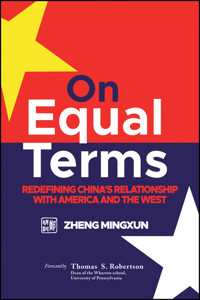
An insightful look at the future of China's relations with the West and the United States For anyone who wants to better understand China and its economic and political relations to the West, On Equal Terms offers front-row insight. Exploring China's state-capitalist economic model and the unique qualities and ideals of Chinese culture that can make difficult for Westerners to understand its approach to business interactions, the book looks to the future, explaining how China and the United States can cooperate to solve some of the world's major problems. Covering the extraordinary changes taking place in China and China's relationship with America and the West over ten powerful chapters, the book looks at China's state-capitalist model of governance, how history affects her behavior in foreign policy, how China is emerging as an economic world power, that products are not made but assembled in China, that China is not one big market but many markets, and much more. * Provides an inside view on the future of China and America from an expert with personal experience on both sides of the story * Explains the sometimes mysterious worlds of "Guanxi" and "Mianzi"--the notions of giving, saving, and preserving "face" in business and cultural relationships that many Westerners struggle to understand * A truly up-to-date resource that gives reader's the most recent information about Chinese-American relations China and America need to cooperate in order to solve the major problems of the world, and On Equal Terms gives readers the information they need to improve their business and professional relationships in China.
Sie lesen das E-Book in den Legimi-Apps auf:
Seitenzahl: 320
Veröffentlichungsjahr: 2011
Ähnliche



















CONTENTS
Foreword
Acknowledgments
Introduction: An East-West Journey
Chapter 1: The Hybrid Machine: Governance with Chinese characteristics
Real Politics
Key People
Everything Is Possible
Sweeping Progress
Chapter 2: Guns and Roses: Expect a roller-coaster ride
Military Matters
Looking Ahead
Chapter 3: The Chinese Piggy Bank: The global shift in economic relations
Easy Target
International Developments
U.S. Response
Building the Private Sector
Financial Crisis
Chapter 4: Not Made in China: Why the U.S. trade deficit with China is not what it seems
Building Industry
It’s All About Jobs
Pressure from Below
Chapter 5: Land of Many Markets: “The mountains are high and the emperor is far away”
Many Identities
Fanning Out Across China
Life in the Regions
Coping With Diversity
Chapter 6: Guanxi and Mianzi: Still important despite legal reform
The Ties That Bind
Reciprocal Dignity
Chapter 7: Soft Power: Winning hearts and minds
Soft Rivalry
Values and Rewards
Spreading the Word
Chapter 8: Climbing the Technology Ladder: From “Assembled in China” to “Innovated in China”
Research and Development
Sector by Sector
Innovation Across the Board
Online Development
Looking Ahead
Chapter 9: Winds of Change: China’s drive for alternative energy is gaining worldwide attention and respect
Everybody’s Business
China’s Role
The U.S. Role
Work for the Future
Chapter 10: The Dream Team: China and America must put politics aside and work together for the benefit of the planet and for future generations
Unavoidable Interconnection
Building Bridges
Media and Message
A Course of Action
Afterword
Appendix A: China’s Current Leadership
Appendix B: China-U.S. Joint Statement
Glossary
Index
Advance Praise for ON EQUAL TERMS
Redefining China’s Relationship with America and the West
With the emergence of China as an important economic power, readers will benefit immensely from Zheng Mingxun’s views and observations given his distinctive vantage point as an accomplished leader in both China and the U.S. In this important book, he sets out to foster greater objectivity and understanding between China and the West. Management at multinational corporations interested in China will benefit from his rich and balanced insights on this often challenging and increasingly complex market.
Tom Neff
Chairman
Spencer Stuart USA
China has risen to become the second largest economy in the world. Nevertheless, it is still a developing and emerging nation. The U.S. is the most developed country and the world’s leading superpower. No bilateral relationship today would be more crucial in shaping the global order and agenda than the one between China and the U.S. in the twenty-first century. Zheng Mingxun with his bi-cultural background has written this thoughtful book to help readers in the West better understand the complexities and intricacies of China. Hopefully, leaders in both the private and public sectors, not only in America but also in the West as a whole will heed his observations and advice.
C H Tung
Vice Chairman of Chinese People’s
Political Consultative Conference
Former Chief Executive of Hong Kong
China’s rise is changing the global equation. Zheng Mingxun with his East-West background has written this timely book to encourage readers in the West to have a more objective and balanced view on China. Reading On Equal Terms will be a good starting point for practitioners in both the private and public sectors to better appreciate the cultural and ideological differences between China and the West.
Francesco Trapani
Chief Executive Officer
Bulgari Group
Copyright © 2011 by John Wiley & Sons (Asia) Pte. Ltd.
Published in 2011 by John Wiley & Sons (Asia) Pte. Ltd.
1 Fusionopolis Walk, #07–01, Solaris South Tower, Singapore 138628
All rights reserved.
No part of this publication may be reproduced, stored in a retrieval system, or transmitted in any form or by any means, electronic, mechanical, photocopying, recording, scanning, or otherwise, except as expressly permitted by law, without either the prior written permission of the Publisher, or authorization through payment of the appropriate photocopy fee to the Copyright Clearance Center. Requests for permission should be addressed to the Publisher, John Wiley & Sons (Asia) Pte. Ltd., 1 Fusionopolis Walk, #07–01, Solaris South Tower, Singapore 138628, tel: 65–6643–8000, fax: 65–6643–8008, e-mail: [email protected].
This publication is designed to provide accurate and authoritative information in regard to the subject matter covered. It is sold with the understanding that the publisher is not engaged in rendering professional services. If professional advice or other expert assistance is required, the services of a competent professional person should be sought.
Neither the authors nor the publisher are liable for any actions prompted or caused by the information presented in this book. Any views expressed herein are those of the authors and do not represent the views of the organizations they work for.
Other Wiley Editorial Offices
John Wiley & Sons, 111 River Street, Hoboken, NJ 07030, USA
John Wiley & Sons, The Atrium, Southern Gate, Chichester, West Sussex, P019 8SQ, United Kingdom
John Wiley & Sons (Canada) Ltd., 5353 Dundas Street West, Suite 400, Toronto, Ontario, M9B 6HB, Canada
John Wiley & Sons Australia Ltd., 42 McDougall Street, Milton, Queensland 4064, Australia
Wiley-VCH, Boschstrasse 12, D-69469 Weinheim, Germany
Library of Congress Cataloging-in-Publication Data
ISBN 978-0-470-82886-1 (Hardcover)
ISBN 978-0-470-82888-5 (ePDF)
ISBN 978-0-470-82887-8 (Mobi)
ISBN 978-0-470-82889-2 (ePub)
For my wife, Janet, for her untiring support and extraordinary patience during the many hours I spent on this project.
For my international bunch of children and grandchildren spread across the world—be happy and live your lives to the fullest.
FOREWORD
For many Americans, the middle two weeks of August 2008 were spent glued to the television, watching the athletes of the world compete in the Summer Olympic Games in Beijing—China’s first turn as host nation. More countries than ever before took home at least one medal from the competition, with Chinese athletes winning the most gold medals and American athletes winning the most medals overall. Yet for many viewers, the event was as much an eye-opening introduction to the new China as it was an entertaining international competition. Who can forget the magnificent opening ceremony, which was kicked off by 2,008 perfectly synchronized drummers and told the story of five thousand years of Chinese history?
Certainly China wanted us to be impressed. The 2008 Olympics were a major statement of economic status and a unique vehicle for communicating the China brand to the rest of the world. China is now the second-largest economy in the world, behind the United States, and the fastest-growing G20 economy. It is also the largest trading nation—the largest exporter of commodities and the second-largest importer after the United States. This ancient nation has without a doubt arrived on the modern economic stage.
But what, many Westerners rightly ask, does this mean for us? There is a temptation to think in terms of competition, with China’s rise somehow foreshadowing the future decline of the United States. This is somewhat paranoid—and it is the wrong way to conceive of our relationship. We cannot say for sure what the world will look like in twenty, thirty, or forty years, but we do know that the United States and China are the major powers right now, and with power comes responsibility. If we have learned anything from the Cold War, it is that cooperation and collaboration are the way forward, and such progress is possible only when both powers exercise mutual respect and understanding. Simply put, Americans need to know more about China—its unique history, values, and systems—so that we can work together for the greater good.
So argues Zheng Mingxun—or Paul Cheng, as I know him—in his book, On Equal Terms. Straddling our two countries with clear eyes and profound knowledge, Paul understands, and has sympathy for, both China and the United States. But he also has many suggestions for both countries. He offers them quietly and in a gentle way, with conviction based on a unique perspective that few others will ever have. Born in China, educated in the United States, having worked for multinationals and having served in both the public and private sectors in his home country, Paul is more than a national treasure—he is a global treasure.
For an American, I am a relatively experienced China hand. Over the years I have taught in several Chinese executive education programs, and I currently sit on the boards of several prominent Chinese business schools. But even I was surprised, riveted, and enlightened to read Paul’s book and find that, in aggregate, I knew so little about China and the ways it has both changed and remained the same over the decades. As a Western-trained Chinese business leader watching his country’s transition to a market economy, Paul brings us an indispensable perspective.
As he tells us here, the Chinese term for business, sheng yi, can also translate into English as “create new meanings.” This is what the United States and China must do going forward, and it is what Paul himself has done in this fine book. He implores Americans to reconsider China, to try to understand this rising power on its own terms and not merely through a Western lens. The results of such understanding—and a mutual effort on the part of Chinese—will be of great benefit to Americans and Chinese alike, and indeed, to the entire world.
Thomas S. Robertson
Dean of the Wharton School
University of Pennsylvania
ACKNOWLEDGMENTS
I would like to thank my mother, Madame Tan Jen-Chiu, who brought me up single-handedly and who instilled in me one of her favorite prayers:
O Lord, thank thee for the friends who need me, to give me a purpose in Life
Thank thee for those whom I need to teach me the meaning of humility
Thank thee, Lord, for the friends who have wronged me for how else do I learn to forgive?
I was fortunate to have met Don Sedgwick, chairman and part-owner of the Transatlantic Literary Agency, who was my agent for this project. I am grateful for his invaluable support and encouragement. David Hayes, the Canadian feature writer, assisted me with editing my draft to ensure the book will be an easy read for general readers. He along with a Chinese student in Toronto, Zhang Cuiping, also contributed valuable research.
I want to thank Nick Melchior, senior editor at John Wiley & Sons (Asia), together with his team of Joel Balbin, Karin Seet and Cindy Chu for their advice and support and for their confidence in me as a first-time author.
Last but not least, I would also like to thank Hilary Powers for her diligence with the copy-editing process and Professor Guo Rongxing, author of How the Chinese Economy Works, who acted as independent reader and reviewer for Wiley, for his valuable suggestions and advice.
Otherwise, as I said in the Introduction, this is one man’s “home cooking.” I hope you will enjoy it.
INTRODUCTION
AN EAST-WEST JOURNEY
My life has been an interesting East-West journey. I am Chinese, but I spent more than a decade in America attending college, completing graduate business school, and working in New York City. Then I returned to my home—Hong Kong. During that journey, I had a front-row seat for two of the world’s top news events of the past half-century. I watched the rise of China as a potential global force, and I followed its complicated and changing relationship with the West, particularly the United States. As I viewed all these events, I was reminded of an old Chinese proverb: Those who play the game do not see it as clearly as those who watch.
Today we are amazed at China’s dramatic changes—a shift in influence and power, becoming the second-largest economy and the largest exporter in the world. More automobiles are sold each day in China than in the United States. This is remarkable because there were only a few private cars in China just fifteen years ago. On October 1, 2010, China moved closer to its goal of landing on the moon as the Chang’e-2 satellite was successfully launched. This probe plans to test technology in preparation for an unmanned moon landing in 2013.
The phenomenon of new wealth in China now exists in eastern coastal cities such as Shanghai, Beijing, and Guangzhou, with some exceptional cases in selected second-tier cities. ’s latest list of the world’s richest billionaires ranked China (including Hong Kong) with 119 (some sources are even quoting a figure of 150), second only to the United States. And wealthy Chinese are not just buying property and luxury products (cars, watches, jewelry). With forty more airports planned across the country, tens of millions of dollars are being spent on private jets (Gulfstream, Cessna, and Bell Helicopter all regard China as their next big market opportunity). We are seeing a form of keeping-up-with-the-Joneses mentality (or should I say keeping-up-with-the-Wangs?) that no one associated with China a mere generation ago. Early in 2011, reported that a Chinese buyer paid 156,000 euros ($208,000) for a racing pigeon at an auction in Belgium, setting a new world record—a signal that the sport is taking off in China. The bird, named Blue Prince, has a pedigree full of Belgian champions—considered to be the best in the racing-pigeon world. At another auction, a 218-bird collection was apparently snapped up by Chinese buyers for 1.37 million euros ($1.82 million).
Lesen Sie weiter in der vollständigen Ausgabe!
Lesen Sie weiter in der vollständigen Ausgabe!
Lesen Sie weiter in der vollständigen Ausgabe!
Lesen Sie weiter in der vollständigen Ausgabe!
Lesen Sie weiter in der vollständigen Ausgabe!
Lesen Sie weiter in der vollständigen Ausgabe!
Lesen Sie weiter in der vollständigen Ausgabe!
Lesen Sie weiter in der vollständigen Ausgabe!
Lesen Sie weiter in der vollständigen Ausgabe!
Lesen Sie weiter in der vollständigen Ausgabe!
Lesen Sie weiter in der vollständigen Ausgabe!
Lesen Sie weiter in der vollständigen Ausgabe!
Lesen Sie weiter in der vollständigen Ausgabe!
Lesen Sie weiter in der vollständigen Ausgabe!
Lesen Sie weiter in der vollständigen Ausgabe!




