


3,59 €
Mehr erfahren.
- Herausgeber: Hesperus Press Ltd.
- Kategorie: Geisteswissenschaft
- Sprache: Englisch
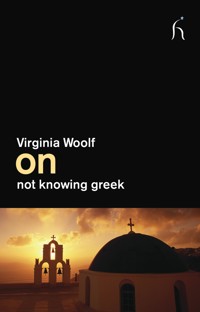
Taken from the two volumes of The Common Reader, Virginia Woolf's celebrated essay collection, the pieces presented here were expressly intended for the enjoyment of those who read for pleasure, rather than for professional critics. Casting her expert eye over Greek tragedy, Elizabethan theatre and – particularly pertinently for a pioneer of modernism – modern fiction, Woolf enlivens her subject matter and brings to it the profundity and idiosyncrasy associated with the author of Orlando and A Room of One's Own. As erudite as it is sympathetic, On Not Knowing Greek is a perceptive and exacting guide to reading books from one of the foremost writers of the modernist movement.
Das E-Book können Sie in Legimi-Apps oder einer beliebigen App lesen, die das folgende Format unterstützen:
Veröffentlichungsjahr: 2024
Ähnliche



On Not Knowing Greek
Virginia Woolf
‘on’
Published by Hesperus Press Limited
165-167 Great Portland Street, W1W 5PF. London
www.hesperus.press
First published by Hesperus Press Limited, 2008
This ebook edition published in 2024
Introduction © Elena Gualtieri, 2008
Virginia Woolf texts: Copyright © The Estate of Virginia Woolf 1925, 1932
The Estate of Virginia Woolf asserts the moral right of Virginia Woolf to be identified as the Author of the Work in relation to all such rights as are granted by the Estate to the Publishers under the terms and conditions of this agreement.
‘On Not Knowing Greek’, ‘Notes on an Elizabethan Play’, ‘Modern Fiction’, ‘The Russian Point of View’ and ‘The Modern Essay’ from The Common Reader by Virginia Woolf, copyright 1925 by Houghton Mifflin Harcourt Publishing Company and renewed 1953 by Leonard Woolf, reprinted by permission of the publisher.
‘How Should One Read a Book?’ from The Second Common Reader by Virginia Woolf, copyright 1932 by Houghton Mifflin Harcourt Publishing Company and renewed 1960 by Leonard Woolf, reprinted by permission of the publisher.
ISBN: 978-1-84391-605-5
e-ISBN: 978-1-84391-348-1
All rights reserved. This book is sold subject to the condition that it shall not be resold, lent, hired out or otherwise circulated without the express prior consent of the publisher.
Contents
Introduction
On Not Knowing Greek
Notes on an Elizabethan Play
Modern Fiction
The Russian Point of View
The Modern Essay
How Should One Read a Book?
A paper read at a school
Notes
Biographical Note
Introduction
On 30th January 1926 Virginia Woolf stood up in front of an audience of schoolgirls to deliver a lecture on how to read. The lecture was far from condescending; it spoke to her audience of her recurrent preoccupation that each kind of book should be received in the spirit in which it was written, fiction as the creation of an imaginative world, poetry as the expression of a vision, and biography to consolidate one’s knowledge (and refresh one’s palate). It also stressed that much of reading is actually made up of not reading, of withdrawing from the world of the book to order our impressions of it and make sense of them. Not reading should not be confused with reading other people’s criticism; Woolf warned the schoolgirls that ‘nothing is more disastrous than to crush one’s own foot into another person’s shoe’. When the lecture was later revised for publication in Woolf’s second volume of collected essays in 1932 (the version we reprint here), Woolf reluctantly amended her earlier, absolute rejection of the uses of criticism with the concession that the critics ‘are only able to help us if we come to them laden with questions and suggestions won honestly in the course of our own reading’ (‘How Should One Read a Book?’).
The schoolgirls in the audience would perhaps have been surprised to find that for more than twenty years Woolf had in fact been earning most of her money through criticism and reviewing. The career of the writer we have come to recognise as ‘Virginia Woolf’ had in fact started when she was neither Woolf nor a novelist, but the 22-year-old Virginia Stephen, an apprentice in the art of professional writing whose first articles were unassumingly (and anonymously) published in the Guardian, a weekly for the clergy. A year later, the fledgling writer was already having short notices published in the Times Literary Supplement (though, again, anonymously); longer articles followed soon, and in the next few years Woolf came to rely on her income from journalism and reviewing to support her living expenses (though she was also the recipient of a legacy from her aunt). By 1926 her reputation as a critic had been cemented through the publication of her first collection of essays, The Common Reader, with a second volume to follow in 1932. Although Woolf was, as always, worried about the reception of her critical volume when it first appeared, throughout her life her essays in fact enjoyed a ‘more catholic’ appreciation (in Leonard Woolf’s phrase) than her novels. Woolf herself was surprised at how much her criticism was liked, and thought her first collection of essays ‘too highly praised’. Today, the latest edition of her critical writings hails her as ‘the last of the great English essayists’.
Despite Woolf’s considerable influence as a leading modern critic and essayist, when she came to publish her first collection of criticism, Woolf chose to present her efforts under the banner of the ‘common reader’, borrowing the expression from Dr Johnson, and yet radically reinterpreting it to give her critical stance a solid foundation. In Woolf’s understanding, the common reader is both ‘worse educated’ than the scholar and less gifted than the critic, but, unlike them, is driven by a love of reading that is undiminished in its enthusiasm. The banner captures much of the persona Woolf inhabited in her essays; it conveys her sense of being placed outside the critical and educational establishments, while at the same time claiming for that position of outsider the ability to see things afresh. It is a position Woolf chose to take even though of the twenty-four essays selected to appear in the First Common Reader, ten were articles at first written for the TLS and not for some obscure, marginal publication. Unlike most of her contemporary modernists who wrote for ‘little’ magazines of limited circulation, Woolf’s criticism and essays were unashamedly intended not for the margins but for the mainstream. Within the mainstream, though, Woolf still clearly felt herself to be closer in spirit and approach to the private reader inhabiting ‘rooms too humble to be called libraries, yet full of books’ than to the professional critic and reviewer.
It is clear then how we should not read Woolf’s essays. They are neither the product of a critic gifted with an unquestionable belief in her own judgement, nor of a scholar whose knowledge solidly rests on the foundations of an expensive education. Woolf never received any formal education, either at school or at university. Like many women of her class and generation, she watched her brothers leave for boarding school while she stayed at home to be tutored by her mother and father, with lessons in Greek taken by a private tutor (first Clara Pater, Walter’s sister, then Janet Case). Though she had consistently been writing diaries, journals, and contributions to the family newspaper, Hyde Park Gates News, from a very early age, Woolf effectively learnt her craft as she went along, serving her apprenticeship in print.
In the first few years of her apprenticeship she discovered what was to become her characteristic critical voice by experimenting with the boundaries of ‘reality’: it is not uncommon to find among early essays reviews cast as dialogues between fictional characters, or non-existent books being the subject of an extended review. These experiments did not always meet with approval from Woolf’s editors, and Woolf often chafed under the bit of editorial propriety. Reflecting back on her TLS contributions at the end of her life, she found in them the still visible traces of her ‘tea-table training’, of the hours she had spent as a young woman sitting around that centre of Victorian family life, and administering to the ‘shy young men’ who had come to visit. For a woman of her generation and class to write in her own voice, Woolf had explained a few years earlier, it had been necessary first to lay to rest that ghostly remnant of Victorian womanhood, the Angel in the House who peered over the shoulder of women writers to make sure that they should not give offence to male sensibilities. The battle had not, though, been definitely won, and Woolf continued to see in her TLS articles, in ‘their suavity, their politeness, their side-long approach’, proof of the remarkable resilience of that ghost. Are we then to follow Woolf’s own judgement and read her essays as the results of an inevitable compromise between the truth of what Woolf thought, and the reality of what she allowed herself to write? When we read these essays, are we just being transported to the Victorian drawing room, with all the veiled truths and unacknowledged conflicts Woolf was so bravely to lay bare in novels like The Years? While it may be tempting to strip away what Woolf herself called ‘the surface manner’ of her essays to reveal their true meanings, such an act would in fact be destroying the very substance of her essays, not just her characteristically elusive persona, but also that which makes them into ‘assays’, attempts at finding a way through uncharted territories.
Woolf was a great admirer of the originator of the essay, the Frenchman Michel de Montaigne, to whom she dedicated one of the pieces included in the First Common Reader. She saw in Montaigne’s writing a celebration of indirectness, the inspiration for turning meandering and digression into an art form. Montaigne had conceived of his essays as replacements for conversations with his dead friend, La Boétie, and, like conversations, they were allowed to spread out and follow the paths that his mind suggested, without a sense of preconceived destination. Woolf found in Montaigne’s essays a reflection of her own conception of what modern fiction should be like, their suppleness and elasticity perfect receptacles for the mind’s ‘myriad impressions – trivial, fantastic, evanescent, or engraved with the sharpness of steel’ (‘Modern Fiction’). The boundary between essays and novels is often, in Woolf’s writing, extremely permeable. It is not just that we can find in Woolf’s fiction the infiltration of a more essayistic voice, as in Jacob’s Room or, indeed, The Years, originally conceived as a novel-essay. It is rather that the looseness and adaptability of the essay were the stylistic weapons Woolf used to transform the English novel from ‘a series of gig lamps symmetrically arranged’ to ‘a luminous halo, a semi-transparent envelope’ (‘Modern Fiction’).




