


62,99 €
Mehr erfahren.
- Herausgeber: John Wiley & Sons
- Kategorie: Fachliteratur
- Sprache: Englisch
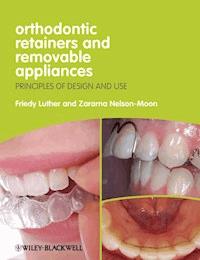
This book is a practical guide for both dental students and practitioners to designing, fitting and adjusting removable orthodontic appliances and retainers. The book offers step by step instructions with clear illustrations on the key areas of clinical practice. In each case, information is provided on indications for use, principles of design, fitting, activation and trouble shooting. Further chapters coach students to deal effectively with their patients and to manage the treatment plan in question.
Sie lesen das E-Book in den Legimi-Apps auf:
Seitenzahl: 352
Veröffentlichungsjahr: 2012
Ähnliche



















Table of Contents
Cover
Title page
Copyright page
Preface
Why we need this book and who is it for?
Acknowledgements
Abbreviations
1 Assumptions: What You Should Know and Understand Before You Use this Book
2 Upper Removable Appliances: Indications and Principles of Design
Prerequisites for orthodontic treatment
Anchorage
Components of URAs
What are the indications for the use of URAs?
Advantages and disadvantages of removable appliances
Design
3 Cases Suitable for Treatment with Removable Appliances
Expansion
Moving teeth around the arch
Reduction of overbite
Reducing an overjet
Other individual tooth movements: Extrusion of incisors
Space maintainers
Basic errors
Summary
4 Fitting and Activating Removable Appliances
When the URA arrives from the laboratory
Advice to the patient prior to fitting
Fitting the appliance and what to check for
Adjustment and/or activation of components
Instructing the patient/parent/ guardian on insertion and removal of the appliance
5 Follow-up Appointments: What to Check and Why
Appointment frequency
What to monitor
Adjustments at follow-up appointments
Managing the end of treatment and retention
What not to treat with standard removable appliances
When to refer
6 Test Yourself
Questions
Answers
7 Retainers
What is relapse?
Cases that are particularly prone to relapse and why
Types of retainers
Removable versus fixed retainers
Retention regimes
Liaison with the specialist: why do we need to know what is being retained?
Contra-indications to retention
‘Natural’ retention
8 Fitting and Checking Retainers
First fitting of removable retainers
Follow-up visits: is the retention working?
Long-term follow-up
9 Problems with Retainers and Trouble-shooting
Problems with removable retainers and trouble-shooting
Problems with bonded retainers and trouble-shooting
Managing treatment termination and removal of retainers
10 Removable Appliances for the Postgraduate in Specialist Orthodontic Training
Removable appliances for correcting excessive positive overjet
Removable appliances and their role in correcting molar relationships
Other types of removable appliances for correcting reverse overjets
11 Vacuum-Formed Active Appliances
General considerations
Summary
Example cases
Index
This edition first published 2013
© 2013 by Friedy Luther and Zararna Nelson-Moon
Wiley-Blackwell is an imprint of John Wiley & Sons, formed by the merger of Wiley’s global Scientific, Technical and Medical business with Blackwell Publishing.
Registered office: John Wiley & Sons, Ltd, The Atrium, Southern Gate, Chichester, West Sussex, PO19 8SQ, UK
Editorial offices: 9600 Garsington Road, Oxford, OX4 2DQ, UK
The Atrium, Southern Gate, Chichester, West Sussex, PO19 8SQ, UK
2121 State Avenue, Ames, Iowa 50014-8300, USA
For details of our global editorial offices, for customer services and for information about how to apply for permission to reuse the copyright material in this book please see our website at www.wiley.com/wiley-blackwell.
The right of the author to be identified as the author of this work has been asserted in accordance with the UK Copyright, Designs and Patents Act 1988.
All rights reserved. No part of this publication may be reproduced, stored in a retrieval system, or transmitted, in any form or by any means, electronic, mechanical, photocopying, recording or otherwise, except as permitted by the UK Copyright, Designs and Patents Act 1988, without the prior permission of the publisher.
Designations used by companies to distinguish their products are often claimed as trademarks. All brand names and product names used in this book are trade names, service marks, trademarks or registered trademarks of their respective owners. The publisher is not associated with any product or vendor mentioned in this book. This publication is designed to provide accurate and authoritative information in regard to the subject matter covered. It is sold on the understanding that the publisher is not engaged in rendering professional services. If professional advice or other expert assistance is required, the services of a competent professional should be sought.
Library of Congress Cataloging-in-Publication Data
Luther, Friedy.
Orthodontic retainers and removable appliances : principles of design and use / Friedy Luther, Zararna Nelson-Moon.
p. ; cm.
Includes bibliographical references and index.
ISBN 978-1-4443-3008-3 (pbk. : alk. paper)
I. Nelson-Moon, Zararna. II. Title.
[DNLM: 1. Orthodontic Appliances, Removable. 2. Orthodontic Appliance Design. 3. Orthodontic Retainers. WU 426]
617.6'43–dc23
2012022787
A catalogue record for this book is available from the British Library.
Wiley also publishes its books in a variety of electronic formats. Some content that appears in print may not be available in electronic books.
Cover images: left - courtesy of iStockphoto/© Dawn Poland; top right and bottom right - courtesy of the authors
Cover design by Meaden Creative
Preface
Why We Need This Book and Who Is It For?
This book aims to fill a gap in the literature that has existed for many years. Whilst it is a General Dental Council (GDC) requirement (quite rightly) to teach dental students orthodontic diagnosis and the principles of interceptive treatment (amongst other things), there seem to be no books that explain concisely, in practical terms (and in enough detail), what principles to apply when trying to design the appliances to enable this interceptive treatment to be undertaken. This book therefore sets out to address this.
Many books contain the principles but these are often obscured by excessive detail – or perhaps there is too much theory in the wrong place. Either way, things can get confusing. Alternatively, suggestions are made for ‘standard appliances’, but a one-size-fits-all approach is not always useful when it comes to working out when the ‘standard appliance’ is not appropriate. To reinforce this point, we also include a “Test yourself” chapter. Here, the reader can assess some patients for themselves and see whether or not a URA (upper removable appliance) would be appropriate or not.
In addition, in some cases, it may be necessary to refer a patient for specialist advice. For example, a patient may require initial, interceptive treatment but, in addition, may require referral for definitive treatment thereafter. It should be said that this would hopefully not be as a result of the interceptive treatment! Again, it is a GDC requirement that the dental graduate be competent at making appropriate referrals based on assessment. This is another aspect that this book gives advice on – what makes a good referral letter.
This book also includes a basic section on orthodontic retainers: current trends increasingly mean that patients wish to maintain their teeth as straight as possible following frequently lengthy, usually fixed, appliance treatment. Specialists performing orthodontic treatment must necessarily focus on the active treatment of the patients referred to them. Ultimately, such patients, if they wish to continue wearing retainers long term, need to be referred back to their own general dental practitioner (GDP) so they take over the responsibility of looking after their own patients and their patients’ retainers. However, there is little, readily available information for the GDP to enable them to perform this duty. Therefore, this book aims to provide some basic guidance to address this.
In addition, there are a limited number of lower removable appliances (LRAs) which may have a use in certain, somewhat restricted, circumstances. These will be referred to at appropriate points in relevant chapters. For reasons of completeness, the book also includes chapters, specifically for the specialist trainee, on some other uses of removable appliances. These cover basic aspects of functional appliance design and the use of vacuum-formed active appliances (VFAAs; also known as aligners).
This book is thus aimed at dental undergraduates who have received basic training in orthodontic diagnosis; have a reasonable level of understanding; and are familiar with the basic terminology. However, we also intend it to be useful to postgraduate students of orthodontics; orthodontic therapists; qualified GDPs; orthodontic technicians, and postgraduates in paediatric dentistry – all of whom require a knowledge of interceptive orthodontic treatment.
Friedy LutherZararna Nelson–Moon
Acknowledgements
We have written this book in the hope that it will be useful to future generations of students of orthodontics. We have tried to achieve this by illustrating it as well as we possibly could. To this end, we have been reliant on the goodwill of fellow colleagues, clinicians and postgraduate students to help us obtain photographs (often at short notice), when we have not been able to obtain them ourselves. Jay Kindelan, Consultant Orthodontist at York (York Teaching Hospital NHS Foundation Trust) also helped us greatly by writing Chapter 11 for this book. We hope everyone will forgive us for badgering them.
However, above all we have been reliant on patients who have so kindly agreed to let us use their clinical photographs. We could not have produced this book without their willingness to help others.
We must also thank all the following colleagues and departments for all their help in supplying photographs or materials to be photographed. In no particular order, they are as follows.
At The Charles Clifford Dental Hospital, Sheffield Teaching Hospitals NHS Foundation Trust /School of Clinical Dentistry, University of Sheffield:
At the Leeds Dental Institute/Leeds Teaching Hospitals NHS Trust/University of Leeds:
At St Luke’s Hospital, Bradford/Bradford Teaching Hospitals NHS Foundation Trust:
At York, York Teaching Hospital NHS Foundation Trust:
Thanks are also due to the following for their help:
Finally, huge thanks must also go to our long-suffering partners and families who survived the ordeal as well as to our publishing team at Wiley-Blackwell who include: Sophia Joyce, Lucy Nash and Katrina Hulme-Cross.
Abbreviations
Throughout this text, the following abbreviations have been used:
In addition, readers should note that the commonly used abbreviation for a supernumerary tooth, $, is used.
Tooth notation: the alpha numeric tooth notation system will be used, e.g. upper right lateral incisor would be UR2. An upper right deciduous central incisor is noted as UR A.
1
Assumptions: What You Should Know and Understand Before You Use this Book
As a reader of this book, it is only fair that you know what you are getting as the remit is certainly not to teach orthodontics! It concentrates on discussing the practical aspects of only two, relatively discreet, but important aspects of orthodontics:
Interceptive treatment
deals with the developing, childhood dentition at a time when decisions can strongly influence long-term outcomes. Identifying and explaining the principles of interception are among the learning outcomes identified by the General Dental Council.
Retention
is an increasingly important part of orthodontic treatment for many patients. More and more, patients may wish to maintain (for as long as feasible) their treatment result following what may often have been lengthy and complex treatment. It is thus likely that general dental practitioners will need to take over the care and responsibility for their patients’ retainer requirements. Incidentally, however, it should be noted that whilst upper removable appliances (URAs) are appropriate for childhood interceptive treatment, they are not often useful for adults. In contrast, retainers may be worn by children or adults.
This book will also give pertinent advice on:
What makes a good referral letter
(again in line with the General Dental Council outcomes), e.g. when a patient requires referral to a specialist for definitive orthodontic treatment.
What is required when and the reasons for taking over the care and responsibility of a patient’s retainer requirements
.
In addition, discussion of lower removable appliances (LRAs) is included where appropriate, as well as specific chapters for the specialist trainee.
The authors acknowledge that the practical advice given in this book will sometimes not exactly match that given by every clinician, but subtle differences in approach are evident between clinicians in all specialties. The approach adopted here is one that we have found works for us. Furthermore, as this is essentially a practical guide based on clinical experience, it is not written nor intended as a fully-referenced academic text.
So, this book assumes a basic level of orthodontic knowledge of the sort you would hopefully receive from an undergraduate dental training. This means that it does not explain terms such as overjet, overbite, the different skeletal, incisor or molar classifications, etc. – it will assume you know these already. It will also not explain how to undertake an orthodontic diagnosis, only pointing out aspects of diagnosis that are relevant to the particular problem under discussion.
Also this book will not explain how to undertake all orthodontic treatment. That is a specialist area. However, what this book will do is give guidance on situations where interceptive treatment could potentially be considered and how. Yet, this can never be comprehensive since no two patients are ever entirely identical. Many aspects of diagnosis can influence a decision as to whether a treatment is reasonable, possible or even feasible.
In addition, this book does not discuss issues of consent, risks of orthodontic treatment and balancing the risk/benefit ratio. These are all vital issues, but again we assume a level of knowledge that basic undergraduate dental training should cover.
Lastly and obviously, this book provides no direct practical experience whatsoever!
2
Upper Removable Appliances: Indications and Principles of Design
Upper removable appliances (URAs) are ‘removable braces’ that fit on the upper arch only. In the past, URAs were used for many malocclusions, including severe Class II division 1 cases. However, this is no longer seen as appropriate because removable appliances can only achieve very simple movements, i.e. simple tipping of teeth, and the vast majority of malocclusions that warrant treatment require far more complex movements (using fixed appliances) to achieve an adequate outcome. Fixed appliances can also tip teeth, but in complete contrast to removable appliances, they can also achieve bodily movement (including rotations, intrusion and extrusion) as well as torque. Therefore, regarding active treatment, this book will mostly confine itself to interceptive treatment where the types of malocclusion to be intercepted are very limited; if tooth movement is required, it is confined to tipping movements. The exceptions are covered in Chapters 10 and 11.
Lesen Sie weiter in der vollständigen Ausgabe!
Lesen Sie weiter in der vollständigen Ausgabe!
Lesen Sie weiter in der vollständigen Ausgabe!
Lesen Sie weiter in der vollständigen Ausgabe!
Lesen Sie weiter in der vollständigen Ausgabe!
Lesen Sie weiter in der vollständigen Ausgabe!
Lesen Sie weiter in der vollständigen Ausgabe!
Lesen Sie weiter in der vollständigen Ausgabe!
Lesen Sie weiter in der vollständigen Ausgabe!
Lesen Sie weiter in der vollständigen Ausgabe!




